
Attorney Job Description That Attracts Top Talent in 2026
June 23, 2026 · 17 min read · Five Star Placements

Table of contents
You're probably in one of two situations right now. You posted an attorney opening and got almost no qualified applicants, or you got far too many resumes from people who looked decent on paper but weren't even close to what the role requires.
That usually isn't a sourcing problem first. It's an attorney job description problem.
Most legal hiring teams still treat the job description like an administrative document. It isn't. It's your first screening tool, your first pitch to the market, and often the first signal serious attorneys use to decide whether your opportunity is worth their time. A vague posting attracts vague interest. A sharp one attracts attorneys who can see the work, the expectations, and the upside clearly enough to opt in.
Table of Contents
- Beyond the Template Why Most Attorney Job Descriptions Fail
- The Anatomy of a Compelling Attorney Job Description
- Defining Core Responsibilities and Daily Functions
- Specifying Qualifications Experience and Modern Skills
- Tailoring the Description for Seniority and Practice Area
- Posting Measuring and Optimizing for Success
Beyond the Template Why Most Attorney Job Descriptions Fail
The most common mistake is simple. Firms write for internal approval instead of candidate response.
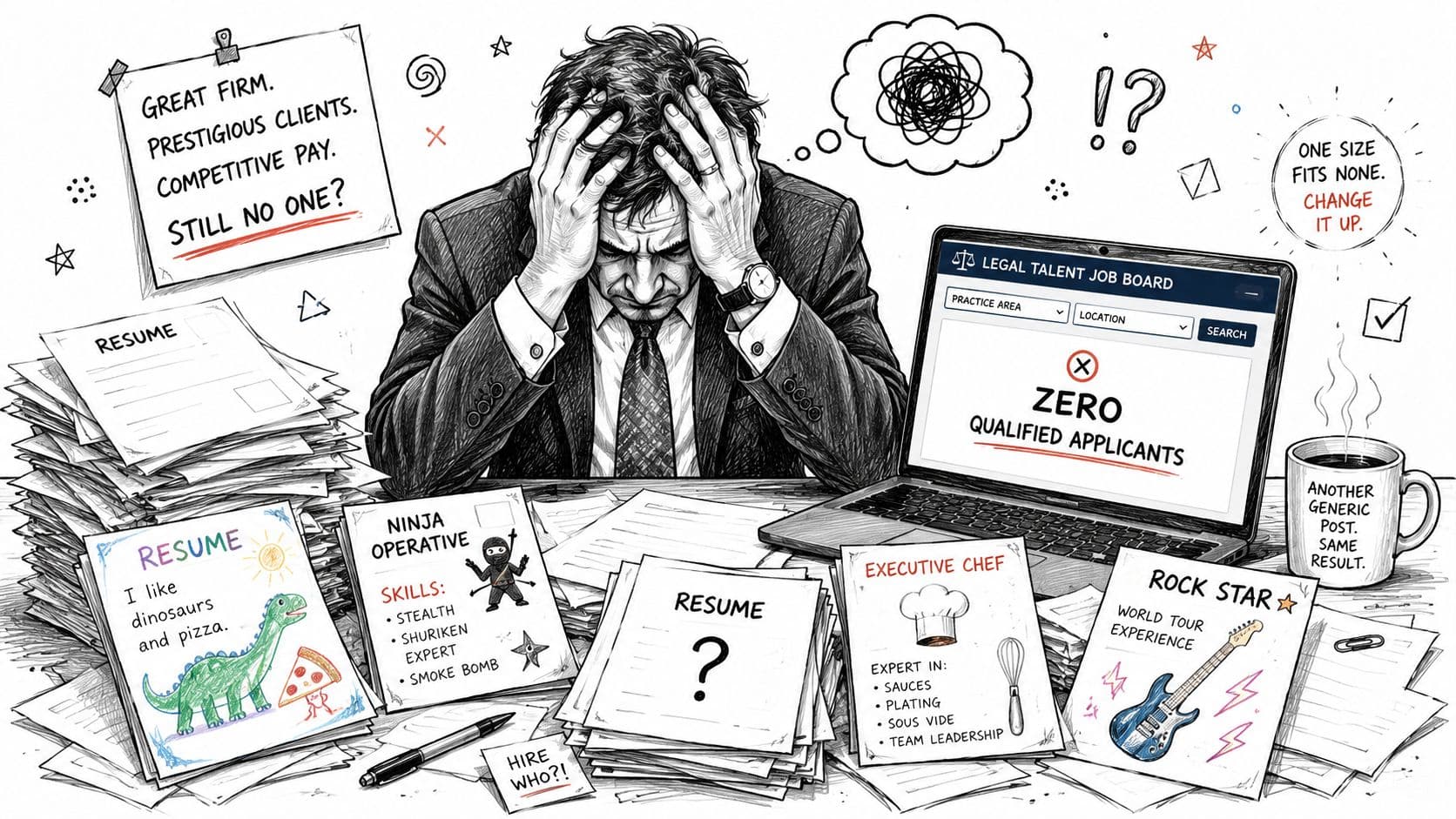
A hiring partner sends over a few bullet points, HR adds standard language, someone inserts generic culture copy, and the posting goes live. Then the same people wonder why strong attorneys pass on it. Good candidates are reading quickly. If they can't tell what the practice looks like, how the workload is structured, what success means, or why the move is worth making, they keep scrolling.
Generic language creates expensive noise
Phrases like “handle various legal matters,” “must be a team player,” and “excellent communication skills required” don't filter anyone. They also don't persuade anyone. They create a resume pile, not a shortlist.
The better approach is to think like a marketer and an operator at the same time. Your posting needs to do three jobs well:
- Define the work: Spell out what the attorney will own.
- Set expectations: Be candid about pace, client contact, autonomy, and internal support.
- Sell the right opportunity: Show why the role matters, not just that it exists.
Practical rule: If a candidate can swap your firm name with another and the posting still reads the same, the description is too generic.
A weak description also wastes partner time. Every vague line in the posting becomes a screening issue later. If you don't specify courtroom exposure, deal flow, client-facing responsibility, or technology expectations up front, recruiters and hiring managers spend weeks sorting out misunderstandings that the posting should have prevented.
The job description is your first filter
The best attorney job descriptions narrow the field without sounding rigid. That means distinguishing between what's essential and what's flexible. It also means giving candidates enough operational detail to self-select out when the role isn't right.
That's one reason firms that take hiring seriously usually treat recruiting as a strategic function, not a clerical one. Teams built around that mindset tend to produce cleaner job scopes, better screens, and stronger hiring outcomes. You can see that positioning in firms that describe recruiting as an extension of the client team, like Five Star Placements' approach to legal recruiting partnerships.
A good attorney job description doesn't try to attract everyone. It attracts the attorney you'd hire.
The Anatomy of a Compelling Attorney Job Description
A strong posting has structure. Busy attorneys don't read job descriptions line by line at first. They scan for fit. That means the order of information matters almost as much as the content itself.
Start with the title and opening summary
The title should match how lawyers search. “Litigation Associate,” “Employment Counsel,” “Real Estate Attorney,” or “Trusts and Estates Attorney” will outperform creative internal labels because candidates use practice-area language, not branding language.
Then the opening summary has to answer three questions fast:
- What is the role?
- What kind of matters will this attorney handle?
- Why should a strong candidate care?
That summary shouldn't repeat the title in sentence form. It should establish scope. If the attorney will run smaller matters, support a trial team, negotiate commercial agreements, advise business leaders, or inherit an active book of work, say so.
Ground the role in the real work of lawyers
There's no reason to get clever about the fundamentals. The core functions of legal practice are already well understood. According to O*NET's summary for lawyers, attorneys primarily work on drafting and reviewing legal documents, advising clients, and representing clients in proceedings, alongside legal research, evidence gathering, interviewing, and argument presentation. That baseline gives you the bones of a credible posting.
Use those functions as the foundation, then make them specific to your opening.
For example:
- Too broad: Draft legal documents and represent clients.
- Better: Draft pleadings, motions, discovery responses, and settlement materials for commercial disputes in state and federal court.
- Too broad: Advise clients on legal issues.
- Better: Counsel employer clients on workplace investigations, discipline, wage-and-hour exposure, and day-to-day HR risk.
Strong candidates don't need a law school definition of what lawyers do. They need a realistic description of what this lawyer will do in your seat, with your clients, under your partners.
Include the six parts candidates actually look for
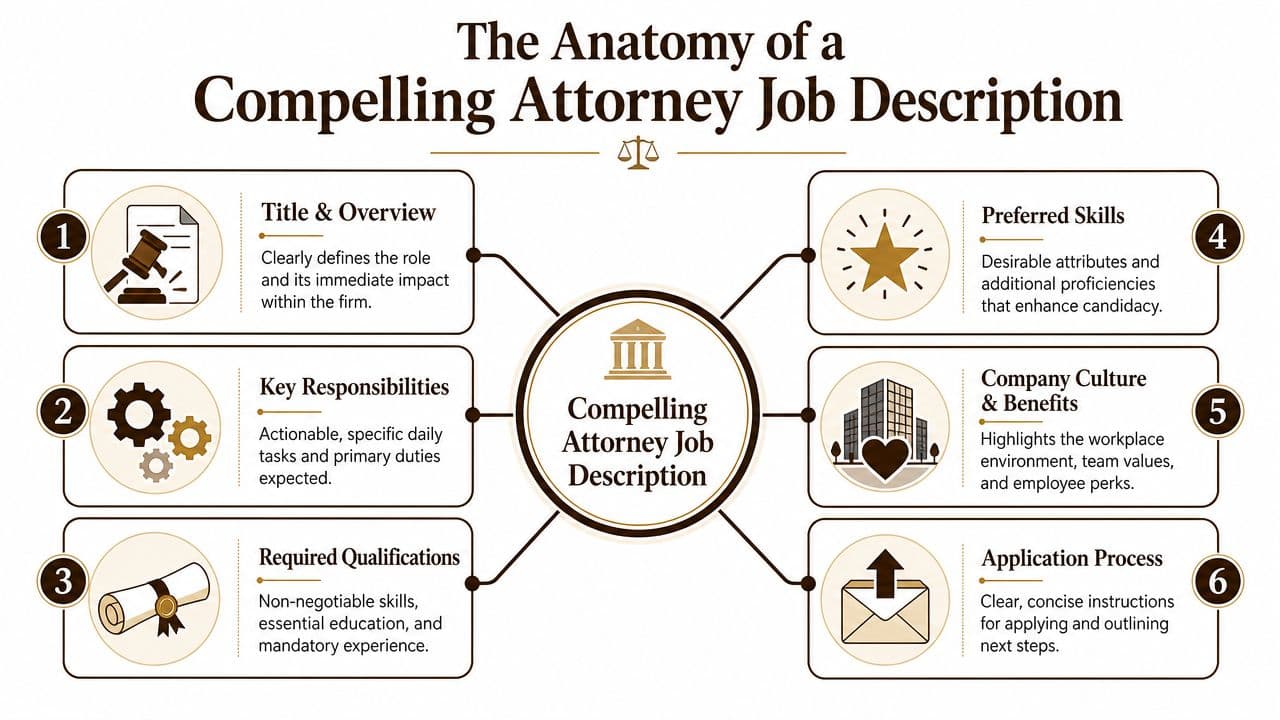
A compelling attorney job description usually includes these elements:
- Clear title: Practice area and level should be obvious.
- Concise role summary: Give the candidate the shape of the opportunity.
- Core responsibilities: Focus on ownership, outputs, and level of autonomy.
- Required qualifications: Reserve this for true non-negotiables.
- Preferred skills: Use this to widen the pool without lowering standards.
- Application path: Tell candidates what happens next and what materials matter.
A common miss is burying the value proposition. Lawyers aren't only evaluating compensation. They're evaluating platform. That includes partner access, sophistication of matters, level of responsibility, support staff quality, path to advancement, and whether the firm's operating style matches how they want to practice.
Readability matters more than most firms think
Many postings fail because they read like policy manuals. Dense blocks of text make even solid opportunities look disorganized.
A better format is clean and skimmable:
| Section | What the candidate should learn |
|---|---|
| Opening summary | Why the role exists and what kind of work defines it |
| Responsibilities | What the attorney will own day to day |
| Qualifications | What's mandatory versus preferred |
| Environment | Team structure, support, pace, and workflow style |
| Next step | How to apply and what the timeline looks like |
If a posting is hard to scan, candidates assume the job itself may be hard to deal with.
Defining Core Responsibilities and Daily Functions
Many attorney job descriptions lose credibility because they list duties, but they don't describe the job.
Attorneys want to understand the actual shape of the day. Are they drafting first versions or revising partner work? Running depositions or just summarizing them? Negotiating directly with opposing counsel or feeding talking points upward? Managing client relationships or staying behind the scenes? If the posting doesn't answer those questions, candidates fill in the blanks themselves, and they often guess wrong.
Write duties as ownership, not categories
“Handle litigation matters” doesn't tell anyone much. Neither does “support transactions” or “manage client files.”
Use action verbs tied to matter stages and outcomes. That creates a picture of the role. For instance:
- Litigation example: Manage discovery for commercial disputes, including written discovery strategy, document review coordination, deposition preparation, and motion drafting through trial readiness.
- Corporate example: Draft, review, and negotiate commercial agreements, coordinate due diligence, and support closings in middle-market transactions.
- Trusts and estates example: Prepare estate planning instruments, oversee trust and probate administration, and advise clients on tax-sensitive transfer strategies.
That kind of language helps candidates self-calibrate. It also helps hiring teams screen more accurately.
Be candid about workload and responsiveness
Lawyers don't expect a low-pressure profession. What they do expect is honesty.
The workload piece matters because the role itself often includes long hours and unpredictable demands. The Texas Career Check summary for lawyers notes that lawyers commonly work full time, many exceed 40 hours per week, and associates at large firms often bill 1,800 to 2,200 hours annually. Whether your opening sits at that level or below it, the posting should make the pace clear.
A useful way to frame this is through expectations, not warnings:
- Availability: Explain whether client needs regularly extend beyond standard business hours.
- Deadlines: Note whether the role includes court deadlines, deal closings, emergency filings, or other schedule volatility.
- Autonomy: Clarify whether the attorney will manage a personal caseload or work in a heavily supervised team model.
Candidates usually won't reject a demanding role because it's demanding. They reject it because the posting hid the demand and the interview process revealed it too late.
Show what success looks like
A better job description includes a short performance picture. Not a full review rubric. Just enough for the candidate to understand what “good” means in your environment.
Consider language like this:
- Early success means turning drafts quickly with limited revision cycles.
- The attorney is expected to maintain strong client communication and keep matters moving without constant follow-up.
- The role requires sound judgment on issue spotting, escalation, and deadline management.
That kind of specificity does two things. It makes the role more attractive to strong attorneys, and it pushes out candidates who prefer a different operating style.
Specifying Qualifications Experience and Modern Skills
The qualifications section is your tightest filter. It's also where many firms accidentally shrink the pool too far, especially when they confuse “ideal” with “required.”
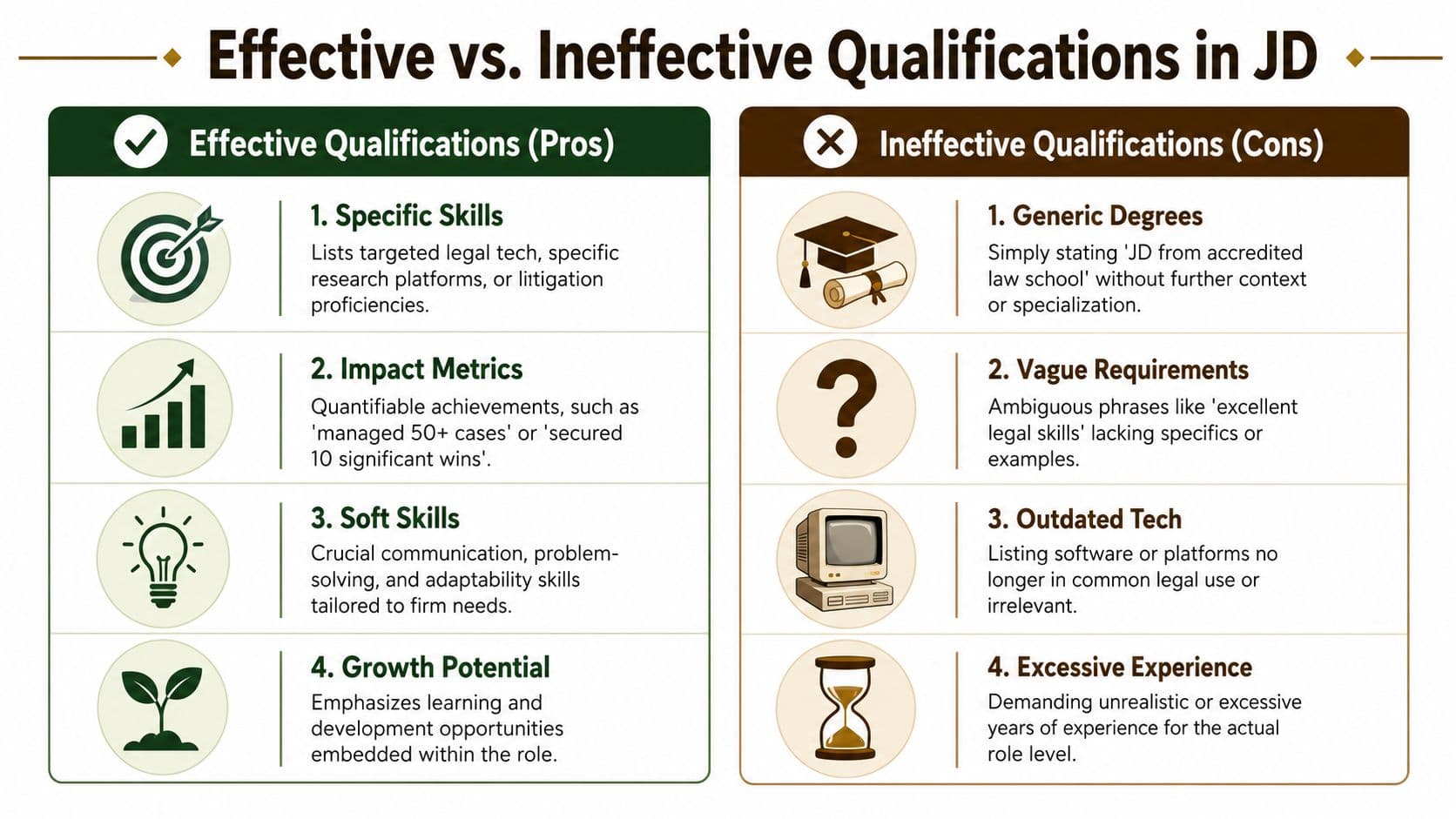
The strongest attorney job description separates true barriers from nice-to-haves. Bar admission in the relevant jurisdiction may be required. Experience with a particular case management system may not be. Prior first-chair trial experience may matter for one opening and be completely unnecessary for another. When everything is labeled essential, candidates stop trusting the list.
Split required from preferred the right way
A practical test helps. Ask whether you would reject a great candidate solely because they lack the item in question. If the answer is no, move it to preferred.
Required qualifications often include:
- Active bar admission in the jurisdiction relevant to the role
- Practice-area experience that is necessary to serve clients safely and competently
- Writing, drafting, or courtroom exposure at the level the role demands
- The ability to manage the level of client contact built into the position
Preferred qualifications often include:
- Familiarity with a specific docketing, e-discovery, or contract lifecycle platform
- Experience in a narrow industry niche
- Portable business, if the role can still work without it
- Exposure to adjacent practice areas that would help but aren't central
This distinction doesn't lower standards. It sharpens them.
Modern legal hiring requires technology specificity
Technology expectations can't sit in a throwaway line anymore. If the role depends on legal tech fluency, the posting should name the tools or at least the workflows.
That matters because legal employers increasingly expect attorneys to work inside AI-enabled research, review, and contract systems. Robert Half's legal hiring research notes that 65 to 70% of legal job postings expect proficiency with at least one AI-enabled platform, and postings that clearly list preferred or required technology systems see 20 to 30% higher conversion from shortlist to interview.
That doesn't mean every attorney job description should read like software documentation. It does mean a generic line such as “comfortable with technology” is too weak.
A stronger version looks like this:
- Experience using e-discovery and litigation support tools, including predictive coding workflows where relevant
- Comfort working in contract lifecycle management systems for redlining, clause review, and approval routing
- Ability to use AI-assisted legal research or contract review tools with sound legal judgment and human verification
Hiring note: “Tech-savvy” is not a qualification. Named systems, named workflows, and clear expectations are qualifications.
Don't punish non-linear legal careers
This is one of the most underused levers in legal hiring. Firms say they care about skill and readiness, then write job descriptions that favor uninterrupted timelines.
That's outdated. A modern posting can maintain selectivity while signaling that career paths aren't always linear. The key is to focus on present capability, not résumé symmetry. The legal market has grown more accepting of gaps tied to caregiving, health, relocation, layoffs, and bar preparation, and legal career guidance increasingly reflects that shift, including LawCrossing's discussion of attorney résumé gaps and hiring perceptions.
Use language that keeps the bar high while opening the door:
- We welcome candidates with strong recent or transferable experience, including attorneys returning to practice after time away.
- Skills, judgment, writing ability, and client readiness matter more than a perfectly linear résumé.
- Candidates with career gaps are encouraged to highlight relevant prior practice, current licensure, training, and readiness to reenter.
That wording works because it doesn't sound apologetic. It sounds confident.
What doesn't work
A few qualification habits routinely hurt response quality:
| Weak approach | Better approach |
|---|---|
| Requiring every possible skill | Separating core capability from trainable tools |
| Listing vague traits like “go-getter” | Naming the behaviors the role needs, such as ownership and deadline management |
| Demanding excessive years of experience | Matching experience expectations to matter complexity and supervision level |
| Hiding tech expectations | Naming systems, workflows, or AI-enabled tasks directly |
The best qualifications section filters for competence, not pedigree theater.
Tailoring the Description for Seniority and Practice Area
One attorney job description can't serve every level well. A junior associate posting should read very differently from a lateral partner posting, even inside the same practice group. The work, the risk profile, and the business reason for the hire aren't the same.
The easiest way to improve response quality is to rewrite the description around the level of attorney you need, rather than recycling a “firm attorney” template. Firms that need help pressure-testing those distinctions often turn to legal recruiting partners with nationwide practice-area coverage, especially when multiple offices or specialty groups are hiring at once.
Seniority changes the center of gravity
A junior or midlevel associate is usually being hired to increase execution capacity. A senior associate may be hired for judgment, case leadership, and client management. A partner hire is often about revenue, relationships, or strategic expansion.
That difference should show up directly in the posting.
| Role | Primary Focus | Key Responsibilities | Business Development Expectation |
|---|---|---|---|
| Junior Associate | Training and execution | Drafting, research, discovery, deal support, matter organization | Limited or none |
| Midlevel Associate | Independent matter handling | Direct client work, negotiations, motion practice, workflow management | Helpful but not central |
| Senior Associate or Counsel | Judgment and leadership | Complex drafting, mentoring, strategy input, client responsibility | Often expected |
| Partner | Growth and platform impact | Practice leadership, client origination, team leverage, strategic expansion | Central |
A frequent mistake is writing every role as if it requires rainmaking. That turns off excellent associates. The reverse mistake is writing a partner opening like a senior associate slot with a fancier title.
Use revenue expectations carefully for senior roles
For senior attorneys, especially partners and highly autonomous counsel, the business case belongs in the job description. Not in a blunt way, but in a professional one.
Many firms use the Rule of Thirds to frame profitability. Under that model, an attorney should generate collected revenue equal to three times total compensation cost, according to LeanLaw's explanation of the Rule of Thirds. The same source gives a simple example: an associate costing $150,000 should target $450,000 in collected revenue.
That doesn't belong in every posting word for word. But the principle matters. If the role is expected to carry a book, manage realization, or support economics of team utilization, the job description should say so. Revenue-linked roles need revenue-linked language.
For example:
- For a partner role, specify whether a portable book is required, preferred, or optional.
- For senior counsel, clarify whether the attorney is expected to expand client relationships or primarily service institutional work.
- For practice leaders, explain whether the mandate includes building a team, cross-selling, or opening a new market.
A senior legal hire can be outstanding on substance and still fail commercially if the business expectations were never made explicit.
Practice area language should sound like the work itself
Specialists spot generic copy immediately. The easiest fix is to use practice-area vocabulary that reflects how attorneys in that field describe their work.
For litigation roles, include the forum, the matter type, and the procedural exposure. Mention pleadings, discovery, depositions, hearings, trial prep, appeals, arbitration, or regulatory proceedings where relevant.
For corporate and transactional roles, define the deal mix. Commercial contracts, M&A support, finance transactions, private equity work, governance, securities, and day-to-day business counseling are not interchangeable.
For trusts and estates roles, make the split clear. Estate planning, probate, trust administration, fiduciary disputes, and tax-sensitive planning all attract different profiles.
A useful checklist when tailoring by practice area:
- Matter type: What legal problems land on this attorney's desk?
- Client profile: Individuals, middle-market businesses, public companies, lenders, employers, fiduciaries?
- Workflow style: High-volume, bespoke, team-based, independently managed?
- Exposure level: Drafting support, matter ownership, first-chair responsibility, client origination?
That's what turns a broad legal opening into a targeted market message.
Posting Measuring and Optimizing for Success
A polished attorney job description still won't perform if you treat posting as the finish line. It's the launch point.
Most firms spend almost all their energy writing the opening and almost none measuring whether it worked. That's backwards. If the posting isn't attracting the right attorneys, the market is giving you useful information. You need to read it and adjust.

Check the posting before it goes live
A final review should cover more than grammar. It should answer operational questions.
- Search alignment: Does the title match the words candidates use?
- Screening strength: Are required and preferred qualifications clearly separated?
- Technology detail: Are named systems or workflows included where they matter?
- Compliance review: Has counsel or HR reviewed the posting for jurisdiction-specific requirements and equal opportunity language?
This is also where channel strategy matters. A role aimed at active candidates may perform well on standard boards. A role aimed at specialized or passive attorneys may need recruiter outreach, direct referral campaigns, or niche legal networks. Publishing broadly without adjusting the message usually creates more noise, not better fit.
Treat the job description like a performance asset
A posting should be measured the same way any serious recruiting asset is measured. Not every useful metric needs to be numeric in the posting itself, but your team should still track what the market is telling you.
Useful review questions include:
- Are qualified candidates applying, or only adjacent profiles?
- Are shortlisted candidates accepting interviews?
- Are interviewers seeing alignment between the posting and the actual role?
- Are finalists withdrawing because the role differs from what they expected?
If shortlist-to-interview conversion is weak, the posting may be too broad, too vague, or too generic about systems and workflow. That's one reason the earlier point on technology specificity matters so much. As noted above, postings that clearly identify required or preferred technology systems produce stronger shortlist-to-interview conversion than generic descriptions.
Optimize in cycles, not once
The best hiring teams revise live openings. They don't leave a weak description untouched for weeks just because it was approved once.
If candidates keep misunderstanding the role, the market isn't confused. The posting is.
A practical optimization cycle is simple:
- Review applicant quality after the first wave.
- Compare the profile you wanted with the profile you attracted.
- Tighten responsibilities, qualifications, or level language where mismatch appears.
- Repost or refresh with sharper copy and updated screening criteria.
For firms that publish ongoing hiring guidance and recruiting insights, resources like the Five Star Placements blog on legal hiring can help teams benchmark what stronger market-facing language looks like across roles.
The payoff from all this is straightforward. A better attorney job description reduces wasted interviews, improves candidate trust, sharpens internal alignment, and gives your firm a better chance of landing attorneys who will perform well and stay.
If you need help turning a vague opening into a market-ready attorney job description that attracts qualified candidates, Five Star Placements works with law firms and legal departments across the United States on targeted legal hiring, screening, and permanent placement.
Need help filling a legal role?
Five Star Placements partners with law firms and legal departments nationwide.
Schedule a Call