
In House Counsel vs General Counsel Explained
September 18, 2026 · 16 min read · Five Star Placements

Table of contents
Your company is growing, deals are getting harder, and executives want legal involved earlier. Someone suggests hiring a General Counsel. Another argues that a strong Corporate Counsel could handle the contracts, employment issues, compliance work, and commercial negotiations without the cost or organizational weight of a C-suite appointment.
That disagreement is common, and it creates real hiring risk. A company can over-title a role, pay for enterprise leadership it doesn't need, and frustrate a hands-on lawyer with a job that is mostly operational. It can also under-title a role, then discover that no one owns board advice, legal strategy, governance, risk appetite, or outside counsel spend.
The right question in the in house counsel vs general counsel discussion isn't which title sounds more senior. It's which level of authority your business needs now. Title affects reporting lines, compensation expectations, candidate experience, executive credibility, and the scope of decisions the lawyer is expected to own.
This guide gives hiring leaders a practical threshold model. It separates matter execution from enterprise legal leadership, uses compensation and operating metrics to clarify the trade-off, and identifies the point at which a versatile in-house lawyer should become, or be replaced by, a General Counsel. Five Star Placements advises both corporate legal departments and law firms on permanent legal hiring, so the recommendation here is deliberately focused on role design and fit rather than title inflation.
Table of Contents
- Introduction Why This Distinction Matters Now
- What In House Counsel and General Counsel Actually Mean
- Detailed Comparison Across Responsibilities and Authority
- Compensation Seniority and Career Path Realities
- When to Hire In House Counsel and When You Need a General Counsel
- How Legal Departments Measure Performance Beyond Titles
- Recommendation Choosing the Right Model for Your Organization
Introduction Why This Distinction Matters Now
A mid-market technology company recently reaches the point where its sales team needs faster contract review, its people team is handling sensitive employment matters, and its board wants clearer reporting on legal risk. The founders open a search for a General Counsel because the legal workload feels important. But the day-to-day job may still be mostly commercial contracting and practical issue spotting.
That role needs a lawyer who can move quickly, understand revenue priorities, and make sensible risk calls without turning every negotiation into a legal project. A formal GC title could attract candidates who expect board exposure, executive authority, governance ownership, and a leadership mandate that the company hasn't defined. The result is often a mismatch on both sides.
The opposite problem appears in a larger organization. A company may hire a senior Corporate Counsel to manage agreements and regulatory questions, while no executive owns the legal department's budget, external firms, compliance coordination, board reporting, or enterprise risk framework. The lawyer may perform well, but the organization still lacks a legal business steward.
The title changes the hiring brief
In-house counsel is an umbrella category. It covers lawyers employed by a company, including Corporate Counsel, commercial counsel, employment counsel, compliance counsel, intellectual property counsel, and lawyers who report to a legal director or GC.
General Counsel is normally the most senior legal executive. The role typically includes legal strategy, governance, board and C-suite advice, risk oversight, external counsel management, and coordination with compliance or other control functions. The ACC executive summary on leading legal department practices describes the GC as a leader whose responsibilities can extend into company secretary, privacy, governance, and broader enterprise risk duties.
| Hiring question | In-house counsel or Corporate Counsel | General Counsel |
|---|---|---|
| Primary value | Executes and manages legal matters | Leads the enterprise legal function |
| Typical focus | Contracts, employment, compliance, specialist advice | Strategy, governance, risk, board and executive advice |
| Decision authority | Recommends legal positions and resolves assigned matters | Sets legal risk posture and escalates material enterprise decisions |
| Reporting | Legal director, deputy GC, or GC | CEO, executive leadership, or board |
| External counsel | Coordinates routine work | Selects, directs, and budgets external legal partners |
| Best hiring trigger | The business needs legal capacity and commercial speed | The business needs accountable legal leadership and governance |
A useful test is simple: if the role succeeds by closing matters faster, hire for counsel capability; if it succeeds by changing how the business governs risk, hire for GC leadership.
What In House Counsel and General Counsel Actually Mean
The terminology becomes clearer once you separate employment status, functional scope, and organizational authority.
In-house counsel is any attorney employed directly by a company rather than retained as outside counsel. The phrase says where the lawyer works, not how senior the lawyer is. A junior lawyer handling contract templates and a senior lawyer leading global regulatory work can both be in-house counsel, even though their authority and responsibilities differ sharply.
General Counsel describes the senior legal leader, not merely a more experienced in-house lawyer. The GC owns the legal function or a substantial portion of it, advises the CEO and board, shapes legal strategy, and accepts accountability for the organization's legal risk framework. Some companies use Chief Legal Officer, or CLO, as an equivalent or broader title. Others use GC for the top legal executive and reserve CLO for a role with a particularly strong enterprise, compliance, or public-company mandate.
A practical hierarchy
Chief Legal Officer or General Counsel
            |
Deputy General Counsel or Legal Director
            |
Senior Corporate Counsel or specialist counsel
            |
Corporate Counsel or In-House Counsel
That hierarchy isn't universal. A startup may give a single lawyer the GC title while that person still reviews contracts personally. A regulated company may employ several senior lawyers, with one GC coordinating a department that includes compliance, privacy, litigation, and legal operations. The reporting relationship and decision rights matter more than the label alone.
The distinction also reflects how the legal profession has developed. The ACC historical population data shows that the U.S. in-house counsel population grew from 78,000 in 2008 to 145,000 in 2024, an 87% increase. That expansion reflects the broader shift from the GC as an elite advisory post toward a more operational leadership role as corporate complexity, regulation, and litigation expanded.
Why company context changes the meaning
The same title can carry different weight across ownership structures and industries.
A Corporate Counsel at a heavily regulated business may own substantial compliance and regulatory work. A GC at a small company may remain involved in contracts and employment matters. A public-company GC may spend more time with the board, securities issues, disclosure controls, governance, and investor-facing risk. A private-equity-backed business may expect the GC to support acquisitions, financing, integration, and sponsor reporting.
Use the title to communicate the role's accountability, not to reward seniority. If the lawyer won't report to the CEO, advise the board, control the legal budget, or own enterprise legal risk, calling the position General Counsel may create expectations the business can't support.
Detailed Comparison Across Responsibilities and Authority
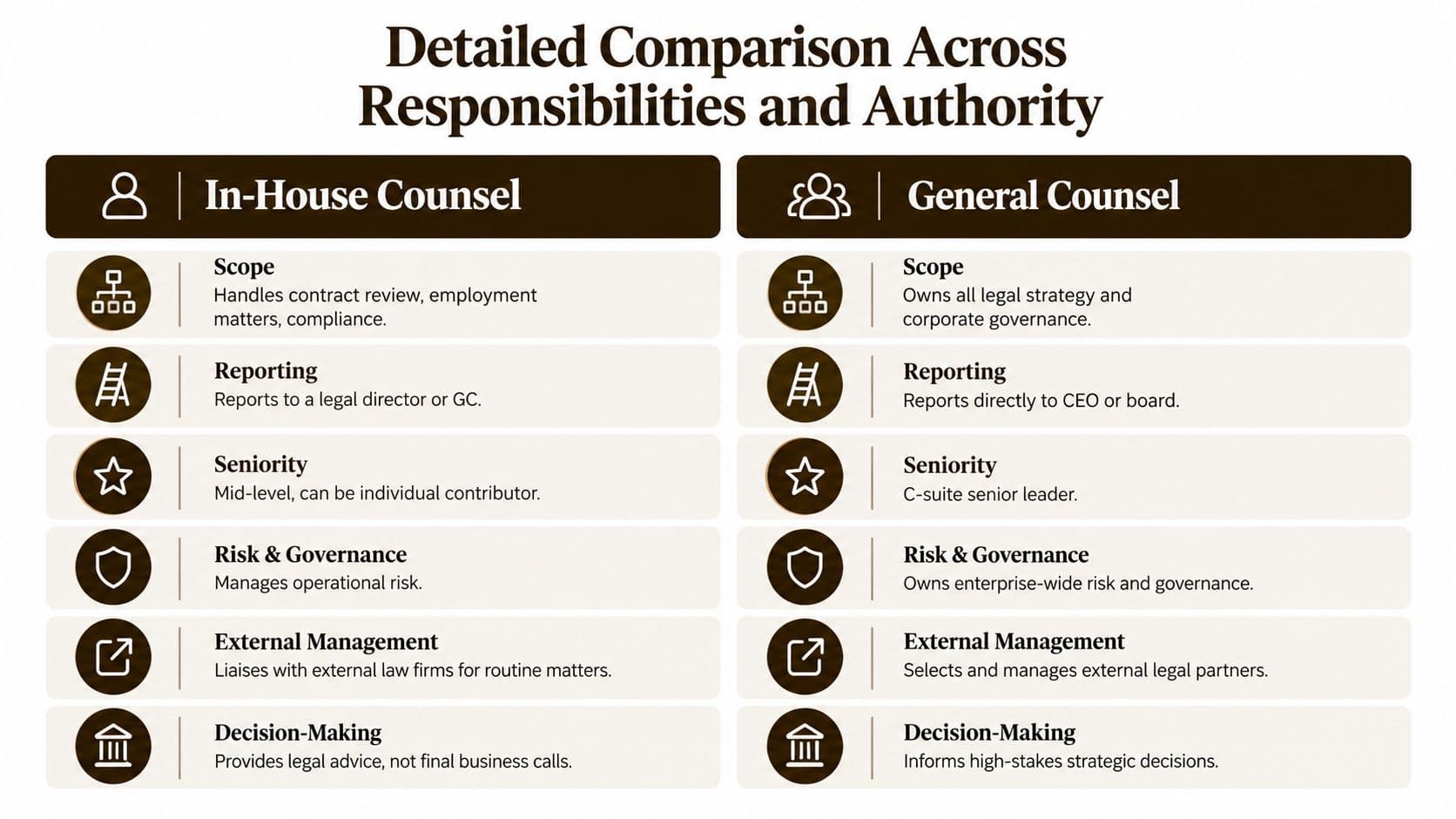
The difference between the roles is best understood through authority. Both lawyers may review contracts, advise executives, work with outside firms, and manage risk. The GC, however, is accountable for how the organization makes legal decisions at an enterprise level.
Scope of responsibilities
In-house counsel usually owns a defined portfolio. That might include commercial agreements, employment matters, privacy, intellectual property, litigation support, or a specific business unit. Success depends on sound advice, practical execution, responsiveness, and the ability to keep assigned matters moving.
A GC has a wider mandate. The GC sets priorities across legal work, identifies material risks, allocates resources, and determines when a matter requires executive or board attention. The role may include governance, compliance coordination, privacy oversight, crisis response, and legal operations.
Reporting structure
Counsel commonly reports to a GC, legal director, deputy GC, or another executive responsible for a business function. That structure gives counsel room to make routine decisions while preserving escalation paths for matters with broader consequences.
The GC generally reports to the CEO, executive leadership, or the board. Independence matters because the GC must sometimes challenge commercial decisions, investigate executive conduct, or explain a risk that senior management would rather avoid.
Seniority and leadership
A strong in-house counsel doesn't need direct reports to create value. A specialist can be the right hire when the company needs deep expertise and reliable execution. Seniority should follow the complexity and consequence of the work, not the candidate's desire for a more impressive title.
A GC leads through judgment, prioritization, influence, and department design. That can mean recruiting lawyers, setting outside counsel standards, establishing escalation protocols, building a legal operations function, and communicating legal value to executives who measure the business through growth, margin, cash flow, and operational resilience.
Key differentiator: In-house counsel owns matter execution. General Counsel owns the legal function's enterprise risk and decision framework.
Risk and governance ownership
Counsel identifies legal exposure and recommends a course of action within an assigned area. The lawyer may manage a regulatory response or negotiate a limitation of liability, but the GC typically decides how that issue fits the company's overall risk appetite.
The GC also owns governance architecture. That includes board materials, approval processes, delegated authority, compliance coordination, and the distinction between a risk the company can accept and one it must eliminate or escalate.
External counsel management
Counsel may instruct outside lawyers on a discrete matter and monitor deadlines, budgets, and work product. That relationship is usually tactical.
The GC decides which work should remain inside, which firms should be retained, how matters are staffed, and whether spend is aligned with business value. The ACC legal department benchmarks emphasize metrics such as outside-versus-inside spend, spend-to-budget variance, and workload per lawyer. Those measures give the GC evidence for staffing and sourcing decisions.
Business advisory role
Counsel advises business partners and translates legal issues into practical options. The best counsel doesn't merely identify obstacles. They explain trade-offs and recommend a path that supports the company's objective without accepting unnecessary exposure.
The GC operates as a business steward. The role informs strategic decisions involving transactions, organizational change, market entry, products, investigations, and executive priorities. The GC may not make the final business call, but the CEO and board expect the GC to frame the legal and governance consequences clearly enough to make that decision responsibly.
Compensation Seniority and Career Path Realities
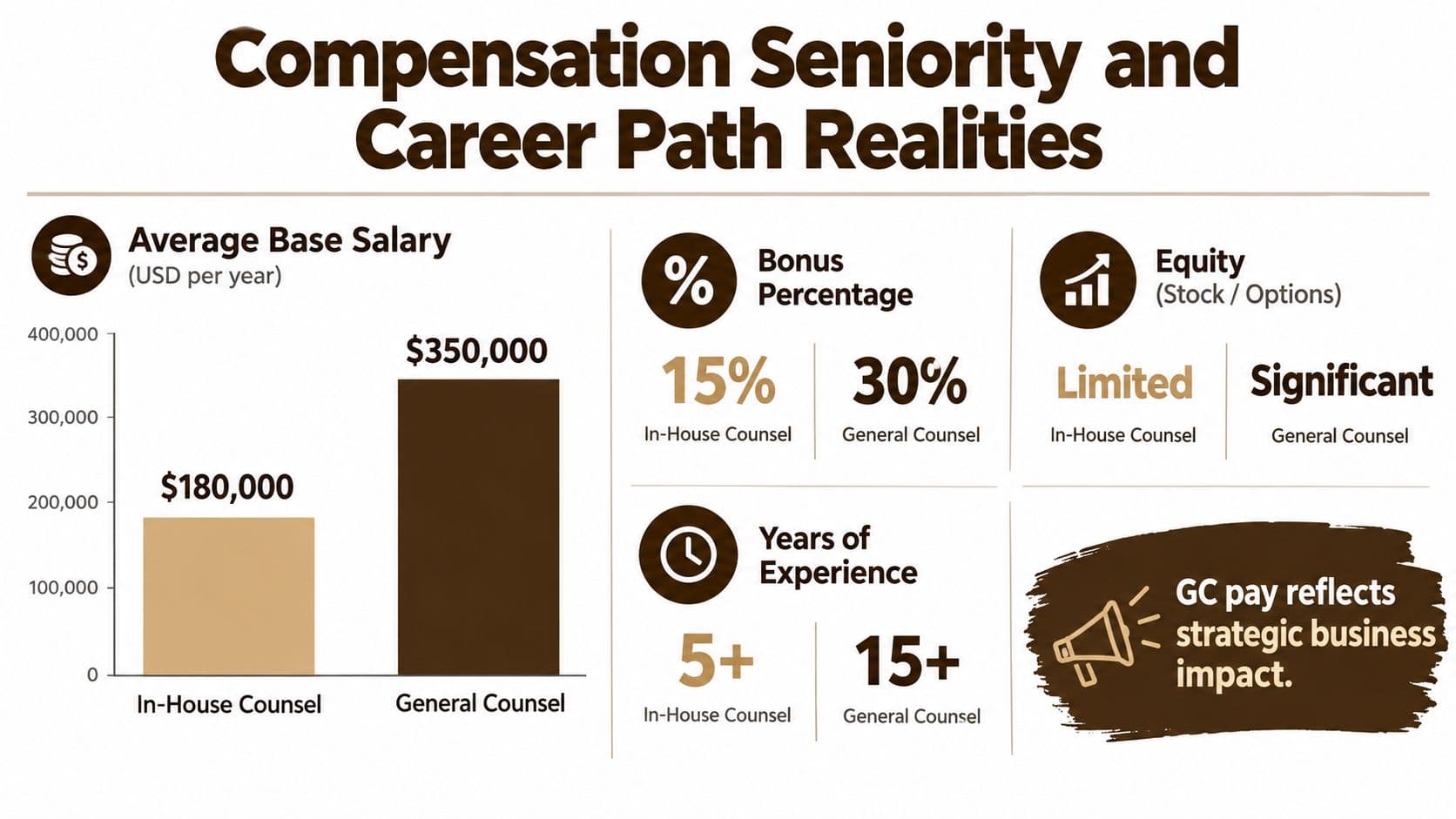
Title sets the candidate pool and the price. A company that advertises for a GC but offers only matter-level authority will lose credible GC candidates and may overpay a counsel candidate who accepts the title for career reasons.
The compensation gap is visible in recent market data. A 2026 compensation report found median total cash pay of $739,000 for public-company GC and CLO roles and $500,000 for private-company GC and CLO roles. Equity was reported for 63% of public-company respondents and 52% of private-company respondents in those roles. The same report reflects how ownership structure changes the value proposition, not just the base salary. See the in-house counsel compensation report for the reported comparison.
Broader in-house counsel compensation sits in a different band. A 2024 survey reported median in-house counsel compensation of $274,000, up 4.4% from the prior year, with cash bonuses paid at 95% of target. That compensation reflects high-value legal specialization and commercial contribution, but it usually doesn't carry the same enterprise accountability, board exposure, or equity expectations as the GC role.
The career path is usually internal
GC is often the culmination of an in-house career rather than a direct move from outside counsel. In a 2018 survey, 70% of U.S. general counsels came from in-house backgrounds rather than law firms, according to the compensation data source linked above.
That pattern matters for hiring. A law firm partner may bring excellent technical depth, client judgment, and transaction experience, yet still need to demonstrate department leadership, operating discipline, executive communication, and comfort making decisions with incomplete information. A senior in-house lawyer may already understand those demands, even if they need broader exposure before taking the top role.
What the title signals to candidates
A counsel title signals specialization, execution, and contribution within a legal structure. A GC title signals ownership of the structure itself. Candidates will reasonably ask about reporting access, board interaction, budget control, team-building authority, equity, crisis expectations, and whether compliance or privacy sits within the mandate.
The title also changes expectations around technology and AI. 51% of global GCs surveyed in a 2026 KPMG outlook identified understanding and implementing AI across the business as their most important operational priority, while 41% of U.S. in-house counsel in a 2026 Chambers survey identified technology and innovation as a critical focus area over the following 18 months, as reported by BarkerGilmore's legal compensation report coverage. A GC is increasingly expected to govern how the organization adopts AI, not just advise on a single technology contract.
Budget accordingly. If you need a lawyer who owns a portfolio, recruit and pay for counsel capability. If you need someone who will set legal strategy, carry board-level accountability, lead AI governance, and build the department, budget for GC expectations.
For a broader view of market positioning and executive compensation, review this General Counsel salary guide before setting the role's range.
When to Hire In House Counsel and When You Need a General Counsel
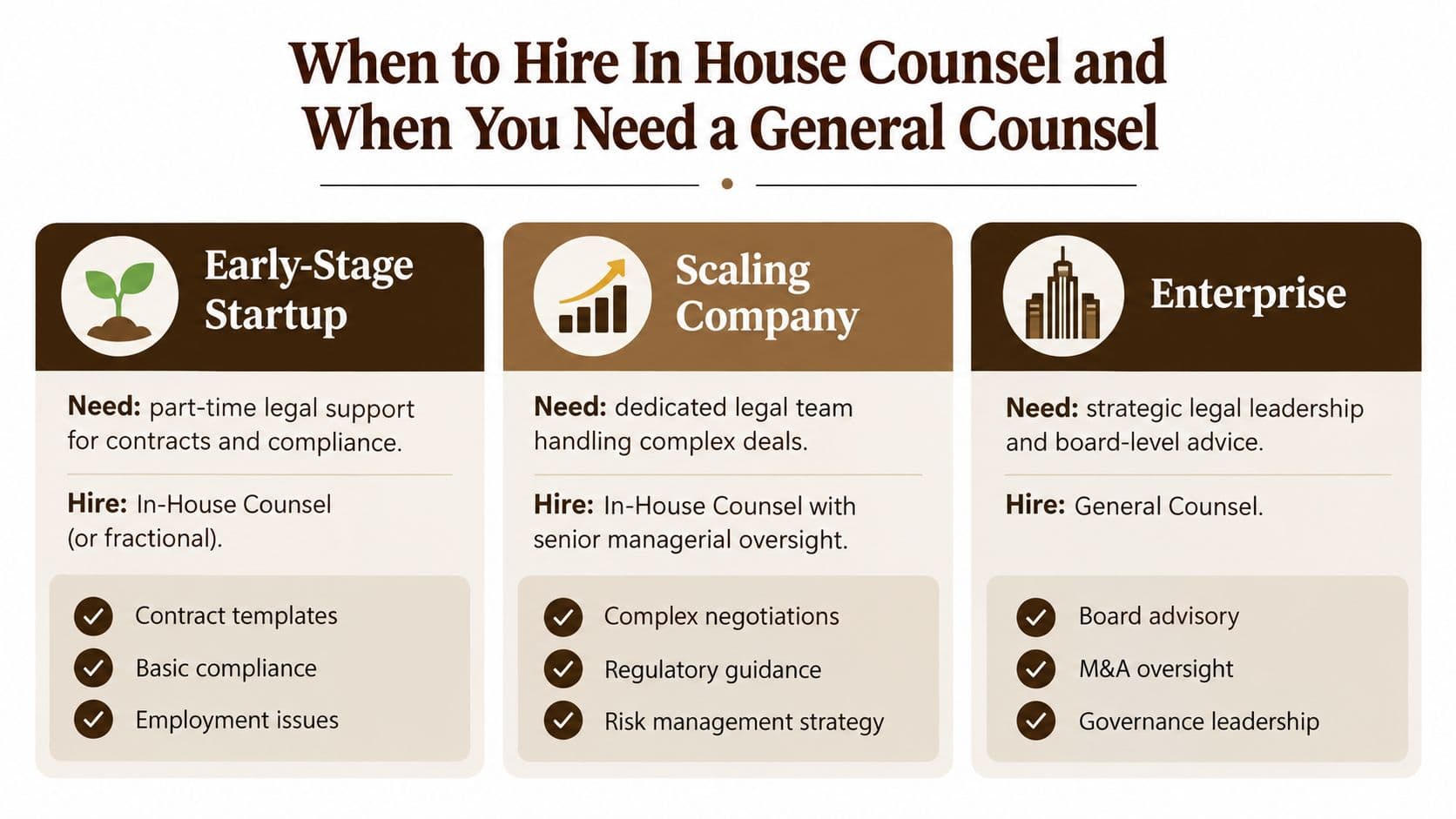
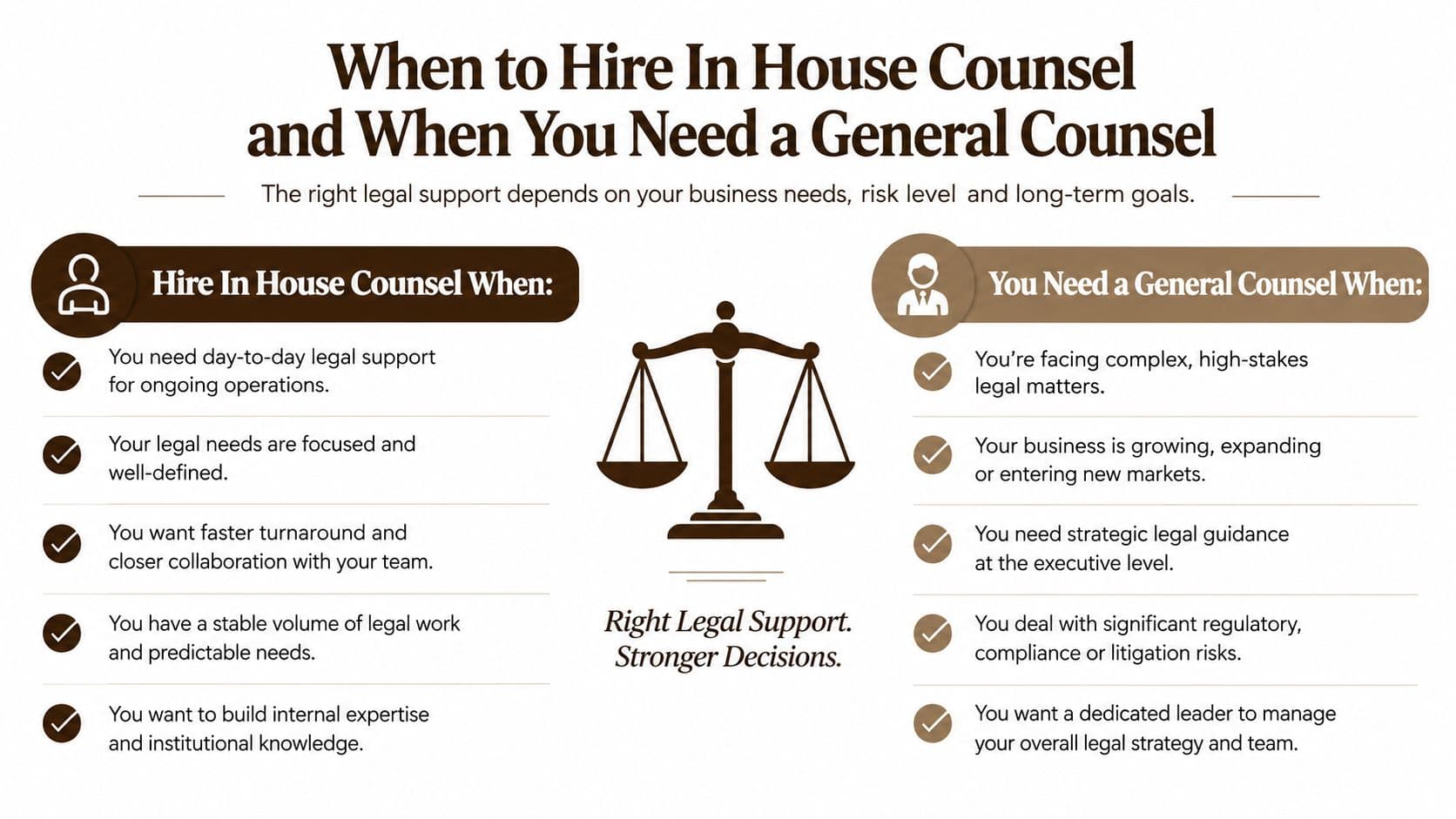
The hiring threshold should follow the company's decision burden, not its headcount alone. A small company with complex commercial exposure may benefit more from a commercially sharp in-house lawyer than from a GC who spends too much time designing a department that doesn't yet exist. A larger company may need a GC even when individual matters are already handled competently, because no executive owns the legal system around those matters.
Early stage and mid-market businesses
Start with in-house counsel when the recurring workload is practical and close to revenue. The business may need contract templates, negotiation support, basic compliance guidance, employment advice, and a reliable point of contact for outside firms.
The ideal candidate is hands-on. They should understand sales operations, procurement, product teams, and finance. They need enough judgment to identify material risks, but they shouldn't escalate routine questions only because the company hasn't built a formal legal hierarchy.
A fractional lawyer or specialist outside counsel can supplement the role while volume develops. Don't use the GC title to compensate for the absence of a clear mandate.
Scaling companies
Consider senior in-house counsel, a legal director, or a GC when complexity starts to compound across functions. Common triggers include complex commercial negotiations, regulatory expansion, cross-border activity, acquisitions, recurring disputes, data governance, or a growing network of external legal providers.
At this stage, the question is whether the company needs more legal hands or one accountable legal decision-maker. If the work is increasing but the issues remain contained within defined portfolios, add counsel. If executives need consistent risk prioritization across products, people, finance, and strategy, raise the leadership requirement.
Enterprise organizations
An enterprise needs a GC when legal risk has become inseparable from business governance. The GC should advise the board and C-suite, manage external counsel strategy, oversee legal and compliance coordination, establish escalation standards, and explain how legal performance supports organizational objectives.
Recent data reinforces the need to test that mandate instead of assuming it. In the 2026 ACC survey, 63% of respondents expected legal headcount to remain stable, while a separate 2026 corporate law department report identified staffing as the top in-house pain point and reported that up to 42% of C-suite respondents believed legal contributed little or not at all to organizational objectives. The 2026 State of the Corporate Law Department report highlights the credibility gap a GC must close.
Use this checklist before approving a GC search:
- Executive access: Will the lawyer advise the CEO, executive team, and board?
- Risk ownership: Will the lawyer set enterprise legal priorities and escalation rules?
- Operating mandate: Will the lawyer control budget, staffing, outside counsel, or legal operations?
- Strategic involvement: Does the business need legal input on growth, transactions, AI, or governance?
- Leadership gap: Is the company missing accountable legal leadership, rather than just legal capacity?
The practical recommendation is contrarian but useful: hire hands-on in-house counsel before a formal GC when execution is the bottleneck. Hire the GC when the business needs a steward who can connect legal risk, governance, and strategy. For lawyers evaluating the transition from private practice, this guide to going in-house provides useful career context.
How Legal Departments Measure Performance Beyond Titles
A senior title doesn't prove that a legal department is effective. The GC should be able to show what the team handles, how quickly it moves, where money goes, and whether staffing matches demand.
Operational KPIs create that evidence. The Thomson Reuters legal department structuring guidance identifies several useful measures for in-house teams.
Matter speed and workflow control
Track matter turnaround time and cycle time by matter type. Contract review, employment advice, regulatory requests, and litigation don't share the same natural timetable, so measure comparable work rather than forcing every matter into one target.
The internal matter-management rate shows how much work the team handles internally instead of sending to external firms. A rising internal rate can indicate stronger capability, better playbooks, or improved triage. It can also expose overload if matters are being retained inside without adequate staffing.
Spend and capacity
Monitor spend-to-budget variance per lawyer and the outside-versus-inside spend split. These measures help the GC explain whether external costs reflect genuine complexity, weak internal capacity, poor scoping, or inconsistent firm management.
Workload per lawyer adds the missing capacity view. A team can appear efficient while operating at unsustainable pressure. Review matter volume, complexity, urgency, and escalation frequency together. Headcount decisions should follow the work profile, not a title hierarchy.
Use metrics to define the hire
If turnaround time is poor because no one owns commercial intake, hire counsel or legal operations support. If external spend is uncontrolled because no executive sets sourcing and risk priorities, the business may need a GC. If the department has a GC but no reliable data, the immediate need may be a legal operations leader, better matter management, or disciplined reporting. A legal operations director search can address that operating gap without miscasting it as a seniority problem.
Recommendation Choosing the Right Model for Your Organization
Choose in-house counsel when the company needs practical legal capacity, faster commercial execution, and focused expertise. Give the lawyer a defined portfolio, clear escalation rules, access to business leaders, and a path to broader responsibility if the organization grows.
Choose General Counsel when the company needs one executive to own legal strategy, governance, enterprise risk, board and C-suite advice, external counsel management, and the operating performance of the legal department. Don't offer a GC title without the access and authority required to perform that job.
Build a layered department when the organization has both needs. The GC should set risk posture, advise leadership, allocate resources, and manage the function. Counsel should own defined legal portfolios and resolve matters efficiently. Legal operations can provide the workflow, spend, capacity, and reporting discipline that lets the entire model scale.
| Organizational need | Recommended model | Hiring priority |
|---|---|---|
| Repetitive contracts and employment questions | Corporate Counsel or in-house counsel | Commercial judgment and speed |
| Specialized regulatory, privacy, IP, or employment exposure | Specialist in-house counsel | Technical depth and practical advice |
| Cross-functional risk and transaction complexity | Senior counsel, legal director, or GC | Breadth, prioritization, and influence |
| Board governance and enterprise accountability | General Counsel or CLO | Executive leadership and risk ownership |
| Growing legal volume with weak reporting | Counsel plus legal operations support | Workflow control and measurable performance |
My recommendation is direct: don't hire the most prestigious title. Hire the lowest level of authority that fully solves the business problem, then design a credible path upward. If the company already needs enterprise stewardship, don't disguise a GC search as a senior counsel role to save budget. The wrong title will narrow the candidate pool, distort compensation, and leave accountability unclear.
Five Star Placements provides permanent placement for in-house counsel, General Counsel, Corporate Counsel, compliance, contracts, M&A, tax, and legal operations roles. Its contingency-based search model includes customized screening for experience, skills, and organizational fit, with payment due upon a successful hire rather than upfront.
Share your current legal workload, reporting structure, risk profile, and growth plans with Five Star Placements to determine whether your next hire should be hands-on in-house counsel, a General Counsel, or a layered legal team. The firm can source and screen qualified legal talent for a permanent placement aligned with the authority your organization needs.
Need help filling a legal role?
Five Star Placements partners with law firms and legal departments nationwide.
Schedule a Call