
Go in House: The Attorney's 2026 Transition Playbook
September 12, 2026 · 14 min read · Five Star Placements

Table of contents
You're a sixth-year M&A associate, and the calendar is full of late-night diligence calls, partner revisions, and clients who expect instant answers. A mid-cap technology company has invited you to interview for corporate counsel, and the role appears to offer what private practice no longer does: fewer simultaneous matters, closer contact with decision-makers, and a clearer connection between your advice and the business.
Before you accept that premise, be precise about what you're buying. Going in house isn't an escape from demanding work. It's a trade from billable-hour economics for business fluency, operational ownership, and internal influence. The attorneys who succeed make that trade deliberately. The ones who struggle usually expect the company to preserve the parts of firm life they value while removing the pressure they don't.
Table of Contents
- Why Going In House Is a Business Trade, Not an Exit
- Mapping Your Skills From Firm Life to In-House Demands
- Rewriting Your Resume and LinkedIn for In-House Recruiters
- Building the Network and Running the In-House Search
- Negotiating Compensation and Choosing the Right Role Type
- Your First 90 Days Onboarding for Long-Term Success
Why Going In House Is a Business Trade, Not an Exit
The move into a corporate legal department has become a major reallocation of legal talent, not a niche career detour. An Association of Corporate Counsel report on the in-house population, drawing on U.S. Bureau of Labor Statistics data, says the U.S. in-house counsel population nearly doubled from 78,000 in 2008 to 145,000 in 2024, an 87% increase. The same source describes a longer historical shift, with in-house departments becoming larger, more specialized, and more strategic.
That growth changes the conversation. You aren't merely leaving a law firm. You're moving into a business unit that may own contracting, privacy, compliance, M&A, litigation strategy, product counseling, and governance. Your value will be judged less by how elegantly you analyze an isolated issue and more by whether you can help the company decide, execute, and manage consequences.
What you give up and what you gain
A firm rewards leverage, technical depth, partner confidence, reputation, and portable training. You learn to handle complex matters under pressure, coordinate teams, and satisfy demanding clients. Those skills remain useful in-house, but the reward system changes.
An internal legal team rewards domain ownership, prioritization, stakeholder judgment, and commercial speed. You may handle fewer parallel matters, but each matter can carry more organizational context. A contract issue may involve sales targets, product design, finance approval, data practices, procurement constraints, and an executive decision. The legal answer is only one part of the job.
Practical rule: If your reason for moving is only “I want fewer hours,” you haven't finished evaluating the role.
Shorter hours, where they exist, don't mean easier work. In-house lawyers often operate with less information, fewer layers of review, and no partner available to absorb ambiguity. The business wants a recommendation, not a memo that preserves every possible qualification. You'll need to explain what matters, what can wait, and what risk the company is consciously accepting.
Why 2026 raises the standard
The 2026 transition also requires a more modern skill set. Legal departments are using technology to compress routine workload, while headcount discipline increases the premium on attorneys who can work across functions. A lawyer who can use AI tools responsibly, understand workflow design, and brief a finance or product leader will usually be more valuable than one who only offers excellent issue spotting.
The strongest candidates therefore present the move as a business decision. They can explain which company problems they understand, which decisions they've influenced, and how their legal judgment supports revenue, product delivery, risk allocation, or operational scale. That is the difference between an attorney seeking relief and an attorney offering an advantage.
Mapping Your Skills From Firm Life to In-House Demands
A law-firm résumé describes legal activity. A General Counsel hires for business utility. Your first task is to translate the former into the latter without overstating your role.
Four translation buckets
Substantive law remains important, but companies rarely hire you to display doctrine in isolation. A firm-side commercial lawyer who drafted agreements should describe the ability to own a contract lifecycle, identify recurring negotiation friction, improve templates, and advise business owners before a deal reaches escalation.
Matter management is broader than calendaring deadlines. Running a complex discovery plan can demonstrate that you know how to coordinate people, vendors, information, and competing priorities. In-house, that same capability may support a product launch, regulatory response, acquisition integration, or enterprise contracting initiative.
Client service becomes executive stakeholder management. A partner may value responsiveness and polish. A GC also wants you to understand whether the stakeholder needs a decision, a risk boundary, a short explanation, or permission to proceed.
Leverage changes shape. Delegating to associates at a firm demonstrates supervision. In-house, the equivalent is building an effective relationship with outside counsel, setting a clear scope, controlling spend, and deciding which work belongs inside the department.
| Firm-Side Skill | In-House Equivalent | Underweighted Business Competency |
|---|---|---|
| Drafting and revising agreements | Contract lifecycle ownership | Understanding revenue, margin, and approval friction |
| Managing discovery or a major matter | Coordinating cross-functional initiatives | Comfort with ambiguity and changing priorities |
| Serving a demanding partner or client | Advising executives and business owners | Writing briefly for non-lawyer audiences |
| Supervising junior lawyers | Directing outside counsel and vendors | Managing budget and work allocation |
| Researching legal issues | Making a practical recommendation | Flagging risk early without blocking the deal |
The skills candidates underestimate
P&L literacy matters because legal recommendations consume resources and affect commercial outcomes. You don't need to become an accountant, but you should understand how a delay, indemnity, pricing term, vendor dispute, or compliance requirement affects the business.
Ambiguity tolerance matters because internal clients often bring incomplete facts. Waiting for a perfect record can be less helpful than identifying the decision, stating the assumptions, and giving a defensible path forward.
Brevity is a professional skill. A business leader may not read a detailed analysis, even if the analysis is excellent. Lead with the answer, identify the material risk, and state the action you recommend.
Run this self-audit before applying. List the last ten matters you handled, then write one sentence for each describing the business question solved, not the legal task performed. “Drafted acquisition documents” is a legal activity. “Helped the company acquire a new capability while allocating integration and liability risk” shows commercial understanding.
Rewriting Your Resume and LinkedIn for In-House Recruiters
Most firm-side résumés fail in-house screening because they describe credentials instead of usefulness. Make three edits before sending a single application.
Replace pedigree with positioning
Your summary should take about four lines and answer four questions: Which industry do you understand? Which matters do you handle? Which stakeholders have you advised? What business result did your work support?
Avoid a summary built around partner-track ambition, class rank, or prestige alone. Those details can support your candidacy, but they shouldn't lead it. A hiring manager wants to see a lawyer who can enter the company's workflow and become useful quickly.
A stronger summary might identify experience advising technology companies on strategic transactions, commercial agreements, data issues, and disputes, with regular exposure to executives, finance teams, product leaders, or sales organizations. Keep the language accurate. If you supported a partner, say so. If you owned the workstream, say that instead.
Rewrite every experience bullet
Lead with scope, then explain the decision or outcome. Replace “drafted memoranda” with the issue you helped resolve. Replace “managed discovery” with the operational responsibility you carried. Where confidentiality limits detail, use a truthful qualitative description rather than inventing a transaction value or savings figure.
Before:
- Drafted pleadings, managed discovery, and prepared legal research for complex commercial litigation.
After:
- Supported commercial litigation strategy from initial assessment through discovery, coordinating factual development and translating procedural risk into concise recommendations for the client's business and executive teams.
The revised version still needs refinement if you can add legitimate scope. For example, identify the number of business units involved, the jurisdictions covered, the type of dispute, or the decision enabled. Don't add a dollar amount unless you can substantiate it.
Your resume dos and don'ts should also guide formatting, chronology, and editing. The objective is not to make firm experience sound like something it wasn't. It's to make the transferable value visible.
Make LinkedIn match the role
Your headline should target the work you want, not announce that you're an attorney. “M&A Associate | Technology Transactions | Commercial Contracts | Strategic Legal Advisor” gives a recruiter more to work with than a title and firm name.
Rewrite the About section in the first person. Explain the business problems you've helped clients solve, the industries you know, and the internal stakeholders you've worked with. Use the Featured section for a public article, speaking appearance, CLE contribution, or portfolio artifact that demonstrates judgment without exposing confidential information.
Turn on the “Open to Work” signal for recruiters only if discretion matters. Your profile, résumé, and outreach should tell the same story: you're not applying to every legal role, you're pursuing a defined transition into a specific type of business.
Building the Network and Running the In-House Search
Broad networking produces polite conversations. Targeted networking produces useful introductions. Build a 20-person target list segmented by industry, company stage, and current legal-team need, then give every person a reason to respond.
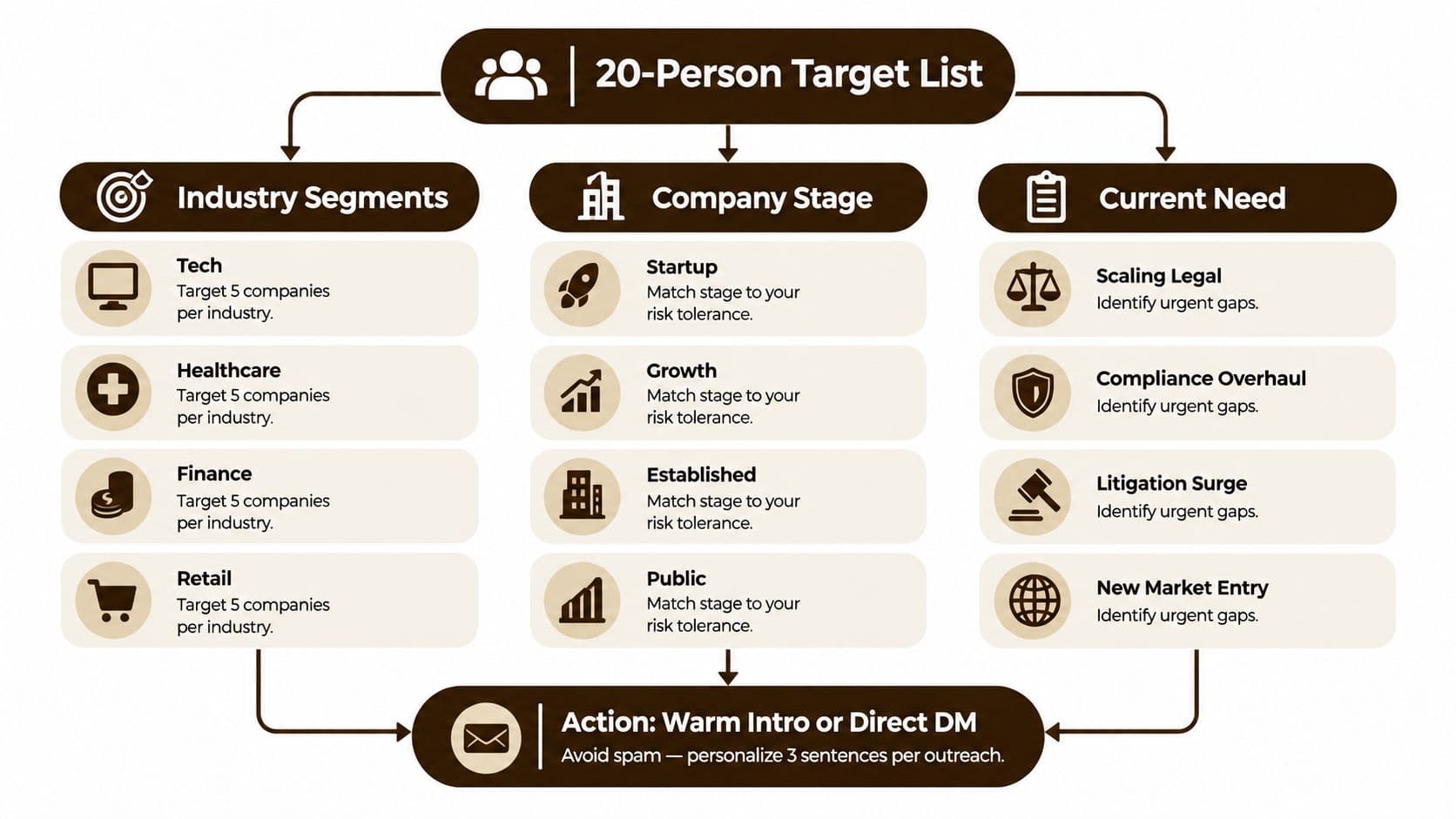
Start with people who can evaluate your target role, not just people who share your profession. Include current and former GCs, legal operations leaders, business executives you've served, former colleagues who moved in-house, and recruiters who regularly handle the relevant market.
Make the outreach specific
A weak message says you're exploring in-house opportunities and would appreciate advice. A stronger message connects your experience to a recognizable company problem.
You might write that you've worked on technology transactions involving product, sales, and privacy stakeholders, and that you're researching legal teams supporting a particular stage of growth. Ask for a short conversation about how that department allocates commercial work, not for a job. If the person sees a fit, the referral can follow naturally.
Run parallel channels instead of relying on LinkedIn. Legal operations communities, General Counsel alumni groups, niche Slack communities, bar association committees, CLE panels, and former colleagues often reveal roles before they become widely visible. A reverse introduction can work well when you share a board connection, panel, client relationship, or professional committee with a GC.
You can also use in-house counsel recruiters as one channel while maintaining direct relationships with target companies. A recruiter should understand your practice, constraints, compensation expectations, and preferred role design. Don't send the same generic résumé to every intermediary.
Treat the interview as mutual diligence
Expect a process that may include:
- A recruiter screen focused on practice fit, motivation, location, compensation, and availability.
- A hiring-manager interview with the GC or senior legal leader.
- A stakeholder panel involving legal and business partners.
- A take-home business case, short memo, or practical judgment exercise.
- Reference checks addressing collaboration, judgment, responsiveness, and ownership.
Use every stage to test the company. Ask the GC how the role became available, what happened to the prior occupant, which stakeholders create the most pressure, and how the department handles disagreements over risk. Ask about budget cycles, planned hiring, outside-counsel dependence, and whether the reporting line sits directly under the GC.
The most revealing question is often simple: “What would make this person unsuccessful?” Listen for a coherent answer. If the company can't describe the mandate, priorities, or decision rights, the title may be clearer than the job.
Negotiating Compensation and Choosing the Right Role Type
Base salary is only one part of an in-house offer, and title is often the least reliable indicator of scope. A “senior” title can conceal an individual-contributor role with little influence, while a narrower title may carry direct ownership of a valuable business area.
The broader market is substantial. ACC and Major, Lindsey & Africa's 2026 benchmarking work draws on 576 in-house legal departments across 45 countries, while Thomson Reuters' 2025 Legal Department Operations Index reported median internal spend of $3,000,000 and mean internal spend of $17,310,229. Those figures show that legal departments operate as serious business units with meaningful budgets, but they don't tell you whether a specific seat is stable or well designed.
Compensation surveys cited in the same verified market data show that 2025 base salaries for in-house legal counsel rose by 2.8% on average, while General Counsel base salaries rose 2.5%. One survey reported median General Counsel compensation of $325,000, and another placed 2026 General Counsel base salary in the range of $222,750 to $270,500. Treat these benchmarks as negotiation context, not as a promise for your level or market.
Evaluate the whole package
Ask for the written mechanics behind every variable component.
- Bonus: Is there a documented formula, or does the company retain broad discretion?
- Equity: What is the vesting schedule, what happens on termination, and what change-of-control provisions apply?
- Sign-on payment: Does repayment apply if you leave voluntarily, are terminated, or experience a material role change?
- Relocation: Which expenses are covered, and are they subject to repayment?
- Title and scope: Does the title reflect decision rights, reporting level, and ownership, or only recruiting appeal?
The 2025 in-house legal pay analysis describes a relatively settled legal labor market, with limited reported hiring difficulty and rare retention pressure despite rising headline salaries. It also points to greater use of interim and project-based lawyers, along with legal operations and AI or compliance functions. That means you should ask whether the position is a permanent seat, a project-heavy assignment, or a path toward broader operational work.
Compare the role types honestly
| Role Type | Base Salary Range | Bonus & Equity | Income Predictability | Career Upside | Resume Value |
|---|---|---|---|---|---|
| Permanent in-house counsel | Not stated in verified data | Review bonus, equity, and sign-on terms individually | Generally stronger, subject to department stability | Broad ownership and progression | Strong if scope and reporting line are credible |
| Interim or fractional counsel | Not stated in verified data | Often project-specific rather than standardized | More variable | Builds adaptability and sector breadth | Valuable when assignments show clear ownership |
| Legal operations role | Not stated in verified data | Depends on company and function | Depends on funding and department design | Strong route into process, technology, and department leadership | Strong for lawyers building operational fluency |
| Boutique secondment | Not stated in verified data | Contract-specific | Limited to assignment terms | Can create an internal conversion opportunity | Useful when the work produces measurable ownership |
The table contains no invented salary ranges because the verified data doesn't provide role-specific figures. Negotiate by anchoring to credible external benchmarks, then connect your request to outcomes you can own. If base salary is constrained, trade among base, sign-on protection, equity, title, review timing, and scope. Do not accept a vague “stretch” bonus or an unclear reporting line buried under operations without understanding the consequences.
Before signing, have the agreement reviewed through a disciplined process, including the terms addressed in this employment agreement review guide.
Your First 90 Days Onboarding for Long-Term Success
The first quarter determines whether colleagues see you as a strategic advisor or as a former firm lawyer waiting for instructions. Your legal knowledge gets you hired. Your ability to make the department easier to use determines whether you gain influence.
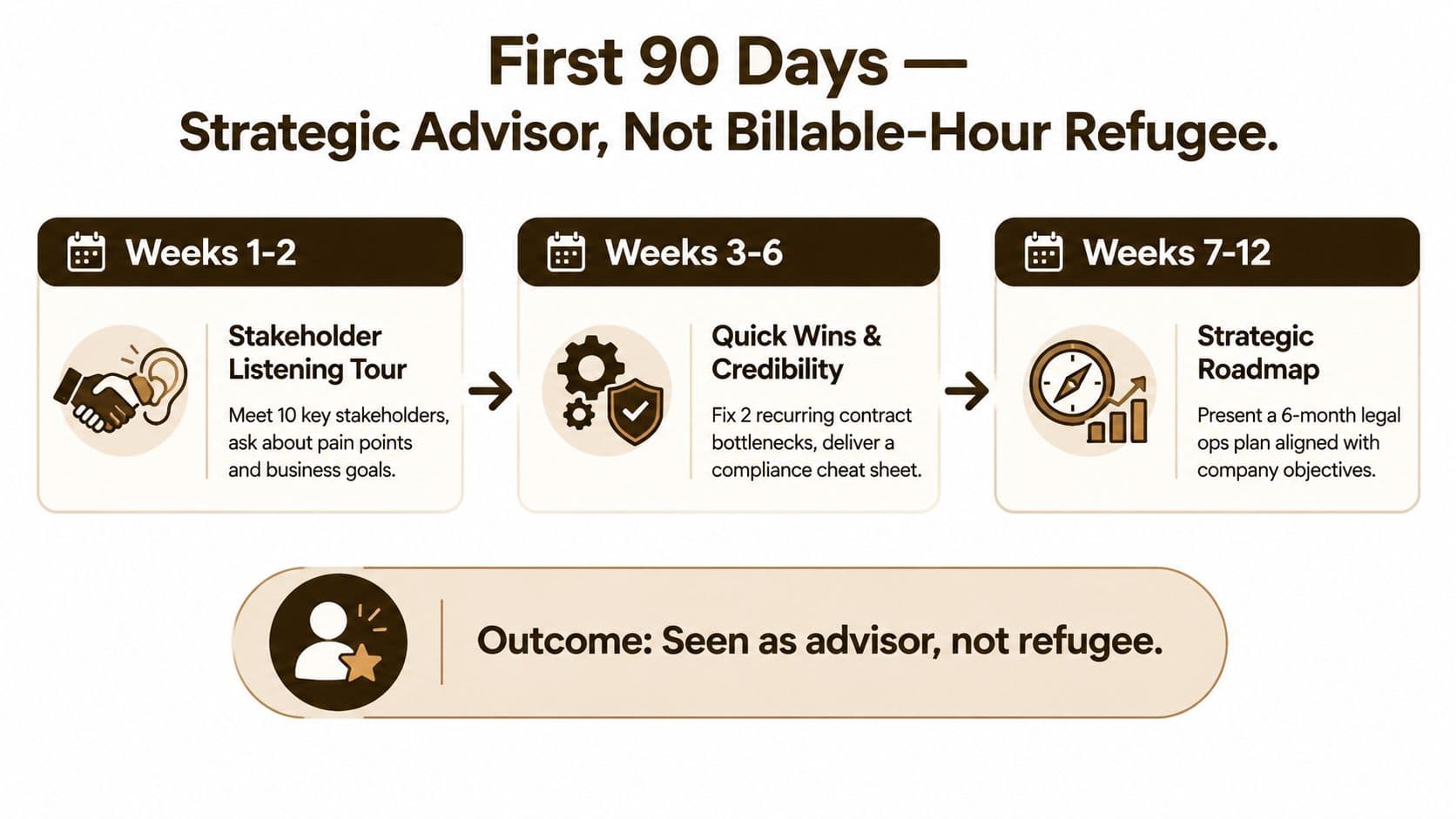
Weeks 1 through 2
Listen before redesigning anything. Map the GC, finance lead, sales leader, product owner, security contact, HR partner, procurement lead, and other people who regularly create or consume legal work. Ask each person what slows decisions, where legal advice arrives too late, and which risks they don't understand.
Request a written charter, access to the legal technology stack, the outside-counsel budget, and a seat in relevant commercial pipeline meetings. Read recent contracts, playbooks, board materials you're permitted to access, open disputes, compliance guidance, and outside-counsel invoices. You're learning how the department operates, not how its policies describe it.
Weeks 3 through 6
Shadow business owners and turn recurring questions into plain-English guidance. If sales repeatedly asks about approval thresholds, build a usable decision tree. If procurement sends inconsistent terms, clarify the intake route and fallback positions. If product teams need privacy input, create a short checklist that identifies when legal must be involved.
Use AI tools only within approved company policies and with appropriate confidentiality controls. Learn what the organization permits, what requires human review, and which workflows can be improved without weakening privilege, security, or accuracy. Attorneys who ignore AI training and legal operations will struggle to explain their value as routine work becomes more structured.
A useful internal presentation on practical AI and legal workflow design can supplement formal training:
Weeks 7 through 13
Ship one visible improvement for each major business group you support. The wins don't need to be dramatic. A clearer contract intake process, a practical compliance cheat sheet, a better escalation path, or a concise risk dashboard can establish credibility if users adopt it.
By the end of the quarter, propose a recurring legal review cadence tied to commercial planning, product releases, compliance obligations, or governance needs. Produce five artifacts:
- Stakeholder map: Who owns each decision and when legal enters.
- Matter and risk inventory: What is open, urgent, recurring, or undocumented.
- Contract playbook: Which terms are acceptable, negotiable, or escalated.
- Legal workflow improvement: One process made clearer or faster for users.
- Quarterly legal roadmap: Priorities, owners, dependencies, and decisions required.
Skip non-lawyer relationships, avoid the approved technology stack, and keep all guidance in your head. By month six, your pedigree won't compensate for the resulting lack of trust.
Five Star Placements provides permanent placement for attorneys, including General Counsel, Corporate Counsel, Compliance Counsel, and legal operations leaders, with screening aligned to practice needs and organizational culture. If you're ready to go in house with a clearer view of role scope and fit, visit Five Star Placements to discuss your search.
Need help filling a legal role?
Five Star Placements partners with law firms and legal departments nationwide.
Schedule a Call