
A Guide to in House Counsel Recruiters for 2026
June 22, 2026 · 15 min read · Five Star Placements

Table of contents
A legal role has been open for months. The business is feeling it. Contracts wait longer for review, a financing workstream stalls, product teams stop asking legal in advance because they assume no one has bandwidth, and the General Counsel starts spending time on work that should sit two levels down.
That's usually the moment people start searching for in-house counsel recruiters. Not because recruiting suddenly became interesting, but because the cost of a bad vacancy finally became impossible to ignore.
The hard part is that many firms sound similar on paper. They all say they know the market. They all say they have strong networks. They all say they can find top talent. Very few explain how they reach passive candidates, how they assess business fit, or when their fee model helps versus hurts the search.
Table of Contents
- The Evolving Role of In-House Counsel
- Understanding a Recruiter's True Value
- How to Find and Engage the Right Recruiter
- A Vetting Framework for Hiring Managers
- An Evaluation Guide for Legal Candidates
- Building a Lasting Recruitment Partnership
The Evolving Role of In-House Counsel
A decade ago, many companies still treated in-house legal hiring as a side process. Post the role, ask outside counsel for referrals, review applicants, hope the right lawyer appears. That approach breaks down fast when the role needs business judgment, internal credibility, and the ability to operate with very little supervision.

Corporate legal departments are larger and more important than they used to be. The U.S. in-house counsel population grew from 78,000 in 2008 to 145,000 in 2024, an 87% increase, and that growth outpaced both law firm and government legal sectors, according to the Association of Corporate Counsel's in-house population report.
That shift changed the recruiter's role too. A serious in-house search partner isn't just filling a seat. They're translating business need into a candidate profile that can survive a real operating environment.
Why the job got harder
Legal departments now hire for narrower and more commercially specific needs. A company may want someone who can handle commercial contracts, but what they need is a lawyer who can support a fast-moving sales team, negotiate with procurement-heavy customers, stay calm with product leaders, and know when to escalate risk instead of flooding the business with caveats.
That's not a keyword search. It's judgment.
The strongest in-house hires usually make the business feel faster and safer at the same time.
Why old hiring methods underperform
When a role stays open, hiring groups first increase volume. They post more broadly, collect more resumes, and schedule more screenings. For in-house legal, that often creates more noise than progress.
The reason is simple. The best candidates for many in-house roles aren't actively applying. They're employed, selective, and willing to move only if the role makes sense in scope, leadership access, compensation, and trajectory. A recruiter with real market access can bring those people into the process before the company's own job post ever reaches them.
That's why hiring managers increasingly treat in-house counsel recruiters as strategic partners. The value isn't just candidate flow. It's market intelligence, calibration, and access.
Understanding a Recruiter's True Value
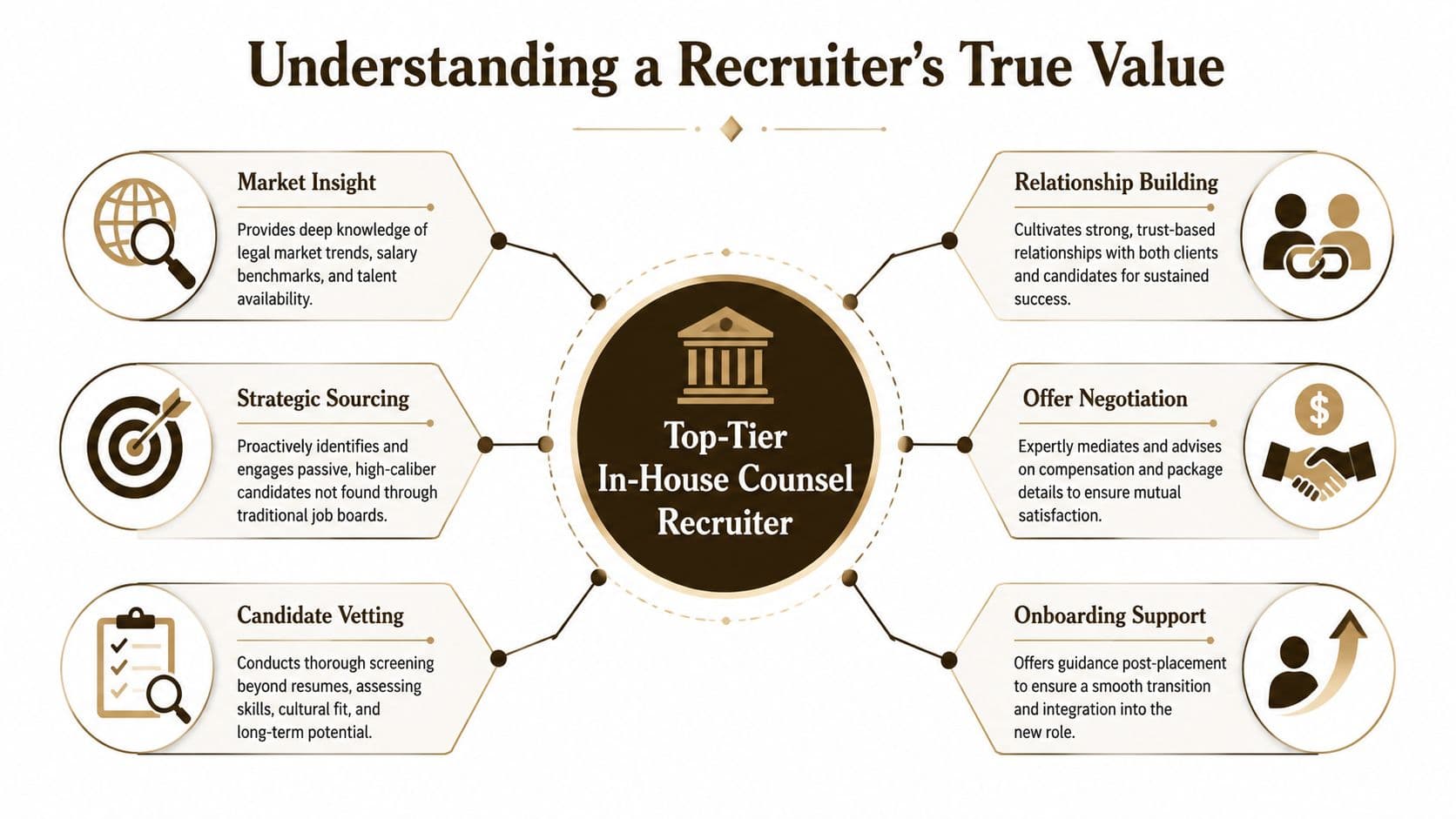
A lot of people still picture recruiters as resume brokers. That's a dated view, especially in legal search. In-house counsel recruiters who perform at a high level do three things well: they understand the legal function, they know how to access passive talent, and they can evaluate whether a lawyer will work inside a specific business.
Why specialization matters
This niche has been specialized for a long time. Major, Lindsey & Africa states that its in-house counsel recruiting practice has existed for over four decades, and that 98% of its recruiters are former lawyers, which says a lot about how much the market values domain knowledge in legal search, as noted on its in-house counsel recruiting overview.
That tracks with what hiring managers and candidates need. A recruiter who has never worked around legal teams may understand compensation mechanics or interview scheduling, but they often miss the substance that matters in-house:
- Reporting lines: Does this role sit as legal advisor, risk gatekeeper, or business partner?
- Scope reality: Is “commercial counsel” a broad operational role with privacy, product, and disputes mixed in?
- Executive fit: Can the candidate communicate with non-lawyers in a way that builds trust?
- Organizational context: Is the company building legal infrastructure or hiring someone to inherit it?
A generalist can sometimes fill a legal role. A specialist can usually diagnose it better.
What strong recruiters do before they send a resume
The best recruiters start by mapping the problem, not the title. They ask what work is piling up, where decisions are getting delayed, who the lawyer will influence, and what kind of judgment the company trusts.
Then they source against that reality.
A strong process often includes:
- Business-scope matching. They identify candidates who have already worked at a comparable company stage, deal pace, or regulatory complexity.
- Passive outreach. They contact lawyers who fit the brief whether or not those lawyers are applying anywhere.
- Contextual screening. They test how the candidate makes trade-offs, communicates risk, and partners with finance, sales, HR, or product.
- Candidate calibration. They explain what parts of the role are attractive, and what parts may frustrate the wrong person.
- Market feedback. They tell the client if the brief is unrealistic, too broad, or mis-leveled.
Practical rule: If a recruiter can't explain why a role will attract the right lawyer, they probably can't sell it to one.
For candidates, the right recruiter also improves visibility into roles that never become broad public searches. For hiring teams, they reduce wasted interviews by filtering out lawyers who look polished on paper but aren't built for the actual environment.
If you want to compare how different firms describe their legal hiring approach, the broader Five Star Placements blog is one place to review how a legal-focused staffing firm frames search, screening, and placement topics across the market.
How to Find and Engage the Right Recruiter
A common approach is to look for a recruiter when a search is already urgent. That's understandable, but it's not ideal. The best recruiter relationships usually start before a vacancy becomes painful or before a candidate decides to leave.
The reason is visible in how lawyers move. In one legal recruiting discussion, only about 19% of lawyers' roles were found through direct company outreach, while 22% came through colleague referral and about 29% to 30% through proactive networking, as discussed in this legal recruiting panel conversation on YouTube. Network-driven channels outperform reactive posting.
Where strong recruiter relationships usually start
If you're a hiring manager, start with people who have filled similar roles in your market or industry. Ask other GCs, deputy GCs, heads of compliance, and trusted outside counsel which recruiters brought them thoughtful candidates. Not just resumes. Candidates they would hire again.
If you're a senior legal candidate, pay attention to which recruiters know your niche without being spoon-fed. A recruiter who covers everything from patent litigation to tax controversy to chief compliance officer roles may still be useful, but many candidates are better served by someone with clearer in-house depth.
Useful channels include:
- Peer referral: The fastest credibility check is still a recommendation from another lawyer who has worked with the recruiter.
- LinkedIn pattern recognition: Look for recruiters who repeatedly place in your slice of the market, not just those who post job ads.
- Association visibility: Recruiters who stay close to legal communities tend to understand how roles are evolving.
- Repeat interaction: If the same recruiter keeps appearing in conversations around strong legal moves, that usually means something.
How to handle the first conversation
The first call shouldn't sound like a generic intake. It should feel like a serious calibration discussion.
If you're hiring, come prepared with:
- The actual business pain: What is not getting done because this role is open?
- The reporting reality: Who does the lawyer need to influence day to day?
- The deal-breakers: Which experience gaps can you train, and which ones will break the hire?
- The internal friction points: Why has the role been hard to fill so far?
If you're a candidate, bring:
- Your move logic: Why are you open now?
- Your scope preferences: What work do you want more of, and less of?
- Your operating style: Builder, specialist, player-coach, fixer, manager.
- Your deal-breakers: Commute, compensation structure, title sensitivity, reporting concerns.
A short opening message is enough. You don't need a speech. You do need specificity.
Good recruiter outreach gets better when both sides talk about decisions, stakeholders, and business conditions instead of just titles.
For a direct starting point with a legal recruiting firm, a simple option is to use a legal recruiting contact page and ask for a conversation focused on either a current search or long-term market calibration.
A Vetting Framework for Hiring Managers
Most recruiter pitches sound strong in the first thirty minutes. The question is whether the firm can produce candidates you couldn't have reached yourself, and whether its search model matches the stakes of the hire.
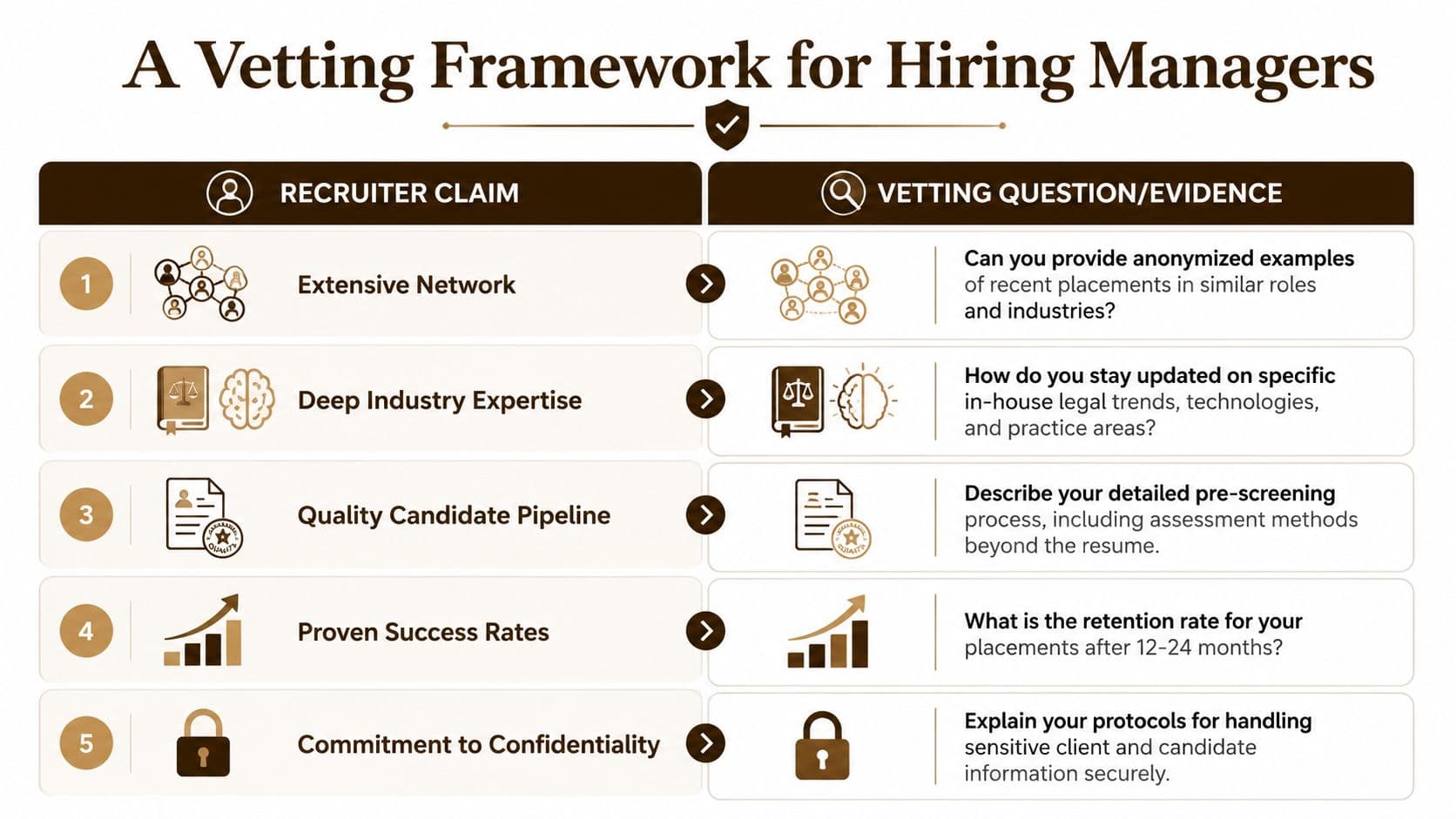
A useful way to evaluate in-house counsel recruiters is to test claims against process. “We have a great network” isn't evidence. “We know this market” isn't evidence either. You need to hear how they run the search, where candidates come from, and what they do when the brief is difficult.
For a quick visual overview of legal recruiter evaluation issues, this interview may help frame the discussion:
How to test passive talent access
Passive talent access is one of the most overclaimed and under-verified parts of legal search. Any recruiter can say they know senior lawyers. Fewer can explain how they identify, approach, and qualify lawyers who are not in the market.
Ask questions that force operational detail:
| Recruiter claim | What to ask |
|---|---|
| Deep network | What types of in-house roles have you worked on that resemble this one in scope and stakeholder exposure? |
| Strong pipeline | How many of your presented candidates usually come from direct outreach versus inbound applicants? |
| Market knowledge | Which companies or legal team structures do you see as the closest talent pools for this role? |
| Candidate quality | What do you test in screening beyond technical legal experience? |
| Confidential process | How do you handle outreach when the search is sensitive or politically delicate? |
The strongest answers are concrete and calm. Weak answers tend to stay abstract.
Look for signs of a genuine search process:
- Role mapping first: They can describe target backgrounds before discussing resume flow.
- Passive strategy: They talk about outreach campaigns, referral chains, and market mapping, not just posting.
- Judgment screening: They assess how a lawyer works with executives and cross-functional teams.
- Pushback when needed: They challenge a brief that combines too much scope for the level or compensation.
How to choose between contingency and retained
Fee model is not just a pricing issue. It shapes behavior.
A contingency model can work when the role is well defined, candidate supply is broad enough, and the company can tolerate a more competitive sourcing process. It often struggles when the role is confidential, senior, unusual, or highly dependent on cultural and political fit.
That trade-off becomes sharper at the top end. A 2024 McKinsey report found that 52% of contingency-based searches for senior in-house roles failed to produce a culture-aligned candidate within 6 months, whereas retained searches achieved an 89% alignment success rate, according to McKinsey's people and organizational performance insights page.
That doesn't mean retained is always the right answer. It does mean hiring managers should stop treating fee model as a separate procurement issue. It is a search design choice.
When the role is expensive to get wrong, the cheapest-feeling search model can become the most expensive decision.
A practical decision guide looks like this:
- Use contingency when the mandate is mid-level, the market is identifiable, and speed matters more than exclusivity.
- Lean retained when the role is senior, confidential, politically sensitive, or requires heavy passive outreach and advisory work.
- Pause before launching any model when the company itself hasn't aligned on scope, level, reporting line, or interview ownership.
Questions that expose weak search process
Good vetting questions are uncomfortable in a useful way. They force the recruiter to reveal whether they are running a search or waiting for applications.
Ask:
- Where will you look first, and why there?
- How do you evaluate business judgment in legal candidates?
- What usually causes this kind of role to fail?
- How will you present our company if candidates raise concerns about title, budget, or legal department structure?
- What will you do if the first wave of profiles misses the mark?
If the answers stay generic, keep looking. In-house legal hiring is too selective for hope-based recruiting.
An Evaluation Guide for Legal Candidates
Candidates need to vet recruiters just as carefully as employers do. A weak recruiter can waste your time, misrepresent your background, push you into a role that doesn't fit, or shop your resume too broadly. In a close legal market, that can damage your reputation.
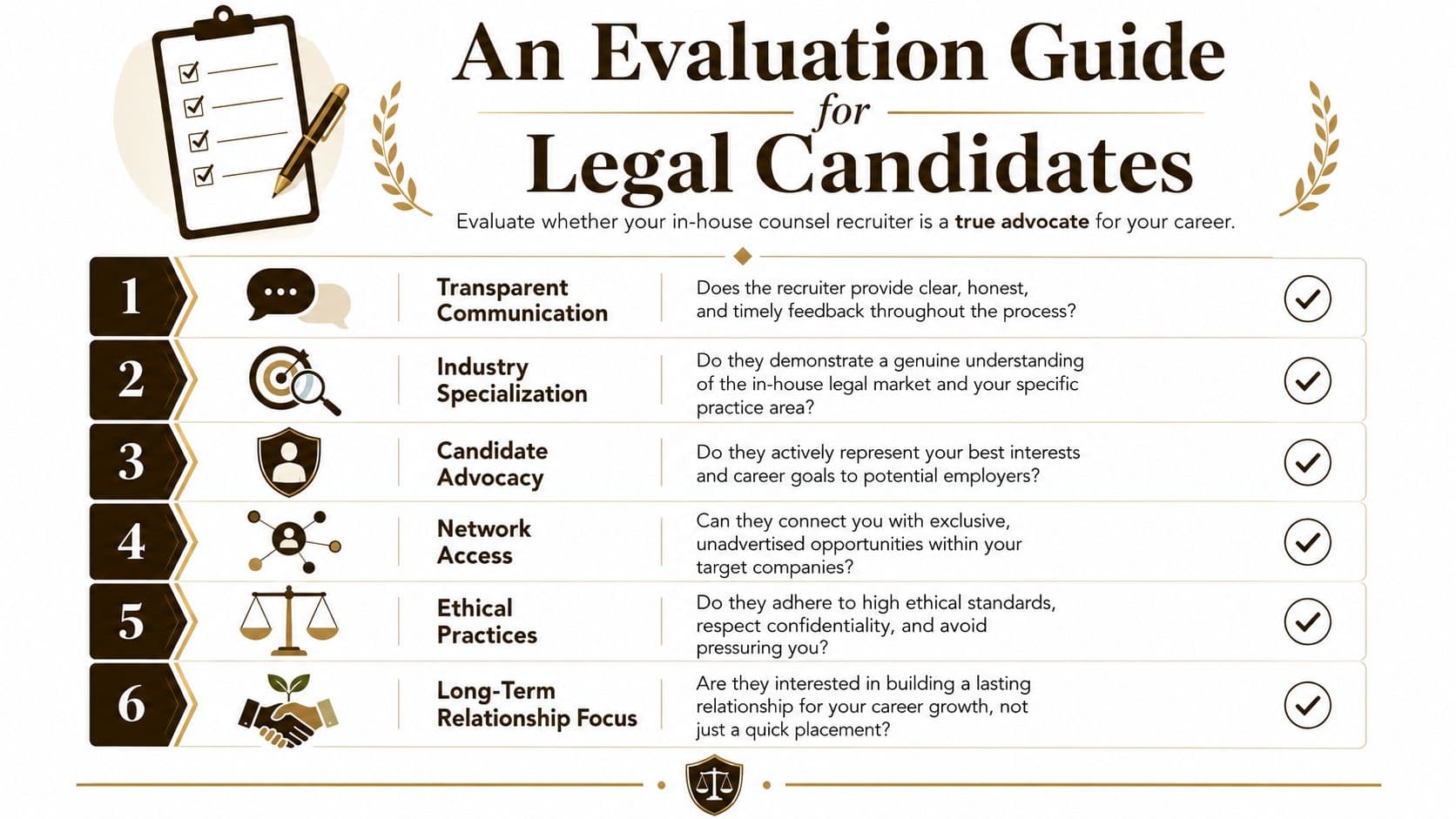
The right recruiter acts more like a market interpreter and career advocate. They know what the client needs, they know how to frame your experience accurately, and they won't try to close a placement that doesn't make sense for your long-term path.
What a good recruiter should know about your role
A strong recruiter should be able to discuss your background in business terms, not just legal labels. That matters because top legal search relies on a two-track sourcing model: identify candidates who have already operated at the required business scope, then prioritize passive-candidate outreach over resume collection, as discussed in Major, Lindsey & Africa's analysis of recruiting top in-house legal talent.
That has a direct implication for candidates. If a recruiter only asks for your resume and a compensation target, they may not know how to position you. If they ask about reporting exposure, board contact, transaction responsibility, risk ownership, and cross-functional influence, they're probably trying to understand where you fit.
Ask them questions like these:
- How is this legal team viewed internally?
- What problem is this hire supposed to solve in the first year?
- Who has real influence over the process?
- Why would someone succeed here, and why might someone strong still fail?
- How are you presenting my experience to the client?
Red flags candidates should take seriously
Some warning signs show up early.
A recruiter may be the wrong fit if they:
- Can't describe the role clearly: If they don't know who the lawyer will support or what work dominates the position, they're flying blind.
- Pressure you to move fast: Urgency can be real, but pressure without substance usually means the recruiter is trying to force momentum.
- Over-focus on pedigree: Brand-name firms and schools matter in some searches, but in-house hiring often turns on judgment, communication, and operating style.
- Avoid your questions: If they dodge reasonable questions about company culture, team structure, or interview process, be careful.
- Treat every candidate the same: You should not feel like one more document in a batch submission.
A recruiter who won't protect your credibility is not your advocate. They're using your profile as inventory.
How strong recruiters position senior legal talent
Senior legal candidates are rarely hired just for technical excellence. They get hired because someone believes they can operate inside a business. That means your recruiter should help translate your experience into commercial relevance.
A better presentation sounds like this:
- You supported revenue teams under time pressure.
- You built processes that let the business move with less friction.
- You advised executives through ambiguity.
- You handled risk with proportionality.
- You influenced without hiding behind legalese.
A weaker presentation sounds like a law firm bio. Long matter lists. Prestige markers. Generic statements about excellence.
Candidates should also listen for whether the recruiter is calibrating, not flattering. A good recruiter will tell you if your target title is too ambitious, if your compensation expectations don't align with the market, or if your resume is underselling the kind of work that matters to in-house teams.
That kind of honesty is valuable. It helps you make better moves, even when the answer is “not this role.”
Building a Lasting Recruitment Partnership
The best recruiter relationships don't start and end with one opening. They compound over time.
For hiring managers, that means using a trusted recruiter as an external market sensor. Someone who can tell you when your brief is too broad, when compensation is out of line with what the role demands, when your interview process is losing candidates, and when a role should be redesigned rather than reposted.
For candidates, it means having a discreet point of contact who understands your history, your strengths, and the kinds of environments where you perform well. The best conversations with recruiters often happen when you're not actively trying to leave.
What lasting partnerships look like
A durable relationship usually has a few traits in common:
- Candor: Both sides can say when a role, process, or candidate isn't lining up.
- Specificity: Conversations stay tied to business context, not recruiting jargon.
- Timing discipline: Nobody forces action before the facts are there.
- Reputation protection: Confidentiality and thoughtful communication matter on both sides.
- Memory: The recruiter remembers prior searches, prior concerns, and the patterns that matter.
Why this matters over time
Legal hiring is unusually sensitive to mismatch. A lawyer can look credible on paper and still fail because the role needed someone more commercial, more operational, more politically agile, or more comfortable with ambiguity.
That's why a transactional approach underperforms in this corner of the market. In-house counsel recruiters add the most value when they know the people, the environment, and the trade-offs well enough to advise instead of just react.
If you want to understand how a legal recruiting firm describes its team and operating model, the Five Star Placements about page provides that kind of background for one firm serving law firms and corporate legal departments.
If you're hiring for an in-house legal role or evaluating your next move as a legal candidate, Five Star Placements offers permanent legal recruiting across corporate legal departments, law firms, and legal operations roles, with search and screening suited for practice needs and organizational fit.
Enhanced by the Outrank tool
Need help filling a legal role?
Five Star Placements partners with law firms and legal departments nationwide.
Schedule a Call