
Legal Recruiting Agencies a Strategic Hiring Guide for 2026
July 4, 2026 · 16 min read · Five Star Placements
Table of contents
A managing partner has a litigator out the door, two matters running hot, and associates already billing nights and weekends. A GC has a compliance opening that keeps getting pushed behind quarter-end work, while business leaders keep asking when legal will catch up. In both cases, the vacancy looks like a hiring problem. It isn't. It's an operating problem.
That's why smart firms and legal departments stop treating legal recruiting agencies like resume vendors. The right agency is a capacity solution, a market intelligence source, and a decision partner. If you use one well, hiring stops being a reactive scramble and starts supporting growth, client service, and retention.
Table of Contents
- The High Cost of an Empty Chair in Legal
- What a Legal Recruiting Agency Actually Does
- The Recruiting Workflow from Search to Start Date
- Decoding Fee Models and Calculating Your ROI
- A Checklist for Choosing the Right Agency Partner
- Maximizing Your Partnership and Spotting Red Flags
- Turn Your Next Hire into a Strategic Advantage
The High Cost of an Empty Chair in Legal
A vacant legal seat rarely stays contained to that seat.
When a firm loses a midlevel real estate associate, partners don't just absorb the work neatly. They reassign drafting, push deadlines, delay business development, and ask stronger associates to carry weaker workflow design. When a corporate legal department loses commercial counsel, contracts stack up, sales gets impatient, and the legal team starts making tradeoffs it shouldn't make.
The real cost isn't the recruiter fee
Most hiring committees still frame the question badly. They ask, "Should we pay a recruiter?" The better question is, "What is this vacancy already costing us every week?"
That cost shows up in places your finance report won't neatly isolate:
- Partner diversion: Rainmakers spend time screening resumes instead of serving clients or developing business.
- Team fatigue: Good people start doing two jobs, and they remember who left them overloaded.
- Lost speed: Matters move slower, internal clients wait longer, and your strongest performers become bottlenecks.
- Bad compromises: Under pressure, firms lower standards or rush to a hire they later regret.
Practical rule: If a role directly affects revenue, matter flow, risk management, or team stability, it shouldn't sit open while you "see what comes in."
Legal recruiting agencies matter because they solve a business continuity problem. They give hiring leaders a faster path to qualified, screened talent while internal stakeholders stay focused on practicing law, running the department, and keeping clients served.
Vacancy pressure changes behavior
I've seen committees do three predictable things when a critical role stays open too long. First, they delay. Then they panic. Then they overcorrect.
That cycle creates bad hiring. The job description gets rewritten by committee. Interviews drag. Feedback gets vague. A candidate who looked strong three weeks ago is suddenly gone, and the team starts over with less patience and worse judgment.
A legal recruiting partner helps break that pattern by forcing clarity early. What does success in the role look like? Which requirements are mandatory? What cultural traits fit the team? What tradeoffs are acceptable, and which ones are not?
An empty chair in legal isn't neutral. Your team pays for it daily, whether finance tracks it or not.
That's the lens hiring committees should use. Not whether an agency feels like an extra expense. Whether leaving the role open is the more expensive choice.
What a Legal Recruiting Agency Actually Does
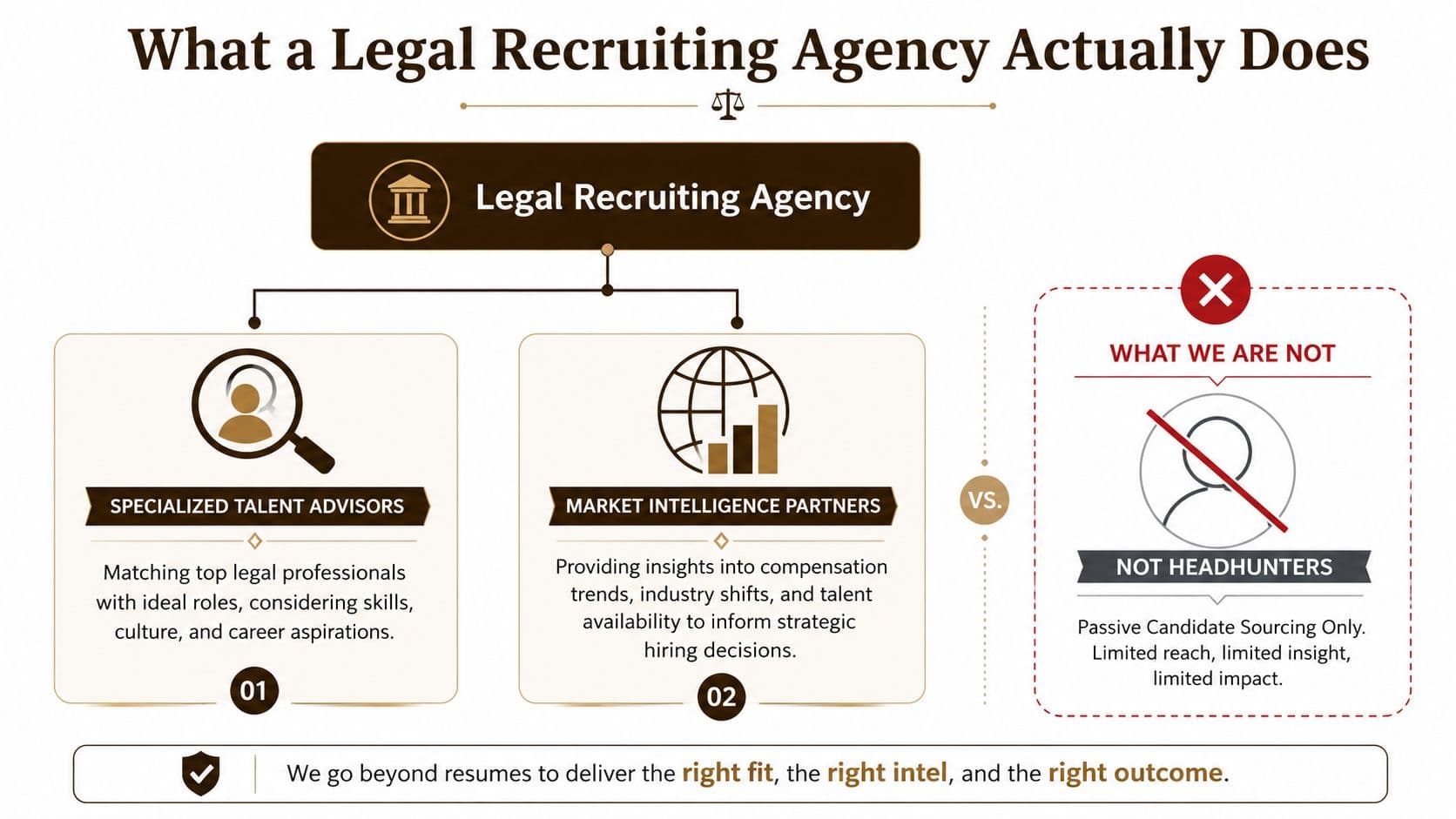
Most buyers still misunderstand the job. They think legal recruiting agencies post openings, collect resumes, and forward the least bad options. That's a low-value view, and it leads to low-value outcomes.
A serious legal recruiter works more like a specialized talent agent for the legal profession. The agency doesn't just look for applicants. It shapes the search, tests the market, qualifies interest, screens fit, and protects your time.
They cover far more than associate hiring
The legal market isn't one lane. Good agencies recruit across the full operating structure of a firm or legal department.
That includes:
- Attorneys across practice areas: Litigation, personal injury, trusts and estates, family law, immigration, construction, business and corporate, labor and employment, tax, real estate, and healthcare.
- Partner and lateral leadership hires: Managing partners, equity partners, junior partners, and practice-specific lateral leaders.
- In-house counsel roles: General counsel, corporate counsel, compliance, contracts, M&A, IP, and tax counsel.
- Legal support professionals: Paralegals, legal assistants, legal secretaries, law clerks, records clerks, case managers, intake specialists, and litigation support staff.
- Legal operations and management roles: COO, CFO, firm administrator, director of operations, director of finance, director of legal recruiting, VP of HR, tax manager, and senior accountant.
That breadth matters. A recruiter who understands only associate hiring won't advise well on a lateral partner search. A recruiter who only fills support roles usually won't know how to evaluate in-house counsel for stakeholder management, board exposure, and internal influence.
They act like scouts, not job boards
The best analogy is a scout for a professional sports team.
A scout doesn't wait for athletes to send an email. They track talent over time, know who's open to a move, understand fit by system and style, and tell the hiring organization who is worth pursuing. Legal recruiting agencies should work the same way.
Here's what that looks like in practice:
- Market mapping. They identify where the relevant talent sits by practice area, geography, industry, and seniority.
- Relationship-based outreach. They contact lawyers and legal professionals who aren't actively applying but may move for the right role.
- Fit screening. They test more than credentials. They ask about management style, client exposure, work preferences, compensation expectations, and reasons for moving.
- Presentation discipline. They don't flood you with resumes. They narrow the field.
A recruiter earns value by filtering aggressively before your partners or legal leaders ever enter the interview.
That's the strategic distinction. Passive candidate sourcing is only one piece. The broader job is talent advisory.
If you're evaluating providers, look for signs they think this way. One example is Five Star Placements, which focuses on permanent legal placement across firms and corporate legal departments and screens for both role fit and organizational fit. That model is closer to embedded talent advising than transactional headhunting.
The Recruiting Workflow from Search to Start Date
A hiring committee approves a search on Monday. By Friday, the partners are already asking why they have not seen candidates. Two weeks later, the interview panel is rescheduling meetings, compensation is still unclear, and the strongest prospect has taken another call. That is how legal hiring turns expensive. The problem is rarely candidate supply alone. The problem is process control.
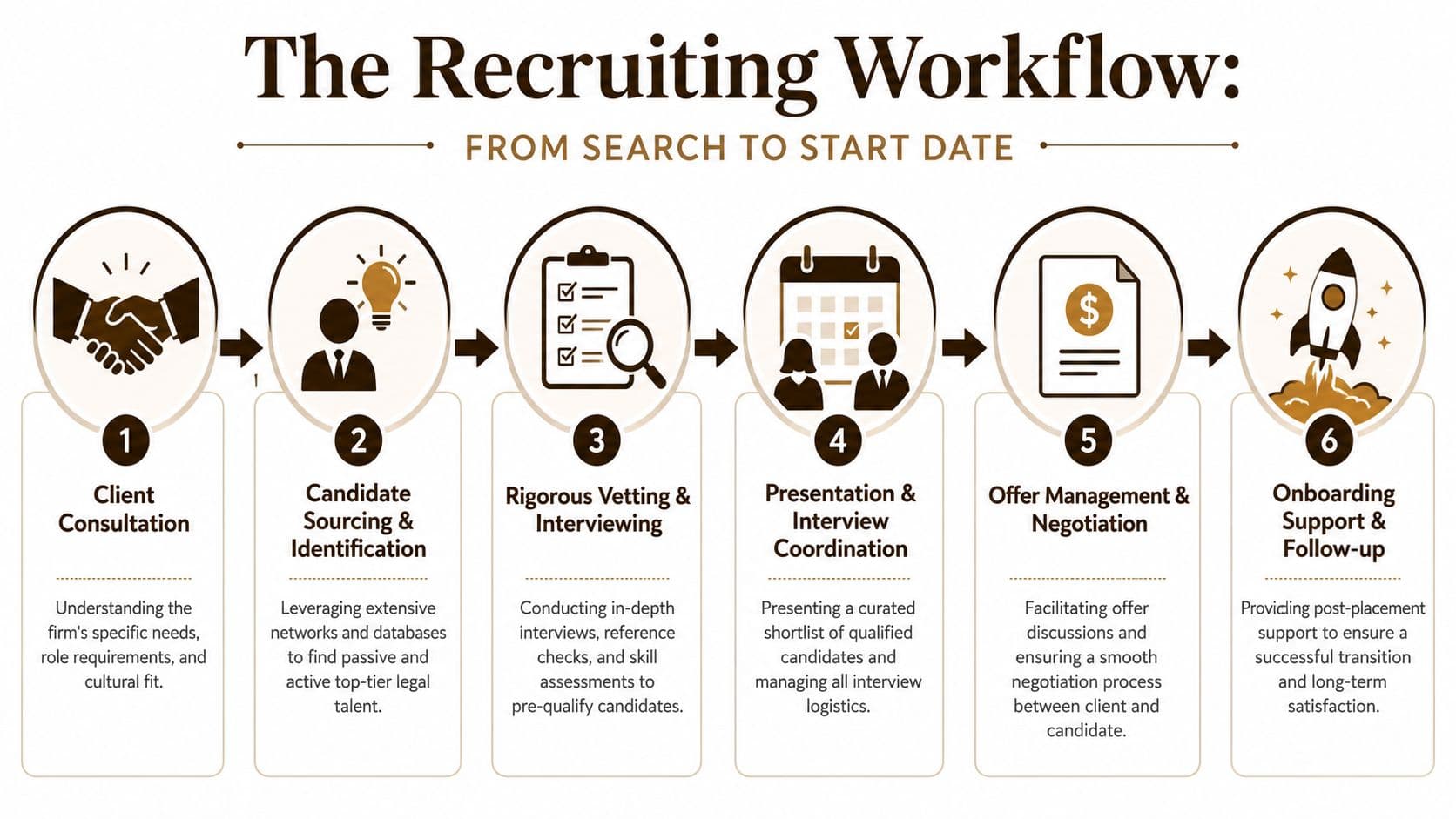
Clients usually see two visible points in the search: kickoff and candidate submission. The value sits in the middle. A strong agency runs that middle with discipline, clear reporting, and enough market judgment to keep the search from drifting.
What happens first
The search starts with intake, but a real intake is a working session, not a job-order form. The recruiter should press on the issues that drive outcomes: why the role is open, what the hiring manager will not compromise on, how work is delegated, where prior hires struggled, and what kind of lawyer gains credibility fast inside your organization.
That conversation determines whether the agency is filling a seat or solving a business problem.
After intake, the recruiter should move into confidential sourcing and market mapping. For senior legal roles, specialized agencies often reduce time-to-fill because they already track the relevant talent market, know who is movable, and can approach candidates discreetly. If you want a sense of how experienced firms explain search execution and market coverage, review a legal recruiting agency blog with process examples.
Speed matters, but precision matters more. A fast shortlist built on a weak brief usually creates three avoidable costs: wasted partner time, candidate churn, and a reset search.
A quick visual summary helps frame that process:
What happens after candidates enter the process
Screening is where strong recruiters earn their fee.
A resume shows pedigree and chronology. It does not show judgment under pressure, client handling, leadership style, appetite for business development, or whether the candidate will last past the first year. The recruiter should test those issues before your team spends an hour in an interview.
Look for evidence of these steps:
- Role-specific vetting: A litigation associate, a deputy general counsel, and a legal operations leader should not go through the same screening script.
- Motivation analysis: Candidates need a clear, credible reason to move. If the story is vague, the risk of a late-stage withdrawal goes up.
- Compensation alignment: Range, bonus structure, and title expectations should be discussed early.
- Work-style fit: Focus on pace, reporting lines, autonomy, responsiveness, and stakeholder management.
A disciplined agency sends a tight shortlist with a point of view. If you receive a stack of resumes without context, your internal team is doing the recruiter's filtering work.
What good process control looks like
Once the shortlist is set, the recruiter should manage the search like a project with deadlines and decision points. Interview scheduling, briefing, debriefing, reference strategy, offer timing, and candidate follow-up all pull legal leaders away from their primary responsibilities. If no one owns those details, the search slows down and confidence drops on both sides.
The final stage decides whether the hire closes and sticks.
| Stage | What the recruiter should control |
|---|---|
| Interview coordination | Scheduling, candidate prep, interviewer alignment |
| Feedback loop | Fast collection of specific reactions from both sides |
| Offer management | Terms, timing, expectations, and likely objections |
| Pre-start follow-up | Candidate engagement until the start date |
| Early onboarding support | Check-ins that surface issues before they become exits |
Here, the recruiter shifts from vendor to strategic partner. A good partner does not just move candidates through interviews. They keep the search calibrated to market reality, flag process friction early, and protect the odds of acceptance and retention.
Partner searches usually take longer than paralegal or staff hiring because the diligence burden is higher. Delay without a stated reason is different. Delay means the brief is weak, the panel is not aligned, the compensation package is off-market, or the recruiter is not controlling the process. Those are management problems, not hiring inevitabilities.
Decoding Fee Models and Calculating Your ROI
Most debates about recruiter fees are shallow. They focus on the invoice and ignore the economics of delay.
That's a mistake. A fee model matters, but it matters less than whether the search gets filled with the right person before the vacancy does more damage.
How the main fee models differ
The two fee structures most buyers encounter are contingency and retained search. Some firms also use hybrid arrangements, but the core distinction is simple: who takes the risk upfront, and how exclusive the engagement is.
Here's the practical comparison.
| Feature | Contingency Search | Retained Search |
|---|---|---|
| Payment timing | Paid only after a successful hire | Partial payment begins before the hire is made |
| Upfront client risk | Lower | Higher |
| Best fit | Many associate, counsel, support, and operational hires | Highly sensitive or executive-level searches |
| Search structure | Often competitive and outcome-driven | Usually exclusive and tightly managed |
| Client expectation | Speed, qualified shortlist, low initial spend | Deep research, close advising, extensive market mapping |
If you want a straightforward way to compare firms that use a contingency model, review how they describe their process, search scope, and client communication on their legal recruiting blog.
For many law firms and legal departments, contingency search is attractive because it aligns incentives cleanly. If the agency doesn't deliver a hire, you don't pay. That doesn't automatically make contingency better. It makes it efficient when the recruiter has an actual legal network and a disciplined screening process.
A practical ROI formula
Use this basic framework:
ROI = value of filling the role faster + value of better fit - recruiter fee - internal time spent managing the search
Keep it practical. Don't overengineer it.
Ask your team four questions:
- What work is being delayed? Think billable matters, contract review volume, compliance work, internal advisory work, and partner time.
- Who is covering the gap? If senior lawyers are doing less strategic work, that's a hidden cost.
- How much internal time is hiring consuming? Resume review, scheduling, interviews, follow-up, and failed searches all pull legal leaders off their actual jobs.
- What happens if you hire wrong? Reopening a role is expensive in ways accounting rarely captures cleanly.
Don't calculate recruiter ROI against zero. Calculate it against the cost of vacancy, drag, and a possible mis-hire.
Many committees encounter a common obstacle. They compare an agency fee to an internal posting as if both options produce the same candidate quality and speed. They don't. Internal recruiting can work well, especially for predictable hiring. But for specialized or business-critical roles, legal recruiting agencies often produce better decision velocity and better candidate access.
A Checklist for Choosing the Right Agency Partner
Your hiring committee approves a search on Monday. By Friday, three agencies have pitched the role, all claiming market reach, all promising speed, and all quoting fees within a narrow range. If you choose based on responsiveness or price alone, you are not selecting a vendor. You are choosing who will shape candidate quality, search discipline, and the market's perception of your firm.
That decision deserves operating standards, not guesswork.
Questions that separate strategic partners from resume pushers
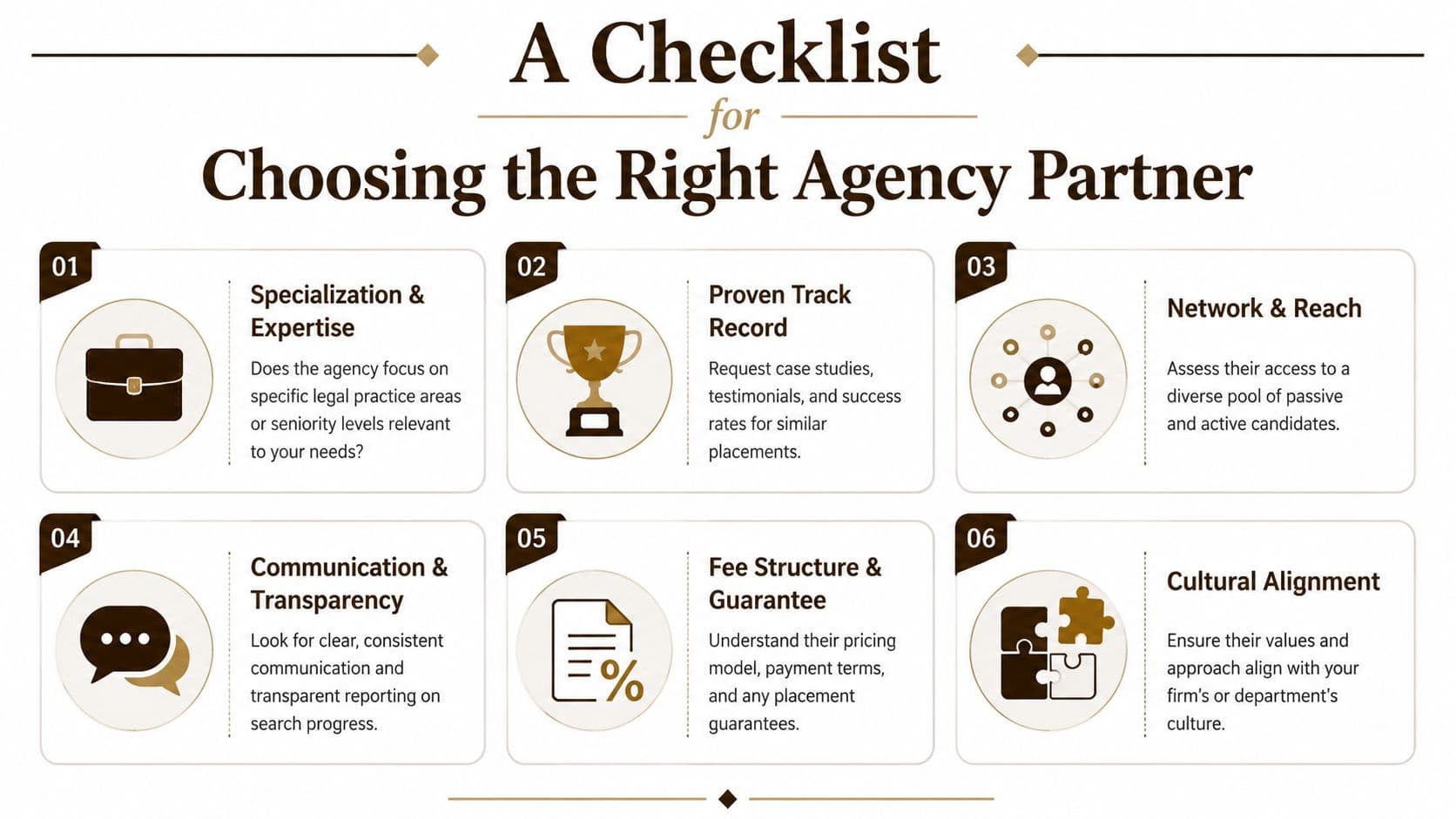
Start with whether the agency can own your specific search, not legal hiring in the abstract. A recruiter who fills "attorney roles" is not enough if you need a privacy counsel, a funds associate, or a deputy GC with real cross-functional credibility. You need pattern recognition in your lane.
Use this checklist in the first conversation:
- Practice-area depth: Ask which legal functions, role levels, and hiring scenarios they handle repeatedly.
- Market coverage: Ask where they have completed placements, not where they are willing to recruit.
- Candidate access: Ask how they reach lawyers who are employed, selective, and not applying through job boards.
- Assessment discipline: Ask what they evaluate before a candidate ever reaches you, including motivation, compensation alignment, timing, and risk factors.
- Search management: Ask who runs the assignment, how updates are delivered, and what happens when the search stalls.
- Employer representation: Ask how they position your opportunity, protect confidentiality, and prepare candidates before interviews.
A strong recruiter brings a point of view. They should challenge a weak brief, flag unrealistic requirements, and tell you where the market will push back. If they only agree with you, expect a shallow slate.
What to verify before you sign
Skip the polished pitch. Test for judgment.
Ask questions that force specifics:
- Describe a hard legal search you closed recently. Listen for how they refined the brief, handled candidate objections, and kept the client aligned.
- How do you decide a candidate should not be submitted? Good recruiters have clear exclusion standards.
- How do you assess long-term fit? You want more than credentials. You want evidence that they can evaluate work style, reporting tolerance, pace, and stakeholder demands.
- What usually causes late-stage failures in your searches? Their answer will tell you whether they understand closing risk.
- What do you need from our side in the first two weeks? Serious partners know exactly how to get traction early.
You should also review how the firm presents its operating model. The language on the agency's background and recruiting approach should match what the recruiter says about screening, communication, and legal placement focus. If the story sounds disciplined but the call sounds improvised, keep looking.
If an agency cannot explain how it qualifies, filters, and advises, it will not save your team time. It will create more review work.
One more standard belongs on every checklist. Judge the recruiter the way a candidate will. Your agency is speaking to the market on your behalf. Sloppy outreach, weak preparation, and poor follow-through do not just hurt the search. They weaken your employer brand with the exact lawyers you want to attract.
Choose the partner you would trust to represent your firm in a confidential call with a top candidate. That is the true test.
Maximizing Your Partnership and Spotting Red Flags
Even a strong recruiter can't rescue a badly managed client.
The firms and legal departments that get the best outcomes usually do a few things consistently. They define the role accurately, designate one decision-maker or point of contact, and give prompt feedback with actual substance. They don't vanish for a week and then complain that the shortlist has cooled off.
What clients should do better
If you want your recruiter to perform like an extension of your team, give them what an internal hiring lead would need.
That means:
- A real brief: Explain the work, reporting line, success profile, and internal politics that affect the hire.
- Fast feedback: Not "good candidate" or "not a fit." Explain why.
- Decision discipline: Keep interviewers aligned on what matters so candidates aren't getting conflicting signals.
- Compensation honesty: If the budget is narrow, say it early.
- Search realism: If you want elite credentials, immediate availability, low compensation expectations, and perfect cultural overlap, expect a longer search or revise the brief.
Good recruiters can find talent. They can't fix indecisive clients, fuzzy requirements, or a broken interview process.
The strongest partnerships also involve trust. If you hired a legal recruiting agency because the market is hard to access, listen when the recruiter tells you the profile is too narrow, the compensation is off, or the interview process is too slow. You don't need blind trust. You need enough trust to respond to market feedback.
Red flags that should end the relationship fast
Some warning signs are obvious. Others get tolerated far too long.
Watch for these:
- Resume dumping: The recruiter sends volume instead of judgment.
- Thin candidate notes: You get a resume with no context on motivation, compensation, or fit.
- Poor follow-through: Candidates disappear between stages because no one is managing them.
- Weak understanding of your culture: The recruiter keeps presenting people who look right on paper and wrong in person.
- Pressure tactics: The recruiter pushes you to compromise on key requirements to force a close.
- No challenge function: They agree with everything you say, even when the hiring brief is unrealistic.
A productive recruiter doesn't just take orders. They refine the search with you.
That's the shift many clients need to make. Legal recruiting agencies aren't most useful when treated like transactional vendors. They're most useful when they're given enough information and authority to operate like strategic hiring partners.
Turn Your Next Hire into a Strategic Advantage
A vacancy in legal isn't just an HR event. It's a signal that your operating model is under strain.
The firms and legal departments that hire well don't wait until the pressure becomes unbearable. They use legal recruiting agencies to tighten decision-making, reach better candidates, and protect the time of the people already carrying the business. That's the difference between reactive hiring and strategic hiring.
Be practical about your next search. Define the role sharply. Pick an agency with real legal specialization. Set a communication cadence. Demand screening quality, not resume volume. And calculate value based on business impact, not just fee sensitivity.
If you do that, the recruiter won't feel like an outside vendor. They'll function like an extension of your leadership team.
If you're evaluating your next search and want a direct conversation about role scope, candidate market realities, or contingency-based permanent placement, start with contacting a legal recruiting team.
If your firm or legal department needs permanent legal talent across attorney, partner, in-house counsel, support staff, or legal operations roles, Five Star Placements offers contingency-based recruiting with customized screening and nationwide search support. Explore Five Star Placements to discuss your next hire.
Need help filling a legal role?
Five Star Placements partners with law firms and legal departments nationwide.
Schedule a Call