
How Much Does a Legal Recruiter Cost
June 25, 2026 · 15 min read · Five Star Placements

Table of contents
Legal recruiters usually charge a contingency fee of 25% to 35% of the candidate's first-year guaranteed salary. On a $150,000 hire, that often means a fee around $45,000, and depending on the agreement and role, it can land anywhere from $30,000 to $52,500.
That number tends to hit hiring committees in one of two ways. Either someone says, “That's expensive,” or someone else says, “We don't have time to miss on this hire.” Both reactions are fair. A vacant partner seat, an unfilled associate role, or a missing in-house counsel position creates pressure quickly. Work backs up. Clients notice. Internal leaders start stretching beyond capacity.
The mistake is treating recruiter cost as a simple procurement question. It isn't. It's a hiring risk question.
A law firm or legal department usually isn't deciding whether to spend money. It's deciding where to place risk. You can put the risk on internal time, on a rushed process, on a shallow candidate pool, or on a recruiter whose fee is tied to a result. That's why the smarter question isn't only how much does a legal recruiter cost. It's what that fee is buying, what kind of exposure it reduces, and when the premium is worth paying.
Table of Contents
- Introduction The Real Question Behind Recruiter Cost
- The Anatomy of a Legal Recruiter Fee
- Contingency vs Retained vs Flat Fees Compared
- Key Factors That Influence Your Final Cost
- Beyond the Fee Calculating the True ROI of a Recruiter
- Negotiating a Fair Agreement and What to Look For
- The Five Star Placements Advantage A No-Risk Partnership
Introduction The Real Question Behind Recruiter Cost
Most hiring committee chairs first ask about recruiter fees when the problem is already costing them money.
A practice group is carrying an open req for too long. Partners are reviewing resumes at night. HR is coordinating interviews for candidates who look polished on paper but don't survive serious scrutiny. The role stays open, and everyone tells themselves they're saving money by avoiding an outside fee. In practice, they're often just shifting the cost into slower matters, distracted billers, and a higher chance of a weak hire.
That's why recruiter pricing needs to be judged in business terms, not just budget terms.
Practical rule: If a role is important enough that a bad hire would hurt revenue, morale, or client service, the recruiter fee belongs in the risk column, not just the expense column.
The raw number is straightforward. Legal recruiters generally work on a percentage of the candidate's first-year compensation. The harder part is deciding whether your search calls for a recruiter at all, which fee structure makes sense, and what protections should sit inside the agreement.
Hiring leaders also need to separate sticker price from actual exposure. A lower-fee arrangement can still be expensive if it produces weak screening, poor market reach, or a sloppy handoff at offer stage. A higher-fee arrangement can be justified if the search is sensitive, niche, or senior enough that failure is materially costly.
When committees evaluate recruiter cost well, they usually ask four questions:
- What are we paying for: Sourcing, screening, process management, candidate control, and post-hire protection.
- When do we pay: Only after a successful hire, partially upfront, or on a fixed schedule.
- Who carries the risk: The client, the recruiter, or both.
- What happens if the hire fails: Refund, replacement search, or no protection at all.
That's the framework that matters in legal hiring.
The Anatomy of a Legal Recruiter Fee
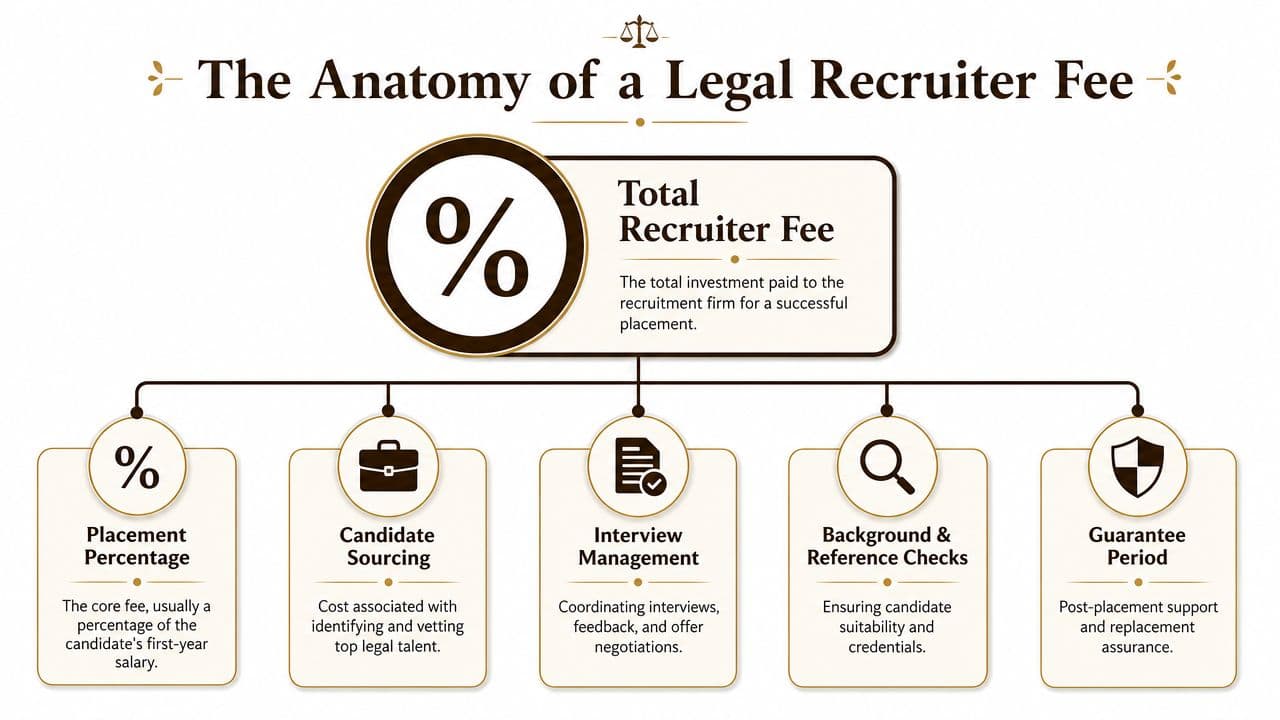
A hiring committee usually sees the fee percentage first. The better question is what number that percentage applies to, what services sit behind it, and what risk the firm is shifting off its own balance sheet.
What the percentage is based on
A legal recruiter fee is usually calculated as a percentage of the candidate's first-year compensation. Lawtrades notes that legal recruiters commonly charge 25% to 35% of first-year salary, and that for legal professionals earning $120,000 to $150,000, the fee often lands between $30,000 and $52,500.
The math is simple. The contract language is where firms get exposed.
If the agreement says first-year salary, confirm whether that means base salary only or guaranteed compensation. For some searches, that distinction is minor. For others, it materially changes the fee because signing bonuses, guaranteed draws, clerkship bonuses, or other guaranteed amounts may be included. Good committees settle that definition before the search starts.
Here is the practical effect:
- Mid-level legal hire: A compensation package in the $120,000 to $150,000 range often produces a recruiter fee between $30,000 and $52,500.
- Higher-paid associate or counsel hire: The same percentage can push the fee up quickly once compensation rises.
- Partner or group move: The fee can become a major line item because the compensation number underneath it is much larger.
That fee can look expensive in isolation. It looks different when compared to the cost of a miss. A bad legal hire can burn well past $250,000 once you count lost billable time, partner interview hours, write-offs, delayed matters, client disruption, and the cost of running the search again. In that context, the recruiter fee is often less a sourcing expense and more a form of risk control.
Why senior searches get expensive fast
The higher the compensation, the more serious the economics become. Lawtrades reports that a partner with a $2 million compensation package can generate a recruiter fee of $350,000, and that retained recruiters may require substantial upfront payments before the search begins.
That number gets attention, and it should. But senior searches also carry the largest downside if the committee gets the hire wrong. A weak partner hire can damage originations, internal morale, integration efforts, and client confidence. The recruiter fee is high because of the substantial risks involved.
In practical terms, the fee usually covers four things:
- Access to off-market candidates: Lawyers who are productive, discreet, and unlikely to apply through a public posting.
- Screening and calibration: Recruiters test interest, compensation fit, portability claims, conflicts issues, and cultural fit before your partners spend time on interviews.
- Process control: They keep the search moving, manage feedback loops, handle objections, and reduce the odds that a viable candidate goes cold.
- Replacement or guarantee protection: Many agreements include a refund, credit, or replacement search if the hire leaves within the stated period.
A committee should judge the fee the same way it judges malpractice coverage or a strong lateral integration plan. The point is not to spend money for its own sake. The point is to reduce the odds of an expensive mistake.
Contingency vs Retained vs Flat Fees Compared
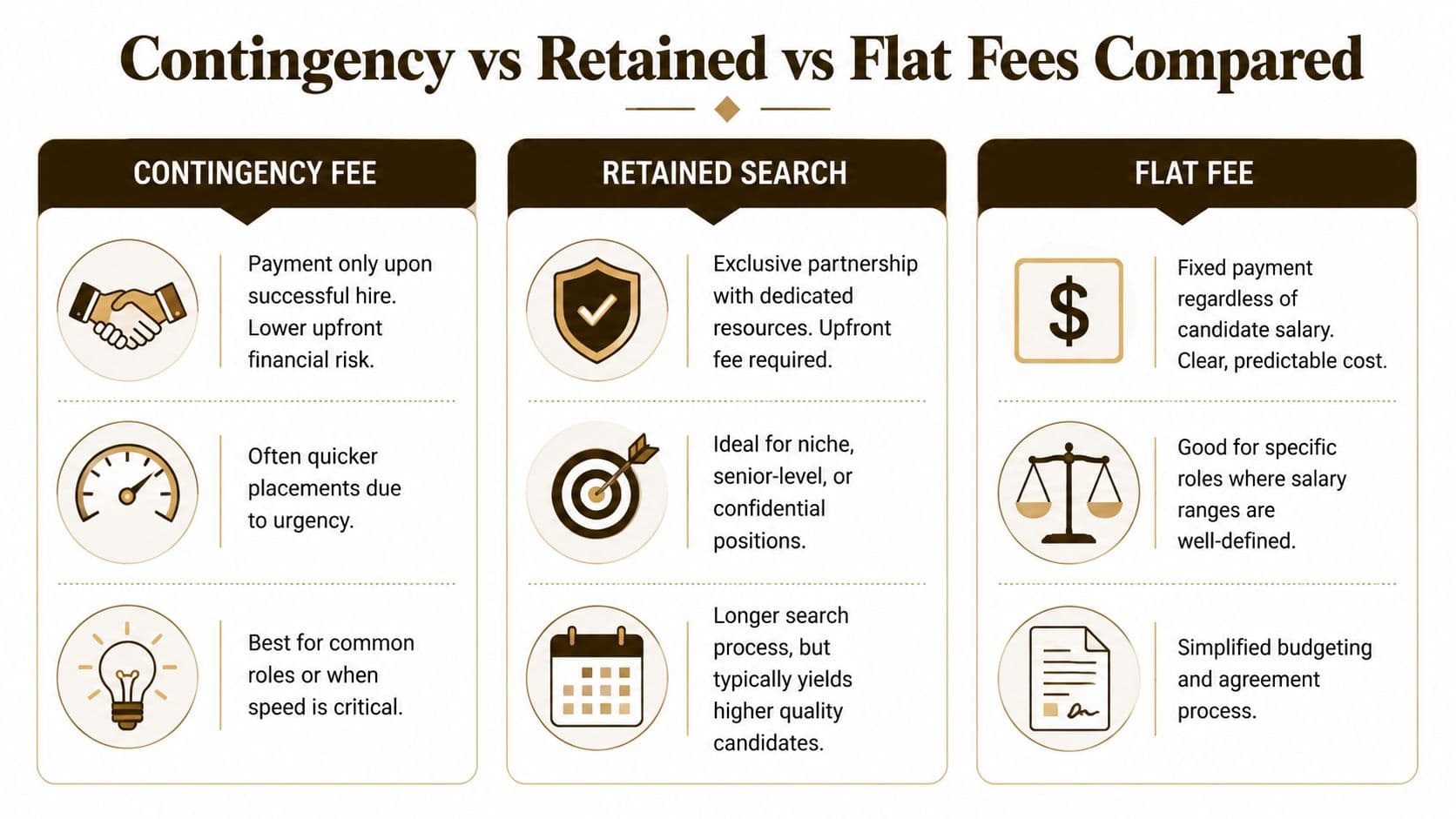
The fee model matters as much as the fee percentage. It tells you when cash leaves the business, who absorbs the search risk, and how much exclusivity you're buying.
Contingency search
This is the model most hiring committees encounter first. The recruiter gets paid only if the candidate is hired. If the search produces no hire, there's usually no fee.
Lawclerk explains that for an associate with a $150,000 starting salary, a recruiter fee of $30,000 to $45,000 is standard under a contingency arrangement, paid only upon successful hire. The same source says payment is tied to the candidate's continued employment for a defined period, typically 3 to 6 months, and notes that candidates don't pay the fee.
That structure works well when the committee wants outside help without front-loading the financial risk.
What works well
- Speed-sensitive searches: You need resumes moving now, not after a retainer is approved.
- Mid-level attorney hiring: The role is important, but not so rare that it needs a fully retained campaign.
- Budget control: Finance prefers outcome-linked spending.
What doesn't
- Overloading too many recruiters: Once several agencies chase the same role, candidate ownership disputes and duplicated outreach can follow.
- Weak intake on your side: If the firm can't give clear feedback, even a strong contingency recruiter will struggle.
A quick visual can help if your committee is comparing models in one meeting.
Retained search
Retained search shifts more commitment to the client. You pay for the search process itself, not just the result.
This model is common when the role is confidential, highly specialized, politically sensitive, or senior enough that the firm wants one recruiter to run a tightly managed market process. You're not only buying sourcing. You're buying focus, exclusivity, and more control over the search narrative.
Retained search can be the right choice when:
- The role is market-defining: Managing partner, equity partner, or a niche in-house legal executive.
- Confidentiality is central: You can't have your opening widely circulated.
- Internal politics are delicate: A single outside quarterback reduces noise.
The downside is obvious. The client carries more upfront financial exposure. If your committee isn't aligned on the role, compensation, reporting structure, or urgency, retained search can magnify the cost of indecision.
Contained or hybrid search
Hybrid models sit between the two. A recruiter may take a smaller upfront commitment, then collect the balance on placement. Some firms call this contained search. Others frame it as milestone-based recruitment.
This can work when the client wants stronger commitment than contingency but doesn't want a full retained structure. It's often useful when the role is important but the search economics don't justify a full retained mandate.
Here's the side-by-side view most committees need:
| Feature | Contingency Search | Retained Search | Contained (Hybrid) Search |
|---|---|---|---|
| When you pay | On successful hire | Upfront plus later payments | Partial upfront, balance on hire |
| Client risk at start | Lower | Higher | Moderate |
| Recruiter commitment signal | Outcome-based | Exclusive and front-loaded | Shared commitment |
| Best fit | Common attorney and support roles | Senior, niche, confidential searches | Important searches that need more structure |
| Budget predictability | Depends on hire | Planned from the start | More predictable than pure contingency |
If your role is straightforward, contingency usually protects your downside. If the role is sensitive or rare, paying for dedicated search attention may be rational.
Key Factors That Influence Your Final Cost
Two firms can fill what looks like the same title and pay very different recruiter fees. The difference usually comes from the market around the role, not from arbitrary pricing.
Seniority changes everything
The cleanest driver is seniority. BCG Search reports that hiring entry-level counsel through traditional agencies typically costs $30,000 to $50,000, while executive-level hires can cost $150,000 to $250,000. That same source also notes that 25% of first-year salary is the accepted standard fee in the U.S. in many legal recruiting contexts.
That's why committee members shouldn't react to a fee quote without looking at the role level first. A fee that looks high on paper may be ordinary for a senior in-house counsel search and inflated for a junior support role.
The title alone also won't tell you enough. An “associate” can be a relatively accessible generalist role or a highly specific practice-area opening that requires targeted outreach.
Market difficulty and search terms matter
Beyond seniority, final cost usually moves based on a handful of practical variables:
- Practice area scarcity: A niche specialist is harder to source than a broadly available profile.
- Geography: Salary bands differ by market, and percentage-based fees rise with salary.
- Exclusivity: A recruiter with a clear lane often works differently from one competing against several firms at once.
- Search urgency: Tight deadlines compress process and reduce room for trial and error.
- Candidate profile: A role requiring a portable book, a narrow client set, or unusual management experience is harder to fill.
One more point matters in committee discussions. A lower quoted percentage doesn't always mean a lower final hiring cost. If the recruiter can't access the right segment of the market, the search may drag, the role may stay open, and the internal team may spend far more time chasing a weak slate than the fee difference was ever worth.
That's why serious buyers compare search difficulty, not just price sheets.
Beyond the Fee Calculating the True ROI of a Recruiter
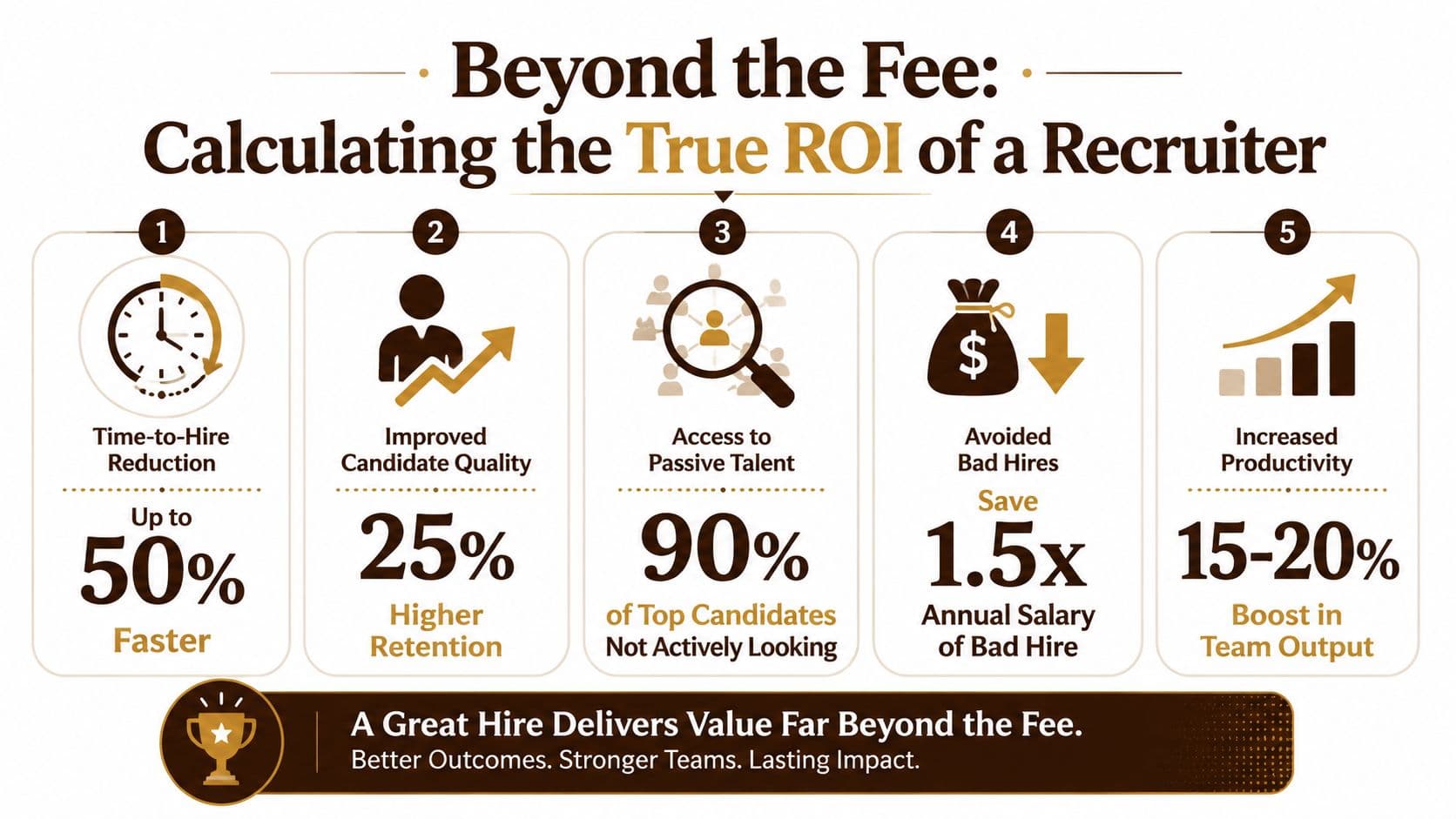
Most firms ask the wrong financial question. They ask whether the recruiter fee is too high. The better question is whether the cost of getting the hire wrong is materially higher.
The bad hire math is worse than the fee math
A single bad legal hire can cost a firm $250,000 to $500,000 in turnover, lost revenue, and retraining. Against that backdrop, a recruiter fee is often the smaller and more controllable expense.
That's the investment case. A recruiter is not just a sourcing vendor. In a strong engagement, the recruiter is a screening layer, a market filter, and a process control mechanism designed to reduce the odds of an expensive mismatch.
Hiring lens: If avoiding one bad legal hire protects a quarter-million dollars or more, the fee discussion changes immediately.
This matters most in selective environments. Some legal teams operate with a hire rate of less than 1% of applicants. In those settings, skipping structured external help to “save the fee” can be a false economy. The business isn't merely buying introductions. It's buying a better chance of avoiding an outcome that is far more expensive than the search bill.
For practical examples of how legal hiring teams think about search strategy and recruiting economics, the Five Star Placements blog is one useful reference point.
Where recruiter ROI actually shows up
The return doesn't appear in one line item. It shows up across several business outcomes:
- Better screening: Fewer wasted partner interviews with candidates who were never viable.
- Lower process drag: Internal HR and attorneys spend less time coordinating and re-coordinating a loose search.
- Stronger close rates: Good recruiters handle compensation friction, counteroffers, and candidate concerns before they derail the hire.
- Reduced turnover risk: Better matching on role fit and culture fit lowers the chance of fast attrition.
There's also the vacancy problem. An unfilled legal role creates its own tax on the business. Work shifts to already busy lawyers. Response times slip. Managers delay decisions because they're carrying too many tasks themselves. None of that shows up in the recruiter invoice, but all of it affects profitability and execution.
A committee should therefore evaluate recruiter ROI the same way it evaluates malpractice coverage or key-person risk. You hope the protection doesn't need to prove itself in dramatic fashion. But when it does, the value becomes obvious.
Negotiating a Fair Agreement and What to Look For
A hiring committee usually starts fee negotiations by trying to shave a point or two off the percentage. That is rarely where the actual money is won or lost. The larger financial question is who carries the risk if the search drags, the candidate backs out, or the hire fails within the first few months.
A recruiter agreement should answer that clearly. If it does not, the firm is often paying a meaningful fee while still keeping most of the downside.
Terms worth negotiating
Price matters, but the structure matters more. Review these terms in plain business language before anyone signs:
- Fee trigger: State exactly when the fee is earned. Many firms want payment due only after the candidate starts.
- Compensation definition: Spell out what is included in first-year compensation, such as base salary, guaranteed bonus, signing bonus, or other cash compensation.
- Guarantee period: Confirm whether an early departure leads to a replacement search, a partial credit, or a refund, and under what conditions.
- Candidate ownership: Set a reasonable time limit on ownership of submitted candidates so the firm does not pay for someone already known to the team.
- Exclusivity: Decide whether the recruiter has an exclusive assignment or is competing with other firms, because that changes both effort level and pricing logic.
The guarantee deserves careful attention.
If a bad legal hire can cost the firm $250,000 or more in lost time, write-offs, client disruption, and repeat recruiting expense, then post-placement protection is not a courtesy term. It is part of the risk-control value you are buying. A slightly higher fee with a credible replacement or credit provision can be the better economic deal.
What a fair agreement should actually do
A fair contract does three things. It defines the fee with precision. It sets performance expectations. It allocates failure risk in a way both sides can explain in one meeting.
That matters even more on senior searches. Partner and senior in-house hires carry larger compensation packages, wider client impact, and more internal politics. If the agreement is vague, the dispute usually arrives after the candidate is hired, when nobody wants to argue over fee math or ownership claims.
Red flags in the agreement
Some contract problems show up repeatedly:
- Ambiguous compensation language: If the fee basis cannot be explained in one sentence, revise it.
- No post-placement protection: That leaves the firm exposed if the match fails quickly.
- Overbroad ownership terms: The recruiter should not claim every candidate the firm has seen, met, or sourced independently.
- Upfront payment without defined deliverables: If money is due before results, the agreement should specify the search scope, reporting cadence, market mapping, and candidate presentation standards.
- Unclear off-limits or conflict terms: In legal recruiting, candidate relationships and client relationships overlap. The contract should address how conflicts are handled.
One practical rule helps here. Negotiate the agreement as if the hire will fail, not as if everything will go smoothly. That approach produces cleaner terms and fewer surprises.
If your committee wants to compare contingency terms, replacement provisions, or fee definitions before opening a search, the Five Star Placements contact page for legal recruiting discussions is a practical place to start.
The Five Star Placements Advantage A No-Risk Partnership
For firms that prefer recruiter economics tied directly to results, a contingency model remains the cleanest fit. It limits upfront exposure and forces the recruiter to earn the fee through an actual hire.

Five Star Placements operates in that lane. The firm works on contingency-based permanent placement for attorneys, legal support staff, partners, in-house counsel, and legal operations leaders, with payment tied to successful hiring rather than upfront search fees. Its model focuses on customized screening around experience, skills, and culture fit, which is the part of recruiting that matters most if your goal is to reduce bad-hire risk rather than just generate resumes.
That kind of structure tends to make sense for law firms and legal departments that want outside market reach without taking on retained-search exposure for every opening. It also fits hiring committees that want an external recruiting partner to function as an extension of the internal team while keeping the economics tied to outcomes.
For more on the firm's background and operating model, see the Five Star Placements about page.
If you're weighing whether to use a recruiter for your next legal hire, the right question isn't just what the fee is. It's whether the fee is smaller than the risk you're carrying without help. Five Star Placements offers a contingency-based option for law firms and corporate legal departments that want outside recruiting support without upfront search cost.
Need help filling a legal role?
Five Star Placements partners with law firms and legal departments nationwide.
Schedule a Call