
Employment Agreement Review: A Step-by-Step Guide
August 22, 2026 · 14 min read · Five Star Placements
Table of contents
You've accepted the offer, told your current employer, and started planning the move. Then you read the employment agreement again and notice that the bonus discussed in interviews isn't defined, the hybrid schedule appears nowhere, and the intellectual property clause seems to reach anything you create outside work. None of those issues is theoretical. They can affect your pay, professional mobility, work location, and ownership of your own projects after you start.
Employment agreement review is the point where those gaps become visible and negotiable. A careful review compares the legal language with the job you were offered, the jurisdiction governing the relationship, and the systems that will administer payroll, benefits, leave, working time, and termination. The best review isn't a slow read from the first page to the last. It's a structured check for conflicts that become expensive after hiring.
Table of Contents
- Why Employment Agreement Review Matters Before You Sign
- The Three-Phase Employment Agreement Review Workflow
- Critical Clauses to Examine During Employment Agreement Review
- Red Flags That Signal Employment Agreement Problems
- How to Negotiate Employment Agreement Terms Effectively
- When to Involve Counsel or a Recruiter During Employment Agreement Review
Why Employment Agreement Review Matters Before You Sign
A mid-level attorney once accepted an in-house role after reviewing a standard agreement that appeared familiar. The salary, title, and start date matched the offer discussion, and the document contained clauses the attorney had seen in other employment contracts. Several months later, the attorney wanted to publish an academic article describing a general area of legal work and participate in professional discussions about the role. The confidentiality language was broad enough to create concern about discussing work publicly, even without revealing client information.
The problem wasn't necessarily that every restriction would be enforced exactly as written. The problem was that the agreement created uncertainty after the attorney had already joined. By then, the employer had operational expectations, the employee had resigned from a previous position, and both sides had less practical flexibility.

Familiar wording can carry new consequences
Restrictive covenants demonstrate why a surface-level read isn't enough. In 2024, the U.S. Federal Trade Commission estimated that about 30 million American workers, roughly one in five, were bound by a noncompete clause, and described noncompetes as terms that can restrict joining a competitor or starting a competing business for a defined period or geographic area. The FTC's noncompete rulemaking record also shows why these clauses affect ordinary employment agreements, not only executive contracts.
The legal environment has continued to attract attention. The FTC announced a rule in April 2024 banning nearly all noncompetes and again described the restrictions as affecting about 30 million workers, as stated in its announcement on noncompete restrictions. That regulatory history doesn't mean a candidate can assume a noncompete is harmless or automatically invalid. Enforceability depends on the applicable law, the worker's location, the employer's operations, the wording, and developments affecting the relevant jurisdiction.
Practical rule: Review the agreement as a document that will govern a real working relationship, not as a formality attached to the offer.
Review the agreement against the life you'll actually lead
The most damaging problems often sit outside headline clauses. The document may omit the agreed work location, leave bonus approval entirely discretionary, fail to identify who owns pre-existing work, or describe working hours in a way that conflicts with payroll and scheduling practices. A candidate who only searches for “noncompete” may miss the clause conflict that matters most.
For attorneys, paralegals, and legal support professionals, systematic review is now a core professional skill. It helps identify what is legally questionable, what is operationally unworkable, and what should be clarified before signature. It also gives the candidate a defensible record of the questions raised and the answers received.
The Three-Phase Employment Agreement Review Workflow
A reliable review separates three questions that are often mixed together:
- Is the agreement legally compliant and enforceable in the governing jurisdiction?
- Does it accurately describe the job and compensation that were offered?
- Have the right people approved the terms before anyone signs?
That structure follows the practical employment contract review checklist, which separates legal compliance, operational accuracy, and governance sign-off.
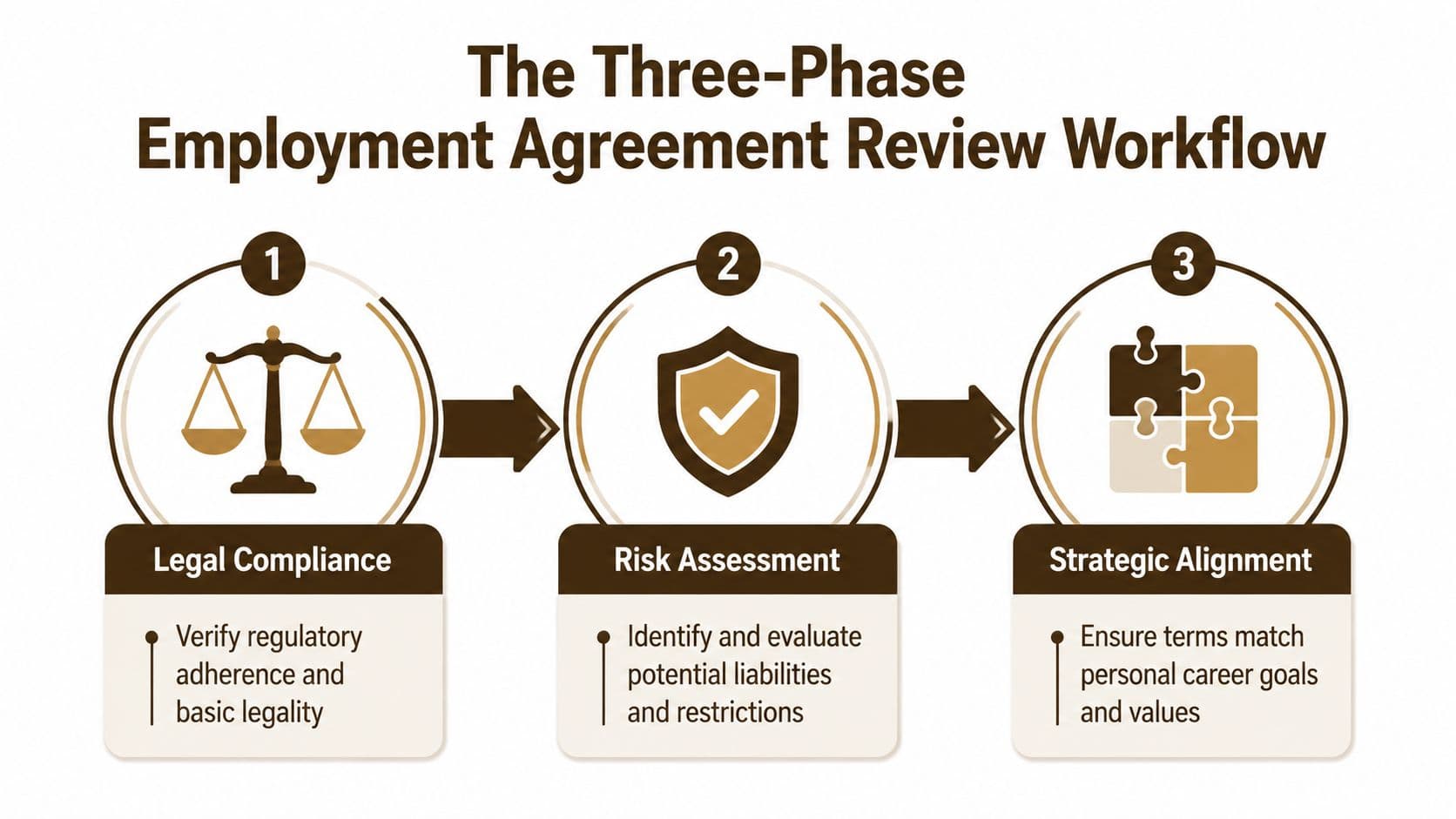
Phase one focuses on legal compliance
Start with the rules that apply to the worker and the place of work. Confirm the employment status or classification, required notices, probation terms, benefits, leave provisions, confidentiality duties, intellectual property assignment, data-processing language, post-termination restrictions, and dispute-resolution mechanism.
Location deserves more attention than many reviewers give it. A contract may identify the employer's headquarters but leave the employee working from another state or country. That creates potential conflicts involving wage rules, leave, privacy, termination standards, tax administration, and the enforceability of restrictive provisions. A remote arrangement should identify the expected work location and explain whether a relocation or travel requirement exists.
Legal updates also require fresh review rather than automatic reliance on an old template. Recent workplace-law coverage identifies tighter pay transparency requirements, AI-in-employment regulation, leave expansion, and limits on restrictive covenants as important developments affecting contract language. Current workplace-law updates from Gadens illustrate why a clause that was routine in an earlier template may need jurisdiction-specific analysis now.
Phase two tests operational accuracy
Put the agreement beside the offer letter, compensation summary, recruiting emails, job description, and any written discussion of remote work. Check the title, reporting line, location, salary, bonus formula, commission terms, equity documentation, hours, travel expectations, and start date.
This comparison catches disputes before they acquire momentum. For example, a hiring manager may describe a discretionary bonus as an expected part of annual compensation, while the contract says the employer alone decides whether anything is paid. A recruiter may describe a permanent hybrid schedule, while the contract reserves an unrestricted right to require work from the office.
Phase three creates accountability
The final review isn't complete until each responsible function has confirmed its terms. HR should verify employment administration and benefits. Finance should validate salary, bonus, commission, equity, deductions, and payroll treatment. Legal should assess enforceability and jurisdiction. The hiring manager should confirm that the written role matches the work the candidate is expected to perform.
Keep a written issue log showing the clause, the concern, the owner, and the resolution. That simple record prevents one team from assuming another team handled a disputed term. It also creates a clean version-control process so the signed agreement reflects the final negotiated language.
Critical Clauses to Examine During Employment Agreement Review
A clause can look standard at signing and become the center of a dispute after hiring. Prioritize terms that govern ownership, restrictions, compensation, and termination. Benchmark data from Legal Stack Tools identifies IP assignment in 87% of reviewed agreements, at-will termination in 82%, noncompetes in 60%, and arbitration clauses in 53%. Those figures appear in its employment contract benchmark analysis. Frequency signals where reviewers should begin, even though it does not determine enforceability.
| Clause Category | Prevalence in Agreements | Primary Risk if Ambiguous |
|---|---|---|
| IP assignment | 87% | Disputes over side projects, inventions, and work product |
| At-will termination | 82% | Confusion about exit rights, notice, and implied promises |
| Noncompete | 60% | Limits on future work and potential enforcement disputes |
| Arbitration | 53% | Unclear forum, procedure, cost allocation, or claim coverage |
Start with the role and compensation
The role description should be precise enough for performance management and daily administration. Check the title, duties, reporting relationship, location, travel, working hours, overtime treatment where relevant, and the employer's authority to change responsibilities. A broad change-right can undermine the position described during recruitment, particularly where the contract gives no process or boundary for reassignment.
Compensation requires the same care. Salary is only one part of the arrangement. Confirm how bonuses are calculated, which conditions apply, whether the employer may reduce or cancel them, when payment occurs, and what happens if employment ends before the payment date. Commission plans should state the triggering event, treatment of pending matters, and records used to calculate payment.
Annualized pay, set-off wording, superannuation drafting, and payment records may require technical review rather than proofreading alone. These details can affect whether a promised package matches payroll treatment and statutory obligations.
Separate ownership, restrictions, and exit terms
The IP assignment should distinguish employer work from pre-existing materials, personal projects, publications, and inventions developed independently. Attach a schedule of excluded work where appropriate. A clause covering anything “related to” the employer's business can create friction for attorneys who write, teach, or maintain professional projects outside work.
Test noncompetes and nonsolicits against defined competitors, geographic reach, duration, restricted conduct, and the interests the employer says they protect. Enforcement trends vary by jurisdiction, so the same wording may carry different practical consequences depending on governing law and where the employee works. A specific restriction may be easier to defend than a sweeping ban. Candidates still need to understand the work they may be unable to accept after departure.
Read termination provisions alongside notice, severance, garden leave, benefits continuation, and post-termination obligations. Check both with-cause and without-cause rights, then compare the entire arrangement with applicable statutory minimums. A savings clause may not repair defective drafting when separate provisions conflict. The result can be uncertainty about exit rights, payment, or continuing obligations.
Finally, examine arbitration language as carefully as any other dispute clause. Identify covered claims, cost allocation, venue, procedure, class or collective waivers, and the related parties allowed to enforce it. The clause should set out a workable process, with terms that fit the jurisdiction and the disputes the parties are likely to face.
Red Flags That Signal Employment Agreement Problems
The strongest warning signs usually appear where the contract and the hiring process disagree. A job can be described as a focused counsel role during interviews, then drafted as a broad “other duties” position with no meaningful limits. A bonus can be presented as part of expected compensation, then reduced to a purely discretionary payment. A hybrid arrangement can be central to the candidate's decision, yet disappear from the executed document.
Language that leaves the working relationship undefined
Look closely at vague job scope, undefined working hours, unclear probation, undocumented commission terms, and missing benefit details. These omissions matter because employees and employers use different operational records after hiring. Payroll records, timekeeping systems, rostering tools, leave records, and written approvals may become the evidence used to resolve a disagreement.
A contract that doesn't align with those records creates friction even when no one intended to mislead. Practical guidance on attorney background checks is relevant to the broader hiring process because role verification, recruiting records, and contract accuracy should support the same picture of the candidate and position.
Watch for an agreement that gives the employer unilateral power to change location, duties, hours, or compensation without explaining boundaries. Flexibility can be commercially reasonable, especially in a growing legal department. It becomes a problem when the candidate cannot tell whether the promised job will still exist in practical terms after signature.
Restrictions that reveal the employer's risk posture
An expansive noncompete covering an entire market, every potential competitor, or any activity connected loosely to the employer's business should prompt questions. Declining enforcement trends don't eliminate the cost of having to assess or defend the clause. The restriction may also affect future recruiting conversations, professional networking, and the candidate's willingness to leave.
An IP clause deserves equal scrutiny when it reaches work created on personal equipment, outside working hours, or before employment. List prior publications, templates, software, training materials, and business concepts that must remain outside the assignment.
Arbitration can be another warning sign when it combines broad claim coverage, an inconvenient forum, one-sided cost provisions, or a class-action waiver. The presence of arbitration isn't automatically improper, but the details determine whether the process is balanced and usable.
Termination and benefits require evidence, not assumptions
A termination clause that says little about notice, severance, benefits, or final payments leaves the candidate exposed to assumptions. Benefits language should identify the governing plan documents and make clear which terms are controlled by those documents. Leave provisions should match the applicable law and the employer's administration practices.
Recent employment-enforcement commentary also demonstrates why templates need active maintenance. In 2025 employment contract enforcement developments in India, operational omissions such as unclear notice, rest-day provisions, and privacy language are treated as practical enforcement concerns, not merely drafting imperfections. The lesson travels across jurisdictions: review the agreement against the systems and evidence that will govern the job every day.
How to Negotiate Employment Agreement Terms Effectively
Negotiation works best when it converts uncertainty into a specific drafting request. Don't send a general message saying the agreement feels too restrictive. Identify the clause, explain the practical concern, propose language or a defined limit, and ask who will confirm the revision.

Negotiate the terms that affect daily reality
Begin with the points that influenced your decision to accept. If the role was sold as hybrid, ask for the expected location and any office-attendance requirement to appear in the agreement or an incorporated policy. If compensation included a bonus, request the formula, performance criteria, payment timing, and treatment on departure. If equity is part of the package, review the separate grant documents, vesting terms, forfeiture provisions, and any acceleration language rather than relying on a summary sentence.
For restrictive covenants, ask the employer to identify the legitimate interest protected and narrow the clause to that interest. Possible requests include defining competitors, limiting the restricted activities, reducing geographic reach, or clarifying the duration. A candidate with specialized legal experience may have more influence on these points than someone entering a standardized role, but every request should remain commercially grounded.
The average lawyer starting salary guide can help candidates frame compensation conversations realistically, but the agreement still needs to state the actual package being offered. Market context doesn't replace precise drafting.
Use a written negotiation record
After a call, send a concise summary: “My understanding is that the bonus will be calculated under the attached plan, the work location will remain hybrid subject to the stated policy, and my pre-existing publications are excluded from the IP assignment.” Ask the employer to confirm or correct the summary.
That approach is professional rather than adversarial. It also separates a promise from a preference. Employers may not agree to every request, but they can usually respond more effectively when the candidate explains the operational consequence of ambiguity.
Use the following decision sequence:
- Clarify first: Ask whether the disputed term is intentional, a template error, or covered by another document.
- Propose a narrow fix: Request a defined edit rather than rejecting the entire agreement.
- Escalate proportionately: Bring in employment counsel when the clause affects mobility, ownership, equity, termination, or a different jurisdiction.
- Decide before signing: If the employer refuses to clarify a term central to your decision, assess the risk as part of the offer, not after accepting it.
A short educational video can help candidates recognize why contract language deserves a structured conversation, but it shouldn't substitute for jurisdiction-specific legal advice.
Counsel is especially valuable for senior hires, lateral moves, partner-track positions, and in-house roles involving equity, confidential business information, or significant post-termination restrictions. A recruiter can help preserve communication with the employer and identify whether a disputed term reflects the organization's standard practice, but a lawyer should advise on legal rights and enforceability.
When to Involve Counsel or a Recruiter During Employment Agreement Review
Self-review is often reasonable when the position uses a straightforward template, the jurisdiction is familiar, compensation is fixed, and the agreement contains no unusual restrictions. Even then, compare the document with the offer and confirm the practical details in writing. A careful candidate can catch missing location, unclear reporting lines, undefined bonus language, and discrepancies in start date without turning every review into a formal legal engagement.
Professional help becomes more valuable as the agreement becomes harder to evaluate or more expensive to get wrong. Use this decision framework:
- Role seniority: Partner-track, executive, and senior in-house positions usually justify legal review because duties, authority, compensation, and exit terms are more complex.
- Compensation structure: Seek help when the package includes equity, commissions, deferred payments, discretionary bonuses, or multiple plan documents.
- Jurisdiction: Involve counsel when you live in one jurisdiction, work in another, or the employer uses a governing-law clause that may not match your working location.
- Restrictive language: Obtain advice on noncompetes, nonsolicits, confidentiality, garden leave, and broad IP assignments before signing.
- Regulated work: Extra review is sensible where privacy, AI-assisted employment decisions, financial services, healthcare, or government contracting rules affect the role.
- Material disagreement: Ask for professional support when the employer refuses to explain a clause that influenced your decision.
Match the professional to the problem
An employment lawyer advises on enforceability, statutory rights, negotiation strategy, and litigation exposure. A recruiter contributes a different kind of value. A legal recruiter can explain how the role was presented, coordinate questions with the hiring organization, and help identify whether the written agreement matches the recruiting process. The practical role of a recruiter is described in what legal recruiters do for candidates, but recruiter support isn't a substitute for legal advice.
Ask prospective counsel whether they regularly handle the governing jurisdiction and the specific clause at issue. Ask a recruiter how they will document questions, protect confidentiality, and communicate requested changes to the employer. The right support should make the agreement clearer, not pressure you to sign quickly.
Employment agreement review is complete only when you understand the legal restrictions, the operational expectations, the compensation mechanics, and the consequences of leaving. If one of those remains unclear, pause before signing.
Five Star Placements helps attorneys, partners, in-house counsel, and legal support professionals evaluate opportunities where role scope, compensation, culture, and contract expectations need to align. Visit Five Star Placements to explore permanent legal placement support and connect with a recruiter who can help you approach the offer process with greater clarity.
Need help filling a legal role?
Five Star Placements partners with law firms and legal departments nationwide.
Schedule a Call