
Average Lawyer Starting Salary 2026: Your Compensation Guide
July 20, 2026 · 13 min read · Five Star Placements

Table of contents
The most popular advice on average lawyer starting salary is also the least useful: people quote the top-of-market number as if it describes the whole profession. It doesn't. If you're a hiring partner, that shortcut can push you into offers that don't fit your economics or your candidate pool. If you're a new associate, it can leave you misreading a fair offer as a bad one, or worse, accepting a weak one because you never benchmarked it correctly.
A better approach starts with one question: average for whom? A first-year associate in a national firm, a government honors hire, a judicial clerk, and a public interest lawyer all enter the profession under the same title, but not under the same pay model. Firm size, geography, and sector each change the number. Together, they determine whether an offer is market, aggressive, or out of step.
Table of Contents
- Beyond the Headline Salary Number
- The Great Divide How Firm Size Dictates Pay
- Location Matters Geographic Salary Benchmarks
- Practice Area and Sector Salary Variations
- Strategic Salary Setting for Hiring Partners and GCs
- Positioning and Negotiation for First-Year Candidates
Beyond the Headline Salary Number
The headline number gets attention because it's dramatic. It's also incomplete. A widely circulated view of the average lawyer starting salary treats $200,000 to $225,000 as the default benchmark, even though 68% of law offices pay first-year associates less than $225,000, and firms with 100 or fewer lawyers have a median starting salary of $155,000, according to LawFuel's analysis of lawyer salary data.
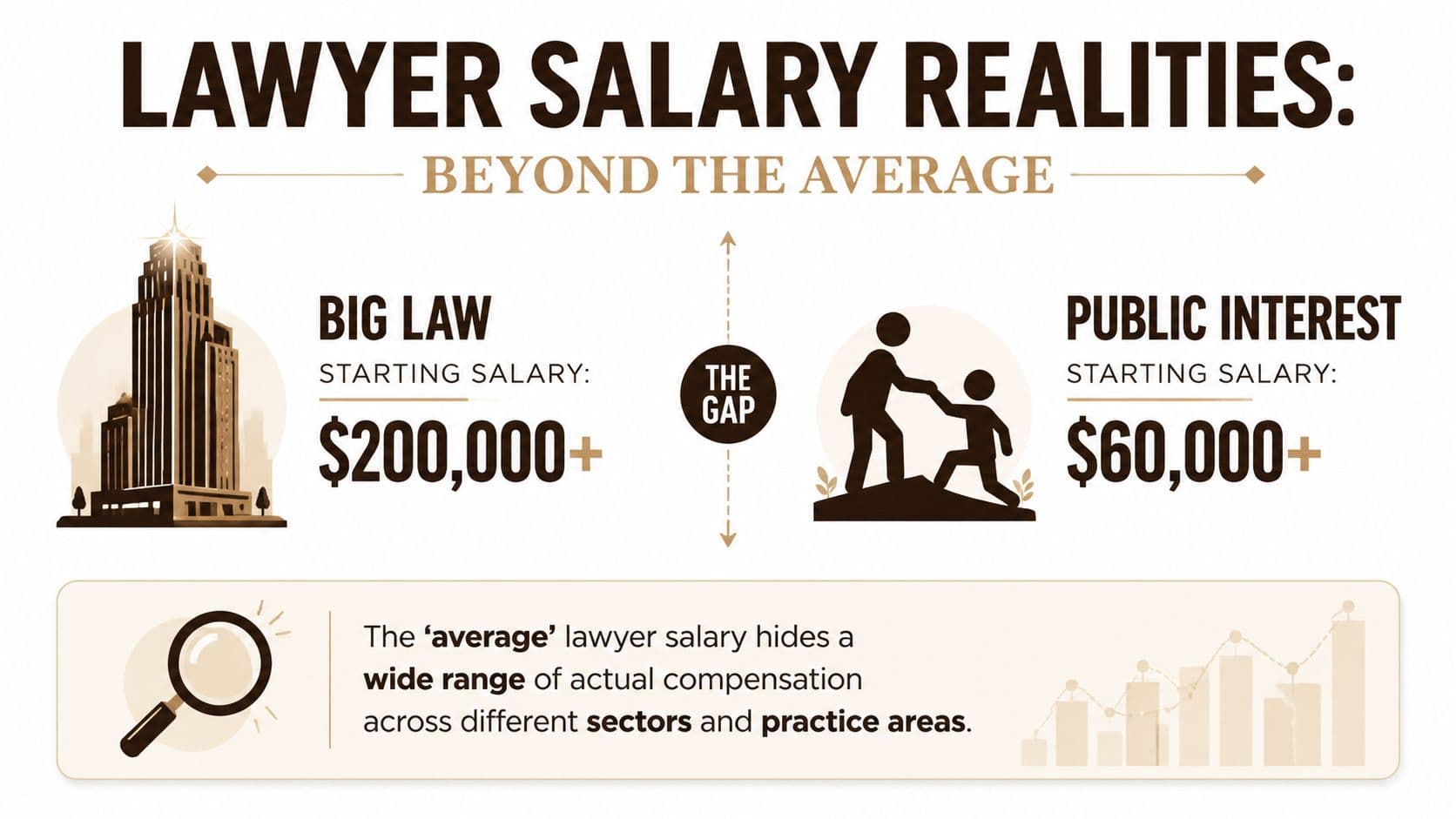
The number people repeat most often
The market doesn't have one true starting salary. It has a visible top tier and a much broader middle. That distinction matters because the public conversation usually starts with the top tier.
For candidates, the mistake is obvious. They hear a Big Law figure and assume anything lower is suspect. For employers, the mistake is subtler. They assume candidates expect a single national number, when many candidates are evaluating fit, progression, training, and workload alongside pay.
Practical rule: If a salary benchmark doesn't specify firm size, location, and sector, it isn't a benchmark. It's a headline.
The better frame is this: average lawyer starting salary is a distribution problem, not a single-number problem. Once you accept that, compensation becomes easier to interpret and easier to negotiate.
Why this distorts hiring and job searches
A hiring partner at a regional litigation boutique isn't competing with every Am Law firm in Manhattan. A public interest employer isn't trying to mimic private practice pay. And a first-year associate shouldn't compare a clerkship, a midsize firm offer, and a national corporate platform as if they were interchangeable.
That's why salary conversations need context before they need confidence. If you're trying to calibrate where your offer sits in the market, broad commentary won't help much. Practical hiring analysis looks more like the market commentary found in the Five Star Placements blog for legal employers and candidates, where role type and hiring conditions matter more than generic averages.
Here is the point often overlooked: the top number doesn't just overstate the market. It changes behavior. Candidates over-anchor. Smaller firms under-explain. Employers and applicants then talk past each other, even when the offer itself is reasonable for that role.
The Great Divide How Firm Size Dictates Pay
Firm size shapes starting salary more than most applicants realize. It also shapes compensation strategy more than many partners admit. The economics are different, the billing structures are different, and the tolerance for standardized salary scales is different.
According to this summary of NALP-based associate salary data, the median first-year associate base salary in the United States reached $200,000 in 2025, but that figure is heavily skewed. Firms with more than 700 lawyers show a median of $225,000, while firms with 100 or fewer lawyers show a median of $155,000. That's a $70,000 disparity between the largest and smallest private practice employers.
What the largest firms can pay
Large firms can absorb higher first-year salaries because they usually pair compensation with a specific operating model. They have larger institutional clients, higher billing rates, extensive staffing models, and more predictable recruiting pipelines. A standardized first-year salary also simplifies class-based hiring.
Smaller firms don't operate that way. They often hire one associate at a time, tie compensation more directly to immediate productivity, and rely on narrower practice economics. That doesn't make a lower base irrational. It means the salary reflects a different business model.
Median Starting Salary by Law Firm Size 2026
| Firm Size (Number of Attorneys) | Median Starting Salary |
|---|---|
| More than 700 lawyers | $225,000 |
| 100 or fewer lawyers | $155,000 |
A table like this doesn't tell the whole story, but it gives both sides a valuable starting point. If you're a candidate interviewing with a smaller firm, expecting the compensation structure of a global firm will usually lead to the wrong conclusion. If you're a hiring partner at a smaller shop, pretending the comparison doesn't exist will also hurt you.
How hiring partners should use this
The strategic move isn't to chase the top of the market blindly. It's to decide where you want to position your firm and explain that position clearly.
Consider three practical questions:
- Who are you competing against: If your candidate pool overlaps with regional boutiques and midsize firms, benchmark there. Don't build your salary plan around firms your candidates aren't realistically choosing between.
- What can your platform offer besides base salary: Smaller firms often compete through earlier client contact, tighter mentorship, stronger trial exposure, or faster advancement. Those advantages need to be stated, not assumed.
- How consistent is your compensation philosophy: Candidates notice when a firm says it's merit-based but can't explain how raises, bonuses, or progression work.
A lower base can still be a competitive offer when the firm explains the workload, training, path to origination, and compensation growth with precision.
For candidates, the same logic applies in reverse. If a smaller firm offers less than a top-tier national firm, that isn't automatically a red flag. The pertinent question is whether the salary matches the firm's size, market, and expectations. That's where intelligent benchmarking starts.
Location Matters Geographic Salary Benchmarks
Geography isn't a footnote in legal compensation. It's one of the main drivers. Two firms can hire for similar first-year work and land at very different salary levels because their local markets support different billing rates, client demand, and labor competition.
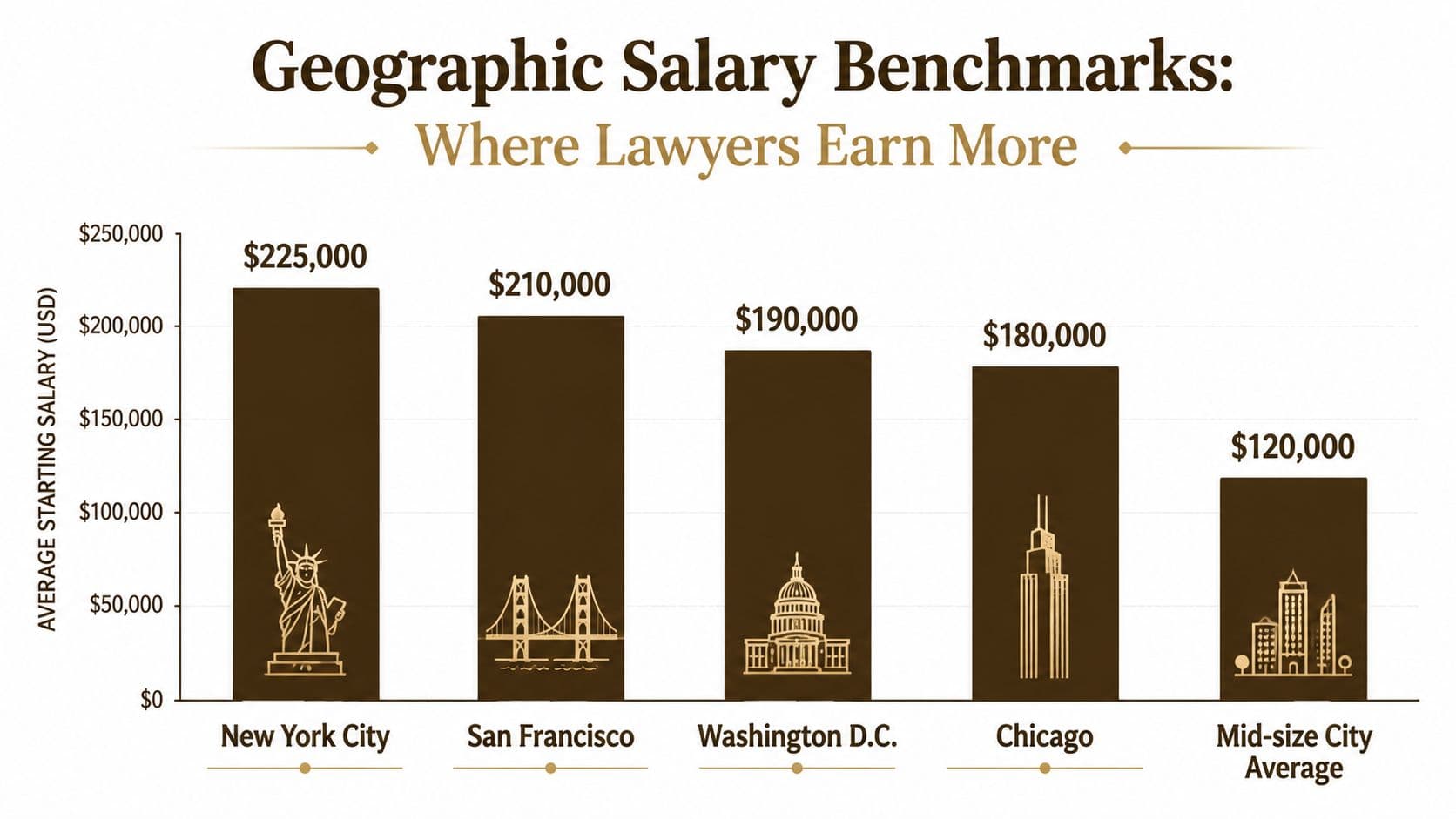
In six major legal markets, Austin, Boston, Houston, New York City, San Francisco, and Washington, DC, the median starting salary for first-year associates has reached $225,000, while the lowest median salaries in the South and Midwest are $160,000, according to Clio's review of first-year lawyer salary benchmarks. That is a $65,000 geographic premium.
Where the premium shows up
The premium isn't random. It tends to show up where firms compete intensely for the same credentialed candidate pool and where clients support higher fee structures. In those markets, firms don't just pay for legal skill. They pay for scarcity, signaling, and recruiting speed.
The image below captures how market perception often gets visualized, even though city-specific numbers in the broader conversation are often simplified.
Candidates should still be careful. A major-market salary can be impressive and still come with a heavier workload, narrower practice flexibility, and a cost structure that changes how far the paycheck goes. Employers should be equally careful not to justify below-market pay with vague references to lifestyle if they haven't defined what that tradeoff really means.
A short discussion of the legal salary picture can help frame this further:
What candidates should compare besides base pay
When you're judging an offer across markets, compare the full working reality, not just the headline salary.
- Practice intensity: A firm in a top-paying city may expect a pace and availability level that a secondary market firm doesn't.
- Training access: Some markets offer scale. Others offer responsibility earlier.
- Long-term positioning: A city may carry stronger exit opportunities for some practices, while another market may offer faster client-facing growth.
For hiring partners, geography gives you a defensible story when you use it straightforwardly. If your office sits outside a top-tier salary market, don't compete by apology. Compete by clarity. Explain the local benchmark, the work mix, and the progression opportunity. That usually lands better than trying to sidestep the issue.
Practice Area and Sector Salary Variations
A lawyer's first salary isn't determined only by firm size or city. The type of employer matters just as much. Private practice, government, public interest, and clerkships all use different compensation logic, and they reward different parts of the professional experience.
According to NALP's starting salary data for prospective law students, the median starting salary for Class of 2020 graduates in private practice was $130,000. Public service roles came in much lower, with medians of $64,000 for government, $55,000 for public interest organizations, and $60,000 for judicial clerks. The overall median salary for all graduates with qualifying full-time jobs was $75,000, which shows how much higher-paying private practice roles can pull the broader conversation upward.

Private practice and public service are different markets
The first mistake people make is treating these sectors as if they compete on the same terms. They don't. A government office or legal aid organization isn't failing because it doesn't match a large-firm private practice salary. It's hiring under a different mission, budget, and retention model.
That matters for candidates. If you want courtroom exposure, policy work, public service alignment, or clerkship training, your starting salary may be lower than a private practice peer's. But that doesn't mean the role is a weak career move. It means the compensation reflects a different value proposition.
How to read sector data correctly
Use sector data to answer the right question.
- If you're choosing among private firms: compare the offer to private practice benchmarks in similar environments.
- If you're considering public service: compare across public pathways, not against the largest corporate firms.
- If you're evaluating a clerkship: treat it as a developmental platform first and a salary comparison second.
The fastest way to misunderstand your market value is to compare offers from sectors that were never priced to solve the same hiring problem.
For employers, the lesson is straightforward. If you can't lead on cash, lead on mission, supervision quality, courtroom access, substantive ownership, or long-term exit value. Candidates can understand tradeoffs. What frustrates them is vagueness.
For candidates, salary should be part of career design, not a substitute for it. The average lawyer starting salary only becomes meaningful when you anchor it to the kind of lawyer you intend to become.
Strategic Salary Setting for Hiring Partners and GCs
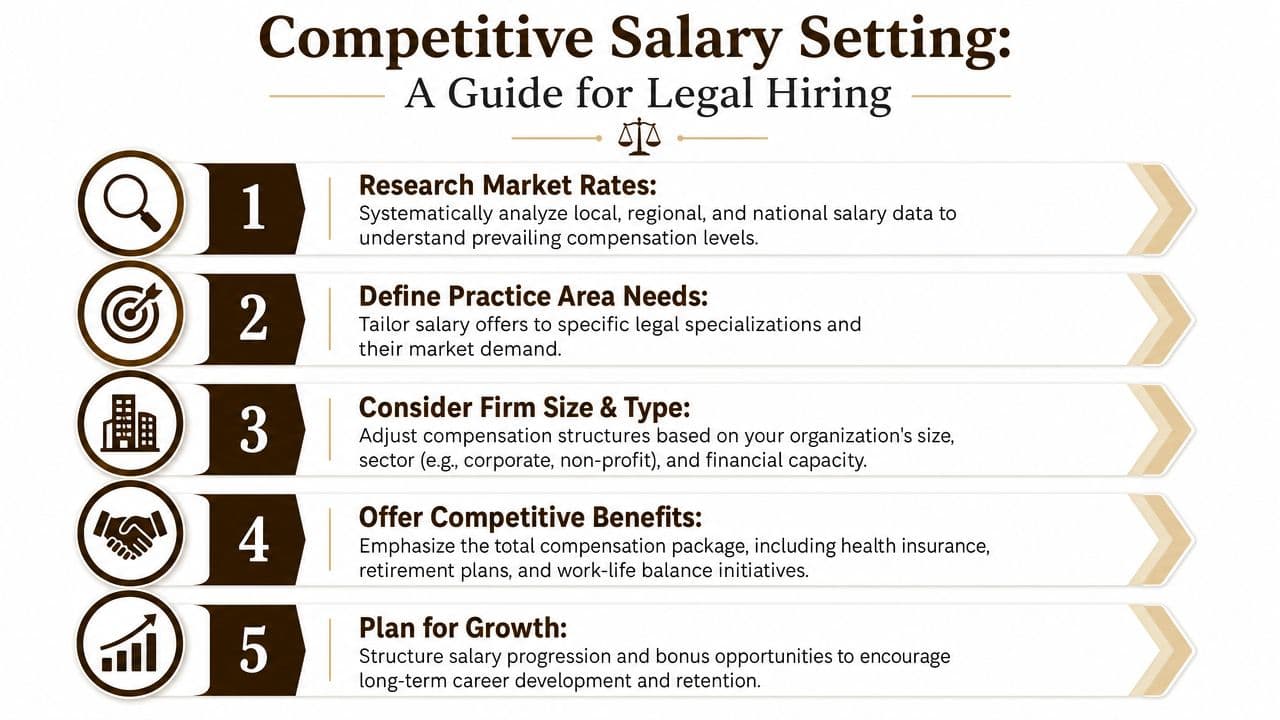
Compensation strategy works best when it is deliberate, not reactive. Many legal employers lose strong candidates not because their offer is low in absolute terms, but because the offer doesn't make sense in context. It feels unstructured, under-explained, or disconnected from the role's demands.
Build offers around your actual competitor set
A hiring partner should start with market alignment, but market alignment doesn't mean copying the loudest salary in the room. It means identifying the employers your candidates are realistically considering.
If you're a regional labor and employment boutique, your competitor set probably isn't every global firm office in the country. If you're hiring in-house, your competition may include firms, peer companies, and selective specialty teams. Each of those candidate flows calls for a different offer strategy.
A practical framework looks like this:
- Map the role accurately. Define practice area, expected hours, supervision model, and advancement path.
- Benchmark the market accurately. Use salary data as a range-setting tool, not a branding exercise.
- Decide where you want to sit. Lead, match, or trail on base pay. Then support that choice with the rest of the package.
What a strong offer package communicates
A strong legal offer says more than "here's the salary." It tells the candidate how the organization values development, retention, and performance.
That usually means spelling out the non-base components with real specificity:
- Bonus structure: Is it discretionary, formula-based, or tied to hours, collections, or company performance?
- Career path: Is there a defined review cycle, progression ladder, or path to partnership or leadership?
- Work design: What does hybrid work look like in practice, and who controls flexibility?
- Support system: Who trains the associate, reviews their work, and helps them build judgment?
If you're hiring for a demanding role and want a top-tier candidate, don't leave these answers implied. Put them on the table. The strongest employers I see don't always win on base salary. They win by making the full offer legible.
For organizations refining that hiring position and employer story, the Five Star Placements team overview gives a useful picture of how specialized legal search firms think about fit, structure, and role alignment across law firms and legal departments.
Positioning and Negotiation for First-Year Candidates
Most first-year candidates approach negotiation emotionally. That's understandable. It's a high-stakes moment. But the best negotiating position isn't aggression. It's calibration.
Benchmark the offer before you negotiate
Start by placing the offer inside the right market bucket. Ask four questions.
- What kind of employer is this: national firm, midsize firm, boutique, government office, clerkship, nonprofit, or in-house team?
- What market is this job in: top-paying legal center, regional hub, or smaller market?
- What work will I do: general commercial litigation, trusts and estates, family law, insurance defense, corporate work, or something else?
- How is progression handled: lockstep, informal, merit-based, or tied to business need?
Those questions prevent a common mistake. Candidates often negotiate as if they are underpaid relative to the entire profession, when the better comparison is the subset of employers that resemble the offer in front of them.
Ask for the compensation philosophy if the number seems light. The answer often tells you more than the opening salary.
Negotiate the whole deal, not just salary
For first-year lawyers, salary flexibility can be limited. That doesn't mean there is nothing to negotiate. It means you need to choose the right points.
You may be able to discuss start date, bonus eligibility, bar expense support, relocation treatment, hybrid expectations, review timing, or the structure of early performance evaluation. In a smaller firm, you may also be able to ask for clarity on origination credit, direct client contact, or the timeline for compensation review.
A practical approach sounds like this:
- Lead with fit: make clear that you want the role.
- Show your benchmark: reference the market category, not a random headline salary.
- Ask narrow questions: broad demands create friction. Precise requests invite discussion.
Candidates also need to know when not to push. If the employer uses a fixed class-year system, the room to move may be small. If the role is in public service, the better conversation may be about mentorship, courtroom exposure, or promotion timing. If the base salary is below what the role seems to require, ask how the employer reviews compensation and what performance markers trigger increases.
If you're weighing offers or preparing for those conversations, reaching out through Five Star Placements' contact page can help you pressure-test how a role is positioned in the broader legal market.
The most useful takeaway is simple: don't negotiate against a myth. Negotiate against the right comparison set, and evaluate the full career value of the offer in front of you.
If you're hiring legal talent or evaluating your next move, Five Star Placements can help you benchmark roles, assess market positioning, and make smarter compensation decisions across law firms and legal departments.
Need help filling a legal role?
Five Star Placements partners with law firms and legal departments nationwide.
Schedule a Call