
Resumes Do's and Don'ts: Attorney & Legal Pro Guide 2026
September 4, 2026 · 19 min read · Five Star Placements
Table of contents
A legally accurate resume can still fail. Accuracy answers whether your history is correct, but it doesn't answer the recruiter's first question: why are you a fit for this specific practice, role, and audience? A litigation partner, general counsel, legal operations executive, and paralegal hiring manager may read the same career history differently. Your resume has to position the relevant version of your experience before the reader moves on.
That matters because recruiters often spend only about 6 to 8 seconds on an initial resume scan, and only about 3% of resumes ultimately lead to an interview, according to a review of current resume screening statistics. Large employers also rely heavily on applicant tracking systems, with a 2025 review reporting 97.8% ATS adoption among Fortune 500 companies. In other words, your document must work for software and for a selective legal professional reviewing it quickly.
The ten resumes do's and don'ts below cover attorneys, paralegals, legal assistants, partners, in-house counsel, and legal operations professionals. Each section uses practical before-and-after editing, so you can see how a wording or structure change affects screening, role fit, credibility, and client presentation. When a resume can't carry the full context of a transition or practice change, targeted recruiter feedback and interview coaching, including support from Five Star Placements, can help you prepare the explanation behind the document.
Table of Contents
- 1. Do Tailor and Customize Your Resume to the Specific Practice Area, Role, and Audience
- 2. Don't Include Irrelevant Employment History or Unclear Gaps
- 3. Do Quantify Your Accomplishments and Impact
- 4. Don't Use Overly Dense Formatting or Poor Visual Organization
- 5. Do Highlight Relevant Certifications, Bar Admissions, and Continuing Legal Education
- 6. Don't Oversell Experience or Misrepresent Your Role
- 7. Do Include a Strong Summary or Professional Headline if You're Changing Roles or Have a Non-Linear Career
- 8. Don't Use Unprofessional Email Addresses, Phone Numbers, or Social Media Profiles
- 9. Don't Neglect to Proofread or Include Obvious Errors
- 10. Do Emphasize Soft Skills, Leadership, and Cultural Fit Indicators Relevant to the Target Organization
- Top 10 Resume Dos vs Donts
- Run the Final Legal Resume Review
1. Do Tailor and Customize Your Resume to the Specific Practice Area, Role, and Audience
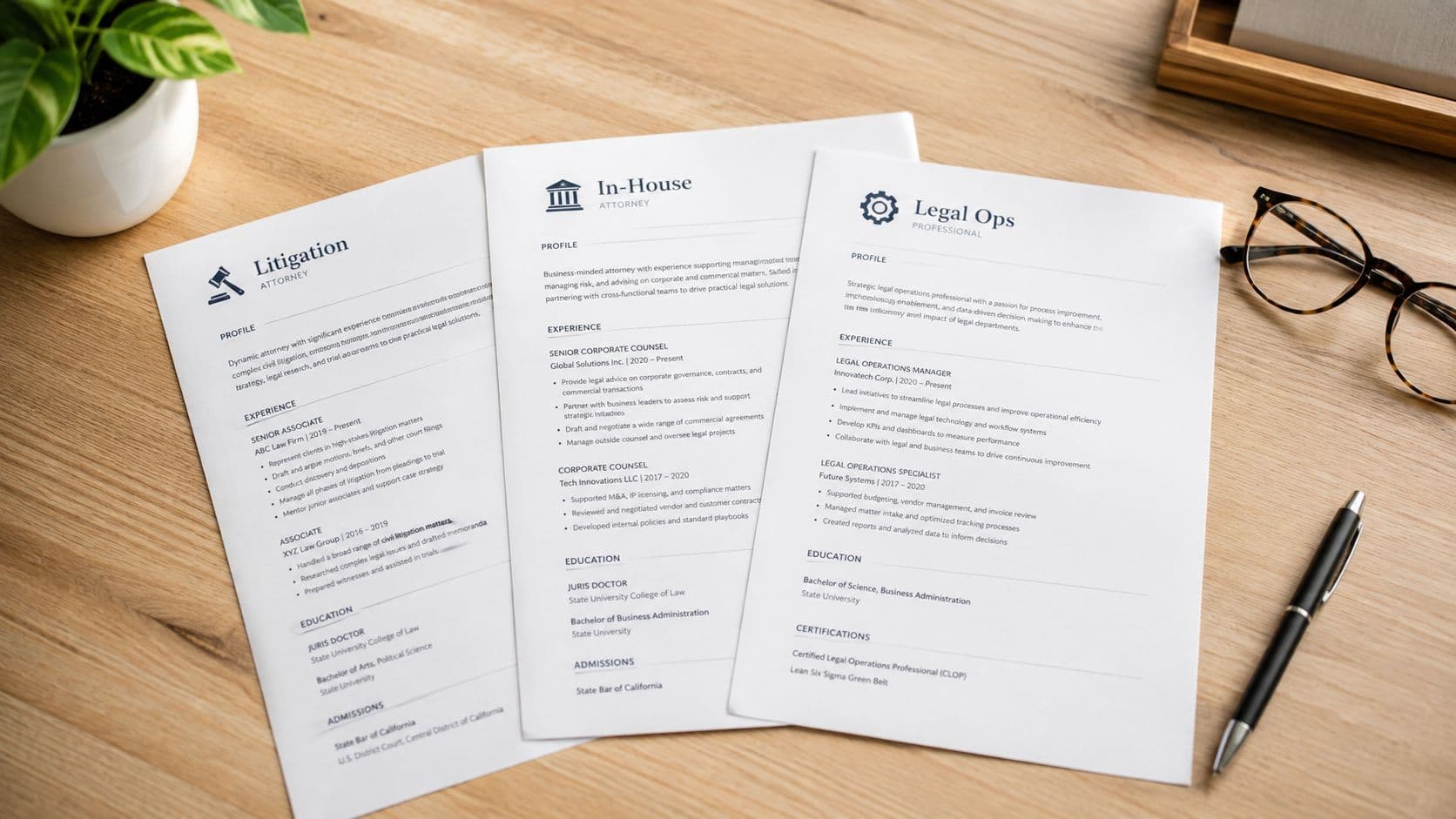
A resume for a personal injury firm shouldn't read like a resume for a corporate M&A practice. The legal foundation may overlap, but the hiring audience is looking for different evidence of value. A litigation attorney should foreground opposing counsel negotiations, settlement strategy, discovery management, and courtroom preparation when applying to a personal injury firm, rather than leading with unrelated corporate transactions.
The same distinction applies outside private practice. An in-house counsel candidate applying to a healthcare corporation should emphasize contract management, regulatory compliance, and collaboration with business teams. For a software company, the stronger positioning may involve IP, technology agreements, privacy, and product counseling. Legal operations candidates need a different vocabulary again, including matter management, process design, reporting, vendor oversight, and cross-functional implementation.
Build role-specific versions
Create a small set of focused templates rather than sending one generic document everywhere:
- Partner or lateral resume: Lead with client relationships, practice development, matter leadership, team building, and defensible business results.
- In-house counsel resume: Prioritize contracts, compliance, risk management, commercial judgment, and communication with non-legal stakeholders.
- Legal operations or administration resume: Highlight systems, workflows, budgeting, metrics, project delivery, and operational leadership.
Mirror the job description's core terminology, but only where it accurately describes your background. Mention relevant matters by type when confidentiality prevents naming clients. Save files with a clear convention such as YourName_Resume_Partner.pdf or YourName_Resume_InHouse.pdf, then confirm the attachment matches the opportunity before sending it.
2. Don't Include Irrelevant Employment History or Unclear Gaps
Recruiters read a resume as a positioning document, not a complete autobiography. Give prominence to work that supports the role, practice area, and client presentation the hiring team needs. A paralegal with substantial legal support experience should usually reduce older food service work, since it can pull attention away from case management, filings, discovery, trial preparation, and attorney support.
Older non-legal employment can remain useful when it explains a transition or proves a relevant capability. A business professional pursuing in-house counsel work might connect commercial management, compliance exposure, or contract negotiation to the target position. Legal operations candidates can retain earlier systems, project, or vendor-management work when it supports process design and operational judgment. State the connection in a short bullet so the recruiter does not have to infer it.
Unexplained employment gaps create avoidable questions about availability and career direction. Add a factual label that gives the recruiter enough context to present your timeline accurately. Keep private medical or family details out of the resume.
Use a brief timeline entry
- Career transition: “Transitioned from business operations into legal practice.”
- Planned leave: “Professional sabbatical for family relocation.”
- Return to work: “Returned to legal practice following a planned career pause.”
Then give the document's limited space to relevant legal roles, credentials, and results. Prepare fuller context for a cover letter or interview. Five Star Placements interview coaching can help you explain a transition clearly, without sounding evasive or defensive. Review the final timeline for unexplained overlaps, inconsistent dates, and descriptions that imply a role or qualification you did not hold.
3. Do Quantify Your Accomplishments and Impact
A resume should show what your work changed, not merely list assignments. “Managed litigation matters” gives a recruiter no clear sense of ownership, scale, or result. Add figures when you can explain and defend them, such as matters handled, contracts reviewed, team size, portfolios supported, process improvements, clients retained, or revenue connected to your work.
Before: “Managed litigation matters and supported the litigation team.”
After: “Managed 20+ active litigation matters averaging $500K in annual billings and achieved an 85% settlement rate before trial.”
The revised bullet positions the candidate through workload, commercial scale, and outcome. Use the same test across practice areas. An in-house attorney might write, “Reduced contract review cycle time by 40% through process optimization and managed an IP portfolio of 150+ trademarks across North America.” A lateral partner could write, “Built a practice group from 4 to 12 attorneys over 5 years and grew annual billings from $1.2M to $4.8M through client retention and new matter development.” Treat these as models only when they accurately reflect your record.
Show scale without disclosing protected information
Confidentiality limits what attorneys can name, but it does not prevent clear evidence of contribution. Replace client names, sensitive amounts, or identifying facts with accurate descriptions of scope:
- Matter volume: “Supported a significant commercial litigation docket across multiple jurisdictions.”
- Output: “Drafted and negotiated vendor agreements for recurring business needs.”
- Leadership: “Mentored junior attorneys and coordinated work across a multi-disciplinary team.”
- Process impact: “Standardized intake and reporting procedures for the legal department.”
Legal support professionals should quantify filings processed, attorneys supported, or workflows improved when those figures are verifiable. Legal operations candidates can emphasize cycle-time reductions, systems implemented, or departments served. For immigration attorneys, immigration attorney career opportunities may require a clear account of client work, case responsibility, and practice fit.
Review every metric before submitting. Confirm the period, define your role, and prepare the explanation you would give in an interview. A credible approximate description is stronger than a precise figure you cannot support.
4. Don't Use Overly Dense Formatting or Poor Visual Organization
A crowded resume makes the reader work too hard. Dense paragraphs, inconsistent dates, unclear headers, tiny text, and decorative design can hide the information that should earn the next conversation. They can also create parsing problems for applicant tracking systems, which is why clean structure is now a practical requirement rather than a design preference. A summary of ATS and resume screening findings reports that roughly 75% of resumes are rejected by ATS or AI screening before human review, and that 77% of hiring professionals reject resumes containing spelling or grammar mistakes.
The visual standard should be conservative, but not lifeless. Use a single professional font such as Arial, Calibri, or Times New Roman. Establish clear sections for professional experience, education, bar admissions, certifications, and skills. A hiring partner should be able to locate practice area, seniority, admissions, and recent impact without decoding the page.
Compare the structure, not just the style
Poor:
Twelve-point text, narrow margins, long paragraphs, eight to ten bullets for every position, and no visible distinction between responsibilities and achievements.
Better:
Readable text, consistent margins, clear section headings, short bullets, and enough white space to separate employers, roles, and outcomes.
Keep each role focused on the strongest evidence rather than every task you performed. Avoid graphics, text boxes, decorative icons, and complex columns unless you've confirmed the format remains ATS-readable. Export to PDF when the application instructions allow it, open the file on another device, and ask a recruiter or peer what information stands out during a quick scan.
A short visual demonstration can help you inspect hierarchy, spacing, and readability before submitting the document.
5. Do Highlight Relevant Certifications, Bar Admissions, and Continuing Legal Education
Credentials help a recruiter decide whether your background fits a role and can be presented credibly to a client. Put them where they can be found quickly, then connect them to the work you want next.
For attorneys, list bar admissions with each jurisdiction and current status when relevant. Corporate counsel candidates should also identify compliance, privacy, industry, or other credentials that match the employer's risk profile. A bar admission may establish eligibility, while a targeted credential can clarify practice fit.
Legal support professionals should name the exact certification and issuing organization rather than writing only “paralegal certification.” Legal operations candidates can include systems, project, process, or compliance training when it supports the target position. Continuing legal education belongs on the resume when its subject matter reinforces the desired practice area. A long list of unrelated courses can make positioning less precise.
Use a format that supports verification:
- Bar admissions: Jurisdiction, license status, and any relevant qualification.
- Certifications: Exact credential name, issuing organization, and current status.
- CLE and training: Relevant subject, provider, and completion details where useful.
- Support credentials: Paralegal, litigation support, compliance, or technology certifications tied to the position.
Check every entry before submitting. Confirm spelling, jurisdictions, dates, active status, and professional standing. Do not describe a lapsed credential as current. Hiring teams may verify these details during screening, so attorney background check considerations make accuracy especially important for attorneys, partners, and in-house counsel.
A recent, role-specific credential can support a career transition, but it does not substitute for practical evidence. Pair it with the work it enabled, such as compliance investigations, contract review, discovery technology, or legal department reporting. This shows both qualification and application.
6. Don't Oversell Experience or Misrepresent Your Role
Your resume positions you for a recruiter, hiring partner, general counsel, or client presentation. Inflated titles and borrowed credit may improve keyword matching briefly, but they create credibility problems when an interviewer asks what you personally handled. Accurate positioning protects strong experience from being discounted.
Keep the title used in your employment records, then define your scope with precise bullets. If you supported a senior partner on complex disputes, do not call yourself lead counsel. Write: “Provided litigation support and legal research on complex commercial disputes under the guidance of senior counsel and contributed to settlement strategy.” The example shows substantive involvement without claiming responsibility for the matter.
Seniority requires the same discipline. A Senior Counsel who led client relationships or business development should not list Partner as the title. A credible description is: “Senior Counsel leading client relationships, supporting practice profitability, and mentoring junior associates.” Attorneys should distinguish matter ownership from assistance. Legal support professionals should separate document preparation, coordination, and independent responsibility. Legal operations candidates should identify the process or system they managed and the decisions they influenced.
Match each verb to the work performed
- Owned: You directed the work and were accountable for the result.
- Led: You coordinated people or a defined initiative.
- Contributed: You performed a substantive part of a collaborative effort.
- Supported: You assisted a senior professional or broader team.
- Exposure to: You gained foundational experience but were not independently responsible.
Review every bullet against your records and be ready to explain it in an interview. Confidentiality also limits useful detail. Describe a matter by practice, industry, or procedural type when naming it would violate an agreement. Recruiters can present carefully bounded experience to clients. They cannot safely present a candidate who discloses protected information or claims work they cannot verify.
7. Do Include a Strong Summary or Professional Headline if You're Changing Roles or Have a Non-Linear Career
A summary earns its space when the reader needs context. It can connect a lateral move, explain a return to legal work, or translate experience from one setting into another. For a straightforward candidate applying to the same role in the same practice, a headline with precise keywords may be enough. For everyone else, the top of the resume should answer the question that chronology can't.
A useful summary is short, direct, and employer-focused. For example:
General Counsel transitioning to an in-house counsel role with corporate experience across IP, contracts, and compliance in technology and healthcare environments.
A litigation attorney moving toward employment law might write:
Litigation attorney with complex commercial defense experience transitioning into employment law, bringing strength in discovery management, motion practice, client counseling, and trial preparation.
These statements don't pretend that the transition doesn't exist. They explain why the candidate's existing skills remain relevant.
Align the written and spoken pitch
Your summary should match what you'll say on a recruiter call. If the resume says you're moving from private practice to in-house work, prepare a concise explanation of the business problems you want to solve and the experience that supports that move. If you're returning after a career pause, acknowledge it plainly, then turn to current credentials and relevant capability.
Avoid clichés such as “results-driven legal professional” unless the next sentence proves the claim. Replace broad language with practice, setting, and contribution. A recruiter should be able to repeat your positioning accurately to a hiring partner without translating it first.
8. Don't Use Unprofessional Email Addresses, Phone Numbers, or Social Media Profiles
Contact details are small, but they influence the first impression. An email such as legalbeagle99@email.com or rockstarlawyer@email.com introduces avoidable doubt. Use a simple address based on your name, such as jsmith.attorney@gmail.com or an address on a personal domain.
Check the phone number and voicemail before you submit. A recruiter who reaches an outdated greeting or a full mailbox may move to another candidate because communication becomes inconvenient. Include your name in the greeting and make sure you can return calls promptly.
Your digital presence also extends the resume. Legal employers often consider reputation, judgment, and confidentiality risk, particularly for client-facing attorneys, partners, and in-house leaders. LinkedIn should show a consistent practice focus, current experience, professional photo, and language that aligns with the resume. Public social profiles deserve an audit even when you don't include them in the application.
Perform a quick visibility audit
- Email: Use your name, avoid slang, and check the address for typing errors.
- Voicemail: State your name clearly and use a professional greeting.
- LinkedIn: Confirm dates, titles, practice areas, and credentials match the resume.
- Public content: Remove or restrict material that could create a reputation concern.
- Signature: Include your current title and relevant professional details in application communications.
Search your name as a recruiter might. Don't create an elaborate online persona that the resume can't support. Consistency across the document, profile, and interview is more persuasive than polished language that changes from one channel to another.
9. Don't Neglect to Proofread or Include Obvious Errors
A legal resume is an early sample of your work product. A typo such as “Commerical disputes” instead of “commercial disputes” can make a recruiter question your review habits before reaching your substantive experience. Incorrect capitalization, punctuation, dates, or employer names creates a similar credibility problem, especially for attorneys whose roles require precise written judgment.
Treat automated tools as a first filter. Spell-check and Microsoft Word or Grammarly can catch obvious errors, but they may miss a correctly spelled word in the wrong context, an incorrect court name, or conflicting dates. Legal terminology, jurisdictions, proper nouns, credentials, and matter descriptions need human review.
Review the document in passes, with each pass serving a different screening purpose:
- Content pass: Verify titles, dates, jurisdictions, credentials, matter descriptions, and metrics.
- Language pass: Check grammar, tense, parallel structure, and repeated wording.
- Visual pass: Inspect spacing, page breaks, bullets, headers, and contact details.
- Human pass: Ask a colleague, mentor, or recruiter what feels unclear, inconsistent, or unsupported.
Read the resume aloud. A printed copy can expose errors that disappear on screen. Attorneys should confirm that practice areas and matter language accurately reflect their role. Legal support professionals should check titles, systems, and procedural terminology. Legal operations candidates should verify project names, team scope, and process outcomes.
Export the final version to PDF, open that file, and inspect every page. A polished resume cannot guarantee an interview, but an obvious error can end consideration before your fit reaches the discussion stage.
10. Do Emphasize Soft Skills, Leadership, and Cultural Fit Indicators Relevant to the Target Organization
Technical legal ability is necessary, but a resume that lists only matters, statutes, and procedural tasks can make a candidate look interchangeable. Hiring partners want to know how you work with clients and colleagues. General counsel want evidence that you can advise business stakeholders. Legal operations leaders need proof that you can lead change across teams that don't report to you.
Avoid unsupported labels such as “excellent communicator” or “natural leader.” Show the behavior in context. Instead of writing, “Managed 15 active matters and won 3 trials,” add the dimension that explains how you worked: “Managed 15 active matters, maintained trusted client relationships, and collaborated with litigation teams through successful trial outcomes.” Use only facts you can substantiate.
Match the organization without mimicking it
Review the firm or company's website, LinkedIn presence, and public professional materials. Look for recurring priorities such as client service, collaboration, mentorship, innovation, or cross-functional partnership. Then select evidence from your background that demonstrates those qualities.
For in-house counsel, a stronger bullet might say:
Partnered with Finance, HR, and Operations on compliance initiatives, translating legal requirements into practical processes for non-legal stakeholders.
For a partner, combine business development with relationship quality. “Generated business” is incomplete if the role depends on trust, retention, and referral relationships. For a legal operations leader, show how you brought attorneys, finance, technology, and vendors into a shared process.
Leadership can include mentoring, committee work, practice group development, project ownership, and change management. Use guidance on assessing leadership potential to think beyond title and identify the behaviors your target organization is likely to value. The best cultural-fit evidence is specific, relevant, and supported by the rest of the resume.
Top 10 Resume Dos vs Donts
| Practice Item | Implementation Complexity 🔄 | Resource Requirements ⚡ | Expected Outcomes 📊 | Ideal Use Cases 💡 | Key Advantages ⭐ |
|---|---|---|---|---|---|
| DO: Tailor and Customize Your Resume to the Specific Practice Area, Role, and Audience | Moderate–High: multiple targeted versions and research | Time-intensive: firm research, multiple resume files | Higher screening pass-rate; more callbacks and recruiter engagement | Applying across different practice areas (litigation, in‑house, legal ops, partner searches) | Signals commitment and culture fit; enables precise recruiter positioning |
| DON'T: Include Irrelevant Employment History or Unclear Gaps | Low: prune or explain history | Minimal time; may need concise gap explanations | Cleaner, focused resume; fewer screening red flags | All legal applications; career changers and re‑entrants | Improves focus and preempts concerns about reliability |
| DO: Quantify Your Accomplishments and Impact | Moderate: gather and verify metrics | Requires performance data and confidentiality checks | More compelling, verifiable candidacy; stronger pitch language | Lateral partners, in‑house counsel, legal operations leaders | Demonstrates ROI, scale, and defensibility of results |
| DON'T: Use Overly Dense Formatting or Poor Visual Organization | Low–Moderate: redesign for scannability | Time to reformat; possible design guidance | Better ATS parsing and faster recruiter scans | High‑volume screening and selective firm reviews | Improves readability and conveys attention to detail |
| DO: Highlight Relevant Certifications, Bar Admissions, and CLE | Low: list credentials clearly and current | Minimal: verify dates and active status | Increased eligibility and geographic mobility | Multi‑jurisdictional searches, certified roles, paralegals | Differentiates candidates and meets explicit requirements |
| DON'T: Oversell Experience or Misrepresent Your Role | Low: use accurate titles and honest framing | Minimal: confirm records and references | Preserves credibility; avoids disqualification during checks | All hiring processes, especially reference‑checked searches | Maintains reputation and long‑term career prospects |
| DO: Include a Strong Summary or Professional Headline if Changing Roles | Low–Moderate: craft concise narrative (3–4 sentences) | Moderate: time to refine summary and align messaging | Clarifies non‑linear careers; improves callback rates | Career changers, re‑entrants, lateral moves | Contextualizes candidacy and aids recruiter storytelling |
| DON'T: Use Unprofessional Email Addresses, Phone Numbers, or Social Media Profiles | Low: update contacts and audit profiles | Minimal: create professional accounts and adjust privacy | Stronger first impression; reduced reputation risk | Client‑facing roles and all legal applicants | Enhances accessibility and aligns with professional standards |
| DON'T: Neglect to Proofread or Include Obvious Errors | Low: thorough review and external proofing required | Time and at least one reviewer (peer or recruiter) | Fewer automatic rejections; demonstrates precision | All applications, crucial for highly selective placements | Signals attention to detail; increases interview likelihood |
| DO: Emphasize Soft Skills, Leadership, and Cultural Fit Indicators | Moderate: identify examples and evidence of fit | Requires examples, endorsements, and tailored language | Better retention potential; stronger shortlist positioning | Partner candidates, lateral hires, in‑house roles | Differentiates beyond technical skills; predicts cultural alignment |
Run the Final Legal Resume Review
A final review should be more demanding than a spell-check. Start by identifying the exact role and audience for this submission. A partner-search version, in-house version, and legal operations version may share your career history, but they shouldn't give equal space to the same evidence. Confirm that the filename, headline, summary, keywords, and first bullets all point toward the opportunity.
Then inspect the document for focus. Remove unrelated history unless it explains a transition or demonstrates a directly transferable capability. Check that each position shows more than duties. Replace “responsible for contract review” with an accurate description of the contracts, stakeholders, volume, complexity, or process contribution involved. If you use metrics, verify every figure and prepare to explain how you produced the result.
Confirm the facts before submitting
Use this sequence:
- Role match: Confirm the resume reflects the target practice, industry, seniority, and work setting.
- Employment history: Verify employers, titles, dates, promotions, and any gap explanations.
- Credentials: Check bar admissions, certifications, CLE details, and current status.
- Matter descriptions: Remove confidential information and describe protected work by type or scope.
- Impact statements: Distinguish personal ownership from team contribution and support.
- Formatting: Open the final file, inspect page breaks, and confirm the structure remains readable.
- Contact details: Test the email address, phone number, voicemail, and LinkedIn link.
- Proofreading: Complete a human review after using automated tools.
The resume should also prepare you for the interview. Compare it against the job description and mark the evidence supporting each major requirement. Then practice a consistent explanation for transitions, metrics, role scope, and any change in practice area. If the resume says you led a project, be ready to describe the decisions you made, the people involved, and the result. If it says you contributed to a matter, explain precisely what you handled.
Recruiter feedback can reveal a positioning problem that grammar review won't catch. A document may be accurate yet still bury the practice experience a hiring partner needs to see. Five Star Placements provides customized screening and interview coaching, with permanent placement support for attorneys, legal support staff, partners, in-house counsel, and legal operations leaders. Its searches cover law firms and corporate legal departments across the United States, with screening aligned to practice needs and organizational culture.
The strongest resume isn't the longest or most decorated version of your career. It's the version that makes the right reader understand your fit, credibility, and likely contribution quickly. Treat every edit as a positioning decision, then carry that same positioning into your recruiter conversations and interviews.
Five Star Placements provides customized screening, interview coaching, and permanent placement for attorneys, legal support professionals, partners, in-house counsel, and legal operations leaders. If you want a legal resume that presents your experience accurately for the right practice and audience, visit Five Star Placements to connect with a recruiting team.
Need help filling a legal role?
Five Star Placements partners with law firms and legal departments nationwide.
Schedule a Call