
What Does in House Counsel Do? Duties, Roles and Skills
October 26, 2026 · 13 min read · Five Star Placements

Table of contents
You're reading an in-house job description, and the responsibilities seem to cover everything: negotiate contracts, support product launches, advise HR, manage disputes, and brief executives. You may know how to do some of that work already. The harder question is what happens when everyone wants an answer at once and you're the only lawyer in the meeting.
In-house counsel turn legal rules into decisions a business can act on. The job requires sound legal analysis, but it also requires choosing priorities, explaining costs, and helping people carry out your advice.
Table of Contents
- What In-House Counsel Does in Practice
- A Day in the Life of an In-House Lawyer
- Acting as a Business Partner, Not Just a Lawyer
- General Counsel, Corporate, Compliance and IP Roles Compared
- How In-House Work Differs From Law Firm Practice
- Skills In-House Employers Test and How to Build Them
- Decide Whether an In-House Career Fits You
What In-House Counsel Does in Practice
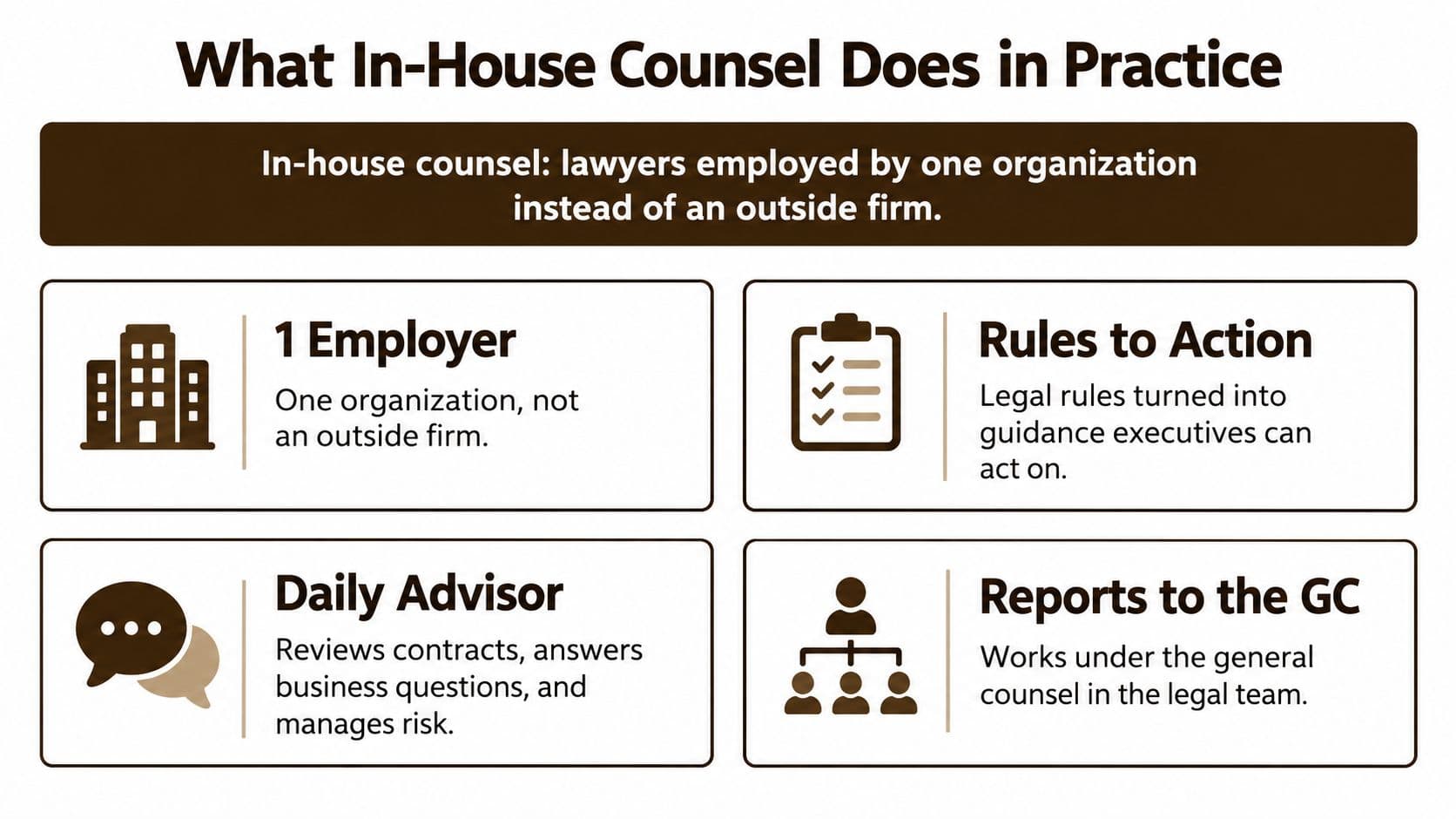
In-house counsel are lawyers employed by one organization rather than an outside law firm, and their job is to translate legal rules into practical guidance for executives and employees. They advise the organization, not individual managers personally, even when those managers ask the questions.
Say a product leader wants to launch a subscription service. Counsel checks the customer terms, cancellation process, privacy notices, and marketing claims, then identifies what needs to change before launch. The useful answer isn't just a list of legal concerns. It's a workable launch plan with clear responsibilities.
The role combines legal advice with ongoing involvement in the business.
Core In-House Counsel Duties
| Duty area | What counsel does | Typical example |
|---|---|---|
| Contracts and commercial agreements | Drafts, negotiates, and approves vendor, customer, and partner terms | Negotiating a liability cap in a software vendor agreement |
| Corporate transactions | Supports mergers, acquisitions, financing, and due diligence | Reviewing a target company's contracts before an acquisition |
| Regulatory compliance | Turns laws into policies, training, and monitoring | Building a privacy program for customer data |
| Employment and labor | Advises on hiring, terminations, and collective-bargaining agreements | Advising on a reduction in force |
| Intellectual property | Manages patents, trademarks, copyrights, and licences | Clearing and filing a trademark for a new product name |
| Tax | Assesses tax consequences of deals and corporate structures | Reviewing tax effects of an intercompany transfer |
| Disputes and investigations | Manages litigation with outside counsel, legal holds, and internal investigations | Issuing a litigation hold after a demand letter |
| Executive advice | Briefs leadership and the board on legal and regulatory risk | Summarizing remaining risk before a major launch |
The U.S. Bureau of Labor Statistics specifically describes corporate counsel as advising executives on patents, contracts with other companies, taxes, and collective-bargaining agreements. That breadth matters: the same department may support routine purchasing and a transaction that changes the company's direction.
Responsibility Doesn't Mean Doing Everything Personally
Counsel must recognize when a matter needs specialist help. An employment generalist might handle routine policy questions but engage local outside counsel for a sensitive cross-border termination. A corporate lawyer may coordinate tax advice rather than personally resolve a complicated tax issue.
The internal lawyer still owns the instructions, budget, and explanation to management. Hiring an outside firm doesn't transfer responsibility for making the advice usable.
A sole lawyer may carry every duty in the table, although not every task will arise daily. A large legal department divides the work among specialists. Likewise, not every in-house lawyer reports to a general counsel: the most senior lawyer may lead the function directly.
A Day in the Life of an In-House Lawyer
Consider a hypothetical Tuesday for corporate counsel at a software company, reporting to the general counsel. You arrive expecting to finish a vendor agreement. Before you open it, the sales director asks whether a customer contract can be signed today.
Much of the work happens through conversations around documents, not solitary drafting.

Morning Decisions Arrive Before the Planned Work
The customer contract includes an uncapped indemnity. You check the contract playbook, clarify what claims it covers, and compare it with your delegated approval authority. If the proposed exception exceeds that authority, you send the general counsel a focused recommendation rather than forwarding the entire agreement without explanation.
Next, a product manager asks whether customer usage data can train an AI feature. You check what data is involved, what customers were promised, and whether the proposed use needs additional permission or another legal basis. You work with privacy and security colleagues on an acceptable design rather than assuming consent wording alone solves the problem.
At lunch, outside litigation counsel calls about a demand letter. You identify the employees and systems holding relevant records, issue preservation instructions, and confirm that routine deletion won't remove evidence.
The pressure isn't always the difficulty of an individual question. It's deciding which question cannot wait.
Afternoon Work Includes Preventing Tomorrow's Problems
The contract queue needs attention. You prioritize requests by business impact, genuine deadlines, and legal exposure, then flag vendor renewals whose notice dates have already passed. Those renewals require a commercial discussion, not just a better calendar reminder.
Late in the day, you draft a board-pack summary: the issue, potential exposure, controls already in place, and the decision leadership needs to make.
For another perspective on the work, watch the video below.
That pattern helps explain the resource pressure: in 2023, 70% of legal departments reported higher matter volumes, while 66% reported flat or declining budgets, according to Thomson Reuters. Notice which parts of this day you'd enjoy and which would drain you.
Acting as a Business Partner, Not Just a Lawyer
The hardest answer is often neither an unconditional yes nor a flat no. It's a recommendation that protects the company without making a worthwhile deal impossible.
Suppose sales wants to accept unlimited liability for data breaches. The technically safest contractual position may be unacceptable to the customer. Identifying that tension alone leaves the business with the same problem it brought to you.
Put the Commercial Choices Beside the Legal Risk
Counsel should develop credible alternatives:
- Accept the exposure with safeguards. Investigate available cyber insurance and stronger security commitments. Explain exclusions, policy limits, and the added premium, because insurance doesn't make unlimited liability harmless.
- Negotiate a defined cap. Propose a separate data-breach cap tied to contract fees or another defensible measure. Check whether the potential loss bears any relationship to the deal's value.
- Decline the contract. Explain the revenue forgone and why the remaining exposure exceeds the company's approved tolerance.
You then recommend a path and identify who has authority to approve it. Executives can accept permitted commercial risk; they can't authorize unlawful conduct by calling it a business decision.
This expectation helps explain why the Thomson Reuters 2025 State of the Corporate Law Department report reported concern among general counsel about delivering value at three times the prior year's level, with cost control also becoming a higher priority.
Influence Matters More Than Control
Most colleagues don't report to legal. They involve you early when you understand their goals and give usable answers, not because you insist on reviewing everything.
Publish approved clauses and explain which changes business teams can accept themselves. Reserve escalation for meaningful departures. Otherwise, you become a bottleneck for decisions that don't require fresh legal judgment.
Success needs a balanced scorecard. Contract turnaround time shows responsiveness, outside counsel spend per matter shows cost discipline, and issues identified before disputes provide evidence of prevention. None should stand alone: fast signatures aren't a success if the company accepts obligations it can't perform.
Practical test: State your recommendation in a sentence, including its commercial cost and the risk that remains.
For example, recommend negotiating a capped exposure while explaining that doing so may delay signature. That's more useful than describing a clause as risky and leaving sales to work out what happens next.
General Counsel, Corporate, Compliance and IP Roles Compared
Reporting lines help explain why the work can feel close to executive management. In the Association of Corporate Counsel's 2025 Chief Legal Officers Survey, 79% of chief legal officers reported directly to the CEO, rising to 83% in the United States.
Those findings concern legal leaders, not every lawyer in a department. A corporate counsel role may involve regular contact with executives while still reporting through several layers of legal management.
In-House Counsel Roles and Reporting Lines
| Role | Core focus | Typical reporting line | Typical deliverables |
|---|---|---|---|
| General counsel or chief legal officer | Whole legal function, risk appetite advice, and budget | CEO or board | Department plan, board risk briefings, budget requests |
| Corporate counsel | Contracts, governance, and transactions | General counsel | Drafted and negotiated agreements, governance records |
| Compliance counsel or chief compliance officer | Regulatory obligations, codes of conduct, and investigations | General counsel, sometimes audit committee | Policies, training programs, investigation reports |
| IP counsel | Patents, trademarks, licensing, and clearance | General counsel, often working with R&D or product | Filings, clearance searches, licence agreements |
| Employment counsel | Labor law, terminations, and workforce disputes | General counsel or chief HR officer | Separation agreements, policy advice, dispute responses |
These are common arrangements, not fixed organizational rules. A chief compliance officer may sit outside legal to preserve independent oversight and isn't necessarily a lawyer. Employment counsel can work closely with HR while retaining a legal reporting line.
The distinction between in-house counsel and general counsel is especially important when evaluating seniority. In-house counsel describes the employment setting; general counsel usually identifies the lawyer responsible for leading the legal function.
Read the Responsibilities Before Trusting the Title
A corporate counsel title might describe a commercial contracts specialist or a broad generalist. At a small company, a senior counsel may effectively run legal without holding the general counsel title. At a multinational, someone with the same title may handle a narrow product portfolio.
Specialists become useful when recurring work requires sustained expertise. A patent-heavy business needs counsel who understands invention disclosures and prosecution strategy. An employer with complex workforce issues may need dedicated employment advice rather than repeatedly buying it externally.
When reading a job description, identify the dominant deliverables. Are you expected to negotiate sales agreements, lead investigations, manage a department, or advise on product rights? A long list of practice areas can hide a role whose real workload sits mostly in one category.
Then ask who makes the final decision, what outside counsel budget is available, and who covers unfamiliar jurisdictions. Those answers reveal the support behind the title and whether the employer's expectations are realistic.
How In-House Work Differs From Law Firm Practice
A law firm lawyer can resemble a specialist contractor brought in for a renovation. In-house counsel is closer to the resident engineer who knows the building and must keep it operating after the work is complete.
The analogy has limits. Firm lawyers can be heavily involved business advisers, and in-house lawyers can be highly specialized. The main difference is the continuing relationship with the organization.
In-House Counsel Versus Law Firm Practice
| Criterion | Law firm | In-house |
|---|---|---|
| Client | Usually multiple clients, with separately scoped matters | The employing organization |
| Measure of success | Client outcomes, quality, and often billable work | Business outcomes, risk management, cost, and speed |
| Scope | Often deep specialization within a practice | Broad coverage or specialization within the employer's business |
| Time recording | Often records time for client billing | Usually tracks resources through budgets and matter systems |
| Advice style | Advice shaped by the engagement and client instructions | Recommendation plus coordination of implementation |
| Conflicts | Checks across clients and matters | Still considers affiliates, personal interests, and individual representation |
| Career path | Partnership, counsel, or other firm leadership roles | Legal leadership, general counsel, or selected business roles |
One employer doesn't mean conflicts disappear. A manager's interests may diverge from the company's during an investigation. Counsel must be clear about whom they represent and when an individual needs separate advice.
What Transfers and What Needs Practice
Research discipline, drafting precision, and issue spotting transfer well from firm practice. So does knowing how to instruct a specialist: a clear factual summary and focused question can prevent unnecessary work.
The adjustment is often in how you deliver advice. Your colleagues may need a short decision note for a meeting rather than a thorough memorandum. You still do the necessary analysis, but you present the parts that change the decision.
You also remain involved after the recommendation. If you advise adding an approval step, you'll hear whether employees can really use it. If it causes avoidable delays, you'll need to help revise it.
In-house teams manage outside firms as professional service providers, including agreeing scope, staffing, budgets, and reporting expectations. Firm experience helps you assess that work, but it doesn't replace understanding how your employer earns money and operates.
Skills In-House Employers Test and How to Build Them
Hiring leaders need evidence that you can handle unfamiliar questions without either guessing or escalating everything. They'll look for legal competence alongside judgment about when to investigate, involve a specialist, or give a clear answer.
The Skills Checklist
- Legal depth and adjacent knowledge. Bring a strong practice foundation and recognize issues outside it.
- Commercial judgment. Explain how a legal choice affects revenue, delivery, customer relationships, or reputation.
- Triage and control design. Distinguish urgent exposure from routine work and assign ownership for corrective action.
- Contract lifecycle management. Understand intake, clause assessment, negotiation, signature authority, obligation tracking, and renewals.
- Executive communication. Lead with the decision needed, then explain the supporting reasoning.
- Budgeting and vendor management. Scope outside counsel work and challenge staffing or charges constructively.
- Change management. Help colleagues adopt a process instead of merely distributing a policy.
Use in-house lawyer interview questions to practice explaining those skills through specific decisions. Describe the issue, your recommendation, the competing priorities, and what changed because of your work.
AI Adds Governance Responsibilities
A 2025 survey of 152 legal departments across 17 countries, reported by Law360 Pulse, found that 55% were actively using or piloting AI, while general AI literacy was the most sought technical skill at 49%. Adoption creates work for counsel as well as potential efficiency gains.
A lawyer using AI for contract review still needs to verify the proposed edits against the agreement and approved playbook. Counsel also helps define permitted uses, protect confidential and personal data, assess vendor terms, and specify when human review is mandatory.
A polished AI output isn't evidence that its legal analysis or factual assumptions are correct.
Build experience through practical projects. Clean up a contract repository in SharePoint, create a renewal tracker, or maintain an approved-clause playbook. Follow a transaction from term sheet to signature so you understand how negotiated promises become operating obligations.
For AI governance, draft an internal acceptable-use policy and test it against realistic employee requests. Pair structured training with supervised application. In interviews, use sanitized examples and never disclose a former employer's confidential documents.
Decide Whether an In-House Career Fits You
An in-house move changes what you're responsible for, not just where you work. You'll need to judge whether the daily demands suit your temperament as well as your legal experience.
Questions Worth Answering Honestly
- Breadth or depth. Do you enjoy learning enough about unfamiliar areas to identify the next safe step, or would you rather remain highly specialized?
- Independent responsibility. Can you handle being the only lawyer on a question while recognizing when you need help?
- Influence without authority. Are you comfortable persuading colleagues who have different priorities and don't report to you?
- Business accountability. Do you want your advice judged partly by whether the organization can implement it successfully?
If the generalist version doesn't appeal, a specialist in-house role may still fit. Likewise, enjoying autonomy doesn't mean you should accept a position without a realistic outside counsel budget or access to experienced support.
Turn Interest Into Evidence
Compare prospective jobs by their actual deliverables, reporting lines, and resources. A practical guide to going in-house can help you organize the transition, but conversations with lawyers in your target sector will reveal the less visible demands.
Ask how they measure success, what interrupts their planned work, and what their busiest periods involve. Prepare an interview example that demonstrates a useful improvement, such as a clearer playbook or a repaired contract process.
Ultimately, the answer to “what does in-house counsel do?” is about responsibility for usable advice. This week, choose a job description, identify its biggest apparent legal risk, and write the sentence you'd use to recommend a response, including the trade-off.
Five Star Placements provides permanent recruiting for corporate legal departments, including general counsel, corporate counsel, compliance, and IP roles. Visit Five Star Placements to discuss an in-house career move or a search aligned with your department's responsibilities and culture.
Need help filling a legal role?
Five Star Placements partners with law firms and legal departments nationwide.
Schedule a Call