
10 in House Counsel Titles: Roles, Duties, and Seniority
October 15, 2026 · 20 min read · Five Star Placements

Table of contents
A candidate sees “Counsel” in a job posting and still can't tell what the job involves. Is it a broad generalist seat supporting sales and operations, a specialist role in privacy or tax, or a leadership position with responsibility for an entire legal function? Hiring managers face the same problem in reverse: a familiar title can attract candidates whose experience doesn't match the authority the business needs.
In house counsel titles vary by company size, industry, reporting line, and legal department design. A Corporate Counsel at a growing technology company may work directly with the founders, while the same title at a multinational may sit several layers below a General Counsel. A Chief Legal Officer may oversee compliance and public policy in one organization but function as a renamed General Counsel in another.
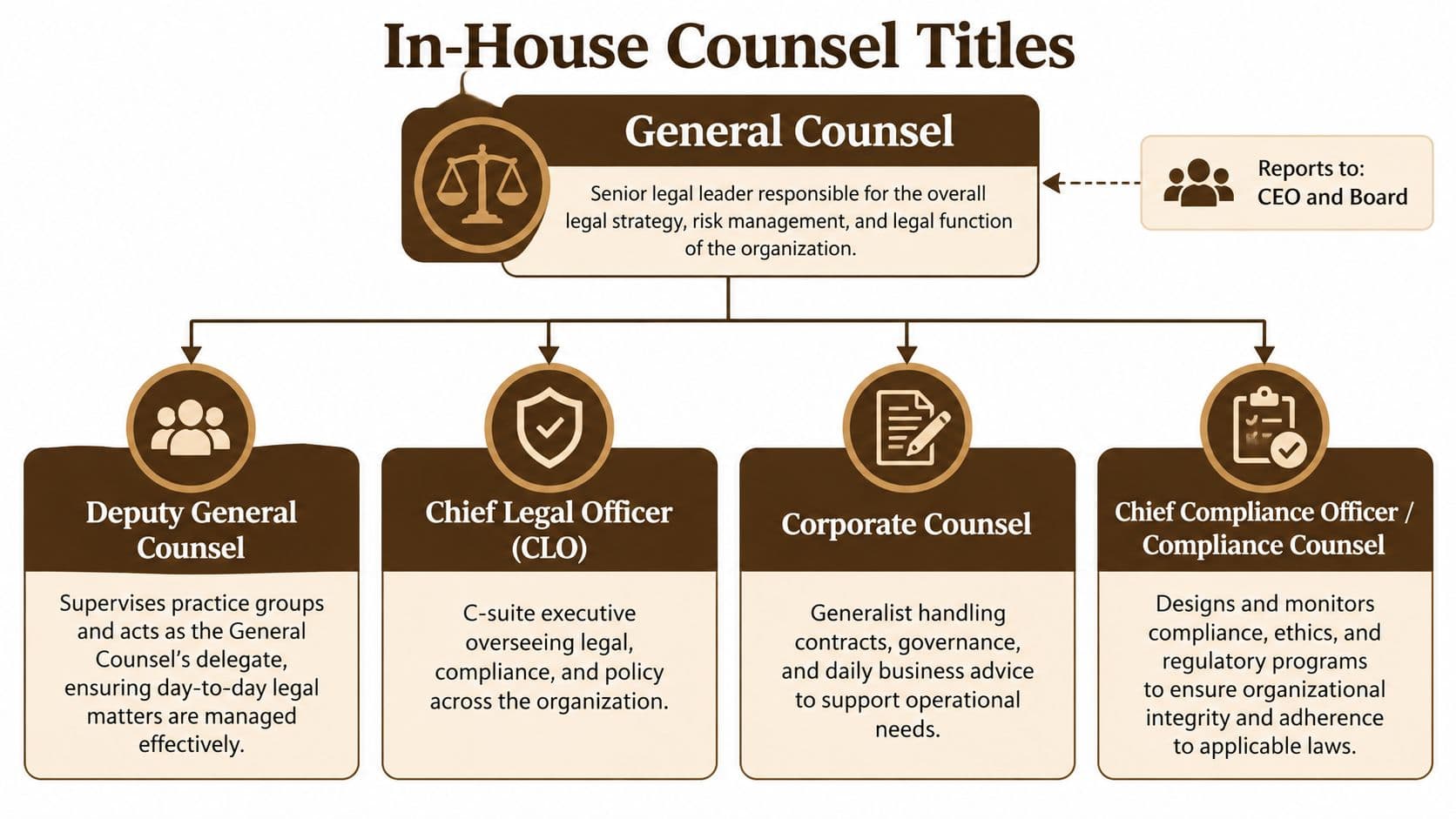
The practical way to compare titles is to examine scope, decision rights, day-to-day work, background, and hiring signals, not the label alone. The roles below are ordered from broadly scoped counsel positions to the most senior legal leadership positions. Use the list to assess where seniority begins, what each person should own, and whether a candidate's past work matches the role's real mandate.
Table of Contents
- 1. Corporate Counsel
- 2. Contracts Counsel
- 3. Privacy Counsel
- 4. Intellectual Property Counsel
- 5. Tax Counsel
- 6. Mergers and Acquisitions Counsel
- 7. Chief Compliance Officer and Compliance Counsel
- 8. Deputy General Counsel
- 9. General Counsel
- 10. Chief Legal Officer
- In-House Counsel Titles: 10-Role Comparison
- Matching the Right Title to Your Legal Team's Next Hire
1. Corporate Counsel
Corporate Counsel is usually the broadest generalist role in an in-house department. The lawyer may review customer and supplier agreements in the morning, advise an operations leader on employment risk after lunch, and help prepare corporate approvals or board materials before the day ends. At a mid-sized SaaS company, the role may combine commercial contracting with data-processing terms and governance support. In manufacturing, it may involve supplier agreements, product liability questions, and employment policy updates.
The title often marks the entry point into an in-house career, but it isn't necessarily junior. A Corporate Counsel with deep company knowledge can have substantial practical influence, particularly when business teams rely on that person as their first legal contact. Seniority begins to show through matter ownership, autonomy, stakeholder access, and responsibility for risk decisions, not through the title itself.
What hiring managers should test
Look for a mix of transactional and advisory experience rather than a narrow practice background. Strong candidates can identify the legal issue, explain its business consequence, and recommend a workable path without turning every operational question into a memo.
- Breadth: Ask which legal areas the candidate handled independently and which required escalation.
- Communication: Use a scenario involving a sales deadline or product launch and assess whether the candidate can explain risk to non-lawyers.
- Adaptability: Explore how the candidate managed unrelated matters arriving at the same time.
- Project ownership: Ask for an example of building a process, improving intake, or coordinating outside counsel.
A law firm associate with strong transactional experience can transition well, but hiring teams should test business judgment, prioritization, and comfort with incomplete information. Those skills often matter more than familiarity with a particular contract form.
2. Contracts Counsel
A sales team waiting on a customer agreement needs a legal answer that protects the business without stopping the deal. Contracts Counsel, also called Commercial Counsel, handles that work closest to revenue and procurement. Day to day, the role may involve drafting customer agreements, negotiating vendor terms, reviewing licensing provisions, maintaining templates, and advising sales or procurement on acceptable fallback positions. In a software company, one lawyer may handle subscription agreements, data-processing addenda, security schedules, and reseller terms in parallel.
The role also extends beyond individual documents. An effective Contracts Counsel turns recurring negotiation issues into usable playbooks, approval thresholds, fallback language, and intake rules. They may work with legal operations to improve a contract-lifecycle management process. Icertis and DocuSign CLM can support that system, but the lawyer must first convert legal judgment into workflows that business teams can follow.
To assess commercial maturity, ask candidates to describe the agreements they handled, the decisions they made themselves, and the points they escalated. A useful interview exercise presents a customer redline involving liability, security, indemnity, and termination rights. The candidate should explain the risk, propose a practical position, and connect the answer to revenue, margin, or customer retention.
Look for evidence that the candidate has:
- Playbook design: converted recurring negotiation issues into guidance for sales and procurement.
- Process fluency: used CLM tools and personally improved templates, routing, or approvals.
- Negotiation judgment: balanced deal speed with exposure rather than treating every clause alike.
- Business partnership: explained legal limits in terms commercial colleagues could act on.
Seniority begins when the lawyer owns the commercial framework, sets escalation rules, and influences how the company contracts globally. A junior Contracts Counsel may review standard forms, while a highly experienced one may shape policy, coach negotiators, and decide which risks require executive approval. The title alone does not establish that scope.

3. Privacy Counsel
Privacy Counsel turns data protection requirements into operating practice. The work may include reviewing data-processing agreements, advising product and marketing teams, maintaining privacy notices, supporting consumer rights processes, assessing vendors, and responding to incidents. In organizations operating across jurisdictions, the lawyer may also advise on international data transfers, regulator inquiries, retention rules, and privacy-by-design reviews.
The title is often paired with a Chief Privacy Officer or Data Protection Officer function, but the reporting structure matters. A Privacy Counsel reporting to the General Counsel may focus on legal interpretation and risk advice. A privacy leader with direct access to product, security, and senior management may own the entire privacy program. Candidates should understand both the law and the systems that make compliance work in practice.
How to evaluate the specialist
Credentials can help, particularly certifications such as CIPP/US, CIPP/E, or CIPM from the International Association of Privacy Professionals. They shouldn't replace practical testing. A candidate may know the terminology but struggle to map data flows, prioritize remediation, or communicate a product decision to engineers.
Ask candidates to explain how they'd handle a new product that collects personal data through multiple vendors. Strong answers should address data mapping, purpose, notices, contracts, access controls, retention, incident response, and documentation. They should also distinguish a legal requirement from a prudent control.
Technical literacy matters. Screen for comfort discussing systems architecture, identity and access, encryption, logs, cookies, analytics, and vendor integrations. A Privacy Counsel who can't understand where data moves will struggle to give useful advice, regardless of doctrinal knowledge.
For companies operating in Europe or across multiple U.S. jurisdictions, recruit for implementation experience rather than policy drafting alone. The best candidate can make privacy part of product development instead of treating it as a final review gate.
4. Intellectual Property Counsel
An IP Counsel's daily work depends on what the company creates, sells, and protects. The role may cover patents, trademarks, copyrights, trade secrets, licensing, product clearance, freedom-to-operate analysis, or infringement disputes. A life sciences company may need patent prosecution and technical litigation experience. A consumer brand may instead prioritize trademark portfolio strategy and enforcement.
Start hiring with the company's actual IP mix. A patent specialist may not manage brand protection, while a trademark lawyer may lack the background to advise engineers on ownership and invention assignment. Strong candidates can explain how they decide which assets merit registration, which risks warrant investigation, and when licensing offers more commercial value than enforcement.
The scope often reveals seniority more clearly than the title. An IP Counsel who sets portfolio direction, approves outside-counsel budgets, and advises executives is operating at a senior level, even without “Senior” in the title. Someone handling assigned prosecution or registration work may have substantial technical expertise but limited authority over enterprise priorities.
For patent-focused positions, confirm USPTO registration or patent bar status when the job requires it. A technical background can matter for software, engineering, biotechnology, and pharmaceutical work. Prosecution credentials alone do not show whether a lawyer can connect filings and enforcement decisions to product plans, research priorities, and revenue.
Use practical examples in interviews:
- Portfolio strategy: Which filings, renewals, licenses, or abandoned applications did the candidate prioritize, and why?
- Clearance work: How did the review change a product or brand launch?
- Business collaboration: How did the lawyer work with research, product, marketing, or engineering?
- Disputes: Did the candidate assess exposure, direct outside litigators, or negotiate a commercial resolution?
These answers show whether the candidate is an IP technician or a business adviser who happens to specialize in intellectual property. ભરતી
5. Tax Counsel
A proposed acquisition can look commercially attractive until tax treatment changes its structure, cost, or feasibility. Tax Counsel examines those consequences and advises the business before decisions become difficult to revise. The work may include reorganizations, transfer pricing, international planning, multistate obligations, tax controversy, and coordination with finance, accounting, auditors, and external advisers.
Hiring priorities should match the company's footprint and transaction profile. A multinational technology or pharmaceutical business may require international structuring and transfer pricing experience. A retailer or online marketplace may need state and local tax knowledge, including sales and use tax obligations. A transaction-heavy company may favor counsel who can assess tax consequences while negotiating deal documents.
Credentials help screen candidates, but they do not establish scope. An LL.M. in Taxation or CPA qualification may support the role, while the interview should focus on decisions the lawyer personally owned. Ask which tax issue they analyzed, which business decision it affected, and how they worked with finance or external advisers.
Assess the candidate against four practical signals:
- Technical match: Does the experience fit the company's international, state, transactional, or controversy work?
- Commercial judgment: Can the lawyer explain tax risk clearly while identifying workable paths forward?
- Cross-functional work: Have they advised controllers, treasury, auditors, or deal teams?
- Authority: Did they advise decision-makers, or mainly prepare analysis for another lawyer or executive?
Tax Counsel is usually a specialist adviser rather than a broad legal generalist. Seniority shows in the complexity of decisions owned, access to finance and executive leadership, and responsibility for external advisers or tax controversy. A lawyer who sets the tax position for major transactions operates at a different level from one who supplies technical analysis under supervision.
6. Mergers and Acquisitions Counsel
A transaction is approaching signing, diligence has uncovered a contract problem, and executives want a clear recommendation before the next negotiation. M&A Counsel handles the legal work behind acquisitions, divestitures, joint ventures, strategic investments, and restructurings. The work can include diligence, deal structure, confidentiality arrangements, purchase or merger agreements, disclosure schedules, regulatory review, signing and closing mechanics, and post-closing obligations.
Day to day, the lawyer keeps finance, tax, HR, intellectual property, regulatory specialists, executives, and outside deal counsel aligned. The strongest practitioners identify issues that could change price, timing, liability, or integration plans. They also distinguish a material risk from a point that consumes negotiation time without meaningful protection.
What the title signals
A law-firm M&A background can prepare a candidate for the role, particularly experience in a recognized deal practice. Hiring managers should test whether the lawyer can make decisions with incomplete information and changing commercial priorities.
Ask candidates to explain one transaction they personally drove:
- Which diligence finding changed the structure, price, indemnity, or closing conditions?
- How did they coordinate antitrust review or other approval processes?
- How did they control advisers, business owners, dependencies, and deadlines?
- What legal work continued after closing, including contracts, people, systems, or governance?
The answers show scope more clearly than the title. A lawyer who prepared documents under supervision has a different remit from one who set the transaction strategy and advised executives directly.
Senior M&A Counsel usually owns the legal workstream, allocates responsibilities across advisers, and escalates decisions with clear commercial consequences. An in-house M&A Counsel can lead major transactions without being the department's most senior lawyer. A Corporate Counsel title may conceal substantial deal leadership, so candidates should describe the matters they owned, the decisions they influenced, and their access to executives.

7. Chief Compliance Officer and Compliance Counsel
Compliance Counsel designs, implements, and monitors the company's compliance program. The work may cover anti-corruption, anti-money laundering, sanctions, trade controls, ethics, healthcare rules, financial regulation, government contracting, or other industry-specific requirements. A Chief Compliance Officer generally has a broader program mandate, including policy ownership, investigations, training, monitoring, reporting, and interactions with regulators or the board.
The title needs careful scoping. Compliance Counsel may advise on legal requirements while another executive owns operational controls. A CCO may own the full program and have authority to investigate, escalate, discipline, and report independently. If the role lacks access to senior leadership, the company may have created accountability without giving the compliance function enough authority to operate.
Hiring and governance signals
Industry experience matters. Financial services, healthcare, life sciences, and government contracting each create different compliance demands. Credentials such as the Certified Compliance and Ethics Professional designation from the Society of Corporate Compliance and Ethics may support a candidate's profile, but investigation judgment and regulator experience deserve equal attention.
Practical rule: Give the compliance leader a clearly documented path to the board or audit committee, especially when the role handles investigations or escalations involving senior employees.
Ask candidates to describe a compliance issue from detection through remediation. Strong answers cover evidence preservation, independence, privilege, root-cause analysis, corrective action, communication, and follow-up testing. Also ask how they decide whether a policy is working. A policy library is not the same as an effective program.
For a deeper view of the role's responsibilities, hiring teams can review this guide to a regulatory compliance attorney. The key distinction is authority: a compliance title becomes senior when the holder can influence conduct, access decision-makers, and require business owners to address control failures.
8. Deputy General Counsel
A Deputy General Counsel steps into the role when the legal department needs senior leadership below the GC. The title usually marks department leadership, people management, executive access, and delegated decision authority, not deeper expertise in one practice area. Seniority begins when the lawyer must set priorities, allocate resources, resolve internal conflict, and represent the department with executives.
The remit depends on the company. One Deputy may run daily legal operations and supervise several practice groups. Another may own litigation, governance, or a major commercial portfolio while the GC handles the board, CEO, public reporting, and enterprise strategy. Some Deputies serve as the GC's delegate and prepare for succession. Others remain permanent leaders of a defined function.
How to distinguish a ready candidate
Assess the work behind the title. Ask candidates to describe a period when business units competed for legal support, an internal investigation required difficult judgment, or executives resisted an unfavorable legal conclusion. Their answers should show how they made decisions, communicated risk, and kept work moving under pressure.
Look for evidence in four areas:
- Team leadership: hiring, coaching, performance management, and reorganizing lawyers.
- Breadth: oversight of multiple areas, such as transactions, litigation, employment, or governance.
- Delegation: clear judgment about what to retain personally and what to assign.
- Executive presence: the ability to represent the GC credibly with senior leaders or the board.
An internal promotion can preserve business knowledge and provide continuity. An external hire may bring experience redesigning a department or managing a broader portfolio. Before hiring, define whether the Deputy owns a specific remit or acts as the GC's general second-in-command. This Deputy General Counsel guide provides another reference point when calibrating the title and its expectations.
9. General Counsel
The General Counsel is typically the company's top lawyer and usually reports to the CEO, the board, or both. The GC sets legal strategy, manages the department, oversees outside counsel, advises executives and directors, and owns the legal response to major transactions, disputes, governance issues, regulatory matters, and enterprise risk. The role combines legal judgment with executive leadership.
A GC isn't merely the person who approves difficult contracts. The job often involves deciding how legal resources are allocated, which risks the company accepts, when to involve the board, and how the organization responds to regulators, litigation, employees, customers, and investors. In smaller businesses, the GC may still do substantial hands-on work. In larger departments, the GC's value increasingly comes from setting priorities and leading people.
The hiring signal that matters most
Look for a history of operating at the intersection of law and business. Candidates should be able to explain how they built or scaled a legal function, managed outside counsel, controlled legal spend, and advised executives under pressure. Board presence matters, but so does the ability to make complex risk understandable to non-lawyers.
A structured process should include the CEO, CFO, and relevant board representatives. They need alignment on reporting, authority, compliance ownership, budget, people leadership, and the expected balance between hands-on legal work and executive management. A vague mandate produces a poor search and an unstable hire.
The title itself remains dominant, but the market is shifting. The Association of Corporate Counsel's 2024 Chief Legal Officers Survey found that 57% of respondents held the title General Counsel, down from 66% in 2022. The same survey reported that the share using Chief Legal Officer rose to 28%, an increase of 7 percentage points over that period. The change reflects broader executive expectations, but it doesn't make GC and CLO interchangeable.
For candidates, evaluate the authority behind the title. A GC without budget control or executive access may have less influence than a differently titled legal leader with direct responsibility for enterprise risk and strategic decisions. Compensation should be assessed alongside scope, and hiring teams can use this resource on General Counsel salary as part of a broader market discussion.
10. Chief Legal Officer
Chief Legal Officer is usually the broadest legal leadership title in the list. In many organizations, the CLO holds a C-suite seat and oversees legal alongside compliance, ethics, government affairs, public policy, or risk. Some companies use CLO as a direct replacement for General Counsel, while others reserve it for an executive whose remit extends well beyond traditional legal advice.
The distinction matters because the title creates expectations. A CLO may present to the board, participate in enterprise strategy, lead responses to regulatory pressure, and coordinate functions that previously reported through separate channels. The role can be especially useful when legal decisions are inseparable from public policy, compliance, security, or government engagement.
Define the mandate before recruiting
Don't advertise a CLO role until the company has written down what the executive will own. Candidates need clarity on reporting to the CEO and board, compliance independence, government affairs, ethics, corporate security, budget, team size, and decision rights. Without that detail, the search may attract senior lawyers whose experience is impressive but misaligned.
The ACC Legal Technology Report surveyed 252 in-house counsel and legal-operations professionals across 22 countries and found that 78% considered legal technology a “must-have” for in-house legal departments. For a modern CLO, that doesn't mean becoming a systems administrator. It does mean understanding how matter management, contract lifecycle tools, workflow automation, knowledge management, metrics, vendor governance, and information security support the department's strategy.
A higher title doesn't automatically mean broader influence. Decision rights, executive access, budget ownership, and functional scope reveal the real level.
Candidates should demonstrate board communication, public company governance or regulated-industry experience where relevant, and the ability to connect legal judgment to business outcomes. Hiring managers should decide whether they need an enterprise executive or a top legal adviser. Sometimes the answer is General Counsel. Sometimes it is Chief Legal Officer. The title should follow the mandate, not substitute for one.
In-House Counsel Titles: 10-Role Comparison
| Role | 🔄 Complexity | ⚡ Resources & Speed | 📊 Expected Outcomes | Ideal Use Cases | ⭐ Key Advantages / 💡 Tips |
|---|---|---|---|---|---|
| Corporate Counsel | 🔄🔄 Medium, broad, varied matters | ⚡⚡ Moderate, reactive operational support | 📊 Day-to-day legal advice, contracts, compliance | Mid-sized firms needing generalist in-house counsel | ⭐ Broad exposure, business-facing. 💡 Hire transactional + advisory experience; strong communicator |
| Contracts Counsel (Commercial Counsel) | 🔄🔄 Medium, process-driven, repeatable | ⚡⚡⚡ High impact on deal velocity and throughput | 📊 Faster contract cycles, reduced negotiation risk | High-volume sales/SaaS, procurement, CLM implementations | ⭐ Direct revenue enablement. 💡 Seek CLM experience and playbook builders |
| Privacy Counsel | 🔄🔄🔄 High, fast-changing regulation | ⚡⚡ Ongoing, cross-functional resource needs | 📊 Managed data governance, breach response, regulatory compliance | Companies processing personal data; GDPR/CCPA/CPRA exposure | ⭐ Strong regulatory value. 💡 Look for IAPP certs, tech literacy, program-building experience |
| Intellectual Property (IP) Counsel | 🔄🔄🔄 High, technical plus legal nuance | ⚡⚡ Moderate, portfolio maintenance; licensing can be productive | 📊 IP protection and monetization; FTO and enforcement | Tech, life sciences, consumer brands with patents/trademarks | ⭐ Specialized, revenue-linked. 💡 Verify patent bar and technical degree when relevant |
| Tax Counsel | 🔄🔄🔄 High, complex, technical tax rules | ⚡ Low, resource-intensive, not rapid turnaround | 📊 Tax-efficient structuring, compliance, audit defense | Multinationals, cross-border transactions, transfer pricing issues | ⭐ Deep technical expertise. 💡 Prefer LL.M. in Tax/CPA and Big Four or tax-firm experience |
| Mergers & Acquisitions (M&A) Counsel | 🔄🔄🔄🔄 Very high, deal complexity and coordination | ⚡ Low, intense, deadline-driven resource demands | 📊 Executed transactions, managed regulatory approvals, smooth integrations | Companies pursuing acquisitions/divestitures or PE-backed growth | ⭐ Deal execution and negotiation strength. 💡 Hire law-firm M&A veterans with antitrust familiarity |
| Chief Compliance Officer / Compliance Counsel | 🔄🔄🔄 High, program design and oversight | ⚡⚡ Ongoing, continuous monitoring and training | 📊 Reduced regulatory and conduct risk; audit readiness | Regulated industries (financial services, healthcare, gov't contracting) | ⭐ Enterprise risk reduction. 💡 Seek regulator experience, CCEP, and board reporting capability |
| Deputy General Counsel | 🔄🔄🔄 High, management plus substantive work | ⚡⚡ Moderate, operational leadership, escalations | 📊 Department continuity, supervision of practice groups, high-stakes handling | Large legal teams needing succession and day-to-day leadership | ⭐ Leadership pipeline to GC. 💡 Prioritize team management and multi-practice experience |
| General Counsel | 🔄🔄🔄🔄 Very high, enterprise legal strategy | ⚡⚡ Strategic, controls legal spend and priorities | 📊 Enterprise risk management, board counsel, legal strategy | Public companies or organizations needing senior legal leadership | ⭐ Top-level influence and visibility. 💡 Target 15+ years, board-facing communication, proven scaling ability |
| Chief Legal Officer (CLO) | 🔄🔄🔄🔄 Very high, C-suite scope across functions | ⚡⚡ Strategic, oversees legal, compliance, policy & stakeholders | 📊 Integrated legal, compliance and policy outcomes aligned with business strategy | Large multinationals, public companies with significant policy/regulatory exposure | ⭐ C-suite strategic leader. 💡 Clarify scope (policy/compliance/gov't affairs) and reporting lines early |
Matching the Right Title to Your Legal Team's Next Hire
The best title starts with the work the business needs done. Before opening a search, map the department's current gaps across commercial support, specialist advice, compliance, transactions, operations, people leadership, and executive risk management. Then identify the reporting line, decision rights, budget authority, team responsibility, and access to the board or executive committee.
That exercise often narrows the choice quickly. A business drowning in customer and vendor negotiations may need Contracts Counsel, not a broadly defined Corporate Counsel. A company entering a regulated market may need Privacy Counsel or Compliance Counsel with implementation experience. An organization pursuing repeated acquisitions may need M&A Counsel with authority to coordinate internal and external deal teams. A department with several specialists but no operating leader may need a Deputy General Counsel before it needs another technical expert.
The title should reflect scope and seniority, but the job description must explain both. State which matters the person owns, which decisions require escalation, who controls outside counsel, which teams the lawyer manages, and how success will be evaluated. “Supports legal matters” isn't enough. Say whether the role negotiates commercial terms, leads investigations, sets compliance policy, manages a portfolio, or advises the board.
Candidates should use the same framework when evaluating an opportunity. Ask who the role reports to, whether the title is used consistently across the organization, what authority accompanies it, and whether the position is new or replacing someone. A General Counsel title may represent a hands-on solo lawyer in one company and an executive managing a global department in another. A Chief Legal Officer role may carry C-suite status, or it may only be a renamed GC position.
The data supports treating titles as signals, not proof. A 2021 U.S. survey of 93 senior in-house lawyers found that 83% reported one of the typically senior-most titles. Global or organizational General Counsel represented 40%, Chief Legal Officer 31%, and division General Counsel 12%, although respondents could select more than one title because multinational and divisional structures complicate naming. The Harvard Law School Forum on Corporate Governance survey report illustrates why role scope must be read alongside the label.
Technology also belongs in the hiring brief. A legal operations mandate shouldn't be a vague add-on. Define ownership for systems, workflow, metrics, vendor management, information security coordination, and adoption. One practitioner survey reported that 45% of legal professionals described themselves as General Counsel tasked with running legal operations, while 82% said their department had at least one dedicated legal-operations role. Those figures reinforce a practical point: title and function often diverge.
Once the mandate is clear, choose one or two titles that accurately communicate it. Avoid inflating a title to attract candidates when the organization can't provide the authority it implies. Avoid minimizing a role whose decision rights and executive access justify senior leadership status. Accurate naming improves candidate quality, internal expectations, succession planning, and retention.
Five Star Placements can support companies hiring in-house counsel, including searches for Corporate Counsel, Compliance Counsel, Intellectual Property Counsel, M&A Counsel, Contracts Counsel, Tax Counsel, General Counsel, and Chief Legal Officer roles. The firm provides contingency-based permanent placement, so there are no upfront costs, and it screens candidates against the client's experience, skills, and culture requirements. For hiring managers who have defined the mandate but need help reaching qualified legal talent, external recruiting support can make the title and scope alignment more practical.
Five Star Placements provides permanent placement for in-house counsel and legal operations leaders, with customized search and screening for corporate legal departments across the United States. If you're hiring for a clearly scoped counsel, GC, or CLO role, visit Five Star Placements to discuss the search.
Need help filling a legal role?
Five Star Placements partners with law firms and legal departments nationwide.
Schedule a Call