
General Counsel Salary 2026: A Complete Breakdown
July 17, 2026 · 17 min read · Five Star Placements
Table of contents
General counsel pay at the top end is no longer “big law adjacent.” It's full executive compensation. Median total compensation for General Counsels at the largest 500 U.S. public companies hit $3.4 million in 2024, up from $2.8 million in 2020, according to Equilar's General Counsel pay trends release.
That headline number gets attention, but it also distorts the market. Most companies aren't in the Equilar 500. Most GC searches happen in private companies, growth-stage businesses, regional employers, and lean legal departments where the job is broad, the support is thin, and compensation data is frustratingly opaque.
That's where companies make bad offers and candidates misread their bargaining power. Boards anchor too high on Fortune 500 examples or too low on stale salary surveys. Candidates focus on base pay and ignore the mechanics that drive long-term value. Neither side benefits from that confusion. If you need broader legal recruiting context beyond compensation, Five Star Placements' company overview gives a clear picture of the legal hiring environment they work in.
Table of Contents
- Understanding the Modern General Counsel Salary
- The Four Pillars of General Counsel Compensation
- Key Drivers of General Counsel Salary Variation
- General Counsel Salary Benchmarks by Company Size
- How to Negotiate Your General Counsel Compensation
- Structuring a Competitive General Counsel Offer
- Frequently Asked Questions About GC Salaries
Understanding the Modern General Counsel Salary
The title “General Counsel” used to signal senior legal oversight. Now it often means legal chief, risk manager, strategist, board advisor, compliance quarterback, and internal fixer all at once. Compensation followed that shift.
At the public-company elite tier, the money is obvious. In the middle market, the logic matters more than the headline. A private-company GC may not see a public-company package, but the role can still carry enterprise-level responsibility: financing support, employment risk, contracts, disputes, privacy, commercial strategy, governance, and managing outside counsel with almost no internal bench.
Why the market keeps confusing buyers and sellers
Most salary content treats the market like it has only two versions of the job. One is the Fortune 500 legal chief with multimillion-dollar upside. The other is a vague “national average” that's too broad to help anyone make a real offer.
That's useless in practice.
A founder hiring the first real legal leader needs to know whether the role is closer to a senior commercial lawyer, a true GC, or a future Chief Legal Officer seat in disguise. A candidate needs to know whether the company is paying for judgment, for operational grind, or for both.
A strong GC package should reflect the scope of risk the company is handing over, not just the prestige of the title.
What smart benchmarking looks like
If you're a company, stop asking, “What does a GC make?” Ask four narrower questions:
- What stage are we at: Early-stage, sponsor-backed, mature private, or large public companies pay differently because the legal problems are different.
- How exposed is the business: Heavily regulated, litigation-prone, or transaction-heavy companies need deeper judgment.
- How lonely is the seat: A law department of one deserves different treatment than a heavily staffed legal team.
- What kind of upside are we offering: Cash-light companies need a credible equity story, not a hand-wavy one.
If you're a candidate, benchmark the role before you benchmark the title. That's where most compensation mistakes start.
The Four Pillars of General Counsel Compensation
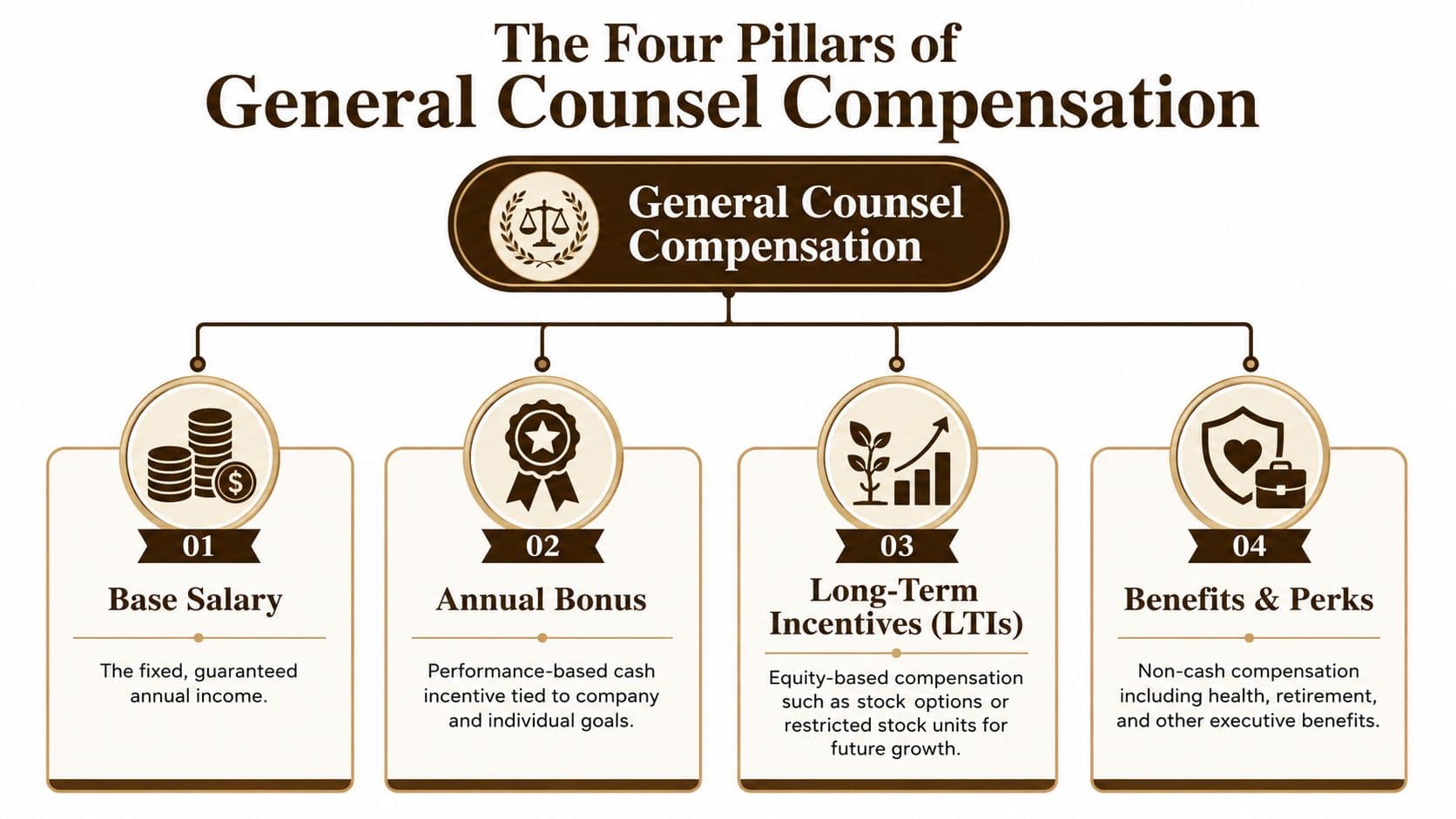
A General Counsel package has four moving parts. Most offer letters list them cleanly. Most candidates still evaluate them badly.
The right way to read a GC offer is to separate what's guaranteed, what's contingent, what's long-term, and what's implicitly valuable.
Base salary is the floor, not the full story
Base salary matters because it sets the stable cash value of the role. It anchors bonus formulas, influences severance, and signals how seriously the company views legal leadership.
But at senior levels, base salary is often the least interesting part of the package. In large U.S. public corporations, base salary represents only 18% of the total package, while stock awards account for 27% and performance incentives 35%, according to BarkerGilmore's breakdown of large-corporation GC compensation.
That's the key lesson candidates and hiring teams miss. If you negotiate only base, you're negotiating the smallest lever in the package.
Variable pay decides whether the offer is executive-level
A serious GC offer usually includes an annual bonus and some form of long-term incentive. Those are not decorative extras. They're how companies move a legal hire from “senior lawyer” into “enterprise executive.”
Consider the four pillars this way:
- Base salary gives predictability. It covers the day job and reduces candidate risk.
- Annual bonus rewards near-term execution. That should tie to company performance, personal performance, or both.
- Long-term incentives align the GC with enterprise value. Equity, options, or stock-linked awards matter most when the company expects the legal leader to help shape growth, financing, governance, or exit readiness.
- Benefits and perks don't usually win the negotiation, but they can close it. Executive benefits, retirement, health coverage, severance protection, and flexibility often matter more to experienced candidates than employers assume.
What each pillar should do in a real offer
A weak package is lopsided. It offers a passable base, a vague bonus, and “equity to be discussed later.” That tells an experienced GC the company hasn't thought through the role.
A better package has internal logic:
| Pillar | What it should answer |
|---|---|
| Base salary | What is the guaranteed cash value of the role today |
| Annual bonus | What short-term outcomes will be rewarded |
| LTIs | How does the GC participate in long-term enterprise value |
| Benefits and perks | What protections and quality-of-life terms make the role sustainable |
Practical rule: If the company calls the role strategic but keeps the entire package cash-only, it probably wants executive judgment without paying for executive alignment.
Candidates should also press on definitions. Ask what performance means. Ask how bonus targets are measured. Ask whether equity vests on a standard schedule, accelerates on change in control, or disappears if the company changes course.
That's not being difficult. That's reading the deal correctly.
Key Drivers of General Counsel Salary Variation
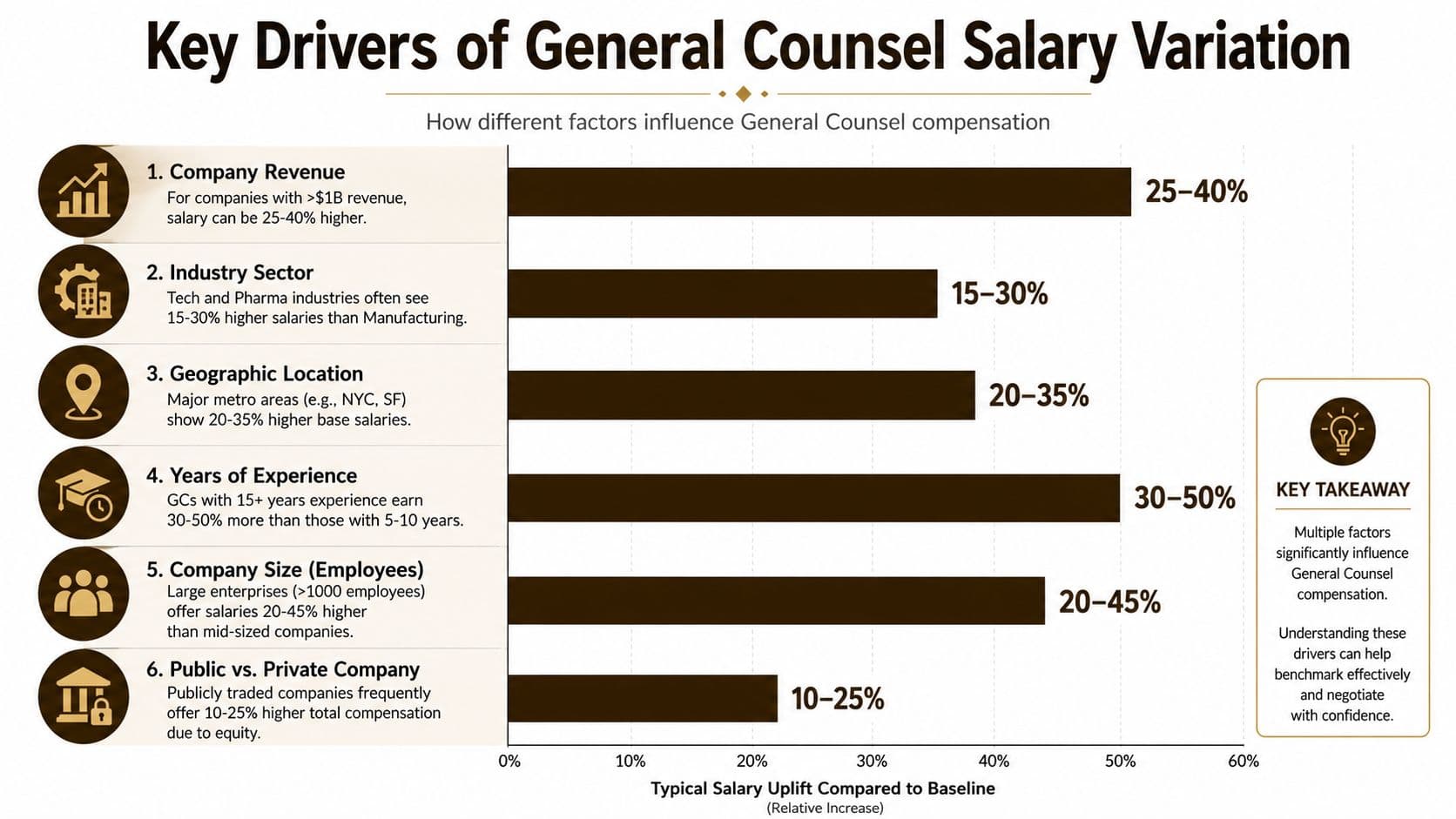
General counsel salaries vary widely because the role itself is not standardized. A GC who handles contracts, employment issues, and outside counsel management creates a different level of business value than one advising the board on financing, investigations, governance, and acquisitions.
That is why broad national averages are so unhelpful, especially for private companies and mid-market employers. They flatten real differences in scope, risk, and decision-making authority.
Company stage and legal complexity set the pay range
Stage matters because it changes what the company is buying. In an earlier-stage business, the top legal hire may be building the function from scratch, standardizing contracts, setting policies, and controlling outside counsel spend. In a more mature company, the GC often becomes a daily advisor to the CEO, a regular presence with the board, and the person expected to handle financing support, internal investigations, litigation oversight, and high-stakes commercial decisions.
For mid-market companies, this is the benchmark most often missed.
A private company with growing revenue, lender pressure, acquisition activity, and a lean legal team should not price the GC role like a basic commercial counsel job. It also should not copy public-company packages at the top of the market. The right comparison is a company with similar revenue, ownership structure, and legal pressure.
Industry and ownership structure change the value of judgment
Some sectors create more legal intensity than others. Heavily regulated businesses, repeat litigants, companies with major privacy exposure, and businesses that live on large customer or vendor agreements usually need a stronger, more experienced GC. That drives compensation up because the cost of weak judgment is higher.
Ownership structure matters too. Public companies carry disclosure obligations, governance demands, securities exposure, and investor scrutiny that private companies do not. But private equity backed and founder-led businesses can be just as demanding in a different way. They often expect a GC to move faster, build processes with limited headcount, support transactions, and act as a practical business partner without the infrastructure of a larger legal department.
That is the gap many salary guides skip. They cover Fortune 500 legal chiefs or generic U.S. averages, while the middle of the market gets lumped together. If you want a better read on how legal hiring trends show up across real employers, the Five Star Placements legal hiring blog is a useful supplement to compensation surveys.
Geography still matters, but less than scope
Location can move compensation, particularly in markets tied to finance, regulation, or high-cost executive hiring. According to Global Legal Post's report on U.S. general counsel compensation, Washington, D.C. reports significantly higher average GC base pay than San Francisco. That does not mean every employer in D.C. should match that level. It means market expectations rise where legal work is closer to regulators, federal contractors, policy risk, or major institutions.
Still, geography is usually a modifier, not the main pricing tool. Scope wins.
The practical ranking I use when advising clients
If you are trying to benchmark a GC role, weigh the factors in this order:
- Company stage, revenue, and growth pressure. These set the basic pay band.
- Legal complexity. Financing, M&A, litigation, compliance burden, and board exposure change the value of the role fast.
- Ownership structure. Public, PE-backed, family-owned, and venture-backed companies demand different things from the GC.
- Team depth. A GC with no bench is both strategist and doer, and that should be paid accordingly.
- Geography. This adjusts the number, but usually should not determine it on its own.
The title does not price the role. The operating conditions do.
If you are a candidate, compare offers based on what you will own. If you are a company, benchmark against similar pressure, not similar prestige. That is how you avoid overpaying for title inflation and underpaying for real executive judgment.
General Counsel Salary Benchmarks by Company Size
The spread in GC pay is massive. Early legal leaders at smaller companies can sit at the low end of the market, while chief legal officers at the largest public companies can land at the top. That gap is exactly why generic averages fail, especially for the mid-market companies that make up a large share of actual hiring.
That is the blind spot in most salary guides. They either track Fortune 500 compensation or collapse everything into one national number. Neither helps a private company with $75 million in revenue hiring its first true GC, and neither helps a candidate decide whether an offer matches the job.
Use company size to set the band, then price the role inside it
Company size matters because it usually predicts budget, board visibility, deal activity, and legal risk. It does not price the job by itself.
A $40 million private company with one lawyer handling commercial contracts, employment, claims, compliance, and outside counsel can justify a stronger base salary than a larger business that gives its GC a full legal team and narrower direct ownership. Size sets the lane. Scope sets the number.
For more perspective on how employers structure legal hiring across different situations, the legal hiring insights on the Five Star Placements blog can help as a secondary reference point.
Sample GC compensation bands by company revenue
Use these bands as working benchmarks, not as a script. The middle market has fewer clean public data points than top-tier public companies, so honest ranges beat fake precision.
| Annual Company Revenue | Base Salary Range | Annual Bonus Target | Long-Term Incentive Value |
|---|---|---|---|
| Early-stage startup | Lower end of the GC market, especially if this is the first senior legal hire and cash is tight | Often lighter cash bonus where equity carries more of the package | Can be meaningful if the company expects the lawyer to build the function and share growth risk |
| Lower middle market private company | Usually higher than startup levels, but often well below public-company executive pay | Common for rewarding execution on contracts, employment matters, compliance buildout, and outside counsel control | Often modest or selective, depending on ownership structure and growth plans |
| Upper middle market private company | Higher base pay where the role includes financing support, board work, litigation oversight, or multi-state compliance | Bonus targets are often stronger because the GC is influencing broader business performance | More common where owners want retention and strategic alignment over several years |
| Large public corporation | Upper end of the market, with much wider upside in total compensation | Bonus is often a major share of total cash compensation | Equity or other long-term incentives are often central to the package |
Mid-market employers should stop copying public-company templates. A private company does not need to mimic a Fortune 500 pay design to compete. It needs to match the actual weight of the job.
My recommendation is straightforward. If the GC will be a department of one, carry direct board exposure, and clean up years of underbuilt legal process, pay more in base salary. If the company already has legal infrastructure, shift more value into bonus or long-term incentives. That approach is easier to defend internally and easier to sell to strong candidates.
Candidates should read these bands the same way. Ask where the company fits by revenue, then test whether the offer reflects what you will personally own. If the employer wants a builder, strategist, compliance lead, commercial reviewer, and outside counsel manager in one seat, the compensation should reflect that reality.
How to Negotiate Your General Counsel Compensation
Most GC candidates negotiate too late and too narrowly. They react to the offer instead of shaping the frame before numbers harden.
That's a mistake, especially in the mid-market. Public-company packages are easier to discuss because the compensation language is more developed. Private-company offers often come with fuzzier benchmarks, thinner documentation, and more room for arbitrary decisions.
Lead with scope, not just seniority
A lot of salary content still centers on top-tier public-company pay and broad national averages. That leaves a major blind spot in the actual hiring market. Mid-market private-firm GC compensation remains poorly benchmarked, and the 2019 ACC survey report cited average pay of $219,911 for that segment, as noted in Paragon Legal's analysis of the data gap in general counsel salary reporting.
That data point is useful because it proves the gap. It is not a number you should copy into a current negotiation without context.
Your advantage comes from showing the company what it's really buying. Build your case around role scope:
- Risk ownership: What legal exposure will sit with you personally.
- Operational breadth: Whether you'll manage only legal strategy or also handle contracting, employment, compliance, privacy, and outside counsel.
- Executive access: Whether the role is embedded with the CEO, board, or investors.
- Build mandate: Whether you're inheriting a functioning department or creating one from scratch.
If the company wants you to be the first call for every hard problem, negotiate like an executive, not like a senior individual contributor.
A short resource like this video can help candidates sharpen how they frame compensation conversations before the final round.
Negotiate the structure before you negotiate the headline number
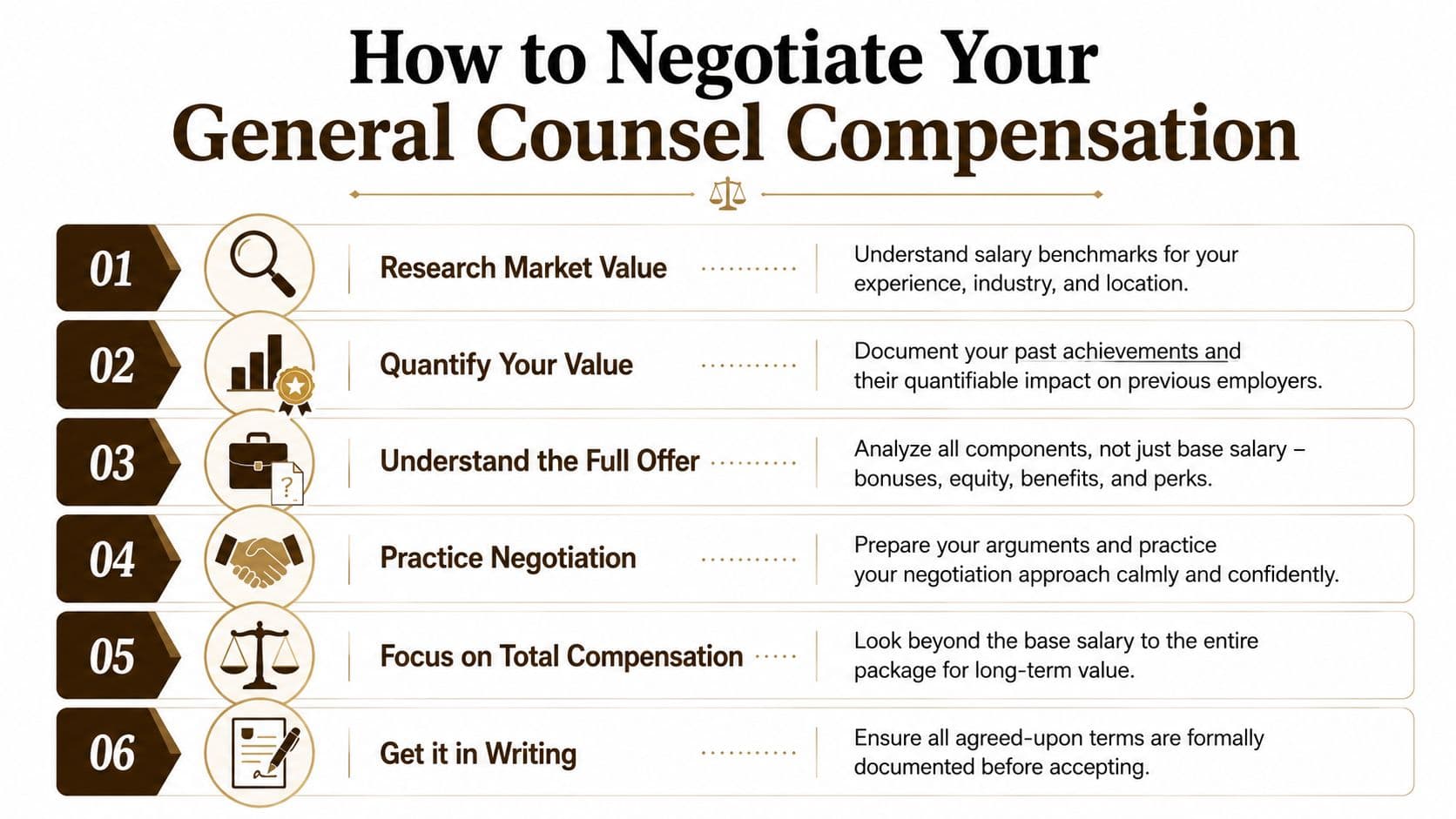
The cleanest GC negotiations usually cover these points in order:
-
Define the role clearly
Confirm reporting line, board exposure, team size, and functional ownership. -
Clarify the cash package
Ask what the base is meant to reflect and how bonus targets are measured. -
Interrogate the long-term upside
If there's equity, ask what form it takes, how it vests, and what happens in a transaction. -
Address downside protection
Senior candidates should care about severance, change-in-control treatment, and restrictive covenants. -
Get the full package documented
Verbal promises disappear fast when leadership changes.
If you need a direct conversation about a live search or offer structure, contact Five Star Placements after you've mapped the role and the economics.
The strongest negotiators stay calm and specific. They don't demand more money because they “deserve” it. They show why the company's expectations require a different package.
Structuring a Competitive General Counsel Offer
Companies lose strong GC candidates for predictable reasons. The role is underscoped, the offer is over-indexed on base salary, the equity story is vague, or the decision-makers can't explain why the package is structured the way it is.
That's avoidable.

Stop benchmarking against the wrong peers
If you're a private company, don't compare your role to the top end of the public-company market. That creates sticker shock and usually produces the wrong internal reaction. But don't use generic attorney salary references either. A real GC isn't just another in-house lawyer with a fancier title.
Benchmark against peers that match your legal burden:
- Ownership model: Founder-led, private equity-backed, family-owned, or public.
- Business complexity: Single-product and domestic is different from multi-entity and regulated.
- Support structure: One legal hire versus an established department.
- Strategic exposure: Board-facing and transaction-heavy roles deserve a more executive package.
Show the candidate how the package works
A competitive offer isn't just a number. It's a narrative with math behind it.
Spell out the base. Define the bonus target and what earns it. Explain why the equity piece exists and when it becomes valuable. If the company can't articulate that clearly, experienced candidates assume the package is improvised.
Here's the offer design I usually recommend in concept:
| Offer element | Employer objective |
|---|---|
| Strong enough base | Reduce candidate risk and signal seriousness |
| Clear annual bonus | Tie execution to visible business goals |
| Meaningful long-term incentive | Retain the GC and align judgment with enterprise value |
| Practical protections | Make the role acceptable for a senior executive leaving a stable seat |
Hiring signal: The more ambiguity in the offer, the more expensive the search becomes.
The best offers also reflect the actual pain points of the job. If the company needs a builder, pay for buildout. If it needs a board-ready strategist, pay for judgment. If it needs both, don't pretend one compensation lever will cover the whole ask.
Frequently Asked Questions About GC Salaries
Is a Chief Legal Officer paid more than a General Counsel
Often, yes. The higher pay shows up when the Chief Legal Officer owns more than legal advice and takes on compliance, corporate governance, risk, government affairs, or the corporate secretary function.
For mid-market and private companies, title inflation is common. A company may call someone CLO to signal status without expanding the job. Benchmark the seat by scope, reporting line, board exposure, and control over adjacent functions. That is what changes compensation.
What should a first General Counsel at a startup expect
Expect a package built around tradeoffs. Base salary is often lighter than at a larger private company, but the role is usually broader, more operational, and more exposed to leadership decisions.
That matters.
A first GC is rarely hired just to review contracts. The company is buying judgment, infrastructure buildout, outside counsel management, policy creation, and execution under pressure. If the business wants one person to act as strategist, builder, and day-to-day legal operator, the offer should pay for all three jobs. Candidates should press hard on equity terms, bonus metrics, and severance, because early-stage cash gaps only make sense if the upside and protections are real.
How does remote work affect general counsel salary
Remote work has added real complexity to senior-level benchmarking. Some companies still peg pay to headquarters or executive location. Others use a national range for hard-to-fill legal leadership roles, especially in the mid-market where talent pools are thinner.
The right approach is practical. Price the role based on business complexity, decision authority, board access, travel expectations, and the number of jurisdictions or business lines involved. Then make a location adjustment if it materially affects the market. Geography should influence the offer. It should not define it.
A remote GC supporting a PE-backed company, a distributed executive team, or multi-state operations should be paid like a senior business operator, because that is the job.
Does private equity ownership change GC compensation
Yes, and companies routinely underestimate how much it changes the role.
PE-backed GCs usually deal with tighter reporting cadence, lender and investor visibility, add-on acquisitions, governance discipline, and faster decision cycles. That combination often supports higher bonus opportunity, stronger equity participation, or both. If a sponsor expects the GC to help drive transactions, integration, and exit readiness, pay should reflect that added pressure and value creation.
If you're hiring for a General Counsel, Corporate Counsel, compliance, legal operations, or law firm leadership role, Five Star Placements can help you benchmark the market, define the role properly, and reach qualified legal talent without wasting time on mismatched candidates.
Need help filling a legal role?
Five Star Placements partners with law firms and legal departments nationwide.
Schedule a Call