
Write a Powerful Cover Letter Legal Assistant: Tips &
July 12, 2026 · 17 min read · Five Star Placements
Table of contents
You're probably looking at a legal assistant job posting right now, tweaking your resume, and wondering whether the cover letter matters enough to justify another hour of work. That reaction is reasonable. A lot of job seekers have been told that cover letters are outdated, ignored, or optional.
In legal hiring, that advice falls apart fast.
For a legal assistant role, the cover letter is often the only place where you can show judgment, tone, precision, and how you think about supporting attorneys, clients, and deadlines. A resume lists tasks. A strong cover letter legal assistant application explains why your background fits that employer's workflow, pressure points, and standards.
Table of Contents
- Why Your Cover Letter Is More Than a Formality
- The Anatomy of a High-Impact Legal Assistant Cover Letter
- Showcasing Your Skills as Solutions
- Tailoring Your Message for Law Firms vs In-House Roles
- Optimizing for ATS and Digital Submissions
- Common Cover Letter Mistakes That Guarantee Rejection
- Legal Assistant Cover Letter FAQ
Why Your Cover Letter Is More Than a Formality
A legal assistant opening can attract candidates with similar software exposure, similar filing experience, and similar administrative credentials. The difference usually isn't who can type “calendar management” or “document preparation” on a resume. The difference is who can show a hiring manager, clearly and quickly, how that experience translates into value.
That matters in a market where the work remains steady. The U.S. Bureau of Labor Statistics reports that the median annual wage for paralegals and legal assistants was $61,010 as of May 2024, and projects approximately 39,300 openings each year on average even though employment is expected to show little or no change from 2024 to 2034, according to the BLS occupational outlook for paralegals and legal assistants. Stable demand sounds comforting, but it also means employers can be selective.
What the resume can't do on its own
A resume is built for scanning. It helps a reviewer confirm where you worked, what software you know, and whether you've touched the right kinds of matters. It doesn't do a great job of explaining context.
The cover letter does. It lets you answer questions hiring partners and general counsel care about:
- Can this person support our pace
- Do they understand our practice
- Will they communicate professionally with clients and attorneys
- Can they solve operational problems instead of adding to them
Your cover letter isn't there to summarize your resume. It's there to interpret it.
That distinction is where many applicants lose ground. They submit a polite letter that says they're organized, detail-oriented, and excited to apply. None of that is harmful, but none of it is persuasive either.
What legal employers are really looking for
Legal teams hire under pressure. Someone is covering overflow. Deadlines still have to be met. Clients still need updates. Documents still need to be filed correctly. When a role opens, the employer isn't looking for a generic professional. They're looking for relief.
A strong cover letter legal assistant strategy does one thing well. It connects your past work to the employer's immediate needs. If the posting suggests heavy litigation support, show how you handled fast-moving deadlines and attorney calendars. If the posting points to client intake and case organization, explain how you keep matters moving without dropped details.
Here's the trade-off candidates miss. A generic letter is faster to send. A targeted letter is far more useful to read. In legal hiring, useful wins.
The Anatomy of a High-Impact Legal Assistant Cover Letter
A hiring partner opens your application between calls, sees one page, and can tell within seconds whether you understand how legal work gets done. That is the standard your cover letter has to meet. Strong legal assistant letters are built for speed, clarity, and relevance because the reader is screening for someone who can reduce pressure on the practice, not add to it.
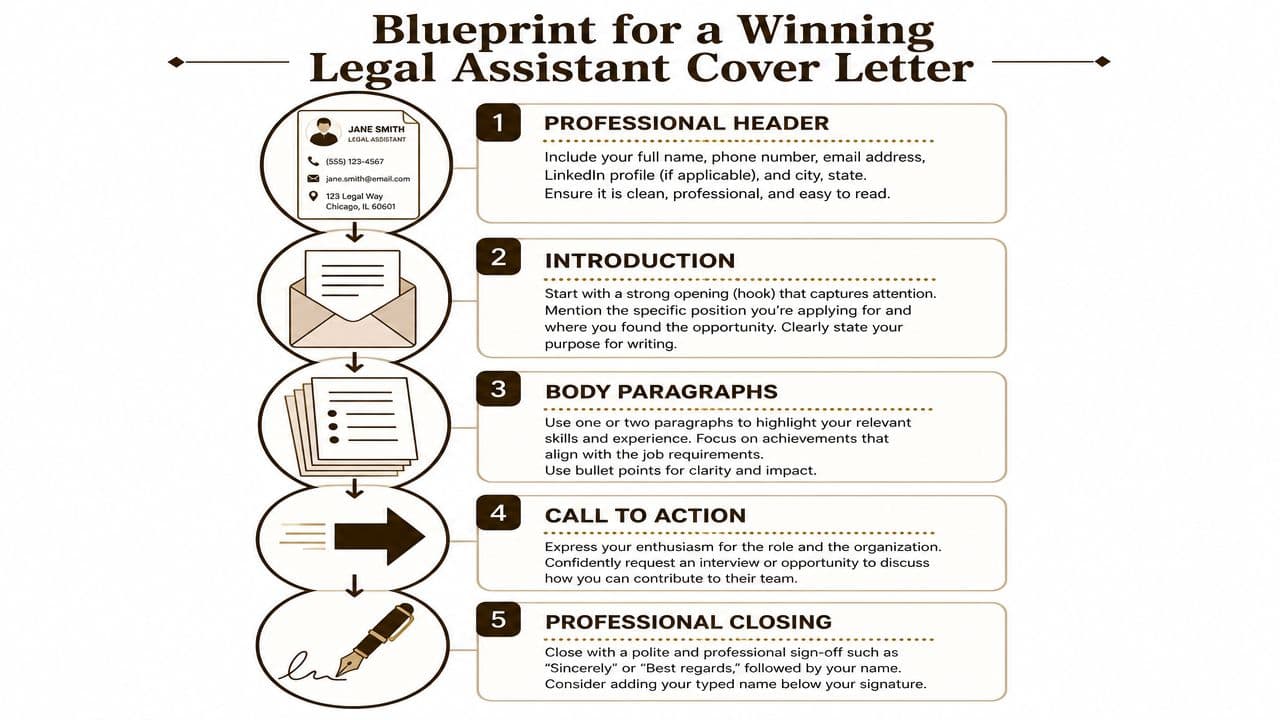
Clio's guidance is useful on structure. It recommends a focused three-part format and a one-page limit in its legal assistant cover letter guidance. That advice holds up in actual hiring. Legal employers want concise writing that shows judgment about what matters.
Keep it to one page and make every line earn its place
From a recruiting standpoint, long cover letters create risk. They suggest the candidate may not know how to prioritize, and prioritization is part of the job. A legal assistant who supports litigation, transactions, compliance, or intake work has to separate the urgent from the merely relevant. Your letter should show the same discipline.
A useful target is roughly 250 to 350 words. That is enough space to connect your background to the role without drifting into biography. If you cannot fit your case in that range, the issue usually is not formatting. It is selection.
The five parts that matter
Use a structure that makes review easy:
| Part | What it should do | What to avoid |
|---|---|---|
| Header | Match your resume format and include contact details | Decorative layouts or inconsistent styling |
| Salutation | Address a real person if possible | “To Whom It May Concern” |
| Opening paragraph | State the role and your strongest point of fit | Generic interest or a broad career summary |
| Body paragraph | Prove you can support legal operations with accuracy, pace, and professionalism | Repeating resume bullets or listing software with no context |
| Closing | Reinforce the value you would bring and ask for an interview | A passive sign-off that adds no substance |
What each paragraph needs to accomplish
The opening paragraph should do more than announce that you are applying. It should position you in the employer's world. If the role is plaintiff litigation, support-heavy corporate work, trusts and estates, or in-house compliance, say so and tie your background to that environment. Hiring teams notice candidates who understand the setting they are walking into.
The body paragraph is where strong candidates separate themselves. Do not just mention calendaring, filings, document prep, client contact, or matter management. Explain what those tasks solved. Did your support help attorneys stay ahead of filing deadlines, keep intake organized during volume spikes, or maintain accurate records across active matters? That is the level of framing that makes a legal assistant cover letter persuasive.
Practical rule: If a sentence only describes a duty, add the operational result or cut it.
The closing paragraph should be short and controlled. Confirm your interest, point back to the match, and invite further discussion. A good close sounds confident, not performative.
A simple formula that holds up in legal hiring
This sequence works because it mirrors how employers review candidates:
-
State the role and legal context
Identify the job and show you understand the practice area, department, or workload. -
Connect your experience to operational needs
Show how your background helped attorneys, clients, and matters move with fewer delays, errors, or administrative gaps. -
Close with a direct next step
Express interest in discussing the role and keep the tone professional.
That structure gives hiring partners and general counsel what they need fast. It also forces you to make the right trade-off. Instead of trying to say everything, you present the few points that prove you can step in and make the legal team run better.
Showcasing Your Skills as Solutions
Most legal assistant cover letters falter because candidates describe what they did, but they never explain why it mattered. Hiring teams already assume a legal assistant can schedule meetings, maintain files, and prepare documents. Those are baseline expectations.
What they want to know is whether you can make the office run better.
Indeed-based hiring guidance and user discussions highlight a major gap in conventional advice. The strongest letters frame experience as a problem-solving tool for firm-specific pain points, such as backlog, intake volume, or workflow friction, instead of listing skills like scheduling or filing, as discussed in this legal assistant cover letter resource from Indeed.
Stop listing duties and start translating them
Here's the shift that improves a cover letter legal assistant application immediately.
Instead of writing this:
- Weak: Managed case files and attorney calendars.
- Better: Supported attorneys in a deadline-driven practice by keeping calendars, filings, and case materials organized so matters moved without avoidable delays.
Instead of this:
- Weak: Responsible for client communication.
- Better: Served as a steady client contact point, ensuring updates, intake details, and document requests were handled professionally and on time.
The second version in each example does more than describe a task. It shows the purpose of the task inside a legal workflow.
Read the posting like a staffing problem
A good legal assistant doesn't just read for qualifications. They read for pressure points.
Look for language such as:
- Fast-paced environment
- Heavy caseload
- Support multiple attorneys
- Client-facing
- Document management
- Deadline-driven
- Litigation support
- Contracts administration
- Compliance coordination
Each phrase tells you what's causing pain inside that office. Your letter should answer that pain directly.
If the posting emphasizes multiple attorneys, speak to prioritization and responsiveness.
If it emphasizes litigation, highlight deadline management, document preparation, and coordination.
If it emphasizes intake, focus on client communication, accuracy, and process discipline.
If it emphasizes in-house support, show that you understand business-facing legal work, approvals, contracts, or compliance support.
Use specifics without inflating
The strongest candidates use concrete proof. If you have real metrics, use them. If you don't, stay specific without inventing numbers.
For example:
- Strong without numbers: Built a cleaner intake workflow that helped attorneys receive complete information earlier in the matter lifecycle.
- Strong with verified-style specificity: Managed 50+ active cases simultaneously, a type of quantifiable detail recommended in legal cover letter best practices from the earlier cited resume guidance.
What doesn't work is fake precision. Legal employers can spot padded claims quickly, and once credibility slips, the rest of the letter goes with it.
The sentence should answer, “What problem did your work solve for the legal team?”
A better way to think about your experience
Don't frame your background as a list of responsibilities. Frame it as a series of operational outcomes.
| If your experience includes | Present it as |
|---|---|
| Scheduling | Keeping attorneys prepared and reducing missed handoffs |
| Filing | Maintaining compliance, order, and retrieval speed |
| Client intake | Improving information flow and client confidence |
| Spreadsheet tracking | Giving attorneys visibility into deadlines and status |
| Document preparation | Supporting accuracy and speed under supervision |
That approach is what separates a serviceable letter from one that gets attention. Legal employers don't need another applicant who says they're organized. They need one who proves they understand what organization does for a legal team.
Tailoring Your Message for Law Firms vs In-House Roles
A letter that works for a litigation boutique can miss badly with a corporate legal department. The title may be the same, but the operating environment isn't.
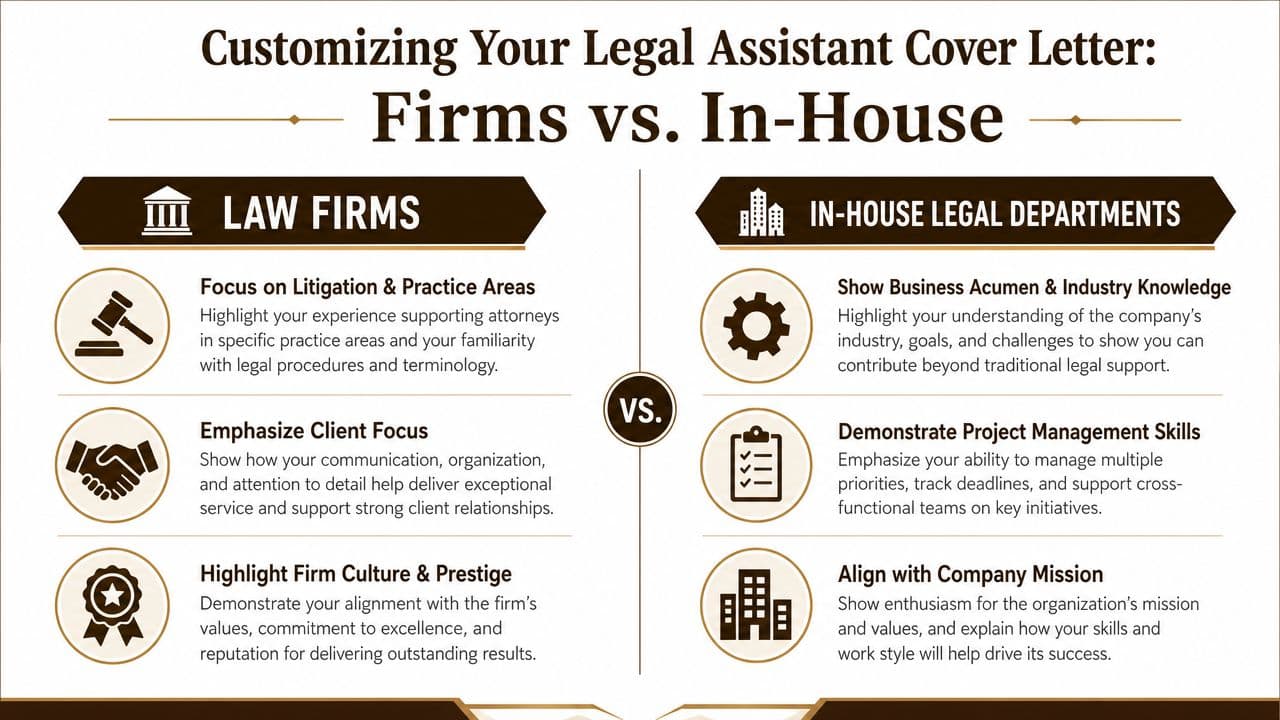
Legal employers often reject letters that don't show specificity about the firm, and vague claims like being “organized” tend to hurt more than help. Stronger letters include concrete examples of initiative and problem-solving, according to this checklist for legal assistant cover letters on LinkedIn.
What law firms usually want to hear
Law firms tend to care about pace, client service, attorney support, and practice-area fit. They want to know you can operate in a professional environment where deadlines are real, attorneys are busy, and clients expect responsiveness.
A strong law firm letter usually emphasizes:
- Practice familiarity such as litigation, trusts and estates, family law, real estate, or corporate support
- Attorney-facing support including calendaring, filings, drafting assistance, and matter organization
- Client professionalism because legal assistants often shape the client's day-to-day experience
- Workflow discipline so nothing slips between intake, drafting, review, filing, and follow-up
If the firm's website emphasizes reputation, complexity, or a particular style of service, reflect that language carefully. Don't flatter blindly. Show that you understand how they work.
What in-house legal departments usually value
In-house teams often care less about law firm polish for its own sake and more about whether you can support legal work inside a business. The legal assistant may interact with contracts, approvals, internal stakeholders, compliance requests, or matter tracking across departments.
That means your letter should sound different. Focus on:
- Business awareness
- Responsiveness to internal clients
- Organization across cross-functional workflows
- Comfort with contracts, compliance, or internal document systems
If the company operates in a regulated or specialized industry, show that you understand the legal function sits inside broader business operations.
A side-by-side view
| Target employer | Stress these themes | Tone that tends to work |
|---|---|---|
| Law firm | Attorney support, client service, deadlines, filings, matter flow | Formal, polished, practice-aware |
| In-house department | Business partnership, contracts, compliance, internal coordination | Direct, practical, operations-aware |
How to tailor without rewriting from scratch
You don't need a brand-new document every time. You need a flexible core.
Keep these elements stable:
- your contact block
- your base writing style
- one or two strongest legal support examples
Change these every time:
- the opening paragraph
- the employer-specific language
- the examples you emphasize
- the closing sentence
One practical way to do this is to study the employer's site before drafting. A quick review of the organization's company background and legal recruiting focus can show how legal employers describe culture, specialization, and hiring priorities. The same principle applies when you review any law firm or legal department website before applying.
Generic letters tell the employer you want a job. Tailored letters tell the employer you understand their job.
That's the standard.
Optimizing for ATS and Digital Submissions
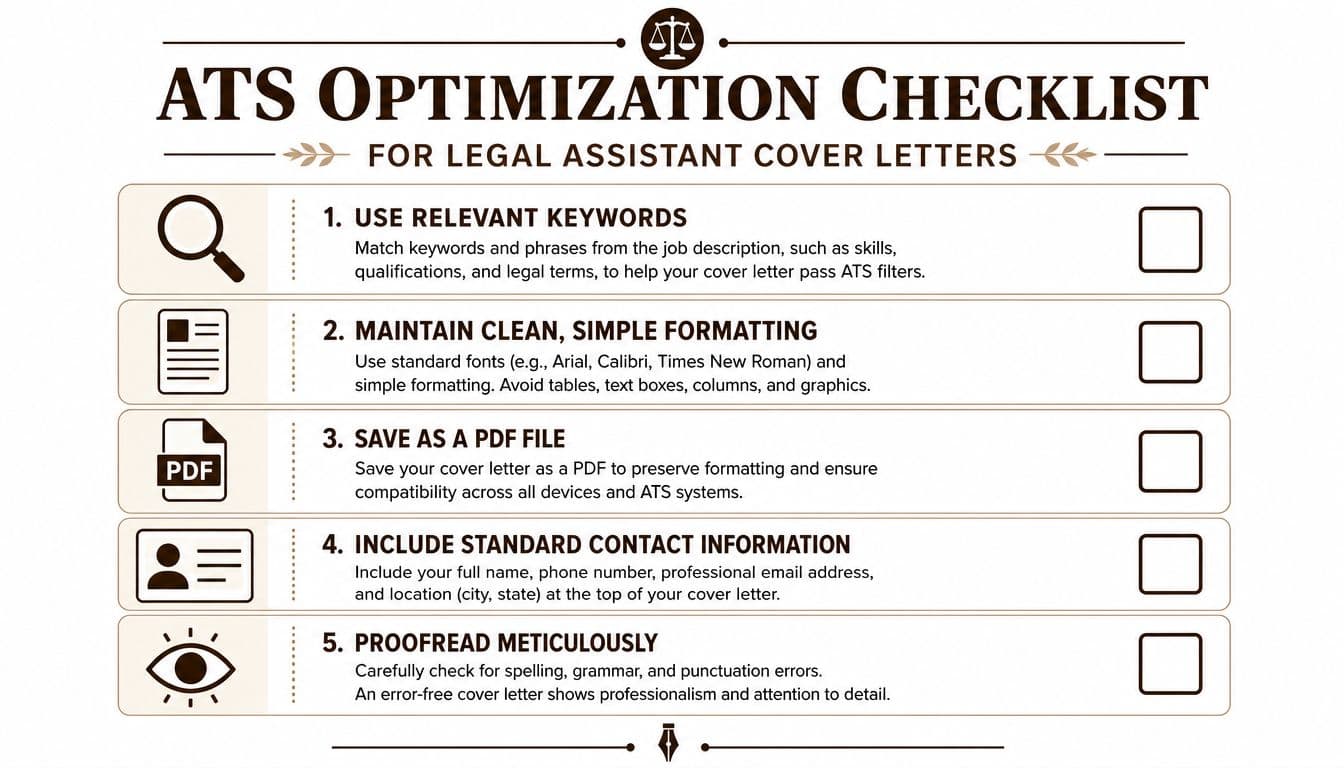
Before a human reviews your letter, a system may parse it, sort it, or display it inside an application portal. If your formatting is messy or your wording misses obvious job-description language, a strong draft can lose impact before anyone reads it properly.
Start with a clean file.
Use the posting's language naturally
Applicant tracking systems aren't impressed by stuffing keywords into a paragraph. They are better served by clarity and consistency. Pull exact phrases from the posting where they fit naturally.
Examples include:
- document preparation
- calendar management
- client communication
- litigation support
- contract administration
- case management
- filing
- scheduling
If the posting says “document management” and your letter says “handled paperwork,” you've made the parser's job harder and the recruiter's job slower.
Formatting choices that reduce friction
Use plain, professional formatting:
- Match your resume font so the documents feel consistent.
- Keep contact details standard at the top of the document.
- Avoid text boxes, graphics, and unusual layouts that can confuse parsing.
- Use a professional file name with your name and the employer name.
- Proofread the final PDF before uploading.
This short video gives a useful visual overview of digital application habits that help candidates present more cleanly online.
What to check before you upload
Use this quick review list:
-
Keywords align
Your letter uses the employer's terminology where accurate. -
Formatting is simple
No tables used for layout, no decorative elements, no awkward spacing. -
Tone matches legal hiring
Formal, concise, and precise. -
File name is clean
Something like FirstName-LastName-CoverLetter-Employer.pdf works well. -
Submission details are correct
Double-check employer name, role title, and attached files.
If you want more application guidance beyond the letter itself, legal candidates often benefit from reviewing broader job-search advice in the Five Star Placements blog.
Common Cover Letter Mistakes That Guarantee Rejection
A hiring partner opens your application between client calls. They have time for one fast read. If your cover letter creates extra work, shows weak judgment, or sounds interchangeable with 40 others, the file moves to the no pile.
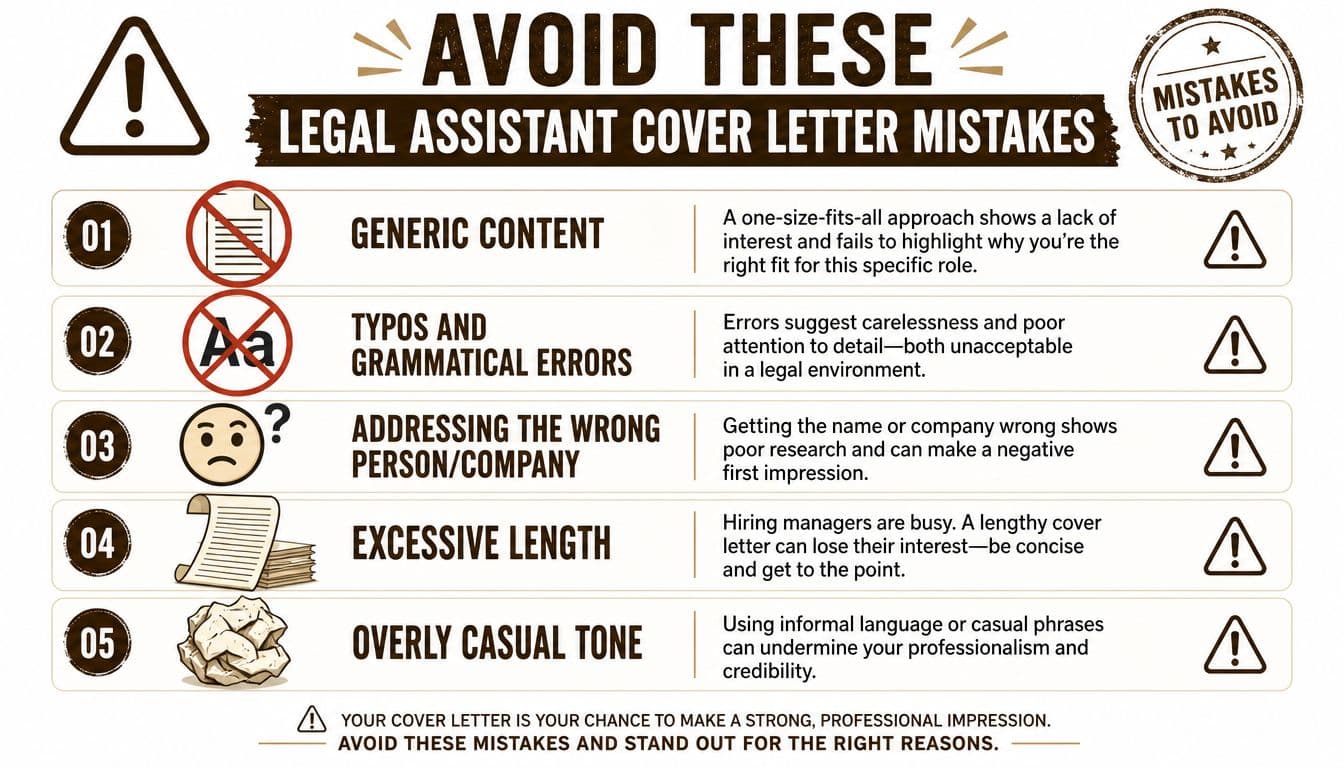
The letters that get rejected first usually fail for simple reasons. They do not show care. They do not show fit. And they do not help the employer see how the candidate will reduce pressure on attorneys, protect deadlines, or keep matters organized under load.
That last point matters more than many candidates realize. A legal assistant cover letter should not just summarize experience. It should translate that experience into a practical answer to a firm's or legal department's operating problems.
The errors that do the most damage
A vague salutation is one problem, but the bigger issue is lack of specificity throughout the letter. If you can address the hiring manager, do it. If you cannot, use a professional alternative tied to the role or team. What hurts your chances is sounding like you sent the same draft to ten employers.
Other common rejection triggers:
-
Generic content
“I am writing to express my interest” is harmless. Three more lines of generic enthusiasm are not. Strong letters quickly connect your background to the employer's actual needs. -
Typos or grammar slips
Legal support work depends on precision. One visible error raises doubts about proofreading, document handling, and attention to detail. -
Resume repetition
A hiring partner can read your resume on their own. The cover letter should explain why your experience matters in this role, with this team, under this workload. -
No evidence of operational value
Claims like “organized” or “detail-oriented” are weak unless you tie them to outcomes, such as cleaner filings, better calendar control, smoother client communication, or stronger deadline management. -
Misreading the employer
A litigation boutique, an Am Law firm, and an in-house legal department do not hire for the same pressures. A letter that ignores that difference reads as unsophisticated. -
A passive close
End with purpose. Confirm your interest, reinforce your fit, and make it easy to continue the conversation.
What stronger candidates do instead
| Avoid this | Do this |
|---|---|
| Generic opening | State the role and show you understand the team's legal environment |
| Duty list | Explain how your work kept attorneys, cases, or contracts on track |
| Self-description | Show proof through examples of accuracy, follow-through, and judgment |
| One-size-fits-all pitch | Adjust your message to the employer's pace, practice area, and operational needs |
| Weak ending | Close with direct interest in discussing how you can support the team |
I tell candidates this often at Five Star Placements. The best legal assistant cover letters make the employer's decision easier. They show where you can step in, what friction you can remove, and why your background is relevant now.
Before you send the letter, read it three times with three different goals. First, check whether it answers the employer's hiring problem. Second, check tone and professionalism. Third, check names, dates, grammar, and document details.
If you want a second set of eyes before you apply, contact our legal recruiting team at Five Star Placements.
A polished letter will not guarantee an interview. A careless one can end the conversation before it starts.
Legal Assistant Cover Letter FAQ
How do I write a legal assistant cover letter if I don't have direct legal experience
Lead with adjacent experience that matches the work. Administrative coordination, document handling, scheduling, client communication, records management, and deadline tracking all transfer well. The key is to connect those skills to a legal environment instead of pretending you already have experience you don't.
Show that you understand the expectations of legal support work. Precision, confidentiality, professionalism, and follow-through matter.
Is it ever okay to go over one page
No. For this type of role, one page is the standard. If your draft spills over, the fix isn't tighter margins. The fix is sharper editing.
Cut repeated adjectives, broad self-description, and any sentence that doesn't help the employer picture you in the role.
What if I can't find the hiring manager's name
Use a specific professional salutation tied to the team or function. “Dear Hiring Manager” is better than a vague or outdated greeting. If the posting identifies a department, you can address that context directly and still sound polished.
The goal is professionalism, not forced familiarity.
Should I mention legal software by name
Yes, if you've used it and it's relevant to the posting. Case management platforms, document management systems, Microsoft Excel, Outlook, Adobe Acrobat, and e-filing tools can strengthen your credibility when they match the employer's needs.
Only include tools you can discuss confidently in an interview.
How direct should the closing be
Direct, not aggressive. Ask for the interview. State that you'd welcome the chance to discuss how your experience supports the team's needs. Legal employers generally respond well to clarity.
A closing should sound confident and businesslike.
Should I use the same cover letter for every application
No. Reuse your core material, but tailor the opening, employer references, and proof points each time. The fastest way to look uninterested is to send a letter that ignores the actual job posting.
If you want help thinking through a specific application or legal career move, you can reach the team through the Five Star Placements contact page.
Five Star Placements works with law firms and corporate legal departments across the United States on legal support and attorney hiring. If you're exploring your next move and want guidance grounded in how legal employers evaluate candidates, visit Five Star Placements.
Need help filling a legal role?
Five Star Placements partners with law firms and legal departments nationwide.
Schedule a Call