
Deputy General Counsel: Your Hiring Guide
July 5, 2026 · 15 min read · Five Star Placements

Table of contents
Most advice about the deputy general counsel role gets the hierarchy right and the business value wrong. It treats the position as a senior lawyer who can take work off the General Counsel's desk. That's incomplete, and in many companies, it's the reason the hire disappoints.
A strong Deputy General Counsel isn't just overflow capacity. This person is often the operator who turns legal strategy into working systems, the internal successor who keeps the department stable when the General Counsel is stretched, and the executive who can carry risk-heavy functions without constant escalation. When companies define the role too narrowly, they usually attract capable technicians and lose the leadership value they need.
That mismatch shows up in the market. An ABA Journal report found that 86% of deputies are dissatisfied because of role attributes such as limited board exposure or weak succession planning, which is exactly why the role should be designed as a leadership track rather than a holding pen for senior legal work (ABA Journal coverage of deputy general counsel dissatisfaction and succession concerns).
Table of Contents
- The Misunderstood Deputy General Counsel
- What Is a Deputy General Counsel The COO of Legal
- Core DGC Responsibilities and Required Skills
- General Counsel vs Deputy General Counsel Key Distinctions
- Deputy General Counsel Salary Benchmarks for 2026
- Your Guide to Screening and Hiring a DGC
- Elevating Your Legal Leadership Team
The Misunderstood Deputy General Counsel
The most common hiring mistake is assuming the deputy general counsel is the second-best lawyer in the department. In practice, the role is closer to a business-critical hinge point. The deputy sits where legal judgment, operational discipline, and leadership continuity meet.
That matters because the legal department rarely fails from lack of legal intelligence alone. It fails when no one translates broad legal strategy into repeatable execution, no one manages the flow of high-risk issues across teams, and no one is prepared to step into larger leadership when the General Counsel is unavailable or departs. A deputy general counsel who can't operate at that level may still be a very good lawyer. They just won't solve the core problem.
Why the title often gets misused
Some companies create the role to reward tenure. Others use it to split work by subject matter. Both approaches can work, but neither is enough on its own. If the role lacks decision rights, visibility with business leaders, and a path toward broader leadership, the title becomes decorative.
That's where frustration starts. Deputies don't leave only because of money. They leave when the organization wants executive accountability from them but withholds executive scope.
Practical rule: If your deputy general counsel owns major risk but has no exposure to the forums where risk decisions are made, you haven't built a deputy role. You've built an overburdened specialist position.
What clients should understand before hiring
A deputy general counsel should be evaluated as part operator, part strategist, and part succession option. That changes the brief. You're not only asking whether the candidate can handle litigation, contracts, compliance, governance, or investigations. You're asking whether they can absorb pressure from the General Counsel, lead a team through ambiguity, and keep the legal function aligned with business priorities.
The best hiring committees test for a few practical trade-offs early:
- Depth versus breadth: A litigation star may not be the right hire if the department needs cross-functional operating leadership.
- Technical excellence versus executive readiness: Some candidates are superb lawyers but haven't yet shown that they can influence senior management.
- Immediate need versus succession value: If the company hires only for today's pain point, it may miss the person who could stabilize the function over the next leadership cycle.
The deputy general counsel role is misunderstood because it sits between categories. It isn't just legal support. It isn't always the next General Counsel either. But if you structure it correctly, it becomes one of the most valuable hires in the department.
What Is a Deputy General Counsel The COO of Legal
The cleanest way to understand a deputy general counsel is to think of the role as the COO of the legal department. The General Counsel sets direction, carries enterprise-level legal accountability, and manages the highest-stakes external relationships. The deputy general counsel makes that strategy work in practice.
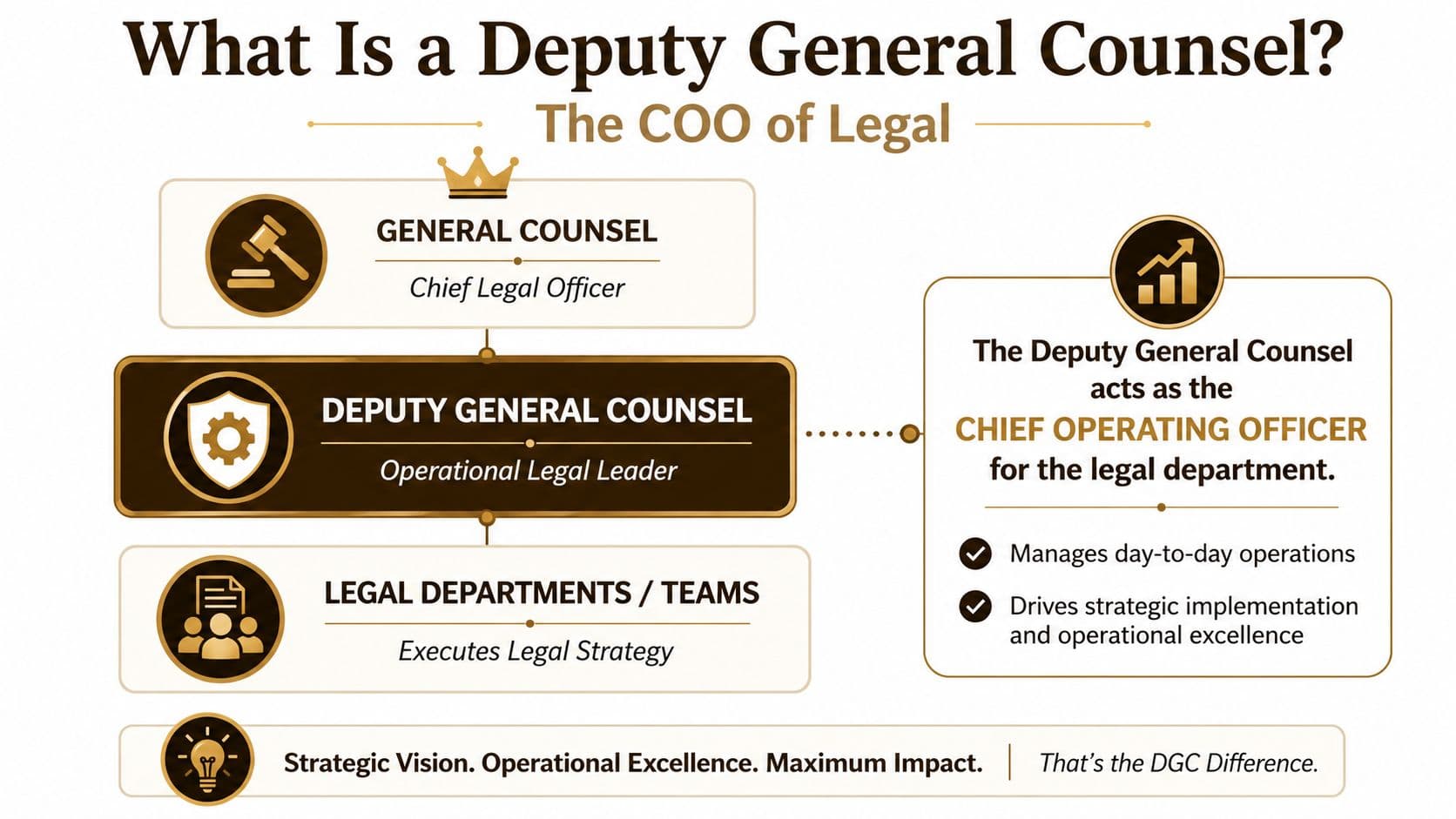
This is more than a helpful analogy. The role has a direct connection to organizational risk. Umbrex describes the Deputy General Counsel as a senior legal executive who reduces the likelihood of regulatory penalties and financial exposure by overseeing compliance protocols, managing active litigation, and aligning legal strategy with business objectives (Umbrex guide to the deputy general counsel role).
How the role works inside a legal department
A strong deputy general counsel usually owns the machinery of the function. That can include triaging incoming matters, supervising outside counsel, coordinating internal specialists, and deciding which issues require the General Counsel's direct involvement. The practical objective is simple. High-risk matters move quickly, routine work doesn't clog leadership bandwidth, and the department operates with consistency.
The role also tends to be the legal department's implementation engine. When the company needs new policies, faster contract escalation, better compliance controls, or tighter coordination with finance, HR, security, and operations, the deputy is often the person who builds those operating habits into the department.
What a CEO or GC should expect
If you hire the right person, the deputy general counsel should make the legal function more predictable. Not quieter. Not smaller. More controlled.
A useful test is whether the candidate can do all three of these things:
| Need | What the Deputy General Counsel should do |
|---|---|
| Risk control | Build processes that catch problems early and keep legal exposure from spreading |
| Execution | Convert broad guidance from the General Counsel into workflows, decisions, and team accountability |
| Business alignment | Support commercial objectives without letting urgency override legal discipline |
The best deputies don't merely answer legal questions. They decide how legal work should move through the company.
That's why the title deserves executive-level thought. If you treat the deputy general counsel as a highly paid senior counsel, you'll underuse the role. If you treat it as operational leadership inside the legal function, you'll gain value from it every day.
Core DGC Responsibilities and Required Skills
The deputy general counsel role has widened. Many companies still write the job description as if they're hiring a generalist corporate lawyer with management polish. The market has moved beyond that.

Current mandates often blend classic legal leadership with technology-heavy subject matter. A City of Hope posting for a deputy general counsel focused on technology transactions calls for 10+ years of in-house experience and deep experience with IP licensing and SaaS agreements, reflecting broader demand for capability in artificial intelligence, data governance, and digital health technologies (City of Hope deputy general counsel technology transactions posting).
The work usually falls into three buckets
First, there's operational leadership. This is the least glamorous part of the role, and often the most important. The deputy may allocate work across team members, manage outside counsel relationships, sharpen issue intake, and keep business clients from routing everything directly to the General Counsel. If no one owns that operating layer, legal becomes reactive.
Second, there's substantive legal leadership. Depending on the company, that may center on litigation, governance, commercial contracting, compliance, internal investigations, employment risk, or regulatory matters. The key is that the deputy doesn't just advise on these issues. The deputy organizes how the company responds to them.
Third, there's strategic support. Good deputies can brief the General Counsel crisply, pressure-test options, and step into cross-functional conversations with enough business fluency that commercial leaders see them as practical partners rather than internal obstacles.
The capabilities that separate strong candidates from average ones
Some skills are table stakes. Strong legal analysis. Sound judgment. Comfort with ambiguity. Credibility with senior executives. But those basics don't distinguish top deputies.
What usually does:
- Executive translation: They can explain legal risk in language a CFO, CEO, or operating leader will act on.
- Team Effectiveness: They know when to handle a matter personally and when to structure, delegate, and supervise it.
- Technology fluency: They don't need to be engineers, but they do need to understand how modern products, data flows, procurement models, and digital partnerships create legal exposure.
- Change management: They can install better processes without alienating internal clients.
- Succession posture: They operate with enough breadth and composure that others can imagine them stepping into broader leadership.
For additional perspective on how legal teams think about specialized legal hiring and role design, it helps to review market commentary from the broader Five Star Placements legal recruiting blog.
A deputy general counsel earns trust when business leaders stop asking, “Who can review this?” and start asking, “Who should run this?”
General Counsel vs Deputy General Counsel Key Distinctions
Confusion between the General Counsel and deputy general counsel roles causes overlap, delay, and politics. The fix isn't to draw a rigid line. It's to create a disciplined division of labor.
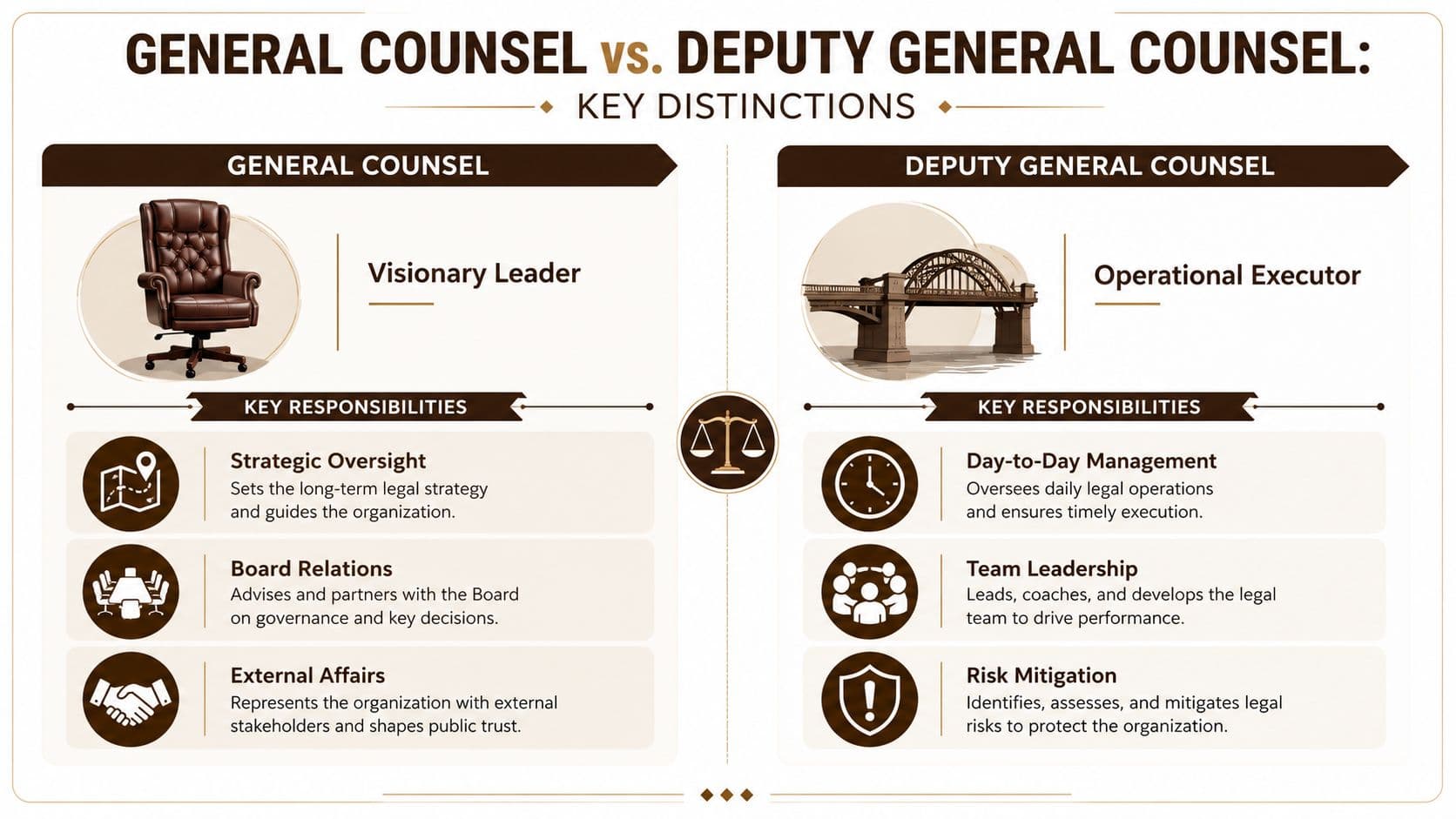
Spencer Stuart's benchmark view captures the core distinction well. The deputy serves as the primary deputy to the General Counsel, often with expertise in high-risk areas such as corporate governance, executive compensation, and class-action litigation management, while the General Counsel sets strategic direction and the deputy general counsel executes operational execution (Spencer Stuart on the path to General Counsel and the deputy role).
A practical division of labor
Here's how effective legal departments often separate the roles:
| Area | General Counsel | Deputy General Counsel |
|---|---|---|
| Primary focus | Enterprise legal strategy | Day-to-day legal execution |
| Board interface | Leads board and top committee engagement | Supports preparation and follow-through |
| External posture | Handles the most sensitive external stakeholders | Manages internal coordination and issue flow |
| Department management | Sets priorities and leadership tone | Runs operations against those priorities |
| Escalation point | Decides enterprise-level trade-offs | Filters, frames, and resolves matters before escalation |
That framework matters because a department runs poorly when both roles chase the same work. If the General Counsel is stuck supervising routine execution, strategic bandwidth narrows. If the deputy is excluded from meaningful ownership, the role becomes expensive redundancy.
Where companies get it wrong
The most common structural mistakes are familiar:
- Dual ownership of the same matters: This creates confusion for the business and weakens accountability.
- No delegated authority: The deputy is given responsibility without decision rights.
- Artificial separation from leadership forums: The deputy is expected to lead but isn't allowed to participate where key choices are made.
The strongest GC and deputy pairings work like a strategy-and-operations partnership. One defines the destination. The other ensures the department can get there.
Deputy General Counsel Salary Benchmarks for 2026
Compensation for a deputy general counsel is a strategic issue, not an administrative one. If the role carries enterprise risk, succession value, and broad operating responsibility, the package has to reflect that reality. Underpaying this hire doesn't save money for long. It usually narrows the field, increases replacement risk, or forces the General Counsel to retain work that should have been delegated.
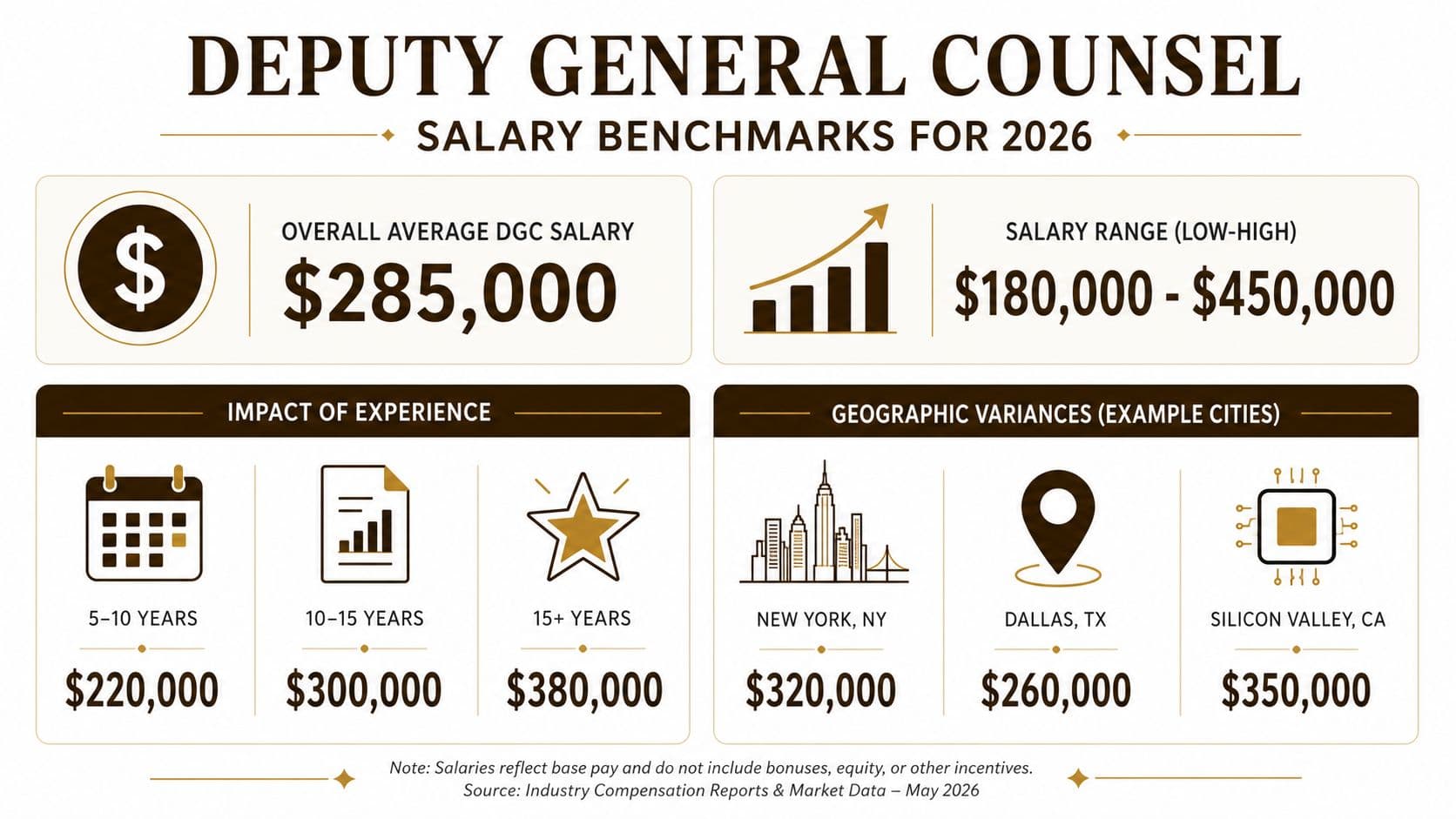
In major U.S. markets such as Washington, DC, deputy general counsel salaries range from $185,000 to $400,000, and a financial-services leadership role at FINRA listed compensation between $197,600 and $389,200. The same market snapshot also notes that deputy general counsel roles typically require 10 to 15 years of prior legal practice experience and proven senior leadership, which reinforces that employers are hiring for an executive seat rather than a midlevel counsel role (Indeed Washington, DC deputy general counsel market listings).
What drives pay at the top of the range
The title alone doesn't determine compensation. Scope does. A deputy general counsel who manages high-stakes litigation, oversees compliance infrastructure, supports governance, and leads legal staff should command more than one with a narrower commercial remit.
Industry also matters. Heavily regulated sectors, public company environments, and businesses with complex government touchpoints usually need broader judgment and steadier crisis handling. Those demands make the candidate pool smaller and the compensation discussion more competitive.
How to think about the offer
The right question isn't just, “What's market?” The better question is, “What profile are we asking someone to perform?”
A practical compensation discussion should cover:
- Base salary: This signals how the company values the role on a sustained basis.
- Incentive structure: If the deputy is expected to operate like a business executive, the package should align with leadership expectations.
- Retention logic: Strong deputies are hard to replace because they carry institutional knowledge, internal trust, and leadership continuity.
Compensation should match the role you've actually designed, not the title you've put on the org chart.
When clients miss on compensation, they usually aren't slightly off. They're signaling that they want executive-level output at a senior-counsel price point. The market rarely rewards that approach.
Your Guide to Screening and Hiring a DGC
Hiring a deputy general counsel requires more discipline than most legal leadership searches. The reason is straightforward. Many candidates can look strong on paper because the title covers a wide range of realities. One deputy may have run large teams and cross-functional risk issues. Another may have been an excellent specialist with limited operating authority. The resumes can appear comparable when they aren't.
Axiom's UK deputy general counsel report found that 100% of respondents reported feelings of stress or burnout in their current role, and 46% reported feeling very or extremely stressed or burnt out, which should affect how you assess workload design, management style, and retention risk before you make an offer (Axiom UK Deputy General Counsel report).
Sample job description priorities
Most job descriptions fail because they read like a recycled list of legal tasks. A better brief defines the role in terms of business outcomes and operating authority.
Include the following elements:
- Mandate clarity: State whether the deputy will own legal operations, subject-matter leadership, people management, or some combination.
- Decision rights: Specify what the person can resolve independently and what goes to the General Counsel.
- Business exposure: Describe expected interaction with executives, business units, and governance bodies.
- Succession relevance: If the role is part of leadership continuity planning, say so.
A useful summary line might read like this: the deputy general counsel will partner with the General Counsel to manage day-to-day legal execution, lead key risk areas, and strengthen leadership continuity across the department.
Interview questions that surface judgment
The best interviews don't test only legal knowledge. They test operating maturity. Ask questions that force the candidate to reveal how they think, prioritize, and lead under pressure.
A few that work well:
- Tell us about a matter you chose not to escalate immediately. What made you confident you should own it, and what controls did you put around that decision?
- Describe a time when a business leader wanted speed and you needed process. How did you protect the company without damaging the relationship?
- How have you reorganized legal work inside a team? Listen for evidence of systems thinking, not just personal heroics.
- What should a General Counsel be able to rely on you for without checking your work? This surfaces self-awareness and executive readiness.
- What parts of the role drain people in this seat? Candidates who answer this candidly usually understand the pressures of the job.
Ask fewer doctrinal questions and more operating questions. Most failed deputy hires don't fail because they forgot the law.
Screening signals that matter
Resume review should focus on actual authority, not title inflation. Look for signs that the candidate managed complex issue flow, influenced senior leadership, and had repeat exposure to matters with real business consequence.
Strong signals include:
- Evidence of scope: Oversight of investigations, governance support, litigation management, compliance programs, or high-value commercial work.
- Cross-functional credibility: Regular work with finance, HR, operations, product, or regulatory teams.
- Leadership pattern: Team supervision, mentoring, process redesign, or responsibility during leadership transitions.
- Context fit: Experience in a regulatory, cultural, or growth environment similar to yours.
Reference checks should be pointed. Don't ask if the person is smart. Ask whether they reduce noise for the General Counsel, whether executives trust them in sensitive moments, and whether they create calm or confusion under strain.
When the search is active, many legal departments also benefit from outside calibration and candidate-market perspective through a focused legal recruiting conversation with Five Star Placements.
The final hiring decision should account for stamina as much as pedigree. The deputy general counsel role carries load from above and below. Pressure comes from the General Counsel, the business, outside counsel, and the team. Candidates who've only excelled in narrow lanes can struggle once that pressure converges.
Elevating Your Legal Leadership Team
A deputy general counsel is one of the few hires that can improve legal judgment, operating discipline, and leadership continuity at the same time. That's why companies should stop treating the role as a convenient second seat and start treating it as a design decision.
The right person will do more than deliver strong legal work. They'll make the department more reliable under pressure, sharpen the handoff between strategy and execution, and give the organization a credible leadership option when the General Counsel can't carry every issue personally. The wrong person can still look impressive for a while, but the cracks usually show up in escalation overload, unclear ownership, and avoidable turnover.
Organizations that get this hire right are usually deliberate about three things. They define the role by outcomes, not title. They match compensation to real scope. And they interview for executive judgment, not just legal pedigree.
For companies rethinking legal leadership structure and long-term talent strategy, it's worth understanding the broader recruiting perspective and firm background behind Five Star Placements.
If you're hiring a deputy general counsel and want a sharper process, Five Star Placements helps legal departments define the role, calibrate the market, and identify candidates who fit both the mandate and the culture.
Need help filling a legal role?
Five Star Placements partners with law firms and legal departments nationwide.
Schedule a Call