
Immigration Attorney Jobs a Strategic Guide for 2026
July 19, 2026 · 13 min read · Five Star Placements

Table of contents
You may be looking at a posting right now that seems promising on paper, then starts to wobble the closer you read. The title says immigration associate. The duties read like three jobs stitched together. The salary is either missing, buried, or framed so vaguely that you can't tell whether the firm values the role or just needs a body in a chair.
That's common in immigration attorney jobs. The practice is mission-driven, technically demanding, and unusually exposed to policy swings. In July 2025 alone, demand for immigration lawyers surged by 40%, driven by court backlogs and policy shifts, according to VisaVerge's reporting on the 2025 demand spike. A hot market helps, but it also creates noise. Firms hire fast, candidates move on incomplete information, and plenty of attorneys end up in roles that don't match their skills or long-term goals.
A strong search in this field isn't about sending more applications. It's about reading the market correctly, presenting your experience in the way immigration hiring partners evaluate it, and negotiating with a clear view of where compensation diverges by sector.
Table of Contents
- The High-Stakes Search for Your Next Role
- Mapping the Landscape Where to Find Your Next Role
- Crafting an Application That Gets Noticed
- Mastering the Interview and Salary Negotiation
- Navigating Current Market Challenges and Future Trends
- How a Legal Recruiter Accelerates Your Search
The High-Stakes Search for Your Next Role
Immigration law rarely gives attorneys the luxury of a passive job search. Most candidates I speak with are balancing active files, anxious clients, and shifting agency conditions while trying to assess whether a move will improve their training, compensation, or sustainability.
The pressure is real because the practice itself is high pressure. The work affects status, family stability, employment, detention risk, and long-term life outcomes. That means employers don't just hire for legal knowledge. They hire for judgment, stamina, precision, and client management under strain.
Practical rule: In immigration attorney jobs, your next role isn't only a title change. It's a bet on what kind of docket, supervision, and professional identity you want.
A lot of attorneys make the same mistake early in the search. They ask, “Who's hiring?” before asking, “What kind of platform do I need to do my best work?” Those are different questions.
Start with three filters:
- Case mix: Do you want removal defense, asylum, humanitarian relief, family-based work, business immigration, or a mixed practice?
- Training structure: Will you have a reviewing attorney, a real litigation path, and feedback on strategy, not just filing mechanics?
- Compensation model: Is the offer built around salary stability, bonus potential, mission alignment, or some combination?
If you're weighing a move and want a professional read on the market before applying blindly, a confidential conversation through Five Star Placements' contact page can help clarify where your profile fits.
Mapping the Landscape Where to Find Your Next Role
Where you practice immigration law changes almost everything. The pace changes. The type of client changes. The emotional burden changes. The ceiling on pay often changes too.
The market is also location-sensitive. Bloomberg Law reported that firms are actively recruiting midlevel associates with three to five years of experience in hubs including Atlanta, New York, Texas, and Washington, D.C., especially for complex foreign worker processes, in its coverage of the visa crackdown and concentrated recruiting markets.

Private practice rewards specialization
Private firms offer the widest spread of immigration attorney jobs. That's both the attraction and the trap. One firm may have complex employment-based work with strong systems and manageable expectations. Another may run a high-volume consumer docket where attorneys spend most of the day triaging emergencies.
The upside is clear. Firms can offer broader matter exposure, stronger compensation upside, and clearer advancement for attorneys who become known for a defined specialty. If you have experience in business immigration, deportation defense, or courtroom-heavy asylum work, private practice often rewards that sharper positioning better than generalized experience.
What works in this environment:
- Owning a lane: Candidates who can say, with precision, what they handle are easier to place.
- Speaking the client's language: Private clients want legal answers tied to timing, risk, and business or family consequences.
- Handling volume without sloppiness: Hiring partners look for lawyers who can move quickly and still protect the record.
What doesn't work is presenting yourself as willing to do “a little of everything” when the firm is trying to solve a specific capacity problem.
Non-profit roles offer direct impact and different trade-offs
Non-profit and legal aid roles attract attorneys who want immediate client contact and visible public service impact. The work can be profoundly meaningful. It can also be emotionally demanding and operationally stretched.
These organizations often value trauma-informed representation, cultural competence, community trust, and courtroom readiness. If you've represented vulnerable clients, supervised legal screenings, or managed difficult credibility issues with care, that experience carries real weight here.
The strongest non-profit candidates don't frame themselves as idealists alone. They show they can carry a difficult docket responsibly and work within funding, staffing, and procedural limits.
The trade-off is that resources may be thinner, support staff may be leaner, and advancement can depend more on organizational structure than on individual performance.
Government and in-house paths suit different strengths
Government immigration roles suit attorneys who value process, adjudication, enforcement, policy exposure, or public-sector stability. The appeal is often structure. The challenge is that bureaucracy can limit autonomy, and the work may become narrower than candidates expect.
In-house immigration roles are less common and usually more specialized. They fit lawyers who understand mobility, compliance, internal stakeholders, and preventative counseling. These jobs often go to attorneys who can translate legal risk into practical advice for HR, operations, and leadership.
If you're comparing paths, use something more concrete than job titles.
Comparing Immigration Attorney Career Paths
| Sector | Typical Caseload | Compensation & Benefits | Career Trajectory |
|---|---|---|---|
| Private firms | Often mixed or specialized, depending on firm size and business model | Usually the strongest salary upside, with compensation tied to specialization, client demand, and firm economics | Best for attorneys building a niche, developing books of business, or moving into leadership |
| Non-profits | High client-contact work, often humanitarian, asylum, detention, or community-based matters | Often steadier but lower cash compensation, with mission alignment and public service value as major factors | Best for attorneys committed to advocacy, impact litigation, or long-term public interest work |
| Government agencies | Procedure-driven dockets, policy, adjudication, or enforcement-oriented responsibilities | Typically structured compensation and benefits with clearer institutional frameworks | Best for attorneys who value formal systems, public service, and defined advancement paths |
| In-house legal departments | Narrower, business-aligned immigration and compliance work | Can be competitive where the role is tied to global mobility or workforce planning | Best for attorneys who want advisory work, internal client management, and cross-functional influence |
Crafting an Application That Gets Noticed
A generic legal resume is easy to ignore. Immigration hiring managers don't want to infer what you can do. They want to see how quickly you can step into their workflow, what kind of cases you've handled, and whether your experience matches the pressure points in their practice.

Write for the hiring partner not for the algorithm
Most immigration resumes fail because they read like bar applications. They list responsibilities, not proof of useful experience.
Replace broad statements with matter-specific framing. “Managed immigration cases” says almost nothing. A stronger bullet identifies the type of case, your level of responsibility, and the setting. If you've handled client prep, USCIS interview prep, master calendar appearances, merits hearings, PERM support, or employer counseling, say that plainly.
A better application package usually does five things:
- Names the practice lane clearly: State whether your work has been family-based, humanitarian, removal defense, business immigration, or mixed.
- Shows responsibility level: Distinguish between drafting, independent case handling, court appearances, supervision, and strategy ownership.
- Reflects procedural fluency: Employers want to know whether you've worked with USCIS, EOIR, DOL, consular matters, or employer compliance processes.
- Signals client management strength: Immigration practices live or die on communication. If you've led consultations, managed expectations, or handled urgent escalations, include that.
- Uses a targeted cover letter: One page is enough. Tie your experience to the employer's case mix and explain why the move makes sense.
Treat bilingual fluency like a practice asset
Many attorneys bury language skills in a footer as if they were optional. That's a mistake in this market. CLINIC-linked hiring trends show that while listings often say Spanish fluency is preferred, it is frequently an indispensable prerequisite for high-volume detention and asylum work, as reflected in the employment posting context discussed by CLINIC.
That means language ability shouldn't sit in the “additional information” section beside software and interests. It belongs near the top if it materially affects your value.
Use it in context:
- Client representation: Note that you conduct consultations or prep sessions directly in Spanish if that's true.
- Courtroom function: If you can manage hearings, prep testimony, or handle fast-moving factual development with bilingual precision, say so.
- Operational impact: Firms care that language fluency reduces friction, improves trust, and expands the matters you can handle safely.
Don't describe bilingual ability as a personality trait. Describe it as a professional tool that changes what work you can carry.
Mastering the Interview and Salary Negotiation
Interviews for immigration attorney jobs tend to split into two tests at once. First, the employer is checking competence. Second, they're deciding whether you can function under pressure without creating avoidable risk.
That's why polished but vague answers don't land well. You need to sound like someone who has lived the realities of the work.
Answer the questions behind the questions
When a hiring partner asks about a difficult case, they're rarely asking for drama. They're testing your judgment. They want to hear how you assessed facts, identified weak points, communicated risk, and moved the matter forward.
Good answers usually include four elements:
- The procedural setting
- The legal or factual difficulty
- The action you took
- What that shows about how you practice
If you interview for business immigration, expect detailed questions about process control, documentation discipline, and issue spotting. If you interview for removal defense or asylum work, expect questions about client preparation, trauma-sensitive communication, and courtroom composure.
Use specifics, but stay disciplined. Long war stories can make you sound unfocused. Short, structured examples make you sound trustworthy.
A strong interview answer doesn't prove you've seen everything. It proves you know how to think when the file gets messy.
You should also have questions ready that reveal how the employer operates the practice. Ask who reviews filings. Ask how responsibilities are divided between attorneys and support staff. Ask what kinds of matters are driving the hire. Ask how the firm handles surges in urgent client needs. Those questions tell you more than culture statements ever will.
Negotiate with sector reality in mind
Many immigration attorneys under-negotiate because they compare themselves to the wrong segment of the market. That's especially dangerous in this practice because compensation isn't uniform across sectors.
The market is bifurcated. Non-profit and legal aid roles often cluster in the $74,000 to $93,000 range, while private firms may pay 20% to 40% more for similar bar-admitted experience, based on the salary gap described in The Advocates for Human Rights career context.
That doesn't mean every private offer is better. It means you need to compare like with like.
Here's the practical approach:
- Benchmark by sector first: A legal aid salary and a private firm salary are not interchangeable reference points.
- Price the role you're undertaking: A courtroom-heavy bilingual detention role is different from a filing-focused support role, even if both carry the same title.
- Negotiate the full package: Ask about supervision, training, support staff, remote flexibility, origination expectations, and review timelines, not just base pay.
- Present your unique strengths thoughtfully: If you bring rare language ability, court confidence, or business immigration specialization, state that directly and tie it to the employer's needs.
One more point matters. Salary negotiation is easier before you've signaled emotional attachment to the offer. Stay professional, enthusiastic, and measured. If the employer wants you, a reasonable ask won't kill the deal. It often improves it.
Navigating Current Market Challenges and Future Trends
A good candidate talks about past work. A stronger candidate also shows awareness of what is changing operationally inside immigration practice.
Show that you understand operational risk
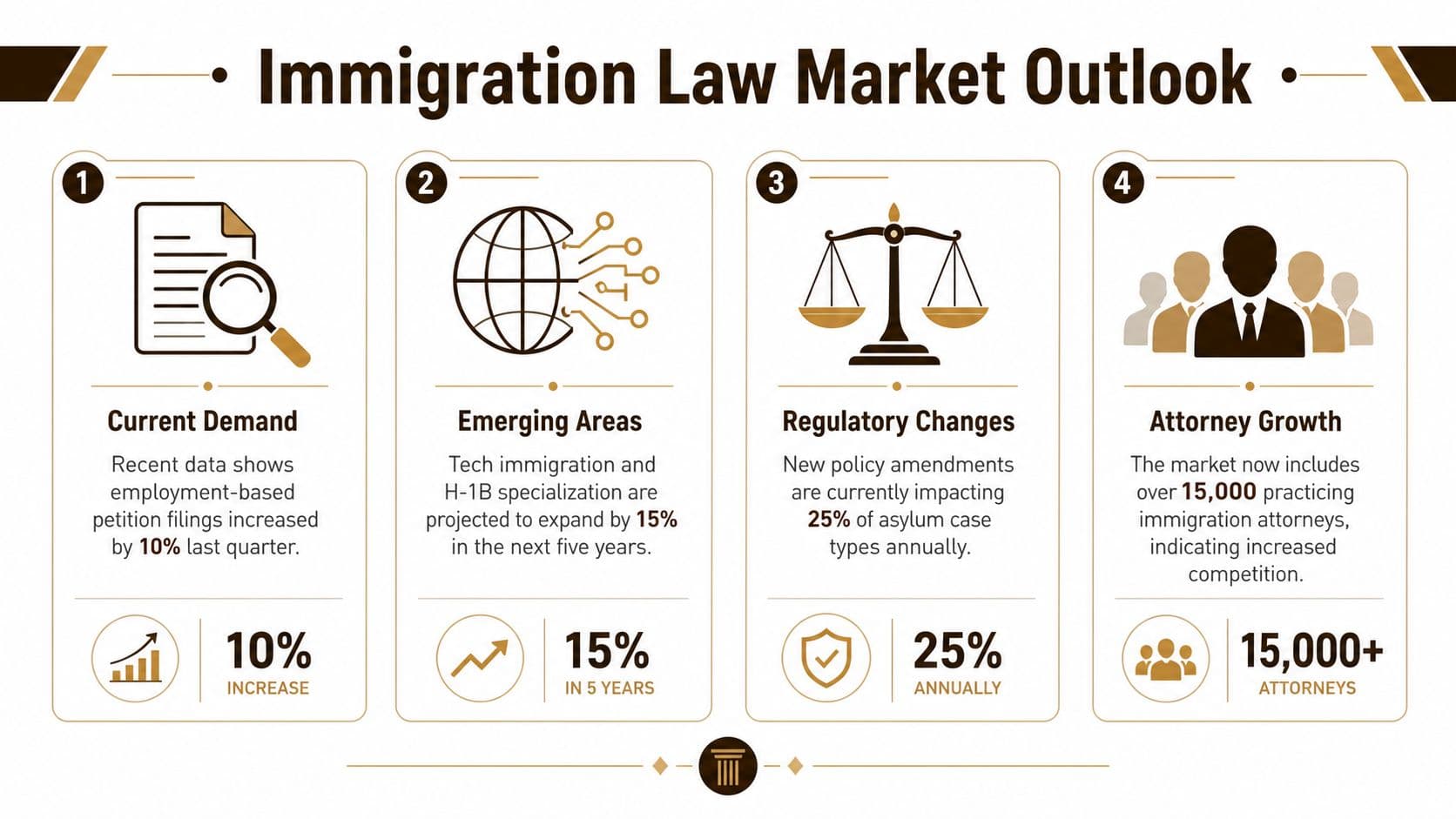
One important 2026 issue is the end of five-year Employment Authorization Documents in many categories, with USCIS reducing most to 18 months, which increases renewal volume and the risk of administrative gaps. Duane Morris also notes that experts expect 40% to 60% of routine immigration tasks to be automated in 2026, in its discussion of employment immigration trends and challenges for 2026.
Those are not abstract developments. They affect staffing, client communication, intake design, and how firms define attorney value.
If you want to stand out in interviews, speak to concrete risk points such as:
- Renewal volume management: How to prevent lapses and prioritize time-sensitive matters.
- PERM discipline: Why documentation and recruitment auditing matter when scrutiny rises.
- Client expectation setting: How to explain delay, uncertainty, and incomplete agency timelines without losing trust.
A useful way to sharpen your market awareness is to follow commentary that tracks hiring and practice changes, including the Five Star Placements blog.
Build a career that survives automation
Automation will affect the most repetitive work first. That's not bad news for attorneys who've built skills machines don't replace easily.
The safest long-term positioning is in work that depends on judgment, advocacy, strategy, credibility assessment, and difficult client counseling. Drafting support may become faster. Basic process tasks may become more standardized. But complex fact analysis, high-stakes hearing prep, nuanced employer counseling, and real-time problem solving still require an attorney clients trust.
The practical takeaway is simple. Don't market yourself as a filer if you can market yourself as a strategist.
How a Legal Recruiter Accelerates Your Search
The immigration law market is large enough to create opportunity and specialized enough to create blind spots. The U.S. immigration law services industry reached $10.6 billion by 2026, and there were 15,420 immigration attorneys actively practicing in the United States as of 2023, according to Gitnux's immigration law services industry statistics. In a market that size, candidates don't just need openings. They need context.

Good recruiters reduce information gaps
A specialized legal recruiter should tell you what a posting leaves out. That includes whether the role is replacement or growth, whether the supervising partner provides training, whether the compensation is aligned with expectations, and whether the title matches the work.
That matters in immigration attorney jobs because titles can be misleading. An “associate” role might be a strong developmental seat with a real path. It might also be an overloaded position with weak support and no strategic mentorship.
A recruiter also helps with narrative. Many good immigration attorneys undersell themselves because their experience feels ordinary to them. They don't realize that direct client communication in another language, independent hearing prep, or procedural fluency across agencies can sharply improve their candidacy when framed correctly.
Representation matters most late in the process
The later stages are where avoidable mistakes get expensive. Candidates accept vague compensation structures. They miss warning signs in supervision models. They negotiate against themselves because they don't know how the employer prices comparable talent.
That's where a recruiter can add the most value. They can pressure-test the offer, surface concerns diplomatically, and help you compare opportunities on more than instinct.
If you want a quick overview of the firm behind that work, learn more about Five Star Placements.
A short video can also give you a feel for the team and approach before you reach out.
If you're evaluating immigration attorney jobs and want a clearer read on compensation, fit, and long-term positioning, Five Star Placements can help you approach the search with better information and stronger leverage.
Need help filling a legal role?
Five Star Placements partners with law firms and legal departments nationwide.
Schedule a Call