
General Counsel Recruitment: 2026 Playbook for Top Talent
July 13, 2026 · 20 min read · Five Star Placements
Table of contents
A board meeting is coming up. The company is growing, regulators are asking harder questions, a financing or acquisition is on the horizon, and the CEO has realized the business has outgrown ad hoc legal coverage. That's usually the moment when general counsel recruitment stops being a staffing task and becomes a business risk decision.
The mistake many leadership teams make is treating the hire like a senior lawyer search with a better compensation package. It isn't. A General Counsel will shape how aggressively the company moves, how clearly risk is framed, how the board gets informed, and whether legal becomes a brake or a strategic enabler. If the fit is wrong, the damage rarely shows up on day one. It shows up when a sensitive investigation lands, when a commercial dispute needs a practical answer by morning, or when the CEO needs someone who can say no without losing trust.
That's why the process has to be built around judgment, alignment, and staying power, not just credentials. For organizations evaluating their legal leadership options, the team behind Five Star Placements about page operates in a market where those distinctions matter.
Table of Contents
- Why Your Next General Counsel Hire Is a Strategic Imperative
- Defining the Modern General Counsel Role Profile
- Building a Winning Candidate Sourcing Strategy
- Screening and Assessing Candidates Beyond the Resume
- Running Interviews That Reveal True Leadership DNA
- Structuring the Offer and Closing Your Top Candidate
- Accelerating Impact With a Strategic 90-Day Onboarding Plan
Why Your Next General Counsel Hire Is a Strategic Imperative
A company rarely hires a General Counsel because everything is simple. The hire usually comes when complexity has outpaced the current structure. Revenue is expanding into new markets. The company is handling more sensitive data. Commercial contracts are getting larger. Employment issues are no longer isolated. The board wants cleaner reporting on risk.
At that point, the legal leader isn't there just to review documents. The role is to convert uncertainty into decisions the business can act on. A strong GC knows when to escalate, when to contain, and when to tell the CEO that the technically correct answer isn't the commercially useful one.
That's also why this hire carries unusual downside if you get it wrong.
Practical rule: A bad GC hire rarely fails because the lawyer lacks intelligence. The failure usually comes from misread mandate, weak executive chemistry, or poor judgment under pressure.
Leadership teams often underestimate how many roles the General Counsel plays at once. Adviser to the CEO. Translator for the board. Manager of outside counsel. Internal diplomat across finance, HR, operations, and product. Guardian of privilege. Sometimes crisis quarterback. If your process only tests legal knowledge, you're interviewing for the narrowest slice of the job.
A mis-hire in this seat creates a chain reaction:
- Decision drag: Business leaders stop looping legal in early because the advice feels abstract or late.
- Board friction: The board gets over-lawyered or under-warned, both of which erode confidence.
- Talent issues: Internal legal staff lose direction when the new leader can't prioritize or delegate well.
- Cost creep: Outside counsel spend rises when the GC can't separate true enterprise risk from routine work.
The strategic value of a good hire works in the opposite direction. The right GC gives management sharper options, not longer memos. That person helps the company move with discipline. The legal department becomes more predictable, executives get cleaner advice, and difficult issues get surfaced before they become reputational events.
That's why general counsel recruitment has to start with one question. What is this company going to ask this person to carry over the next several years that no one else in the executive team can carry as well?
Defining the Modern General Counsel Role Profile
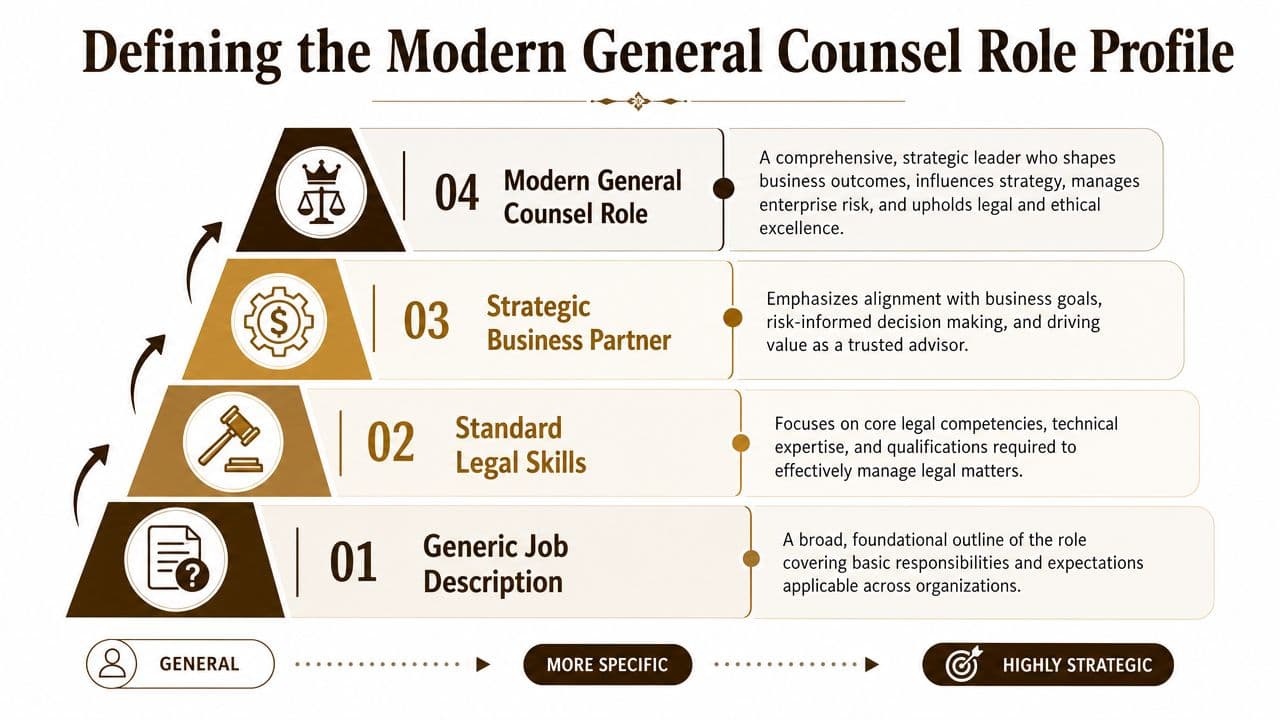
A weak search starts with a recycled job description. A strong one starts with a success profile. Those are not the same thing.
The job description lists duties. The success profile defines the situations this person will face, the relationships they must manage, the business model they must understand, and the kind of judgment the company expects when facts are incomplete. Until that's clear, candidate evaluation turns into personal preference disguised as rigor.
Start with the business problem
Define the hire around the company's next chapter, not its past legal workload. A pre-IPO business needs something different from a family-owned company professionalizing governance. A healthcare platform under regulatory pressure needs something different from a private equity-backed roll-up focused on acquisitions and integration.
Use a short working brief that answers these questions:
| Question | Why it matters |
|---|---|
| What business events are likely in the next few years? | It determines whether the GC must be a builder, operator, deal adviser, or crisis manager. |
| Where does legal currently break down? | It exposes whether the company needs process discipline, executive presence, technical depth, or all three. |
| How does the CEO use advisers? | Some CEOs want debate. Others want synthesis. A GC has to match that operating style without becoming passive. |
| What does the board expect from legal? | This shapes reporting cadence, candor level, and visibility. |
If the leadership team can't answer those questions in plain language, the search isn't ready.
Choose the right General Counsel archetype
Most companies don't need a generic “top lawyer.” They need a particular type of legal executive.
One organization may need a business strategist who can sit with product and sales leaders and translate risk into workable options. Another may need a risk mitigator who can tighten controls, strengthen governance, and create discipline after a period of loose decision-making. A deal-heavy environment may need a deal maker who understands transactions, integration, and board communication. A highly regulated company may need a compliance guardian who can build systems and credibility with regulators and auditors.
The error is trying to hire all four in one person without ranking priorities.
The best role profiles are honest about trade-offs. If the company wants a commercially aggressive operator, it may not get the same style as a deeply process-driven governance leader.
That trade-off doesn't mean lowering the bar. It means specifying where excellence matters most.
Build the scorecard before the search starts
Before candidates enter the process, build a scorecard that hiring leaders will use. Keep it practical. No vague labels like “strong presence” unless everyone agrees what that looks like in conduct.
A useful GC scorecard usually includes:
- Mandate fit: Can this person solve the legal and business problems the company is about to face?
- Executive influence: Do they advise senior leaders with clarity, or do they retreat into technical language?
- Judgment: Can they distinguish legal risk from business-ending risk?
- Team leadership: Have they built, inherited, or reshaped teams successfully?
- Culture match: Will they thrive inside this CEO, this board, and this company's pace?
Write the evidence standard for each category before interviews start. For example, if “executive influence” matters, decide what proof counts. Board exposure. Cross-functional leadership. Ownership of hard conversations. Clear examples of advising through conflict. That makes the process more disciplined and less vulnerable to charisma.
Building a Winning Candidate Sourcing Strategy
A CEO usually feels the sourcing mistake only after the shortlist is built. Three candidates look impressive on paper. One wants the title but not the operating pressure. One can manage legal work but has never influenced a skeptical board. One is credible, but the role was pitched so loosely that the candidate withdraws halfway through. By that point, the search has already lost time and credibility.
A strong sourcing strategy prevents that outcome. At GC level, sourcing is a market-positioning exercise as much as a recruiting task. The company has to decide who it wants to reach, why that person would listen, and which channel gives the best odds of attracting someone who can handle the legal mandate and the executive politics around it.
What each sourcing channel gets right
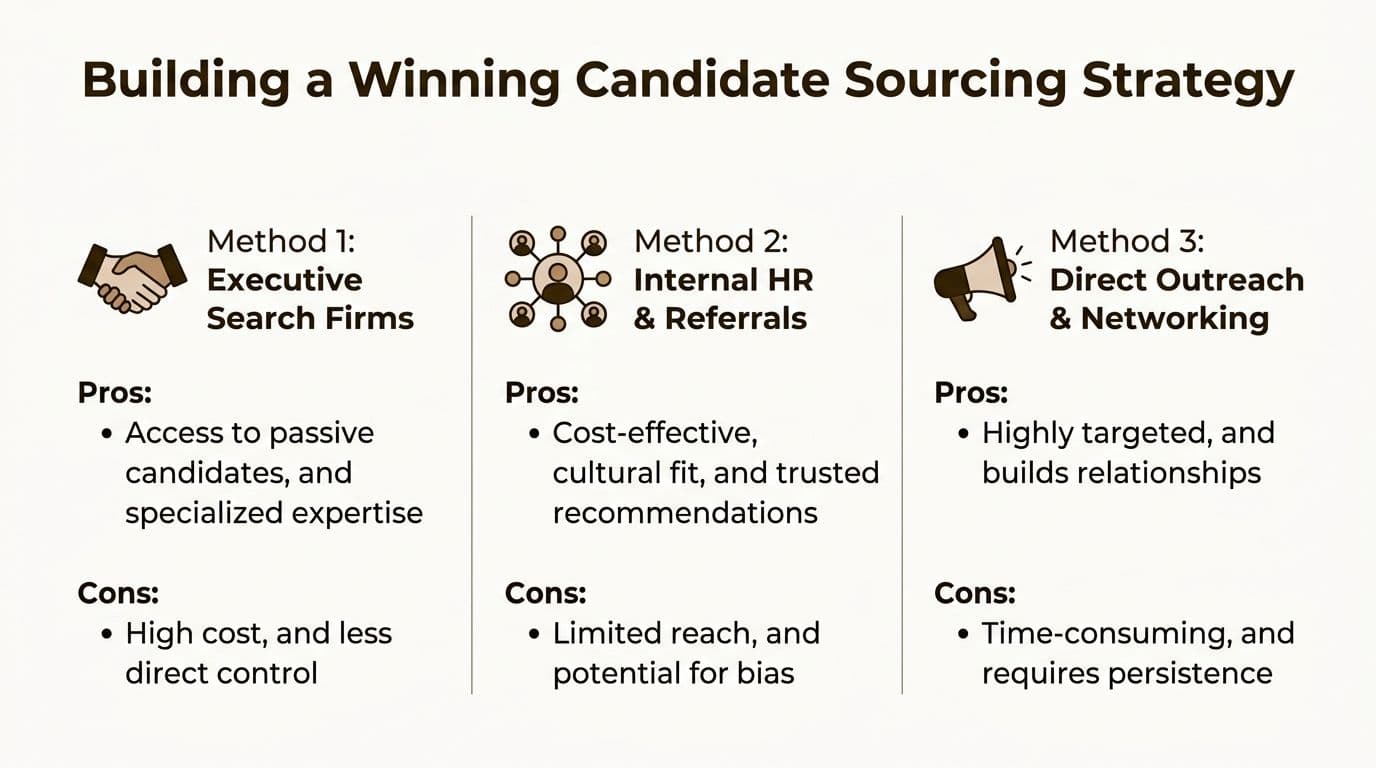
Each sourcing path solves a different problem. Each also creates a predictable risk if leadership is not honest about what the role requires.
| Sourcing path | Where it works | Where it breaks |
|---|---|---|
| Internal promotion | Strong succession bench, known culture fit, lower integration risk | A reliable deputy is treated as ready for enterprise-level influence without enough evidence |
| In-house talent team | Strong employer brand, patient process management, internal coordination | Limited access to passive legal executives and less precision in judging board-facing credibility |
| Specialized external search | Access to off-market candidates, calibrated outreach, stronger market mapping | Search quality rises or falls on role definition, stakeholder alignment, and search partner quality |
Internal promotion works best when the successor has already been tested in real tension. CEO conflict. Board exposure. A regulatory issue that required judgment, not just legal accuracy. Companies get into trouble when they mistake institutional knowledge for readiness. A deputy may know the business cold and still be unprepared to counsel a founder, challenge a CFO, or reset the legal team under pressure.
Internal recruiting teams often manage the process well. They know who needs to be aligned, how the company is perceived, and where compensation or approval friction usually shows up. The limitation is access and calibration. Senior legal leaders who are succeeding in another company rarely respond to generic outreach, and a weak first approach can narrow the pool.
For many companies, an external search is the right channel because the best candidates are often off-market. Spencer Stuart notes in its guidance on General Counsel searches that GC searches commonly run for 4 to 6 months and that a meaningful share of Fortune 500 GC appointments come from external hiring. That matters because passive candidates need a sharper case for change, more discretion, and a more disciplined process.
Why passive candidate access changes the search
Passive sourcing is not just about getting more names. It changes how the role must be framed.
A sitting GC or divisional legal leader will usually ignore a search that sounds interchangeable. They respond when the company can explain the mandate clearly: what has to be built, where executive friction sits, what the board expects, and why this role has real scope. Title alone rarely moves the best people. A serious strategic challenge sometimes does.
Confidentiality matters just as much. Senior legal candidates will test whether the company handles sensitive information with care before they trust it with their interest. Sloppy scheduling, inconsistent messaging, or a broad internal rumor trail can cost a company candidates it never knew it had.
For companies assessing whether internal reach is enough, Five Star Placements legal recruiting support is one example of how a search can extend beyond the visible applicant market.
The common mistake is assuming sourcing ends once a slate exists. It does not. Good sourcing qualifies motivation early, filters out prestige mismatches, and protects the search from a familiar failure point: choosing the candidate who interviewed smoothly instead of the one who can effectively handle this CEO, this board, and this company's next three years.
Screening and Assessing Candidates Beyond the Resume
At GC level, resumes mislead people. They reward polish, chronology, and recognizable institutions. None of those tells you how the person performs when the CFO wants speed, the CEO wants optionality, and the board wants certainty.
That's why early screening should challenge the assumption that pedigree equals fit. A candidate may have excellent law firm credentials, marquee employers, and broad subject-matter coverage, then still fail because they can't prioritize, can't influence, or can't adapt their advice to the company's operating reality.
The hiring risk gets worse when teams latch onto prestige markers and commercial mythology. A key warning from BCG Attorney Search on partner-search pitfalls is that a primary failure point in senior legal recruitment is over-indexing on a candidate's book of business or past revenue while neglecting cultural fit and leadership ability, which drives costly mis-hires and poor retention. The same guidance also stresses disciplined process, including recording initial interview feedback within one hour to preserve accuracy.
What to test in the first screen
The first conversation should not be a biography review. It should test how the candidate thinks.
A strong screen often revolves around a few direct prompts:
- Business judgment under tension: Ask about a time legal advice had to be adjusted to fit commercial reality without compromising principle.
- Executive calibration: Ask how they handle a CEO who wants speed when the facts are still incomplete.
- Team delegation: Ask what work they keep close and what they push down to internal staff or outside counsel.
- Conflict navigation: Ask for an example of disagreeing with a powerful stakeholder and what happened after.
Listen for specifics. Strong candidates talk in terms of choices, trade-offs, and consequences. Weak candidates stay at the level of doctrine or title.
Record interviewer reactions immediately after the meeting. If feedback waits until the end of the week, memory gets replaced by the loudest opinion in the room.
Resume signals that actually matter
Look for evidence of scope, influence, and repeatability. Scope means the candidate operated across functions, not just across legal topics. Influence means business leaders trusted them with decisions, not only review. Repeatability means they built systems, teams, or practices that lasted beyond a single transaction or crisis.
Useful resume clues include:
- Cross-functional ownership: Work with finance, HR, operations, product, or compliance that goes beyond legal review.
- Board or committee exposure: Not as a vanity line, but as evidence they can present, synthesize, and field difficult questions.
- Team-building history: Hiring, restructuring, mentoring, or inheriting underperforming groups and improving how work gets done.
- Range with judgment: A candidate who has handled disputes, governance, contracts, and internal escalation may have stronger enterprise instincts than one with a narrower but more glamorous profile.
For leaders refining their evaluation approach, Five Star Placements blog resources speak to the broader issue of screening for practical fit rather than resume optics.
The deepest signal in screening is whether the candidate can explain complex legal work in a way a non-lawyer would trust. If they can't do that in an initial call, they won't suddenly do it well with your board.
Running Interviews That Reveal True Leadership DNA
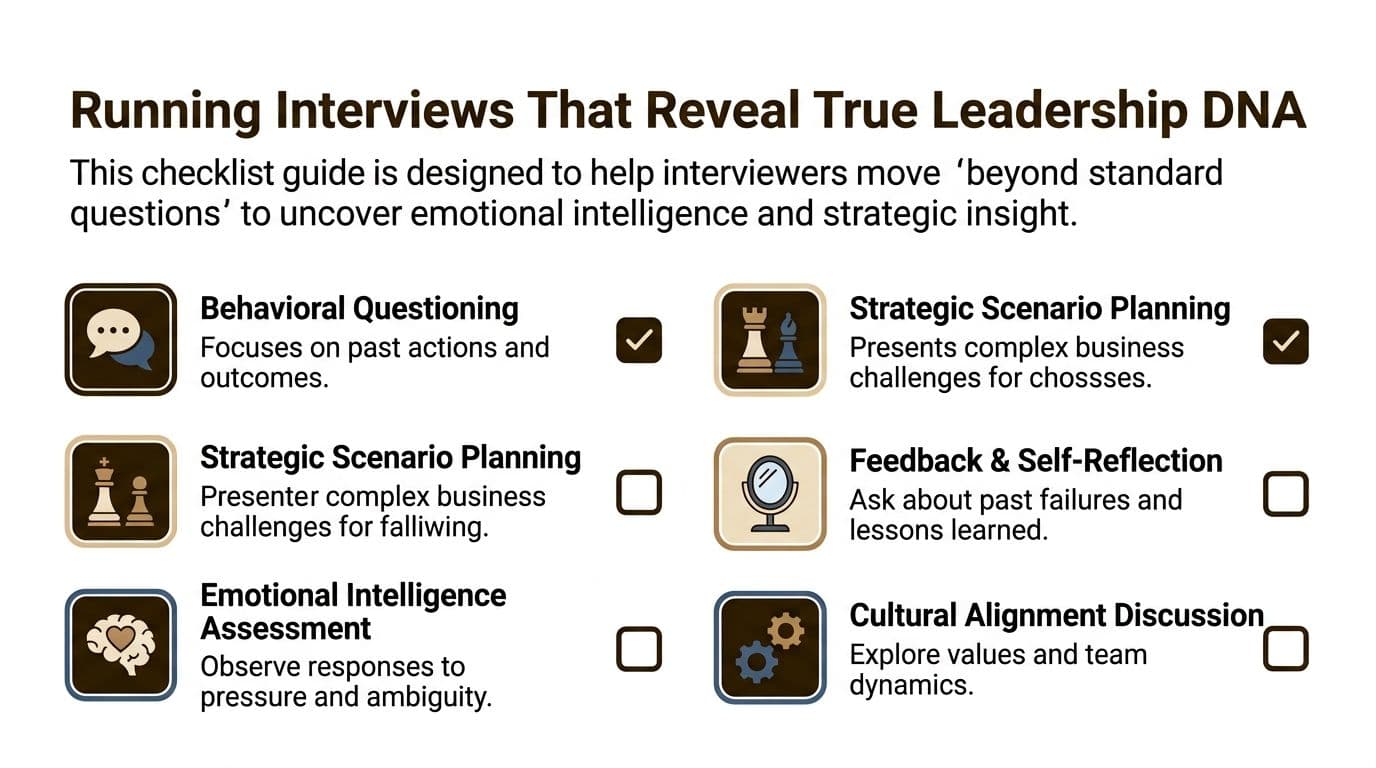
By the time a GC finalist reaches formal interviews, legal competence should already be assumed. The interview process should be testing something harder. Can this person operate inside executive tension, absorb incomplete facts, and give advice that is principled, clear, and usable?
That distinction matters because successful placements don't hinge on who knows the most law in the abstract. The differentiator is whether the candidate can handle power, personalities, and ambiguity. Verified data tied to a discussion on General Counsel success factors notes that emotional intelligence traits like self-awareness are weighted more heavily than substantive skills, because legal competence is assumed and the separator is the ability to handle complex CEO-board dynamics.
Use scenarios, not abstract prompts
Most executive interviews are too easy to game. “Tell us about your leadership style” invites branding. “What are your strengths and weaknesses?” invites rehearsal. Use realistic business scenarios instead.
Good GC interview prompts sound like this:
- A compliance breach has surfaced. Facts are incomplete, media attention is possible, and the CEO wants to contain the issue before the board hears noise elsewhere. What do you do in the first two days?
- The company wants to launch a product on an aggressive timeline. Legal has concerns that are real but not yet fully quantified. How do you advise without becoming the person who always says no?
- A star executive is creating legal and cultural risk. Their performance is strong, their behavior is not. How do you handle the issue with HR, the CEO, and if necessary the board?
- Outside counsel gives a technically sound answer that doesn't fit the business. How do you recalibrate the advice and preserve trust on all sides?
The answer isn't just about issue spotting. Watch the sequence. Good candidates frame stakeholders, privilege, timing, business continuity, and escalation paths. They know when to gather facts and when leadership needs a provisional recommendation.
Watch how the candidate handles power and ambiguity
Interview panels often focus too much on content and too little on conduct. With GC finalists, conduct is the point.
Look for these traits in live conversation:
- Self-awareness: Do they acknowledge what they'd need to learn before acting?
- Composure: Can they stay calm when the scenario becomes politically messy?
- Boundary judgment: Do they know what belongs with the CEO, the board, HR, finance, or outside counsel?
- Candor without theatrics: Can they deliver an unwelcome view directly, without becoming rigid or performative?
Ask one question that forces the candidate to discuss a failed judgment call. The quality of that answer usually tells you more than the polished success stories.
A useful final-stage exercise is to vary the interviewers. The CEO should test trust and synthesis. The CFO should test commercial realism. A board member should test maturity and clarity. A CHRO should test judgment in sensitive internal matters. If the candidate changes personality too dramatically across those settings, pay attention.
The best GC interviews don't produce the most charismatic candidate. They surface the person whose judgment holds steady when stakes and audiences change.
Structuring the Offer and Closing Your Top Candidate
A GC search often goes off course in the final week, not because the candidate changed, but because the company finally reveals how much authority the role has. The CEO thinks they are hiring a strategic adviser. The candidate discovers they will need three approvals to address a serious risk issue. That gap kills strong searches late.
By offer stage, the company should be able to state, in plain terms, why this person is the right hire and what the role is designed to do in the business. If that logic is still fuzzy, compensation starts carrying too much weight. That is usually a sign the company is trying to buy certainty instead of showing conviction.
The strongest GC offers answer the questions senior candidates care about before they have to ask twice. Who do I report to? How often will I be in front of the board? What decisions can I make alone, and what requires CEO or board input? Am I expected to build a function, repair one, or support a business already under strain? A title and salary band do not resolve those points. The reporting line, access, budget, and scope do.
Compensation is only one part of the offer
Compensation still matters. It needs to reflect the size of the mandate, the company's stage, the complexity of the legal and regulatory burden, and the candidate's ability to operate as an executive, not just a technical lawyer.
A credible package usually includes several parts working together:
- Base compensation: Sets the floor and signals how the company values the role.
- Annual incentive: Works best when legal leadership is expected to support growth, governance, and operational discipline, not just react to problems.
- Long-term value: Equity or similar incentives matter when the GC is expected to stay through scale, transactions, or transformation.
- Role architecture: Reporting line, title, committee access, and decision rights show whether the company wants a true executive partner or a senior legal technician.
I have seen companies lose their preferred candidate while offering competitive cash because the rest of the package sent the wrong message. If the GC owns enterprise risk but has weak access to the CEO, limited visibility with the board, and no control over outside counsel spend, the candidate hears the truth quickly. The company wants accountability without influence.
How deals fall apart late
Late-stage failures usually come from unspoken assumptions, and the most expensive ones are not always financial.
| Issue | What candidates hear if it's vague |
|---|---|
| Reporting structure | “You are outside the core decision group.” |
| Board access | “You will carry exposure without direct visibility.” |
| Team resources | “You are inheriting problems without the means to fix them.” |
| Scope creep | “Anything politically difficult will end up with legal.” |
Another common mistake is treating negotiation like a procurement exercise. A GC candidate pays close attention to how the company handles tension, disagreement, and detail under pressure. That process is a preview of the working relationship. If the CEO goes quiet, if the board changes its view late, or if HR starts editing agreed terms to save cost, candidates draw a conclusion fast. They assume internal alignment is weak, and they are often right.
Be careful with last-minute changes. A revised reporting line, a narrower mandate, or ambiguity around board exposure can do more damage than a modest gap in compensation. Senior legal leaders are trained to spot governance risk. If they see it in their own offer, trust drops before day one.
Counteroffers also need sober handling. Some candidates accept them, but many use them to measure how badly their current employer wants to avoid disruption. If your finalist has already decided the core issue is mandate, trust, or career trajectory, a higher number elsewhere will not fix that. The close should focus on why this role is worth taking, not just what it pays.
A clean close is disciplined. Confirm the mandate in writing. Make sure compensation matches the scope. Align the CEO, board chair, and HR lead before the written offer goes out. Then move quickly. The best GC candidates do not stay available for long, and avoidable friction in the final stretch is one of the easiest ways to lose them.
Accelerating Impact With a Strategic 90-Day Onboarding Plan
The search isn't over when the offer is signed. In many companies, that's where the primary retention risk begins.
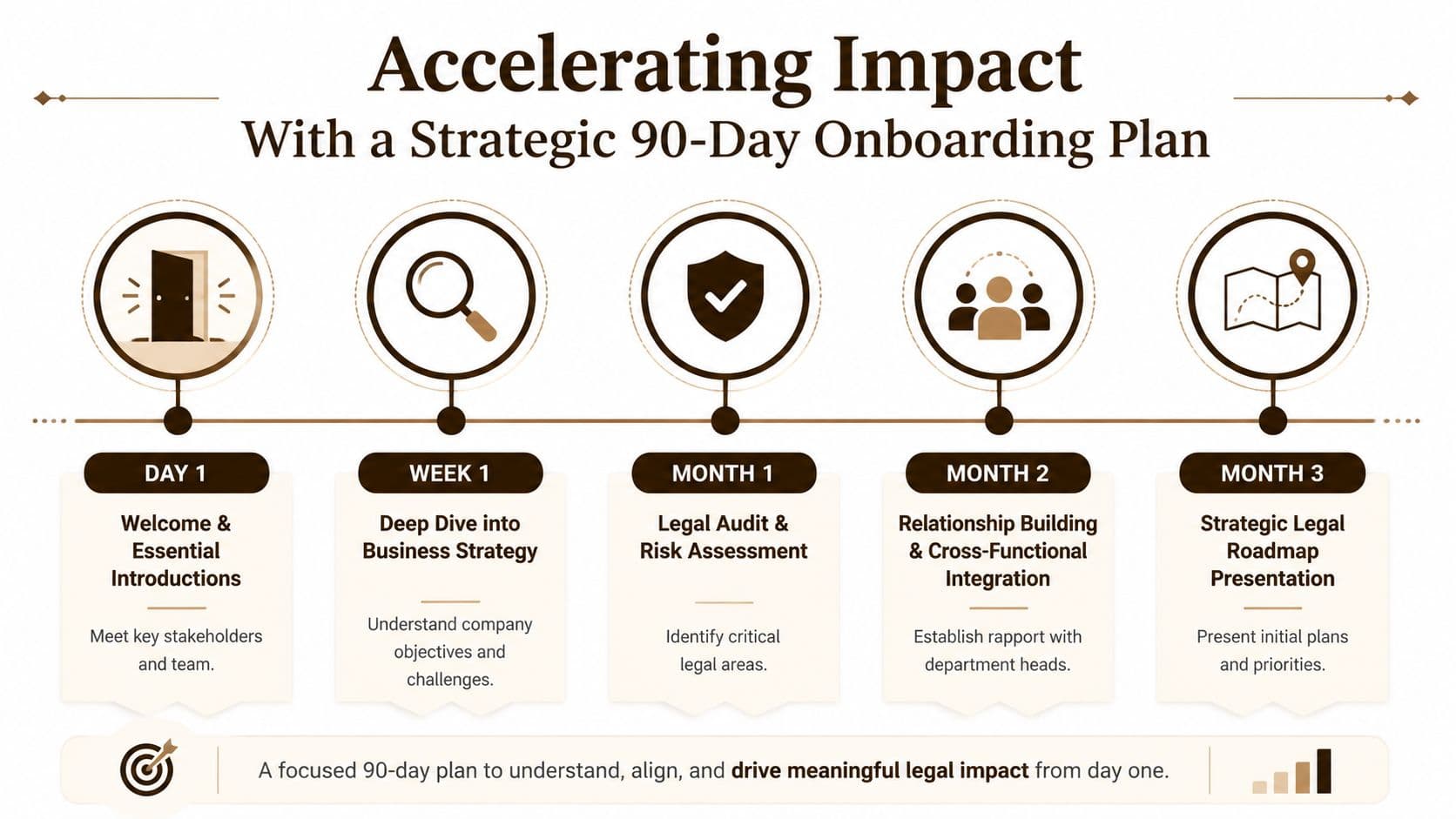
A new GC can enter with strong credentials and still struggle if onboarding is vague, political, or too HR-driven. Senior legal leaders don't need a generic orientation. They need accelerated context. They need direct access to the people who shape risk, revenue, and culture. They need a clear read on where legal is expected to advise, where it is expected to decide, and where hidden landmines sit.
First month priorities
The first month should focus on diagnosis, trust-building, and signal gathering. Not sweeping reorganization. Not cosmetic process changes.
A practical early plan includes:
- CEO alignment meetings: Clarify expectations, decision style, escalation norms, and how bad news should be handled.
- Board and committee exposure: Establish communication lines early so the GC isn't introduced only when something goes wrong.
- Business immersion: Meet leaders in finance, HR, operations, product, sales, and compliance to understand pressure points in their own words.
- Legal function review: Assess current team capability, outside counsel usage, active disputes, contract flow, governance routines, and unresolved risk items.
The new GC should leave the first month with a map of where legal demand comes from, where legal credibility is strong, and where it has already eroded.
Don't ask the new GC for a grand strategy in the first few weeks. Ask for a risk-informed view of what needs attention now, what can wait, and where executive assumptions are incomplete.
Month two and month three priorities
After the listening phase, the focus shifts to action. That doesn't mean trying to solve everything. It means choosing visible, credible priorities that prove the new GC understands the business.
Good month two and month three moves often include:
- Resolve one pain point quickly. Maybe contract bottlenecks, outside counsel sprawl, or weak escalation on employment matters.
- Set operating norms. Define how the business engages legal, what requires escalation, and where self-service is appropriate.
- Build internal alliances. A GC who doesn't earn trust with the CFO, CHRO, and key operators will spend too much time forcing process rather than influencing it.
- Present an initial roadmap. Not a theory deck. A practical set of priorities tied to risk, business goals, and resourcing.
The biggest onboarding mistakes are predictable. The company hides political tensions from the new hire. Access to the board is delayed. The CEO says “be strategic” but rewards only speed. The legal team's weaknesses are understated during recruitment and dumped on the GC after arrival.
A solid onboarding plan prevents that by making early reality visible. It also improves retention because the new legal leader can see that the company is serious about setting them up to succeed, not just eager to fill the seat.
For general counsel recruitment, that last point matters more than many boards realize. The search process identifies capability. The first ninety days determine whether capability turns into durable value.
If your company is preparing for a General Counsel search and wants disciplined support on sourcing, screening, and long-term fit, Five Star Placements works with legal departments and employers across the United States on permanent legal hiring. Their approach is built around practical evaluation, culture alignment, and reducing the risk that comes with high-stakes legal leadership hires.
Need help filling a legal role?
Five Star Placements partners with law firms and legal departments nationwide.
Schedule a Call