
Associate General Counsel Role, Pay, and Hiring
October 30, 2026 · 13 min read · Five Star Placements

Table of contents
The usual advice is to hire an associate general counsel when the general counsel needs a second-in-command. That can produce an expensive extra reviewer rather than a stronger legal department. The better question is which decisions this person will own, and which recurring problems they'll stop sending back to the GC.
A well-designed AGC seat adds capacity through judgment, delegation, and repeatable controls. For a CEO or hiring leader, that means defining the work before debating the title, then paying for the authority and expertise the job requires.
Table of Contents
- What an Associate General Counsel Does
- Associate General Counsel Pay Bands
- Who Owns the Work in a Thin Department
- The Path Into the Associate General Counsel Seat
- Three Departments and What the Role Ran
- How to Hire an Associate General Counsel
- Start the Associate General Counsel Search
What an Associate General Counsel Does
An associate general counsel (AGC) is a senior in-house lawyer who typically reports to the general counsel or chief legal officer and leads a defined portfolio, such as contracts, litigation, employment, privacy, compliance, or transactions. A deputy GC often carries broader cross-portfolio authority, while senior counsel may concentrate on practice-level advice. Titles aren't standardized, so the reporting line and decision rights matter more than the label.
Say a business keeps escalating customer-contract disagreements to its GC. The AGC's job isn't just to review those disagreements faster. It's to establish acceptable positions, identify exceptions, and give sales leaders a reliable route to a decision.
The organizational setting can look very different across employers. The Association of Corporate Counsel's 2024 Chief Legal Officers Survey collected responses from 669 legal leaders across 31 countries and 20 industries, representing departments ranging from a single lawyer to hundreds.
Title test: Ask what the lawyer can decide without seeking another lawyer's approval.
Understanding what in-house counsel does establishes the baseline. The AGC distinction is ownership: translating department priorities into decisions, processes, and advice that business teams can use without repeatedly returning to the GC.
Associate General Counsel Pay Bands
An associate general counsel's salary should be compared with other AGC pay, not treated as a fixed discount from the GC's compensation or compared only with the all-lawyer median. The numbers below measure different things, so check what each benchmark includes before using it to set an offer.
Associate general counsel compensation benchmarks
| Benchmark | Figure | What it covers |
|---|---|---|
| ACC–Empsight 2025, 25th percentile base | Approximately $186,000 | U.S. associate general counsel base salary |
| ACC–Empsight 2025, median base | Approximately $338,000 | U.S. associate general counsel base salary |
| ACC–Empsight 2025, 75th percentile base | Approximately $585,000 | U.S. associate general counsel base salary |
| In-House Connect and SpotDraft, 2024 | $293,951 | AGC average total compensation in a survey of more than 850 in-house legal professionals |
| Legal.io 2024 average salary | $202,856 | Assistant or associate general counsel salary |
| Legal.io 2024 average bonus | $42,123 | Assistant or associate general counsel bonus |
| Legal.io 2024 average stock | $29,977 | Assistant or associate general counsel stock compensation |
| BLS lawyer median, 2025 | $159,670 | All lawyers, not an associate general counsel benchmark |
Read the measures before comparing offers
Base salary is guaranteed pay; total cash generally includes salary and cash incentives, while total compensation may also include equity. These measures are not interchangeable, and the surveys group titles differently.
The In-House Connect and SpotDraft survey's participant count refers to its broader in-house sample, not an AGC-only respondent count. Legal.io groups assistant and associate general counsel together. The BLS figure covers lawyers across roles, so it provides context about the broader occupation rather than a direct AGC comparison.
Build the package around the seat
A national figure cannot capture the difference between a regional commercial portfolio and a role responsible for complex matters across a large organization. Company revenue, location, industry, reporting level, team size, and responsibility for high-value matters all shape a useful comparison.
Years of experience matter, but they do not establish equivalent scope. A lawyer who has handled individual disputes may not have owned litigation strategy, external spend, and executive reporting.
Compare the whole offer, then test whether the authority matches the pay:
- Base pay: Guaranteed compensation for the role's ongoing scope.
- Annual incentive: Target opportunity, performance conditions, and payout discretion.
- Equity or long-term incentives: Vesting terms, liquidity, and the risk attached to the award.
- Benefits and authority: The wider employment package and the decisions the AGC can make.
A general counsel salary comparison can help assess organizational positioning. It should not be used to apply a fixed discount to GC pay: an AGC's compensation depends on the portfolio, decision rights, and scale of responsibility. The all-lawyer median is a broader reference point, not a measure of senior in-house ownership.
Who Owns the Work in a Thin Department
A short-staffed legal department doesn't necessarily need another approval layer. It needs someone who can remove unnecessary approvals while keeping consequential decisions visible.
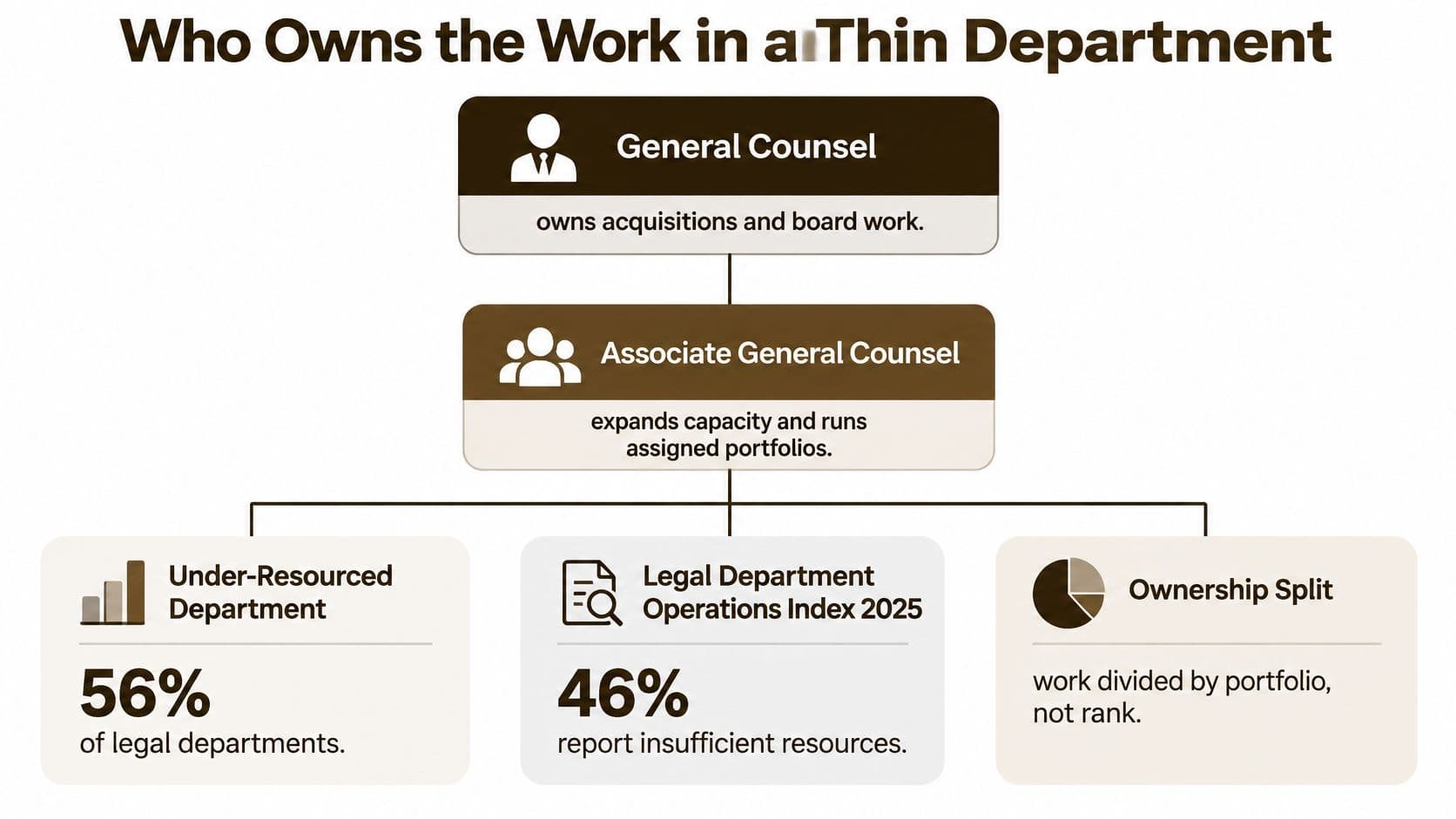
The 2025 Legal Department Operations Index reports that 56% of legal departments are under-resourced, while 46% expect to bring more work in-house. Hiring an AGC without changing how work moves can leave the GC just as overloaded.
The useful structure divides responsibility by portfolio and authority, not merely seniority.
Ownership split for an associate general counsel
| Work | Stays with the GC | Associate general counsel owns | Needs legal ops or the business |
|---|---|---|---|
| Board, CEO, and bet-the-company advice | Final advice and risk appetite | Briefing and options | No routine ownership |
| Specialty portfolio such as contracts, litigation, employment, privacy, or compliance | Escalation and exceptions above threshold | Day-to-day advice and matter calls | Intake and status tracking |
| Contract positions and approval matrix | Approves fallback positions | Drafts positions, runs exceptions, sets thresholds | Clause library and workflow tool |
| Outside counsel | Spend policy and panel strategy | Matter instructions inside policy | Invoices, dashboards, and vendor administration |
| Playbooks and repeatable controls | Signs off on risk tolerance | Designs playbooks and escalation triggers | Training logistics and template upkeep |
| Technology and automation | Decides what risk may be automated | Sets review rules and human sign-off | Tool administration and data environment |
Delegate decisions, not just documents
Start with the board row. The GC retains final executive advice, but the AGC should prepare a recommendation rather than deliver an unfiltered collection of issues.
For the specialty portfolio, delegation means the AGC can make ordinary matter calls within agreed boundaries. Outside counsel should receive clear instructions from that owner, not conflicting requests from several internal lawyers.
Commercial contracting makes the split concrete. The GC approves acceptable fallback positions; the AGC writes the negotiation playbook and decides exceptions within delegated authority; operations maintains the clause library and workflow. Sales owns the business facts, including deal economics and delivery commitments.
A capacity multiplier makes routine decisions repeatable and unusual decisions easier to recognize.
Playbooks also need maintenance. Assign someone to update templates when positions change, and distinguish that administrative task from the AGC's responsibility for the legal substance.
Measure whether the arrangement works through contract turnaround, audit findings closed, and avoidable exceptions. Check the quality of the result too: faster review isn't an improvement if the business receives inconsistent advice or accepts risks nobody recorded.
Before writing a job description, mark your own matters across the ownership columns. If the AGC column contains only review and assistance, you've probably designed another queue, not a portfolio owner.
The Path Into the Associate General Counsel Seat
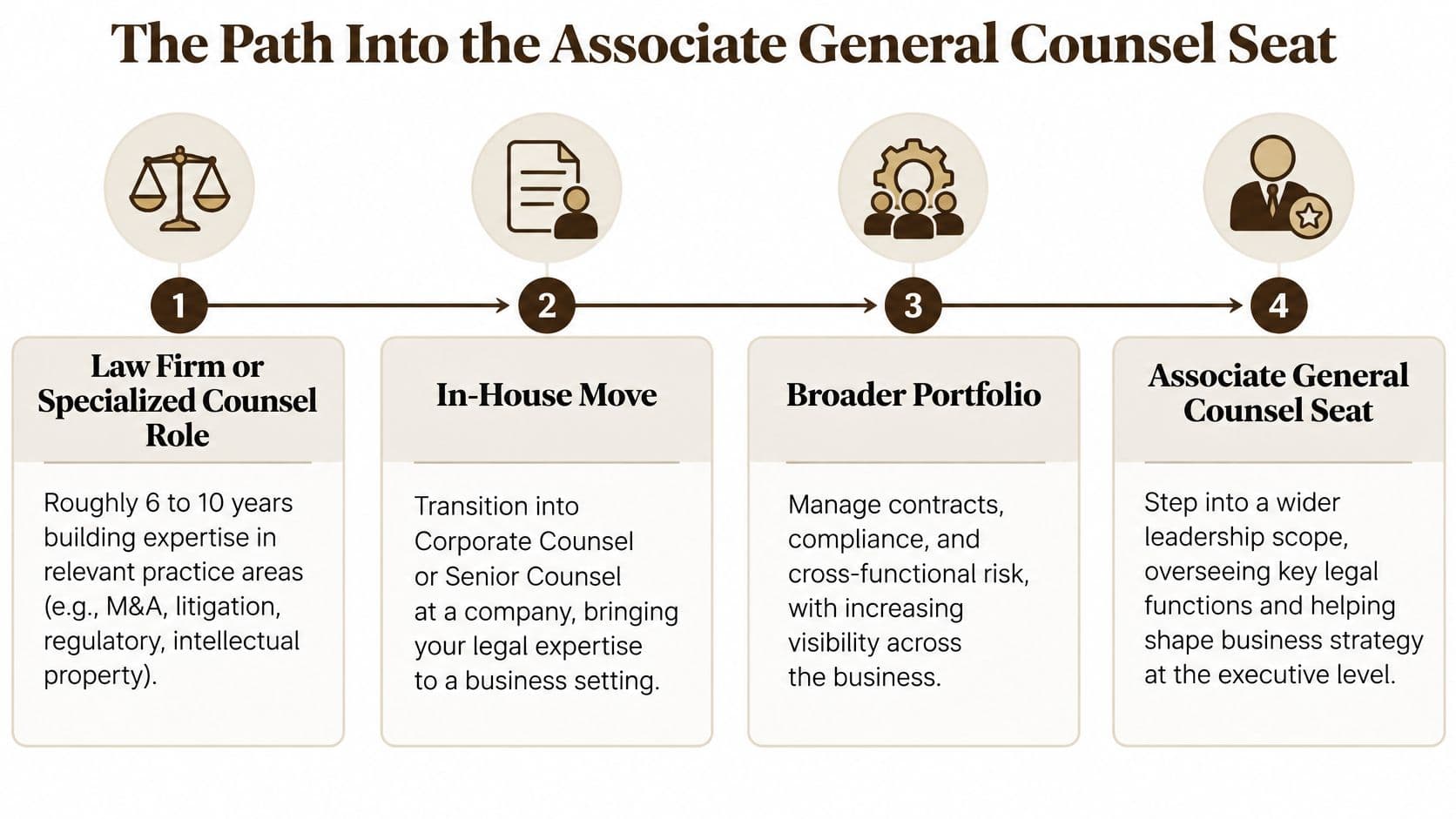
A common U.S. route starts in a law firm or specialized counsel position, continues through corporate counsel or senior counsel, and expands into portfolio leadership. It isn't a mandatory sequence. A lawyer can reach the seat through litigation, employment, regulatory, transactional, or other experience, provided that experience matches the vacancy.
The career progression is best understood as a shift in responsibility, not a fixed timetable.
From excellent advice to accountable ownership
Early practice develops legal analysis and matter execution. In-house work adds a different challenge: recommending an action when the facts are incomplete, the business has a deadline, and not every risk can be eliminated.
An AGC candidate should be able to explain what happened after the advice. Did managers adopt the process? Did finance approve the resources? Who monitored compliance, and what triggered a return to legal?
Hiring teams should look for:
- Appropriate professional standing: Current bar status and eligibility appropriate to the role and jurisdiction.
- Relevant portfolio depth: Matters that resemble the employer's actual exposure.
- Business-facing judgment: Examples of advising non-lawyers who had competing operational priorities.
- Applicable complexity: Regulated or cross-border experience when the company's activities require it.
Don't treat tenure as a substitute for these signals. More years handling the same narrow assignments won't necessarily prepare someone to lead a broader portfolio.
The company changes the career test
In a smaller company, the AGC may be the only senior lawyer beneath the GC. Breadth, triage, and the judgment to call a specialist become important because the next question may concern employment rather than the commercial agreement currently on the desk.
In a large company, the same title may describe a specialist managing other lawyers within a single function. That candidate needs people leadership, consistent advice across matters, and control over external counsel.
A litigator who has never owned a contracting process may struggle in a commercial seat. A technically excellent specialist who can't brief an operating leader may also be unready, even when their legal analysis is sound.
Career self-check: Identify matters where you set a threshold, named an owner, and changed how the business worked.
Prepare those examples without disclosing privileged or confidential information. Explain the decision, the implementation, and the evidence of adoption. Progression to deputy GC or GC may follow, but the AGC title isn't a promise of succession.
Three Departments and What the Role Ran
These composite scenarios illustrate how the same title can describe different jobs. They're hypothetical examples, not accounts of named clients or reported outcomes.
The settings differ, but each requires a clear answer about who runs the work.

A regional manufacturer
Consider a manufacturer whose GC keeps acquisitions and board work while the AGC takes commercial contracts. Sales repeatedly negotiates the same warranty, indemnity, and limitation-of-liability provisions.
The AGC creates a fallback playbook and approval matrix, then teaches sales which positions don't need further legal review. The intended result is fewer repeat negotiations, measured through the contract workflow rather than a larger count of documents reviewed.
Failure would mean the AGC personally rechecking every permitted fallback. That would preserve the bottleneck under a different name.
A healthcare system
Here, the AGC owns privacy and compliance operations while the GC keeps regulator strategy. The AGC coordinates incident assessment, corrective-action owners, and evidence that audit findings have been addressed.
Success means findings close with supportable documentation, not just a status change on a spreadsheet. Board-level incidents still escalate, but ordinary remediation doesn't require the GC to chase each department.
Failure would mean collecting policies without testing whether staff follow them. A control that exists only in a folder won't tell leadership whether a recurring problem has been corrected.
For another perspective on the professional setting, the accompanying video offers additional context.
A growth-stage technology company
A technology company brings routine employment advice and commercial agreements in-house while retaining external counsel for selected disputes. The AGC gives outside lawyers defined questions, budgets, and reporting expectations rather than forwarding entire problems without instructions.
When a product deadline creates a difficult trade-off, the AGC identifies the authorized decision-maker and documents the residual risk. The useful measure is whether routine work stays internal and external assignments remain within scope.
Failure would include automated contract approval without required human sign-off or treating urgency as permission to bypass authority. Ask whether your open seat needs a portfolio owner, a control designer, or both. That distinction should determine the job description.
How to Hire an Associate General Counsel
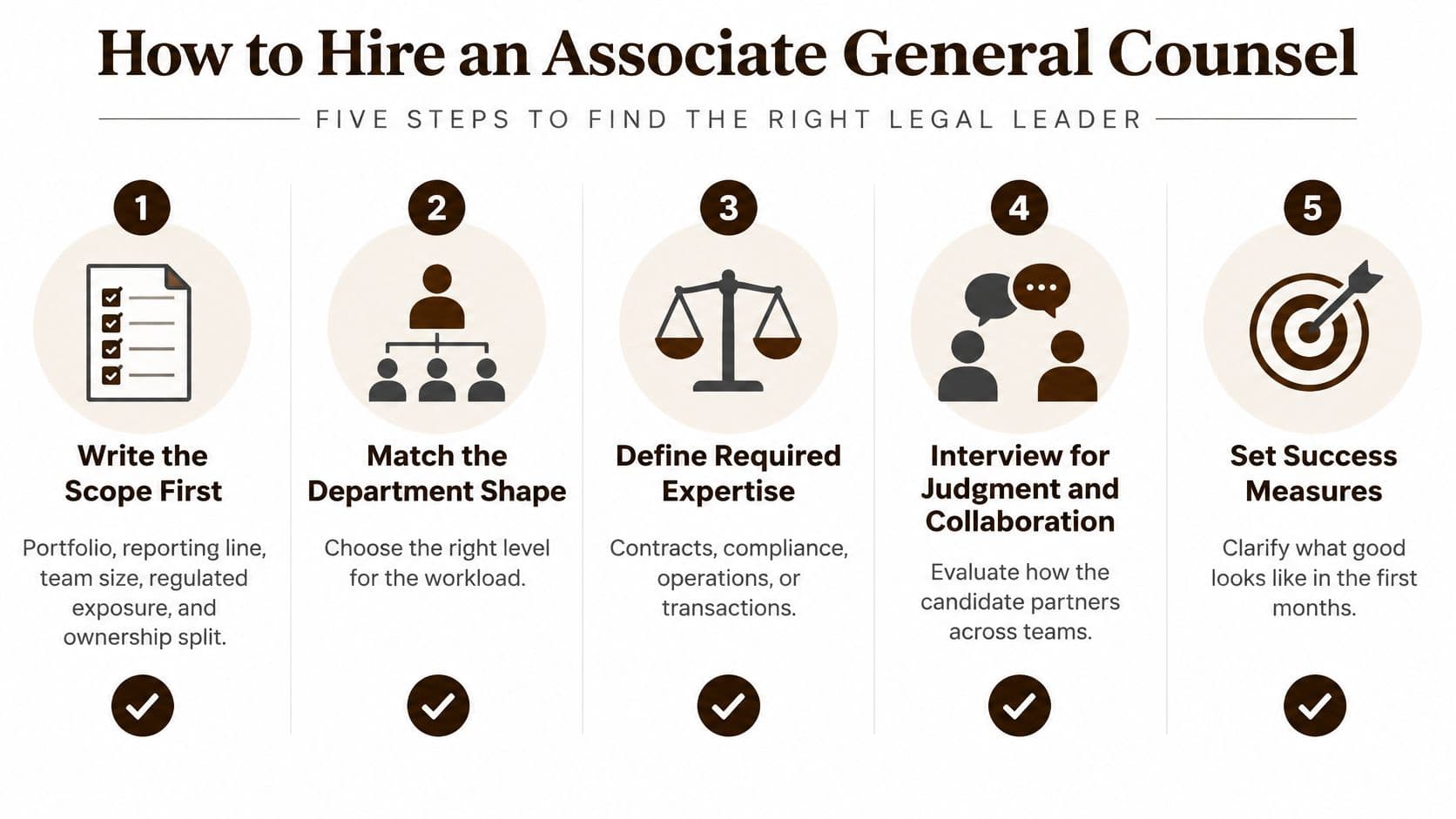
Run the search around the decisions the person must make, not a list of impressive employers. A recognizable résumé can establish exposure, but it doesn't establish ownership.
Use the hiring checklist to align the GC, HR, and business leaders before interviewing.
Define the search and test the work
-
Write the scope before sourcing. Specify the portfolio, reporting line, team responsibility, regulated exposure, and delegated authority. Name the work the person won't own as well. Otherwise, interviewers may assess different jobs under the same title.
-
Approve the compensation structure. Establish base, incentive opportunity, and any equity before approaching candidates. Resolve whether the budget fits a hands-on specialist, a broad generalist, or a leader managing other lawyers.
-
Use a live-style risk exercise. Give candidates a fictional contract or compliance problem with incomplete facts. Ask them to assess probability, severity, detectability, and mitigation cost, then recommend action. Require an owner, deadline, evidence standard, and escalation trigger.
For example, a vendor may resist a security commitment while procurement faces an operational deadline. A strong candidate asks what information the vendor will access, identifies missing facts, proposes interim protections, and separates the legal recommendation from the business decision. A weak answer either blocks everything or approves everything without explaining the conditions.
Assess technology judgment and executive readiness
- Test AI governance, not brand familiarity. A 2025 CLOC-linked survey found 30% of legal teams already using AI and 54% planning adoption within two years. Ask candidates to design an AI-assisted contract-review workflow rather than name the tools they've tried.
The answer should address approved data environments, confidentiality, privilege, vendor terms, accuracy checks, bias, human review, and records of use. For measurement, ask how they'd compare reviewer time and correction effort against the existing process. Speed alone isn't sufficient if lawyers must redo the output.
- Use evidence-based scoring. Give greatest importance to the capabilities the vacancy requires. Strategic judgment and executive communication should remain central; regulated-industry knowledge deserves greater emphasis when the portfolio depends on it.
AGC hiring scorecard
| Capability | Strong evidence |
|---|---|
| Issue spotting and risk quantification | Maps a live-style risk with probability, severity, detectability, and mitigation cost |
| Control design | Names an owner, deadline, evidence standard, and escalation trigger for each control |
| Execution through non-lawyers | Has moved a business team to a new process and measured the result |
| Regulated-industry knowledge | Has owned regulated or cross-border matters and can explain the constraints |
| AI governance | Designs controlled contract review with human sign-off, data limits, accuracy checks, and an ROI metric |
| Executive communication | Briefs leaders with options, a recommendation, and a clear escalation line |
The best hire isn't necessarily the most technical lawyer. It's the lawyer who can improve how the department works without losing confidentiality, accuracy, or accountability.
The executive-alignment questions involved in hiring a general counsel also matter here, but assess the AGC against the authority delegated to this seat.
Start the Associate General Counsel Search
Don't post a generic deputy title and expect candidates to supply the missing design. Settle the portfolio, reporting line, decision rights, and compensation structure first. Then give every interviewer the same scorecard.
At Five Star Placements, every candidate we send has spoken with us on a call before the client sees them. We vet credentials, bar status, matters handled, and fit, and confirm interest in the specific role. That screening is most useful when the employer can explain exactly what the AGC will own.
Give each side a concrete next step
- For employers: Prepare a search brief naming the portfolio, escalation boundaries, essential experience, and expected operating improvements. Use it to discuss the opening with us.
- For attorneys: Prepare examples of decisions and controls you owned, then identify seats where that record matches the work. You can browse current openings or tell us what you're looking for.
Our applications are confidential, and we won't contact an applicant's employer without permission. We charge a contingent fee, with nothing due until the attorney starts.
A successful search should resolve more than who gets the title. It should establish what the department can confidently delegate once that person arrives.
Five Star Placements helps corporate legal departments source and screen in-house counsel against the work the role needs to own. Visit Five Star Placements to schedule a call about your associate general counsel opening or explore current opportunities that match your portfolio experience.
Need help filling a legal role?
Five Star Placements partners with law firms and legal departments nationwide.
Schedule a Call