
How to Hire a General Counsel: A Practical Playbook
September 29, 2026 · 16 min read · Five Star Placements

Table of contents
In a 2025 analysis of Fortune 500 general counsel appointments, 43% of GCs appointed that year had left within five years, compared with 17% in 2022. The same analysis found that 54% were hired externally and 46% promoted internally. Russell Reynolds Associates' analysis makes the point plainly: hiring a GC isn't a standard legal recruitment exercise. It's an executive decision about how the company will manage risk, spend, growth, and accountability.
A failed search consumes outside-counsel budget while the vacancy remains open, restarts the replacement cycle, and weakens confidence among the board and operating leaders. The right process starts before you review a résumé. You need to decide what legal work the company has, how much risk it carries, what leadership it expects, when a permanent hire makes sense, and what evidence will prove that a candidate can operate at enterprise level.
Table of Contents
- Why Hiring a General Counsel Carries Enterprise Stakes
- Defining the GC Role Before You Source Anyone
- Choosing Between Fractional, Interim, and Full-Time
- Building a Sourcing Strategy That Actually Reaches GCs
- Interview Questions That Reveal Strategic Fit
- Setting Compensation That Wins the Right Candidate
- Onboarding and Retaining Your New General Counsel
Why Hiring a General Counsel Carries Enterprise Stakes
A GC can have excellent legal judgment and still be the wrong executive for the business. The failure usually comes from a mismatch between the candidate's operating style and the company's demands. A specialist may excel in a narrow practice but struggle when the CEO needs a commercial answer by lunch, the board needs a risk recommendation, and operating leaders need legal support for a launch.
The Fortune 500 figures make tenure part of the assessment. Forty-three percent of GCs appointed in 2025 had left within five years, compared with 17% for the 2022 appointment group. The analysis also found that 20% of Fortune 500 GCs had held their roles for more than a decade, while 26% had between five and ten years of tenure. Those figures do not prove that longer tenure equals stronger performance. They show why years in the title cannot substitute for evidence that a candidate has led through the company's current level of complexity. The Russell Reynolds findings support a disciplined review of context, progression, and staying power.
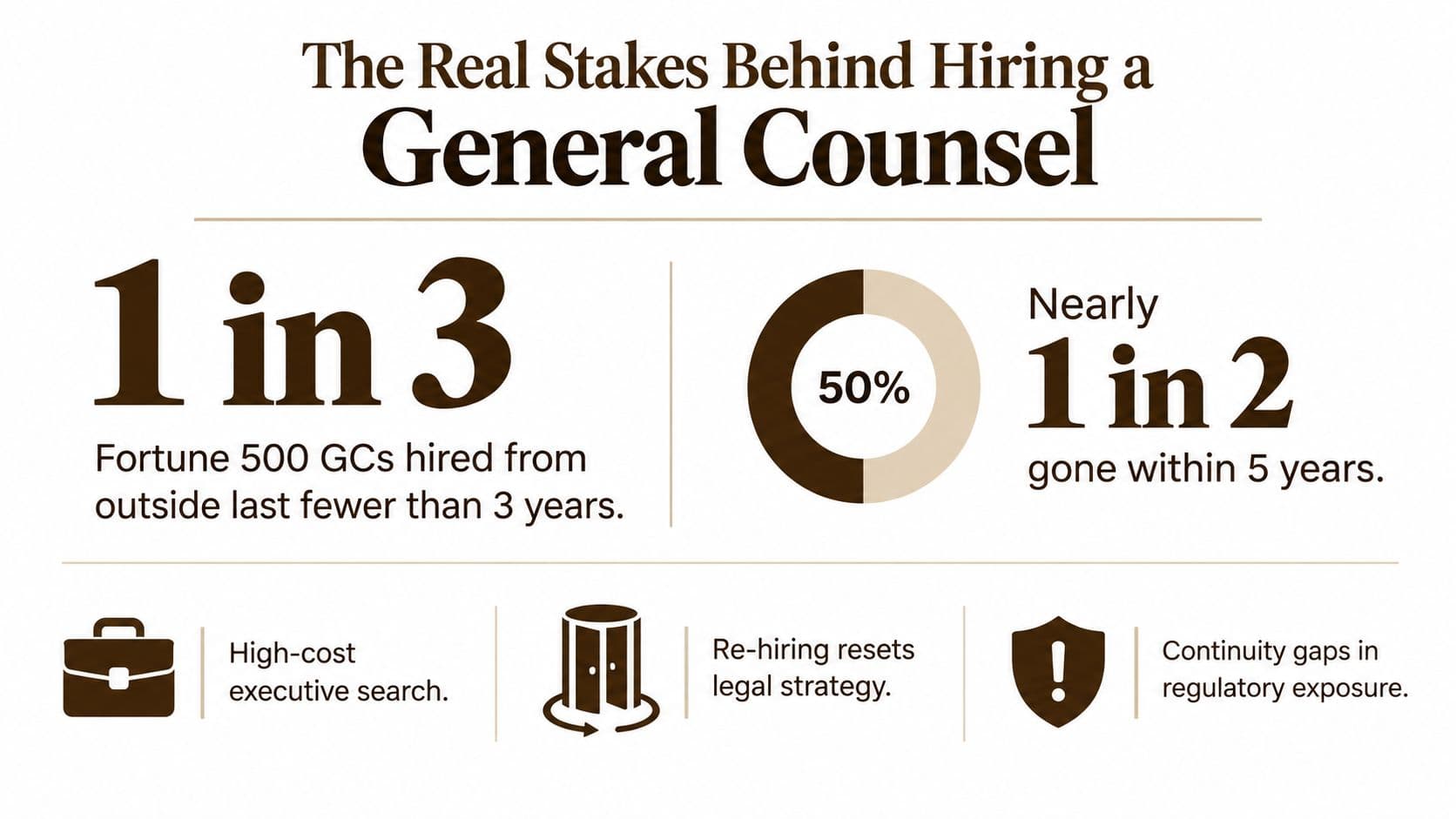
The three budgets a bad hire damages
The first is the legal budget. During a weak transition, outside counsel takes on work that should have been triaged internally. Matters are duplicated, instructions lose consistency, and the company gives firms less reason to compete for its work.
The second is the leadership budget. The CEO, CFO, board chair, and senior operators spend time reopening decisions, briefing new candidates, and managing uncertainty. A failed search also delays choices about whether the company needs a full-time GC, an interim leader, or fractional support. A permanent hire fits sustained legal volume, recurring executive counsel, and ownership of the function. Fractional or interim leadership fits a defined build-out, transition, transaction, or temporary gap.
The third is institutional confidence. Directors need clarity about who owns risk and provides independent advice. Operating leaders need a legal partner who can make decisions, not only identify obstacles. A revolving GC seat signals that the company has not settled the function's mandate or decision rights.
Practical rule: Treat the GC search as an operating-model choice first and a candidate choice second.
Before interviewing, require evidence that candidates have made comparable trade-offs. Ask what they changed, which business leaders they influenced, how they allocated legal spend, and what happened after their recommendation. Legal pedigree opens the conversation. Specific operating results, judgment under pressure, and a credible reason for the next move should determine the hire.
Defining the GC Role Before You Source Anyone
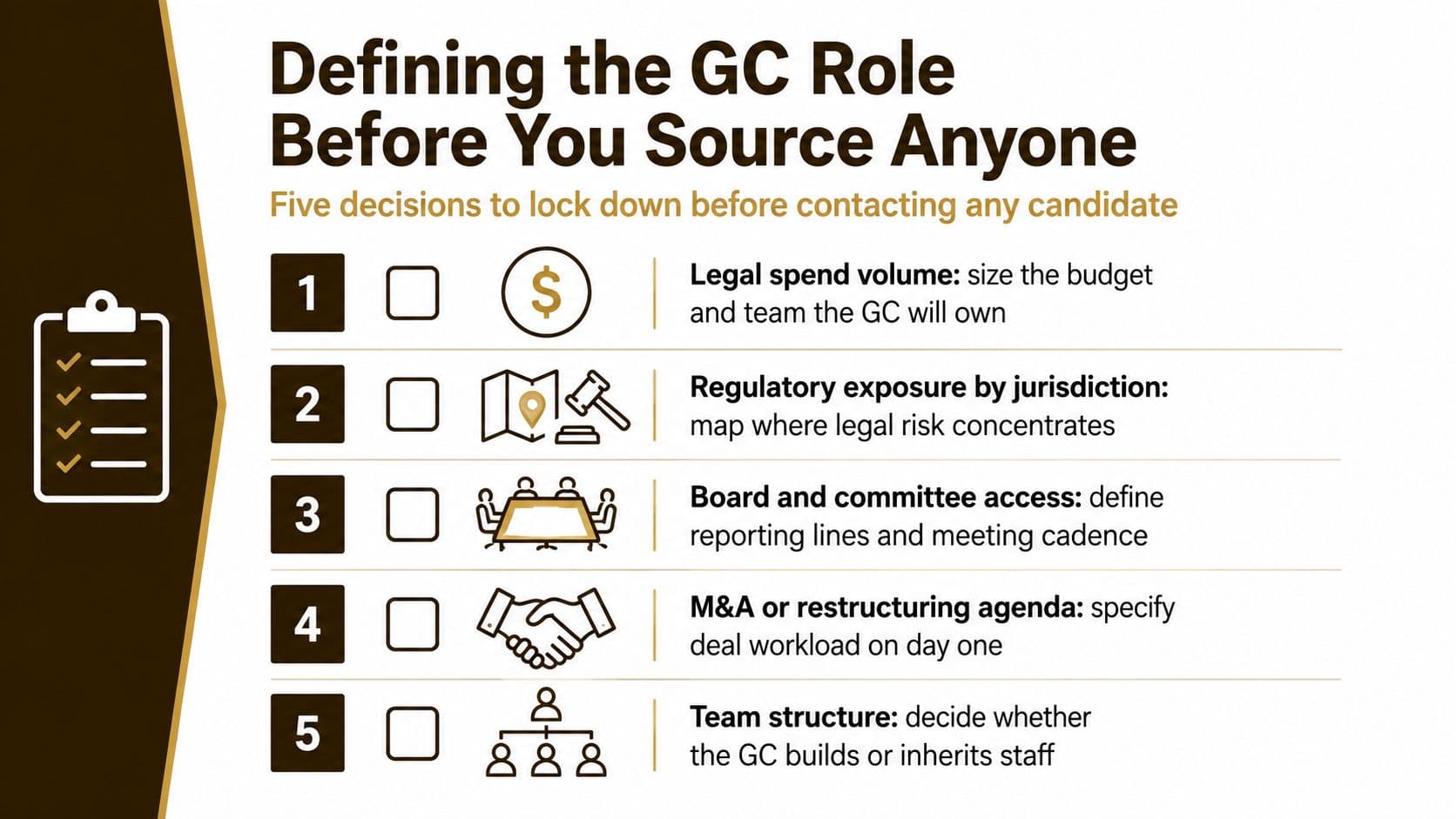
Don't contact candidates until the hiring committee can describe the role in one page. A vague mandate attracts vague profiles, and vague profiles produce interviews dominated by pedigree instead of evidence.
Start with these five decisions.
Legal spend volume
Determine what the GC will control. Will the role own the outside-counsel panel, legal operations, contract workflows, and department budget, or will those responsibilities remain with finance or procurement? Ask, “What legal work arrives every week, and what work appears only during transactions or disputes?”
The answer determines whether you need a hands-on builder, a manager of specialists, or an executive who can redesign the service model.
Regulatory exposure by jurisdiction
Map the company's meaningful exposure rather than listing every jurisdiction where it operates. Identify the regulators, licenses, data obligations, employment risks, product restrictions, and reporting requirements that could materially affect the business.
Ask, “Where would a regulatory mistake interrupt revenue, market access, or customer trust?” A candidate who has handled the relevant regulator or risk environment should explain how they made decisions under pressure, rather than just naming the practice area.
Board and committee access
Define the reporting line and access before sourcing. Will the GC report to the CEO, attend every board meeting, advise the audit committee, or have direct access to the chair when independence matters?
This is a governance decision, not a scheduling detail. A candidate can't deliver independent advice if the company expects them to route every difficult issue through an executive who is directly involved.
M&A or restructuring agenda
Specify the transactional workload on day one. Is the company preparing for acquisitions, a sale process, a financing, a restructuring, or a public-company event? If so, decide whether the GC is expected to lead the deal, manage external advisers, or build the internal capability around it.
Ask, “What must be completed or materially improved during the first year?” Candidates should hear the mandate before they decide whether the opportunity fits.
Enterprise governance and team design
Clarify whether the GC owns privacy, cybersecurity, AI governance, compliance, ESG, corporate secretary responsibilities, or only traditional legal work. Also decide whether the person inherits a team or must build one.
Use this first-GC mandate checklist in the approval meeting:
- Scope: Matters, functions, jurisdictions, and decisions owned by the GC.
- Reporting line: CEO relationship, board access, and committee responsibilities.
- Team model: Existing staff, planned hires, legal operations support, and outside-counsel use.
- Year-one success: Concrete improvements in risk visibility, responsiveness, governance, or spend control.
- Year-three success: The legal function's intended scale, leadership bench, and strategic contribution.
For a useful distinction between adjacent leadership roles, review this guide to in-house counsel versus general counsel. The committee should leave with a role brief that candidates can understand and interviewers can score consistently.
Choosing Between Fractional, Interim, and Full-Time
The hiring decision starts with the operating model, not the candidate. Define the legal leadership the business needs now, then choose the appointment that matches the workload, urgency, and level of executive ownership.
A fractional GC fits recurring but manageable work, including commercial contracts, employment advice, governance support, and outside-counsel coordination. The company gains senior judgment without creating a full-time executive seat for a calendar that is not consistently full. Choose this model when matters arrive in bursts and the business does not yet need continuous executive presence.
An interim GC solves a time-bound leadership gap. Use one after a resignation or during leave, an acquisition, restructuring, investigation, or first-GC transition. The interim leader contains immediate risk, keeps decisions moving, and preserves continuity while the company conducts a permanent search. Set the mandate and handoff expectations at the outset. Do not use an interim appointment to delay a full-time decision the board has already made.
A full-time GC is warranted when legal leadership must sit inside commercial decisions, manage material regulator relationships, advise the board routinely, or build a department around sustained growth. KPMG's 2026 Global General Counsel Outlook found that 96% of GCs expect their role to contribute to enterprise growth over the next three years, with 47% saying that contribution is very likely. The outlook also found that 39% identify regulatory volume and complexity as their biggest pressure, while 80% are focused on expanding legal capacity without increasing headcount and 80% on cost savings. The implication is clear: design the function before adding permanent headcount.
| Dimension | Fractional GC | Interim GC | Full-Time GC |
|---|---|---|---|
| Primary use | Recurring legal oversight without a permanent executive seat | Continuity during a crisis, vacancy, or transition | Embedded strategic leadership and sustained legal ownership |
| Best fit | Reactive or episodic work | Immediate risk, succession, or transaction pressure | Continuous business partnership, governance, and regulatory accountability |
| Main advantage | Cost control and senior coverage | Speed and stability | Institutional knowledge and executive influence |
| Main trade-off | Limited availability and context | Temporary mandate and handoff risk | Highest fixed commitment and longer hiring process |
| Hiring test | Is the work regular enough to need senior judgment but not constant presence? | Is a leadership gap creating immediate exposure? | Must the GC own enterprise decisions and build the function? |
Apply a practical decision rule. Choose fractional coverage when the work is mainly reactive. Appoint an interim leader when a vacancy or event creates immediate exposure. Create a full-time seat when the GC must own regulator relationships, board work, enterprise governance, and the legal function's long-term direction. Interview evidence should match that choice: ask candidates to show how they have made comparable decisions, not merely where they trained or practiced.
Building a Sourcing Strategy That Actually Reaches GCs
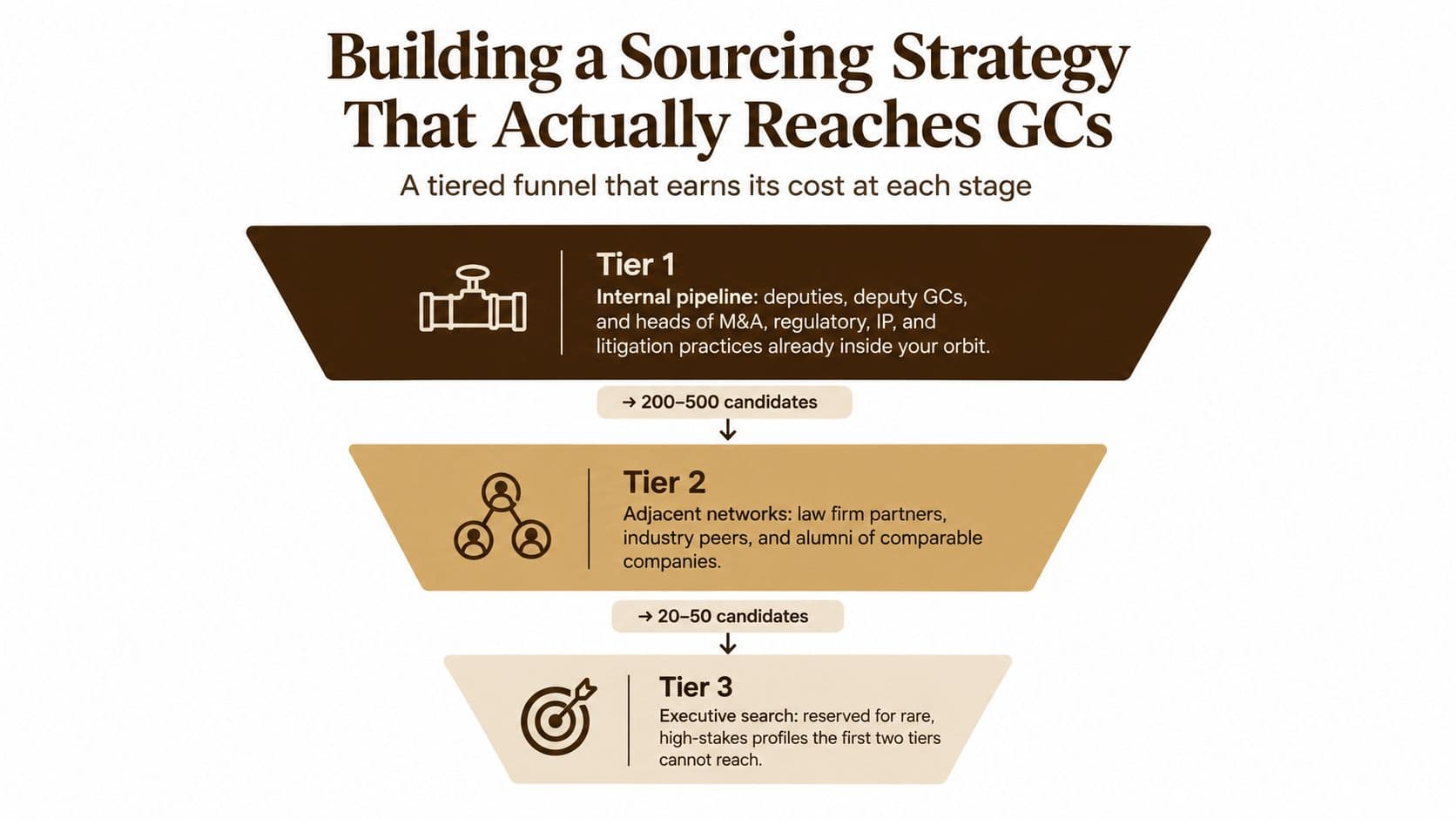
The strongest GC searches don't begin with a job advertisement. They begin with a targeted conversation about the mandate and the people already close to it.
Start with the internal and adjacent pipeline
Review deputies, deputy GCs, senior counsel, and heads of M&A, regulatory, IP, litigation, or compliance. An internal candidate already understands the company's products, politics, and risk tolerance. That context can outweigh a more prestigious external background, provided the person has demonstrated executive judgment and can shift from adviser to accountable leader.
Then ask the CEO, CFO, board members, audit committee chair, and trusted outside-counsel partners for names. These referrals often reveal passive candidates who aren't scanning public postings. The referral should come with a specific reason: “This person has led a regulated expansion,” not “They've got a strong résumé.”
Use the warm market deliberately
Peer GCs at comparable companies, law firm partners, former executives, and alumni from relevant industries can identify candidates who fit the company's operating environment. Give each source the role brief, not a generic title. A candidate who is ideal for a venture-backed technology company may be wrong for an industrial business with licensing and safety exposure.
The sourcing test: Every introduction should answer why this candidate fits the company's risk, scale, governance, and leadership model.
Contingency recruitment can help with counsel and deputy-level hiring, but GC candidates are often passive and difficult to reach through inbound applications. A firm such as Five Star Placements can be considered when the company needs permanent in-house recruitment and customized screening across experience, skills, and organizational fit.
Escalate to retained search when the mandate demands it
Retained executive search earns its cost when the role is confidential, the candidate must be drawn from a narrow peer set, the company needs succession mapping, or the search requires direct access to sitting GCs. The search partner should understand the operating model before presenting names.
Brief the partner on:
- Business context: Revenue model, growth stage, ownership, and strategic agenda.
- Risk profile: Regulators, litigation, privacy, cybersecurity, AI, and cross-border exposure.
- Executive expectations: CEO partnership, board access, independence, and communication style.
- Candidate evidence: Specific experiences that demonstrate commercial judgment and leadership.
- Deal breakers: Conflicts, short tenure without explanation, weak team leadership, or inability to make decisions under uncertainty.
Spencer Stuart reports a typical four-to-six-month cycle from first meeting to accepted offer for a GC search, and recommends involving senior management early and defining competencies before sourcing begins. Its executive-search guidance also describes a mixed internal and external market, with 53% of Fortune 1000 GCs in 2022 hired externally. Plan the process around that reality. A rushed search usually narrows the market before the committee understands what it needs.
Interview Questions That Reveal Strategic Fit
A GC interview should test what the person does when legal advice collides with revenue, reputation, speed, and incomplete information. Don't let the panel reward polished vocabulary. Ask for a specific decision, the alternatives considered, the people involved, and the result.
Use a scorecard before interviews begin. The weights below are a practical starting point, not a substitute for the mandate.
| Competency | Weight | Sample Behavioral Prompt | Anchored Scoring Guide |
|---|---|---|---|
| Business partnership | 25% | Describe a commercial decision where you challenged the CEO. What changed afterward? | 1, vague theory. 3, clear example with limited ownership. 5, specific trade-off, influence, decision, and outcome |
| Regulatory and risk judgment | 20% | Review a redacted enforcement notice. How would you triage advice, communications, and remediation? | 1, lists issues. 3, proposes sequence. 5, prioritizes exposure, stakeholders, timing, and accountability |
| People leadership | 15% | Tell us about a legal team you inherited or rebuilt. What did you change first? | 1, individual contributor focus. 3, manages tasks. 5, creates capacity, standards, and succession |
| Deal execution | 10% | Walk through a transaction where legal strategy changed the commercial outcome. | 1, describes documents. 3, explains process. 5, connects legal choices to value, timing, and risk |
| CEO and board communication | 10% | Give the recommendation you presented to a divided board or executive team. | 1, hides behind options. 3, communicates clearly. 5, gives a decisive recommendation with calibrated escalation |
| AI-era risk literacy | 10% | How would you govern a sales team using generative AI with customer data? | 1, relies on policy language. 3, identifies controls. 5, connects data, privacy, security, training, monitoring, and business use |
| Culture and tenure fit | 10% | What conditions have allowed you to stay effective in a demanding executive role? | 1, generic preferences. 3, identifies working style. 5, explains fit, resilience, and constructive disagreement |
Score each answer from one to five, using written evidence rather than instinct. A five doesn't mean the candidate made the perfect decision. It means the candidate can explain the judgment, trade-offs, stakeholders, and consequences with enough precision for the panel to test the story.
Test AI and enterprise judgment together
For an AI-heavy or regulated business, ask the candidate to design a governance response rather than recite a privacy principle. Give them a realistic scenario involving customer data, sales urgency, security controls, and an unclear regulatory position. Then ask what they would approve, what they would stop, who would own the decision, and how they'd communicate the recommendation.
Reference checks should validate strategic claims with former CEOs, board chairs, business-unit leaders, and direct reports. HR can confirm dates and title, but only operating partners can tell you whether the candidate made difficult calls, earned trust, and improved the function.
Setting Compensation That Wins the Right Candidate
Compensation should match accountability, not the candidate's current salary. A GC responsible for board advice, regulatory exposure, enterprise risk, and legal operations is competing in the executive market. KPMG's 2026 outlook connects the role with enterprise growth and regulatory complexity, while a 2026 legal market report cited in that outlook places U.S. GC salary ranges at $222,750 to $270,500. Treat that figure as a reference point, then adjust for company size, ownership, geography, role scope, and governance exposure.
Set the package in this order:
- Base salary: Establish a defensible range tied to the mandate and comparable executive roles. Do not anchor it to a law firm partner's book of business or another company's title.
- Annual incentive: Link the bonus to outcomes the GC can influence, including risk reporting, matter management, compliance delivery, and transaction execution. Never reward the GC for hiding bad news.
- Long-term incentive: Use equity or another long-term instrument when legal decisions can affect enterprise value over several years. Explain vesting, liquidity, change-in-control treatment, and forfeiture before the offer is signed.
- Transition protection: Address unvested compensation, relocation, notice obligations, and the risk of leaving a secure position.
- Governance clarity: Put authority, reporting, severance, and board access in writing. Executive-level compensation cannot make up for employment terms that restrict executive authority.
A strong package answers a practical question: can this person succeed under the operating model you are offering?
Offer script: “This role owns the legal operating model, advises the CEO and board, and carries responsibility for the risks identified in the mandate. The package reflects that scope. We'll define success through the priorities agreed with the board, and we'll provide the access and resources required to deliver them.”
Do not use compensation to cover a broken role. A high package will not retain a GC who lacks board access, cannot direct outside counsel, or discovers that the company wanted a contract manager after presenting an enterprise leadership opportunity.
Before approving a range, review this general counsel salary guide. The committee should approve the full package and the authority that makes it credible at the same time.
Onboarding and Retaining Your New General Counsel
Maya accepted the offer because the company described a genuine executive mandate. The first weeks must prove that mandate exists. Retention starts with authority, access, and a workable operating model, not with a welcome message.
During days one through fourteen, the hiring committee should give Maya an executive briefing book rather than disconnected files. Include the legal budget, active litigation, material contracts, key regulator relationships, outside-counsel roster, known compliance issues, and board cadence. The CEO should introduce her to every business-unit head. The board chair or audit committee chair should explain how directors expect legal risk to be surfaced and escalated.
During weeks three through six, Maya should listen before reorganizing. She meets finance, security, privacy, sales, HR, product, and operations leaders; reviews outside-counsel invoices; and identifies where legal work stalls. Her first deliverable should be a concise risk register for the CEO, covering owners, urgency, dependencies, and recommended action. She should also draft a GC charter that defines who may instruct outside counsel, approve spend, escalate disputes, and stop a product or transaction when risk exceeds the agreed tolerance.
The first hundred days need visible outputs
By days thirty through sixty, Maya presents legal priorities to the hiring committee. The presentation should separate immediate exposure from structural improvement. It might cover contract intake, regulator engagement, litigation strategy, AI governance, or legal operations support. The committee should challenge the priorities, then remove obstacles instead of adding new ones.
By days sixty through one hundred, Maya and the CEO agree on a three-year legal roadmap, a direct-report hiring plan, and a partnership scorecard for the C-suite. The scorecard can track responsiveness, risk visibility, outside-counsel discipline, business-unit trust, and progress against governance commitments. Use those measures to support judgment. Do not turn the GC into a ticket-closing service desk.
The higher early-tenure turnover noted earlier makes the signed offer only the beginning of retention work. The response must be structural:
- Review the mandate: Revisit scope, reporting lines, and resources during a scheduled executive review.
- Protect independence: Maintain a direct relationship with the audit committee chair when the role requires it.
- Recognize enterprise contribution: Review compensation and long-term incentives as responsibilities expand.
- Support external credibility: Allow appropriate industry association participation and professional visibility.
- Keep the cadence: Hold quarterly check-ins with the CEO, board sponsor, and key executive stakeholders during the first year.
Every quarterly meeting should produce three answers: what changed in the risk profile, what the GC needs to deliver the next priority, and whether the company is honoring the operating model presented during the search. That discipline gives Maya a fair chance to succeed and gives the board an early warning when the role itself needs adjustment.
Five Star Placements provides permanent placement for General Counsel and other in-house legal roles, with customized screening for experience, skills, and organizational fit and payment due after a successful hire. Visit Five Star Placements to discuss a GC search built around your legal operating model, leadership mandate, and long-term retention needs.
Need help filling a legal role?
Five Star Placements partners with law firms and legal departments nationwide.
Schedule a Call