
How to Ask for a Raise Letter That Works
September 28, 2026 · 12 min read · Five Star Placements

Table of contents
A raise request is more likely to succeed when you make it directly. A 2024 LendingTree survey of 2,049 full-time workers found that 82% of employees who asked for a raise received one, compared with 66% of all full-time workers who received a raise whether they asked or not. For attorneys, paralegals, legal assistants, and legal operations professionals, the lesson is straightforward: a well-built raise request letter isn't administrative clutter. It's a negotiation document.
Legal compensation decisions depend on records, comparisons, and approval chains. Your letter should therefore read like a concise internal memorandum, supported by billable performance, matter outcomes, client value, efficiency gains, and market context. The right approach to how to ask for a raise letter is precise, direct, and tied to the business case for keeping you.
Table of Contents
- Why a Raise Letter Changes the Odds for Legal Professionals
- When to Send Your Raise Request Letter
- Anatomy of a High-Conversion Raise Letter
- Sample Letter Templates for Attorneys and Legal Staff
- Common Mistakes That Derail a Raise Request
- Delivering the Letter and Handling the Response
Why a Raise Letter Changes the Odds for Legal Professionals
The first advantage is simple: asking works. The LendingTree survey found that 82% of full-time employees who asked for a raise received one, and employees who proactively asked were more likely to receive a larger increase, with many increases reaching $5,000 or more. The request itself changes the conversation from an unspoken expectation to a decision someone must evaluate.
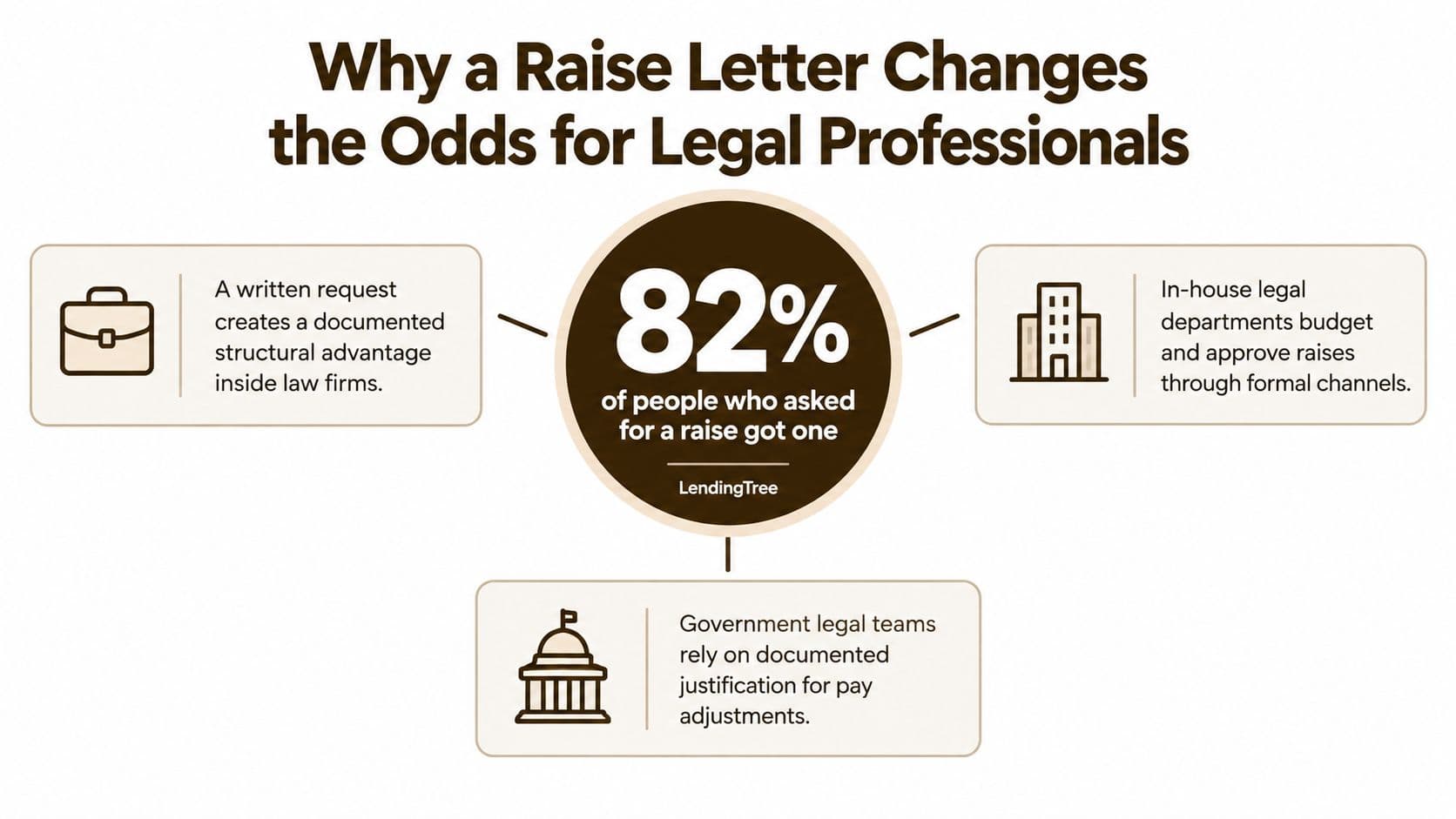
A written request matters even more in legal workplaces because compensation rarely rests with one person. A law firm may involve a practice group leader, managing partner, compensation committee, and firm administrator. An in-house department may require a general counsel, human resources business partner, finance leader, or executive committee to review the request. Government legal teams often need documented justification before a pay adjustment can move through an established classification or budget process.
The structural advantage of a written request
A hallway conversation is easy to defer. A manager can agree that you deserve a review, then become absorbed in a filing deadline, closing, hearing, or budget meeting. A letter creates a record of what you contributed, what you want, and when you raised the issue.
It also gives decision-makers material they can circulate. Your supervisor can forward a concise summary of billable hours, collections, matter results, origination credit, client retention, process improvements, or expanded duties without having to reconstruct the argument from memory. That makes the request easier to defend to senior stakeholders.
For attorneys, this is especially important when compensation reviewers compare production against role expectations. For support professionals, the evidence may involve docket management, discovery coordination, billing accuracy, reduced outside-counsel spend, faster contract turnaround, or ownership of a department-wide system.
Practical rule: Treat the letter as a business record, not a personal appeal.
A strong letter also avoids the unnecessary aggression of an ultimatum. It documents a negotiation without announcing that the relationship has become adversarial. Guidance from Five Star Placements' coaching for attorneys resource aligns with that approach, preparation gives legal professionals a stronger foundation for a focused compensation conversation.
When to Send Your Raise Request Letter
Timing determines whether your request reaches someone with authority, budget, and time to act. A strong case can stall if it arrives during a budget freeze, a litigation emergency, or an internal crisis.
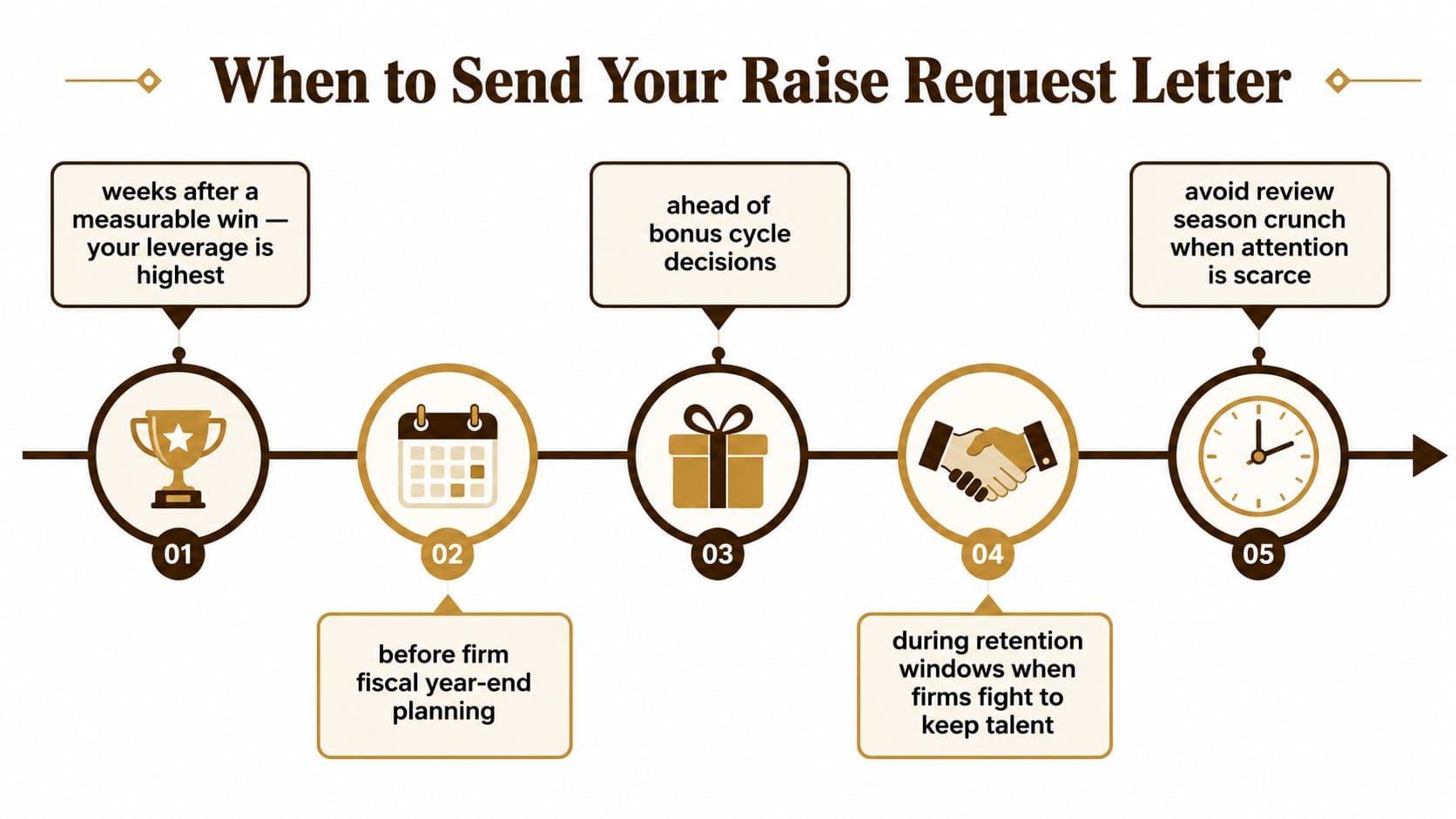
Start with the organization's calendar. Identify the fiscal year-end, annual review period, bonus discussions, partner distribution process, and deadlines for compensation recommendations. In a law firm, partner-level review may occur before the formal performance meeting. In-house legal teams may need approval from both the general counsel and finance. Submit the letter early enough for your supervisor to include it in that process.
Match the request to your strongest position
Use one of these timing windows:
- After a measurable win: Send the letter after a successful motion, favorable settlement, completed acquisition, major client matter, or operational improvement. Billable output, matter results, and process gains are easier to verify while the result remains visible.
- Before compensation planning: Submit the request before the firm or department finalizes salary recommendations. Ask your supervisor when those decisions are made if the calendar is unclear.
- Ahead of bonus discussions: A bonus conversation can show how leadership evaluates your contribution. A bonus should not replace a salary review when your responsibilities have permanently expanded.
- During a retention window: If a recruiter contacts you or you have a genuine competing offer, raise the issue professionally. Do not create a bargaining position you would not use.
- After a promotion without aligned pay: A move to senior associate, counsel, senior paralegal, or legal operations leadership warrants a compensation review when the salary has not changed with the role.
Avoid sending the letter immediately after a public mistake, during layoffs or a hiring freeze, or while the organization has imposed a clear budget restriction. Late Friday and holiday-week messages are also easy to overlook.
Use this calendar rule: send when your evidence is fresh, your supervisor has time to act, and the budget process is still open. Request a dedicated meeting in the letter. Keep the negotiation in that meeting, where you can address billable performance, matter outcomes, retention risk, and partner or executive review directly.
Anatomy of a High-Conversion Raise Letter
Write the letter as a short internal memo, not as a cover letter and not as a career autobiography. The recommended format is two or three brief paragraphs, a clear compensation request, quantified achievements, relevant market data, and a meeting request. Robert Half's guidance on writing a raise request supports that concise, evidence-led structure.
Open with context. Name your title, tenure, department or practice group, and reason for writing. Don't spend the opening praising the organization or apologizing for raising compensation. State that you want to review your salary in light of your contribution and current responsibilities.
The middle paragraph carries the case. Choose the evidence a legal decision-maker can test:
- Production: Billable hours, collections, realization, utilization, or work above the expected target.
- Matter value: Successful motions, favorable resolutions, closed transactions, major filings, or responsibility for complex matters.
- Business development: Client origination, expanded client relationships, cross-selling, or work that protected an important account.
- Operational impact: Outside-counsel savings, faster contract review, improved intake, cleaner billing, better discovery coordination, or stronger compliance workflows.
- Scope: New team leadership, training, systems ownership, or responsibilities added after your last compensation review.
The final paragraph should state the amount or range you want, identify the market source supporting it, and ask for a meeting. Don't bury the number. If you want a salary range, both figures must be acceptable to you.
Compare the formats before you write
| Element | Memo Format | Generic Cover Letter | Bullet List Email |
|---|---|---|---|
| Purpose | Requests a compensation review and meeting | Presents a candidate for a role | Lists accomplishments without a developed argument |
| Evidence | Connects results to business value | Describes experience broadly | Separates metrics from their significance |
| Ask | States a specific salary target or range | Usually omits a compensation request | May hide the number at the end |
| Audience | Built for supervisors, partners, HR, and finance reviewers | Built for an external hiring manager | Built for quick internal scanning |
| Best use | Raise negotiations and documented reviews | Job applications | Follow-up or evidence summary |
Use a confident, factual, grateful tone. Legal decision-makers respond to clear receipts, not flattery. For role-specific application writing, this legal assistant cover letter guidance is useful, but a raise letter should stay narrower and more focused on current contribution.
Sample Letter Templates for Attorneys and Legal Staff
These templates are starting points, not scripts. Replace every bracket with evidence that your supervisor can verify, and adjust the language to fit the decision-maker. A partner-led firm will care about matter economics, collections, originations, and client relationships. A general counsel-led department will focus more on risk reduction, legal spend, commercial support, responsiveness, and expanded ownership.
Mid-level associate at a law firm
Use this version after a meaningful matter result, a sustained production period, a promotion without a corresponding adjustment, or a review cycle that didn't reflect your current scope.
Dear [Managing Partner or Practice Group Leader],
I'm writing to request a review of my compensation as a [practice area] associate with [firm name]. Since my last compensation review, I've expanded my role across [matters or clients], taken primary responsibility for [specific responsibility], and contributed at a level consistent with [senior associate or comparable role]. I'd appreciate a meeting to discuss aligning my salary with that contribution.
Over this period, I recorded [billable hours] billable hours against a target of [target], supported [matter or client] through [result], and [originated, expanded, or protected] work involving [client or practice group]. I also [reduced outside-counsel expense, improved matter workflow, trained junior lawyers, or handled a larger portion of client communication]. These results have increased my value to the practice group and expanded the matters I can manage independently.
Based on [NALP, Robert Half, Major Lindsey & Africa, or another credible market source] for attorneys with my experience and practice focus in [location], I'm requesting a salary adjustment to [specific amount] or a range of [lower amount] to [higher amount]. I'd welcome a meeting by [date] to discuss the request, the firm's compensation process, and any additional information needed.
Sincerely, [Name]
Senior paralegal in a corporate legal department
Use this version when your responsibilities have expanded beyond the original job description or when you can show measurable support for the legal department's efficiency and risk management.
Dear [General Counsel or Legal Department Leader],
I'm writing to request a review of my compensation as [title] at [company]. Since my last review, my responsibilities have expanded to include [contracts, litigation support, entity management, compliance, legal operations, or another function]. I'd appreciate the opportunity to discuss an adjustment that reflects the scope and business value of my current role.
During this period, I [managed or supported] [number or description of matters], coordinated [department or process], and helped [reduce legal spend, improve contract turnaround, strengthen filing accuracy, or organize a critical workflow]. I also assumed responsibility for [system, reporting process, vendor relationship, or team training], which has allowed the department to support [business unit or project] more efficiently. These contributions go beyond my original position and have made me a dependable operational resource for the legal team.
Based on [Robert Half, a relevant legal staffing salary guide, or another credible market source] for senior paralegals in [location and industry], I'm requesting a salary adjustment to [specific amount] or a range of [lower amount] to [higher amount]. Could we meet by [date] to discuss the request and the department's compensation process?
Sincerely, [Name]
For in-house counsel, litigation support, and legal operations roles, swap legal-specific metrics for the measures your leadership tracks. The best template is the one that makes your contribution legible to the person approving the budget.
Common Mistakes That Derail a Raise Request
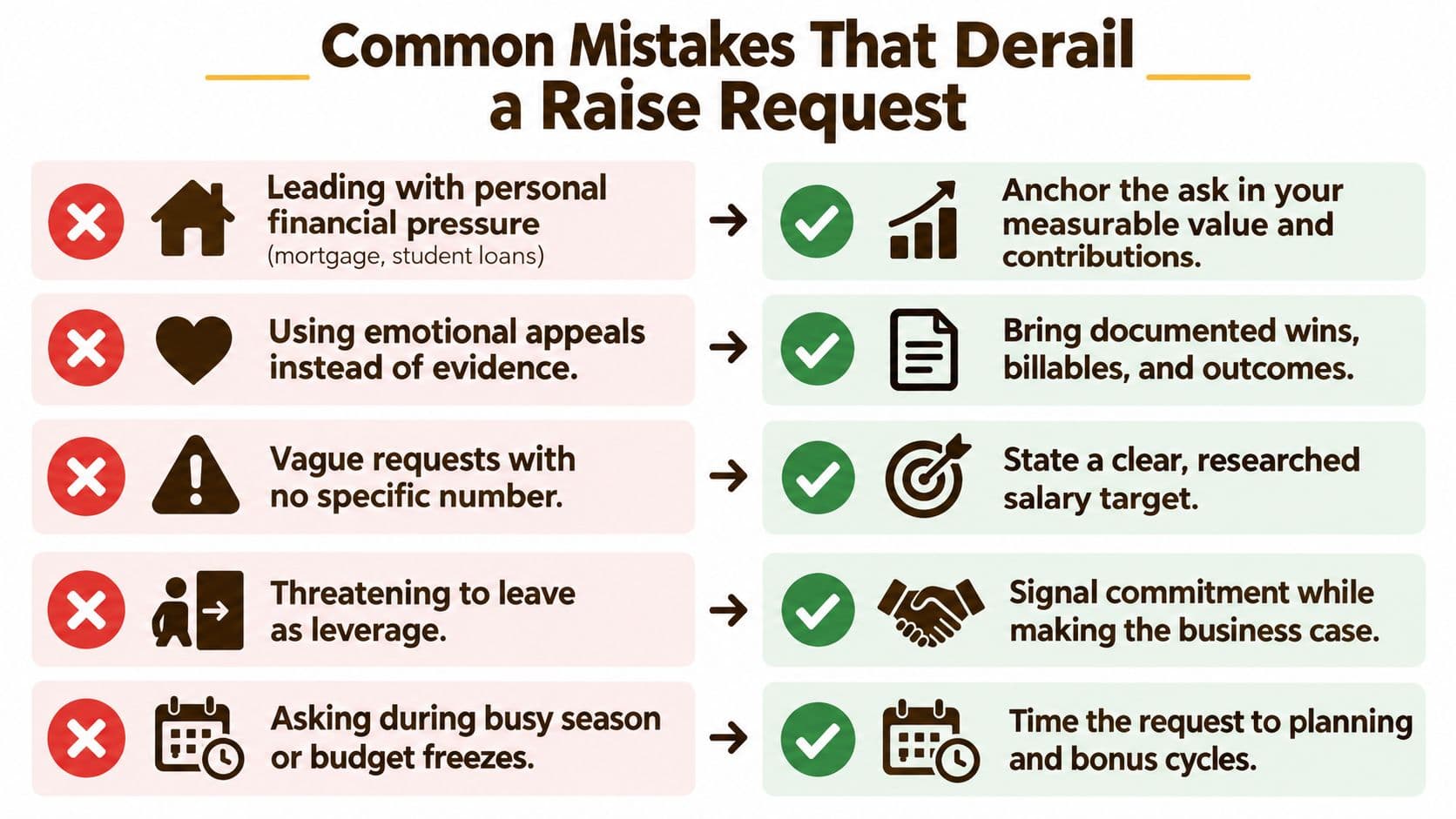
A raise letter fails when it asks the reader to solve the writer's personal problem instead of evaluating the writer's business value. Personal expenses may be real, but mortgage payments, student loans, childcare, and household costs don't explain why the firm or legal department should adjust compensation.
Use this framing instead: “My request is based on the expanded scope of my role and the measurable results summarized below.”
Replace emotion with evidence
Coworker comparisons create a second problem. Even if you know what a colleague earns, naming that person's compensation invites a confidentiality issue and shifts attention away from your own contribution. Use market evidence tied to role, experience, practice area, and location.
Vague language is just as weak. “I'd like to be paid market rate” makes the reader do the research and leaves no clear proposal to approve. State the target and identify the source behind it.
Use this sentence: “Based on compensation data for comparable roles in [market], I'm requesting an adjustment to [amount or range].”
Other recurring errors are easy to correct:
- Burying the number: Put the requested salary or range in the closing paragraph, not in an attachment or unexplained final sentence.
- Writing an essay: A focused memo is easier to circulate than a multi-page narrative. Keep supporting detail available for the meeting.
- Re-litigating a missed bonus: Explain the continuing value of your role and separate one-time compensation from base salary.
- Threatening to leave: If you have a genuine offer, discuss it carefully in person. Don't turn the letter into an ultimatum.
- Apologizing: Remove “I'm sorry to bother you” and “I know this may be a lot to ask.” You're requesting a professional review.
- Choosing poor timing: Don't send the letter during a budget freeze, major crisis, or period when your supervisor can't reasonably act.
A useful replacement for a grievance is: “I'd like to discuss how my current responsibilities and results should be reflected in compensation.”
Treat the tone like a brief prepared for a discerning client. Be candid, organized, and supported by facts. The decision-maker is assessing contribution, retention risk, budget, and precedent, so give them a business case they can defend.
Delivering the Letter and Handling the Response
Send the letter to the person who can sponsor the request. Usually, that's your direct supervisor, practice group leader, department head, or general counsel. Copy a managing partner, HR leader, or finance contact only when the organization's process makes that appropriate. Copying senior people too early can make a routine review look like an escalation.
Request a 20 to 30-minute meeting to discuss the letter. Bring a one-page evidence summary with your core metrics, market source, responsibilities, and requested compensation. Don't read the letter aloud. Restate the ask, answer questions directly, and listen for the actual approval constraints.
Ask questions that reveal the path forward:
- “How does the firm evaluate this type of compensation request?”
- “Which part of my supporting information would be most useful to the review committee?”
- “If the full adjustment isn't possible now, what specific milestones would support reconsideration?”
- “When should we revisit the decision?”
If the answer is yes, confirm the new salary, effective date, and any retroactive component in writing. Don't rely on a verbal assurance that payroll or HR will handle the details.
A partial approval is still a negotiation. Ask whether the remaining gap can be addressed through a performance bonus, additional paid time off, title adjustment, professional development support, or a defined review date. Get the terms and conditions documented, especially if the alternative depends on future performance.
A no without a path forward requires a different evaluation. If your manager can't identify what would justify a future adjustment, assess your external market value discreetly and decide whether the role still supports your goals. Keep the relationship professional, and review any employment restrictions or obligations before acting. Employment agreement review guidance can help you identify provisions that may matter before pursuing an outside opportunity.
Open the meeting with this script:
“Thank you for making time. I'd like to discuss my compensation in light of my current responsibilities and the results summarized in my letter. I'm requesting [specific amount or range], and I'd like to understand how we can move this through the compensation process.”
Five Star Placements provides permanent placement for attorneys, partners, in-house counsel, paralegals, legal support staff, and legal operations leaders across the United States. If your raise discussion reveals that your current role can't meet your market value, visit Five Star Placements for confidential recruiting support and interview coaching designed for legal careers.
Need help filling a legal role?
Five Star Placements partners with law firms and legal departments nationwide.
Schedule a Call