
Law Firm Hiring Process: Every Stage from Brief to Offer
November 18, 2026 · 15 min read · Five Star Placements

Table of contents
You have an open associate position, a shortlist that keeps changing, and a partner who asked last week why the seat is still empty. Three candidates sit somewhere between first interview and decision, and nobody can say precisely where.
That fog is normal, and it comes from running hiring as a sequence of conversations rather than a sequence of gates. The law firm hiring process behaves far better when every stage has to produce a specific document before the next one opens, and when the finish line is a lawyer still productive twelve months later rather than a signed offer letter.
Table of Contents
- Six Stages of the Law Firm Hiring Process at a Glance
- Defining the Role Brief Before Sourcing Begins
- Sourcing Candidates Through the Right Channels
- How to Screen Candidates and Clear Conflicts
- Interviewing and Scoring Candidates Consistently
- Making the Offer and Tracking Fit Through 180 Days
- Confirm Your Role Brief and Decide Whether to Search Internally
Six Stages of the Law Firm Hiring Process at a Glance
The whole process fits in six stages. Each one hands a named output to the next.
| Stage | What happens | Usual owner | Output before moving on |
|---|---|---|---|
| Define the role | Set practice area, seniority, must-haves and pay band | Hiring partner with HR | Signed-off role brief |
| Source candidates | Direct applications, referrals, campus and lateral outreach | Recruiter or HR | Long list of qualified candidates |
| Screen | Résumé review, conflicts check, references | Recruiter with conflicts counsel | Shortlist of cleared candidates |
| Interview and evaluate | Structured interviews scored against one rubric | Interview panel | Ranked candidates with written notes |
| Make the offer | Terms, negotiation, written offer | Managing partner and HR | Accepted offer with start date |
| Integrate and retain | Start-date plan, named integration partner, 30/60/90-day reviews | Integration partner | Retention checkpoints on the calendar |
Searches stall on missing outputs far more often than on slow interviews. A managing partner meets a lateral, likes her immediately, and tells the group the hire is done. Two weeks later the conflicts team finds that her prior client is adverse to a current client of the firm, and a decision already broadcast internally has to be reopened. The interview wasn't the failure. The gate before it was.
Why the same six gates carry different weight by seniority
Associates mostly arrive through summer programs and campus pipelines, where the evaluation is broad and the timeline is set by law school calendars. Partners and senior counsel arrive through lateral searches, where the evaluation narrows to a book of business, a conflicts profile and an integration plan. Same six rows, very different paperwork.
Treat every row as a gate. Check that the output exists, then move on. What follows takes the gates in order, starting with the brief that makes the other five possible.
Defining the Role Brief Before Sourcing Begins
A search for a seventh-year IP litigator and a search for "a strong litigator" look identical for the first two weeks. The difference surfaces at the debrief, when three interviewers arrive with three different definitions of success and the candidate has already accepted elsewhere. A role brief prevents that argument. It is one page, written before anyone sources, and it fixes the practice area, seniority, billable or non-billable status, pay band, must-have criteria and nice-to-have criteria.
Market volume makes the brief more urgent, not less. NALP's 2025 lateral hiring report counted 4,295 lateral lawyer hires in 2024, a 13.9% increase from 2023, with an average of 9.9 hires per responding office, still below the stronger 2018 to 2019 and 2021 to 2022 stretches when offices averaged closer to 16. More attorneys in motion means more resumes that look alike on paper while the seats behind them differ sharply.
Role criteria and checks by seniority
| Role | Core criteria | Extra checks | Share of 2024 lateral hires |
|---|---|---|---|
| Lateral associate | Practice experience, billing history, client references | Conflicts review and economics review | 58.8% |
| Partner | Book of business, origination record, practice leadership | Collections, write-offs, aged receivables, discounts | 22.5% |
| Counsel and staff attorney | Specialist depth, reliable work product | Work-product review and background check | 18.6% |
| Paralegal and legal support | Practice-specific skills, software proficiency | Skills test and reference checks | Outside the lawyer count |
| Legal operations | Process improvement, budget and vendor management | Scenario case and stakeholder references | Outside the lawyer count |
The mix explains why a single template fails. Associates carry the bulk of lateral movement, so the brief can lean on practice match and billing history. Partners are a smaller, more expensive search, so the brief has to define what counts as a portable book before anyone interviews. Counsel roles sit between the two and live or die on how precisely "specialist depth" is spelled out.
Separate must-haves from preferences in writing
A must-have is something you would reject a strong candidate for lacking. Everything else is a preference, and preferences break ties. They don't screen.
Put them in two columns and have the hiring partner sign the page. The exercise surfaces disagreement early, when changing a line costs nothing.
Add one technology expectation tied to the workflow the team uses, such as the document management system, the research platform or the drafting tools in daily rotation. A well-built attorney job description states that expectation in the same breath as the practice area, so candidates self-select before the first call.
Close the brief with six lines: practice area, seniority, must-have skills, pay band, integration owner, and the first 90-day goal. The last two matter most after the offer is signed. Since a hire's real score comes at the 12-month mark rather than at acceptance, the page that launched the search should already say who owns the integration and what the new attorney should have built by day 90.
Sourcing Candidates Through the Right Channels
Campus recruiting gets budget because its conversion is measurable. In 2024, 96.7% of students in 2L summer programs received offers to return as associates and 89.6% accepted, according to NALP's 2025 analysis of law student recruiting. No other channel reports its yield that cleanly, which is part of why the rest get debated rather than funded.
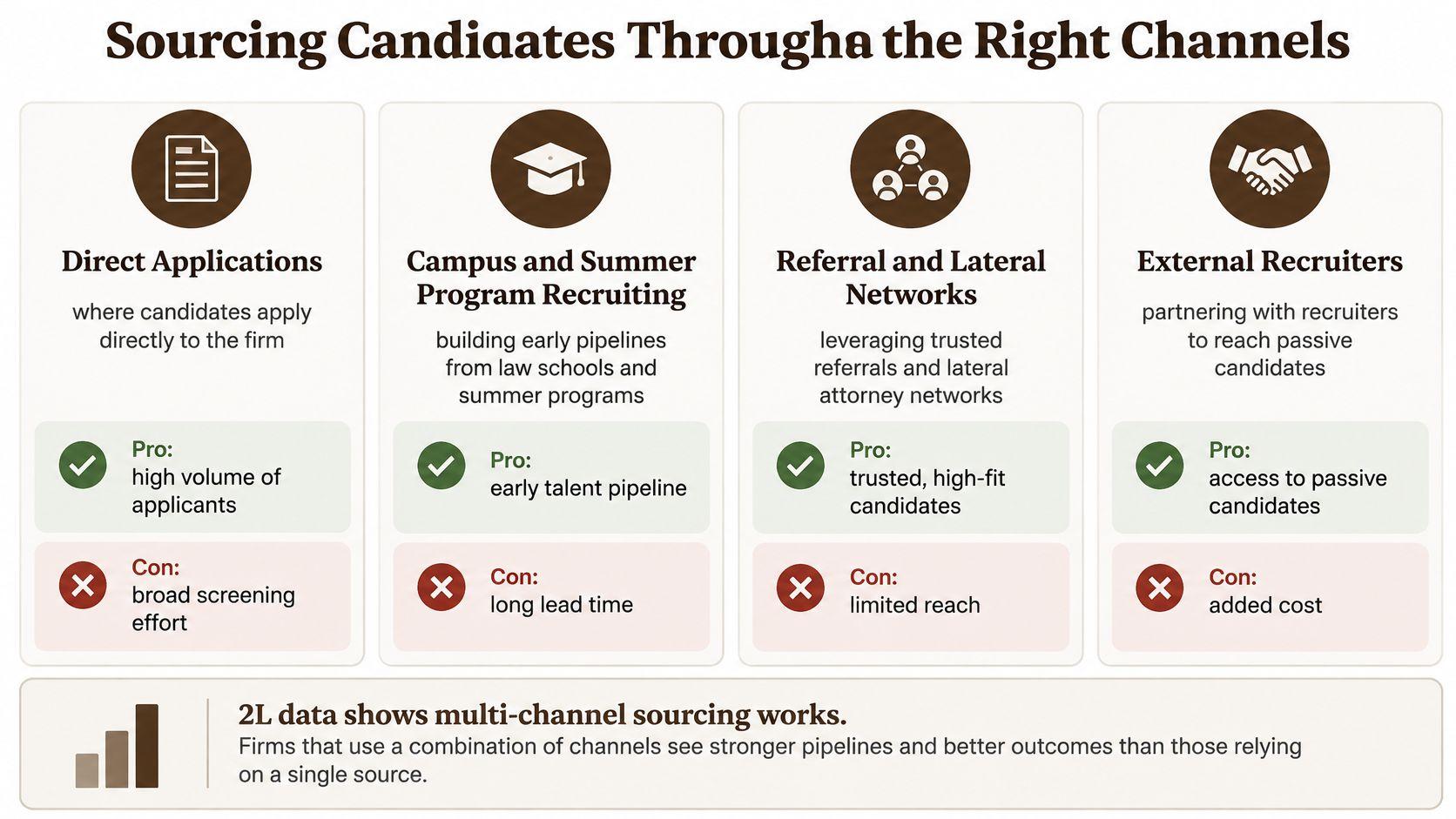
Four channels do most of the work, and each behaves differently.
Direct applications produce the most volume and the heaviest screening load, and the same NALP reporting shows them as the most-used route to 2L candidates. Campus and summer program recruiting builds the pipeline earliest but demands the longest lead time, since an offer extended in the fall reaches a student who will not start for two years. Referral and lateral networks surface people a job board never reaches, because a former clerk or co-counsel already knows who is restless and who is good. External recruiters reach attorneys who are not looking at all, using proprietary search tools and existing referral relationships to identify candidates who match a client's criteria but never appear in a standard search.
| Recruiting channel or pathway | What the reporting shows |
|---|---|
| Direct applications for 2L students | The most-used channel among reporting offices |
| On-campus interviewing for 2L students | Used by most reporting offices |
| Resume collections for 2L students | Widely used, behind on-campus interviewing |
| 1L summer participants receiving an associate offer | Rare; almost none convert that summer |
The last row is the caution. A 1L summer hire almost never turns into an associate offer at the end of that summer, so a 1L program is talent identification rather than hiring. It pays off two years later, and only if the firm keeps tracking the people it met.
A litigation boutique posts an associate role, waits three weeks and gets nothing usable. The partner mentions it to a former clerk over lunch, and the clerk names a senior associate at a larger firm who is tired of document-heavy work and wants first-chair experience. That hire never appears in an applicant pool, which is why relationship channels need to run in parallel with postings. Attorneys weighing a move can browse openings or tell us what they are looking for, and we reach out when a strong fit opens in our network.
Two habits to start this week. Write postings that name the practice, the seniority and the screen-out requirements in the first three lines, so weak fits filter themselves out before they apply. Then log the source of every candidate and keep the log running past the signed offer to the 12-month review. Most firms can say which channel feels busiest; few can say which one produces hires who stay, and that is the number worth having.
How to Screen Candidates and Clear Conflicts
A polished résumé and a strong billable-hours record can hide the thing that matters most: a conflict. ABA professional liability guidance on lateral hires makes the reasoning explicit. A hiring decision can create conflicts, confidentiality exposure, client-retention risk or economic misalignment when a firm evaluates credentials and hours alone.
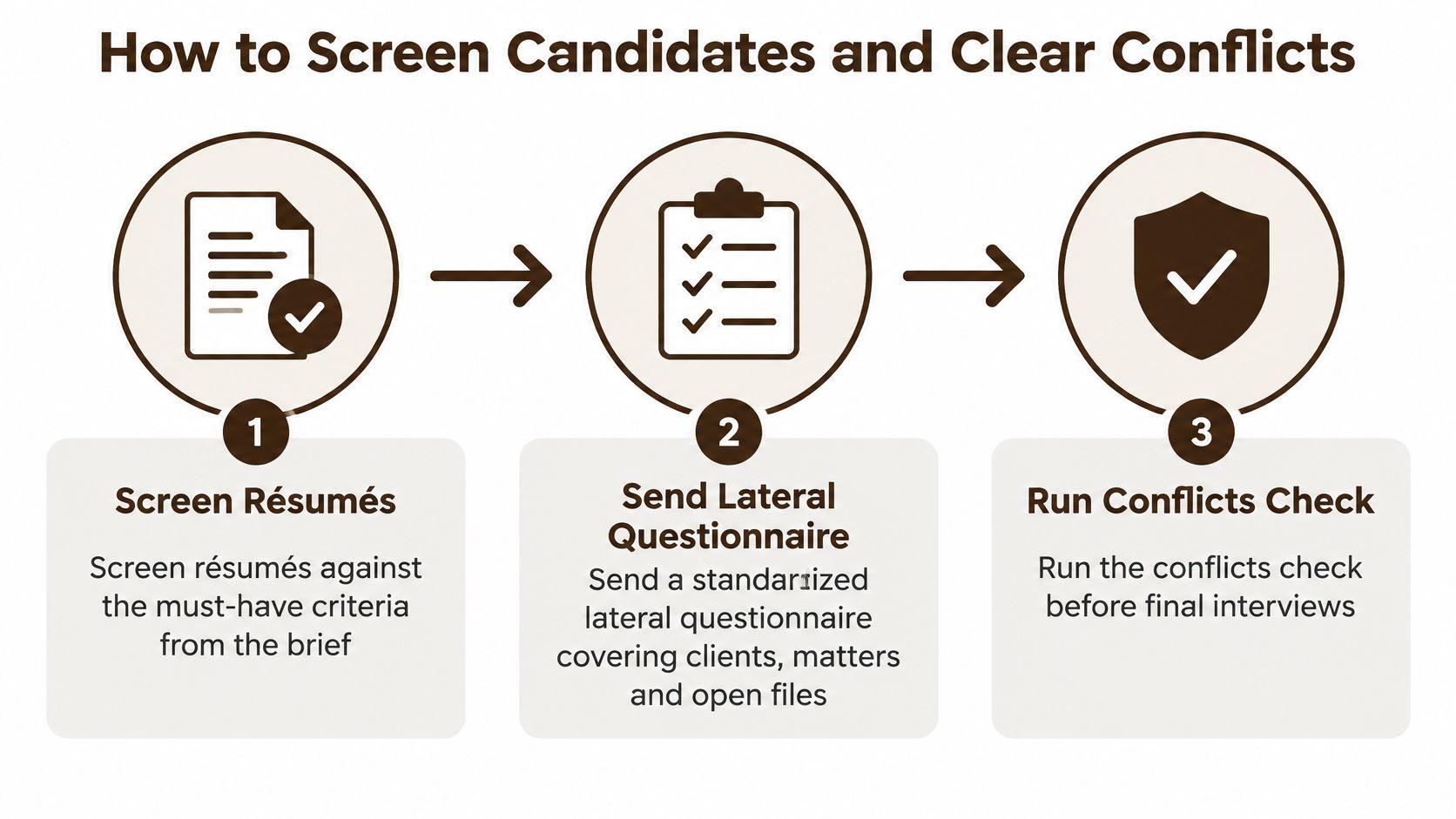
Run the screen as six steps, in this order.
- Score résumés against the must-haves. Not against general impressiveness. The common slip is letting a prestigious firm name substitute for the practice experience you listed.
- Send a standardized lateral questionnaire covering clients, matters and open files. Standardized matters because a free-form version gets filled in differently by every candidate, and the gaps land on the conflicts team.
- Run the conflicts check before final commitment. The ABA guidance places the assessment ahead of the offer, not after it. Screening later means you negotiate terms for a candidate you may not be able to hire.
- Examine the economics. Collections, write-offs, aged accounts receivable, discounts, business-development expenses and the candidate's historic personal contribution tell you what the book of business is worth after the firm's costs, not before.
- Triangulate references through clients, co-counsel and, where appropriate, opposing counsel, alongside work-product review.
- Complete background checks and design integration early. The same guidance recommends a designated integration partner or committee and a plan for the individual, both set before the start date rather than improvised in week one.
Practical rule: No offer goes out until the questionnaire is complete, the conflicts report is cleared, and two independent references have been spoken to by someone at the firm.
Screening before referral changes the economics of interviewing. Every candidate we send has already spoken with us on a call, and we vet credentials, bar status, matters handled and fit, along with real interest in this specific role. That's the same logic as a structured candidate screening question set: consistent inputs, comparable answers.
A passing shortlist has three things on every file. A completed questionnaire. A cleared conflicts report. Two independent references who were reached, with notes. If any of the three is missing, the candidate isn't ready for the panel.
Interviewing and Scoring Candidates Consistently
Give every candidate for a role the same questions and score them on the same rubric, with panel members writing scores before anyone speaks in the debrief. Independent scoring is what stops the most senior voice in the room from deciding the outcome in the first two minutes.

LHH's 2026 law firm hiring trends report describes firms widening evaluation beyond traditional legal expertise to include adaptability, technical fluency, client communication, pricing awareness, project management and cross-functional collaboration. The same coverage raises a harder question: how do you test those things without rejecting a strong lawyer who has never touched a legal-tech platform?
Evaluation criteria for candidate interviews
| Criterion | What to test | Evidence to record |
|---|---|---|
| Legal judgment | Case analysis from a real matter type | Written analysis scored 1 to 5 |
| AI judgment and verification | Find a planted error in an AI-assisted draft | Errors caught and missed, with reasoning |
| Confidentiality awareness | Scenario involving client data and a shared tool | Response and the controls proposed |
| Process improvement | Describe a workflow the candidate changed | Measured result or time saved |
| Adaptability and learning | Recent tool or practice area learned | Example and time taken to become productive |
| Client communication | Explain a recommendation to a non-lawyer | Clarity rating from a second panel member |
| Pricing and project management | Estimate a matter budget and timeline | Estimate compared with the actual outcome |
How to test AI judgment without hiring for tool names
Hand the candidate a short AI-assisted research memo with one fabricated citation and one subtly wrong holding. Ask them to verify it in twenty minutes with the tools they normally use. What you learn is not whether they know a product. It's whether they check before they file.
A partner candidate with no AI tool experience who catches an unreliable citation in that memo tells the panel more than a list of platforms on a résumé. She has the habit the firm needs. A candidate who names every platform and defends the bad citation has none of it.
If your panel has never scored independently, watch a structured interview run end to end before you build the rubric, so the scoring habit is in place before the first candidate arrives.
Interview yield is worth tracking alongside scores. 57% of attorneys we present are invited to interview, based on placement records since January 2025, which gives a firm a benchmark for asking whether its own screens are too loose or too tight.
The closing rule is simple. A candidate who scores well on judgment and shows no tool exposure can rank above one who lists every platform in the market, because the first can be trained and the second has already shown you how they work.
Making the Offer and Tracking Fit Through 180 Days
NALP Foundation's update on associate attrition and hiring) recorded 6,335 associate hires and 4,442 departures across 141 U.S. and Canadian firms in 2025, an overall attrition rate of 19%, with 83% of departing associates leaving within five years of being hired. Read those numbers as a leak in the second half of the process. A signed offer sits at the midpoint, and everything after it decides whether the hire lasts.
Run a pre-hire retention audit before the offer goes out
Five checks, all before the letter is sent. Each one exists because a promise made verbally in interviews has no one assigned to keep it once the hire starts.
- Confirm the compensation band against the number the candidate named in interviews. The figure in the budget memo matters less. When the two do not touch, you have a departure scheduled for month eight.
- Compare the promised workload with the team's real load. Ask the associates already on that team how many matters they carry and who supervises them. A role described as focused sometimes turns out to be three practices sharing one chair.
- Put the named supervisor, advancement path and origination expectations in writing. A promised path no partner has agreed to is the most common slip in this stage.
- Verify that the training and support promised in interviews exists and has an owner. If AI tools came up three times in the panel, someone needs to be responsible for onboarding the new hire onto them.
- Send a written offer with a start date and a named integration partner, so the first day has a human attached to it.
We tell clients what a candidate is likely to accept before an offer goes out, which is one practical way to test expectations against reality while there is still room to adjust.
The signed offer is the midpoint. The remaining half of the process is fit, and it is the half that goes unsupervised once the letter is signed.
Checkpoints from the start date to 180 days
The spacing is deliberate. Early failures are mechanical, like missing system access. Later ones are relational, like a supervisor who never delivered the promised support.
At 30 days, check workload and system access. A new lateral who still cannot open matter files is losing billable time and patience.
At 60 days, collect supervisor feedback and confirm the support promised in interviews materialized. At 90 days, compare origination and cross-selling against what was written down, since memory blurs and documents do not. At 180 days, review engagement and advancement in a real conversation with the hire.
Go wrong here and it is quiet. A lateral's origination targets were discussed verbally, never documented, and at the 90-day review the firm and the attorney arrive with different numbers. Nothing was dishonest. Nothing was written down either, and the friction starts.
That is why hiring quality should be judged by 12-month retention and fit. Speed measures the calendar; retention measures the hire. 95% of attorneys we place are retained at 12 months, based on placement records since January 2025. A fast placement into a role nobody designed is still a weak hire, and a structured way to measure quality of hire shows it sooner than a vacancy report will.
Confirm Your Role Brief and Decide Whether to Search Internally
Before the first search conversation, run the brief check one more time. Practice area, seniority, must-have criteria, compensation band, interview panel, the integration partner who owns the first 90 days, and the source channels the firm will track. Six of those seven items are easy.
The integration owner is the one most firms leave blank, and it's easy to see why. The hiring partner assumes HR handles onboarding, HR assumes the practice group does, and the mentor assumes someone else set the targets. Nobody is being careless, the responsibility just has no name attached. Assign it before the search opens, or the strongest hire in the pipeline starts behind.
We ask clients to spend thirty minutes on a call about the role before a search starts, and every search begins that way. The call exists to catch the gap between what the posting says and what the practice group needs, which is cheaper to find in thirty minutes than in three interviews.
In 70% of our searches, the first candidate goes to the client within two weeks, based on placement records since January 2025. That pace assumes the brief is settled. A search that starts with an unresolved compensation band or two partners imagining different candidates won't move that fast, and shouldn't. Speed pointed at the wrong target just produces faster rejections.
One honest fit note. We may not be the right partner for an AmLaw firm, because we often place attorneys coming from AmLaw firms but rarely place into them. Our network and placement record concentrate in boutique and midsize firms and in-house legal departments.
So the decision splits cleanly. A boutique, a midsize firm, or a corporate legal department with a complete brief should book the call. An AmLaw firm can run the search internally, holding each stage to the same standard. Either way, judge the hire by who is producing at twelve months, not by how fast the seat filled.
If you're hiring for a boutique or midsize firm or building out an in-house legal team, Five Star Placements runs the full sequence for you: a thirty-minute intake call to settle the brief, sourcing through a network that reaches attorneys a posting won't, screening and vetting before any candidate reaches your calendar, and guidance on what an offer will take to land. We work on contingency, so nothing is due until the attorney starts. Bring us the role you've been trying to fill since the spring and book the call, and we'll review the brief with you before any search begins.
Need help filling a legal role?
Five Star Placements partners with law firms and legal departments nationwide.
Schedule a Call