
Tax Law Firms Explained: Types, Services and Hiring
November 5, 2026 · 17 min read · Five Star Placements

Table of contents
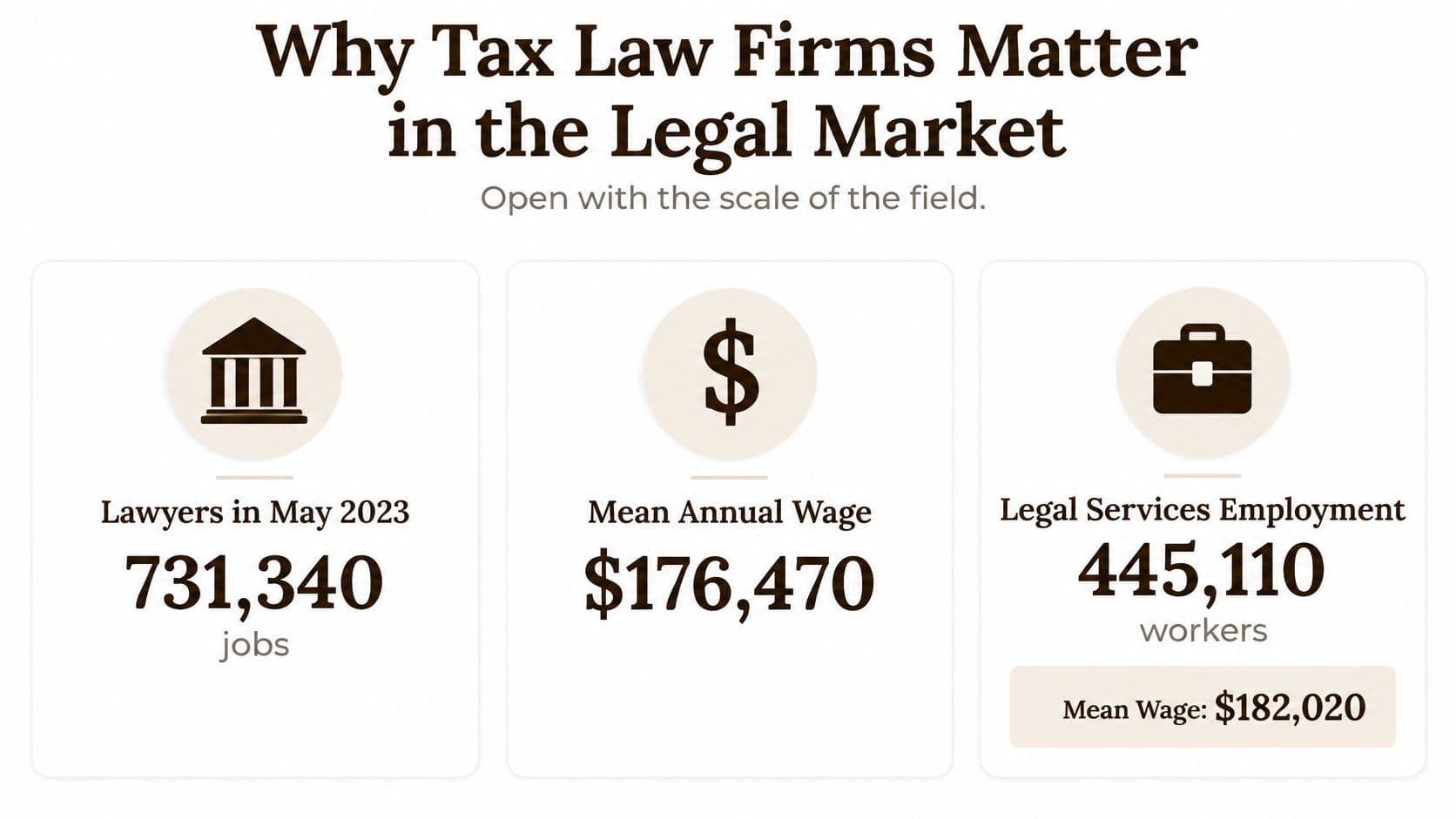
Lawyers held approximately 731,340 jobs in May 2023, with a mean annual wage of $176,470, according to the U.S. Bureau of Labor Statistics. Within legal services specifically, about 445,110 lawyers were employed, and their mean annual wage was $182,020.
That scale is the right frame for tax law firms. Tax work isn't a small hobby attached to a general practice. It sits inside a large, well-paid lawyer market, and the people who do it split into profiles that barely look alike.
A tax law firm advises individuals and organizations on compliance, how a deal should be structured, disputes with the tax authorities, and courtroom matters. Some of that talent also comes from government, including the Internal Revenue Service. Planning is like designing a building before the concrete is poured. Controversy is the inspection and the repair work that starts when someone says the building doesn't meet the code.
Those two sides create a hiring puzzle. The same office can need a careful planner and a courtroom advocate in the same quarter. The pages below sort which firm shape fits a client base, which services drive the hours, and how a tax team should be staffed when the profiles point in opposite directions.
Table of Contents
- Why Tax Law Firms Matter in the Legal Market
- Boutique, Regional and BigLaw Tax Firms Compared
- Core Tax Services From Controversy to Planning and M&A
- How Tax Teams Are Staffed and Who Does What
- Skills Employers Screen For in Tax Lawyers
- Hiring Trends and Next Steps for Employers and Job-Seekers
Why Tax Law Firms Matter in the Legal Market
Tax practices draw from that same lawyer labor market, not from a niche that sits apart from mainstream legal services. Pay in legal services runs above the all-lawyer mean, which is one reason experienced tax counsel is costly to replace. Specialized skill can command more than that legal-services average, so firms compete on matters, mentoring, and role design, not only on a posted number.
Two kinds of tax work, two kinds of lawyers
Advisory work and contentious work ask for different people, even when both sit under a tax heading.
Transactional tax counsel reads a purchase agreement, a partnership structure, or a financing and asks what the tax result will be before anyone signs. They live in drafts, models, and deal calls. Their value shows up as a cleaner structure, a narrower indemnity, or a problem caught before closing.
Controversy and litigation specialists pick up the file after the government disagrees. They manage audits, appeals, collection pressure, and court. A third profile sits close to government investigations and administrative proceedings. That experience often comes from time inside an agency, or from defending clients who were already there.
Hiring reality: A strong planner and a strong litigator can both be excellent tax lawyers and still be the wrong hire for each other's docket.
If you staff both lanes with one general "tax person," you'll get shallow coverage on the lane they didn't grow up in. Clients notice that gap first. A business sale needs someone who has lived inside deal documents. An audit that turns into a court case needs someone who has managed a docket, deadlines, and settlement calls.
What you should decide before you hire
Three questions keep a search from turning into a generic tax posting.
- Which clients are you built for? Owner-managed companies, mid-market businesses, and global groups don't share a staffing model.
- Which service line is busy? A website that lists every tax service doesn't tell you where the hours go.
- Which profile closes the gap? Transactional counsel, controversy counsel, and government-side experience are not interchangeable resumes.
Answer those before you write the job description. The firm shape you pick next decides how much of the work a partner keeps, how much an associate drafts, and whether a candidate from a huge firm will even like the job.
Boutique, Regional and BigLaw Tax Firms Compared
The client list predicts the work, and the work predicts the team. Match the row before you match the title on a resume.
| Firm type | Typical clients | Usual tax work | Team shape |
|---|---|---|---|
| Boutique tax firm | Owner-managed businesses, high-net-worth families | One or two niches such as planning or controversy | Small bench, partners work matters directly |
| Regional full-service firm | Mid-market companies, regional banks, family businesses | Planning, compliance, and M&A tax alongside other practices | Mixed partner and associate teams across offices |
| BigLaw tax group | Large corporations, global groups, private equity | Cross-border structuring, large controversy dockets, complex transactions | Deep specialist teams with layered staffing |
Boutiques keep the partner on the file
A boutique tax firm usually picks one or two niches and stays there. Think owner-managed business transitions, private-client planning, or a controversy docket built around audits and Tax Court. Partners don't hand the client off after the pitch. They draft, they call the revenue agent, and they sit in the settlement meeting.
That shape rewards breadth inside the niche and calm client-facing judgment. A candidate who needs a deep bench of specialists behind every memo will feel exposed. A candidate who wants their name on the advice will feel at home. Hiring here fails when you screen only for a famous former firm and ignore whether the person will still do the work themselves on a Tuesday afternoon.
Regional firms need range across practices
A regional full-service firm runs tax beside corporate, real estate, and estate practices. The clients are mid-market companies, regional banks, and family businesses that want one firm for the deal and the tax consequences. Teams mix partners and associates, often across more than one office.
Range matters more than a single famous subspecialty. The tax lawyer who can sit with the corporate partner on a sale, then turn around and explain basis to the founding family, is the person these groups keep. The trade-off is real. You'll see more variety, and you'll also see matters that a global specialist group would staff with three people. Candidates should ask who owns the client relationship, because in a regional firm it often isn't the tax partner.
BigLaw rewards depth, and it isn't every recruiter's market
A BigLaw tax group staffs deep specialist teams for large corporations, global groups, and private equity. The usual work is cross-border structuring, large controversy dockets, and transactions with many moving parts. Layered staffing is the point. A senior lawyer directs, and several narrower specialists execute.
Depth is the hiring filter. A generalist who "does tax" won't clear a group that already has a partnerships partner, an international partner, and a controversy partner. Five Star Placements often places attorneys coming from AmLaw firms, but rarely places into them, so we may not be the right fit for an AmLaw search. Our candidate network and placement record sit with boutique and midsize firms, and with companies hiring in-house counsel.
Pick the client row first. Then read the team-shape column before you apply or before you open a search. A great lawyer in the wrong shape leaves within a year.
Core Tax Services From Controversy to Planning and M&A
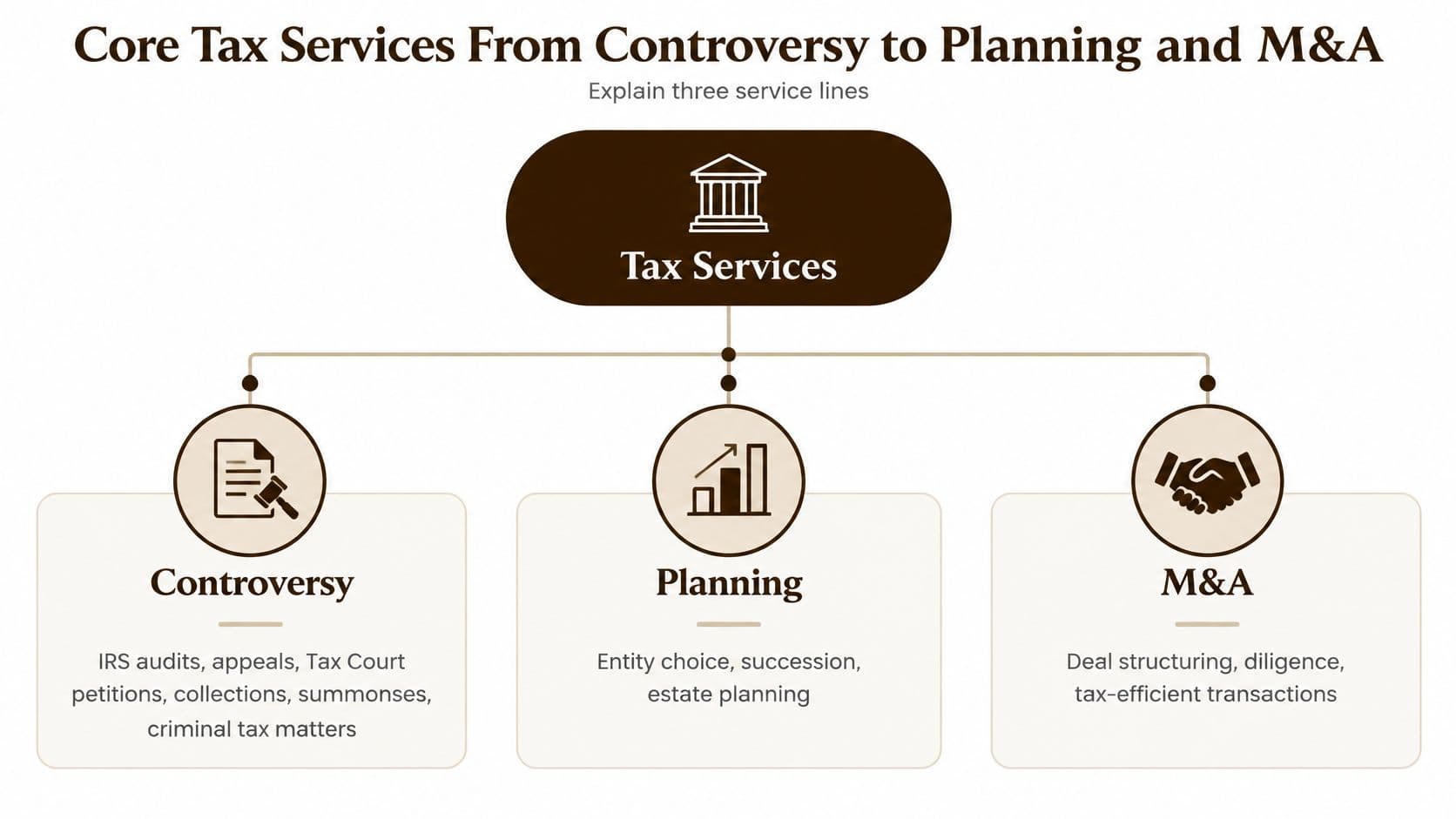
Tax law firms sell three different products that happen to share a statute book. Controversy defends a position the government has already challenged. Planning chooses the structure before the facts harden. Transactional work prices the tax risk inside a deal. Each line needs a different lawyer, which is why one firm can be hiring for opposite profiles at the same time.
Controversy is a docket, not a side task
Controversy covers IRS audits, appeals, Tax Court petitions, collections, summonses, and criminal tax matters. It also pulls in bankruptcy questions and appellate work when a case doesn't stop at the first forum. This isn't return preparation with a louder phone voice. It's a practice of deadlines, records, and settlement math.
The IRS Chief Counsel statistics show the volume. In fiscal year 2025, Chief Counsel received 48,544 cases and closed 47,575, including matters carried over from earlier years. More than 77.6% of new cases involved tax-law enforcement or litigation, and the office received 21,588 Tax Court cases in which taxpayers contested determinations that additional tax was owed.
That docket rewards lawyers who can hold many files without dropping a high-dollar one. Former IRS or Tax Court experience is the clearest signal. So is comfort with collection procedure, summons practice, and the difference between an administrative appeal and a petition. A planner who has never managed an agent relationship will slow a controversy team down, no matter how sharp their memos are.
Planning and deals need different judgment
Planning covers entity choice, succession, estate and charitable structuring, and the compliance that keeps a plan alive after the meeting ends. The attorney you want has estate and entity depth, and the patience to explain trade-offs to people who aren't lawyers. A beautiful structure that the client can't operate is a failed plan.
Transactional tax covers due diligence, deal structuring, and the indemnities that survive a sale. Here the signal is deal reps, not a thick controversy resume. Say a family-owned distributor gets a notice of deficiency after an audit. The controversy team has to move on a short statutory window to petition the Tax Court, while the planning team reviews whether next year's structure should change at all. Those are parallel jobs. They shouldn't be assigned to the same person by default.
Read the matters, not the website
A firm leads with the work it staffs. Look at recent petitions, closing binders, and who signs the advice letter. If every partner bio says "planning, controversy, and M&A" but the last ten matters are all audits, you're hiring a controversy firm. If the bios are identical and the closings are all sponsor deals, you're hiring a transactions group that lists controversy for marketing.
A service line is real when someone on the team could start the matter on Monday without borrowing a colleague's playbook.
How Tax Teams Are Staffed and Who Does What
A controversy team isn't one heroic litigator and a shared inbox. It works better as layers, because the exposure sitting in U.S. tax litigation is large enough that senior time has to be aimed, not spread across every task.
| Role | Core responsibilities | Experience signal |
|---|---|---|
| Senior tax litigator or partner | Legal strategy, settlement authority, client decisions | Tax Court trial or appellate experience |
| Midlevel associate | Motions, discovery, agency correspondence | Several years of controversy or transactional drafting |
| Paralegal or case manager | Document chronology, privilege controls, deadline tracking, damages schedules | Records management and litigation support background |
| Finance or legal operations lead | Matter budgeting, damages quantification, reporting | Financial modeling and workflow measurement |
Why the layers exist
IRS workload figures for fiscal year 2024 reported 24,676 pending tax-litigation cases overall, and pending Tax Court cases excluding appeals numbered 23,468, representing approximately $52.8 billion in disputed tax and penalties, in the IRS Chief Counsel workbook. Pending appeals sat near $2.56 billion. The same year the office received 20,911 Tax Court cases involving about $12.31 billion.
Dollar exposure and billable hours are not the same thing. A thin file can carry a huge number, and a thick file can be a fight over a small adjustment. Judge candidates on technical quality and on whether they create value for the people around them, not on years alone. A scorecard that only counts "years of tax" will hire the wrong senior and then wonder why the docket stalls.
The same logic shows up in how a firm organizes the rest of the office. The roles inside a law firm only pay off when each seat has a job the seat above shouldn't be doing.
A three-person file, then the question every plan must answer
Say a document-heavy dispute lands on a three-person team. The partner sets the legal theory, holds settlement authority, and makes the client decisions. The associate drafts the motions and the letters to the agency. The paralegal builds the document chronology and the privilege log, and watches the deadlines. Nobody is "helping." Each person owns a slice that would waste the person above them.
One senior litigator with that support can carry far more exposure than the same litigator working alone, because the senior isn't rebuilding chronologies at midnight. Planning and transactional teams use the same layers in a smaller form. A deals partner still needs an associate who can hold the diligence memo, and someone who can track what the model assumed.
Every staffing plan has to answer one question. Where does senior time go, and what can move down a layer without hurting the advice? If the answer is "the partner does it all," you don't have a team. You have a bottleneck with a title.
Skills Employers Screen For in Tax Lawyers
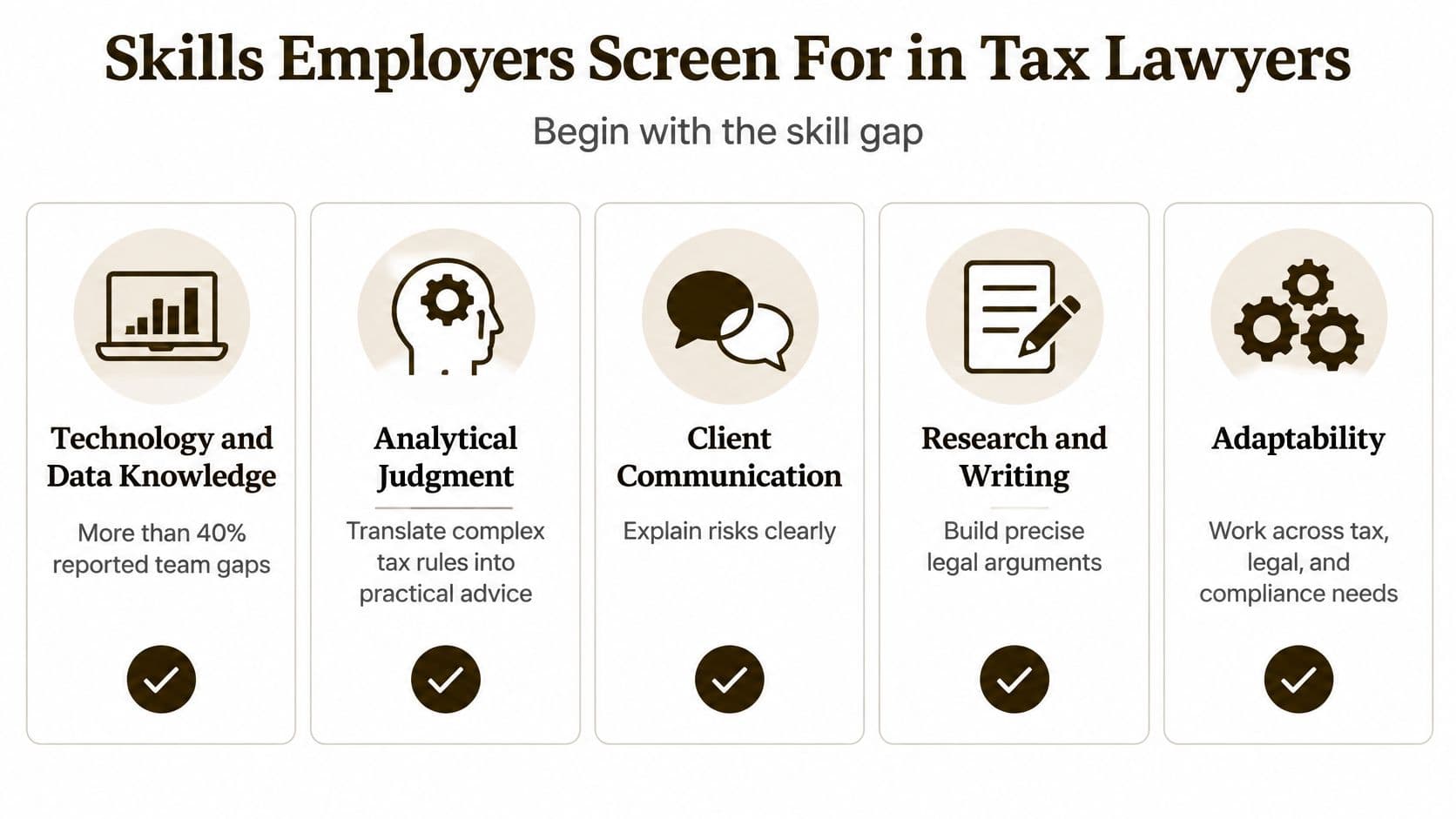
In the Thomson Reuters Future of Professionals Report 2025, a global survey of 2,275 legal, tax, accounting, audit, compliance, and trade professionals, more than 40% reported team skill gaps in technology or data knowledge, or in technical domain expertise. That gap shapes the interview. The scarce hire is a lawyer who can apply tax judgment while using data, automation, and real controls.
Tax work also splits by type, and the screen should follow the split. A controversy practice needs a lawyer who can build a record, test an argument against the statute, and know when an automated summary has missed the document that decides the case. A planning practice needs someone who can sit with a client, spot the risk in a structure, and explain the trade-off in plain language. A transactions tax team needs a lawyer who can hold a diligence memo together and tell the partner which assumptions in the model are load-bearing. Those profiles can look opposite on paper, and the same firm may hire for all three in one quarter.
The contrarian screen
The strongest candidate is rarely the person who claims the most AI experience. It is the tax lawyer who can tell you when automation is unsafe, explain the limit to a client, and keep a human review that would still look defensible if the file were challenged. Tool fluency without that judgment is a liability on a privilege log or a Tax Court petition.
Screen for habits, not the brand of software. The broader set of skills lawyers need still starts with the law. Technology sits on top of that, not in place of it.
| Skill | Interview question | Strong answer shows |
|---|---|---|
| Technical depth in core line | Walk me through the most complex matter you led in your core tax line | A specific matter with a measurable outcome |
| Verification of AI output | Describe a time you rejected an automated draft and why | Names the error and the check used to catch it |
| Confidentiality controls | How do you keep client data out of unapproved tools? | Concrete policy and tool-level steps |
| Workflow design | Which steps would you automate in a dispute, and which stay with a lawyer? | A clear split by risk and review point |
| Client communication | How did you explain an AI limitation to a client who wanted a faster answer? | Plain-language explanation and a documented decision |
Use the questions in that order. Technical depth comes first, because a polished answer about tools cannot repair a weak grasp of the statute. On verification, listen for a named error, such as a miscited revenue ruling or a number that did not tie to the return, and for the check that caught it. On confidentiality, a strong answer names the firm-approved system and what never goes into a public tool, including client identifiers and draft advice. On workflow, you want a split. Chronologies and first-pass document sorts can move. Settlement recommendations and privilege calls stay with a lawyer. On client communication, the best answers sound like a conversation, not a product demo, and they end with a decision the file can show later.
How a screened slate should arrive
Five Star Placements speaks with every candidate on a call before a client sees them. It then checks credentials, bar status, matters handled, and fit, and confirms interest in the specific role. A resume that says "tax and technology" does not survive that call unless the matters and the judgment match the row you are hiring.
Hiring Trends and Next Steps for Employers and Job-Seekers
Headcount is no longer the default growth plan in tax practices. Capacity is a design problem, which means deciding who does the work, which tasks stay with a senior lawyer, and which tasks a process or another role should absorb.

The 2025 State of Tax Professionals survey from Thomson Reuters found that only 21% of respondents said hiring more people was part of their current growth plans, down from 35% the prior year. Meanwhile, 65% said growth centered on expanding the client base and making better use of technology and automation. Recruitment of employees with the necessary skills was the leading challenge, and 47% said AI investment should be a top priority.
Those totals hide a split that matters more at the desk level. A tax practice busy with controversy work needs a different person than one chasing planning and transaction work, and many firms carry both at once. One open requisition can call for someone who has sat across from an IRS agent and knows how a case file is built for appeal. Another, in the same office and the same quarter, needs an associate who can model a partnership structure before a deal closes. Same practice area, opposite profiles. Treating both as "a tax associate" is how a seat stays open for months.
Assign the work before you add a seat
The useful question isn't "How do we recruit tax lawyers?" It's which work belongs to partners, tax attorneys, paralegals, legal operations staff, accountants, or a technology-enabled process, and which work must stay with a senior lawyer. Adding only lawyers can worsen staffing balance, burnout, and cost. Under-hiring support and operations talent leaves expensive lawyers doing chronology, billing cleanup, and status reports.
A smaller, deliberately structured tax practice can outperform a larger one when specialist lawyers sit with strong legal support, finance, knowledge management, and operations. That mix is how you protect senior time for the judgment clients seek. Pipelines are tighter because of retirements and competition for the same qualified people, so a requisition that says "another tax associate" without a task map will sit open, or it will fill with someone who repeats work you already had.
Employers can treat the next hire as a design choice.
- Map capacity by task before you open a requisition. List the weekly tasks on live matters and mark which ones require a senior lawyer. If half the list is chronology, deadline tracking, or first-draft research, the missing seat may be a paralegal, a case manager, or a legal operations lead.
- Measure time to productivity for each hire. Define the first matter they should own alone, and the week you expect that to happen. A controversy lateral and a planning associate won't hit that mark on the same calendar.
- Plan succession for senior roles. Name the matters that walk out the door if one partner leaves, and start the overlap while that partner is still there. Waiting for a resignation turns a staffing plan into a crisis search.
Job-seekers should show documented examples of work they took off a senior lawyer's desk, matched to the firm shape they want. A boutique wants proof you can face the client. A regional firm wants proof you can work beside corporate and estate colleagues. An in-house tax seat wants proof you can set a process the business will follow. Attorney recruitment strategies work when the example on your resume matches the row, not when it lists every tax topic you've ever touched.
Law firms and legal departments can schedule a call with Five Star Placements to talk through a tax search and how your firm is rethinking its staffing mix before the next requisition goes out. Attorneys considering a move can browse current openings or tell us what they want, and we'll reach out when a strong fit in our network opens. Applications are confidential, and we won't contact your employer without your permission.
Five Star Placements recruits tax attorneys, partners, paralegals, and legal operations leaders for boutique and midsize firms and for in-house legal teams, matching controversy, planning, and transactional profiles to the work you have. If you're hiring for a tax seat or you're a tax lawyer ready for a different docket, visit Five Star Placements to schedule a call or tell us what you're looking for.
Need help filling a legal role?
Five Star Placements partners with law firms and legal departments nationwide.
Schedule a Call