
CFO Duties and Responsibilities: A Complete 2026 Guide
August 31, 2026 · 15 min read · Five Star Placements

Table of contents
The most popular advice about CFO duties and responsibilities is also the least useful: “The CFO owns the numbers.” That description is too narrow for a public company, a scaling business, or a law firm. A modern CFO owns the integrity of financial information, but also uses it to challenge pricing, capital allocation, risk posture, technology investment, hiring, and strategic execution.
That distinction matters in legal organizations. A law-firm CFO often sits between the managing partner and the COO, translating partnership economics into operating decisions without treating the firm like a conventional corporation. The candidate must understand cash, controls, and forecasting, but also partner compensation, origination credit, distributions, lateral hiring economics, and the political reality of an equity partnership.
The right search therefore isn't for a glorified controller. It's for an executive who can protect the institution, improve decision quality, and build a finance function that operates without making the CFO the bottleneck.
Table of Contents
- Why the CFO Is No Longer Just the Chief Accountant
- Day-to-Day Duties of a Modern CFO
- KPIs and Metrics a CFO Is Measured On
- Reporting Lines and Where the CFO Sits
- CFO Duties in Law Firms Compared to Legal Operations
- The Hidden Cost of an Expanding Mandate
- Hiring the Right CFO and What to Look For
Why the CFO Is No Longer Just the Chief Accountant
A CFO who only closes the books is already behind the role. Accurate reporting, audit coordination, and budget control remain the foundation, but they do not justify an executive seat on their own. The CFO must turn financial information into better decisions about pricing, staffing, investment, risk, and growth.
That standard is especially demanding in a legal organization. The law-firm CFO often sits between the managing partner and the COO, translating partnership economics into operating discipline. The role combines control of cash, forecasts, and reporting with judgment about partner compensation, origination credit, distributions, lateral hiring, and the firm's ability to invest without creating pressure on partner income.
Deloitte identifies four CFO roles: steward, operator, strategist, and catalyst. The steward protects assets and reporting integrity. The operator builds an effective finance function. The strategist shapes direction, while the catalyst drives performance and organizational change. Deloitte's overview of the four CFO roles explains why financial control and enterprise leadership now belong in the same executive role.
The expansion is measurable. McKinsey's global CFO research, as summarized in Deloitte's analysis, found that the number of functional areas reporting to CFOs rose from 4.5 in 2016 to an average of 6.2 today. The share of CFOs responsible for board-engagement activities increased from 24% to 42%, and responsibility for digital activities doubled. The implication for a search is direct: a candidate whose experience ends with accounting will not cover the full mandate.
The historical shift
Wharton describes the role's earlier form during the 1960s and early 1970s as tactical and accounting-heavy, covering internal reporting, budgeting, cash management, treasury, and debt or equity fundraising. The U.S. Chief Financial Officers Act of 1990 established CFO positions in major federal agencies and further formalized financial governance and accountability. Wharton's history of the changing CFO role places current expectations in that longer development.
In a law firm, the distinction has practical consequences. A corporate CFO may assess an investment through return and risk models. A law-firm CFO must also test the effect on partner draws, working capital, associate staffing ratios, compensation fairness, and the firm's capacity to fund growth without destabilizing distributions.
Hiring principle: A strong CFO does more than explain last month's results. They identify the leadership choices behind those results and recommend the next decision.
A weak candidate waits for the managing partner to request an analysis. A strong candidate spots deteriorating collections, an underpriced practice, or an unsustainable lateral package before the issue becomes a partnership dispute. That judgment separates a finance executive from a reporting function carrying an executive title.
Day-to-Day Duties of a Modern CFO
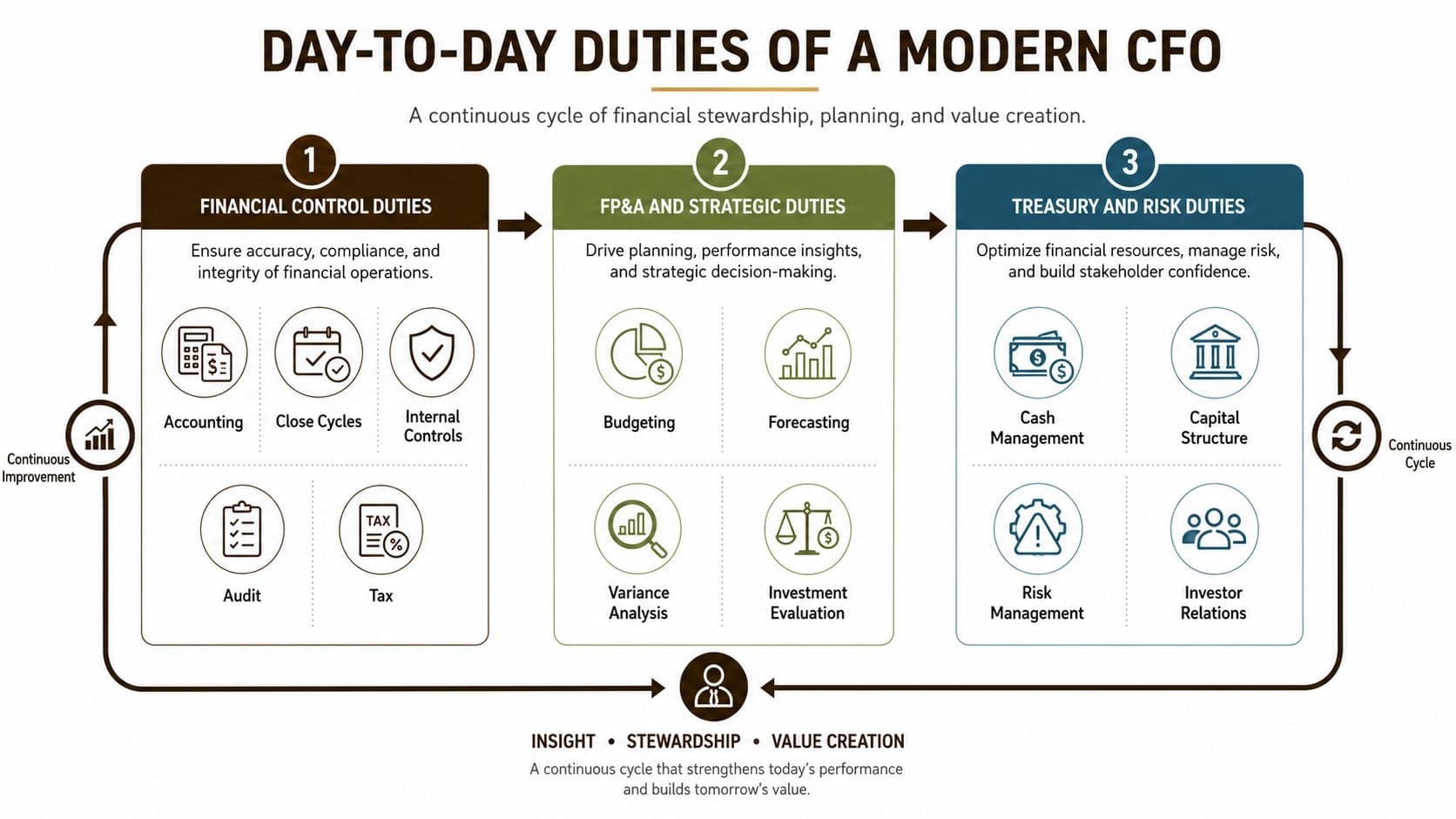
A CFO's calendar is best understood as a recurring operating cadence, not a list of abstract responsibilities. The work falls into three connected groups: financial control, FP&A and strategic decision support, and treasury and risk. Executive partnership cuts across all three.
Financial control duties
The CFO doesn't personally perform every accounting task, but owns the quality of the system that produces financial information. That includes accounting oversight, close-cycle discipline, internal controls, audit coordination, tax planning, regulatory compliance, and management reporting.
The CFO should know which reconciliations remain open, why a close is late, whether revenue recognition is defensible, and where approval authority is too weak. For public companies, the accountability is formal. Public-company CFOs are directly responsible for the accuracy, documentation, and submission of financial reports and for the internal control structure. The requirements associated with CFO certification under Sarbanes-Oxley Section 302 illustrate why control ownership is an executive responsibility, not a back-office preference.
A practical weekly rhythm might include a close review, audit issue tracking, tax planning decisions, and a discussion with the controller about exceptions that require executive judgment.
Capital and treasury duties
Treasury work turns reported performance into usable liquidity. The CFO oversees the daily cash position, banking relationships, debt or credit arrangements, covenant exposure, reserve policies, investment of idle cash, and funding decisions.
In a law firm, the same discipline applies to partner draws, distributions, retirement obligations, lateral hiring packages, and the cash consequences of slow collections. The CFO must distinguish accounting profit from cash available for operations or distributions. A partner group may support an initiative because it appears profitable, while the CFO sees that its billing and collection profile could strain near-term liquidity.
Working-capital discipline belongs here. Role descriptions for technically mature CFO functions emphasize DSO, aging, collections, billing-cycle time, cash-flow projections, AR/AP cadence, and liquidity forecasting rather than treating the monthly close as the only proof of performance. This CFO and COO role description connects receivables, payables, inventory, and cash-conversion management to borrowing needs and growth capacity.
Executive partnership duties
The CFO joins the managing partner, CEO, COO, or board when financial consequences need to be made explicit. That includes pricing, compensation design, lateral recruiting economics, vendor negotiations, M&A evaluation, capital allocation, and board reporting.
The cadence may shift from cash review early in the week to compensation committee work, practice-group forecasting, and executive decisions later in the week. Monthly close review remains important, but it should feed a larger conversation about forecast changes, operating performance, and resource allocation.
Delegation only works when ownership is explicit. The controller can own close execution. The treasurer can own banking administration. FP&A can own model production. The CFO still owns the decision architecture, escalation standards, and the conclusions presented to leadership.
KPIs and Metrics a CFO Is Measured On
A board or managing partner should not judge a CFO by the speed of the monthly close alone. That measures accounting hygiene. The key test is whether the CFO improves pricing decisions, cash collection, capital allocation, risk control, and forecast visibility.
The KPI set must match the organization. A law firm and an in-house legal operations function can apply disciplined financial reporting while measuring different economic outcomes. In a law firm, the CFO often sits between the managing partner and COO, translating partnership economics into operating decisions.
The metrics that drive decisions
For professional services, utilization, realization rate, and worked-versus-billed staffing ratios show whether the firm converts time and talent into revenue. The CFO does not own every billing decision, but should own the reporting structure that exposes pricing leakage, discounting, write-offs, and staffing consequences. Weak candidates report the variance. Strong candidates connect it to the decision that follows.
For an operating business, DSO, working capital, and the cash-conversion cycle show whether revenue becomes cash at an acceptable pace. These measures should prompt decisions about credit terms, collection escalation, billing processes, inventory, and supplier arrangements.
Law firms require partnership-specific measures. Partner payout coverage, distribution coverage, lockup compliance, profit per equity partner, and funding for retiree obligations connect financial performance to partner confidence. A CFO who reports profit without explaining distributable cash leaves the firm's most sensitive economic question unresolved.
Forward-looking measures deserve equal attention. Forecast accuracy, budget variance, liquidity coverage, and runway show whether leadership receives enough warning to act. The metric matters because of the decision attached to it, not because it looks impressive in a board packet.
| KPI | Law Firm CFO | In-House Legal Ops CFO |
|---|---|---|
| Cash conversion | Tracks collections, lockup, distributions, and partner liquidity | Tracks department spend timing, accruals, and budget consumption |
| Profitability | Evaluates practice performance and profit per equity partner | Evaluates legal-service cost against the corporate operating plan |
| Forecast accuracy | Models matter demand, partner compensation, and lateral economics | Forecasts matter spend, outside counsel commitments, and staffing needs |
| Cost discipline | Reviews staffing ratios, compensation, occupancy, and vendor costs | Reviews outside counsel rates, legal technology, and service-provider spend |
| Risk reporting | Connects controls, reserves, and partnership obligations | Connects legal spend, compliance exposure, and corporate risk reporting |
Legal organizations also need adjacent control expertise. A finance leader may work closely with compliance leadership on policies, investigations, and reporting responsibilities. Firms can review the responsibilities associated with a Director of Compliance when defining that support layer.
Reporting Lines and Where the CFO Sits
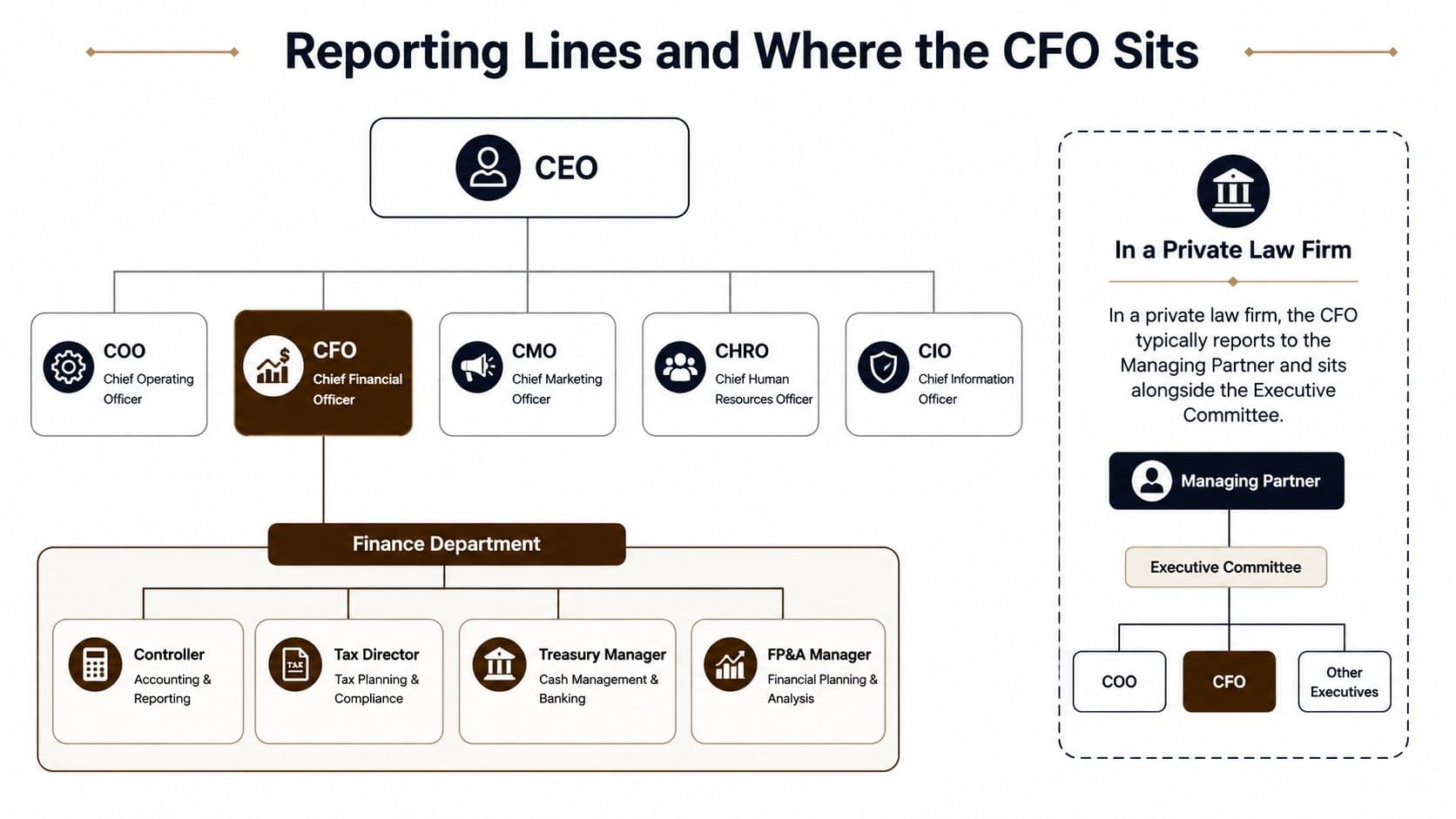
The CFO's authority depends less on the title than on the reporting line, decision rights, and access to governance. A candidate who succeeds under a CEO and audit committee may struggle in a partnership where equity partners retain meaningful influence over distributions and compensation.
Three common structures
In a private law firm, the CFO typically reports to the managing partner or executive committee and works closely with the COO. The CFO may model distributions, partner compensation, lateral economics, reserves, and capital needs, but the equity partnership may retain approval or veto authority over major economic decisions.
In a public company, the CFO reports to the CEO, serves on the executive leadership team, and acts as the primary finance liaison to the audit committee and board. The role carries clear responsibility for disclosure, controls, capital structure, and investor communication.
In an in-house legal department, the structure is more variable. The corporate CFO may own finance for a business unit, while the general counsel controls the legal budget. A legal operations CFO may report dually to the GC and corporate CFO, requiring careful agreement about hiring, technology investment, outside counsel spend, and reporting standards.
| Organization | Primary reporting line | Main authority |
|---|---|---|
| Private law firm | Managing partner or executive committee | Partnership economics, liquidity, financial controls, and decision support |
| Public company | CEO, with audit committee access | Reporting, controls, capital allocation, investor relations, and board communication |
| Corporate legal department | GC and/or corporate CFO | Legal budget, matter economics, vendor spend, and operational finance |
A search committee should define these boundaries before interviewing. If the CFO is expected to challenge partner distributions but can't access the partnership's decision forum, the role is misdesigned. If the CFO owns legal-technology investment but cannot influence the legal operating model, the business is hiring accountability without authority.
For broader context on how finance and operations roles fit within a firm, review the organizational distinctions outlined in positions in a law firm.
CFO Duties in Law Firms Compared to Legal Operations
The title “CFO” covers two materially different jobs. In a law firm, the CFO sits between the managing partner and the COO, translating partnership economics into disciplined financial decisions. The role covers partner capital, distributions, collections, matter profitability, and compensation without losing the confidence of equity partners.
A legal operations CFO works inside a corporate hierarchy. Legal spend is one component of a broader P&L, and the general counsel remains a central budget owner. This CFO must analyze matter costs, manage vendors, assess technology, and explain legal spending to corporate finance.
The candidate profile changes with the setting. A firm CFO needs command of partnership economics and the judgment to challenge partners directly. A legal operations CFO needs matter-spend analytics, procurement discipline, technology evaluation, and practical control over departmental execution.
The accountability horizon changes
A firm CFO manages a balance sheet shaped by recurring compensation and distribution decisions. The work includes modeling origination credit, lockup cash, retiree draw funding, IOLTA compliance, and profit-per-equity-partner results. Strong candidates explain the consequences behind those figures and can lead difficult discussions without reducing every issue to a spreadsheet.
A legal operations CFO works against corporate planning cycles. The focus is matter budgets, outside counsel spend, legal-hold forecasting, eDiscovery, contract-review vendors, and departmental resource allocation. Accountability rests on cost visibility, procurement standards, and enterprise risk rather than partner payout mechanics.
| Dimension | Law Firm CFO | Legal Operations CFO |
|---|---|---|
| Economic model | Partnership balance sheet and partner distributions | Departmental budget within a corporate P&L |
| Core stakeholders | Managing partner, executive committee, equity partners, practice leaders | General counsel, corporate CFO, legal operations, procurement, business leaders |
| Primary analytics | Matter profitability, collections, staffing ratios, lockup, partner economics | Matter spend, outside counsel rates, vendor utilization, technology costs |
| Key systems | Practice-management, billing, trust accounting, ERP, compensation models | E-billing, matter management, procurement, ERP, contract and discovery platforms |
| Typical pressure point | Fairness and liquidity around partner compensation | Cost transparency and service delivery across the legal department |
The broader CFO mandate makes delegation a management requirement. Gartner reported that 95% of senior finance leaders said their roles had expanded beyond traditional finance, and 86% of surveyed organizations now have a chief accounting officer responsible for day-to-day financial-process rigor. Gartner's 2025 survey coverage reinforces the staffing implication: the CFO cannot personally own every financial process and operational project.
A firm that needs this hybrid capability may also need a dedicated legal operations director to own process, systems, and execution. The CFO should set financial priorities, controls, and decision standards. Assigning every workflow problem to the CFO creates accountability without enough operating capacity.
The Hidden Cost of an Expanding Mandate
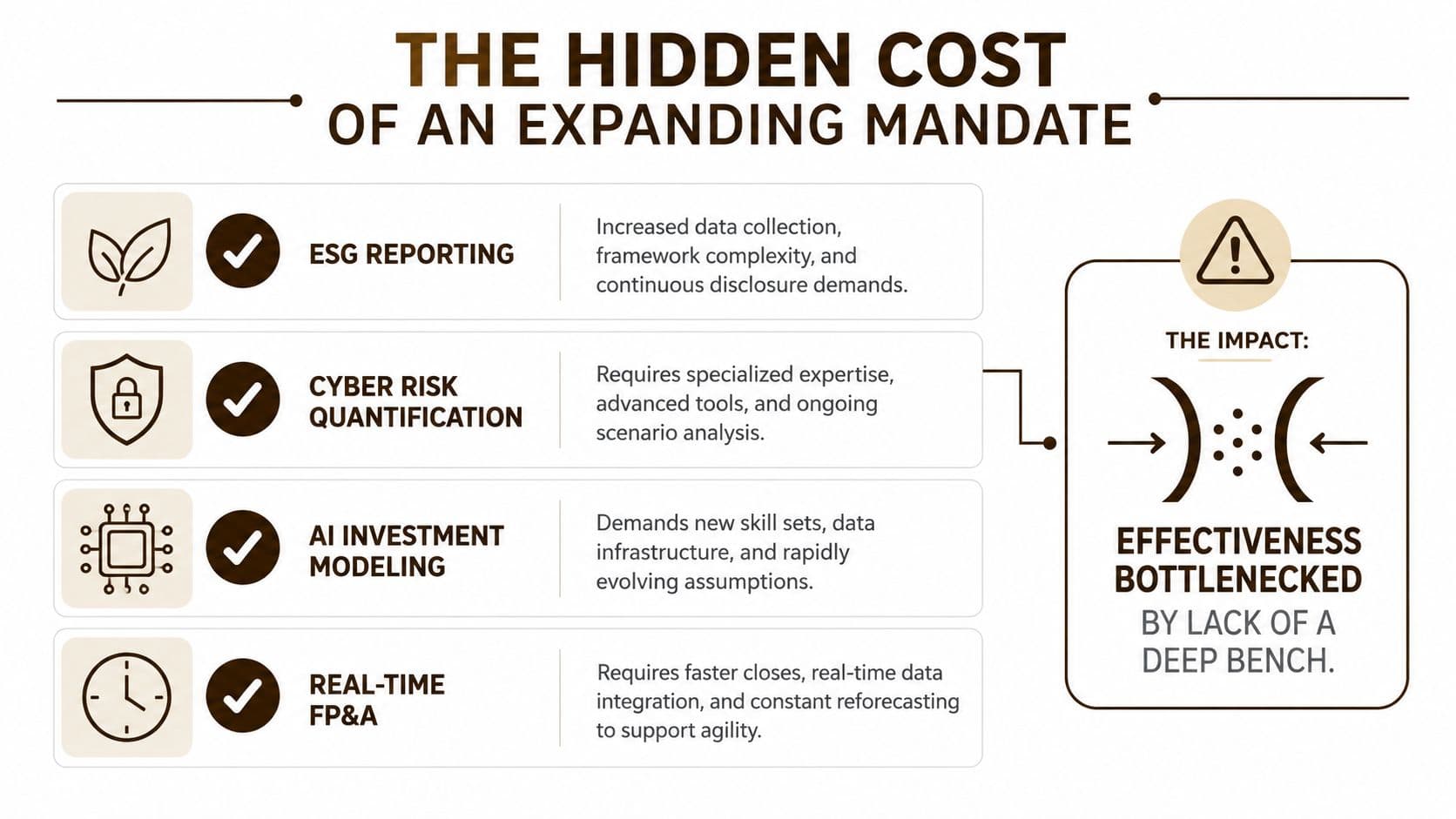
Role expansion sounds like progress until one executive becomes responsible for every unresolved problem. A CFO may now influence enterprise data and analytics, risk, corporate strategy, M&A, procurement, AI, IT, cybersecurity, real estate, and ESG. Gartner reported this broader ownership pattern in its survey of 251 CFOs, showing that the finance seat increasingly reaches beyond traditional accounting. Gartner's survey on broader CFO responsibilities makes the staffing implication difficult to ignore.
The CFO can't personally close the books, run treasury, build the board package, evaluate an AI vendor, quantify cyber risk, and lead every transformation project. When the organization underbuilds the finance bench, the CFO spends executive time on operational firefighting. Strategic work then stalls, even though leadership continues to describe it as a priority.
The minimum support layer
The right structure varies, but a serious CFO mandate usually needs clearly assigned ownership across these areas:
- Controller or chief accounting officer: Owns close execution, reconciliations, accounting policy, and audit readiness.
- FP&A leader: Builds forecasts, variance analysis, scenarios, and decision models.
- Treasurer: Manages cash, banking, liquidity, debt administration, and funding visibility.
- Finance systems and data lead: Maintains reporting architecture, data quality, automation, and finance technology integration.
- Specialist partners: Support tax, risk, cybersecurity, ESG, procurement, and transaction work when the mandate requires expertise outside the core team.
Underinvestment shows up operationally. Close dates slip. Audit findings remain open. Partner-compensation disputes consume senior time. AI and technology projects remain stuck in evaluation because the CFO can't pressure-test the business case and implementation risk.
Practical rule: If the CFO is the only person who can answer routine finance questions, the organization hasn't built a CFO function. It has built a dependency.
Delegation isn't abdication. The CFO must establish controls, review outputs, challenge assumptions, and reserve personal attention for decisions with enterprise consequences. That's how a broad mandate becomes manageable rather than performative.
Hiring the Right CFO and What to Look For
A hiring committee should stop treating credentials as a substitute for evidence. A CPA can establish technical credibility, and an MBA or JD may add useful business or legal context. CMA or CFA credentials can differentiate candidates in management accounting, investment analysis, or capital-intensive environments. None of those credentials proves that a candidate can manage a partnership's economics or influence a skeptical managing partner.
For a law-firm CFO, the strongest profile usually combines CPA-level accounting fluency, executive communication, professional-services P&L ownership, and practical exposure to partner compensation. Fund or trust accounting experience can matter where client funds and fiduciary controls are central. Experience integrating a lateral group, evaluating an acquisition, or modeling a new practice can reveal whether the candidate knows how finance affects growth.
Evidence that separates strong candidates
Ask candidates to explain a decision, not recite a responsibility. A strong CFO can describe how they changed a forecast, what assumptions they challenged, which stakeholders resisted, and how they measured the outcome. They should be able to translate GAAP discipline into a partnership decision without pretending that an equity partnership behaves like a conventional corporation.
Look for these signals:
- Decision ownership: They can identify the capital, pricing, hiring, or risk decision attached to a financial analysis.
- Delegation discipline: They can explain how they built a controller, FP&A, treasury, or accounting team beneath them.
- Stakeholder range: They've worked with boards, executives, operators, partners, auditors, and nonfinancial leaders.
- Commercial judgment: They understand when a profitable opportunity can still create liquidity or execution risk.
- Candor under pressure: They can deliver unwelcome news without hiding behind a spreadsheet.
The recurring red flags are equally clear. A controller promoted without strategic seasoning may be excellent at close management but unprepared for partnership politics. A public-company CFO may understand disclosure and controls yet fail to translate that discipline into partner-economics decisions. A candidate who can't explain how they built and developed a finance team will likely become the bottleneck once the mandate expands.
Pre-hire diligence
Use a written case around a partner-distribution dispute. Give the candidate incomplete information and ask what they would request, how they'd model competing outcomes, and how they'd communicate a recommendation to the managing partner and equity partners.
Then pose a board-style scenario involving a counter-cyclical hiring cycle. The candidate should address liquidity, forecast confidence, strategic timing, downside protection, and the communication plan. Reference checks should probe delegation specifically, including whether the candidate developed capable deputies or kept critical work centralized.
A contingency legal recruiting firm can help define the mandate, test candidates against the organization's actual operating model, and screen for both technical competence and culture fit. Five Star Placements provides permanent placement for CFO, finance, legal operations, and other leadership roles across law firms and corporate legal departments, using a contingency model that charges upon a successful hire. Visit Five Star Placements to discuss a CFO search built around your firm's partnership economics, reporting structure, and required support bench.
Need help filling a legal role?
Five Star Placements partners with law firms and legal departments nationwide.
Schedule a Call