
Of Counsel vs Partner: Roles, Pay, and Career Path
August 29, 2026 · 17 min read · Five Star Placements

Table of contents
A managing partner has a difficult choice in front of her. A senior associate with a substantial client following is ready for a bigger title, but the firm can't decide whether to offer of counsel status or put her on the equity partnership track. At the same time, a corporate general counsel may be asking whether a trusted outside lawyer should be retained as a partner or through a long-term of counsel relationship.
This isn't a vocabulary question. The title determines economics, voting rights, business-development expectations, capital exposure, client portability, and exit terms. A poor choice can leave the firm paying for ownership it doesn't need, or leave a valuable lawyer without the authority and incentives required to retain clients.
The practical comparison has four lenses:
- Economics and billing, including compensation, profit participation, origination credit, and overhead.
- Governance and duties, including voting, management, supervision, and rainmaking.
- Contract and ethics, including conflicts, fee arrangements, restrictive covenants, and departure rights.
- Recruiting fit, meaning the business problem the hire must solve.
The right answer in an of counsel vs partner decision depends on whether the firm needs revenue generation and leadership or senior expertise and reliable capacity.
Table of Contents
- What Hiring Leaders and Candidates Weigh
- Defining Each Title in Plain English
- Compensation, Billing, and Economics
- Governance, Duties, and Day-to-Day Differences
- When Each Role Fits the Strategy
- Contract, Ethics, and Client Portability
- Recruiting and Onboarding Best Practices
- Choosing the Right Title and Next Steps
What Hiring Leaders and Candidates Weigh
A firm hiring a senior lawyer must decide what the role is meant to produce. If the need is a portable book, practice-group leadership, and participation in management, partner status deserves serious consideration. If the need is technical depth, client continuity, or flexible senior coverage, of counsel is usually the more disciplined structure.
The title should follow the business need, not the candidate's preferred label. A partner title can provide authority, profit participation, and a stronger platform for business development. It can also carry capital obligations, management work, and pressure to originate matters. Of counsel can preserve autonomy and reduce governance burdens, but may limit voting power, compensation upside, and influence over firm direction.
Start with the business need
Before discussing titles, the managing partner should write a short role brief. It should answer five questions:
- Revenue: Is the lawyer expected to originate work, or mainly bill and supervise?
- Authority: Does the role require a formal vote or management seat?
- Capacity: Will the lawyer work full time, reduced hours, or around another professional commitment?
- Continuity: Is the firm preserving client access and institutional knowledge?
- Risk: Should the firm share profits and accept capital exposure?
The answers usually identify the appropriate structure. A partner is an investment in the firm's platform and future economics. Of counsel is generally a senior expertise arrangement that retains legal talent without assigning ownership economics.
Candidates should apply the same test personally. Choose partnership when authority, upside, and a long-term leadership role justify the added obligations. Choose of counsel when independence, focused practice, or a reduced management burden matters more than governance rights and partner-level economics.
The market context matters
The distinction has become more important as firms have created more senior tracks. NALP found that the share of firms with partnership tiers and tracks increased from 34.6% in 1995 to 64.5% in 2016, with intermediate readings of 47.2% in 2001 and 67.0% in 2009 across offices in its directory, as reported in NALP's longitudinal research on law-firm partnership structures.
That history requires careful interpretation. For 1991 through 1996, NALP's partner figures included of counsel, so early comparisons can overstate actual partner ranks unless the combined category is adjusted. The label has never been merely decorative. It has served as a distinct senior role, and modern diversity reporting treats counsel separately.
Practical rule: Match the title to the work, authority, and risk allocation. Do not use of counsel as a consolation prize, and do not offer partnership simply to close a difficult hire.
Defining Each Title in Plain English
A partner holds a place in the firm's ownership or leadership structure, but the actual rights depend on whether the role is equity or non-equity. An equity partner typically shares in firm profits, contributes capital under the partnership agreement, and votes on at least some governance matters. A non-equity partner may receive partner status and a senior title without an equity share or the same profit distribution.
An of counsel attorney maintains a continuing, close relationship with the firm while remaining outside both the associate and partner categories. The role fits a specialist, a semi-retired partner, a lawyer returning from public service, or a senior practitioner who wants to advise clients without assuming ownership and management duties.
What the titles look like in practice
A 25-year M&A lawyer returning from government service may bring judgment, relationships, and technical credibility without wanting a full partnership workload or capital commitment. Of counsel status gives the firm access to that expertise while giving both sides room to assess a longer-term fit.
A litigation partner serving on the compensation committee has a different relationship with the firm. That lawyer helps allocate compensation, evaluate senior talent, and address governance decisions. The committee assignment signals authority that generally belongs within the partner structure.
A tax counsel serving one major client over decades can be indispensable without being a rainmaker or owner. The lawyer may handle complex technical work, preserve client knowledge, and mentor younger attorneys while remaining outside the partnership's voting and profit framework.
Of counsel is a status, not a rank
Firms create problems when they use the title as a generic senior designation. Candidates may misunderstand the offer, clients may misread the lawyer's authority, and compensation committees may lack a consistent standard. Of counsel can describe a respected specialist, a reduced-hours attorney, a transition arrangement, or a lawyer who has reached a long-term ceiling outside partnership.
The title also changes meaning by jurisdiction, firm size, and written agreement. It does not by itself establish ownership, voting rights, compensation, or control over client relationships. Those terms belong in the engagement or employment documents and the firm's governance policies.
Historically, NALP noted that some diversity data combined partners and of counsel, while current reporting identifies counsel separately. Counsel has become an important senior-lawyer pipeline, not a peripheral category firms can ignore. Use the title when the lawyer's contribution, authority, economics, and expected relationship support it. Do not use it as a vague substitute for partnership or as a consolation prize for a candidate who was promised ownership.
Compensation, Billing, and Economics
Compensation is where attractive titles become expensive decisions. Equity partners, non-equity partners, and of counsel lawyers can all bill complex matters and supervise teams, but their pay usually comes from different economic systems.
An equity partner's compensation is tied to firm profitability, individual performance, origination, collections, and the firm's allocation formula. The lawyer may also face a capital contribution and a less predictable draw. A non-equity partner generally receives a salary or draw with possible bonuses, while of counsel compensation is more likely to be a salary-plus-bonus arrangement with separately negotiated origination treatment.
At the top of the market, the difference is substantial. Reuters' 2024 Major Law Firms compensation survey reported average compensation of $1.93 million for equity partners and $558,000 for non-equity partners, while a separate legal compensation report placed of counsel compensation in a broad $200,000 to $450,000 salary-plus-bonus range, summarized in this analysis of of counsel and partner economics.
Compensation and Economics by Title
| Factor | Equity Partner | Non-Equity Partner | Of Counsel |
|---|---|---|---|
| Core pay structure | Profit share, draw, and compensation allocation | Salary or draw, often with discretionary bonus | Salary and bonus, usually contract-based |
| Ownership | Usually an equity interest | Usually no equity interest | No ownership interest |
| Profit participation | Direct participation under the firm's formula | Limited or indirect participation | Generally none |
| Origination credit | Usually integrated into partner compensation | Negotiated within the partner system | Must be stated separately |
| Capital exposure | May require a capital contribution | Usually limited | Normally no partnership buy-in |
| Billing economics | Often highest senior rate and firm-level leverage | Senior rate without full equity economics | Senior expertise rate, priced for predictable staffing |
| Income predictability | Lower, because profit and draw fluctuate | Higher than equity compensation | Usually higher, subject to contract terms |
A USC Gould summary of law-firm economics reported that the average associate at the largest firms made about $230,000 in 2007, while equity partners averaged about $1.2 million, a difference of roughly 5.2 times, as described in the USC Gould discussion of law-firm evolution. That spread helps explain why firms developed senior non-partner roles that retain experienced lawyers without granting full ownership economics.
Billing and origination require precision
A partner may receive origination credit through the firm's compensation system even when other lawyers perform the work. Of counsel lawyers can originate matters too, but they shouldn't assume the partner formula applies. The written arrangement should state whether origination credit is paid, how long it lasts, what happens when another lawyer takes over the matter, and whether collections or billed fees control the calculation.
The firm should also model benefits, taxes, retirement contributions, insurance, and administrative overhead before comparing offers. A nominally higher partner number may come with capital exposure and variable distributions. A lower of counsel number may provide more predictable cash compensation and fewer financial obligations.
For firms, the recommendation is direct: use equity partnership only when the lawyer's expected contribution justifies profit participation and capital exposure. Use of counsel when the business needs senior delivery at a controllable cost.
Governance, Duties, and Day-to-Day Differences
Governance creates the clearest lived difference between partner and of counsel. A partner is part of the firm's decision-making machinery. Of counsel usually isn't.
Equity partners commonly vote on leadership, capital requirements, strategic transactions, and new partner admissions. Non-equity partners may participate in practice-group or professional matters, but their authority depends heavily on the partnership agreement and firm policies. Of counsel attorneys generally don't vote at partner meetings, participate in firm ownership decisions, or contribute capital.
The partnership structure and law-firm governance overview is useful background for candidates who need to distinguish title from actual authority.
Governance and Day-to-Day Comparison
| Dimension | Equity Partner | Non-Equity Partner | Of Counsel |
|---|---|---|---|
| Ownership | Yes, subject to the partnership agreement | Generally no equity ownership | No ownership |
| Firm voting | Usually votes on core governance | Limited or agreement-dependent | Usually no vote |
| Capital contribution | Often required | Usually not required | Not required as a partner contribution |
| Business development | Strong expectation | Often expected | Usually secondary to expertise and service |
| Supervision | Expected to lead teams and develop lawyers | Often supervises matters and teams | May supervise, mentor, or advise |
| Committees | Leadership and compensation committees may be available | Practice and operational committees may be available | Usually advisory participation |
| Management duties | Significant and potentially firmwide | Variable, often practice-focused | Limited unless separately assigned |
| Departure | Governed by partnership and related agreements | Governed by employment or partnership documents | Governed primarily by engagement terms |
Similar work, different accountability
Both titles can appear in client meetings, negotiate transactions, argue motions, supervise associates, and handle complex matters. Clients may experience little difference in the day-to-day legal work. The internal accountability is different.
Partners are expected to help build the institution. They mentor lawyers, defend practice-group budgets, participate in recruiting, and accept responsibility for firm-level outcomes. Of counsel attorneys may mentor and lead matters, but their role generally centers on substantive work, client continuity, or a defined transition.
That difference affects committee assignments and performance reviews. A partner review may ask whether the lawyer originated work and contributed to firm strategy. An of counsel review should focus more heavily on quality, utilization, client service, knowledge transfer, and availability.
When Each Role Fits the Strategy
A title should solve a business problem. The following two hiring situations show why the same seniority level can justify entirely different offers.
The rainmaking litigator
A mid-market firm loses a litigator who brought in major matters and anchored a practice group. The vacancy creates more than a staffing gap. Associates need supervision, clients need a visible senior contact, and the firm needs someone who can rebuild the pipeline.
The right hire is usually an equity or non-equity partner, depending on the firm's capital model and the candidate's expected role. The firm should pay a premium only after testing the book carefully. Ask which matters are portable, who controls the client relationship, what the clients say about the lawyer's role, and whether the revenue survives a move.
This lawyer also needs governance appetite. A rainmaker who refuses mentoring, recruiting, management, or cross-selling may still be valuable, but the firm shouldn't pretend it is hiring a broad practice leader. Align the title and compensation with the actual contribution.
Hiring principle: If the firm needs a person to create demand, lead a team, and carry client relationships, offer a partner structure with explicit origination and governance terms.
The technical trusts and estates specialist
A firm needs a senior trusts and estates lawyer with deep technical knowledge. The lawyer will handle complex work, advise existing clients, and mentor associates, but isn't expected to generate a large independent book. The attorney may also be semi-retired or balancing other commitments.
Of counsel is the stronger fit. The firm gets senior judgment and client continuity without diluting governance or paying for a partnership role the business case doesn't support. The agreement can define workload, availability, billing expectations, bonus treatment, mentoring, and client ownership.
This model also works for a lawyer returning from public service, a specialist supporting one key client relationship, or a former partner seeking a less demanding schedule. The title communicates seniority without promising ownership.
The deciding question
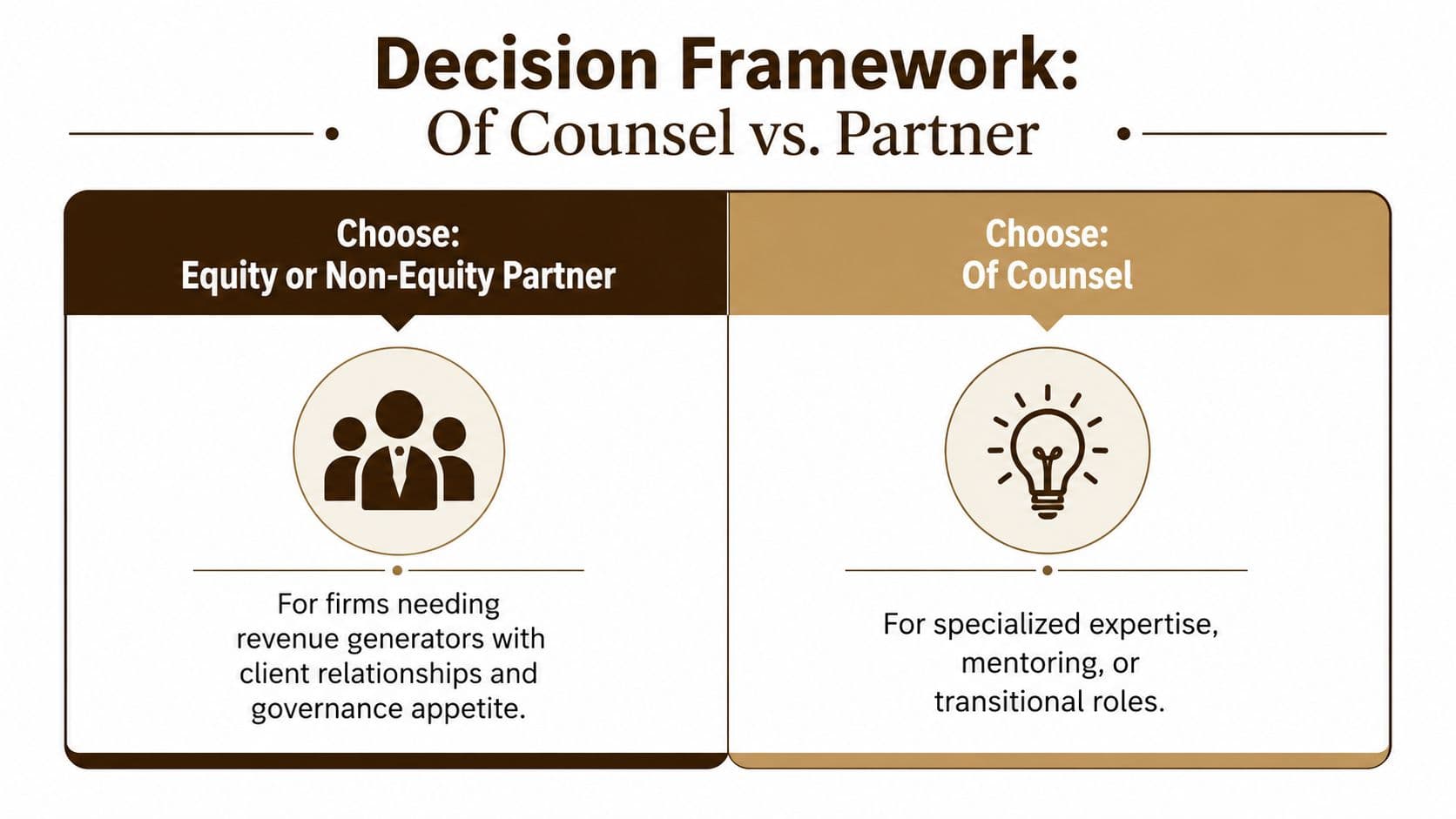
Choose partner when the firm needs origination, leadership, and institutional participation. Choose of counsel when it needs expertise, capacity, continuity, or a transition arrangement. If the firm can't state the expected result in those terms, it isn't ready to negotiate the title.
Contract, Ethics, and Client Portability
The title affects the contract, but the document controls the relationship. A partnership agreement addresses capital, distributions, fiduciary obligations, management, dissociation, and other business terms. An of counsel agreement is usually an employment or attorney-engagement contract that must define compensation, workload, conflicts, client access, confidentiality, and departure rights.
Before either side signs, obtain a focused employment agreement review. A senior lawyer shouldn't rely on the title or an oral promise about future partnership. The agreement should state what happens if the firm changes compensation, reduces hours, terminates the relationship, or later offers partnership.
Conflicts apply to both relationships
Of counsel status doesn't eliminate professional responsibility. Both partners and of counsel attorneys require conflicts screening, ethical-wall procedures, confidentiality protections, and clear identification of the lawyer's relationship with the firm. ABA Model Rule 1.9 can affect duties to former clients for either title, so the conflicts review must happen before the offer becomes final.
The firm should identify:
- Former-client conflicts: Which matters and clients follow the lawyer?
- Current-client conflicts: Can the firm accept the lawyer's existing work?
- Ethical screens: Will restricted matters require a documented wall?
- Client notice: Which clients need notice or consent before the move?
- Fee arrangements: Does the new firm need to revise engagement letters?
Portability is a negotiated issue
Partner-level hires often involve detailed client-portability discussions. The firm may request non-solicitation provisions, client-consent letters, confidentiality obligations, and, where enforceable, restrictions on competition. Those terms must be reviewed under applicable law rather than copied from another firm's template.
Of counsel arrangements may carry lighter post-departure restrictions, but that isn't automatic. The agreement should address whether the lawyer can continue serving a client independently, whether the firm retains the relationship, how fees are divided, and who communicates with the client after departure.
ABA Model Rule 1.5 also matters when lawyers share fees or receive referral compensation. Documentation should identify the services each lawyer performs, the client's consent requirements, and the payment mechanics. Most disputes arise because business expectations were never translated into a signed agreement.
Recruiting and Onboarding Best Practices
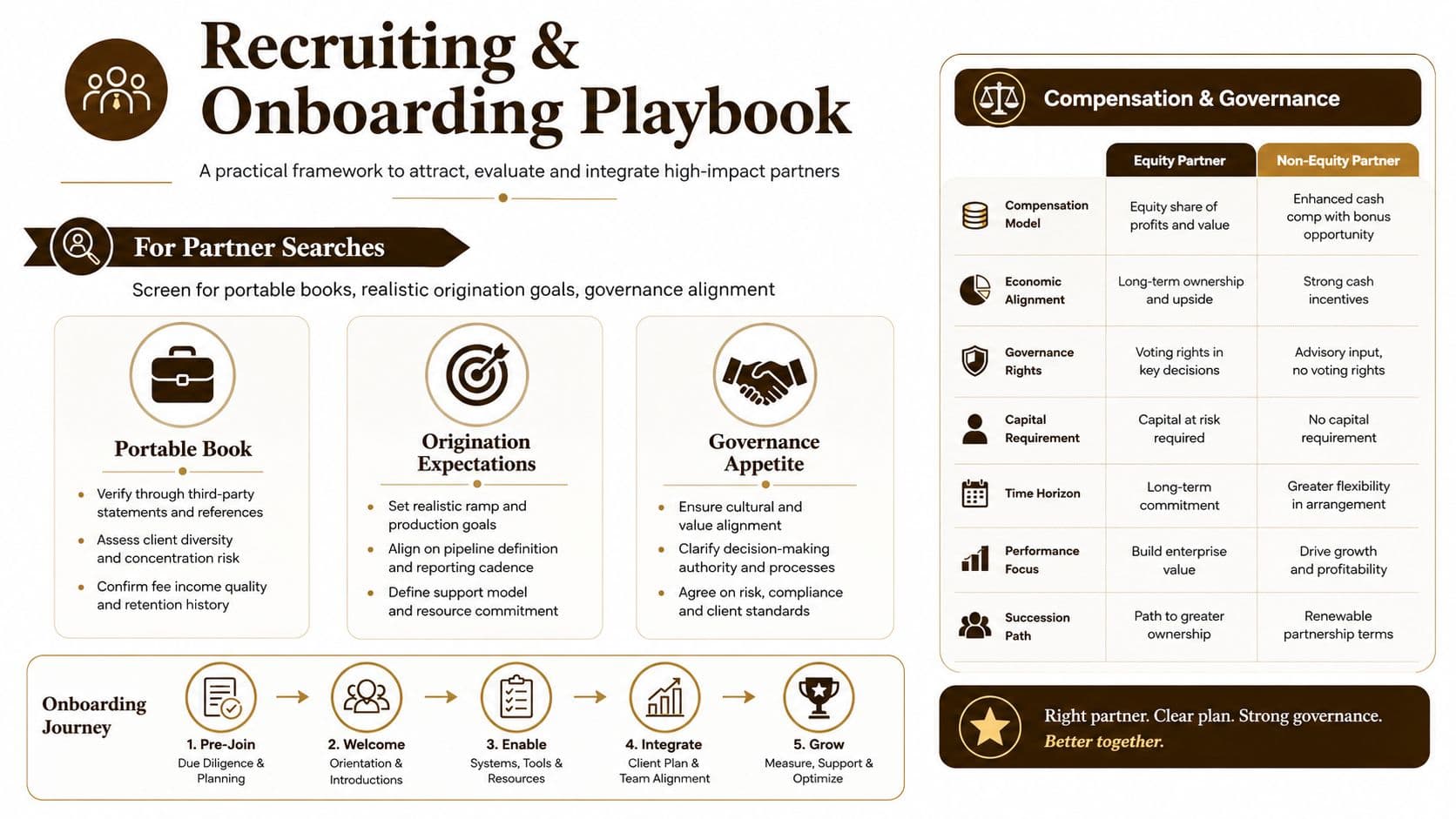
Recruiting improves when the firm treats the title as an operating decision, not a status reward. A partner search should test portable revenue, leadership capacity, and governance alignment. An of counsel search should test technical authority, reliability, mentoring ability, and predictable utilization. For a practical process focused on partner hiring, review this guide to recruiting law firm partners.
Screen partner candidates for evidence
Do not accept a book-of-business figure without a client-by-client explanation. Ask the candidate to separate personally originated matters from work inherited through the prior firm's platform. Confirm the distinction through references, available billing records, and client conversations permitted by ethics rules.
Counsel movement is also an established part of senior recruiting. A prior analysis of Am Law 200 lateral movement reported substantial movement among counsel and of counsel lawyers in 2013, supporting a clear conclusion: counsel is a defined talent category, not merely a fallback for lawyers who are not ready for partnership. Firms should recruit for the work and economics they need, rather than treating the title as a consolation prize.
For partner candidates, interview signals include:
- Portable relationships: Clients know the lawyer personally and may consider following.
- Origination realism: The candidate distinguishes billed work from personally generated work.
- Governance appetite: The lawyer can explain committee, mentoring, or management contributions.
- Economic compatibility: Expectations fit the firm's lockstep, modified lockstep, or individual-performance model.
- Reference consistency: Former colleagues describe both legal ability and institutional behavior.
Screen of counsel candidates for durability
A senior specialist must explain how the role creates value without relying on a partnership title. Test judgment through representative matters, ask how the lawyer mentors associates, and define availability in operational terms. If the lawyer will support one major client, confirm continuity, supervision, and conflicts before announcing the appointment.
Use a written 90-day onboarding plan for either title. Cover conflicts clearance, client introductions, mentor pairing, matter transfer, billing access, technology, and the first compensation true-up. Partner onboarding should also include governance orientation and a review of origination-credit mechanics. Set an early review date so the firm can address workload, authority, and compensation before assumptions harden.
In-house hiring uses the titles differently
Corporate legal departments generally do not use partnership as an internal ownership structure. In-house counsel usually identifies a senior individual contributor or legal leader, not a law-firm partner track. The hiring team should define reporting lines, decision authority, business access, and scope instead of importing law-firm assumptions.
For a nationwide search covering partner, counsel, and other legal roles, Five Star Placements provides permanent placement and customized screening for law firms and corporate legal departments. An outside process can help the hiring team separate title preference from the skills, authority, and operating model the role requires.
Choosing the Right Title and Next Steps
The decision is straightforward once the firm identifies what it is buying.
Choose an equity partner when the lawyer brings meaningful client relationships, can originate work, wants a say in governance, and merits participation in the firm's profit system. Choose a non-equity partner when the person needs partner authority and market stature but the firm doesn't yet want to grant equity or require the same capital arrangement.
Choose of counsel when the firm needs specialized expertise, senior client service, mentoring, flexible capacity, or a transition role. This isn't a lesser answer. It becomes a poor answer only when the firm uses the title to conceal limited compensation, indefinite uncertainty, or a blocked promotion path.
A decision test for firms
Ask these questions in order:
- What must the hire produce? Revenue, leadership, technical work, client continuity, or some combination?
- What authority is necessary? Does the lawyer need a governance vote, or only matter-level authority?
- What risk will the firm accept? Profit participation, capital exposure, variable compensation, or a fixed senior cost?
- What will the candidate expect? Influence, flexibility, income predictability, ownership, or a path to partnership?
- What does the contract promise? Put compensation, origination, workload, review dates, and exit terms in writing.
Lateral attorneys should evaluate their own portable relationships, tolerance for variable income, appetite for management, and desired influence before choosing a path. A lawyer who wants a quieter specialist role shouldn't accept partner obligations for prestige alone. A lawyer who expects to build a practice shouldn't accept an of counsel title without a written route to expanded authority or partnership review.
Take these three steps before making the offer
- Model both structures for 90 days: Compare compensation, benefits, overhead, capital, billing, origination, and expected collections.
- Check governance fit through references: Ask former colleagues whether the candidate leads, mentors, collaborates, and handles institutional responsibility.
- Use a recruiter who handles both titles: A recruiter who understands partner and of counsel searches can test the candidate's economics and motivations without forcing a title prematurely.
The recommendation is clear. Hire a partner when you need a business builder with authority and client responsibility. Hire of counsel when you need senior legal judgment without ownership economics or governance dilution. Then document the arrangement before either side treats the title as a promise.
Five Star Placements helps law firms and corporate legal departments recruit for partner, counsel, in-house, and other permanent legal roles through customized search and screening. If you're deciding between of counsel and partner for a real hire, visit Five Star Placements to discuss the role, compensation model, and candidate profile.
Need help filling a legal role?
Five Star Placements partners with law firms and legal departments nationwide.
Schedule a Call