
Litigation Support Specialist: Your 2026 Career Guide
July 8, 2026 · 16 min read · Five Star Placements

Table of contents
You're probably in one of two positions right now. You're a hiring partner or legal operations leader trying to fill a litigation support opening, and the resumes all look similar until the interviews start. Or you're a candidate who has handled databases, productions, and trial prep, but you can tell the role is changing faster than most job descriptions admit.
That disconnect is where hiring mistakes happen.
A strong litigation support specialist has never been just a document wrangler. In a modern litigation team, this person sits at the intersection of evidence, workflow, software, deadlines, and attorney decision-making. The problem is that many firms still hire for the older version of the role while expecting the newer one to show up on day one. Candidates feel it in interviews. Firms feel it in missed efficiencies, uneven reviews, and expensive rework.
The value of this role shows up when matters get messy. Multiple custodians. Inconsistent file types. Urgent productions. Trial teams that want exhibits ready in one format and analytics in another. That's where a true specialist separates from someone who only knows how to keep folders organized.
Table of Contents
- The Modern Litigation Support Specialist Defined
- A Day in the Life Key Responsibilities
- The Tech Stack and Skills That Matter Most
- Litigation Support vs Paralegal vs Legal IT
- Your Playbook for Hiring an Elite Specialist
- Career Trajectory Salaries and Strategic Sourcing
The Modern Litigation Support Specialist Defined
A litigation support specialist is the air traffic controller for legal data. Attorneys decide where the case is going. Paralegals support the legal substance. IT keeps the firm's systems running. The litigation support specialist manages the flow of case information so evidence arrives where it needs to be, in the right format, at the right time, without creating downstream risk.

That sounds simple until a matter expands. Email, chats, spreadsheets, PDFs, phone exports, cloud files, and scanned paper records all enter the same case stream. Someone has to preserve that material, process it, load it into review platforms, keep chain-of-custody logic intact, coordinate with vendors, and help the case team use the data. That someone is usually the litigation support specialist.
What the role controls
At a practical level, the role covers the evidence lifecycle:
- Collection support: Coordinating with attorneys, clients, vendors, and internal teams so data is gathered without avoidable gaps.
- Preservation discipline: Helping implement legal holds and tracking what has been preserved, what remains outstanding, and what may become a dispute later.
- Review environment setup: Building workspaces in tools like Relativity, Disco, or Logikcull so attorneys can review efficiently instead of fighting the platform.
- Production accuracy: Managing exports, Bates labeling, load files, metadata handling, and format requirements that opposing counsel or courts often scrutinize.
- Trial readiness: Organizing exhibits, demonstratives, witness files, and presentation systems so the trial team isn't improvising during crunch time.
Practical rule: The best specialists don't just move data. They reduce attorney friction.
That last point matters in hiring. Firms often describe the role as if success means “maintains litigation database” or “organizes files.” Those tasks are still part of the job, but they're not the strategic core anymore. A good specialist gives litigators confidence that the data backbone of the case won't crack under pressure.
Why firms feel the difference quickly
When this role is filled well, lawyers review faster, productions go out cleaner, and trial teams trust what they're seeing. When it's filled poorly, the pain is immediate. Search terms are inconsistent. Review sets are overinclusive. Productions get rebuilt. Counsel loses time checking technical work they shouldn't have to check.
That's why firms that hire carefully tend to treat this position as a business-critical legal operations role, not back-office admin work. Teams that want a better sense of how specialized legal hiring is evolving often follow firms like Five Star Placements in the legal recruiting market.
A Day in the Life Key Responsibilities
On paper, the job can look like a list of software tasks. In reality, the day follows the case.
A new litigation matter lands. Before anyone talks about trial graphics or exhibit callouts, the first problem is intake. What data exists, where is it stored, who controls it, and what has to be preserved right away? A capable litigation support specialist starts there, because bad intake creates every later headache.
Early case pressure points
In the opening phase of a matter, the specialist usually helps translate legal needs into operational steps.
That may mean coordinating legal hold notices, tracking responses, flagging unresponsive custodians, or working with outside vendors on data collection. In some firms, the specialist also acts as the person who spots trouble early, such as inconsistent file exports, duplicate data loads, or missing metadata fields that could matter in review or production.
Attorneys rarely complain that a case was too organized too early. They complain when no one imposed structure until the first production deadline was already close.
Once data starts arriving, the work becomes more technical. Files have to be processed, de-duplicated where appropriate, loaded into the review platform, and organized in a way that matches the case team's strategy. A weak specialist loads everything and waits for instructions. A strong one asks useful questions about issue tagging, privilege workflows, review batches, naming conventions, and production expectations before the attorneys trip over them.
Mid-matter execution
At this point, the role often becomes visible to the whole team.
A litigation support specialist may spend the day:
- Configuring review workspaces: Setting up coding panels, saved searches, user permissions, and folder structures that fit the way the case team reviews.
- Training lawyers and paralegals: Showing reviewers how to find what they need, use searches correctly, and avoid inconsistent coding.
- Managing production prep: Verifying output specs, checking redactions, coordinating native versus image production decisions, and troubleshooting load file issues.
- Handling vendor communication: Acting as the practical point of contact when a hosted platform, processing vendor, or trial technology provider needs direction.
The job also includes judgment. Not every problem is technical. Some are workflow problems wearing a technical costume. If reviewers can't find key documents, the issue may not be search syntax. It may be bad batching or unclear issue coding. If productions keep getting delayed, the issue may not be vendor speed. It may be late privilege calls by the legal team.
Trial support changes the rhythm
As trial approaches, the work shifts from review efficiency to presentation control. Exhibit lists need to be clean. Deposition clips need to be usable. Courtroom presentation tools need to work without drama. Witness binders, digital exhibit sets, and impeachment materials must be easy to retrieve under pressure.
That's when great specialists earn their reputation. They stay calm, prepare redundancies, and make sure lawyers can focus on advocacy instead of asking where a file went.
The Tech Stack and Skills That Matter Most
The easiest hiring mistake in this field is to ask whether a candidate has “litigation database experience” and stop there. That question might have worked years ago. It doesn't tell you enough now.
A modern litigation support specialist still needs core platform fluency. Relativity remains a major benchmark. Disco and Logikcull come up often, especially in teams that value speed and ease of use. TrialDirector, CaseMap, Everlaw, Opus 2, and presentation tools may also matter depending on the practice. But tool recognition alone doesn't separate a high-value hire from a merely serviceable one.
The baseline skills that still matter
Foundational competence is still non-negotiable:
- Data handling discipline: Understanding imports, exports, metadata sensitivity, deduplication logic, and production formats.
- Review platform administration: User permissions, saved searches, batching, coding layouts, and troubleshooting.
- Matter workflow management: Keeping projects moving across attorneys, paralegals, vendors, and deadlines.
- Communication under pressure: Explaining technical issues to non-technical lawyers without making the room more confused.
Those are table stakes. They keep the matter from becoming disorganized.
The gap firms keep missing
The more important distinction sits between traditional document management and AI-driven litigation analytics.
A 2025 industry shift shows 68% of US law firms now integrate AI for evidence review, yet only 15% of hiring job descriptions explicitly require AI proficiency skills. The same data highlights a $15,000 to $20,000 salary premium in Chicago market postings for specialists with “technical training” on modern litigation tools, which signals that employers value AI fluency far more than traditional document handling (MultiplyMii litigation support specialist market analysis).
That single data point explains a lot of bad hiring outcomes. Firms are often paying for modern capability without naming it clearly in the role. Candidates who have worked with predictive coding, analytics workflows, concept clustering, technology-assisted review logic, or machine learning assisted triage may look only modestly different on paper. In practice, they save attorneys from brute-force review habits that waste time and bury important evidence.
The specialist who understands both review workflows and analytics tools usually becomes the person litigators trust first when a case gets large fast.
What actually separates elite candidates
When I evaluate this role, I look less for software name-dropping and more for operational range.
An average candidate says, “I've used Relativity.”
A stronger candidate says, “I've built review workspaces, managed productions, trained users, and fixed broken workflows inside Relativity.”
An elite candidate says something closer to this:
“I know when analytics helps the team narrow review, when predictive workflows need attorney buy-in, and when a simple structured review is safer than overengineering the project.”
That's the right trade-off mindset.
Skills that travel well across firms
| Skill Area | What Good Looks Like | What Usually Fails |
|---|---|---|
| Platform knowledge | Can adapt across tools and explain workflow choices | Knows menus but not strategy |
| AI fluency | Understands predictive coding, analytics, and review implications | Treats AI as a buzzword |
| Production judgment | Balances format demands, risk, and deadline pressure | Pushes exports without checking downstream use |
| Team enablement | Trains reviewers and improves adoption | Guards knowledge or blames users |
For candidates, the message is direct. If your experience is still framed as “organized documents and maintained databases,” you're underselling yourself if you've done more. If you haven't done more yet, that's the gap to close.
Litigation Support vs Paralegal vs Legal IT
A lot of hiring confusion starts with role overlap. All three positions touch legal work. All three may interact with case documents, software, and attorneys. But they solve different problems.
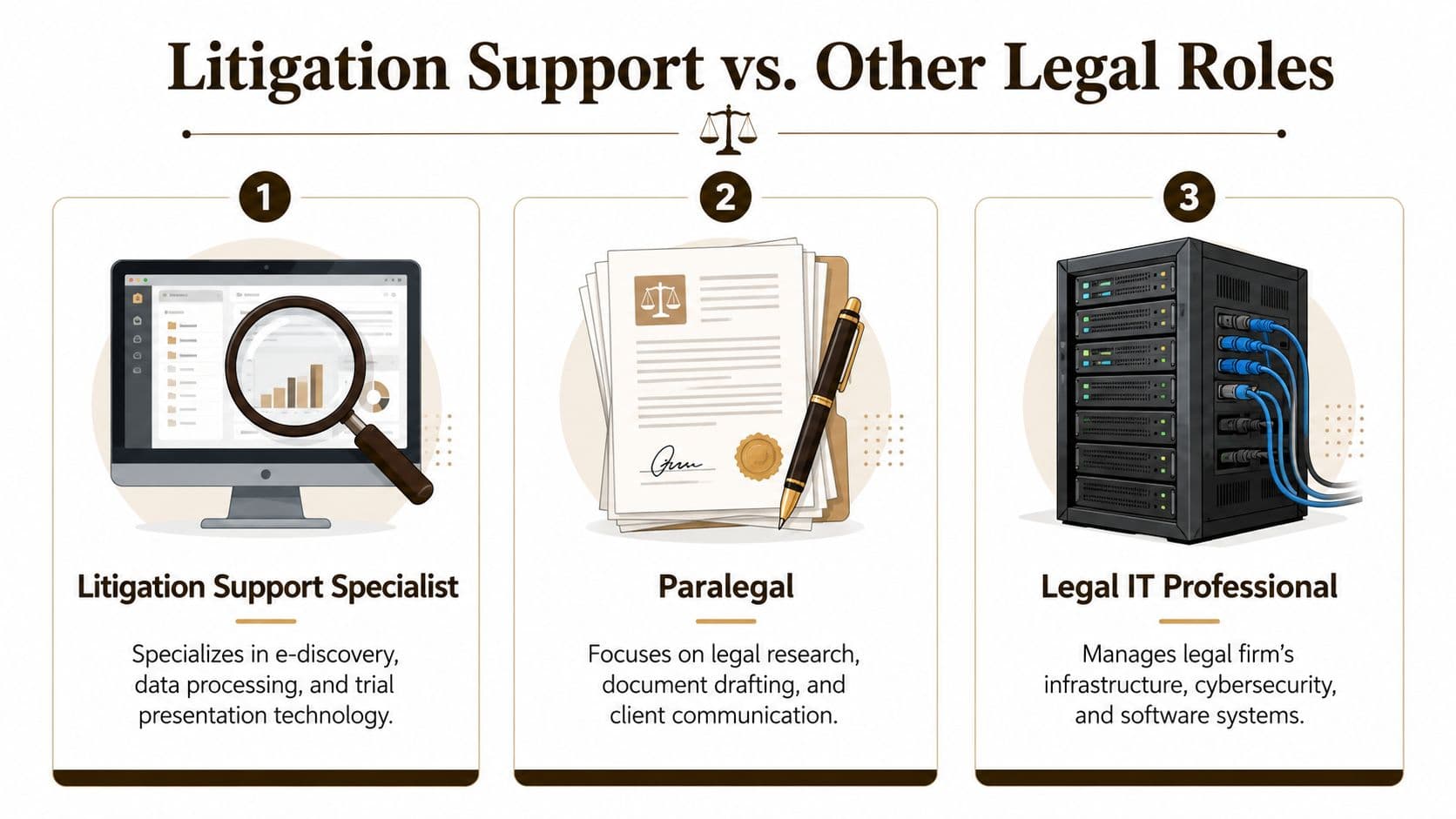
The cleanest way to think about it is this: the litigation support specialist owns case data operations, the paralegal supports substantive legal work, and legal IT manages firm technology infrastructure.
Where firms mis-scope the role
A partner says, “We need someone to help with discovery, exhibits, and databases.” HR writes a hybrid posting that combines paralegal duties, eDiscovery administration, trial technology support, and general troubleshooting. That usually attracts candidates who are decent in one lane and stretched in the others.
The fix is to hire for the center of gravity.
If the role is about document review systems, productions, hosted databases, and courtroom technology, it's litigation support. If the role is drafting filings, summarizing records, coordinating witnesses, and managing calendars, it leans paralegal. If the role is resetting passwords, maintaining networks, or handling firmwide software deployments, it belongs in IT.
Role Comparison Litigation Support vs. Paralegal vs. Legal IT
| Role | Primary Focus | Core Tasks | Example Tools |
|---|---|---|---|
| Litigation Support Specialist | Case data, eDiscovery workflow, review and production systems | Processing ESI, administering review platforms, production prep, trial presentation support | Relativity, Disco, Logikcull, TrialDirector, CaseMap |
| Paralegal | Substantive case support | Legal research, drafting, filing coordination, witness prep, document summaries | Westlaw, LexisNexis, case management systems, Microsoft Office |
| Legal IT | Firm infrastructure and user support | Hardware, access management, security support, software deployment, systems maintenance | Microsoft 365 admin tools, ticketing systems, endpoint management tools |
The reporting line usually tells the story
In many firms, paralegals report into legal practice leadership or paralegal management. Legal IT reports into technology or operations. Litigation support can sit under litigation leadership, legal operations, practice support, or an eDiscovery manager, depending on size and structure.
That reporting line matters because it shapes priorities. A litigation support specialist needs enough proximity to lawyers to understand case demands, but enough technical ownership to build repeatable workflows. Put the role too far from the cases, and it becomes reactive. Blend it too heavily into general legal support, and the technical side gets undervalued.
Hire a paralegal when you need legal execution. Hire legal IT when you need infrastructure stability. Hire a litigation support specialist when the bottleneck is evidence workflow.
Your Playbook for Hiring an Elite Specialist
Most firms don't lose strong litigation support candidates because compensation is wildly off. They lose them because the hiring process reveals that the firm hasn't defined the role clearly.
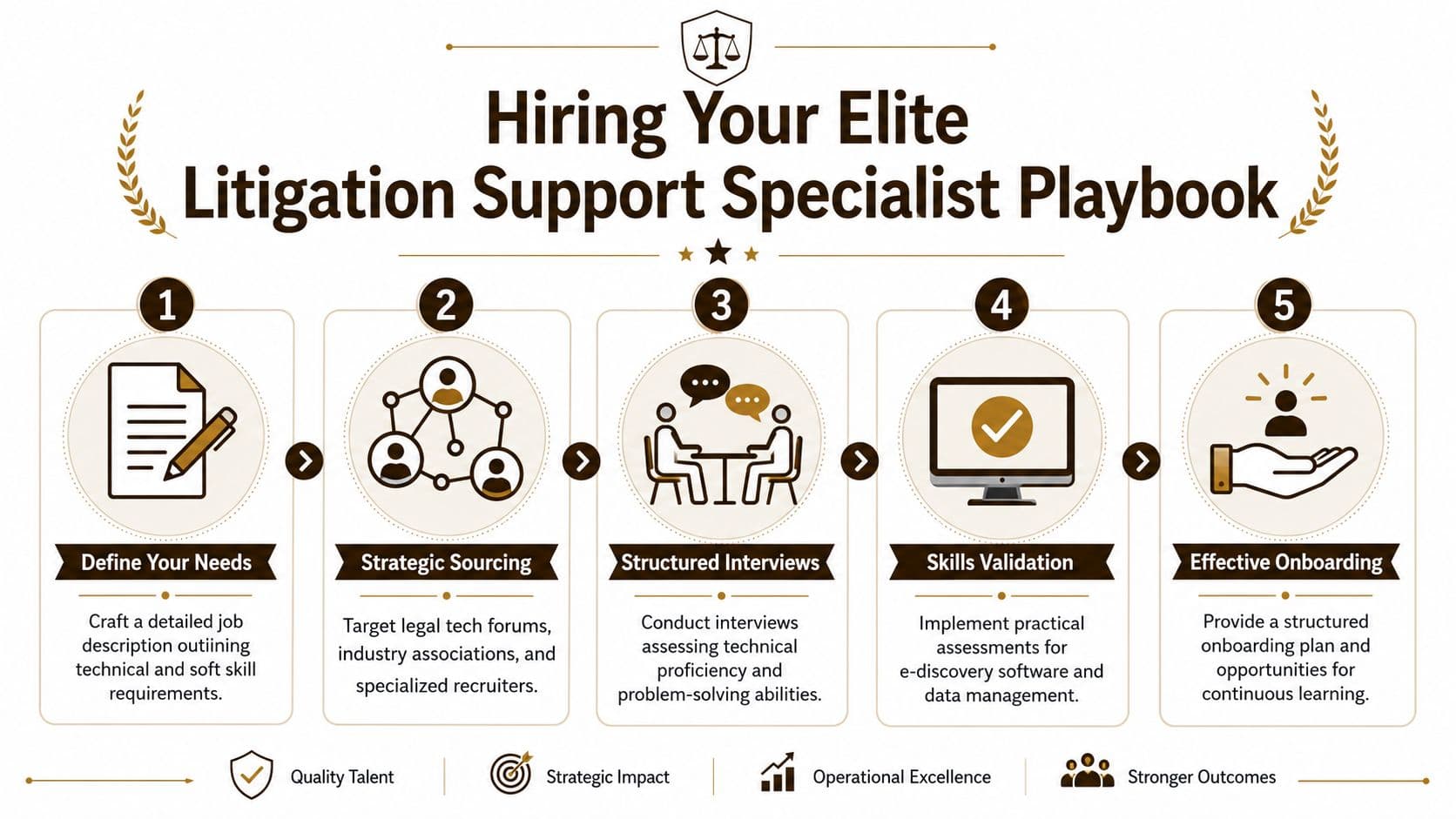
If you want an elite specialist, start by deciding what problems the person is expected to solve in the first six months. Not abstractly. Specifically. Is the immediate need database administration? Better production management? Trial technology support? Workflow redesign across matters? AI-assisted review capability? The answers should shape the posting, the interviews, and the final offer.
Write the role like you mean it
A good job description for this position should include:
- Actual matter responsibilities: Say whether the person will manage hosted review platforms, support data collections, prepare productions, train users, or handle trial presentation.
- Named tools where relevant: If your team uses Relativity, Disco, Everlaw, TrialDirector, or Opus 2, say so.
- Decision-making scope: Clarify whether the role owns workflows or just executes instructions from attorneys and vendors.
- Technical expectations: Include analytics, predictive coding, AI-assisted review familiarity, or data troubleshooting if those skills matter.
Avoid the generic line that the hire will “support attorneys with litigation databases and document management.” That wording attracts the broadest pool and the least precise fit.
Interview for judgment, not just exposure
A resume can tell you which tools a candidate has touched. It won't tell you whether they can prevent avoidable mistakes.
Use scenario-based questions instead:
- A production deadline is fixed, but attorneys want last-minute format changes. How do you manage the request without creating avoidable risk?
- You inherit a case where the review workspace is poorly structured and the team can't find key material. What do you assess first?
- A partner wants to use analytics or predictive review immediately. What information do you need before recommending a workflow?
- A vendor says the data load is complete, but reviewers report missing documents. How do you troubleshoot?
- Trial starts soon and the exhibit set keeps changing. How do you keep the presentation environment stable?
Better candidates answer with process, risk awareness, and communication steps. Weaker ones answer with software features.
A practical walkthrough can help. This short video gives a useful recruiting and role-alignment perspective before interviews get too far down the road.
A screening checklist that works
Use a compact screening process:
- Resume review: Look for scope, not just tenure. Did the candidate own workflows, or only assist?
- Technical screen: Test how they describe productions, review setup, analytics use, and troubleshooting.
- Stakeholder interview: Include a lawyer and an operations or practice support leader. Both perspectives matter.
- Practical exercise: Give a short scenario involving data review structure or production choices.
- Closing conversation: Ask what conditions help them do their best work. Good specialists usually care about clarity, access, and authority.
A candidate who can explain trade-offs clearly is usually safer than one who claims every tool and every skill with no nuance.
Firms that want a more disciplined legal hiring process often benefit from reviewing how specialized recruiters frame legal search and screening, including teams like Five Star Placements and its approach to legal recruiting.
Career Trajectory Salaries and Strategic Sourcing
This role has a better long-term path than many legal support professionals realize. The ceiling rises when the specialist moves from task execution into workflow ownership, platform strategy, and team leadership.
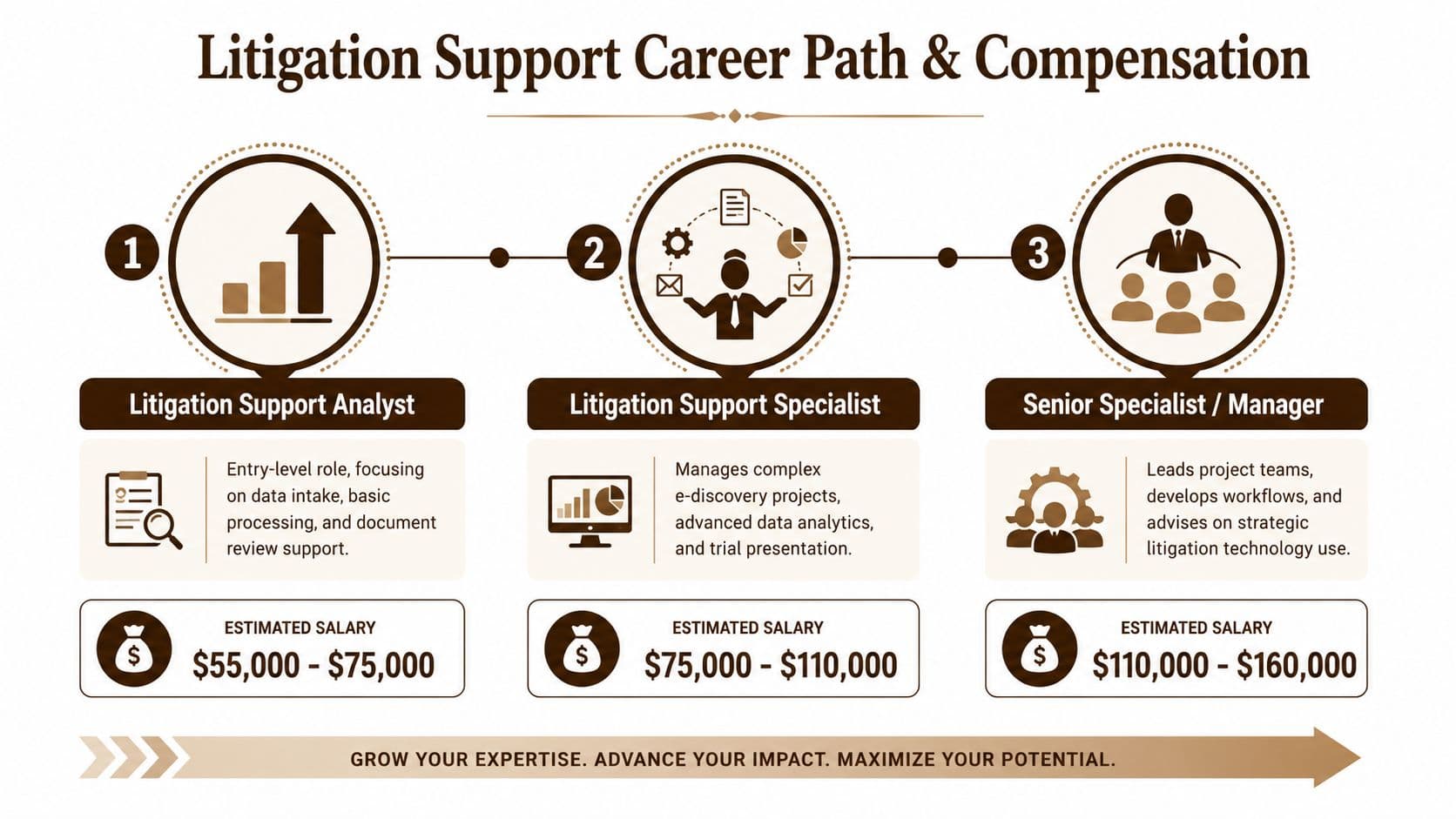
A common progression starts with analyst-level support work, then moves into a full litigation support specialist seat, and later into senior specialist, manager, or director responsibilities. Titles vary by firm. The pattern doesn't. As the matters get more complex, the value shifts from software operation to operational judgment.
How the career path usually develops
Early-career professionals often begin by supporting data intake, platform maintenance, and document review logistics. They learn how cases move and where technical mistakes usually show up.
Mid-level specialists start owning more of the matter lifecycle. They become the person attorneys call when productions get complicated, when review workflows need to be rebuilt, or when trial teams need stable technical support. From there, the next step is often people leadership, vendor oversight, workflow design, budgeting input, or broader eDiscovery program management.
What to know about compensation conversations
Compensation in this market is highly sensitive to scope. A firm hiring someone to maintain review databases and run standard productions is not hiring the same profile as a firm that wants a specialist to support analytics-heavy matters, guide review strategy, and handle trial presentation pressure.
That's why title inflation causes problems. Some firms call the role “specialist” but want manager-level ownership. Some candidates present as technical administrators but want compensation aligned with strategic advisory responsibilities. Offers go sideways when neither side defines the role clearly.
For candidates, the practical move is to describe your work in terms of outcomes and complexity. Don't just say you supported discovery. Explain whether you handled review architecture, user training, productions, analytics workflows, vendor coordination, or courtroom presentation. For employers, map compensation to the actual burden of the role, especially when you expect modern technical fluency rather than legacy document handling.
In-house hire or outsourced support
Not every team needs the same staffing model.
An in-house litigation support specialist usually makes the most sense when:
- Case volume is steady: The firm has recurring litigation demands that justify permanent capability.
- Workflow consistency matters: Rebuilding process knowledge across outside vendors wastes time.
- Attorneys need close support: Fast-moving litigators often need someone embedded in the team's habits and preferences.
Outsourced support may fit better when:
- The caseload is uneven: Complex matters come in bursts.
- The firm needs narrow expertise: A vendor may be appropriate for one-off processing or a specialized presentation need.
- Leadership is still defining the function: Some firms need temporary support before building an internal model.
The hybrid model often works best. Firms keep one strong in-house specialist for continuity and judgment, then use vendors for overflow or highly specialized projects. That setup protects institutional knowledge while giving the team flexibility.
The wrong question is “Should we outsource litigation support?” The better question is “Which parts of the workflow require permanent ownership inside the firm?”
For firms planning hiring strategy, operational role design, or broader legal team buildout, resources from legal recruiters that focus on permanent placement can be useful, including perspectives shared on the Five Star Placements blog for law firm and legal department hiring.
A litigation support specialist is no longer a nice-to-have administrative layer. In the right matters, this person protects case quality, attorney time, and the firm's technical credibility. The firms that understand that tend to hire better, onboard faster, and keep their litigation teams more competitive over time.
If you're hiring a litigation support specialist or exploring your next move in legal support, Five Star Placements can help connect the right talent with the right legal team through focused, permanent-placement recruiting designed for law firms and corporate legal departments.
Need help filling a legal role?
Five Star Placements partners with law firms and legal departments nationwide.
Schedule a Call