
On Call Counsel: What It Is and How to Use It
October 29, 2026 · 14 min read · Five Star Placements

Table of contents
66% of Americans experienced at least one legal problem between 2017 and 2020, according to a 2024 Stanford policy brief. For an organization buying legal coverage, the practical question isn't whether legal problems occur. It's who takes responsibility when a problem arrives outside office hours.
Table of Contents
- What On-Call Counsel Is and Where It Pays Off
- Pros and Cons of the On-Call Model
- Coverage Rotation and Response Tiers
- Fee Models for On-Call Engagements
- Contract Terms That Keep Advice Defensible
- Implementation, Staffing, and Sourcing Steps
What On-Call Counsel Is and Where It Pays Off
On-call counsel is a named lawyer or small rotation, supported by a backup, engaged to be reachable outside ordinary hours for urgent legal triage and a documented handoff. It isn't a second general counsel, an unlimited advice line, or a guarantee that every emergency can be resolved immediately.
The distinction matters when someone asks whether the organization has on call counsel. Having a partner's mobile number isn't the same as having agreed coverage, authority to act, and someone responsible for the next step.
Match availability to the decision
Some matters can't wait until Monday: an arrest, protective-order application, threatened eviction, data incident, workplace injury, collapsing transaction, or regulator's inquiry with an approaching deadline. The on-call lawyer determines what must happen before ordinary operations resume.
For an individual, that might mean identifying whether emergency relief is available and which jurisdiction's lawyer must appear. For an employer, it might mean deciding who may communicate with investigators and what records need protection. For a law firm, it may mean protecting a client's position until the responsible practice group takes over.
Emergency access isn't a commercial convenience. As described in Bradley's publication on remote legal services, some Illinois courts implemented 24-hour, seven-day-a-week access for emergency domestic-violence petitions because weekday business hours weren't sufficient.
Which urgent-counsel model fits
| Model | Best when | Availability | Who pays | Main failure |
|---|---|---|---|---|
| Employee on rotation | Repeat internal crises and tight privilege control | Designated shifts plus a named backup | Employer through salary or stipend, with payroll treatment reviewed for applicable law | Burnout and a single point of failure |
| Outside on-call retainer | Episodic urgency without a full-time specialist | Contracted window, often including nights and weekends | Client through availability and matter fees | Scope creep and conflicts under time pressure |
| Ordinary outside counsel | Predictable daytime matters | Business hours unless someone happens to answer | Client through hourly or fixed matter fees | No guaranteed after-hours acknowledgment |
| Legal-aid or court duty counsel | Individuals facing safety, housing, or criminal emergencies | Program or court hours; some protective-order dockets operate around the clock | Public funding or limited private pay, according to program terms | Eligibility screens and capacity limits |
These routes aren't interchangeable. A court-based service for an eligible individual doesn't replace corporate incident coverage, and ordinary outside counsel shouldn't be treated as a standby service without an agreement.
Before adding emergency duties to an employee's role, distinguish them from the ordinary responsibilities of in-house counsel. A lawyer handling contracts and governance may coordinate an emergency without being qualified to conduct the resulting criminal defense or specialist litigation.
Choose the appropriate row before drafting a fee schedule. A company with occasional incidents may need an outside retainer with specialist escalation, not an expectation that its existing lawyer will carry a phone indefinitely.
Pros and Cons of the On-Call Model
An on-call arrangement is worth buying when it changes a consequential decision, not merely when it produces a faster email reply. Its strongest benefit is that callers know where to turn before they improvise.
Weigh the benefit against its cost
- Preparedness versus standby expense. A lawyer who knows the organization can recognize the significance of a request without a lengthy introduction. The buyer still pays for reserved capacity during quiet periods.
- Specialist access versus staffing commitment. Episodic coverage can cost less than employing a specialist whose skills are rarely needed. Heavy, recurring demand can make that arrangement less economical.
- Familiarity versus new conflicts. An established relationship reduces onboarding friction. A newly identified adverse party can still prevent the designated lawyer from acting.
- Convenience versus scope creep. A clear emergency channel helps callers get urgent attention. Without boundaries, managers may use it for ordinary contract reviews and postponed questions.
There are professional risks too. A generalist who feels compelled to answer immediately may move beyond their competence, while a request involving another state or country may require locally authorized counsel. A buyer needs access to the right lawyer, not just a willing lawyer.
Buying rule: Choose on-call coverage when incidents are genuine but unpredictable, delay would create meaningful harm, and another qualified lawyer can take over.
Test the business case against actual requests
Review a representative period of after-hours messages, calls, and incident reports. For each request, ask whether waiting until business hours would have changed the legal position, personal safety, available evidence, or ability to meet a deadline.
Separate genuine urgency from work that someone submitted late. A routine agreement sent on Friday evening doesn't become an emergency merely because a manager wants to sign it.
If the review reveals continuous substantive work, consider an employed role or broader fractional arrangement. If almost everything could have waited, improve intake and daytime planning before buying standby capacity.
The model loses value at either extreme: too little genuine urgency to justify reserved capacity, or so much ongoing work that emergency coverage becomes an understaffed permanent job.
Coverage Rotation and Response Tiers
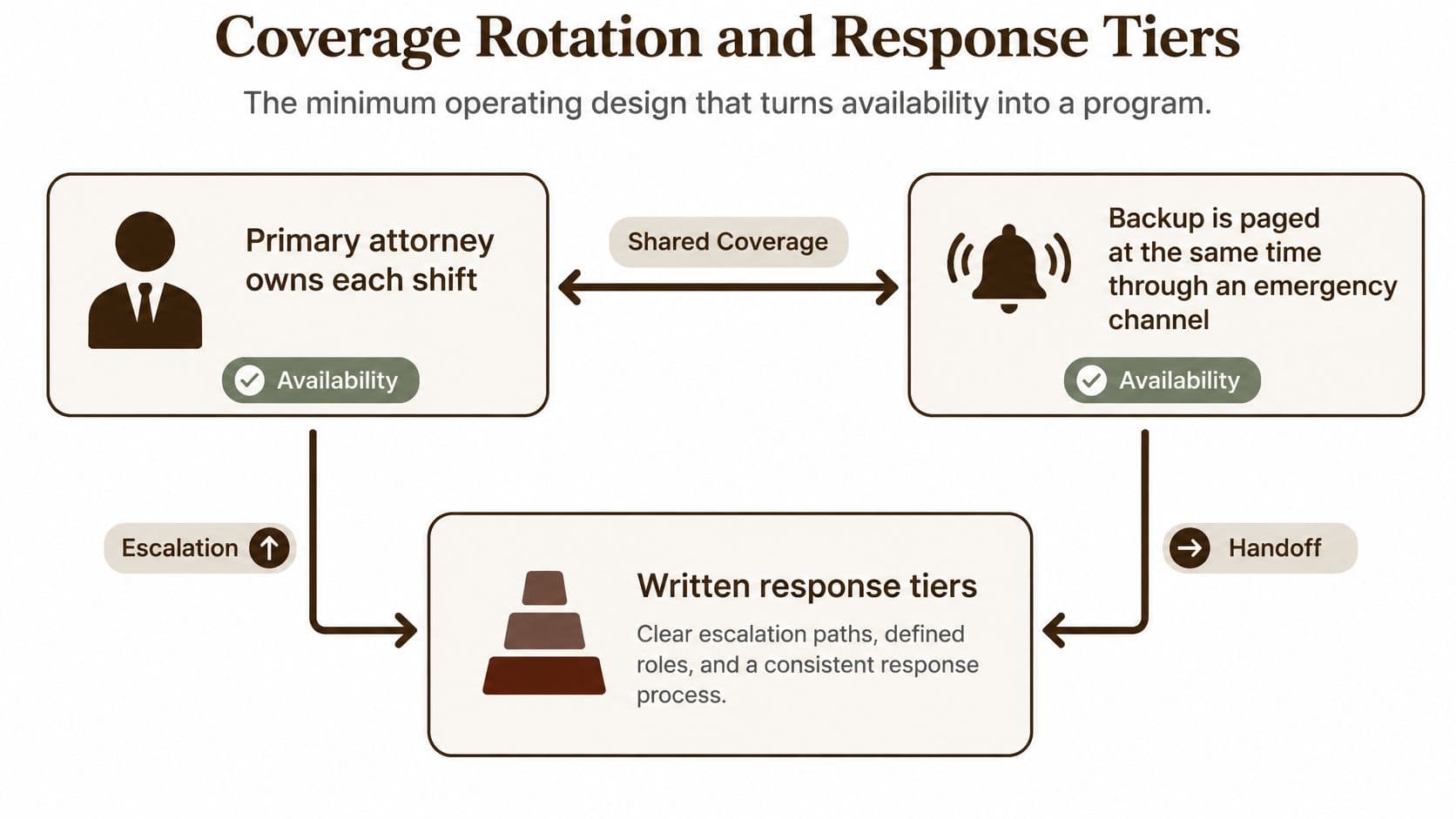
A coverage program starts with ownership. Put a primary attorney on each shift, name the backup, and make clear who can activate additional help.
A published critical-incident representation program describes designated 24/7/365 coverage, a secondary backup, and simultaneous emergency-pager notification to both lawyers. The useful design principle is redundancy without ambiguity: both receive the alert, but the primary owns the response unless the backup takes over.
Build a channel that proves someone received the request
An emergency mailbox alone isn't enough. Use a monitored paging or incident-alert system that records delivery, acknowledgment, reassignment, and escalation.
- Current contact tree. Record the primary, backup, supervising lawyer, specialist contacts, and authorized business decision-maker. Remove obsolete numbers before a shift begins.
- Acknowledgment monitoring. Require an affirmative response from the assigned lawyer. A delivered notification doesn't prove that anyone has read it.
- Automatic escalation. Specify the interval and route for a missed acknowledgment, including who acts if neither designated lawyer responds.
- Night-time intake. Keep conflict-check access and matter-opening procedures available outside office hours. Don't make emergency coverage dependent on an administrator returning.
- Approved communication. Move sensitive facts into the firm's approved secure portal or managed messaging environment rather than continuing in personal texts.
The first call should establish what needs protection now: people, evidence, a filing opportunity, or the client's ability to make an informed decision. It doesn't automatically authorize ongoing litigation, an investigation, or a formal opinion.
Set measurable tiers without inventing a universal deadline
ABA Model Rule 1.3 requires reasonable diligence and promptness. It doesn't supply a universal response-time promise for every on-call engagement.
Negotiate service levels that fit the risk and the available staffing. Distinguish acknowledgment, meaning someone has accepted responsibility for assessing the request, from substantive advice, which may require facts, conflict clearance, or specialist participation.
On-call response tiers
| Event class | Examples | Acknowledgment | First-contact job |
|---|---|---|---|
| Life-safety or liberty | Arrest, protective order, workplace violence | Immediate | Prioritize immediate safety, identify the forum and deadline, coordinate statements |
| Evidence or injunction | Data breach, spoliation risk, temporary restraining order | Immediate acknowledgment and a short triage window | Arrange preservation measures, log facts, contact the specialist |
| Urgent but not critical | Heating contract dispute, dated regulator inquiry | Defined same-day or next-morning window | Classify the issue, run conflicts, name an owner and deadline |
| Routine | Policy question with no expiring deadline | Next business day | Route it out of the on-call channel |
Context determines classification. A heating dispute involving an occupied building in dangerous conditions may require escalation; the contract label alone doesn't establish urgency. Immediate danger also requires appropriate emergency services, not a wait for legal advice.
Make the handoff part of completion
Record the timestamp, issue class, conflicts status, advice given, owner, deadline, escalation decision, and next action. Use matter management systems to give the receiving lawyer a controlled record rather than scattered screenshots.
The receiving lawyer should expressly accept ownership. Until that happens, the outgoing lawyer must know whether they remain responsible or whether the backup has assumed the matter.
Speed without an accepted handoff is an answered call, not a completed service.
Review acknowledgment compliance, time to a qualified attorney, abandoned requests, escalation frequency, repeat contacts, and specialist transfers. Investigate the cause behind missed targets: an outdated contact, unclear ownership, unavailable expertise, or more demand than the roster can support.
Fee Models for On-Call Engagements
Availability and legal work are separate purchases. The availability component reserves capacity; the work component pays for the lawyer's response after an event occurs.
A buyer who combines them into an undefined retainer can end up expecting unlimited advice. A firm that accepts that expectation may discover it has sold substantial night-time work for a fee intended only to cover standby.
How on-call counsel is usually priced
| Structure | What the client buys | When it fits | Commercial shape |
|---|---|---|---|
| Availability retainer | The right to reach a named lawyer after hours | Predictable but episodic incidents | Flat monthly or annual fee; advice often billed separately |
| Blended subscription | Included hours plus after-hours access | Fractional counsel with a steady flow of questions | Monthly fee, hour cap, and overage rate |
| Hourly with premium | Advice only if someone is free | Rare true emergencies and no standby promise | Standard rate plus an agreed after-hours uplift |
| Employed rotation stipend | Internal lawyers sharing a pager | High volume and privilege-sensitive work | Salary plus stipend and recovery time |
| Panel matter opened on a page | A firm that accepts the file when paged | Insurers, hospitals, landlords | Panel rates once the matter is accepted |
The labels don't settle the deal. An availability retainer might include initial triage, while another bills from the first substantive conversation; the agreement should say which applies.
Similarly, panel membership doesn't necessarily guarantee acceptance. Confirm whether the firm must respond, may decline, or must arrange an alternative when it can't act.
Price the operating obligations
Ask each provider to quote against the same coverage specification. Otherwise, a cheaper proposal may exclude the hours, practices, or backup capacity included by another.
- Coverage boundaries. Identify covered hours, time zones, holidays, entities, and practice areas.
- Chargeable activity. Define whether intake, conflict checks, internal consultations, travel, and local counsel generate additional charges.
- Conflict interruption. State what happens to response commitments and fees while the provider determines whether it can act.
- Volume changes. Agree how sustained increases in alerts trigger added staffing, a revised subscription, or a renegotiated standby fee.
For an employed rotation, budget protected recovery time as a staffing requirement rather than a discretionary favor. Salary alone doesn't create spare capacity.
A low retainer paired with unlimited advice encourages callers to send every evening question through the emergency channel. Buy standby when incidents are real but unpredictable; buy employed capacity when recurring work and internal coordination justify a continuing role.
Contract Terms That Keep Advice Defensible
Say an overseas subsidiary contacts the corporate duty lawyer about an employee detention. The lawyer is reachable, but doesn't know the local procedure, hasn't checked the adverse parties, and has received sensitive documents through a personal messaging account.
That isn't primarily a speed problem. The engagement must establish what the lawyer may do before they have enough information and authority to give substantive advice.
Make the engagement letter decide the difficult questions
- Who is the client? Identify the represented entity and clarify whether employees, directors, subsidiaries, or insured persons receive separate representation. A caller shouldn't assume the company's lawyer represents them personally.
- What must intake establish? Require the caller's identity, location, relevant jurisdiction, deadline, known adverse parties, and any existing lawsuit or investigation. Keep initial disclosure narrow enough to support a conflict check.
- What happens before clearance? Define the permissible intake and protective steps under applicable professional rules. Don't promise substantive advice before the lawyer can determine whether accepting the matter is appropriate.
- Who may authorize action? Name the people allowed to instruct counsel, approve specialist spend, authorize filings, or communicate externally.
The letter should distinguish preliminary emergency guidance from a formal opinion. State what further investigation, documents, specialist review, and engagement approval are needed before the lawyer can provide a considered conclusion.
Protect communications without promising privilege
Approved channels and a controlled audience help protect confidentiality, but they don't automatically make every message privileged. Privilege depends on the communication's purpose, participants, and applicable law, not merely a label or the presence of a lawyer.
For multinational operations, identify which office may receive facts, how translation will be handled, and who approves cross-border document transfers. Avoid copying broad distribution lists into legal discussions.
Authority limit: When the issue exceeds the assigned lawyer's competence or authorization, the required response is a controlled referral, not an improvised answer.
Write express boundaries for criminal, immigration, patent, and other specialist matters. For cross-border requests, require locally authorized advice or appearance where needed rather than assuming the duty lawyer can practice everywhere.
Finally, address backup substitution, a conflict discovered mid-incident, termination notice, and responsibility for unfinished matters. The strongest on-call lawyer knows when to stop, obtain the right help, and document why.
Implementation, Staffing, and Sourcing Steps
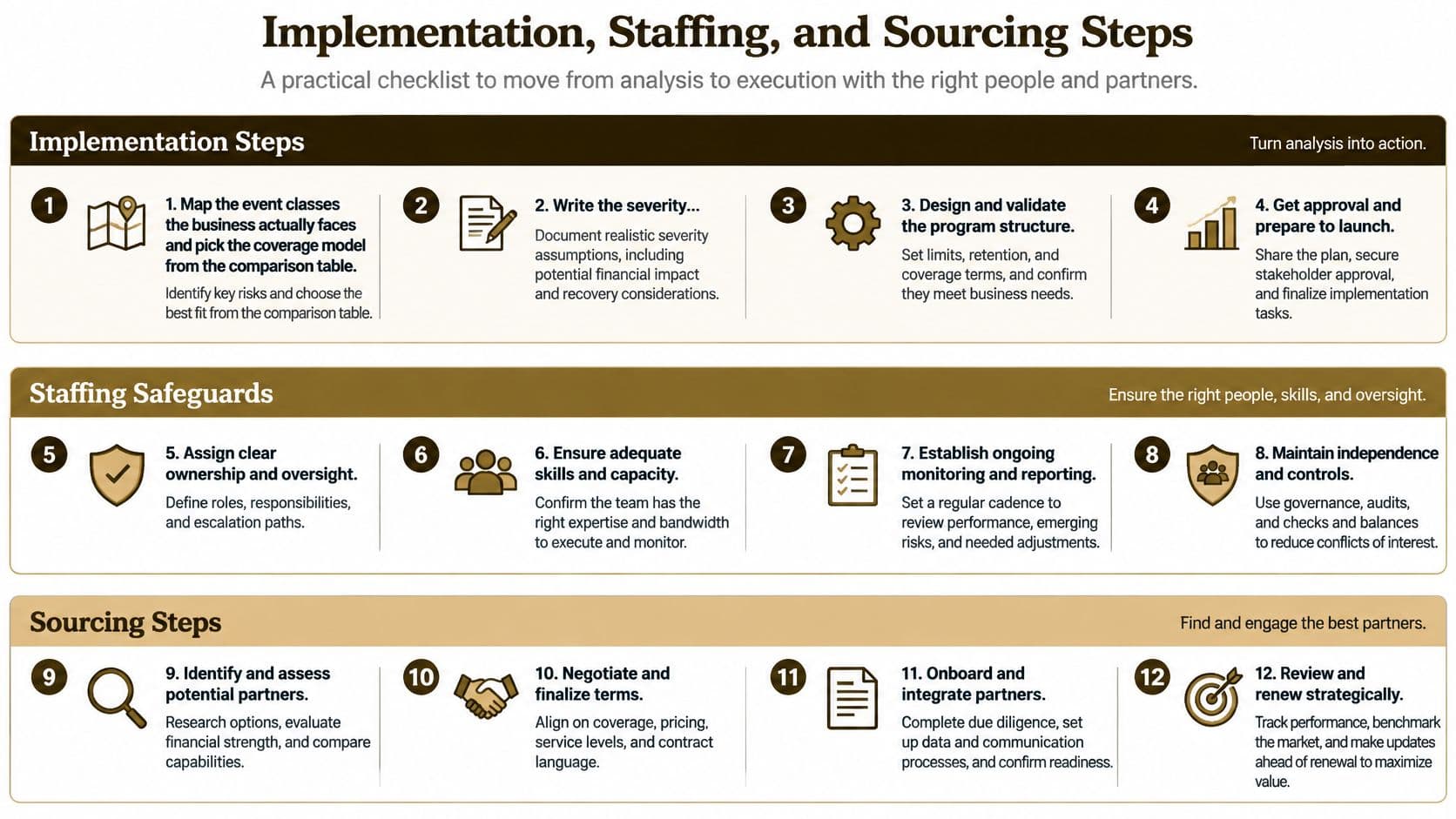
Start with the incidents your organization faces, not a job description promising constant availability. A credible implementation plan turns business risks into coverage obligations that people can meet.
Put the operating design into service
-
Map the event classes and choose the model. Review incident logs, claims notices, security reports, urgent employment issues, and requests sent to outside firms. Identify where delay changes the outcome and where ordinary business-hours support is sufficient.
-
Write the service specification before launch. Put the severity matrix, response commitments, authority boundaries, and handoff requirements into the engagement documents. Give callers a short intake guide so they don't have to interpret a lengthy contract during an incident.
-
Build and test the rotation. Assign the primary and backup, load the contact tree, and provision the approved communication channel. Run a mock night-time page that includes a missed acknowledgment and specialist referral, then correct the failures before opening the service.
-
Source against the actual role. Seek retained coverage through panel reviews, referrals from existing outside firms, or bar lawyer-referral services. Use a permanent-placement recruiter when the need is an employed attorney or firm hire, not as a substitute for contracting emergency legal services.
-
Review demand and adjust staffing. Track alerts per shift, the share requiring substantive advice, overnight interruptions, recovery time taken, backup use, and departures from the rotation. Separate avoidable late work from incidents that required immediate attention.
A test should reach beyond whether the phone rings. Ask the participating lawyer to retrieve the conflict information, locate the authorized decision-maker, open the incident record, and transfer ownership to the receiving lawyer.
Staff for recovery as well as response
LawCare's 2025 survey found that 78.7% of respondents regularly worked beyond contracted hours, while nearly 60% reported poor mental wellbeing, according to Legal Cheek's coverage of the findings. Those findings don't prescribe a particular rotation, but they make it unwise to treat additional availability as free capacity.
Offer letters and rotation policies should name a cap on consecutive on-call periods, a backup who is available, and protected recovery after a disruptive night. The cap should reflect the actual frequency and intensity of calls, not the number of names on the roster.
- Reassign displaced work. If a lawyer handles an overnight incident, identify who covers their morning commitments. Recovery isn't protected when the same deadlines remain untouched.
- Give backups operational capacity. A backup carrying an incompatible hearing schedule or unavailable during the same travel period isn't effective redundancy.
- Reject routine misuse. Permit the duty lawyer to redirect nonurgent requests without being penalized for enforcing the agreed service boundaries.
For a senior internal appointment, apply the same role clarity used when hiring a general counsel. Specify whether the person will personally carry shifts, supervise the roster, manage outside coverage, or combine those responsibilities.
Interview for judgment under pressure
Use a scenario rather than asking whether a candidate is comfortable being available. Present an incomplete request involving an unfamiliar jurisdiction, an uncertain deadline, and a possible conflict.
Ask what they'd establish before advising, when they'd escalate, and what they'd document. A strong candidate should explain how they'd protect the client's position without pretending to know what they haven't verified.
Tell candidates the actual after-hours workload and the recovery arrangements. Write the rotation limits first, then hire or retain someone who can keep them.
Five Star Placements provides permanent legal recruitment for law firms and corporate legal departments, with screening aligned to practice needs and organizational culture. If your coverage plan requires an employed attorney or legal operations leader, visit Five Star Placements to discuss a search built around the role's real responsibilities, escalation expectations, and after-hours workload.
Need help filling a legal role?
Five Star Placements partners with law firms and legal departments nationwide.
Schedule a Call