
What a Legal Search Firm Does and How to Choose
October 23, 2026 · 13 min read · Five Star Placements

Table of contents
A litigation partner's departure can leave a firm with urgent motions to staff, client calls to return, and a practice group struggling to cover active matters. The vacancy may be affecting revenue and client confidence before anyone has even agreed on the job description. Posting an opening and waiting for applications can miss experienced attorneys who are already employed and aren't browsing job boards.
A general recruiter may be able to find candidates, but legal hiring turns on details that a résumé alone can't establish: practice readiness, bar eligibility, matter ownership, client relationships, and the expectations of a particular team. A specialist can start with a relevant legal network and assess those details alongside the employer's needs. The true cost of a slow or mismatched hire goes beyond the recruiter's fee. It can include delayed work, overburdened colleagues, and a replacement search if the new hire doesn't stay.
Table of Contents
- Why a Legal Search Firm Matters Now
- What a Legal Search Firm Actually Does
- Contingency and Retained Search Models
- How Culture Screening Protects Retention
- Searches Across Law Firms and In-House Teams
- How to Evaluate a Legal Search Firm
- Your Next Step in Choosing a Search Partner
Why a Legal Search Firm Matters Now
A managing partner may need a successor who can maintain client relationships, while a department head needs an associate ready to contribute to active litigation. In either case, a vacancy leaves existing colleagues carrying more work. What makes outside search relevant now is the size of the hiring pool: the Bureau of Labor Statistics projects about 35,600 openings for lawyers each year, on average, over the projection period. That figure includes openings across the profession, not just roles suited to a particular employer, so finding the right fit still takes targeted work.
When a role requires specific experience, a public posting may attract applicants without clarifying who can handle the work from day one. A search firm can identify prospects through direct outreach and explain the responsibilities, expectations, and reasons to consider a move. The trade-off is that outreach can widen the pool, but it does not guarantee a quicker hire or a lasting match.
Why specialist outreach matters
Before engaging a firm, ask what sources it will use, who will conduct the screening, and how it will assess readiness for the actual role. Clarify the fee structure, expected timeline, and how the firm will handle confidential searches. Ask how it uses AI in the workflow, including whether tools support research or screening, and who checks their output. These answers show whether the process is designed around sound judgment, not merely a high volume of résumés.
Speed matters, but early-tenure retention offers a better test of fit. A candidate who accepts quickly may still leave if the workload, supervision, or compensation differs from what was discussed. Ask the firm how it checks those expectations with both sides before interviews and how it will follow up after placement. A thoughtful process may take longer than a quick introduction, yet it can reduce the risk of repeating the search.
What a Legal Search Firm Actually Does
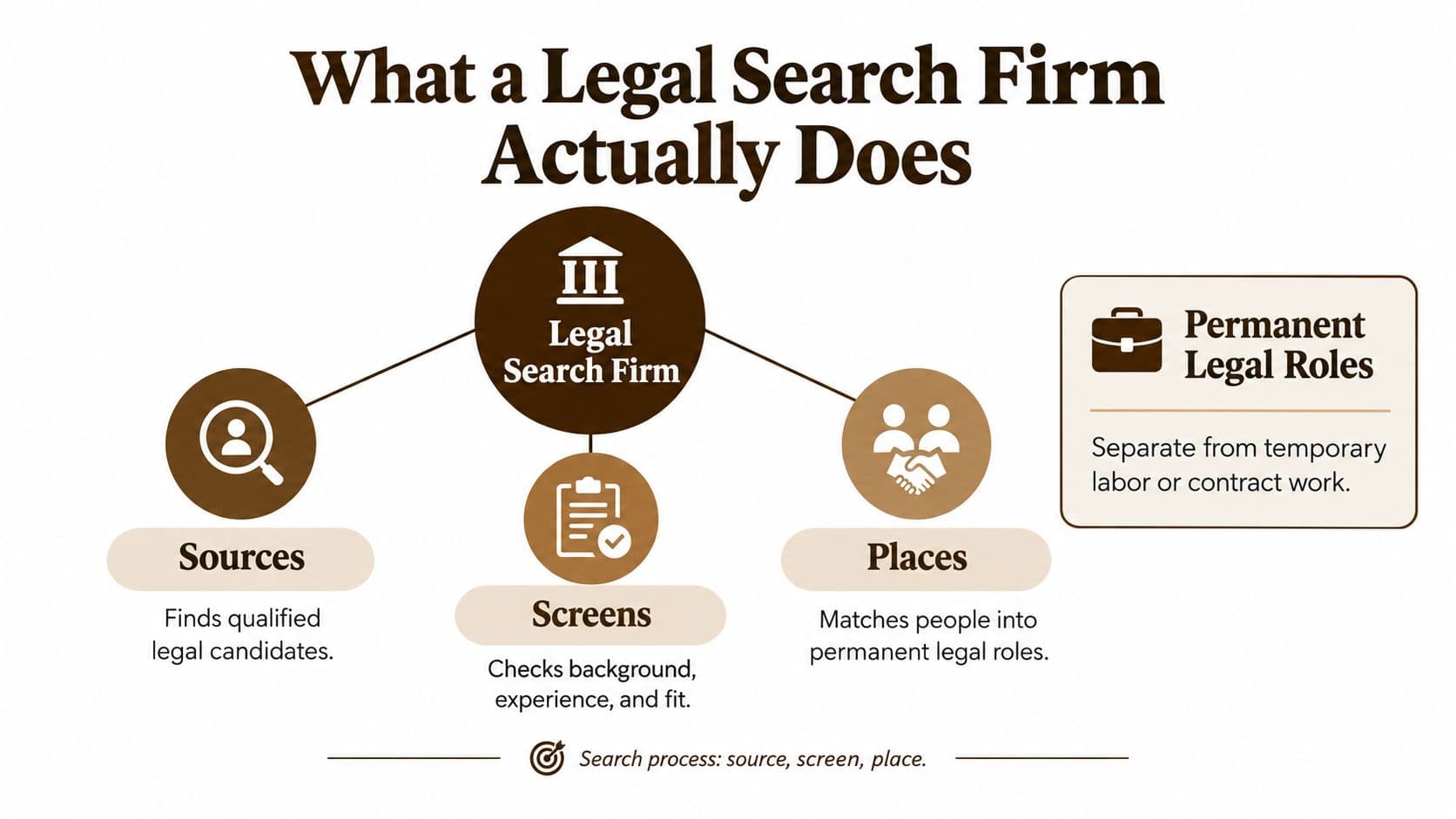
A legal search firm sources, screens, and places candidates into permanent legal roles. That process can include attorneys, partners, in-house counsel, legal support professionals, and legal operations leaders. These roles aren't one interchangeable talent pool: a paralegal search calls for different screening than a partner search, and a corporate counsel role isn't merely a law-firm associate job in a different setting.
The work spans distinct legal markets
On the law-firm side, a search may focus on litigation, personal injury, trusts and estates, family law, immigration, construction, corporate law, labor and employment, tax, real estate, or healthcare. It may target an associate who can manage specific matters, a partner whose client relationships suit the firm's strategy, or a lateral team that can move together.
Corporate legal departments hire for different responsibilities, including general counsel, contracts, compliance, intellectual property, mergers and acquisitions, and tax. Legal support searches may cover paralegals, legal assistants, intake, records, case management, or litigation support. Operations searches can involve firm administrators, COOs, finance leaders, and recruiting or HR professionals.
Associate recruiting often depends on practice-area alignment and an efficient evaluation process. Partner recruiting adds questions about portable business, conflicts, compensation, leadership, and the strength of client relationships. A search firm should understand which evidence matters for the particular role, rather than applying one generic checklist to every candidate.
The need for ongoing hiring isn't limited to firm expansion. The U.S. Bureau of Labor Statistics projects approximately 31,500 annual lawyer openings during 2024–2034, including openings from both employment growth and replacement demand such as retirement or occupational transfers (BLS projection for lawyer openings). A résumé can describe experience, but it doesn't by itself verify bar admission, jurisdictional eligibility, matter ownership, or readiness for the work.
A useful starting point is understanding what a legal recruiter does. The core process is straightforward: find candidates, check their qualifications and fit, and bring the strongest matches into a permanent role. That process is separate from temporary labor or contract work.
Contingency and Retained Search Models
The fee model determines when the client pays, whether the recruiter has exclusive responsibility, and how search risk is shared. Contingency search generally ties the fee to a successful hire, with no upfront payment. Retained search involves payment for a dedicated engagement, often in stages, whether or not the search ultimately closes.
Neither model guarantees a good hire. The useful question is which structure matches the vacancy's business risk and the amount of focused search work it requires.
| Model | Fee timing | Exclusivity | Client risk | Often fits |
|---|---|---|---|---|
| Contingency | Fee due after a successful hire | May be non-exclusive | Lower upfront financial commitment, but screening quality still matters | Permanent placements where the client wants a fee tied to an outcome |
| Retained | Paid for an exclusive engagement, often in stages | Typically exclusive | Client pays for the search process even if no candidate is hired | Selective, confidential, or leadership searches needing dedicated market mapping |
A contingency arrangement can suit an employer whose internal team has limited sourcing capacity and wants the recruiter's fee linked to a placement. It can also bring uncertainty about recruiter attention if several firms are working on the same vacancy. The client should ask how the recruiter will screen candidates and what information will accompany a shortlist, not just how many résumés will arrive.
Retained search can suit a sensitive partner or general counsel search where confidentiality and a coordinated market map matter. An exclusive engagement gives one firm responsibility for managing outreach and candidate communication. In exchange, the client commits to paying for the search work, rather than only for a completed hire. That commitment makes scope, reporting, and decision rights worth agreeing on at the outset.
For more detail on the outcome-linked structure, see this contingency placement example. A risk-based contingency model can reduce uncertainty about recruiter return, but it doesn't replace careful evaluation. A quick, low-cost placement isn't a bargain if the hire proves mismatched and leaves.
Practical rule: Match the fee structure to the cost of leaving the seat open, the need for confidentiality, and how selective the search must be.
How Culture Screening Protects Retention
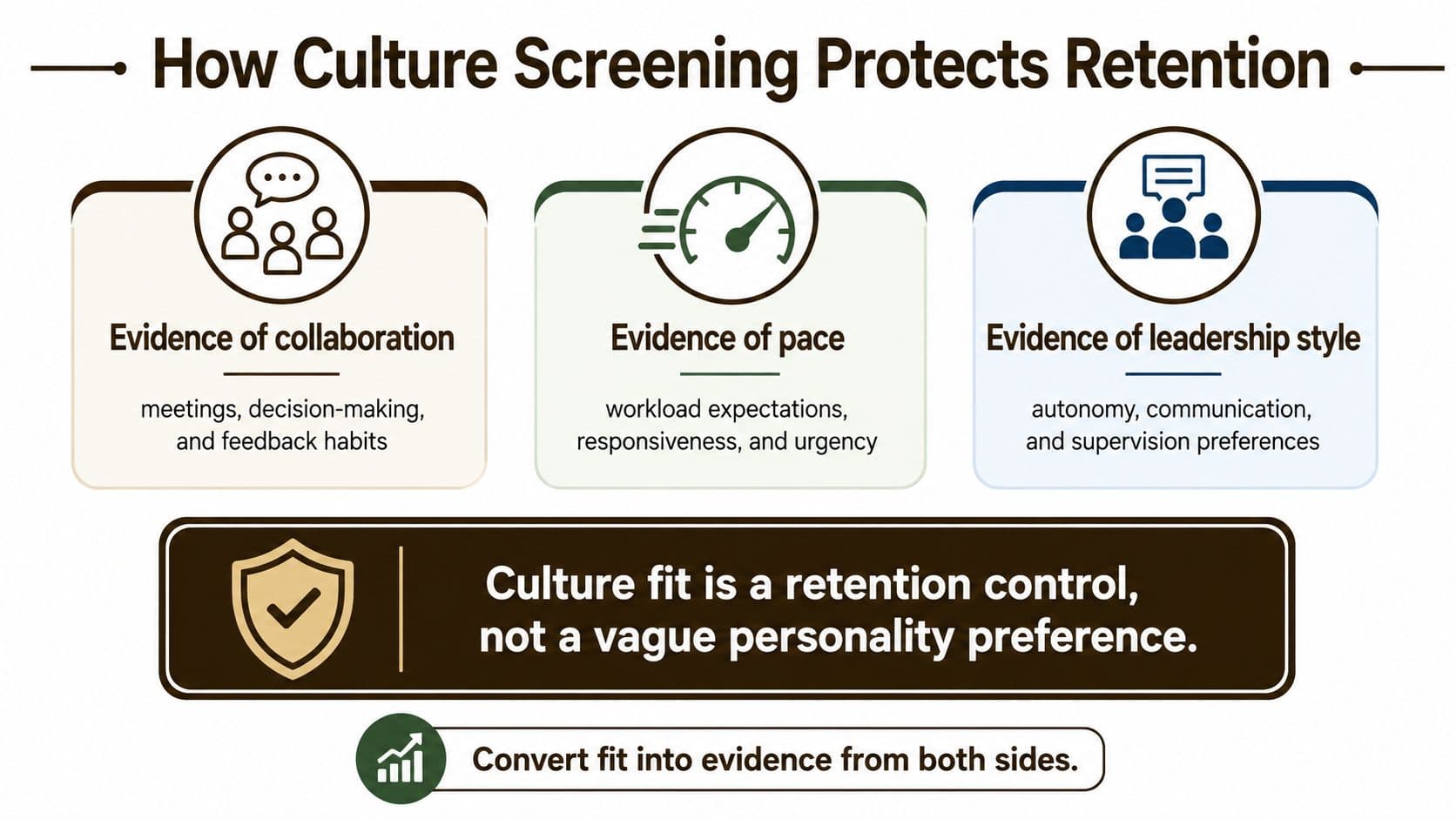
A new associate may expect frequent feedback, while the supervising partner assumes the associate will manage matters independently. If neither expectation is discussed, the mismatch can surface after the hire, when it is harder to correct. Culture screening helps both sides make everyday working conditions clear before an offer.
“Good fit” should describe specific, observable expectations, not whether someone seems familiar. A candidate needs to understand how the team works, and the employer needs to know what conditions help that person do good work. A firm may claim to embrace new ideas but reward only traditional billable work. Ask how that difference plays out in practice.
Make fit observable
Thomson Reuters Institute's 2025 research of more than 2,200 stand-out lawyers in 60 countries found that 56% viewed their firms as innovative, while only 9% said compensation models rewarded innovation (Thomson Reuters Institute's 2025 Law Firm Culture Report). The gap shows why candidates and employers should compare a firm's stated identity with its actual incentives.
Use concrete questions to make that comparison:
- Decision-making and supervision: Who makes calls on matters? How often does a supervisor review work, and what autonomy will the hire have?
- Workload and performance: What billing, responsiveness, or output expectations apply in practice?
- Compensation and advancement: How do incentives work, and what determines progression?
- Innovation and flexibility: Can the person shape process changes? What does the team expect for hybrid or remote work?
- Client development: For senior roles, how will the organization assess relationships and business generation?
Early-tenure fit deserves close attention. The NALP Foundation's 2025 data from 141 U.S. and Canadian firms found average associate attrition of 19%, with 83% of departing associates leaving within five years of being hired. Firms with 100 or fewer attorneys reported 24% attrition (NALP Foundation's associate attrition update)). These figures do not establish that culture mismatch caused each departure. They do show why a search firm should assess the conditions a candidate is joining, not just how quickly it can fill the role.
A useful scorecard records the candidate's expectations beside the manager's actual practices, then flags unanswered questions before an offer. After hiring, a first-year alignment plan gives both sides a way to check whether those expectations hold. A culture fit assessment can guide evidence-based discussion rather than personality judgments. For AI-enabled workflows, include practical judgment in that discussion: can the candidate assess when a tool is appropriate, review its output, and explain its limits? A name-brand tool is not proof of sound judgment.
Searches Across Law Firms and In-House Teams
A law firm replacing a practice-ready associate needs evidence that the person has handled relevant matters, understands the firm's expectations, and can step into the required work. A mismatch can leave colleagues covering the caseload while the new hire learns that the role differs from what they expected.

A partner or lateral-team move calls for a different kind of proof. A search firm should distinguish existing client relationships and realistic portable business from hoped-for originations, while checking conflicts and the candidate's expectations for compensation and leadership. If those points are overstated or misunderstood, a firm may disrupt its team without gaining the practice growth it expected.
In-house hiring changes the questions again. A corporate counsel or compliance candidate needs relevant legal judgment and an understanding of how to work with business teams. For roles involving AI-enabled workflows, the search should assess practical judgment, not just familiarity with tool names.
Major Lindsey & Africa's 2025 General Counsel AI Hiring Survey covered 152 legal departments in 17 countries. It found that 39% had changed hiring criteria because of AI, but only 21% specifically required AI experience. General AI literacy led the technical priorities at 49%, followed by change-management experience at 29%; only 2% sought programming or technical proficiency (survey findings reported by Law360).
A strong interview can ask how a candidate would identify a suitable use case, protect confidential information, validate an AI-generated output, and set review standards. For example, someone helping a legal department improve contract intake may need to understand how the tool supports the workflow and where a lawyer must verify results. That person may need sound legal judgment and the ability to guide adoption, not coding skills.
The same distinction applies to support and operations hiring. A paralegal or intake specialist may be essential during a peak in matter volume, so screening should confirm relevant workflow experience and reliability. A legal operations leader or firm administrator needs to show that they can manage the systems, people, and processes involved. A poor match in either role can delay work or disrupt how the organization functions.
A brief discussion can help frame AI-related questions before interviews begin:
How to Evaluate a Legal Search Firm
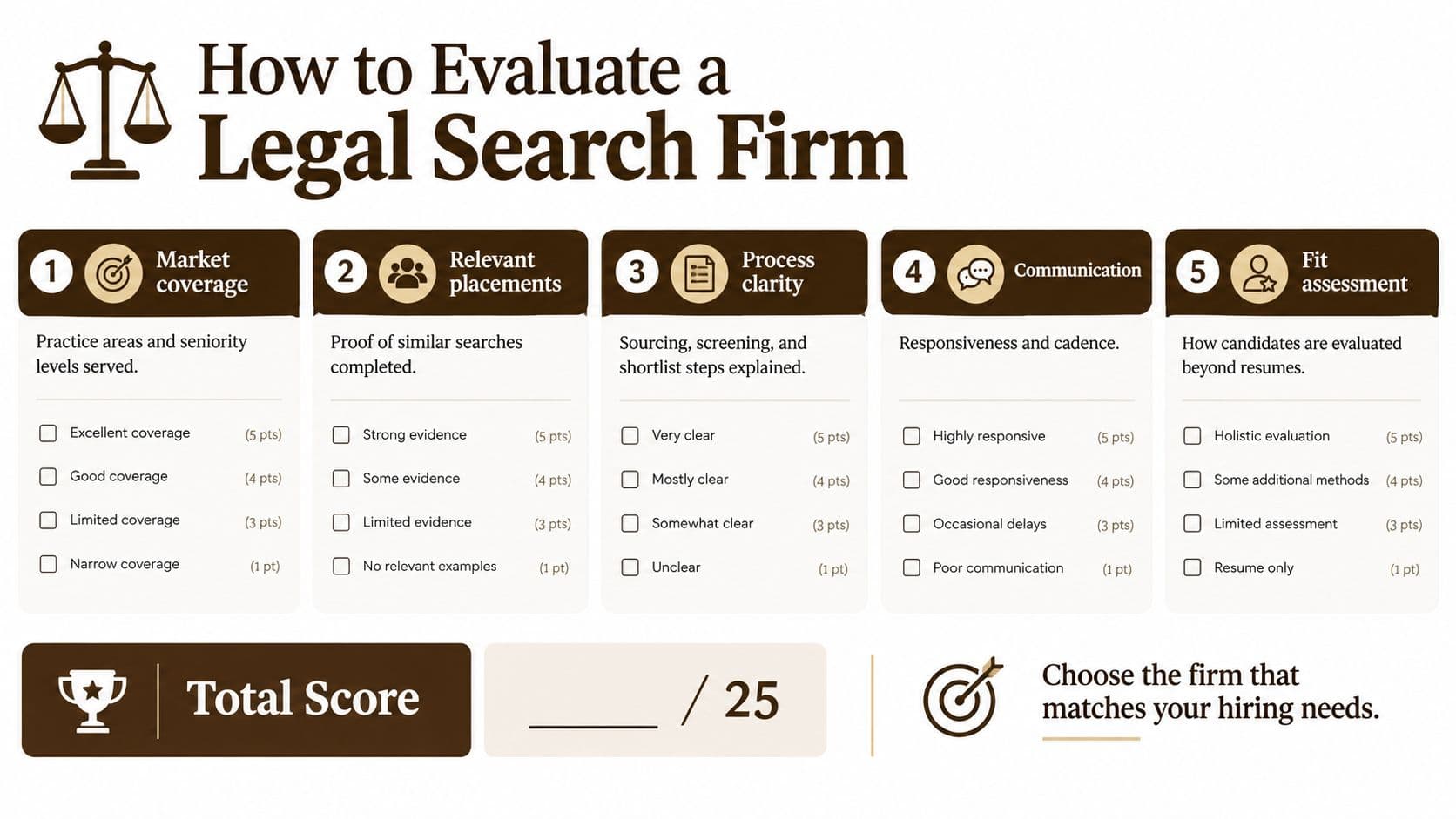
Ask providers to explain their process in terms of the role you need to fill. A firm that recruits associates in a particular practice may not have the same reach or screening approach for an in-house compliance leader or a partner with client-development expectations. Look for clear answers about how the firm will find candidates, what it will verify, and how it will communicate during the search.
Ask questions that expose the process
Use these criteria to compare providers:
- Market coverage: Can the firm reach candidates with the relevant practice experience, seniority, and employer background?
- Screening evidence: Does it go beyond résumés to check credentials, bar status where relevant, matter experience, client relationships, and work expectations?
- Role alignment: How does it document supervision, workload, compensation, advancement, and the manager's style?
- Communication: Who gives updates, how often, and what feedback will the client receive after interviews?
- Search reach: Can the provider handle a single location or a multi-office, nationwide search if needed?
- Fee terms: Does payment depend on a completed hire, or is the client paying for a dedicated search engagement?
Then ask what the recruiter will ask both the client and candidates about the first year. For a partner search, ask how it distinguishes portable business from optimistic projections. For an AI-related legal role, ask how the process separates practical AI literacy and change leadership from programming ability. These questions reveal whether the provider understands the work or is relying on broad labels.
Request a retention-risk brief before the shortlist. It should record role expectations, deal-breakers, manager style, career path, billing or performance requirements, and a 30/60/90-day alignment plan. Ask the recruiter to identify which post-placement signals could suggest a mismatch early, such as confusion about workload, limited feedback, or a disagreement over autonomy.
Five Star Placements is one U.S. option to compare against those criteria. The firm offers contingency-based permanent placement for attorneys, partners, in-house counsel, legal support professionals, and legal operations leaders, with nationwide search, culture and skills screening, collaborative updates, and interview coaching. A useful comparison isn't whether a provider promises a fast shortlist. It's whether its process gives you credible evidence about the candidate, the role, and the conditions needed for the hire to last.
Your Next Step in Choosing a Search Partner
Before contacting search firms, write a one-page description of the vacancy. State the role and practice or department, the experience the person must have, the compensation and billing realities, the manager's working style, and the conditions that would make a candidate unsuitable. Also describe what success should look like at 30, 60, and 90 days.
Share that same brief with two or three providers. Ask each how it would source for the role, what it would refuse to present, and how it would check whether the candidate's expectations match the job's day-to-day reality. If the answers focus only on speed or résumé volume, ask how the process will reduce the risk of an early mismatch.
A contingency partner may suit a permanent search where you want payment tied to a completed hire. If you engage one, request screening notes with the shortlist so you can assess the evidence behind each introduction. Waiting for applications is a choice, and so is deciding to reach qualified candidates directly.
Start the conversation with the role's first-year risks, not just its title. That gives a search partner a clearer basis for finding someone who can do the work and succeed within your team.
If you're hiring for a law firm or corporate legal department, Five Star Placements provides nationwide permanent placement for attorneys, partners, in-house counsel, legal support, and legal operations roles, with contingency fees payable upon a successful hire. Share your role brief and ask for screening notes that address experience, expectations, and fit. Visit Five Star Placements to discuss your search.
Need help filling a legal role?
Five Star Placements partners with law firms and legal departments nationwide.
Schedule a Call