
Partner Search Firm for Law Firms: Selection Guide
August 7, 2026 · 14 min read · Five Star Placements

Table of contents
You're probably staring at a partner search that should've been simple on paper and is already getting expensive in practice. The practice chair wants speed, finance wants certainty, conflicts is nervous, and the last lateral looked great until the first year numbers landed and everyone started explaining what “portability” really meant. That's exactly where a partner search firm for law firms can help, but only if you treat the engagement like a diligence process, not a reflexive vendor hire.
If you skip the business case, accept vague recruiter promises, and leave confidentiality to chance, you're buying risk. If you define the economics, the transition rules, and the service levels up front, you can make the search measurable and stop paying for avoidable mistakes.
Table of Contents
- Why Most Partner Searches Fail Before They Start
- Building the Business Case Before Engaging a Search Firm
- Evaluation Criteria for Selecting the Right Search Firm
- Understanding Fee Structures and Negotiating Terms
- Realistic Timelines and Service Level Agreements
- Managing Confidentiality and Cross-Market Portability
- Measuring Recruiter ROI and Onboarding Success
Why Most Partner Searches Fail Before They Start
A managing partner opens the finance review deck and sees the problem immediately. The lateral partner hired last year has strong credentials, full calendars, and polite client updates, but the economics do not justify the seat. The practice leader says the partner is still ramping. Finance says the firm paid for optimism.
That failure usually starts long before the first recruiter call. The firm hired against a headline profile, not a written business case, so nobody pinned down the required portable business, the conflict exposure, or what success would look like after the hire. NALP's 2024 lateral data shows why that gap matters, because partner moves still represented 22.5% of all lateral hiring, and the average office or firm hired only 9.9 laterals with a median of 4.0 NALP research. Partner searches are concentrated, selective, and too expensive for casual screening.
The break point is inside the firm
Most firms blame the recruiter when a partner search disappoints. That is the wrong diagnosis. The search firm can only work with the target you give it, and too many firms hand over a personality sketch instead of a commercial mandate.
Practical rule: if you cannot explain the practice need, the revenue target, and the post-hire measurement plan in one page, you are not ready to hire a partner.
The economic backdrop makes that discipline unavoidable. LexisNexis CounselLink reported that average partner billing rates rose 5.1% in 2024, and Major, Lindsey & Africa reported average partner compensation at $1.4 million, with corporate partners averaging $1.9 million LexisNexis CounselLink release. When the cost base is that high, a fuzzy search brief turns into an expensive experiment.
What the bad search looked like in practice
The firm thought it wanted “a rainmaker with national reach.” What it needed was a specific client mix, a clean conflict profile, and a transition path that would not rattle a fragile office. The recruiter sourced polished candidates, but nobody defined the scorecard, so every interview became a debate about fit instead of a commercial screen.
That is also where firms waste money before the search even starts. They pay for access to candidates before they have protected the search with confidentiality protocols, set the expected payback period, or agreed on measurable recruiter service levels. A disciplined partner search starts by deciding what the firm can really absorb, what the move must produce, and what evidence will prove the hire was worth the fee. If you need a firm that works through that kind of preparation with law firm leadership, Five Star Placements sets out its approach clearly on its about page.
That is why the first question is not which search firm to use. It is what problem the firm is solving, how the economics work, and how the firm will know the hire succeeded.
Building the Business Case Before Engaging a Search Firm
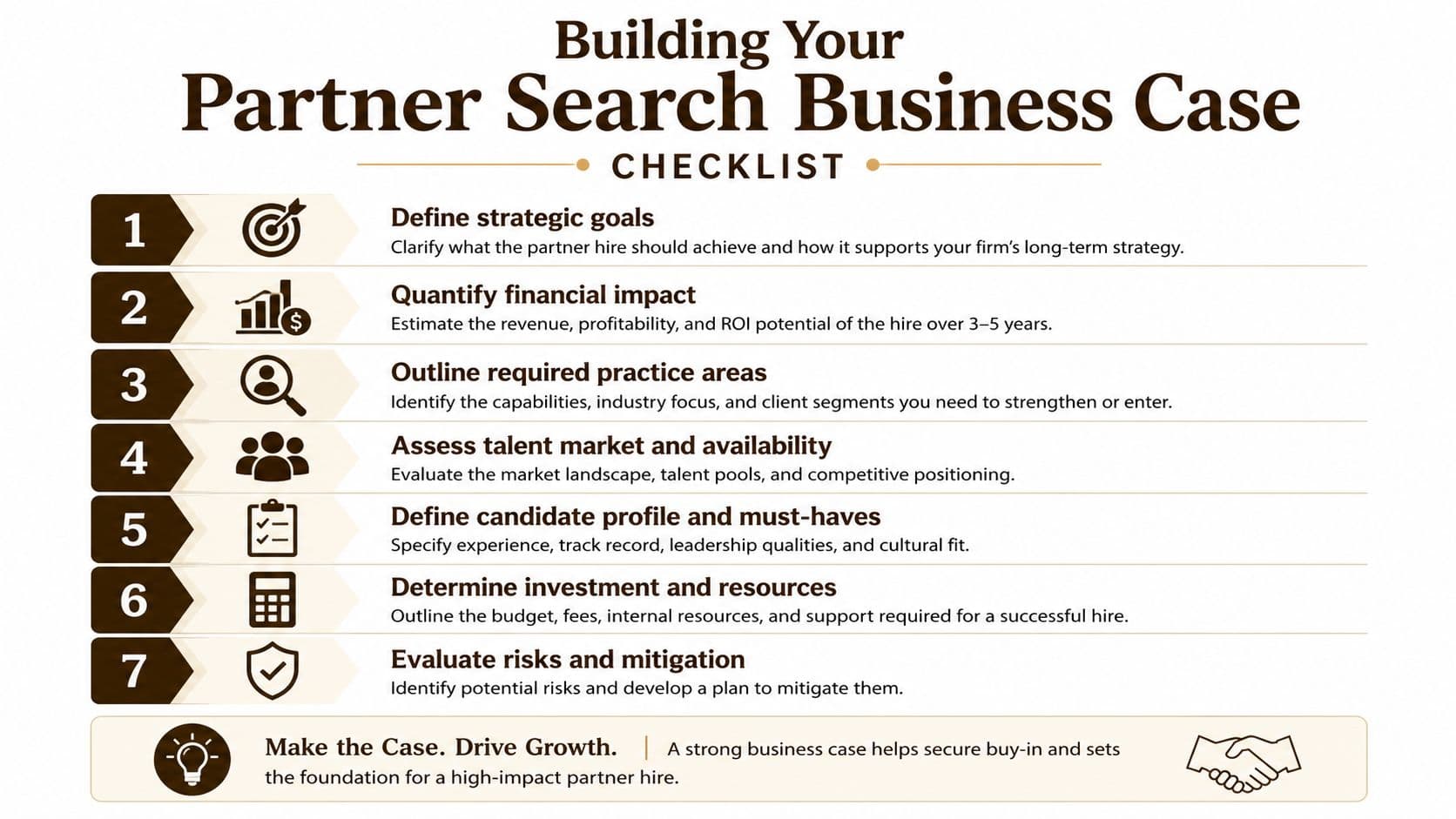
Start with a written business case, not a phone call. If the firm can't describe the practice gap in concrete terms, the search firm will fill the brief with its own assumptions, and those assumptions usually cost money.
Gather the right data before outreach
Use the same information you'd want from a serious candidate. Collect the partner's client base, annual business origination, client-identification details, cross-selling opportunities, conflicts exposure, productivity, annual billables, billing rates, whether associates or a team will move, and any management experience before the search advances to interviews. That front-end diligence is the technical core of partner search because it converts a subjective fit discussion into a measurable screen for revenue portability and platform compatibility BCG Search guidance.
Your internal memo should answer four questions:
- What practice need exists now? Spell out the gap in work, client coverage, or geographic reach.
- What must move with the partner? Define the minimum portable business and any team expectations.
- What can't move? List known conflicts, overlap with current clients, and internal sensitivities.
- How will success be measured? Tie the hire to billing realization, business origination, cross-selling, and retention.
The business case is not paperwork. It is the filter that keeps everyone from chasing impressive bios that can't survive conflicts review or generate enough portable work.
Treat the payback period as part of the brief
Firms waste the most money when they never calculate the payback period before a recruiter gets involved. The math doesn't need to be complicated. Estimate expected revenue from the partner's portable work, subtract integration cost, and compare the result with the total cost of the hire, including search fees, onboarding effort, and the internal time spent on partner votes and interviews.
If the hire needs a heroic story to justify itself, stop there. The firm probably wants a trophy, not a return.
The publisher's own model reflects the risk side of that equation, since Five Star Placements states that it operates on a contingency basis with no upfront cost on its website at Five Star Placements about page. That structure can fit firms that want to push more of the placement risk to the recruiting side, but only when the internal business case is already tight.
Make the business case usable by recruiters
A recruiter can't source well against a vague mandate. Give the search firm a target practice, a compensation envelope, a conflict screen, and a one-paragraph definition of why the move matters to the platform. Then force the conversation back to measurable inputs, not charisma.
If the internal team won't write that brief, the search is already underbuilt.
Evaluation Criteria for Selecting the Right Search Firm
Not every recruiter who can fill a lawyer seat can handle a partner search. Senior lateral work depends on pattern recognition, discretion, and the willingness to push back when a client wants a candidate who looks good but won't fit the economics.
Compare firms on substance, not sales language
Ask for examples of passive candidate networks in the specific practice area, not generic claims about reach. Then ask how they have handled confidential cross-market moves, because practice-group lift-outs and new-office expansion are a different animal from replacement hiring. Industry coverage now treats lateral recruiting as a tool for practice-group growth and multi-market expansion, which makes confidentiality and transition planning central rather than optional Sartori Global USA coverage.
Use this scorecard in the first interview.
| Evaluation Criteria | Strong Indicator | Red Flag |
|---|---|---|
| Practice-area depth | Can name target profiles and current market constraints | Talks only about broad legal recruiting |
| Confidential move handling | Has a real process for discreet outreach and conflict checks | Says “we're always discreet” and stops there |
| Screening method | Goes beyond resumes and asks about portability, clients, and fit | Sends bios without a hard screen |
| Communication cadence | Gives scheduled updates and clear milestones | Goes silent after the intake call |
| Culture alignment | Presses on firm norms, compensation politics, and team dynamics | Treats culture as a soft afterthought |
Ask hard questions early
You want specific answers, not polished nonsense.
- How do you screen for portable business before presenting a candidate? If they can't explain the screen, they don't have one.
- What happens if conflicts appear late? Good firms check early and keep checking.
- How do you report progress? The answer should include candidates contacted, responses, screens completed, and blockers.
- How do you handle a partner search that takes months? If they panic at a long timeline, they're not built for senior laterals.
Culture fit isn't a slogan
Partner searches fail when recruiters treat culture as a warm-and-fuzzy phrase. The core issue is whether the candidate's origination style, associate management style, and client communication style will hold up inside your governance structure.
If you want a practical reference for how a recruiting firm presents itself, the editorial material on the Five Star Placements blog is a useful comparison point because it shows how one provider frames search, screening, and placement in plain language. Judge any firm by whether it can talk about the mechanics with that level of clarity.
Understanding Fee Structures and Negotiating Terms
Most firms negotiate fees backward. They focus on the headline percentage and ignore where the advantage sits, which is in risk allocation, replacement language, milestone triggers, and how the recruiter gets paid when the process slows down.
Know what you're buying
A contingency model means the firm is paid only when a hire closes, which shifts more financial risk away from the law firm. A retained model usually pays the search firm in stages, regardless of whether the search ends in a hire. A hybrid model blends the two and works when the search is difficult but you still want some outcome-based protection.
For partner searches, the question is not which model sounds tidy. It is which model aligns incentives without making you pay for activity instead of results.
Negotiation rule: if the recruiter wants full payment certainty, the firm should demand performance certainty in return.
Push for terms that protect the firm
Negotiate the guarantee period and replacement clause before you talk about start dates. If the partner leaves quickly, the firm needs a clean path to replacement or fee credit. Tie part of the payment to conflicts clearance and clearly defined portability benchmarks, not just the start date.
A partner who starts cleanly but cannot move the expected clients is not a successful hire. As noted earlier, partner economics are high, so the search terms should reflect that risk. If the search firm will not discuss how it protects the firm after the offer is accepted, it is asking to be paid for a partial result.
Use leverage where it exists
You can negotiate more than many firms think. Bundle multiple searches if you are hiring into adjacent practices. Push for milestone-based updates in the fee schedule. Refuse upfront costs unless the market is so specialized that the tradeoff is obvious.
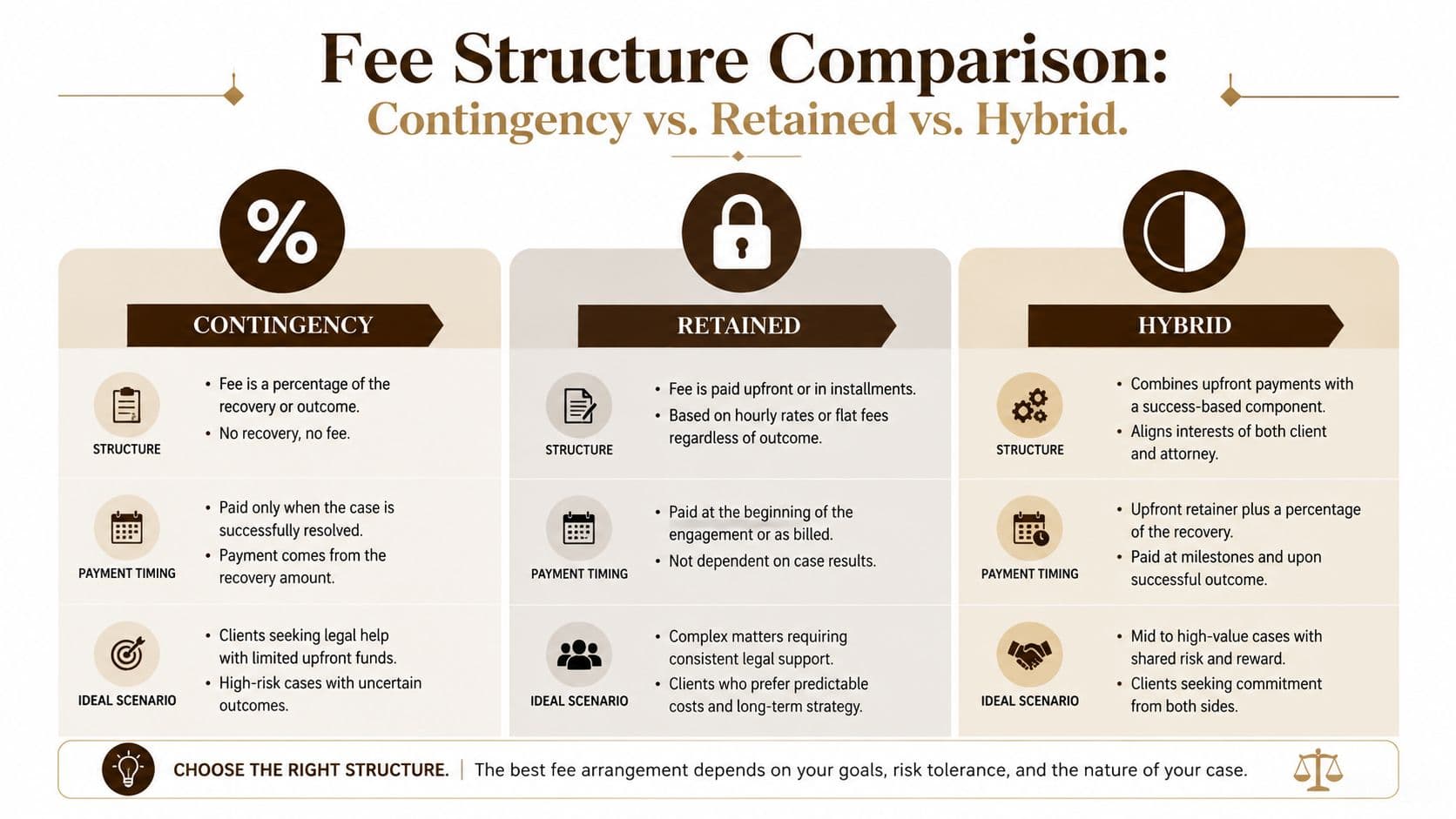
The right fee structure does more than lower expense. It forces the recruiter to behave like a partner in the search, not a vendor collecting progress payments.
Realistic Timelines and Service Level Agreements
Partner searches move slowly because the work is sticky. There are more stakeholders, more conflict checks, more compensation conversations, and more chances for a good candidate to vanish into someone else's faster process.
Set expectations that match reality
One practitioner guide describes partner recruiting as a 9 to 12 month process with market mapping, passive-candidate outreach, screening, multiple interview rounds, compensation discussions, partner votes, and conflicts clearance, and notes that interviews can run 7 to 12 rounds LinkedIn practitioner guide. That is the timeline you should plan against, not the one you wish existed.
A practical SLA should cover these checkpoints:
- Scoping completed with target practice, conflict rules, and compensation range.
- Long list delivered with sourcing rationale and risk notes.
- Short list presented with portability and cultural observations.
- Interview cadence agreed so the firm doesn't lose candidates to scheduling drift.
- Offer and clearance milestones tracked through vote, conflicts, and start date.
Build response standards into the agreement
A search firm should know when you expect an update, what format it comes in, and who escalates if the process stalls. If a candidate is hot, the firm should flag it immediately. If conflicts surface, the firm should say so before everyone wastes time on panel interviews.
Weak targeting, unclear economics, and late conflicts checks are the three mistakes that turn a partner search into a time sink.
Don't let interviews sprawl
Partner interviews can drift because every stakeholder wants one more conversation. That's where deals die. Set an internal limit on who has voting authority, which questions each interviewer owns, and what triggers a final decision.
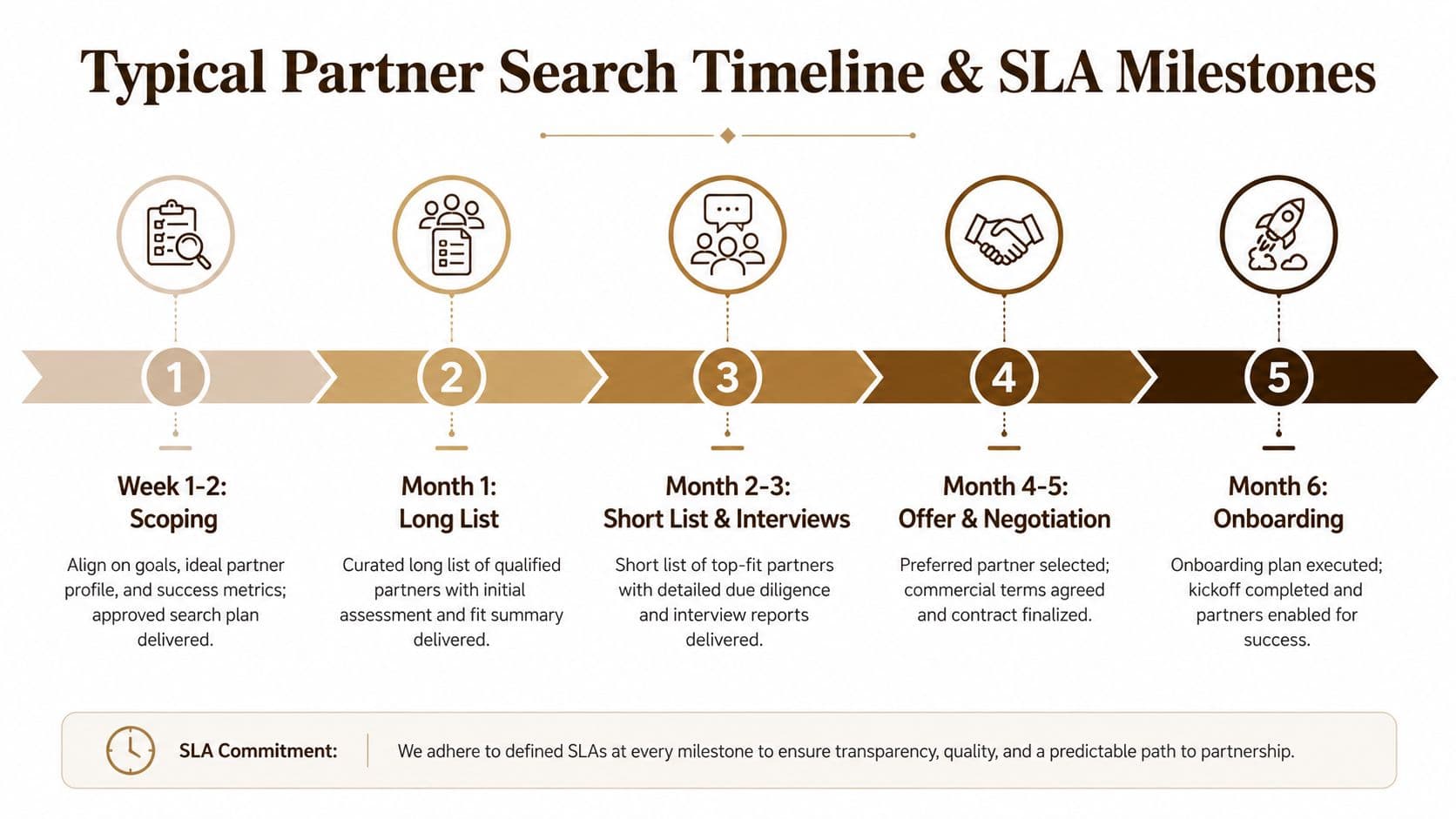
A good SLA doesn't make the process fast. It keeps the process from becoming sloppy.
Managing Confidentiality and Cross-Market Portability
Confidential partner searches are harder than they look because the damage from a leak isn't limited to the candidate. It can trigger internal speculation, upset client relationships, and create morale problems in the very group you're trying to strengthen.
Make confidentiality operational
A real confidentiality protocol starts with anonymous outreach and disciplined internal disclosure timing. The candidate should not be named broadly inside the firm until conflicts have been checked, the business case is still alive, and the decision-makers are aligned. Client names should be disclosed only when necessary, and only to people who need them to assess portability and fit.
Cross-market moves need even more care because practice-group lift-outs and office launches raise different issues than a simple replacement hire. Client consent, non-solicitation risk, and transition sequencing all matter more when the move spans markets or touches multiple teams.
Define portability before the search starts
The search firm should tell you how it evaluates whether the candidate's business is likely to move, what level of client concentration matters, and which relationships are personal versus institutional. If the recruiter can't discuss portability thresholds in plain English, it's guessing.
Your confidentiality protocol should include:
- Candidate communication rules for who speaks, how often, and through which channel.
- Internal disclosure limits so the circle stays tight until a real path exists.
- Client transition planning with the sequence for outreach, consent, and handoff.
- Morale protection steps so the existing team doesn't hear rumors before leadership does.
Discretion isn't a marketing claim. It's a set of controls that survive contact with real people.
The privacy posture of a recruiting firm should be readable, not vague. The Five Star Placements privacy policy is a straightforward place to see how one firm frames confidentiality at the policy level, but policy language is only the starting point. The test is whether the recruiter can execute the protocol without creating noise inside your firm.
Measuring Recruiter ROI and Onboarding Success
A partner search isn't successful because the offer got signed. It's successful when the new partner generates enough business, integrates cleanly, and stays long enough to justify the disruption.
Measure the hire like an investment
Before the hire closes, estimate expected revenue, integration cost, and payback period. After the hire starts, track whether the partner is moving the business you expected, whether cross-selling is materializing, and whether the practice group is holding together.
Use a simple scorecard:
- Client portability within the expected transition window.
- Cross-selling revenue generated from the new platform.
- Billable hour progress against the internal plan.
- Associate retention in the partner's team or practice group.
- Management participation if the role included leadership duties.
Hold the search firm accountable after the start date
A recruiter that disappears after the offer is signed is not a strategic partner. The firm should support onboarding, make the introductions that matter, and stay involved through early check-ins. The first months decide whether the partner feels embedded or isolated.
The cost of a bad lateral is not just the fee. It's the compensation, the integration time, the lost office momentum, and the opportunity cost of the seat. That is why measurement has to continue after day one.
Make the post-hire review blunt
At 30, 90, and 180 days, ask three questions. Is the partner building the right client relationships, are the economics matching the original case, and is the practice group stronger than it was before the hire? If the answer keeps slipping, the problem may be the search design, not the candidate.
Treating partner search as a strategic investment process forces the firm to think like owners instead of shoppers. That shift changes everything, from the recruiter you choose to the terms you negotiate to the way you judge success.
If you want a partner search process that's built around economics, confidentiality, and measurable accountability, talk to Five Star Placements. They recruit attorneys, partners, and legal operations leaders with a screening process tied to client needs and culture fit, and you can learn more or start a conversation at Five Star Placements.
Need help filling a legal role?
Five Star Placements partners with law firms and legal departments nationwide.
Schedule a Call