
Partner Lateral Recruiting: A Practical Playbook for Law
August 1, 2026 · 14 min read · Five Star Placements

Table of contents
You can tell when a partner search is drifting into wishful thinking. The committee starts with a real practice gap, then the conversation slides into personality, brand, and whether the candidate “feels right.” Finance wants evidence, the practice lead wants speed, and the rainmaker being courted already has another firm asking for a meeting. That's the moment partner lateral recruiting stops being a staffing exercise and becomes a deal that can add revenue, create conflicts, or underperform for years if the terms and integration are loose.
Table of Contents
- Why Partner Lateral Recruiting Is a Deal, Not a Hire
- Building the Business Case Before You Source Anyone
- Sourcing Strategies That Actually Surface Partners
- Vetting the Book of Business and Running Conflicts
- Structuring Compensation and the Deal
- Onboarding and Integration in the First 24 Months
- Measuring Success and Avoiding the Common Failure Modes
Why Partner Lateral Recruiting Is a Deal, Not a Hire
A managing partner looking at a lateral rainmaker is not filling an empty chair. The firm is buying a bundle of expected revenue, client relationships, and strategic optionality, while also taking on portability risk, conflicts risk, and integration work that starts before the offer is signed. That's why the best hiring committees treat the process like a transaction, not a résumé review.

A clean way to frame the first committee conversation is with four questions. What practice gap are we really buying against. What client relationships are portable. What conflicts could kill the move or blunt it after arrival. And what does success look like at 12, 18, and 24 months, not just in the pitch meeting.
Practical rule: if those four answers aren't written down, the firm is negotiating with itself, not with the candidate.
The deal framing matters because the market keeps showing that partner movement is active, cyclical, and consequential. NALP reported that 967 partner hires in 2024 represented a 2.3% year-over-year rebound after a weaker 2023, while total lateral hiring across lawyer categories rose 13.9%. That tells you the channel is still live, but partner movement is selective enough that firms can't afford casual decision-making. NALP's 2024 Lateral Hiring Survey
If you're working with a recruiter or search partner, the first useful conversation isn't “Who's available?” It's “What problem does this hire solve, what must be true for the move to work, and who inside the firm owns those answers?” A firm that wants process help can also use a specialist like Five Star Placements as part of the search infrastructure, but only after the deal logic is clear.
Building the Business Case Before You Source Anyone
A real partner search starts with an investment memo. The committee needs to see the practice gap, the revenue case, and the portability risk in the same document, because the candidate's optimistic version of the book is not the same thing as what will follow them after the move.
The numbers need to be internal before they're external
The first draft should answer what the firm loses by waiting. If the seat stays open, who absorbs the work, what gets pushed out, and which cross-sell opportunities never get touched. Those costs are often invisible on a spreadsheet, but they matter just as much as the visible revenue line, especially when the firm is trying to establish credibility in a new vertical or geography.
Then the committee should write the candidate's expected contribution in plain language. The question is not whether the partner has “strategic upside.” It is what the committee believes the partner can originate, convert, or defend after arrival, and what assumptions sit behind that view. The useful discipline is to separate portable work from wishful work, because partner moves often bring less than the seller says they will.
Thomson Reuters summarized research showing that lateral partners bring only 22% of their books of business to the new firm on average, with portability ranging from 0% to 100%. That is the figure to test against, not the pitch deck. If the candidate's story depends on a large handoff from a long client list, the committee should ask for matter-level proof, billing history, and client-contact maps before anyone votes. Thomson Reuters on lateral hiring economics
The pre-search package should already exist
Before any outreach begins, the firm should have five artifacts ready.
- Success metrics: define originations, retention, and cross-sell expectations in advance.
- Decision-makers: name who can approve the move and who can stop it.
- Budget envelope: spell out compensation, transition support, and any capital treatment.
- Conflicts posture: identify the likely client and matter conflicts before recruiting begins.
- Integration owner: assign one person who will track the first-year plan.
That work belongs in the pre-search package because the search itself can otherwise blur the standard for success. NALP's summary of a Citi Private Bank law-firm study says recent laterals had a 60% success rate, while surveyed firms used different success definitions that ranged from 50% to more than 80%. When a committee defines success loosely, it can spend months debating whether a hire worked instead of deciding whether the business case was sound. A written memo avoids that drift, and a clear internal process note from a firm like Five Star Placements can help keep the search aligned with the original assumptions. NALP PDQ summary on lateral success
Sourcing Strategies That Actually Surface Partners
A partner search usually comes through one of four channels, and each one has a different failure mode. Specialist recruiters bring access and screening discipline. Peer referrals bring trust. Direct outreach gives precision. Conferences and industry events expose people who aren't actively calling around, which can matter when the right partner isn't visible through normal market chatter.
| Channel | Best for | Risk to manage |
|---|---|---|
| Specialist legal recruiters | Confidential outreach, screening, and calibrated market intel | Overreliance on one recruiter's network |
| Peer and former-colleague referrals | Credibility and fast trust-building | Echo chambers and untested books |
| Direct outbound to target groups | Closing a known practice gap | Thin response rates and over-optimistic self-assessment |
| Conferences and industry events | Discovering passive candidates in a niche | Surface-level conversations that inflate interest |
Contingency-based search partners can be useful when a committee is cautious about spending before there's proof of traction. They tend to work well when the firm wants outside reach without committing a retainer. Direct outbound, on the other hand, works best when the firm knows exactly which practice pocket it's trying to fill and can name the type of book it needs.
The mistake is treating these channels as interchangeable. They're not. A targeted outbound list can find the right partner faster than broad networking, but only if the business case is specific enough to narrow the search. Meanwhile, referral-heavy searches can feel efficient while still producing candidates who look strong culturally and underdeliver commercially once the move closes.
The channel mix should match the seat. A highly strategic practice build needs precision. A replacement-style growth move can tolerate a broader funnel.
The most disciplined committees use two or three channels at once. They let a recruiter widen the reach, use targeted outreach to pressure-test market interest, and use referrals to validate reputation. That combination reduces the odds that the firm mistakes social familiarity for fit.
Vetting the Book of Business and Running Conflicts
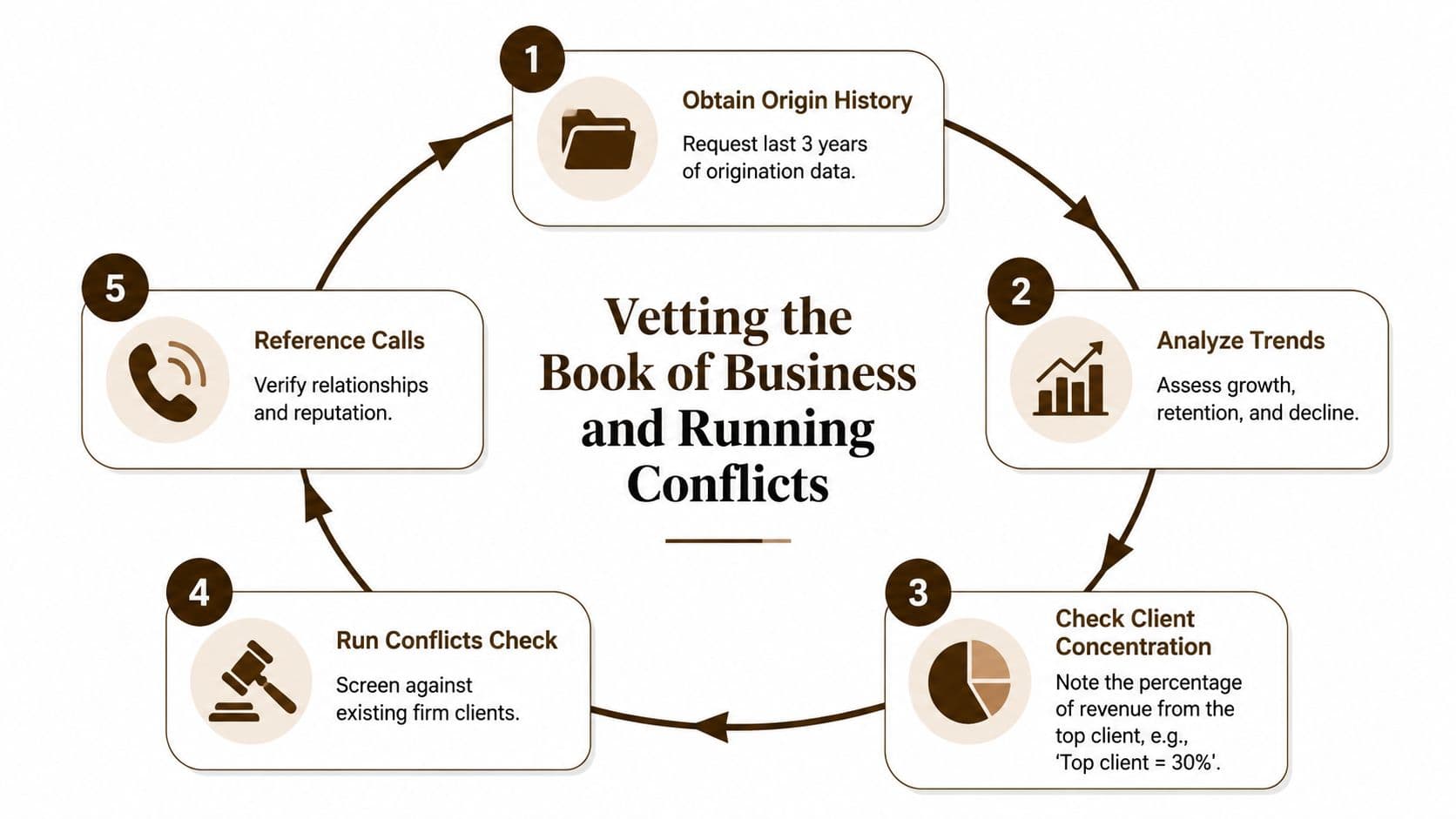
Partner lateral recruiting becomes real at diligence. The résumé may show a strong platform and a visible client base, but the committee still has to answer three practical questions. Is the work portable, are the conflicts clean enough to support the move, and will the relationship hold after the first wave of excitement fades.
Read the originations history for pattern, not peak
Start with the candidate's originations over time. One strong year can come from a transaction spike, a departing partner, or a temporary client event. The better question is whether the book has grown in a way that can be repeated, and whether the partner can explain where that growth came from without leaning on vague talk.
Matter lists and billing support should match the story. Strong diligence looks for concentration, recurring work, and real relationship depth. If the candidate says a client will move, the committee should know who at that client controls the work, who signs off on matters, and who manages the day-to-day contact.
Portability risk matters here. A book that looks large on paper can still shrink quickly if the work sits with a team, a practice group, or a single influential in-house lawyer rather than with the lateral alone.
Run conflicts in both directions
Conflicts review has to cut both ways. The lateral's current clients and open matters need to be screened against the firm's existing client base. The firm's clients and matters also need to be screened against the lateral's pending work, because a move can create friction before the first billing entry lands.
A clean conflicts memo that ignores likely future matters is incomplete. A messy memo that does not separate high-risk conflicts from manageable ones is hard to use.
The practical question is not whether there are any conflicts. There usually are. The question is whether the conflicts can be managed without shrinking the very book the firm is trying to buy.
Use reference calls to test portability and culture
Client references matter more than polished peer references. Peers can confirm reputation, but clients show whether the partner was responsive, sound on judgment, and partner-led in the relationship. Those calls also surface fit, because a partner who works well in a high-autonomy shop may struggle once the firm expects more committee review and more internal coordination.
The most useful reference calls focus on how the client bought the work, who else had access to the relationship, and what happened when the partner was not the only point of contact. If the answer is always the same person, the book may be more portable than a team-driven practice. If the answer shifts across several lawyers or several offices, the committee should be cautious about how much moves with the lateral.
Recent laterals tracked in a Citi Private Bank law-firm study had a 60% success rate, and firms used different definitions of success, ranging from 50% to more than 80%. That spread shows why a firm needs its own definition of success before the move closes. The NALP PDQ summary on lateral success addresses the same problem of inconsistent measurement. NALP PDQ summary on lateral success
Structuring Compensation and the Deal
The term sheet tells you what the firm really believes. A large guarantee with loose accountability says the committee is buying hope. A tighter structure with measurable milestones says the firm expects conversion, not theater. The candidate's pushback also reveals confidence, especially when the proposed terms touch the most sensitive parts of the economics.
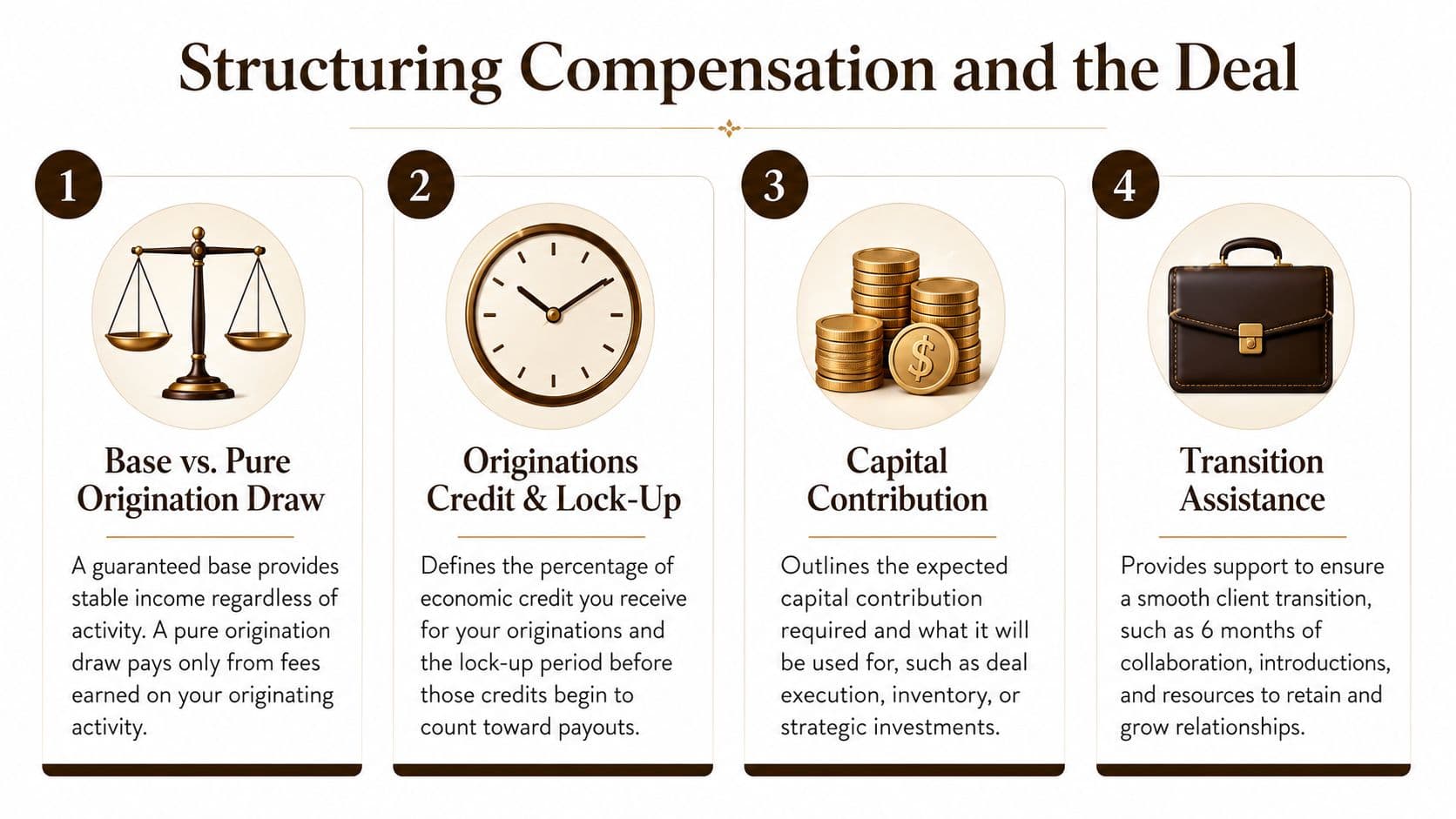
Four levers shape the real deal
The first lever is the base or draw structure. A guaranteed base can help a partner move a real book with less short-term anxiety, but it also raises the cost of a miss. A pure origination draw puts more pressure on immediate production and says the firm wants self-funding behavior quickly.
The second lever is originations credit and any lock-up period. If credit starts immediately, the firm is signaling trust in portability and integration. If credit is delayed or phased, the committee is protecting itself against inflated promises and slow client migration.
The third lever is capital contribution or buy-in treatment. The economics of the move get very concrete here. A partner who pushes hard on this point is often signaling that the initial cash burden matters as much as the headline compensation.
The fourth lever is restrictive covenants and notice terms. Notice period, garden leave, and non-solicit expectations shape how cleanly the partner can transition and how much uncertainty the firm must absorb during the handoff. If the clause set is too aggressive, some candidates will interpret it as a signal that the firm doesn't fully trust the deal.
Special situations need different math
Group moves are different from single-partner hires because the economics depend on whether the group can cross-sell internally after arrival. Equity versus non-equity status matters too, because the candidate may care less about current cash and more about governance, prestige, and long-term control. And lateral-to-corporate transitions often use a different comp logic entirely, since the candidate may be trading autonomy for platform and stability.
The best negotiators don't just ask for more money. They ask where the firm is most nervous, because that's where the structure will bend.
This is also the point where a firm's recruiting process can accidentally overpay for uncertainty. The more the committee relaxes terms without hard portability proof, the more it is subsidizing risk it hasn't measured.
Onboarding and Integration in the First 24 Months
A signed agreement is not the finish line. It's the handoff point between recruiting and execution, and the first 24 months decide whether the firm bought a producer or a project. The firms that do this well start integration before day one, not after the press release.
Decipher's analysis of more than 20,000 lateral moves found that 40% of Am Law 200 partner laterals retained only 1 year, and 40% to 50% did not last 5 years at the new firm. That's why the first-year retention signals need to be visible early, not debated after the damage is done. Decipher and ALM Legal Intelligence on lateral partner outcomes
Lock the 30/60/90 before the start date
Before the lateral signs, the firm should map client introductions, internal sponsors, and matter opportunities. The partner should know which relationships need to be activated first, which internal rainmakers will open doors, and which matters are suitable for immediate staffing. If that map doesn't exist on day one, the first month disappears into orientation.
The 30-day view should focus on access. Is the lateral meeting the right people, seeing the right internal work, and understanding how the firm routes opportunities. By 60 days, the question becomes whether business development conversations are turning into actual introductions and whether practice leaders are pulling the partner into relevant matters.
By 90 days, the firm should be reviewing whether the lateral is hitting the agreed business-development behaviors, not just waiting for new revenue to show up. That means the internal sponsor, practice chair, and business development lead all need to be watching the same dashboard. If each person is using a different yardstick, the integration plan will drift.
Build the support team around the partner
The lateral should not have to work through the firm alone. Business development, finance, IT, practice management, and staffing all need an assigned role. One person should own internal visibility, one should own client-introduction mapping, and one should keep the cross-sell pipeline moving.
I've seen firms lose promising hires because no one owned the process after signature. The partner landed, got busy, and then spent months trying to learn the house while the firm assumed momentum would take care of itself. That's exactly where a search and transition partner can help, and a platform like Five Star Placements fits that kind of handoff support when the firm wants outside recruiting help tied to a structured move.
Measuring Success and Avoiding the Common Failure Modes
A partner move only works if the numbers hold up after the signing meeting. Measure it against the business case, not the candidate's strongest interview week. The right scorecard tracks originations, realization, cross-sell, client retention, associate retention on the lateral's matters, and the lateral's own retention. The review cadence should be visible at 30, 90, 180, 365, and 730 days, because waiting for year-end leaves too little room to correct a bad fit.
The failure pattern is usually familiar. A partner interviews well, the book sounds portable, and the committee assumes the client base will follow. The weak point is usually portability risk, what moves, what stays behind, and whether the clients are tied to the person, the platform, or both. That is why the committee has to judge the business case, not the presentation. Analysts cited by ALM Legal Intelligence and Aderant cited advisory have noted that lateral partners often underperform the book they projected, and some deliver far less than promised.
Fast FAQ
How long does partner lateral recruiting take?
It depends on the practice, the conflicts review, and how quickly the committee can diligence the book and approve the structure. A simple move closes faster than a cross-border or highly regulated one, but no search should be rushed past the point where the portability assumptions are still untested.
What if the book of business doesn't port?
Treat that as a forecast miss, not a surprise. Revisit the assumptions, reset the integration plan, and stop relying on self-reported portability. The firm may still keep the hire if the partner brings other value, but the economics have to reflect what moved.
Equity or non-equity?
Choose based on control, economics, and expected contribution, not title alone. The right answer depends on the level of confidence in the move and the firm's appetite for a longer commitment. If the book is uncertain, a staged structure usually gives the committee more room to manage risk.
The strongest hires are the ones where the firm knew the score before the partner arrived. If the first 180 days are off track, the committee should intervene early, reset expectations, and address the gaps before they harden into a failed transition.
If your firm is weighing a partner move and wants the search handled with realistic screening, market reach, and fit-focused diligence, Five Star Placements can help structure the process around the role you need. Visit Five Star Placements to start a confidential conversation about partner lateral recruiting and the kind of search support that keeps the deal grounded in facts.
Need help filling a legal role?
Five Star Placements partners with law firms and legal departments nationwide.
Schedule a Call