
Interview Coaching for Lawyers: A Practical Guide to Better
August 17, 2026 · 15 min read · Five Star Placements
Table of contents
A lawyer who prepares alone can lose a slot to a candidate with similar qualifications, while structured coaching turns preparation into a repeatable loop of competency mapping, story development, mock interviews, and targeted feedback. In highly selective legal hiring, interview conversion can sit near one-third, and some environments hire fewer than 1% of applicants, so preparation has to improve more than confidence. St. John's Law Review analysis documents why legal hiring funnels can be this narrow.
You know the scene. You researched the firm, reviewed your résumé, and rehearsed a few answers in the car. The interview seemed fine until a partner asked for a specific example of judgment under pressure, then followed up on a matter you'd mentioned. Your answer wandered. You left knowing you were qualified, but also knowing qualification wasn't the only decision being made.
That is where interview coaching for lawyers earns its place. It isn't motivational speaking, generic etiquette, or a polished script. It is preparation designed around the way firms and legal departments screen candidates, with a direct line between your experience, the role's competencies, and the evidence you present in the room.
Table of Contents
- What Interview Coaching for Lawyers Actually Means
- What a Coaching Engagement Looks Like
- Inside a Typical Coaching Session
- Solo Preparation vs Coached Preparation
- Outcomes and ROI of Legal Interview Coaching
- How to Choose the Right Interview Coach
- How Coaching Connects to Permanent Placement
- Frequently Asked Questions About Interview Coaching for Lawyers
What Interview Coaching for Lawyers Actually Means
The interview can turn on one follow-up question. You may know the firm, understand the role, and have rehearsed several answers, yet lose credibility when a partner asks what you personally did on a difficult matter or how your judgment changed the result. Legal employers are testing evidence, not general readiness.
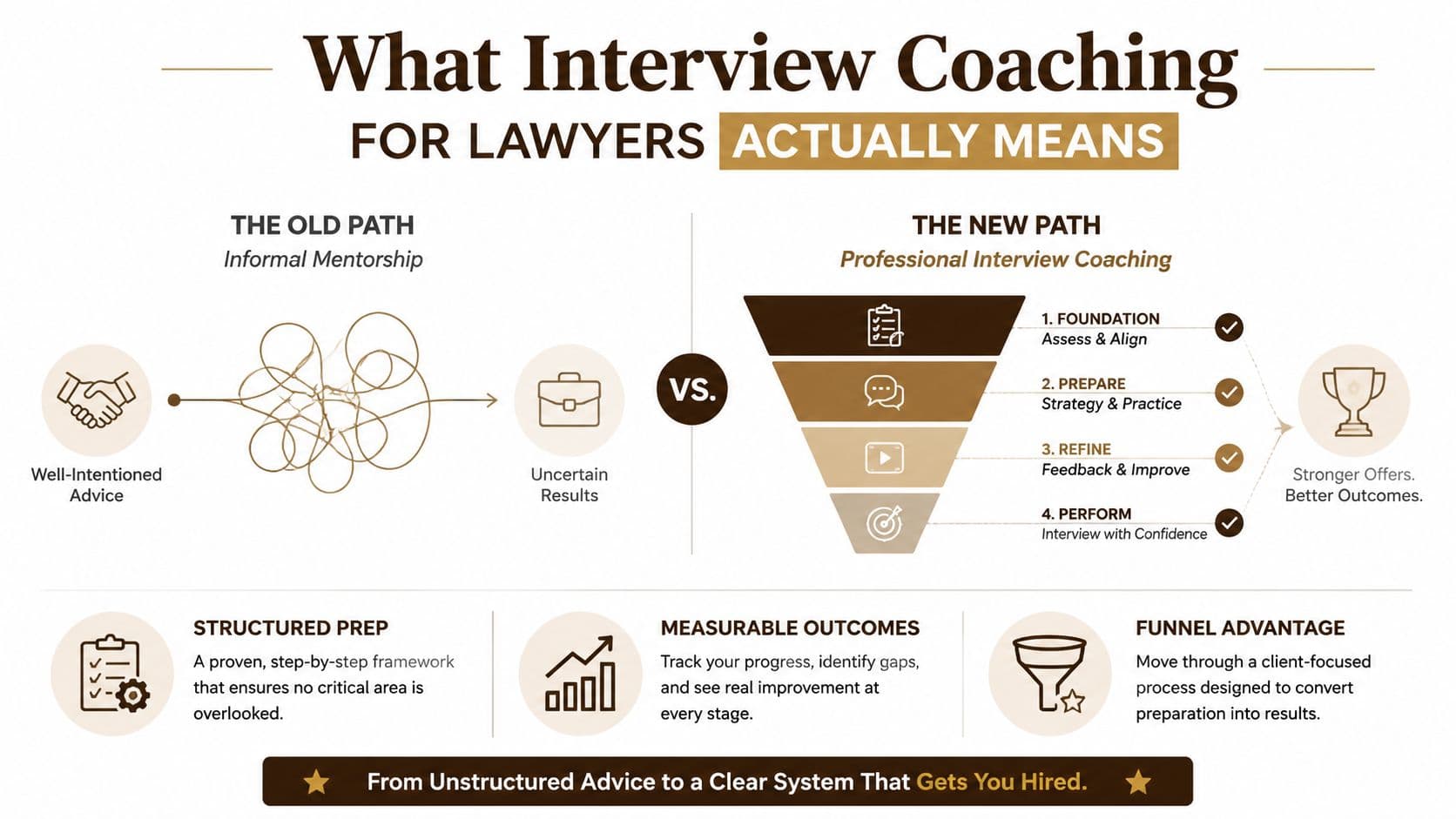
Interview coaching for lawyers converts professional experience into concise, credible proof for a specific hiring funnel. A coach identifies the role's screening criteria, connects your matters to those competencies, simulates the questions likely to expose gaps, and gives feedback you can apply before the next round.
Researching the employer, reviewing its practice groups, and preparing questions still matter. They do not answer the central hiring questions: can you perform the work, communicate with clients and colleagues, exercise sound judgment, and contribute to the organization? Your preparation should make each answer easier to score.
Recruiter's rule: If an answer does not help an interviewer assess a competency, polish will not make it persuasive.
The profession has moved beyond informal advice from a mentor or colleague. The Law Society's interview guidance emphasizes repeated preparation around competencies, examples, and mock interviews. The University of Texas Law guide recommends preparing roughly 10–15 accomplishment examples and practicing delivery as a final step, as set out in its legal interviewing guide.
The difference between tips and a system
Generic advice tells you to research the employer, speak confidently, and answer clearly. A working coaching system forces every response through a stricter test:
- Which competency is the question testing?
- Which matter proves you have it?
- What did you personally do, and what changed afterward?
- Can you explain the matter without breaching confidentiality or burying the point in procedure?
- Which follow-up could expose a weak or inflated answer?
Legal employers assess relevant knowledge, professionalism under pressure, concise verbal expression, responsibility, and readiness for practice. Coaching therefore improves funnel conversion by making the interview evidence easier to evaluate. It helps you use the opportunity your qualifications already earned.
The strongest candidates do not sound scripted. They sound prepared, specific, and straightforward to assess. That is the standard coaching should deliver.
What a Coaching Engagement Looks Like
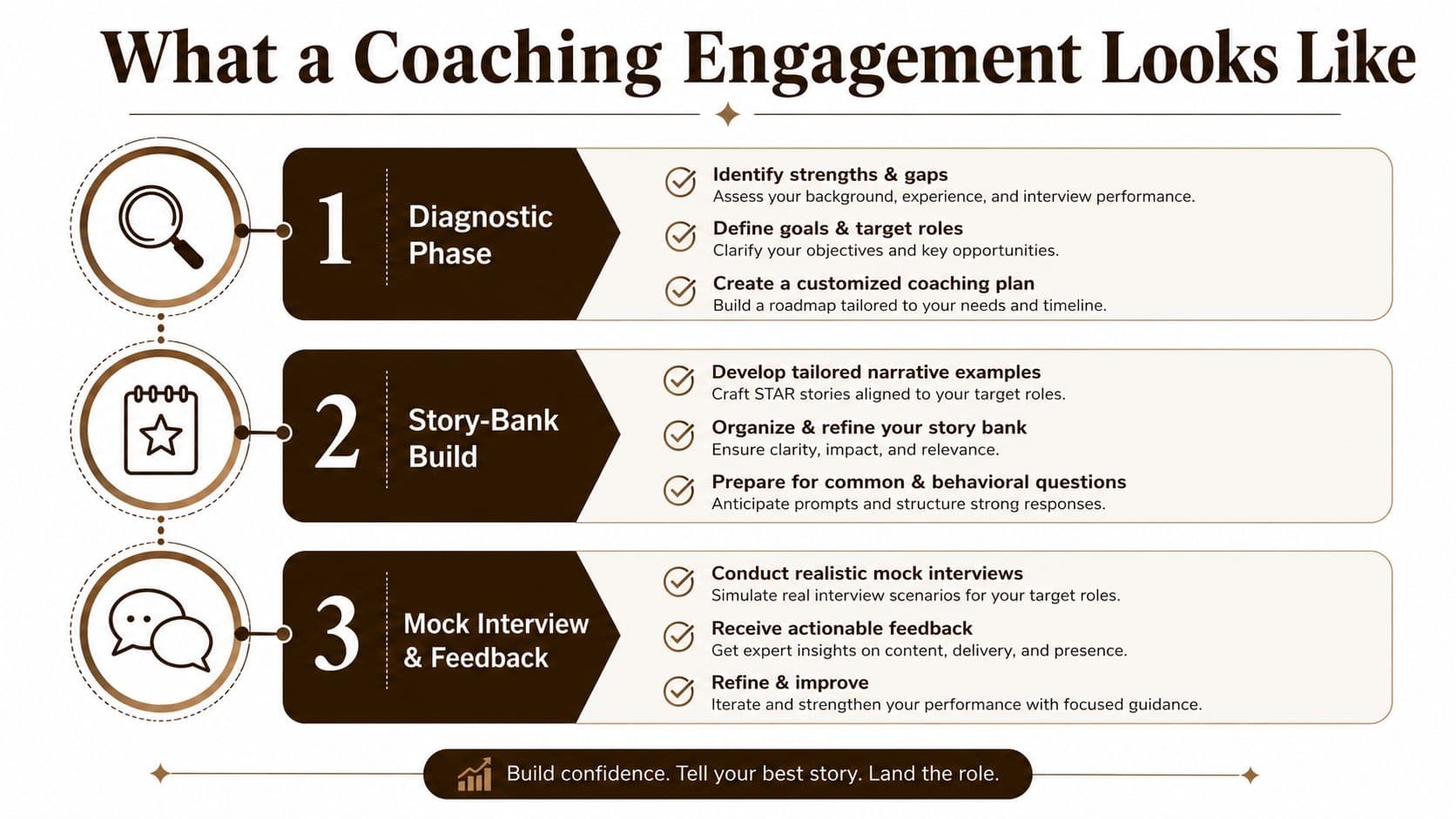
A serious coaching engagement starts with a diagnostic, not a list of standard questions. The coach reviews the target role, résumé, practice history, interview stage, and likely interviewers. For a lateral associate, the emphasis may be matter ownership and portable relationships. For an in-house candidate, it may be commercial judgment, stakeholder management, and the ability to give practical advice.
The next deliverable is a competency map. It translates the job description into the traits the employer is likely to score, such as judgment, diligence, initiative, client management, teamwork, and substantive command. The map prevents a common failure: telling impressive stories that don't answer the employer's actual concern.
The story bank
A résumé lists responsibilities. An interview requires proof. Coaching turns selected experience into STAR narratives, covering the situation, task, action, and result without sounding like a template.
A useful story bank should include examples that can be adapted across questions. One matter might demonstrate initiative, but with a different emphasis it could also show diligence or client communication. The coach pressure-tests each story for ownership, clarity, confidentiality, and relevance.
Expect the engagement to produce tangible work:
- Written competency map: The role's requirements are matched to your strongest evidence.
- Refined story bank: Your examples are concise, specific, and adaptable.
- Recorded mock interviews: You can review answer length, pacing, verbal habits, and nonverbal delivery.
- Timestamped feedback: The debrief identifies exactly where an answer loses signal.
- Personalized closing pitch: You can explain why this role, this organization, and this point in your career make sense.
Why ad hoc preparation falls short
Self-study can produce knowledge. It rarely produces an external assessment of how you sound under pressure. A colleague may say an answer is “good” because they know your background, while an experienced coach will ask whether an unfamiliar partner could understand your contribution quickly.
Legal interview guidance repeatedly recommends researching the firm, interviewer biographies, the job description, and current matters, then tailoring responses to the employer's language. Lateral Link's recruiter guidance also emphasizes practice, concise responses, and preparation for multi-interviewer dynamics. The engagement should reflect those demands rather than rehearse generic etiquette.
Inside a Typical Coaching Session
A productive session starts with the hiring funnel, not a stack of generic questions. The coach identifies what the employer must confirm at this stage, tests your evidence against those criteria, and assigns work that improves the next performance.
Start with the target
The opening establishes the role, interview stage, interviewer mix, and immediate risk. A candidate meeting a litigation group may need to demonstrate strategic judgment on a matter. An in-house candidate may need to convert legal analysis into business advice. The same résumé needs different positioning for each audience.
Map 3–4 core strengths to the job description, then select accomplishment examples that prove them. The University of Texas Law interviewing guide recommends focused preparation supported by a bank of examples. Treat each example as evidence for a competency, not as a polished anecdote kept for its own sake.
Build and test each story
Begin with the facts, then remove background that does not help the interviewer score your answer. State the problem, define your responsibility, describe your action, and explain the result or lesson. A coach should interrupt when “we” obscures your contribution, when confidential details create risk, or when the outcome fails to answer the question.
The story then faces pressure. Follow-ups may ask what you would change, how a partner challenged your approach, or how you handled an unhappy client. These questions test whether the account is genuine and whether you can reason beyond a memorized sequence. Review attorney interview questions for likely prompts, but use them to guide practice, not replace role-specific preparation.
Simulate the room
A mock interview should reproduce the conditions that can affect a hiring decision. Use rapid follow-ups, multiple interviewers, substantive matter discussions, and shifts from behavioral questions to motivation and fit when those conditions match the process.
Feedback must connect delivery to screening outcomes. Review answer length, eye contact, pacing, structure, precision, and recovery after interruption. A concise answer with clear ownership gives the interviewer usable evidence. A polished answer without substance does not.
The final minutes should produce a written action plan. Between sessions, record answers, revise weak stories, research the employer's current matters, and prepare questions that demonstrate judgment rather than repeat website facts.
The last session is a dress rehearsal. Test the opening introduction, core stories, difficult transitions, closing pitch, and practical details. The goal is consistent performance when the interviewer changes direction or stops following your preferred script.
Solo Preparation vs Coached Preparation
Solo preparation can work for an organized lawyer with substantial interview experience pursuing a familiar role. Its weakness is evaluation. Candidates often cannot judge their preparation accurately from inside their own perspective, especially after rehearsing the same answers repeatedly.
Coaching places an informed outside observer between your preparation and the hiring funnel. A qualified coach tests whether your stories show responsibility rather than mere participation, judgment rather than confidence, and commercial awareness rather than business vocabulary. Some elite legal hiring environments report interview conversion near 33%, while other settings hire fewer than 1% of applicants. The narrower the funnel, the less room there is for answers that leave the interviewer to infer your value.
| Dimension | Solo Preparation | Coached Preparation |
|---|---|---|
| Specificity of examples | You choose stories because they feel impressive or familiar. | Stories are matched to the role's competencies and tested for concrete evidence. |
| Feedback quality | Friends and colleagues may give broad reactions. | A coach identifies where structure, ownership, or relevance breaks down. |
| Performance under pressure | Practice often ends once an answer sounds acceptable. | Mock interviews add interruptions, follow-ups, and changes in interviewer dynamics. |
| Employer tailoring | Research may stay descriptive, focused on the website and practice areas. | Research becomes answers about the firm, market, matters, clients, and role. |
| Self-awareness | You may overlook distracting habits or unclear phrasing. | Recorded review exposes pacing, eye contact, answer length, and recovery. |
| Conversion focus | Preparation centers on feeling ready. | Preparation centers on giving interviewers usable evidence for a hiring decision. |
Is coaching worth it?
Judge the investment against the cost of another missed opportunity. Coaching makes the strongest case when interview opportunities are limited, the role requires a practice-area change, you are pursuing a lateral or in-house move, or you have reached final rounds without receiving an offer.
A coach cannot create experience you lack or repair a role that does not fit. Coaching can make strong experience easier to recognize by organizing it around the competencies employers score. It also reveals whether your answer proves the point, or merely describes your involvement.
For attorneys exploring immigration attorney jobs, that translation can matter when practice-specific experience must connect clearly to the employer's client base, matters, and workflow. The right preparation improves the evidence reaching each screening stage.
Outcomes and ROI of Legal Interview Coaching
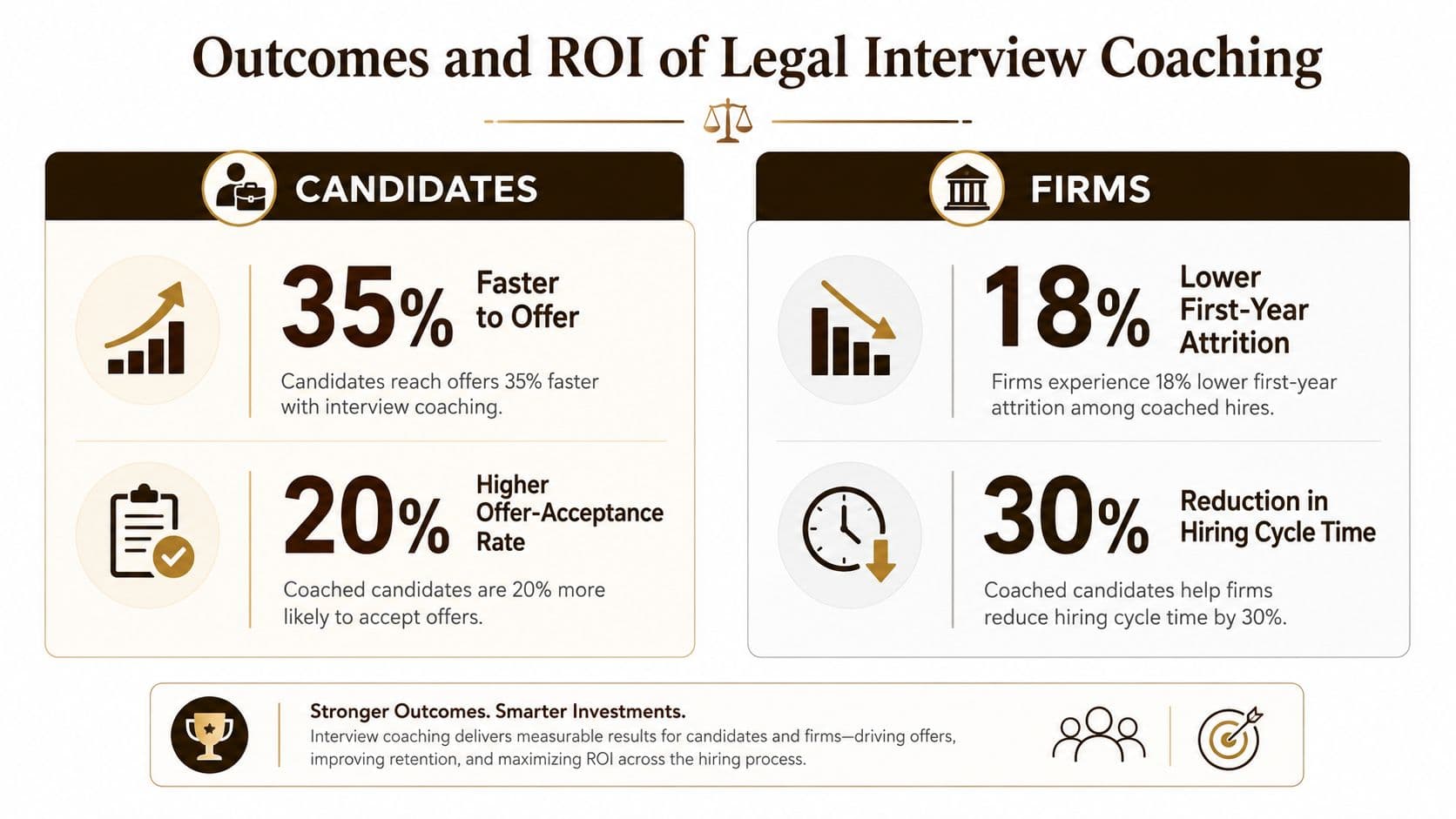
The return on interview coaching should be judged by hiring-funnel results, not by whether you felt calmer. Track whether your answers give screeners usable evidence, connect matters to scored competencies, explain the employer's work with substance, and stay organized when follow-up questions change the discussion.
The infographic attached to this section should not be used to support precise performance claims. Its figures are not verified evidence supplied for this article, so treat the image as illustrative rather than as proof of coaching outcomes.
What candidates should measure
Candidates should measure progress at the stages where employers make screening decisions:
- Interview progression: Are you advancing from initial conversations to substantive and final rounds?
- Answer quality: Can you give a specific example without unnecessary chronology, jargon, or vague claims?
- Competency evidence: Does each story show judgment, responsibility, communication, client management, or another requirement in the role?
- Role alignment: Can you explain why your experience fits this employer's practice, clients, matters, and expectations?
- Offer evaluation: Are you assessing the role as clearly as the employer is assessing you?
- Search efficiency: Are you spending less time repeating weak preparation and more time pursuing suitable roles?
A coach earns the fee by improving the signal that reaches each gate in the funnel. A partner does not hire because you used the STAR label, and a general counsel does not hire because your delivery sounded polished. They hire when your answers make your judgment, ownership, communication, and fit credible.
What hiring teams should measure
Hiring partners and legal department leaders should assess whether candidates communicate the competencies required by the selection process. Screening rubrics can include professional appearance, verbal expression, transferable skills, and demonstrable responsibility. Coaching aligned to those criteria can reduce ambiguity during interviews, but it cannot replace reference checks, substantive evaluation, or cultural assessment.
Employers also pay an opportunity cost when a vacancy remains open. Matters wait, partners absorb work, and internal teams spend time screening candidates who do not convert. Candidate coaching can support a cleaner process only when it reflects the actual role. A coach who trains every attorney to deliver the same smooth, generic performance may improve presentation while hiding the evidence decision-makers need.
The practical test is simple: after coaching, can an interviewer identify what you handled, why you chose your approach, and what the result says about your readiness? If not, the preparation has improved confidence without improving hiring odds.
How to Choose the Right Interview Coach
Choose a coach who understands legal hiring from the inside. A general career coach may be excellent at presentation, but lawyers need someone who can distinguish a strong matter description from a confidentiality risk, understand lateral motivations, and recognize how partners evaluate practice readiness.
Start with the coach's operating process. Ask what happens before the first session, how the job description is analyzed, whether mock interviews are recorded, and how feedback is documented. If the answer is “we'll talk through common questions,” keep looking.
Questions worth asking before you engage
-
How do you diagnose my target role and likely interview panel?
You want a process that considers practice area, seniority, employer type, and interview stage. -
How will you turn my résumé into competency-based stories?
The coach should be able to explain how experience becomes evidence of judgment, diligence, initiative, client management, or another relevant capability. -
Will we conduct recorded mock interviews?
Without observation and review, feedback tends to remain subjective. -
How do you handle confidential matters and client information?
A legal coach should help you anonymize facts while preserving the decision, action, and result. -
What does the debrief produce?
Look for specific revisions, not broad encouragement. -
Have you worked with lateral, in-house, or partner candidates?
Different transitions create different questions about motivation, portability, leadership, and commercial judgment.
Warning signs
Generic scripts are a problem. So are promises of guaranteed offers, a coaching plan with no diagnostic phase, and a coach who can't explain how legal employers screen candidates. A strong coach won't tell you to hide a difficult career fact or pretend every interviewer wants the same personality. They will help you present the truth with structure and relevance.
Ask for a sample deliverable with personal information removed. A competency map, annotated story bank, or written debrief will tell you more than a polished website.
How Coaching Connects to Permanent Placement
Interview coaching and permanent placement solve different parts of the same hiring problem. Placement creates access to a suitable opportunity. Coaching helps the candidate present relevant evidence once the opportunity exists. Separating the two can create avoidable friction, especially when a recruiter understands the client's screening criteria but the coach doesn't.
An integrated recruiter can identify what the firm needs, screen for that need, and prepare the candidate to discuss it accurately. The recruiter also receives useful information during preparation. If a candidate repeatedly struggles to explain matter ownership, that may affect role matching. If the candidate's strongest examples point toward a different practice environment, the search can adjust before an interview is wasted.
Why the workflow matters
A firm doesn't need a candidate who merely interviews well. It needs someone whose skills, expectations, working style, and practice experience fit the opening. Customized screening should go beyond the résumé and assess experience, skills, and culture fit. Coaching should then reinforce that assessment rather than conceal gaps.
Five Star Placements provides contingency-based permanent placement for attorneys, legal support professionals, partners, in-house counsel, and legal operations leaders. Its stated model includes customized screening, nationwide coverage, and candidate interview coaching aligned with client processes. Candidates and employers can review how legal recruiting agencies approach the search relationship before deciding whether an integrated model fits.
What employers should expect
For hiring partners, an effective placement partner should clarify the brief, present candidates who meet the substantive requirements, communicate transparently, and help both sides prepare for the interview. A risk-based fee structure with payment upon successful hire can also align the recruiter's commercial interest with the outcome, rather than charging for activity alone.
For candidates, integration should not mean losing control of your story. You should know what role is being discussed, why you were selected, what the employer values, and how your experience fits. Coaching is useful when it sharpens that alignment. It is counterproductive when it turns a nuanced legal career into a generic sales pitch.
Frequently Asked Questions About Interview Coaching for Lawyers
How long does a typical engagement run?
There isn't one standard duration. A candidate with an interview scheduled soon may need a focused diagnostic, story-bank build, and mock interview cycle. A lawyer making a major lateral or in-house transition may need more iteration because the role changes the competencies and language being tested.
Does coaching help lateral candidates and first-time associates?
Yes, but the preparation target differs. First-time associates need to demonstrate judgment, diligence, initiative, and readiness to learn. Lateral candidates must explain portable experience, matter ownership, motivation for moving, and fit without criticizing a current or former employer.
Is coaching useful for in-house candidates?
Yes. In-house interviews often require lawyers to translate legal analysis into practical business advice, discuss risk in terms stakeholders understand, and show comfort working across functions. The coach should tailor practice to the company, role, interviewer type, and current matters rather than reuse law-firm questions.
How can coaching remain confidential from my current employer?
Use a private communication channel, avoid sharing identifiable client information, and ask the coach about confidentiality practices before the engagement begins. A competent coach can help you describe matters through the decision, responsibility, and outcome without disclosing protected details.
Five Star Placements offers contingency-based permanent placement and candidate interview coaching aligned with client processes across law firms and corporate legal departments. Visit Five Star Placements to discuss a search or prepare for a legal interview with a recruiter who understands the hiring funnel.
Need help filling a legal role?
Five Star Placements partners with law firms and legal departments nationwide.
Schedule a Call