
Support Staff Standards That Actually Work in Law Firms
September 15, 2026 · 15 min read · Five Star Placements

Table of contents
A managing partner can usually identify the moment support staffing starts to fail. Deadlines slip, attorneys begin formatting their own filings, clients wait for routine updates, and a capable paralegal leaves for an in-house role that offers clearer expectations. The firm posts a replacement opening, copies an old job description, and starts the cycle again.
That cycle rarely reflects a simple recruiting problem. It usually shows that the firm never defined what each role owns, how much work the team can absorb, or which signals indicate that a hire is succeeding. Effective support staff standards connect job scope to workload, competency, supervision, and measurable output. They give recruiters a sharper screening brief and give managing partners an operating system for retention.
Table of Contents
- When Support Staff Standards Become a Hiring Problem
- Role-Specific Standards for Paralegals, Assistants, Secretaries, and Clerks
- How Many Support Staff You Actually Need Per Lawyer
- Core Competencies Every Standard Should Screen For
- Performance Metrics That Reveal Real Productivity
- Why More Support Staff Is Not Always the Answer
- A Practical Screening Checklist for Your Next Search
- Putting These Standards to Work This Quarter
When Support Staff Standards Become a Hiring Problem
Consider a mid-market firm with 22 attorneys. The managing partner has lost two paralegals in six months and a legal assistant to a competing corporate legal department. Each departure looked different on paper, but the internal pattern was consistent. The firm expected senior-level matter ownership, fast drafting, client-ready communication, and dependable deadline control while advertising a generic “legal support” role with no defined progression.
The warning signs usually appear before the resignation:
- Stale job descriptions: The firm keeps rewriting a template created years ago instead of describing current practice demands.
- Blended titles: A legal assistant is expected to perform substantive paralegal work, while a paralegal spends much of the day on reception, scheduling, and administrative overflow.
- Unstated utilization expectations: Nobody explains whether the role is billable, quasi-billable, or entirely administrative.
- No competency ladder: The firm can't distinguish a developing employee from a practice-ready senior hire.
- Weak onboarding: A partner hands over a matter list and assumes the new employee will infer priorities, filing procedures, client preferences, and escalation rules.
Recruiter's rule: If a firm can't define acceptable work before the interview, it can't assess fit during the interview or explain success after the hire.
The correction isn't another clever sourcing tactic. It starts with role definitions, workload ratios, competency screening, and performance measures that reveal whether the team design is sound. A recruiter can find a capable candidate, but the firm must give that candidate a role that matches the promised work.
The U.S. Bureau of Labor Statistics identifies paralegals and legal assistants as a substantial legal-services workforce, with 273,590 workers employed in legal services in 2023, representing 23.04% of industry employment. The same source reports a mean annual wage of $64,270 in legal services and $66,460 overall, while its 2025 national figures show a mean of $69,700 and a median of $62,890 for the occupation. Those figures from the Bureau of Labor Statistics' paralegal and legal assistant profile reinforce the point: this is a central operating function, not incidental office support.
Role-Specific Standards for Paralegals, Assistants, Secretaries, and Clerks
Titles aren't interchangeable. A firm that uses one broad “support professional” category will eventually misprice a role, overwork a junior employee, or reject a strong candidate because the interview measures the wrong capabilities.
A paralegal performs substantive legal work under attorney supervision. The standard should include strong drafting, procedural awareness, matter organization, deadline control, and the ability to manage work across a portfolio without treating every task as equally urgent. Certification can help, but equivalent practice experience matters more than a credential viewed in isolation.
A legal assistant supports matter flow through document preparation, calendaring, filing coordination, client communication, and administrative follow-through. The role may include substantive exposure, but the firm must state whether the employee is expected to draft pleadings, maintain discovery materials, or prepare and route documents.
A legal secretary is primarily responsible for attorney-facing administrative execution. Scheduling, transcription, correspondence, time entry, travel coordination, and document production are core measures. A secretary shouldn't be assessed as a paralegal unless the firm intends to change both the duties and the compensation.
A law clerk is generally on an attorney-track or early-career research path. Research quality, cite-checking, writing discipline, and the ability to distinguish a persuasive authority from a merely relevant one should drive evaluation.
A records clerk owns information control. Filing accuracy, indexing, retrieval speed, naming conventions, retention procedures, and careful handling of confidential material matter more than legal drafting.
| Role | Core duties | Must-have skills |
|---|---|---|
| Paralegal | Substantive matter support under attorney supervision | Legal drafting, procedural judgment, matter management, deadline control |
| Legal assistant | Administrative and document support across assigned matters | Calendaring, document production, filing coordination, client communication |
| Legal secretary | Attorney scheduling, transcription, correspondence, and office support | Accuracy, prioritization, transcription, formatting, responsiveness |
| Law clerk | Legal research, writing, cite-checking, and case analysis | Research method, citation accuracy, analytical writing, feedback response |
| Records clerk | Filing, indexing, retrieval, and information governance | File taxonomy, data accuracy, confidentiality, retrieval discipline |
Audit the actual work against the title. If a legal assistant spends most of the week preparing substantive discovery responses, the firm has a paralegal role with an inaccurate label. That mismatch creates resentment, compensation disputes, and poor retention long before a manager sees the problem in a performance review.
How Many Support Staff You Actually Need Per Lawyer
There is no universal headcount formula. A ratio is useful only when the firm defines what it counts, separates direct legal support from general overhead, and adjusts for practice mix.
Independent legal benchmarking guidance describes many firms operating around 0.6 support staff per fee earner, with some practices reporting levels as low as 0.2 to 0.3. The same guidance warns that profitable practices often run lower support levels, while understaffing can increase attorney administrative work, turnaround time, and production bottlenecks. Review the Legal Business Monitor benchmarking guidance for the distinction between direct support and broader overhead roles.
That benchmark doesn't justify copying 0.6 into every staffing plan. A litigation group handling extensive discovery, exhibit preparation, deposition coordination, and court deadlines may need more direct support than a transactional group using standardized contract workflows. A corporate department may employ specialized legal operations professionals rather than adding another generalist assistant.
The ACC's 2022 legal department benchmark found a median department of six total legal staff, including four lawyers, one paralegal, and one allied professional. In enterprises with $10 billion or more in revenue, the median staffing profile included 70 lawyers, 11 paralegals, four legal operations professionals, seven administrative staff, and eight other specialized staff, as reported in the ACC legal department benchmarking executive summary. The lesson is direct. Larger organizations don't merely add more people. They add specialization.
| Practice mix | Small firm, under 20 attorneys | Mid-market, 20 to 75 attorneys |
|---|---|---|
| Commercial litigation | Favor experienced matter ownership and discovery coordination | Build litigation pods with defined discovery, filings, and trial-support responsibilities |
| Transactional and corporate | Use document specialists and reliable administrative coverage | Separate contract management, closing support, and executive-facing assistance |
| High-volume practice | Standardize intake, templates, and quality checks before adding staff | Add specialized queues and supervisors as workflow volume expands |
| Family, immigration, or personal injury | Match staffing to client communication and deadline intensity | Use case-management roles where repeatable processes support consistent service |
Treat the ratio as a diagnostic, not a target. Calculate direct support per fee earner by practice group, then ask whether delays come from insufficient capacity, poor delegation, excessive attorney review, or unstructured work. A lower ratio can work when processes are disciplined. A higher ratio can fail when nobody has time to train or supervise.
Core Competencies Every Standard Should Screen For
A strong competency framework measures work, not title prestige. A senior legal assistant and a developing paralegal may share standards for confidentiality, communication, and workflow discipline, but the firm should set different depth thresholds for substantive drafting and independent matter coordination. This is the practical value of skills-based hiring, especially when resumes use inconsistent titles.
Technical execution
Test document drafting, e-filing, cite-checking, PDF handling, redaction, and Microsoft Word controls. Ask the candidate to explain how they would produce a clean filing package or build a table of authorities. A candidate who claims advanced Word proficiency but can't perform a mail merge or manage styles has overstated technical readiness.
Judgment under pressure
Ask what the candidate would do after discovering two deadlines conflict. A strong answer identifies urgency, checks the governing rule or internal protocol, alerts the responsible attorney, and records the next action. A red flag is an employee who waits because “the attorney didn't ask.”
Communication
Review an anonymized client email, a status update, or a short attorney-facing summary. Look for accurate tone, useful organization, and clear next steps. Vague answers about being a “people person” don't demonstrate partner-ready writing.
Confidentiality hygiene
Probe how the candidate handles privileged documents sent to the wrong external recipient, shared workspaces, metadata, clean-desk practices, and access restrictions. Strong candidates describe containment and escalation. Red flags include forwarding documents casually, discussing matters in public areas, or treating confidentiality as a policy someone else owns.
Workflow discipline
Ask how the candidate tracks intake, ticklers, filing confirmations, time entries, and open tasks. A reliable employee can explain a repeatable system using tools such as Clio Manage, iManage, NetDocuments, Litify, or a carefully maintained spreadsheet. A candidate who relies entirely on memory will create hidden risk even if the interview is polished.
| Competency cluster | Screening signal | Red flag |
|---|---|---|
| Technical skills | Completes a document or filing exercise with limited prompting | Claims mastery but can't explain basic Word, PDF, or filing controls |
| Judgment | Describes escalation steps for competing deadlines | Waits for instructions after recognizing a risk |
| Communication | Produces concise, audience-appropriate written work | Uses vague status language with no owner or next step |
| Confidentiality | Explains containment, reporting, and access control | Treats accidental disclosure as a minor administrative issue |
| Workflow discipline | Shows a consistent tracking and follow-up method | Depends on memory or scattered personal notes |
Score each competency against the role tier before the interview begins. Otherwise, the most confident candidate will often outscore the most dependable one.
Performance Metrics That Reveal Real Productivity
Billable data is useful only when managers interpret it as an operating signal. For support roles that are billable or quasi-billable, a common standard is a 70% to 73% billable-to-worked-hour ratio, with full-time paralegals expected to produce roughly 1,400 billable hours annually. These figures come from the billable-hour benchmarking reference, and they should be treated as diagnostic thresholds rather than automatic disciplinary rules.
A paralegal well below that ratio may be spending time on poorly allocated administrative work, repeating tasks because instructions are unclear, or waiting for attorney review. A paralegal materially above it may be carrying unsustainable demand, skipping development, or working in a team where attorneys fail to supervise and delegate properly. The number doesn't explain the problem. It tells the manager where to investigate.
Use a balanced scorecard
Track utilization alongside quality and flow. A high billable ratio means little if filings are rejected, drafts require repeated revision, or matters remain open because nobody owns the next action.
| Metric | Target range | What a deviation signals |
|---|---|---|
| Billable-to-worked-hour ratio | 70% to 73% for billable or quasi-billable support roles | Allocation, supervision, workflow, or workload problems |
| Annual paralegal billable production | Roughly 1,400 hours for full-time paralegals | Capacity mismatch or inconsistent matter assignment |
| Matter turnaround time | Set by matter type and internal service promise | Intake delays, review bottlenecks, or unclear ownership |
| Drafting revision count | Establish a baseline by document type | Training needs, weak templates, or poor instructions |
| Court filing rejections | Track by filing type and period | Procedural gaps, quality-control failures, or rushed work |
| On-time filing rate | Review consistently by practice group | Deadline tracking, staffing, or escalation failures |
The firm should report these measures by practice group before attaching them to individual evaluations. A family-law team and a commercial-litigation team don't generate the same work pattern, and a new employee may inherit a disorganized portfolio that distorts early results.
Use the quality-of-hire measurement framework to connect recruiting outcomes to post-hire performance. The recruiter's responsibility is to identify likely fit. The firm's responsibility is to provide the allocation, supervision, templates, and feedback needed to turn that fit into dependable output.
Why More Support Staff Is Not Always the Answer
Hiring feels productive because it creates visible movement. A new employee joins the roster, managers announce additional capacity, and the firm expects deadlines and morale to improve. That logic fails when the underlying problem is matter complexity, weak delegation, or a lack of training capacity.
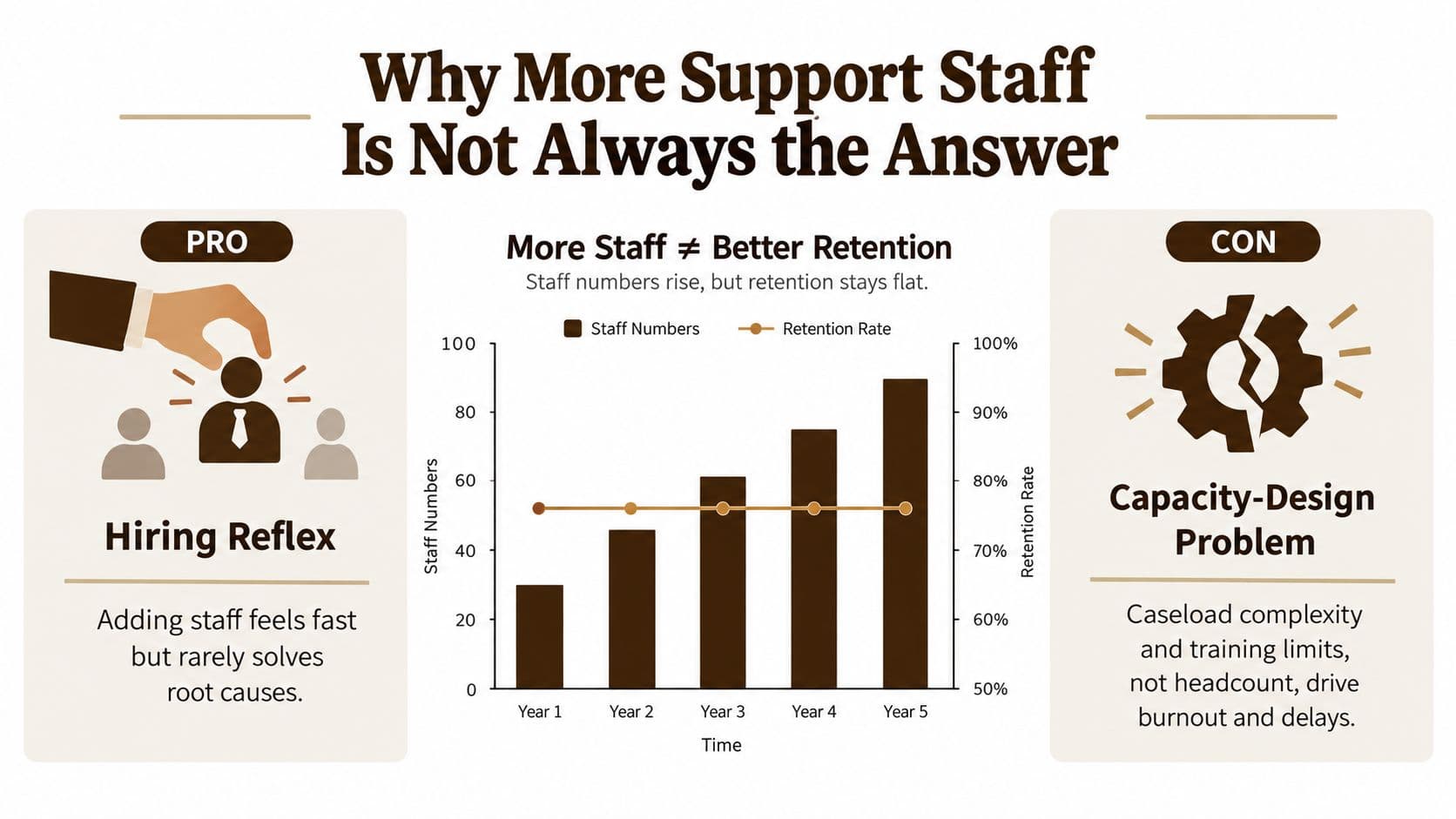
A junior paralegal added to a commercial-litigation team may create more work if no senior employee has time to teach filing conventions, discovery protocols, document naming, or client-specific expectations. Attorneys then review basic work line by line, the junior employee receives inconsistent corrections, and the experienced staff member loses even more production time. The firm has increased headcount while reducing usable capacity.
Compare that with a high-volume immigration practice built around templates, checklists, standardized intake, and defined quality-control points. A leaner support ratio can succeed because the workflow reduces discretionary decisions and makes training repeatable. The difference isn't the title of the employee. It's the design of the work.
Set a supervision ceiling
Before approving another requisition, answer four questions:
- Who trains the hire: Name the person responsible for the first weeks of instruction and ongoing feedback.
- What work is ready: Identify tasks the new employee can perform without creating a new review queue.
- What complexity is present: Separate repeatable production from matters requiring experienced legal judgment.
- What capacity is available: Confirm that the supervising attorney or senior support professional has time to manage the addition.
Washington State public-defense standards provide a useful example of workload-based thinking. They propose at least one full-time legal assistant or paralegal for every four full-time attorneys, plus one investigator for every three attorneys, because adequate support is treated as part of effective representation. Oregon standards also identify experience and training expectations for legal assistants, including one year of legal-field experience or three months of in-house training, along with knowledge of confidentiality and procedural rules. Those requirements appear in the Washington State public-defense standards court packet.
The right standard sets a hiring ceiling tied to supervision bandwidth. Don't add staff until the team can explain how the next person will become productive.
A Practical Screening Checklist for Your Next Search
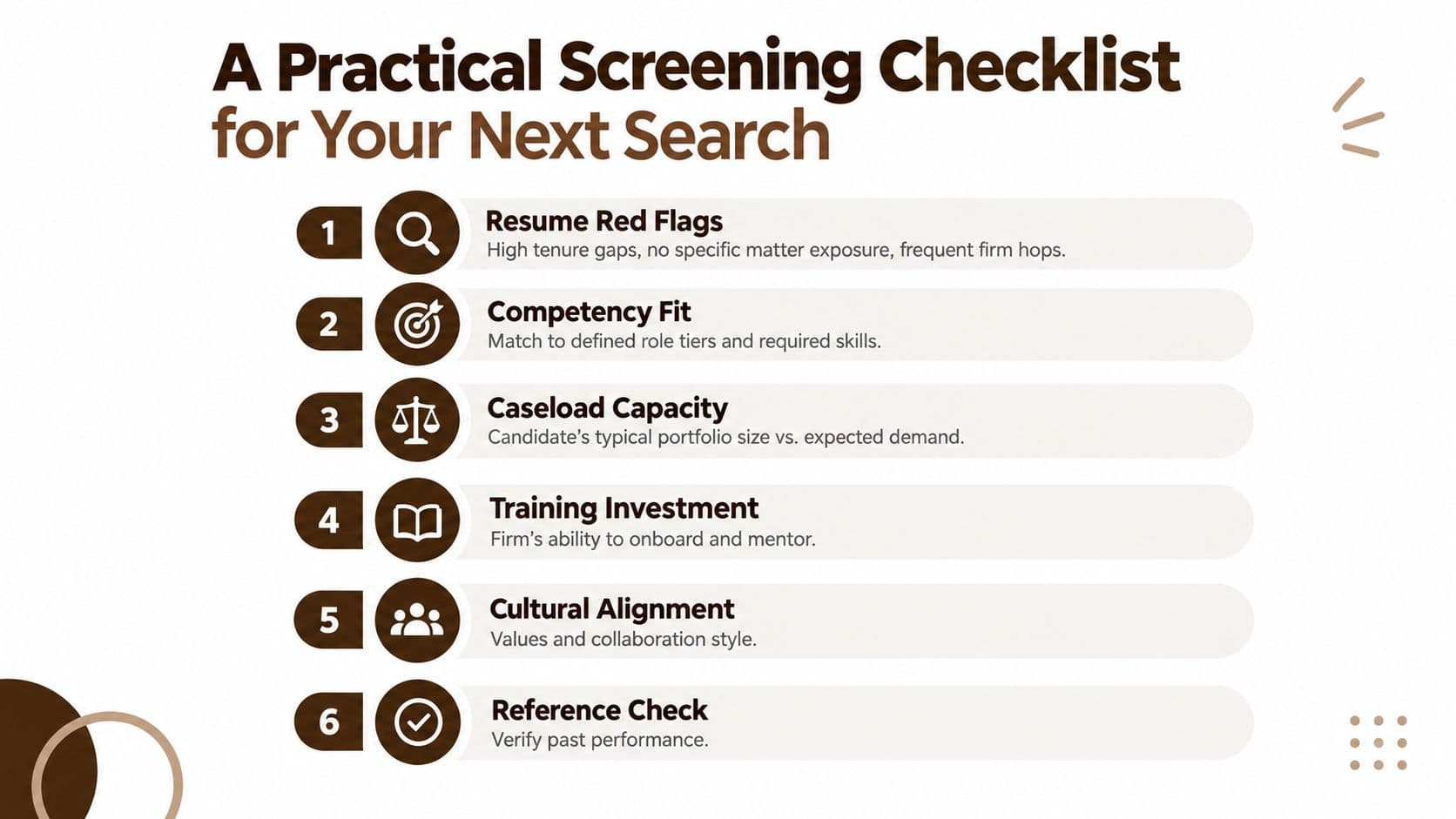
A recruiter or hiring partner should turn the standards into a repeatable evaluation, not a conversation guided by instinct. Use one rubric for every candidate, then adjust the scoring threshold to the role tier.
Start with the resume. Probe high tenure gaps, frequent firm changes, vague descriptions of matter exposure, and certifications that aren't supported by concrete work. Stronger signals include named practice areas, specific filing or discovery responsibilities, familiarity with e-billing systems, and experience with platforms such as Aderant, Clio, iManage, NetDocuments, or Litify.
Next, test the actual work. A paralegal candidate might receive a short drafting exercise, a deadline-triage problem, or a redaction task. A legal secretary candidate should demonstrate document production, calendaring judgment, and correspondence accuracy. The test must resemble the role, not reward abstract test-taking ability. Firms that need help designing this stage can evaluate a candidate testing service.
Ask scenario questions that expose habits
Use the same prompts for every finalist:
- Missed deadline: You discover that a filing deadline was not entered correctly and the deadline is approaching. What do you do first, who do you notify, and how do you prevent a repeat?
- Frustrated attorney: An attorney says your work is consistently too slow, but hasn't identified which tasks are causing the delay. How do you respond?
- Privileged document sent externally: You realize a privileged document was emailed to the wrong recipient. What steps do you take immediately?
Reference checks should test behavior, not personality:
- What work did this person own without close supervision?
- How did they respond when they made a procedural or deadline mistake?
- How accurate were their documents and time entries?
- How did they handle confidential information?
- What type of manager and workflow brought out their best performance?
Have the responsible attorney, a support-staff leader, and the hiring manager score the same one-page rubric. Compare scores before discussing preferences. The rubric should cover role-specific duties, technical depth, judgment, communication, confidentiality, workflow habits, training needs, and the workload implied by the firm's utilization expectations.
A candidate who interviews well but cannot explain how they manage deadlines is not a safe hire. Neither is a technically capable paralegal placed into a role with no substantive work or no supervision plan.
Putting These Standards to Work This Quarter
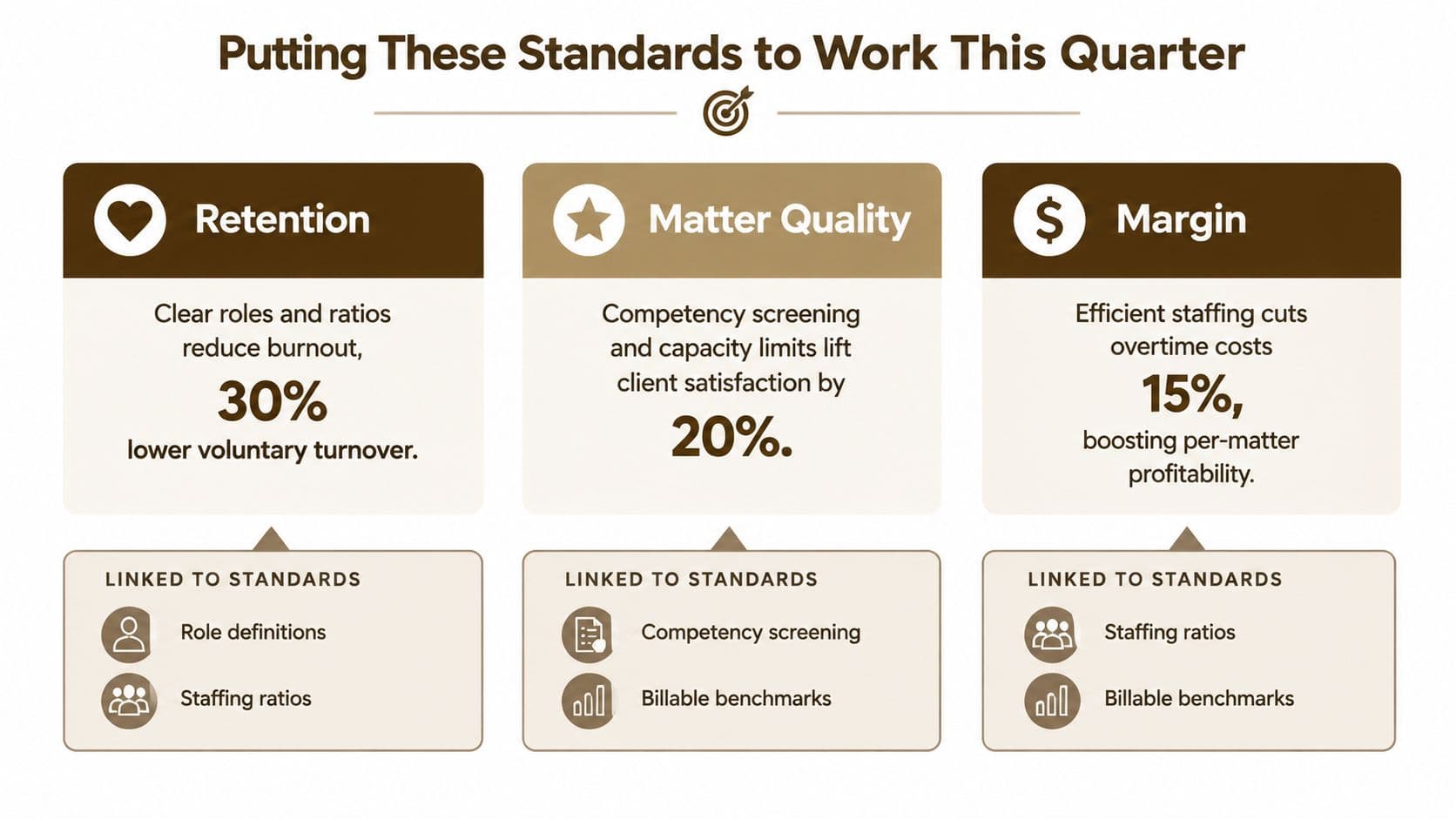
Support staff standards earn their value through decisions, not documentation. Clear role definitions improve retention because employees know what they own. Calibrated staffing ratios protect matter quality because managers can identify capacity gaps before deadlines become emergencies. Competency screening protects margin by reducing the cost of hiring someone who needs a different role than the firm advertised.
The utilization benchmark is part of that system, not a punishment mechanism. A 70% to 73% billable-to-worked-hour ratio and roughly 1,400 annual billable hours for full-time paralegals, cited in the earlier benchmarking source, can flag allocation and supervision problems before a resignation. Managers should investigate the work mix first. They shouldn't use the figures to pressure employees into hiding training, administrative tasks, or quality-control time.
Use the next 30 days to establish operating discipline:
- Audit current roles: Compare titles, actual duties, competency depth, and compensation expectations.
- Recalculate ratios: Measure direct support per fee earner by practice group, excluding reception, facilities, accounting, and unrelated overhead.
- Run one calibration session: Have the hiring team score a sample candidate against the same rubric and resolve disagreements.
- Review workload quarterly: Examine utilization, turnaround time, revisions, filing outcomes, and deadline performance by team.
- Assign ownership: Name the person responsible for acting when the data shows excessive non-billable work, overload, or inadequate supervision.
You don't need new software or a larger staff to begin. You need accurate role definitions, honest workload data, and managers willing to correct the system when the signals appear.
Five Star Placements provides permanent placement for paralegals, legal assistants, legal secretaries, law clerks, records clerks, and other legal support professionals, with screening aligned to practice needs and firm culture. Visit Five Star Placements to discuss a search built around the role standards, workload ratios, and competency checks your team needs.
Need help filling a legal role?
Five Star Placements partners with law firms and legal departments nationwide.
Schedule a Call