
Case Manager Legal Guide: Role, Salary & Hiring in 2026
July 9, 2026 · 17 min read · Five Star Placements
Table of contents
A lot of firms hit the same ceiling at the same time. Intake is strong, attorneys are busy, and new matters keep coming in, but case progress starts to feel uneven. Clients call twice for the same update. Medical records sit in limbo. Deadlines live in too many places. Paralegals get pulled into status-chasing instead of legal work.
That's usually the moment when hiring partners ask the wrong question. They ask whether they need “more support staff.” The better question is whether they need a legal case manager who can take control of workflow, client communication, and file movement so attorneys can stay in strategy, negotiation, and court-facing work.
A strong case manager legal hire doesn't just reduce noise. That person enhances operational efficiency. They make the rest of the team more effective, protect the client experience, and help matters move with fewer avoidable stalls.
Table of Contents
- The Hidden Engine of a Modern Law Firm
- What Is a Legal Case Manager Really
- Core Duties and Daily Responsibilities
- Skills Salary and Career Path for a Legal Case Manager
- How the Role Adapts Across Different Practice Areas
- How to Hire a Legal Case Manager
- Accelerate Your Hire with Five Star Placements
The Hidden Engine of a Modern Law Firm
A personal injury firm signs cases consistently. The lawyers know how to value claims, negotiate, and push files toward resolution. Yet the office still feels behind. Clients want updates. Providers haven't sent complete records. Someone needs to confirm policy information. A deposition date gets discussed, but nobody has locked the calendar. The attorneys stay busy all day and still end the week feeling like the firm didn't move enough files forward.
That's not a legal strategy problem. It's an operations problem.
The legal case manager sits in the middle of that pressure and turns scattered activity into a controlled workflow. Done well, the role becomes the central point for file momentum. Attorneys stop fielding routine status calls. Clients know who to contact. Records requests get followed through instead of merely sent. The handoff between intake, treatment tracking, document collection, and attorney review becomes cleaner.
What bottlenecked firms usually get wrong
Many firms try to solve this by loading more administrative coordination onto paralegals. That works for a short stretch, then breaks. Paralegals end up spending too much time on follow-up, reminders, and client reassurance, and not enough time on the legal work they're trained to handle.
The firms that fix this usually make a more precise hire. They define who owns case logistics, who owns legal substance, and who owns the client communication rhythm.
Practical rule: If attorneys are regularly doing status checks, record chasing, or client hand-holding, your staffing model is costing you productive legal time.
Why this role changes firm performance
A great legal case manager creates consistency. That matters more than firms admit. Cases move when someone owns the details that nobody can afford to miss, even if those details don't look glamorous on a job description.
That's why firms with disciplined staffing structures treat this role as more than clerical support. They treat it as an operational seat tied directly to attorney capacity and client retention. That view aligns with how specialized legal recruiting teams think about support hiring, including the approach reflected on the Five Star Placements team page.
What Is a Legal Case Manager Really
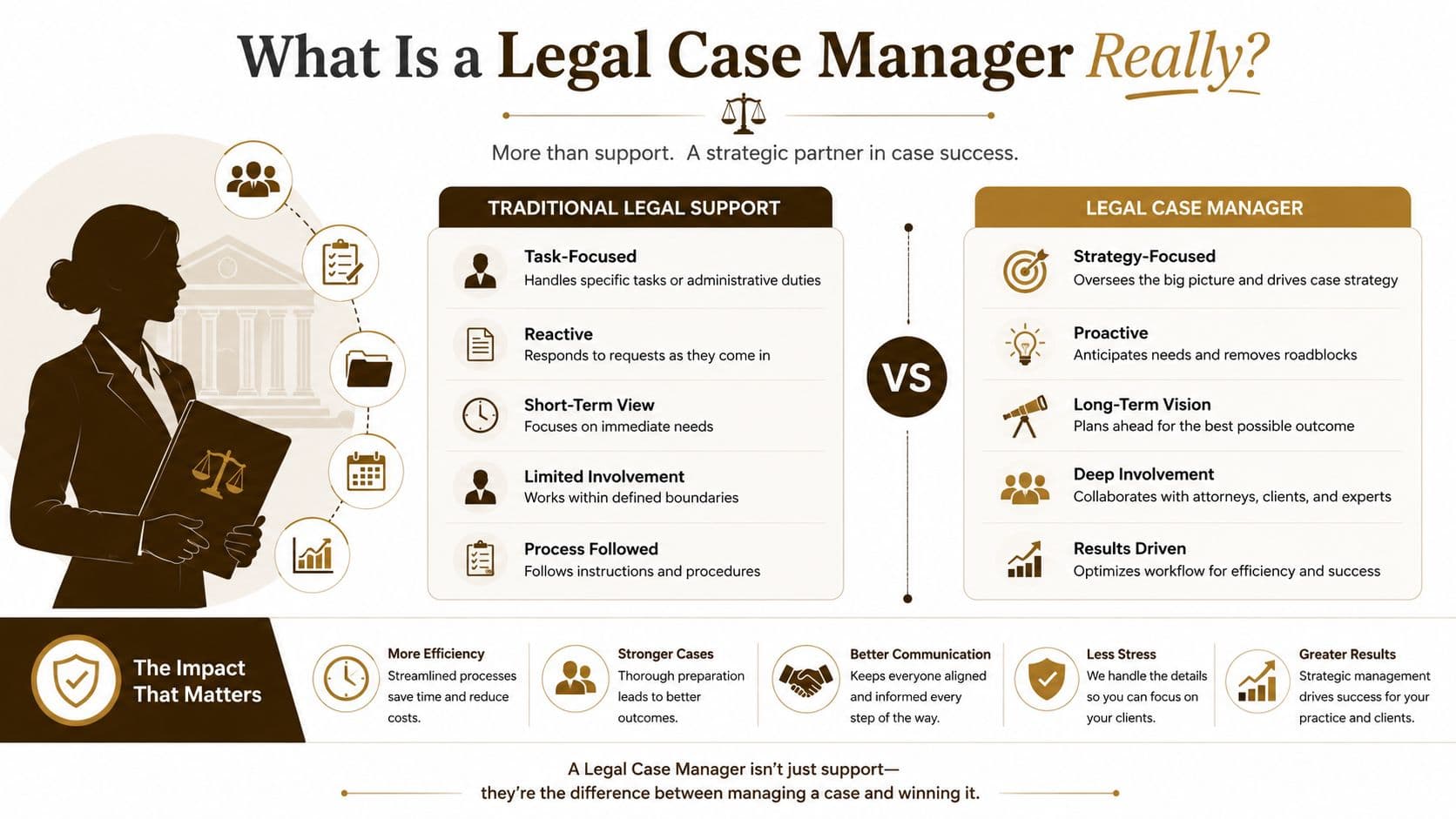
A legal case manager is the air traffic controller for a file. The attorney decides strategy. The paralegal handles substantive legal support. The case manager keeps the matter moving by coordinating people, records, timing, and communication so the legal work can happen without operational drag.
That distinction matters because many firms still use the title loosely. They call someone a case manager when they really mean intake coordinator, legal assistant, or junior paralegal. That confusion creates bad hiring, weak onboarding, and unrealistic expectations.
The cleanest way to define the role
The case manager legal function is built around coordination, logistics, and client-facing follow-through. The role exists to keep the file active, organized, and current. That often includes managing updates with clients, collecting records, tracking treatment or document status, maintaining file readiness, and making certain the next step happens.
A paralegal, by contrast, is tied more closely to substantive legal support. That difference shows up in compensation as well. The median annual wage for paralegals and legal assistants was $59,200 as of May 2023, while the national average salary for a Legal Case Manager was reported at $44,753 as of 2025, according to Wyzer Staffing's comparison of case managers and paralegals.
Where firms blur the line
Some overlap is normal. In smaller offices, one person may touch intake, records, scheduling, and light document preparation. But when firms blur the roles too much, problems start fast.
Here's the practical difference:
| Role | Primary focus | Typical value to the firm |
|---|---|---|
| Legal Case Manager | Workflow control, client contact, logistics, third-party coordination | Keeps files moving and attorneys out of routine operational tasks |
| Paralegal | Legal drafting, research, filings, discovery support | Expands the attorney's capacity to execute substantive legal work |
A firm that expects a case manager to function like a paralegal without the title, pay, or training will usually miss on both sides. The candidate feels set up to fail, and the attorneys still don't get the support they need.
The strongest case managers don't try to be junior lawyers. They remove friction so lawyers and paralegals can do their best work.
What the role is not
It's not a generic admin job. It's not front-desk overflow. It's not “whoever answers the client if the attorney's busy.”
A real legal case manager owns the movement of the file between stages. That ownership is what gives the role business value. Without it, a firm has activity but not control.
Core Duties and Daily Responsibilities
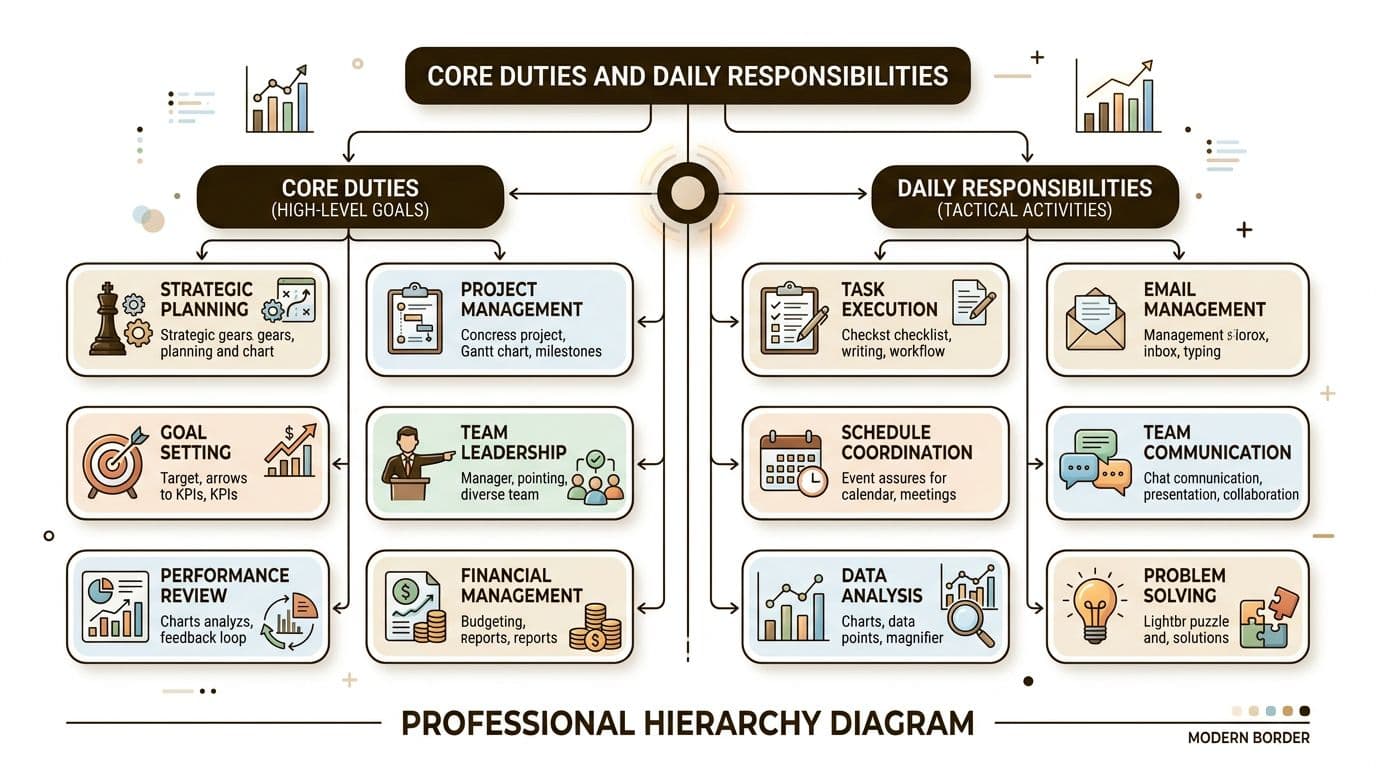
The easiest way to understand the case manager legal role is to stop thinking in tasks and start thinking in operating lanes. The day-to-day work usually falls into a handful of core pillars. Each one supports file velocity in a different way.
Client lifecycle management
This is the most visible part of the job. In many firms, the case manager becomes the primary non-legal contact for the client. That means setting expectations early, keeping communication steady, and making sure the client doesn't feel abandoned between major milestones.
Typical work in this lane includes:
- Intake follow-through: confirming contact details, collecting missing documents, and making sure the file opens cleanly
- Status communication: updating clients on what the firm is waiting on, what has been received, and what happens next
- Expectation management: explaining process steps in plain language without crossing into legal advice
- Escalation control: recognizing when a frustrated client needs an attorney callback versus a workflow update
A weak communicator can wreck this role, even with good technical skills. Clients don't judge a firm only by outcome. They judge it by responsiveness and clarity during the wait.
Records and information flow
Many firms lose time. Requests go out, but nobody tracks what came back incomplete. Bills arrive without matching records. A provider sends the wrong date range. The attorney asks for a summary and learns the file isn't ready.
A strong legal case manager keeps information moving in and in order.
That often means coordinating with medical providers, insurance adjusters, employers, records vendors, and clients themselves. It also means keeping digital files named logically, stored consistently, and updated so anyone stepping into the matter can understand the file quickly.
If your team has to ask, “Do we have the latest version?” your file management process isn't strong enough.
Calendar and deadline integrity
Some firms think of docketing as a separate function. In practice, case managers often protect the deadlines that sit around formal docket events. Follow-up dates, reminder sequences, client meeting schedules, records review points, and internal target dates all need ownership.
This part of the job usually includes:
- Tracking next actions on every active matter
- Calendar coordination for meetings, provider calls, and internal reviews
- Reminder systems so tasks don't disappear after the first request
- Deadline visibility so attorneys aren't surprised by preventable delays
The best candidates don't merely enter dates into software. They understand what each date means operationally.
Attorney and team support
This pillar is less about clerical assistance and more about reducing interruption. Attorneys shouldn't spend prime working hours checking whether records arrived, confirming that a client signed an authorization, or piecing together a status timeline from scattered notes.
Useful support looks like this:
| Support area | What good looks like |
|---|---|
| File readiness | The attorney receives a current, organized file instead of a pile of unresolved loose ends |
| Status summaries | The case manager can explain where the file stands, what's outstanding, and who owns the next step |
| Third-party coordination | Providers, insurers, and clients get timely follow-up without attorney intervention |
| Workflow continuity | A matter keeps moving even when the attorney is in hearings, depositions, or negotiations |
That's the daily reality of the role. The title sounds simple. The execution isn't.
Skills Salary and Career Path for a Legal Case Manager
This role rewards people who can combine discipline, client judgment, and process ownership. Firms often focus too narrowly on whether a candidate has worked in a law office before. Experience matters, but it isn't enough by itself. The best legal case managers bring a specific mix of hard skills and temperament.
The skills that actually matter
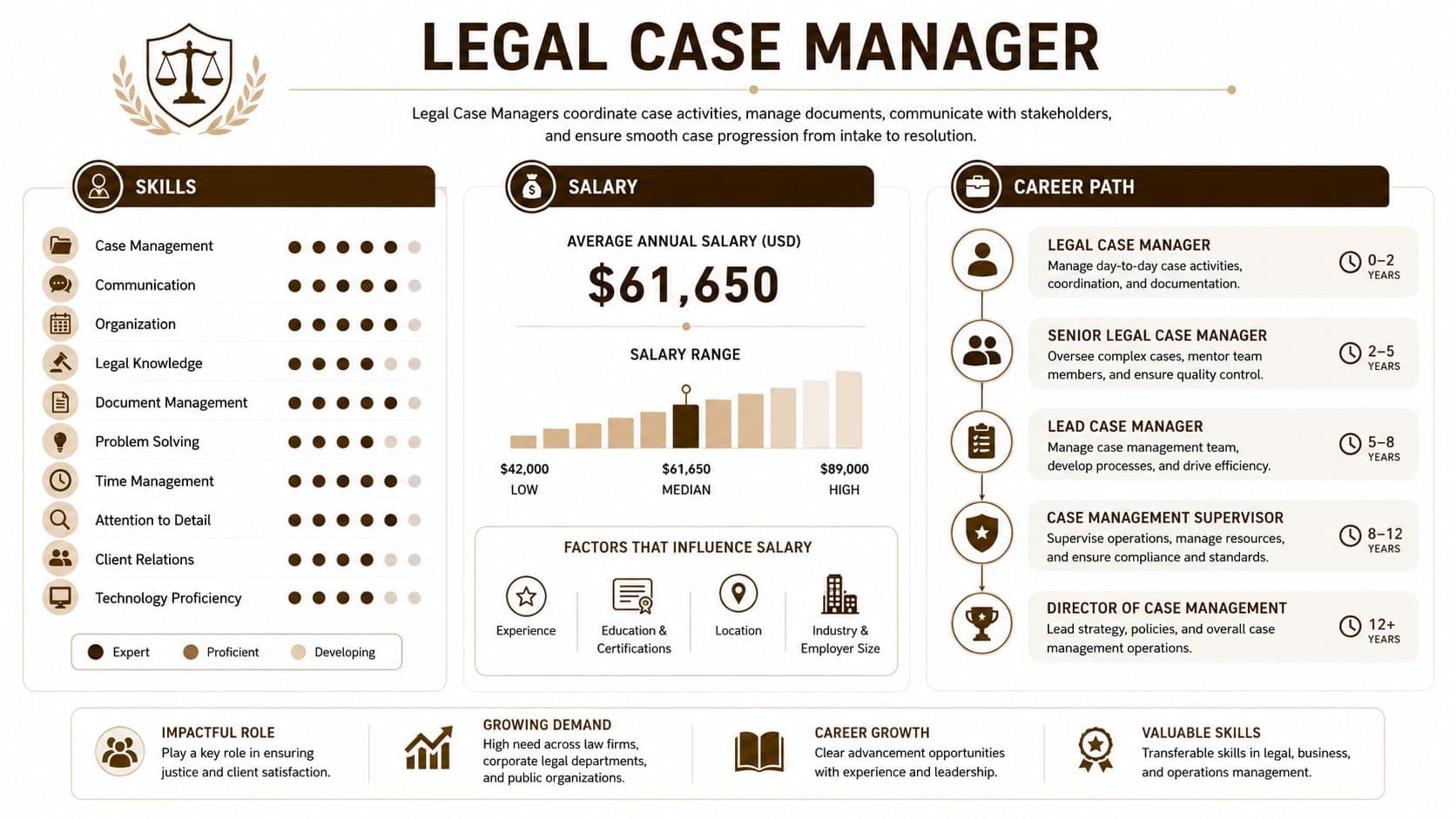
The hard skills are straightforward. Candidates need to work cleanly inside case management software, document management systems, spreadsheets, and standard office tools. In some practices, they also need enough legal process knowledge to support document drafting, record review, and file progression.
The soft skills are where many hires separate. Strong candidates are calm under pressure, direct with clients, organized without being rigid, and proactive without becoming disruptive. They know when to push a provider, when to update an attorney, and when to de-escalate a worried client.
The most useful skill mix usually includes:
- Workflow discipline: keeping many active matters current without losing the next action
- Client communication: staying clear, professional, and steady when clients are anxious or impatient
- Detail control: catching incomplete records, mismatched dates, missing signatures, and broken follow-up chains
- System fluency: using legal software and document workflows without creating file confusion
- Judgment: understanding the line between operational coordination and legal advice
For candidates exploring growth options, the Five Star Placements legal hiring blog is a useful place to study how firms define adjacent support roles and advancement paths.
A quick visual overview helps frame where the role sits in many organizations.
Salary reality in 2026
Compensation for legal case managers varies sharply by market, employer type, and role design. The national average salary stands at $60,437 per year as of 2026, and in New York the average hourly pay reached $37.12, according to ZipRecruiter's New York legal case management market data.
At the top end of that same market, candidates with degrees may command total compensation between $125,000 and $160,000. That's not the norm for every case manager seat. It reflects what happens when a firm needs a highly capable operator in a high-cost market and the role carries more responsibility.
There's another important contrast. Non-profit positions may require a BSW degree and start at $40,000 per year, while private legal case manager roles can be more flexible on formal credentials. That mismatch creates a real salary and certification disconnect between sectors.
Why the hybrid role matters
One of the most interesting shifts in hiring is the rise of the hybrid legal-operational case manager. These are professionals who don't just manage files. They also handle intake flow, data compliance, document management systems, and administrative pieces that used to sit across separate roles.
The verified hiring data notes that this hybrid function can command 15 to 20% higher compensation in markets where firms want broader operational value, as reflected in Los Angeles legal case manager hiring trends on ZipRecruiter.
That shift creates a clear opportunity for experienced paralegals and senior coordinators. If you already understand file progression, client communication, and office systems, you may be able to move into a more valuable seat by expanding your operational range rather than chasing a purely traditional title.
Candidates who can manage both case flow and intake discipline are often more useful to a growing firm than candidates with a narrower support profile.
Career path that makes business sense
The most common path starts with administrative support, intake, or legal assistant work. From there, candidates deepen into case ownership, often by practice area. Personal injury, family law, and immigration are common proving grounds because the volume and client contact demand process control.
From there, advancement usually moves in one of two directions:
| Path | Typical progression |
|---|---|
| Specialist track | Case Manager to Senior Case Manager to Practice-Specific Lead |
| Operations track | Case Manager to Team Lead to Legal Operations or Director of Operations support roles |
For employers, this matters because title design affects retention. If a case manager can only stay lateral forever, the firm will lose good people. If the role has real ownership, process authority, and a path upward, it becomes easier to keep high performers.
How the Role Adapts Across Different Practice Areas
The title stays the same, but the work changes a lot by practice area. That's where many hiring managers get burned. They hire a solid generalist, then discover the person doesn't understand the pace, records, terminology, or client dynamics of the files they'll handle.
Personal injury
In a high-volume personal injury practice, the legal case manager is often the file's logistical backbone before litigation gets deeper. The role includes client intake, medical record aggregation, treatment tracking, and insurance claim filing involving 1P/3P, UM/UIM, med pay, and PIP, according to Virtual Staffing's breakdown of case manager work in personal injury firms.
That type of file rewards a candidate who can stay relentless with providers, understand how records and billing fit together, and keep an accurate view of treatment progress. Systems such as ChartSwap show up here because record collection isn't a side task. It's part of how liability, damages, and policy information get organized before the attorneys need to act.
A good PI case manager also knows that “requested” isn't the same as “received,” and “received” isn't the same as “usable.”
Immigration
Immigration case management is a different muscle. The workflow is more document-heavy in a different way, and precision matters at every turn. A case manager in this setting often spends more time organizing client documentation, tracking filing readiness, coordinating signatures, and making sure forms and supporting evidence stay consistent from one stage to the next.
What works here is process patience. Candidates need to handle clients who are stressed, time-sensitive filings, and documentation gaps that can derail progress if nobody catches them early.
Useful strengths in this environment include:
- Document discipline: keeping forms, identity records, and supporting materials consistent
- Deadline sensitivity: tracking submission timing and follow-up requirements carefully
- Client follow-up: obtaining missing information without creating confusion
- Language and clarity: communicating process steps clearly and respectfully
Family law
Family law case management has a heavier emotional component. The files involve conflict, urgency, and clients who may be overwhelmed or reactive. A technically strong candidate can still struggle here if they don't know how to manage communication under stress.
The best family law case managers bring calm structure. They keep clients focused on what the attorney needs, help coordinate document collection for financial disclosures, and reduce avoidable churn by keeping communication steady and professional.
In family law, emotional regulation is part of the skill set. A candidate who escalates with the client will destabilize the file.
What hiring managers should look for by practice
A broad legal background helps, but practice fit is more important than many firms admit. A simpler perspective is this:
| Practice area | Best case manager profile |
|---|---|
| Personal Injury | Strong with medical records, claims workflow, and provider follow-up |
| Immigration | Detail-heavy organizer with patience and strong document control |
| Family Law | High emotional intelligence, boundary-setting, and deadline discipline |
The role adapts well across practice areas. The hiring criteria shouldn't stay generic.
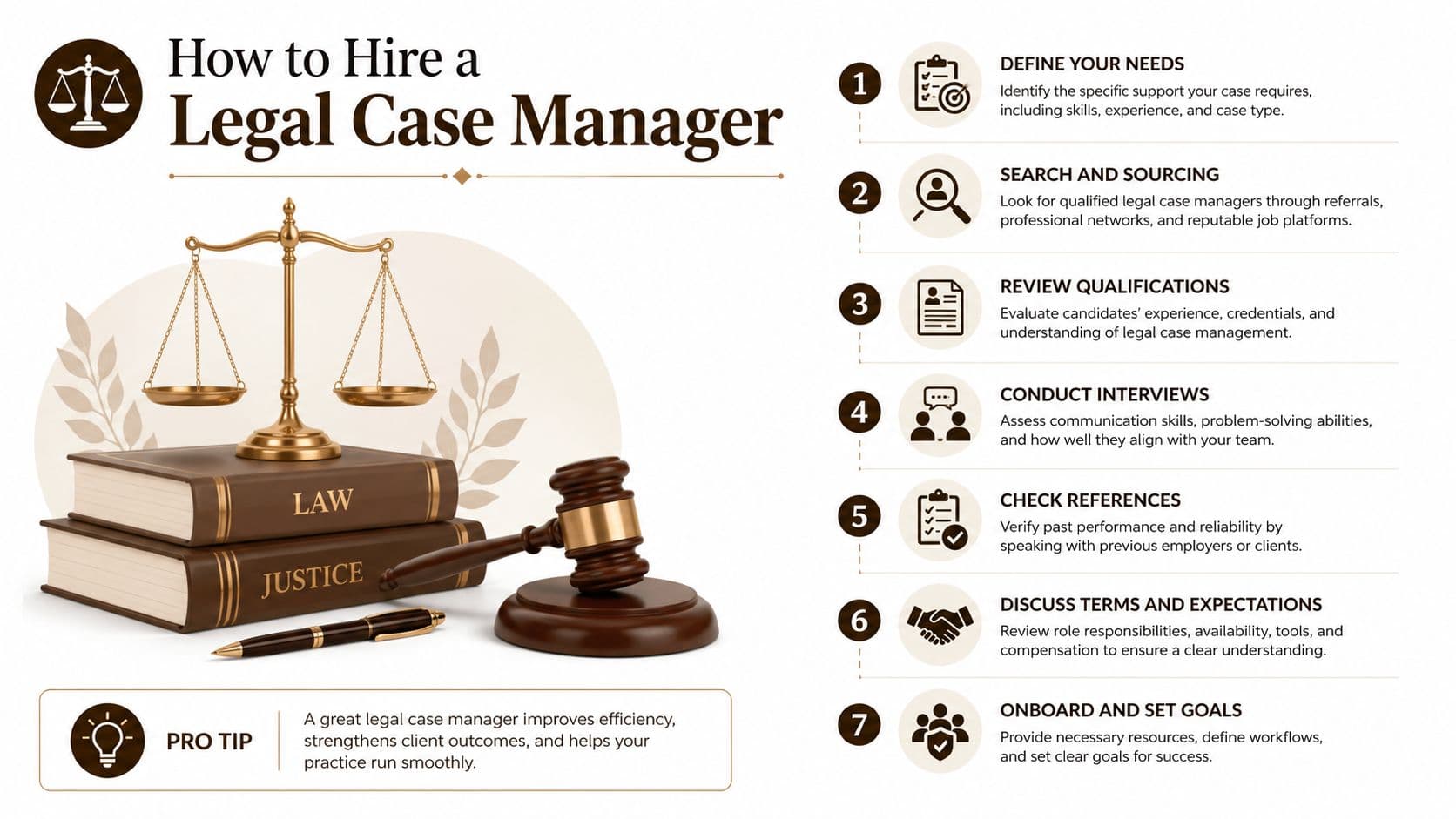
How to Hire a Legal Case Manager
Most hiring mistakes happen before the first interview. Firms write a vague job ad, blend three roles into one, and then wonder why the candidate pool feels off. If you want a productive hire, define the seat around workflow ownership, practice-specific demands, and the exact kind of attorney support the firm needs.
What to put in the job description
The role should be written as an operational position with legal context, not as a catch-all support posting. Verified hiring guidance indicates that the ideal legal case manager often has a bachelor's degree preferred, or a two-year degree with paralegal certification, plus prior experience in case management processes, especially in personal injury or family law, based on Wizehire's legal case manager job description benchmark.
That same benchmark also notes the business impact directly. When case managers consult with attorneys on cost- and time-effective approaches, they reduce opportunity cost tied to delays and prolonged vacancies.
A practical template looks like this:
-
Role summary
Own case workflow and client-facing coordination for active matters from intake through key milestones. Maintain file movement, records follow-up, deadline visibility, and communication with clients and outside parties. -
Core responsibilities
Manage active caseload logistics, including status tracking, records requests, appointment coordination, document collection, and attorney updates. -
Practice-specific requirements
State the file type clearly. Personal injury, family law, immigration, or another area should be named directly so candidates can self-select accurately. -
Technical requirements
List the actual systems used. Case management software, document management systems, spreadsheets, calendaring tools, and any records platforms relevant to the work. -
Success profile
Emphasize ownership and communication, not just admin experience. The strongest candidates are organized, responsive, detail-driven, and comfortable managing competing deadlines.
If the role includes intake, lien work, or settlement support, say so. If court-facing work is excluded, say that too. Clear scope attracts better candidates.
Interview questions that reveal the truth
Resume reviews won't tell you whether someone can control a chaotic caseload. Behavioral interviewing will.
Use questions like these:
- Walk me through how you organize a large active caseload with competing deadlines.
- Tell me about a time a provider, client, or outside party delayed a file. What did you do next?
- How do you decide what needs attorney attention immediately versus what you can resolve yourself?
- Describe your process for tracking missing records or documents until the file is complete.
- How do you handle a client who feels ignored or angry about the pace of the case?
- What information do you include when giving an attorney a status update on a matter?
- Which software systems have you used to manage case flow, records, and calendars?
What to test before you hire
Interviewing alone isn't enough. Good hiring managers also test for work style.
A simple evaluation process should include:
| Hiring step | What it reveals |
|---|---|
| File status exercise | Whether the candidate can identify missing pieces and next actions |
| Client communication sample | Tone, clarity, and professionalism |
| Systems discussion | Whether they actually understand workflows inside legal software |
| Practice-specific scenario | How well they understand the demands of your file type |
Firms that need help defining or filling this role can start the conversation through the Five Star Placements contact page.
Accelerate Your Hire with Five Star Placements
A top legal case manager is hard to replace because the role sits at the intersection of workflow control, client communication, and attorney support. You're not just hiring someone to keep files tidy. You're hiring someone who can reduce interruption, keep matters moving, and protect the client experience when volume rises.
That's why this search often takes longer than firms expect when they run it casually. The resume may look fine, but the candidate may not have the right practice exposure, urgency, communication style, or systems discipline. Those gaps don't always show up until the person is already in the seat.
Five Star Placements helps law firms hire with more precision. The firm handles permanent placement for legal support staff, attorneys, legal operations leaders, and law firm management roles nationwide. Its approach is built around customized screening, practice fit, and culture alignment rather than keyword matching.
For firms, that means access to a stronger candidate network, a faster path to qualified introductions, and a contingency model that reduces hiring risk. For candidates, it means representation by a recruiter who understands how legal support roles function inside real firms.
If you're hiring a legal case manager, or you're a legal professional ready for a stronger opportunity, connect with Five Star Placements. Their team works with law firms and legal departments across the United States to place attorneys, paralegals, case managers, intake specialists, and legal operations talent with the right technical and cultural fit.
Need help filling a legal role?
Five Star Placements partners with law firms and legal departments nationwide.
Schedule a Call