
Business Office Manager: What the Role Really Does
September 21, 2026 · 17 min read · Five Star Placements

Table of contents
If you're reading this, there's a good chance your firm is already feeling the problem.
Billing is late. A partner is asking why receivables haven't moved. Someone in accounting says the numbers are waiting on lawyer approvals. A service vendor wants an answer on a renewal. HR needs onboarding paperwork for a lateral starting next week. Meanwhile, the people with the highest billing rates in the firm are spending time clearing administrative jams they should never have touched.
That's when firms start saying they need an office manager. Often, that's the wrong label. What they usually need is a business office manager who can run the operational spine of the office with enough financial discipline to protect partner economics.
In a law firm, this role only matters if it touches revenue, accountability, and execution. If the person is just ordering supplies, booking conference rooms, and smoothing over minor office annoyances, you hired too low. The right hire keeps billing moving, pushes follow-up where lawyers stall, manages vendors before costs drift, and gives leadership clean operational visibility without constant hand-holding.
Table of Contents
- What a Business Office Manager Does in a Law Firm
- Defining the Role Beyond the Job Description
- Core Responsibilities That Show Up Every Week
- Skills and Experience That Separate Strong Hires
- How the Role Fits With Legal Operations and Finance
- Hiring Criteria and Interview Signals That Work
- Recruiting and Retaining the Right Person
- Deciding If This Role Is Right for Your Firm
What a Business Office Manager Does in a Law Firm
A partner is in hearings all week. Bills are stuck in draft. A client is pushing back on a matter total. Two vendors want renewal decisions. A staff departure just created a coverage gap in intake and time entry. If nobody owns that pileup, partners end up doing expensive administrative work badly and late.
A business office manager should own it.
In a law firm, this role sits inside the firm's revenue engine, not on the edges of office administration. The person in this seat keeps billing hygiene tight, pushes follow-up when lawyers stall, coordinates matter-level handoffs between attorneys and staff, manages vendors before costs drift, and gives leadership a clear read on what is slipping and why. If your hire cannot operate close to billing, collections, staffing coordination, and cost control, you hired an office coordinator, not a business office manager.
Where the role earns its keep
Law firms do not get paid because the office feels organized. They get paid because time is captured, prebills move out on schedule, invoice issues are resolved fast, and receivables are chased with discipline. Margin holds when staffing, vendors, and overhead are controlled at the same time.
That is the job.
A strong business office manager spots the operational failure before it reaches the compensation conversation. They catch missing time before month-end. They push lawyers for billing approvals before invoices age into excuses. They see when a client dispute is really a matter-management problem. They know which vendor relationship is getting expensive and which staffing issue is about to slow work on active matters.
One useful market signal supports the point. Zippia's business office manager demographics data notes these professionals are far more likely to work in private companies than public ones. That lines up with law firm reality. Firms need someone who can handle finance, operations, HR coordination, and administration in a faster, less layered operating model.
What managing partners usually get wrong
They hire for helpfulness instead of control.
The role should reduce leakage in revenue, time, and partner attention. Screen for a person who has enforced billing deadlines, cleaned up broken approval habits, managed service providers with real budget discipline, and kept staff execution aligned across matters. If the candidate talks only about keeping the office pleasant, they are too light for the job.
This is one of the few administrative hires that directly affects partner economics. Treat it that way.
Defining the Role Beyond the Job Description
Most law-firm job descriptions for this role are too vague to be useful. They list “office operations,” “staff support,” and “vendor coordination,” then wonder why the candidate pool skews administrative instead of operational.
Define the role in four buckets. If your description doesn't clearly cover these, it's incomplete.
Finance responsibility
This is the first screen, because revenue discipline separates a true business office manager from a generic office manager. In a firm setting, finance responsibility usually includes billing oversight, accounts receivable follow-through, operating account coordination, expense review, and support around trust-accounting workflows where appropriate.
The key isn't whether the person owns every accounting function. The key is whether they can keep financial processes moving and escalate risk before month-end turns ugly.
For a useful benchmark mindset, office-management KPI guidance often points to task completion of 95% or higher, responses to internal requests within 24 hours, and resolving most issues without escalation, as discussed in office manager metrics guidance from JobNimbus. In a law firm, that kind of discipline matters because every delayed approval or unanswered request tends to land back on a lawyer's desk.
Operations and facilities responsibility
This is the second bucket. It includes vendor contracts, invoice approvals, technology coordination, records logistics, conference room workflows, copy and mail relationships, lease-related coordination, and all the small systems that keep lawyers productive.
A lot of firms already have some version of this work spread across accounting, reception, IT support, and a long-suffering administrator. That fragmentation is exactly the problem.
For firms mapping this role against broader firm-management positions, a firm administrator job description can help clarify where business-office ownership starts and where broader administrative leadership begins.
HR coordination and internal linkage
The third bucket is people coordination, not full HR ownership. Think onboarding, payroll liaison work, benefits paperwork with outside providers, leave tracking coordination, and support for performance documentation.
The fourth bucket is connective tissue. The business office manager keeps partners, finance, staff, and outside vendors talking to each other in real time. In a law firm, that's the job. Not “keeping the office pleasant.” Keeping the firm aligned.
In a healthy firm, the business office manager isn't a side office utility player. They're the person who prevents small process failures from turning into revenue leakage.
Core Responsibilities That Show Up Every Week
The best way to understand this role is to stop talking in abstractions and look at what shows up on a Tuesday morning.
A partner wants a billing adjustment cleared before invoices go out. A vendor says payment is overdue and service may pause. A new associate starts Monday and still needs system access, workspace coordination, and payroll setup. A practice group leader wants a quick status update on old receivables without digging through three systems.
Those are business office manager tasks. Not because they do everything personally, but because they own the follow-through.
Finance work tied to partner economics
In a law firm, weekly financial work isn't just bookkeeping. It's protection of realization, collections, and partner time. The business office manager should be pulling billing previews, spotting missing time, coordinating prebill edits, following up on aged receivables, reconciling operating activity, and flagging likely write-downs before they harden into month-end surprises.
If that sounds too finance-heavy for an “office” role, good. That's the point.
Operations and coordination work
The operations side is just as practical. Contract renewal reminders. Vendor invoice approvals. Office-supply budgeting. Service-ticket follow-up. Coordination with IT on hardware, permissions, and access provisioning. Space issues. Records questions. External service interruptions.
None of this is glamorous. All of it affects whether lawyers can work uninterrupted and whether support staff lose hours to preventable friction.
Weekly Responsibilities of a Law Firm Business Office Manager
| Function | Typical Weekly Tasks | Connects To |
|---|---|---|
| Finance | Billing previews, prebill edits, AR follow-up, expense review, operating account coordination | Partners, billing staff, finance lead |
| Operations | Vendor invoices, contract renewals, office logistics, IT coordination, supply controls | Vendors, IT, office staff |
| HR coordination | Onboarding paperwork, payroll cutoff tracking, benefits liaison work, leave coordination | HR provider, payroll contact, hiring partners |
| Internal reporting | Partner meeting notes, KPI circulation, issue escalation, status updates | Managing partner, practice leaders, COO |
What competence looks like in real time
You can usually tell within a few weeks whether the person thinks like an operator or a coordinator.
An operator says, “The write-off request is connected to delayed time entry from two matters, and if we don't fix that workflow this month, you'll see the same issue again.” A coordinator says, “I sent a reminder.”
That difference is the job.
Skills and Experience That Separate Strong Hires
Most bad hires in this seat fail for a simple reason. The candidate looked organized, pleasant, and experienced, but they didn't have the operating judgment to function inside a law firm.
The right skill stack is narrower and tougher than many firms admit.
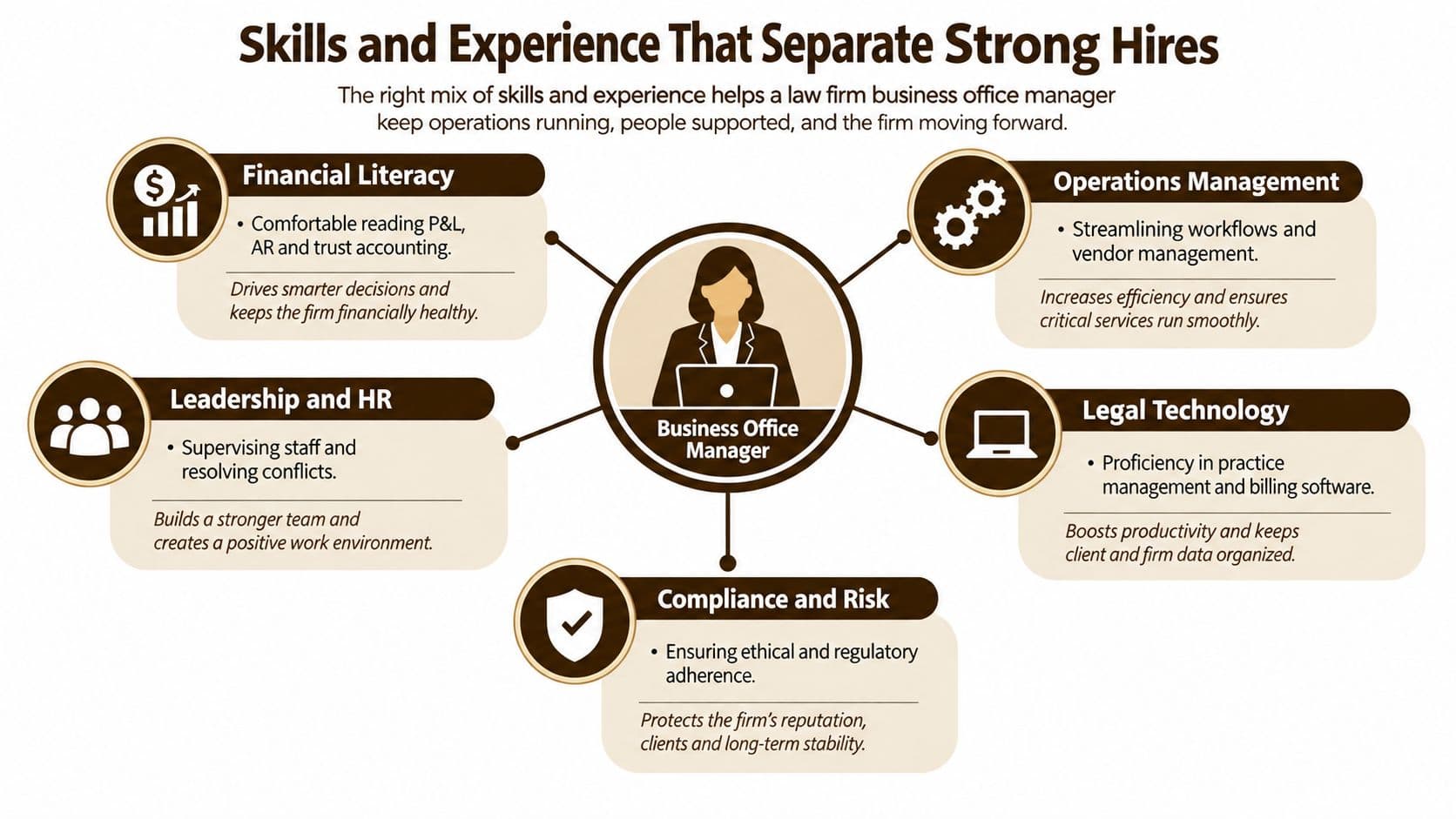
Financial literacy first
Start here. If the candidate can't read a P&L, understand accounts receivable aging, follow billing logic at the matter level, and respect trust-accounting boundaries, stop the interview process. Law firms don't need charming administrators who get lost in numbers.
They need someone who can spot leakage.
Compensation data also tells you this role spans a wide range of scope. U.S. salary benchmarks report an average around $91,669 per year, with a spread from about $57,433 at the 10th percentile to $129,525 at the 90th percentile, according to business office manager salary benchmarks from Salary.com. That spread usually reflects whether the role is narrow coordination or real operational ownership.
Systems fluency and legal-tech comfort
Brand loyalty matters less than learning speed, but the person should be comfortable with legal billing and management systems. Aderant, Elite 3E, ProLaw, practice-management dashboards, Excel, and reporting exports all matter because firms run on data trapped inside systems.
You want someone who asks smart questions about workflow, permissions, reporting cadence, and exception handling. You don't want someone who says they're “good with software” and means Outlook plus basic spreadsheets.
This visual captures the skill mix that matters inside firms.
Judgment under partner pressure
This is the hardest trait to test and the most valuable once hired.
Look for candidates who can push back without creating drama, write a partner-ready memo, manage outside vendors firmly, and escalate the right issues early. Legal environments punish people who freeze when a rainmaking partner makes a messy request. They also punish people who escalate everything.
A strong hire knows the difference between inconvenience and risk.
- Financial command: They can explain revenue-cycle slippage in plain English.
- Operational discipline: They don't let renewals, approvals, or setup tasks drift.
- Vendor judgment: They know contracts need review, not autopilot renewal.
- Communication range: They can speak effectively to lawyers, staff, accountants, and service providers.
- Boundary management: They can say no, or not yet, with reasons that hold.
How the Role Fits With Legal Operations and Finance
Law firms confuse this role with adjacent titles all the time. That confusion leads to bad hiring, overlapping authority, and frustrated employees.
A business office manager is not automatically a legal operations manager. They're not a finance director. They're not an HR director. They're also not just an office administrator with a nicer title.
The cleanest way to place the role
The business office manager usually owns the day-to-day operational backbone of the office. Legal operations tends to lean more heavily into process redesign, technology implementation, workflow architecture, matter analytics, and system improvement across practice groups. Finance owns formal financial strategy, higher-level reporting, tax, and accounting governance. HR owns policy, employee relations, recruiting structure, and benefits at a broader level.
For firms comparing this role to a more specialized process-and-systems leader, this overview of a legal operations director is a useful contrast.
Business Office Manager vs. Adjacent Law-Firm Roles
| Role | Primary Ownership | Day-to-Day Focus | Typical Reports To |
|---|---|---|---|
| Business office manager | Office operations tied to billing, vendors, coordination, and administrative execution | Billing follow-through, vendor management, onboarding coordination, internal reporting | Managing partner or COO |
| Legal operations manager | Process design, legal-tech adoption, workflow improvement, matter analytics | Systems rollout, process mapping, reporting design, cross-functional improvement | COO, executive director, or operations lead |
| Finance director | Financial governance and firm-level reporting | Budgeting, financial statements, accounting controls, strategy | Managing partner, CFO, or executive leadership |
| HR director | People policy and talent infrastructure | Recruiting process, benefits, performance frameworks, compliance | COO, executive director, or managing partner |
| Office administrator | General office support and facilities logistics | Front-office support, supplies, facilities coordination, scheduling | Office manager, administrator, or local leadership |
Reporting lines that usually work
In most mid-size firms, the business office manager should report directly to the managing partner or COO, with close working ties to finance and HR. That reporting line matters because the role needs enough authority to move work across departments.
If this person has accountability without access, the firm will bury them in requests and then blame them for delays they had no power to fix.
Hiring Criteria and Interview Signals That Work
A partner is sitting on $400,000 in aging receivables, prebills are late again, a vendor issue is distracting staff, and the candidate across the table keeps talking about being organized and positive. That candidate is not your answer.
Hire for control. In a law firm, this role protects billing flow, partner follow-through, and the small operational failures that erode profit.
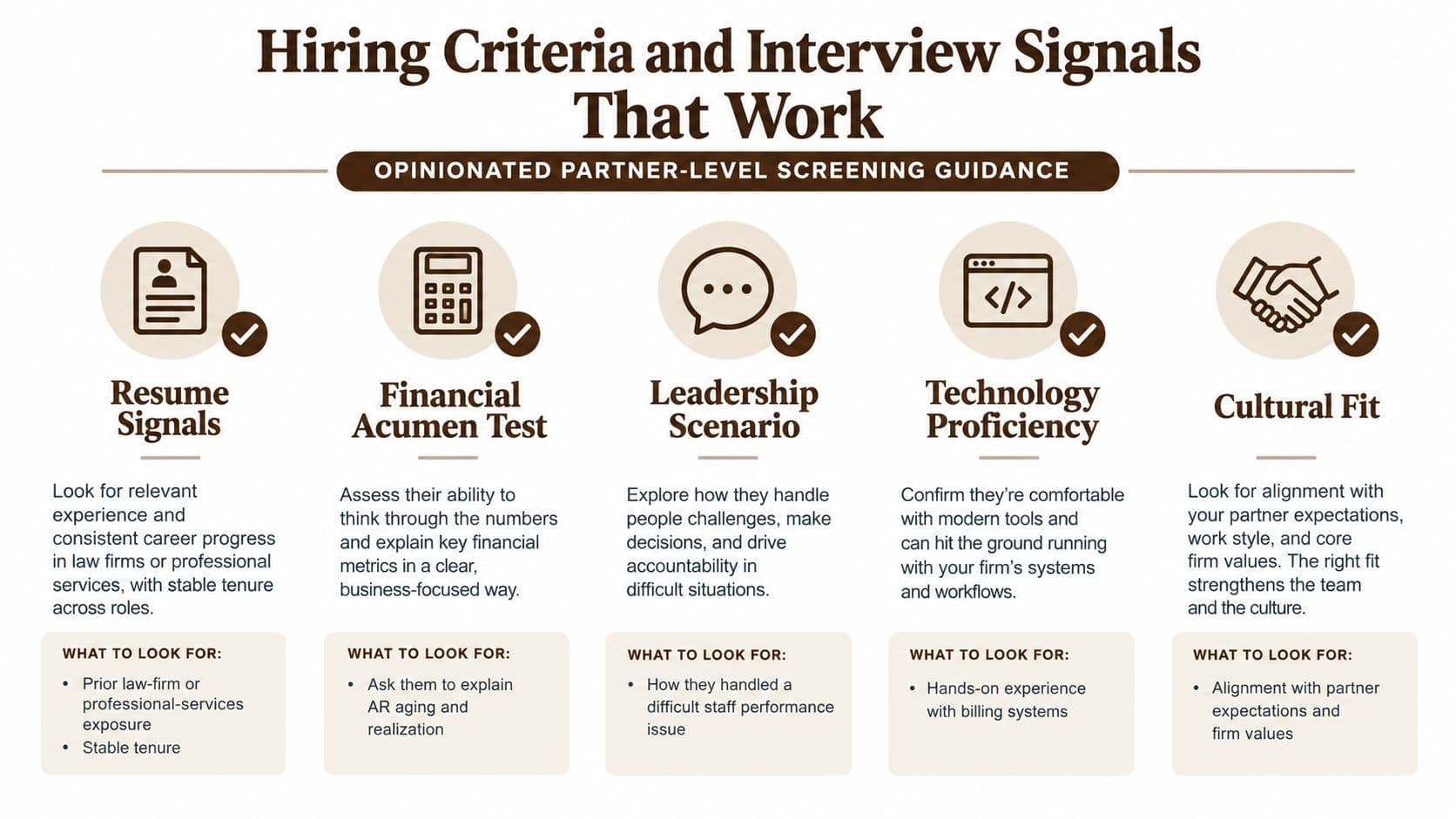
Resume signals worth taking seriously
Read the resume for evidence of operating discipline, not general admin competence. Strong candidates usually show law-firm or other professional-services experience, stable tenure, direct ownership of vendors or office spend, and hands-on work with billing systems, collections follow-up, onboarding coordination, or internal reporting.
Look for specifics. "Managed office operations" means nothing by itself. "Reduced billing delays by tightening prebill review," "reset copier and records vendor terms," or "built weekly AR follow-up reporting for practice leaders" tells you the person has worked inside a revenue-driven environment.
Because this occupation draws a high volume of applicants in many markets, unstructured interviews surface plenty of personable but unsuitable candidates. Use a defined screening process, and compare finalists against the same criteria. These candidate selection methods are a useful framework if your firm tends to hire by instinct.
Interview questions that expose judgment
Ask questions that force the candidate to operate inside a law firm's economics.
- Test billing judgment: “A partner has not approved prebills for eight days, and clients in that practice already pay slowly. What do you do first, who do you involve, and what deadline do you set?”
- Probe AR discipline: “How have you tracked receivables follow-up by lawyer or matter, and what changed because of your reporting?”
- Check vendor control: “Tell me about a vendor relationship you reset. What were the terms, what advantage did you have, and what result did you get?”
- Push on partner management: “Describe a time you had to push back on a senior lawyer whose delay or habit was creating administrative drag.”
- Test prioritization under pressure: “It is month-end. A new hire starts in an hour, billing has exceptions that will hold invoices, and a facilities problem affects staff. What gets handled first, and what can wait?”
- Confirm systems fluency: “Which reports did you pull yourself, from which system, and how did leadership use them?”
The right candidate answers with sequence, ownership, and consequences. Weak candidates answer with vague teamwork language and no real decision path.
Red flags that should end the process
End the process if the candidate cannot tie their work to billing hygiene, lawyer accountability, or matter support.
- Vague ownership: They describe what the office did, not what they personally changed.
- Weak financial judgment: They cannot read an aging report, explain a billing exception, or discuss basic budget control.
- No escalation muscle: They are uncomfortable pressing partners for deadlines or confronting repeat bottlenecks.
- Soft vendor experience: They coordinated vendors but never negotiated terms, challenged invoices, or corrected poor service.
- Job-hopping without increased scope: Short tenures can be fine once. Repeated short stops with no bigger remit usually signal limited staying power.
Use a scorecard. Grade each finalist on law-firm fit, billing and AR fluency, vendor judgment, partner-facing communication, and tenure stability. Then make the decision from evidence, not chemistry.
Recruiting and Retaining the Right Person
The market for this role is broader than many firms think, but the right slice of it is narrow. You aren't just looking for office-management experience. You're looking for someone who can function inside a legal revenue model.
That changes where you source and how you close.

Where good candidates actually come from
The best candidates often surface through legal-specific recruiters, referrals from practice leaders, alumni from prior firms, and targeted searches focused on legal billing systems or law-firm administration backgrounds. General office-manager postings attract too many candidates from environments that don't map well to legal work.
That mismatch is getting worse because the role itself is changing. One workplace-management source notes that office managers now operate with tighter visibility demands from leadership, while also managing distributed workplace portfolios, and reports that 65% expect budgets to be flat or decrease next year, as discussed in office management trends for 2026 at HybridHero. Even if your firm isn't fully hybrid, the underlying point applies. The role is becoming more strategic while resources stay constrained.
How to run the search
Keep the process tight.
- Calibration first: Align the managing partner, finance lead, and any operations stakeholder on scope before you meet candidates.
- Two serious interviews: One should test judgment with firm leadership. The other should test process and financial fluency with the finance lead or administrator.
- Working sample: Give finalists a sanitized billing or vendor scenario and ask how they'd triage it.
- Reference for substance: Ask references what the candidate improved, fixed, or controlled.
Retention is mostly about authority
Strong business office managers leave when the firm gives them responsibility without decision rights. They get buried under partner requests, forced to mediate chronic process problems, and blocked from fixing root causes. Then leadership acts surprised when they burn out or accept another role.
The broader office-manager outlook also supports a sober view of retention. One market summary says the U.S. role shows projected employment change of about -0.3% from 2024 to 2034, yet still generates roughly 144,500 annual openings, while Australia reports 140,600 employed office managers, 3,000 annual employment growth, a median age of 47, and a 34% part-time share, according to office manager career-guide market data from GlobalCybers. Translation: the title may look stable, but turnover and skill reshaping are very real.
Retention improves when the role has direct access to leadership, clear vendor authority, explicit escalation paths, and room to improve systems instead of merely surviving them.
Deciding If This Role Is Right for Your Firm
It is Monday morning. A partner is asking why bills still have not gone out. Another wants to know why a client matter was staffed without the right support. Someone in accounting is chasing time entries. Your office administrator is buried in vendor issues and front-desk coverage. That is not a series of unrelated annoyances. It is a law firm operating model with no clear owner.
The right question is not whether you need more administrative help. The question is whether your firm has reached the point where billing hygiene, collections follow-up, matter support, and office execution need one person who can coordinate them with authority.
Some firms do not need a business office manager yet. A small practice with disciplined partners, clean billing habits, and stable support staff may be fine with a strong administrator and outside accounting support. Other firms are misdiagnosing the problem and really need a billing manager or a legal operations lead.
Many firms, though, wait too long. They treat write-downs, delayed prebills, weak receivables follow-up, inconsistent onboarding, and partner complaints as separate problems. In a law firm, those issues usually connect. Nobody is managing the daily mechanics that protect realization and keep matters moving.
The decision test
Use a harder screen than title inflation.
- Are partners or senior lawyers still spending time on recurring office and process breakdowns?
- Do prebills, edits, and final invoices stall because no one is driving the workflow across attorneys, assistants, and finance?
- Are collections follow-ups inconsistent, late, or left to individual partner habits?
- Do matter teams run into avoidable support problems because staffing, logistics, and office coordination are fragmented?
- Does your current office lead keep the place running, but lack the financial judgment to protect billing discipline and partner economics?
If the answer is yes to several of those, you are no longer deciding whether to add overhead. You are deciding whether to keep tolerating revenue leakage and partner distraction.

A good business office manager pays for the role by tightening execution around the work your lawyers already bring in. Cleaner billing. Faster follow-up. Better matter support. Fewer preventable interruptions. If realization is slipping, receivables are aging, or partners are still acting as backup office managers, this role is operational protection for the firm's revenue engine.
If your firm needs a business office manager who can handle billing pressure, vendor control, and law-firm operational complexity, Five Star Placements can help you hire with more precision than a generic job posting ever will. The team recruits legal support, law-firm management, and legal operations talent nationwide, with screening built around the way firms run. Visit Five Star Placements to discuss the role your office really needs.
Need help filling a legal role?
Five Star Placements partners with law firms and legal departments nationwide.
Schedule a Call