
Firm Administrator Job Description: Key Duties & 2026 Trends
August 16, 2026 · 18 min read · Five Star Placements

Table of contents
The managing partner is answering an employee complaint between client calls, approving a copier invoice, and trying to rescue a strategic plan that nobody owns. The firm has capable attorneys, but its operational backbone depends on whoever has a free hour. That arrangement usually works until growth, turnover, billing problems, technology changes, or a partner transition exposes every missing process at once.
A strong firm administrator job description fixes more than a recruiting problem. It defines authority, separates executive operations from clerical support, gives candidates an honest picture of the work, and gives partners a defensible standard for evaluating performance. A weak posting attracts the wrong level of candidate and then blames the hire for a scope the firm never clarified.
This guide is organized around the decisions that matter: the administrator's actual mandate, core duties, qualifications, reporting line, firm-size calibration, compensation, performance measures, interview questions, and practice-area adjustments. The quick-reference checklist near the end is designed to hand directly to a recruiter or hiring committee. For context on how administrative roles fit within the broader legal staffing structure, review this overview of positions in a law firm.
Table of Contents
- Why Your Firm Needs a Clear Firm Administrator Job Description
- What a Firm Administrator Actually Does in 2026
- Core Responsibilities Worth Putting in Every Job Description
- Required and Preferred Qualifications That Actually Predict Success
- Reporting Structure Options and Where the Administrator Should Sit
- Sample Job Descriptions Calibrated to Firm Size and Structure
- Compensation, Bonus, and Benefits Guidance You Can Defend
- Key Performance Indicators That Show the Role Is Working
- Interview Questions That Reveal Real Operating Ability
- Tailoring the Job Description to Practice Area and Firm Culture
- Quick Reference Checklist Before You Post the Role
Why Your Firm Needs a Clear Firm Administrator Job Description
A vague posting creates a vague employee. “Oversee the office and support the partners” sounds reasonable, but it gives no answer to the questions that determine whether the role can succeed. Does the administrator control the budget? Can they replace a vendor? Do they supervise all non-attorney employees? Are they expected to challenge partner decisions, or only carry them out?
Those details affect both hiring and retention. Current role descriptions commonly place the administrator over personnel, finance, accounting, HR, IT, facilities, and office operations, rather than limiting the position to reception, supplies, and scheduling. LHH's law firm administrator description describes a business-operations leader responsible for financial oversight, hiring, staff development, vendor management, technology, facilities, and strategic support.
Define the operating problem before the requirements
Start by writing down the work partners are currently absorbing. List recurring decisions, delayed projects, unresolved employee issues, billing bottlenecks, vendor problems, and systems nobody owns. Then separate responsibilities that belong in the administrator role from work that requires an accountant, HR specialist, IT provider, marketing professional, or legal professional.
A good posting should make three things unmistakable:
- Business mandate: State the operational outcomes the administrator owns.
- Decision rights: Identify what the person can approve, change, delegate, or escalate.
- Success standard: Describe the records, dashboards, processes, and partner updates expected.
The trade-off is unavoidable. The broader the mandate, the more senior the hire must be, and the more authority partners must delegate. If the partnership wants an executive but plans to second-guess every staffing, vendor, and process decision, the posting is selling a job that doesn't exist.
What a Firm Administrator Actually Does in 2026
A firm administrator is accountable for the firm's performance as a business. In a small practice, that can mean serving as the operational lead, while a larger firm may assign the administrator a defined portfolio under a broader executive structure. The MMA firm administrator career description reflects the role's management-level scope.
The work connects the systems behind legal delivery: budgeting, billing, collections, payroll coordination, hiring, employee policies, facilities, technology vendors, cybersecurity oversight, marketing operations, and partnership reporting. The mix must match the firm's size and practice. A litigation boutique may need close control of staffing, deadlines, and client billing. A larger corporate practice may place greater weight on financial reporting, vendor governance, and coordinated technology.
The sentence your posting needs
Give candidates one direct accountability statement:
The firm administrator leads the firm's business operations, including financial administration, people management, technology coordination, facilities, vendor relationships, and strategic execution, while giving partners reliable information for business decisions.
Adjust the title to the authority you will grant. Office manager signals coordination. COO signals broader operating responsibility. Calling the role a COO while assigning only supplies and calendars attracts the wrong candidates. Calling it an office manager while expecting budget ownership, policy authority, staff leadership, and strategic execution suppresses the senior talent you need.
Before posting, specify the firm-size tier, practice-area priorities, reporting line, and decisions the administrator can make without partner approval. Those details separate a usable job description from a generic list of duties.
Core Responsibilities Worth Putting in Every Job Description
Every firm administrator posting should cover the operating categories below. The emphasis can change by size and practice area, but omitting a category tells candidates that nobody has thought through the job.
Financial administration
The administrator should oversee the financial operating rhythm, even when an external accountant or CFO handles technical work. Include billing workflows, accounts receivable, cash-flow visibility, expense controls, vendor contracts, budget preparation, and financial reporting. A detailed legal administrator job specification includes payroll supervision, business planning, budgeting, hiring planning, systems planning, and facilities planning.
A real-firm example might read: “Review monthly financial reports, monitor billing and collections workflows, coordinate with outside accounting professionals, and present budget variances and recommended actions to the partnership.”
People and personnel
The administrator often supervises non-attorney employees and owns the employment infrastructure. Specify recruiting, onboarding, performance reviews, personnel records, policy administration, employee relations, training coordination, and compliance support. Avoid promising that the administrator will solve every interpersonal conflict. Give the role responsibility for a consistent process, with sensitive legal or employment matters escalated appropriately.
Technology and information security
Name the systems the person will coordinate, such as Clio, PracticePanther, iManage, NetDocuments, Microsoft 365, document automation tools, billing platforms, and outsourced IT providers. The posting should address system evaluation, implementation, user adoption, access controls, vendor management, data protection, and responsible use of AI tools.
Facilities and daily operations
Facilities work remains part of the job, but it shouldn't dominate the posting. Include leases, office moves, repairs, supplies, records storage, workplace safety, vendor performance, business continuity, and hybrid-work logistics where relevant.
Strategic support
The administrator should turn partner priorities into operating plans. Responsibilities may include maintaining a business plan, building KPI dashboards, coordinating marketing execution, preparing partner meetings, and tracking action items. Best-practice guidance recommends formal plans, procedure manuals, dashboards, delegation, and automation, along with measures such as intake conversion, case duration, and turnaround time in order to identify bottlenecks early. This law-firm management guidance supports making measurable management systems part of the role.
Required and Preferred Qualifications That Actually Predict Success
The qualifications section should filter for operating judgment, not decorate the posting with every credential a partner has ever admired. Separate required qualifications from preferred qualifications, and keep the first list tied to work the person must perform immediately.
Required qualifications
For most firms, require demonstrated experience managing business operations, supervising staff, handling confidential information, coordinating budgets or financial workflows, and communicating with senior decision-makers. Strong written communication, discretion, organization, and comfort with technology matter more than a prestigious degree when the firm needs a hands-on operator.
Education should match the mandate. A bachelor's degree in business, finance, HR, or a related field may be appropriate for a mid-sized or complex firm. A smaller firm may reasonably accept equivalent operational experience, especially when the candidate has managed a professional-services office successfully.
Legal experience is useful, but it isn't automatically essential. A strong administrator from accounting, consulting, healthcare, engineering, or another professional-services environment may bring better process discipline than a legal candidate who has only coordinated office logistics.
Preferred qualifications
Place credentials such as CPA, MBA, or Certified Legal Manager in the preferred category unless the role requires them. A CPA can add value when the administrator will own accounting controls and financial reporting. An MBA may help with planning and organizational design. A legal-management credential can signal familiarity with the profession, but it won't replace judgment, authority, or the ability to influence lawyers.
Recruiter's rule: Require the experience that protects the firm. Prefer the credentials that strengthen the hire.
Calibrate by complexity. A small firm may need a versatile generalist who can solve problems personally. A mid-sized firm needs a manager who can establish repeatable systems and lead staff. A large or multi-office firm usually needs experience with departmental coordination, executive reporting, change management, and governance.
Don't list “must have law-firm experience” unless the practice has specialized workflows that make it necessary. For litigation, legal billing, e-discovery, or client-fund controls, direct exposure may be important. For facilities, HR process, vendor management, and operational planning, adjacent professional-services experience can transfer well.
Reporting Structure Options and Where the Administrator Should Sit
Reporting lines determine whether the administrator has authority or merely carries messages between partners. The posting should name one primary supervisor and explain how the administrator interacts with the partnership.
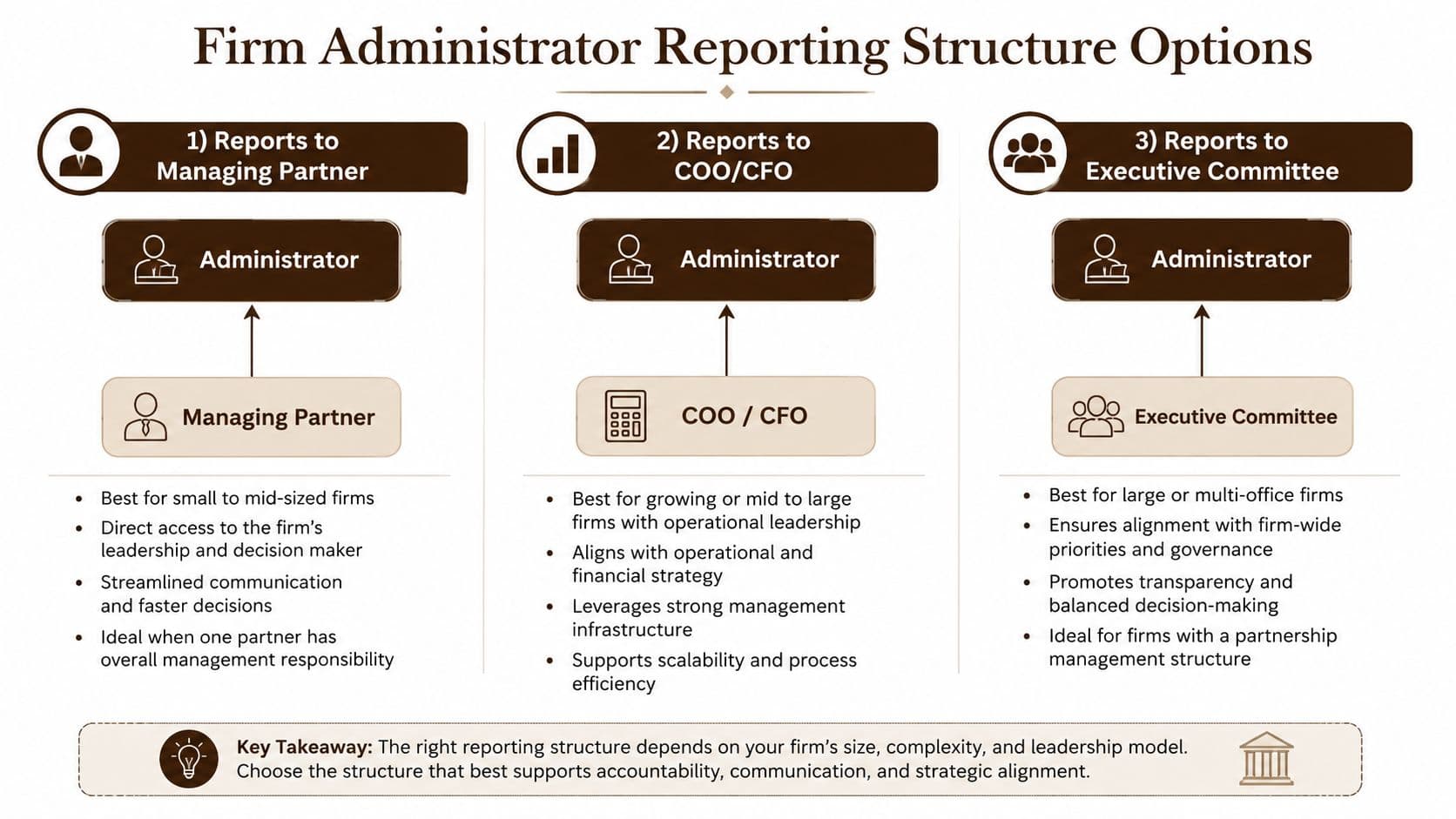
A direct report to the managing partner works when one partner has clear executive authority and will actively sponsor operational decisions. It creates speed and accountability, but it also creates a vulnerability if that partner changes roles or reverses decisions without consulting the administrator.
An executive committee model spreads governance across the partnership. It can build broader trust, especially where partners share authority, but it may slow decisions and expose the administrator to conflicting instructions. An operations committee can work well when the committee meets consistently and has documented decision rights. A COO or CFO structure is appropriate when the firm already has an executive layer and the administrator owns a defined operational portfolio.
Match the structure to the firm
For a very small firm, write a direct managing-partner reporting line and identify the administrator's authority over staff, vendors, and routine operations. For a growing firm, consider an executive committee with one named executive sponsor. For a complex firm, clarify whether the administrator reports to a COO, CFO, executive director, or managing board, and specify which decisions remain with the partnership.
The critical issue isn't the label. It's whether partners will let the administrator enforce policies consistently, including with partners who resist them. A posting that promises “strategic leadership” but gives no access to financial information, no staff authority, and no escalation path is a misrepresentation.
If the role may overlap with a broader legal-operations mandate, compare its scope with a legal operations director before choosing the title. The two positions can intersect, but the reporting relationship and decision rights should prevent internal confusion.
Sample Job Descriptions Calibrated to Firm Size and Structure
Use the samples below as working language, not as finished copy. Replace bracketed material with the firm's actual practice mix, systems, location, reporting line, and authority limits.
| Element | Small Firm (under 20 attorneys) | Mid-Sized Firm (20 to 75 attorneys) | Large or Multi-Office Firm (75+ attorneys) |
|---|---|---|---|
| Title | Firm Administrator or Office Administrator | Firm Administrator or Director of Administration | Firm Administrator, Executive Director, or Director of Firm Operations |
| Primary mandate | Run daily operations and remove administrative work from partners | Lead coordinated finance, people, technology, and facilities operations | Manage a defined portfolio within executive governance |
| Reporting | Managing partner | Managing partner or executive committee | COO, CFO, executive committee, or managing board |
| Financial scope | Billing coordination, expenses, bookkeeping oversight, vendor controls | Budgeting, reporting, collections workflow, accounting coordination | Multi-office reporting, controls, forecasting, and executive dashboards |
| People scope | Supervise all non-attorney staff and coordinate hiring | Lead managers and formalize HR processes | Coordinate HR, department leaders, and workforce planning |
| Technology scope | Own vendors and user adoption | Lead system projects and process improvement | Govern platforms, implementation programs, and cross-office standards |
| Best candidate profile | Hands-on generalist with sound judgment | Senior professional-services operator | Legal-operations or executive-management veteran |
Small-firm version
“[Firm name] seeks a hands-on Firm Administrator to lead daily business operations for our [practice area] practice. Reporting to the managing partner, this person will oversee non-attorney staff, billing and accounts-receivable workflows, vendors, facilities, technology coordination, onboarding, policies, and operational planning. The successful candidate will be comfortable working independently, improving processes, and raising concerns directly with partners.”
Mid-sized version
“[Firm name] is hiring a Firm Administrator to lead finance administration, human resources, technology coordination, facilities, vendor relationships, and strategic execution across our [location or offices]. Reporting to [managing partner or executive committee], the administrator will supervise operational staff, maintain the annual business plan and budget, support system implementations, prepare management reports, and coordinate cross-functional priorities.”
Large-firm version
“[Firm name] seeks a senior Firm Administrator to manage [portfolio] within a multi-office legal organization. Reporting to [COO, CFO, or executive committee], this leader will oversee operating plans, financial controls, technology and facilities programs, vendor governance, staff leadership, and executive reporting. The role requires experience managing complexity across offices, influencing partners, and delivering change through established governance.”
Customize the final paragraph for the practice area. A litigation firm should name matter workflows and discovery vendors. A transactional firm should identify deal-support and productivity systems. A trusts and estates practice should specify compliance calendars and client-fund controls.
Compensation, Bonus, and Benefits Guidance You Can Defend
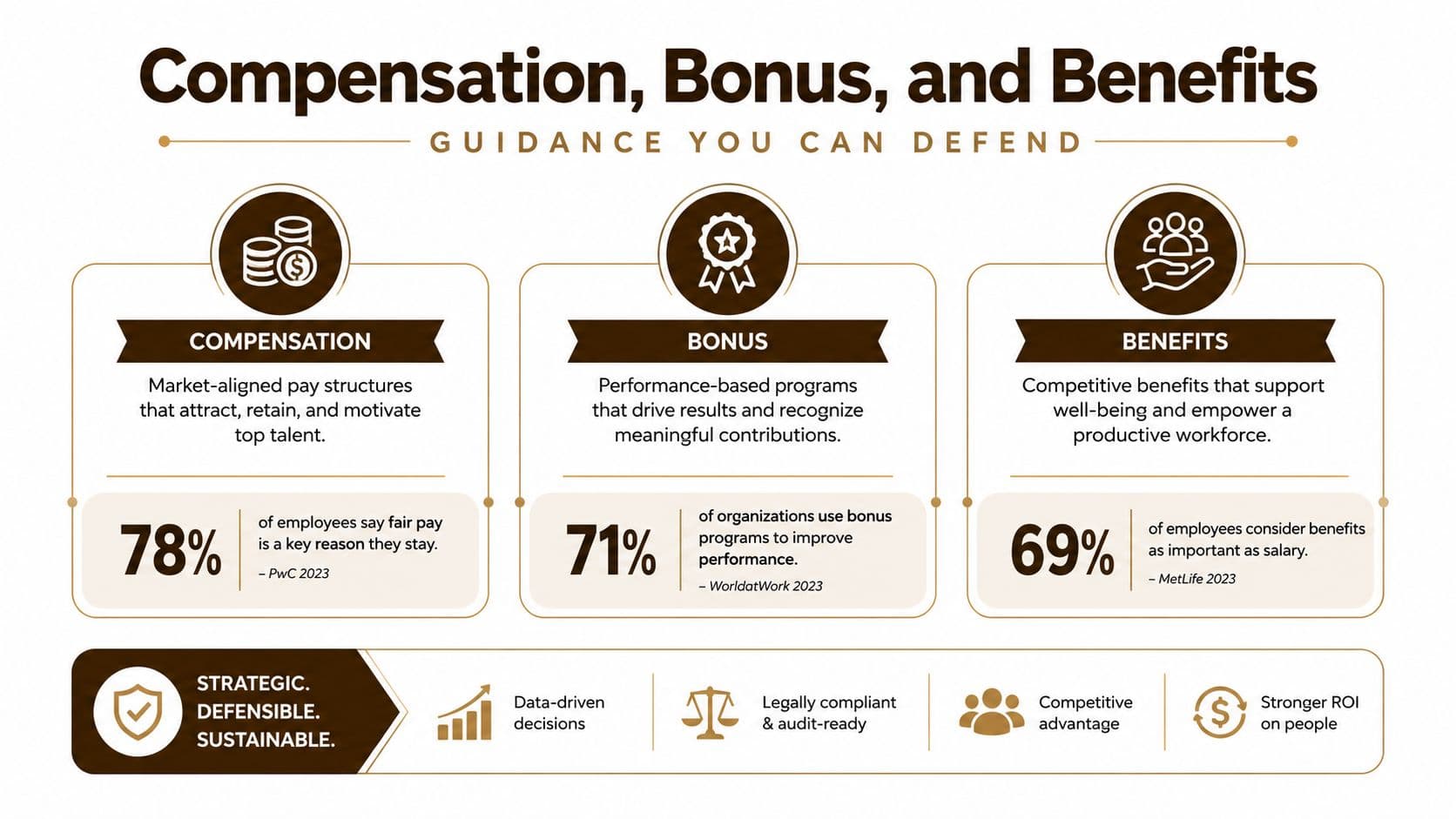
Compensation should match scope, authority, market, and complexity, not an administrator's position outside the partner track. Published estimates place the national average at $80,229 in one source and $70,547 per year in another, while reported roles range from $50,000 to $99,000 annually. Treat these figures as reference points, not an automatic salary band. The MMA firm administrator career source summarizes relevant compensation information.
Senior roles in larger or more complex firms can command $125,000 to $250,000, according to an industry forum. That range does not set a universal recommendation. It shows why a solo-practice administrator, a mid-sized firm operator, and a multi-office executive should not receive the same title, authority, or package.
Build the package around controllable outcomes
Base salary should carry most of the job's value. Use a bonus for outcomes the administrator can influence and document, such as completing a system implementation, improving reporting discipline, delivering an approved facilities project, or meeting agreed operational milestones. Do not base the entire incentive on firm revenue when partners control pricing, staffing, and origination.
Benefits influence the decision because candidates assess the full employment proposition. State whether the package includes health coverage, retirement benefits, paid leave, professional development, technology support, and workplace flexibility. If hybrid work is available, explain the arrangement, approval process, and office expectations instead of calling the role a “flexible environment.”
Firm size and practice area should shape the offer. A litigation administrator may need compensation that reflects discovery vendors and matter pressure. A transactional practice may place greater value on deal-support systems and productivity tools. A trusts and estates firm may prioritize compliance calendars and client-fund controls.
Partners sometimes underpay this role because it is not an attorney position. That ignores partner time, operational drift, failed implementations, unresolved employee issues, and repeated hiring. Pay for the mandate you want, then give the administrator the authority to deliver it.
Key Performance Indicators That Show the Role Is Working
A job description becomes operational when it states how the firm will know the hire is succeeding. Don't fill the posting with empty language such as “drive efficiency.” Identify the information the administrator will maintain, review, and present.
Financial measures
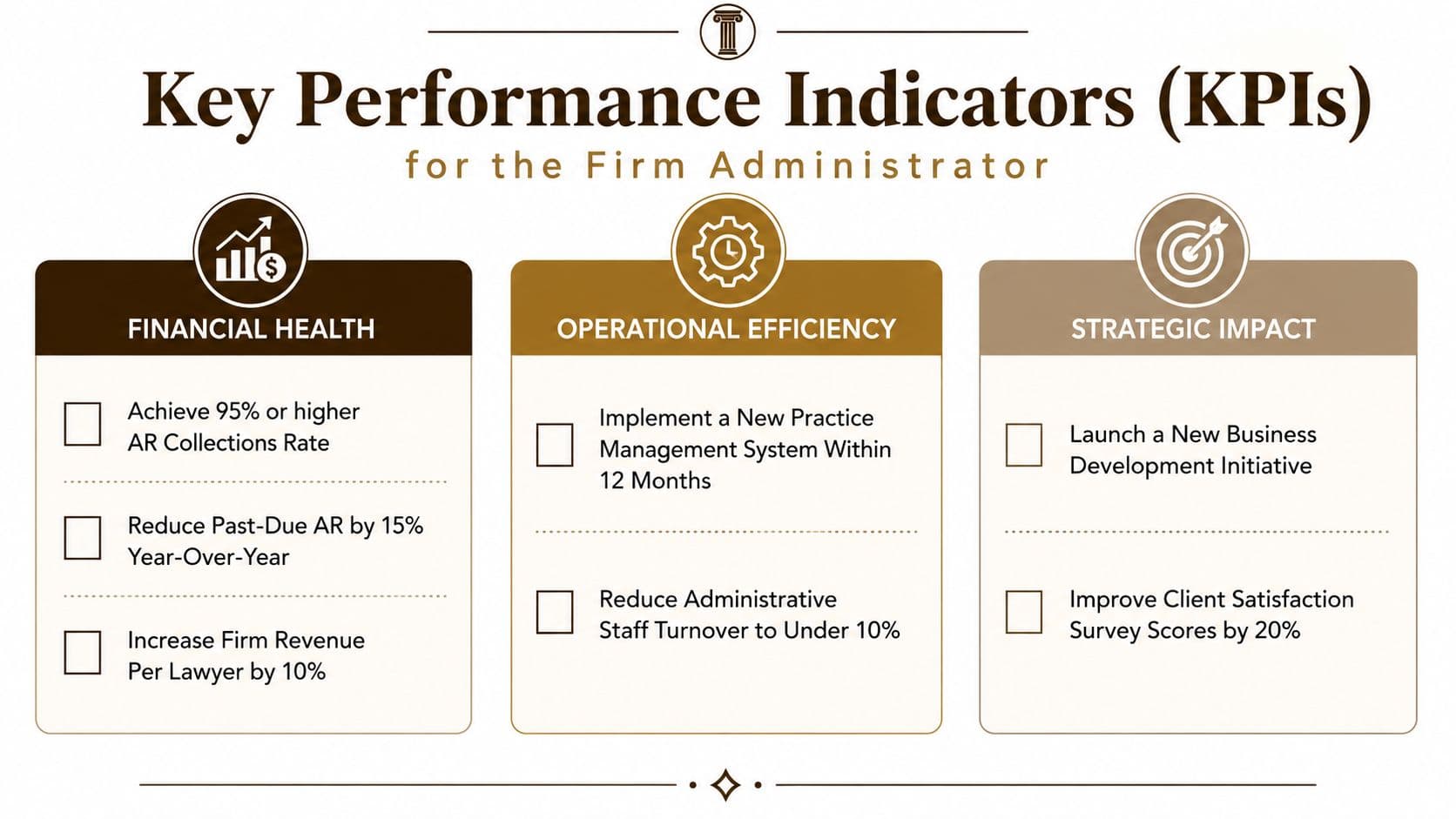
Use measures tied to the administrator's authority, not metrics controlled entirely by attorney behavior. Depending on the role, the dashboard may include:
- Billing workflow health: Track invoice preparation, approval delays, and recurring causes of rework.
- Accounts-receivable visibility: Report aging, collection activity, disputed balances, and escalation status.
- Budget discipline: Compare actual expenses with the approved budget and document meaningful variances.
- Vendor control: Review contract renewals, service issues, spending, and opportunities to consolidate suppliers.
The administrator shouldn't be punished for a partner's refusal to approve invoices or pursue a client balance. The posting should require reliable reporting and escalation, then define which decisions belong to partners.
Operational and people measures
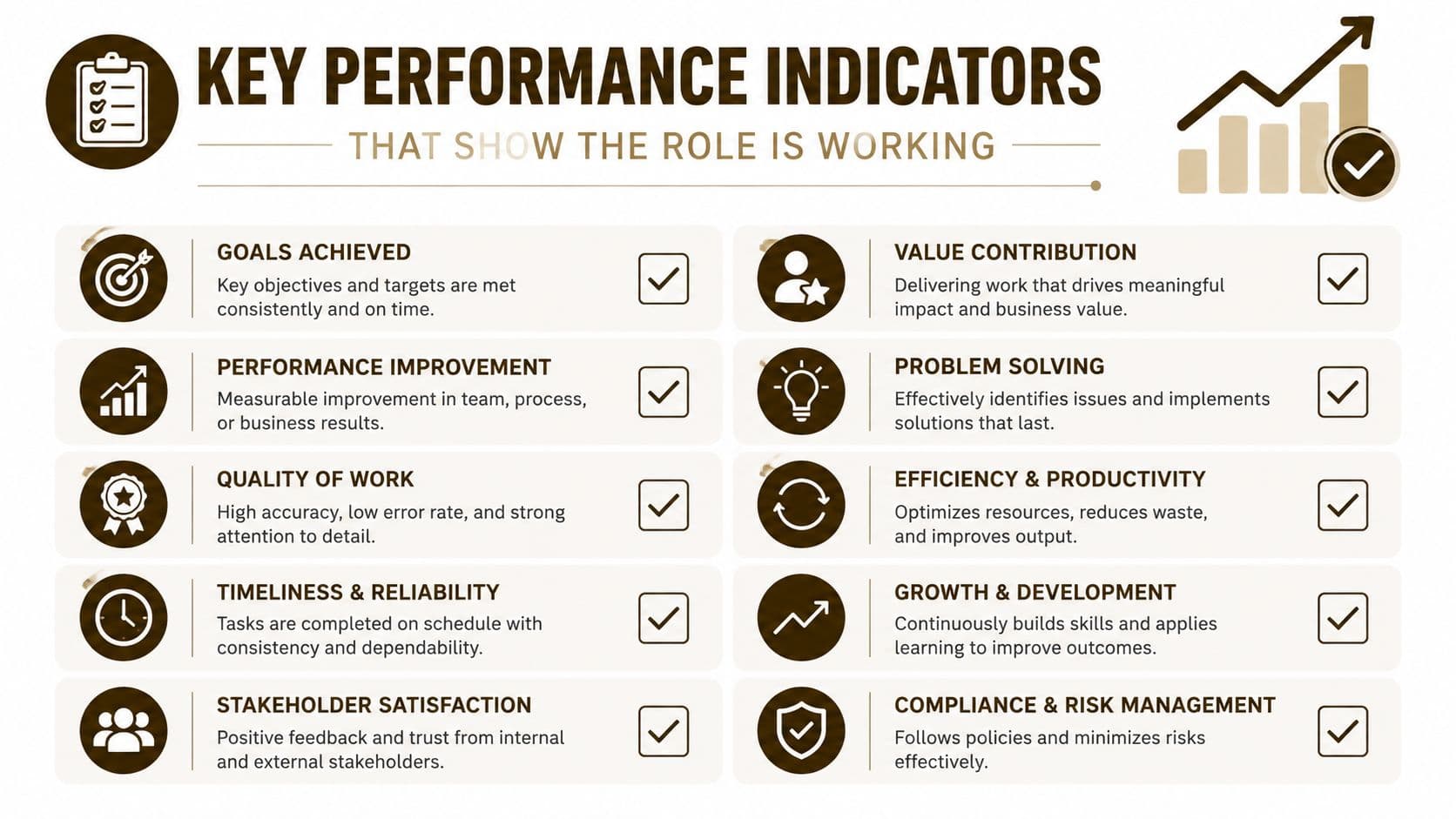
Operational indicators can include intake-to-opening time, matter turnaround, system adoption, vendor response, payment timeliness, and completion of documented procedures. People measures can include non-attorney retention, onboarding progress, time to productivity, employee feedback, and partner satisfaction.
Review a concise dashboard monthly with the managing partner or executive sponsor. Present a broader view to the partnership quarterly. Each metric needs an owner, a definition, a data source, and an agreed response when performance moves in the wrong direction.
A practical first-year framework is simple: establish the baseline, document the process, set a target with the partnership, and report the result consistently. Without that discipline, KPIs become decorative numbers rather than management tools.
Interview Questions That Reveal Real Operating Ability
A polished resume won't tell you whether a candidate can challenge a partner, recover from a billing breakdown, or lead a reluctant team. Ask for specific examples, then keep probing until you understand the candidate's actions, judgment, and result. This interviewer question guide can help structure the broader conversation.
Questions about operating judgment
Ask, “Tell us about a process you inherited that wasn't working. How did you diagnose it, who resisted the change, and what did you leave behind?” Strong answers identify the problem, stakeholders, sequence, communication, and follow-through. Weak answers blame previous employees or describe a software purchase as the entire solution.
Ask, “Describe a time a senior professional refused to follow a policy.” Listen for respectful persistence, written standards, escalation judgment, and consistency. A candidate who says they avoided conflict may struggle in a partner-led firm.
Questions about financial and systems work
Use a scenario: “The firm has growing receivables, attorneys disagree about billing responsibility, and clients are receiving inconsistent follow-up. What would you review first?” A capable administrator will ask for data, map ownership, identify exceptions, and create a repeatable review process. A weak answer jumps straight to demanding collections without diagnosing the workflow.
For technology, ask, “How would you evaluate a practice-management system that attorneys like but finance and support staff find unreliable?” Look for requirements gathering, data integrity, workflow testing, training, adoption measurement, vendor accountability, and a documented decision process.
Reference questions
Ask former supervisors whether the candidate could operate without constant direction, handle confidential matters, influence senior professionals, and finish difficult projects. Ask whether they would rehire the person for a role with comparable authority. The hesitation often tells you more than the initial praise.
Tailoring the Job Description to Practice Area and Firm Culture
The core administrator mandate stays consistent, but the operational risks change by practice. A generic posting misses that distinction and attracts candidates who can manage an office but don't understand the firm's pressure points.
Litigation practices
Emphasize matter lifecycle controls, intake, docket and deadline coordination, e-discovery vendor oversight, litigation-support resources, records management, and trial logistics. The administrator doesn't practice law, but they should understand how missed handoffs, late vendor decisions, and poor file discipline affect client service and case economics.
Transactional firms
Prioritize attorney productivity, deal-support tools, document systems, workflow capacity, client reporting, and flexible staffing models. Ask for experience improving collaboration across deal teams and managing peaks without building permanent overhead that the partnership can't sustain.
Trusts and estates practices
Give greater weight to compliance calendaring, document production, client communication, fiduciary workflows, and client-fund accounting controls where applicable. Detail the confidentiality and accuracy standards expected around sensitive family, estate, and financial information.
Mixed or multi-office firms
Specify the balance between local autonomy and shared standards. Candidates need to know whether they'll centralize vendors, coordinate office leaders, manage common systems, or preserve practice-specific workflows.
Culture should appear in observable terms. Replace “fast-paced” with “partners make decisions quickly, document them, and expect the administrator to execute without repeated approval.” Replace “team player” with “the administrator will resolve staff issues directly, communicate changes clearly, and escalate matters that require partner judgment.” Honest language helps the right candidates self-select and exposes the firm's own expectations.
Quick Reference Checklist Before You Post the Role
Use this block as a final audit. If the hiring committee can't answer an item, the posting isn't ready.
- Scope: Does the description identify finance, people, technology, facilities, vendors, and strategic work that belongs to the role?
- Authority: Can the administrator approve routine decisions, supervise staff, enforce policies, and escalate partner resistance?
- Firm tier: Does the title and mandate match the firm's size, office structure, and operational complexity?
- Qualifications: Are true requirements separated from preferences, with transferable professional-services experience considered?
- Reporting: Is one primary supervisor named, with a clear executive sponsor and escalation path?
- Compensation: Is the range defensible against scope, market, geography, and authority?
- Measures: Are the first-year deliverables and dashboard measures defined before interviews begin?
- Interview kit: Will every interviewer test judgment, financial fluency, change management, discretion, and partner influence?
- Practice fit: Does the posting reflect litigation, transactional, trusts and estates, or multi-office workflows?
- Candidate experience: Does the description tell applicants what decisions they can make and what support they'll receive?
The five common mistakes are predictable: calling a COO an office manager, listing every imaginable duty, requiring credentials instead of judgment, hiding the reporting line, and offering a bonus without defining success. Fix each one before publishing. Then have a prospective candidate or recruiter read the posting and explain the job back to you. If their explanation differs from the partners' understanding, revise the document.
Five Star Placements provides permanent placement for firm administrators and other legal operations leaders, using customized screening aligned with practice needs and organizational culture. If your firm needs help defining the mandate or finding candidates who can operate at the required level, visit Five Star Placements to discuss the search.
Need help filling a legal role?
Five Star Placements partners with law firms and legal departments nationwide.
Schedule a Call