
Paralegal Recruiting a Step-by-Step Hiring Playbook
July 7, 2026 · 18 min read · Five Star Placements
Table of contents
You know the scenario. A strong attorney is carrying a full matter load, deadlines are tightening, and a missing paralegal is turning routine work into a bottleneck. Discovery responses sit too long. Signature packets need another round of edits. Someone senior is doing work they shouldn't be doing, and clients feel the lag before leadership admits there's a hiring problem.
That's why paralegal recruiting can't be treated like administrative hiring. It's operational hiring. The wrong search process creates drag on billable work, attorney productivity, turnaround time, and client confidence. The right process fixes more than a vacancy. It restores flow.
Table of Contents
- Why Great Paralegal Recruiting Is Hard but Essential
- Defining the Role and Writing a Compelling Job Description
- Sourcing Candidates Beyond the Usual Job Boards
- Screening and Assessing for True Competency
- Conducting Interviews That Predict Performance
- The Offer Onboarding and Retention Playbook
Why Great Paralegal Recruiting Is Hard but Essential
A vacant paralegal seat rarely looks urgent on an org chart. It looks urgent inside a case file.
When firms miss on this hire, the cost shows up in small failures first. Drafts need extra revisions. Filing prep gets rushed. Attorneys start triaging administrative and substantive support work at the same time. That's when a search that seemed routine becomes a business risk.
The market doesn't make passive hiring any easier. The U.S. Bureau of Labor Statistics projects paralegal employment will grow 4.2% from 2022 to 2032, with about 37,300 annual openings for paralegals and legal assistants on average, according to the University of Cincinnati's summary of Bureau of Labor Statistics data. Consistent demand means qualified candidates usually have options, especially in stronger legal markets and in practice areas where attorneys need immediate support.
That changes the recruiting math. Firms can't rely on a generic posting, a loose interview, and a slow decision cycle. The strongest paralegals often self-select out of messy processes because they recognize disorganization when they see it.
What makes this role deceptively difficult to fill
Paralegal recruiting sits in an awkward middle ground. The role is often treated like support hiring, but the performance standard is closer to production hiring. You need judgment, precision, software fluency, deadline management, and the ability to protect attorneys from preventable errors.
Practical rule: If your team can't explain what a strong paralegal will own by day 30, day 60, and day 90, you're not ready to recruit.
The firms that hire well usually do one thing differently. They define the actual work environment before they touch the market. That includes pace, attorney styles, document volume, client contact expectations, and how the team collaborates when people aren't all in the same office.
That's also why many firms use a specialist rather than leaving the process entirely to a general HR workflow. A firm like Five Star Placements works specifically in legal recruiting, which matters when the distinction between a litigation paralegal, case manager, legal assistant, and legal operations support role affects the search from day one.
Defining the Role and Writing a Compelling Job Description
Most job descriptions fail before they're posted. They read like recycled HR inventory. Duties. Requirements. Benefits. Nothing that tells a capable paralegal what they'll be stepping into.
The fix is simple, but firms often skip it. Build the role first. Write the posting second.

Build the role before you write the posting
I call this the Role DNA exercise. Before anyone opens a template, define five things:
-
Practice context
A litigation paralegal supporting trial prep is not the same search as a corporate paralegal managing entity maintenance and closing binders. The title can be identical while the work is completely different. -
Attorney working style
Some attorneys want a paralegal who can run with a task and circle back at milestones. Others want close checkpoints. If you don't define this, you'll hire a mismatch and call it a skill issue. -
Tech stack
List the actual tools. Clio. NetDocuments. Relativity. CaseMap. iManage. Adobe Acrobat. E-filing platforms. AI-enabled legal research workflows. Generic “must be tech savvy” language tells serious candidates nothing. -
Work model
In-office, hybrid, or remote. Then go one step further. Does the team rely on Slack-style quick updates, formal email summaries, shared task boards, or cloud-based case management? Candidates need to know how work moves. -
Success standard
What does “good” look like? Fewer document errors? Faster case organization? Better deadline tracking? Cleaner attorney handoffs? Put that into words.
The market rewards technical fluency; in 2025, over 24,300 job postings were for paralegal roles, and employers increasingly prioritized candidates who combine legal expertise with modern legal technology and AI-enabled research skills, according to Robert Half's legal hiring research.
Write for the candidate you want
Once the Role DNA is clear, the job description should sound like a real opportunity, not a compliance form.
A weak version says this:
- Bad: “Responsible for supporting attorneys with legal research, drafting, filings, and administrative tasks.”
A stronger version says this:
- Better: “You'll support a fast-moving litigation team on discovery, deposition prep, exhibit organization, court filings, and deadline tracking. Success in this role requires strong command of document management systems, disciplined proofreading, and comfort managing multiple attorney priorities at once.”
For a corporate role, the contrast is just as sharp:
| Version | Example | ||---| | Generic | “Assist with contracts, corporate records, and legal documents.” | | Specific | “You'll maintain corporate records, support contract workflows, manage signature packets, coordinate closings, and keep entity documentation current across shared systems.” |
The best paralegals don't apply to vague jobs. They apply to jobs where they can see the work, the standards, and the team they'd be joining.
A compelling posting should also answer the questions candidates care about early:
- Who will they support
- What kinds of matters they'll touch
- Which systems they'll use
- How the team communicates
- What kind of judgment the role requires
If your posting reads like it could fit any firm in any city, it won't attract the people who can do the job.
Sourcing Candidates Beyond the Usual Job Boards
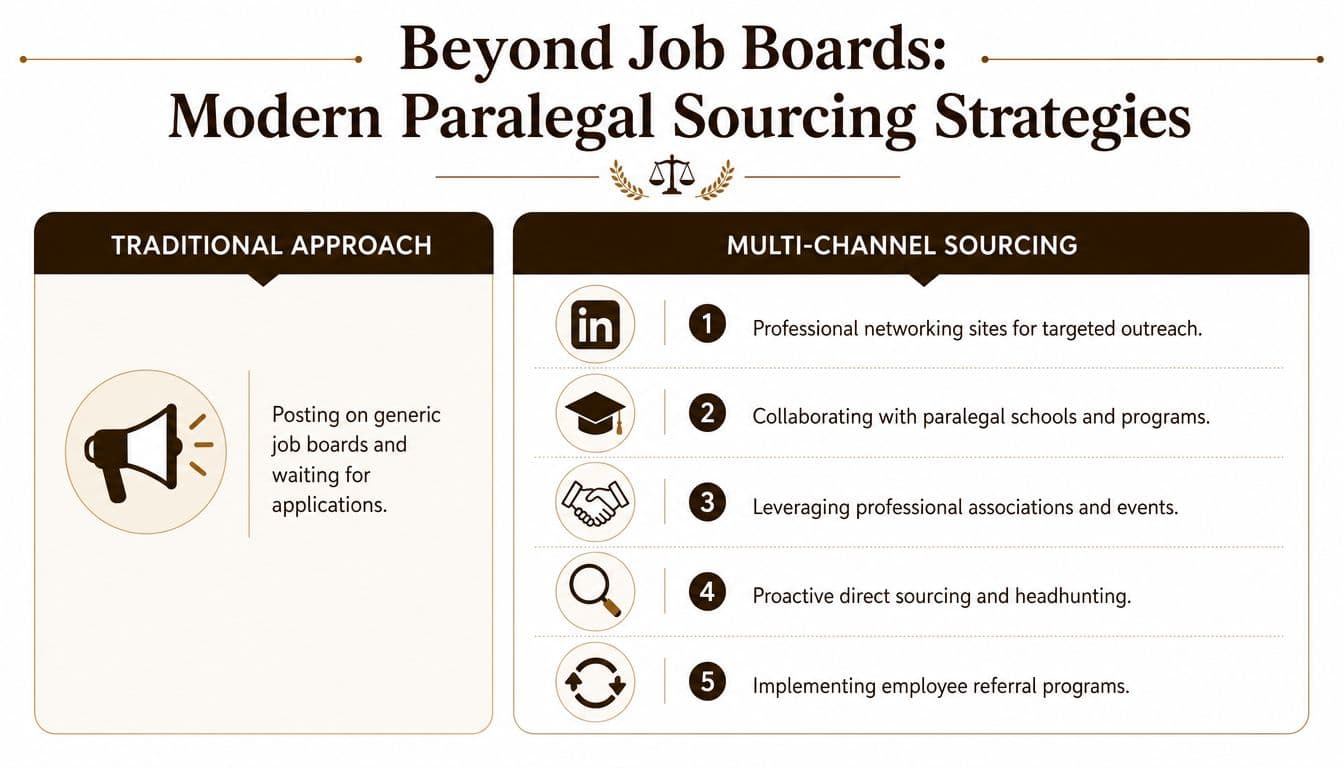
Posting a role and waiting is the weakest part of most paralegal recruiting processes. It produces volume, not precision. For some searches, volume helps. For many, it creates screening debt and slows the hire.
A better approach is to choose sourcing channels based on the role's difficulty, urgency, and specificity.
Which channels work for which searches
| Channel | Best use case | What works | What usually fails | ||---|---|---| | Employee referrals | Teams with strong existing staff | Higher trust and better context on fit | Firms that ask for referrals but give no role detail | | Legal-specific job boards | Standard roles with clear requirements | Better relevance than broad boards | Overly broad postings that attract mixed legal support profiles | | Professional associations and school networks | Junior to mid-level roles, niche practice pipelines | Access to engaged candidates with visible commitment | Treating association outreach like a generic ad blast | | Direct sourcing | Hard-to-fill or confidential searches | Reaches passive candidates not actively applying | Outreach that sounds automated or uninformed | | Specialist legal recruiters | Urgent, niche, or high-stakes hires | Better calibration, pre-screening, and market messaging | Handing over a vague intake and expecting magic |
The mistake I see most often is using all channels the same way. They aren't interchangeable.
When to use each channel
If the role is straightforward and the team can screen quickly, legal-specific boards and internal referrals can work well. If the search needs someone with a narrow mix of litigation support, eDiscovery exposure, and confidence with a particular document system, broad posting usually wastes time.
Professional networks are underused in legal hiring. Local and national paralegal associations, alumni connections, and program relationships often produce better conversations than a cold application queue. Candidates coming through those channels tend to have made a deliberate investment in the profession.
Direct sourcing is different again. It works when the recruiter understands the practice and can write a message that sounds informed. “We have a great opportunity” doesn't work. A note that mentions the type of docket, support structure, and workflow model does.
Good sourcing starts with targeting. If you can't explain why a candidate should leave their current role for yours, outreach won't land.
There's also a point where external support becomes practical, not optional. If the role has been open too long, the hiring manager is stretched thin, or the team keeps interviewing almost-right candidates, a specialist legal recruiter can compress the cycle by handling search design, outreach, and first-round calibration. That can include firms like Five Star Placements, which works on permanent legal placements across paralegal and legal support roles.
For most firms, the strongest sourcing mix looks like this:
- Use referrals first when you trust your internal team and can move fast.
- Use niche legal boards when the role is well defined and marketable.
- Use school and association outreach when you want commitment to the field, not just applicants.
- Use direct sourcing when you need precision.
- Use a legal recruiting partner when delay is already costing the business.
What doesn't work is relying on one channel because it's familiar.
Screening and Assessing for True Competency
A candidate looks strong on paper, interviews well on Zoom, and names all the right systems. Three weeks after starting, deadlines slip, document versions multiply, and attorneys stop trusting the work. That hiring miss usually starts in screening, not onboarding.
Resumes help with triage. They do not prove execution. In paralegal recruiting, the screen has to answer a harder question early. Can this person produce accurate work, inside your workflow, without heavy supervision?
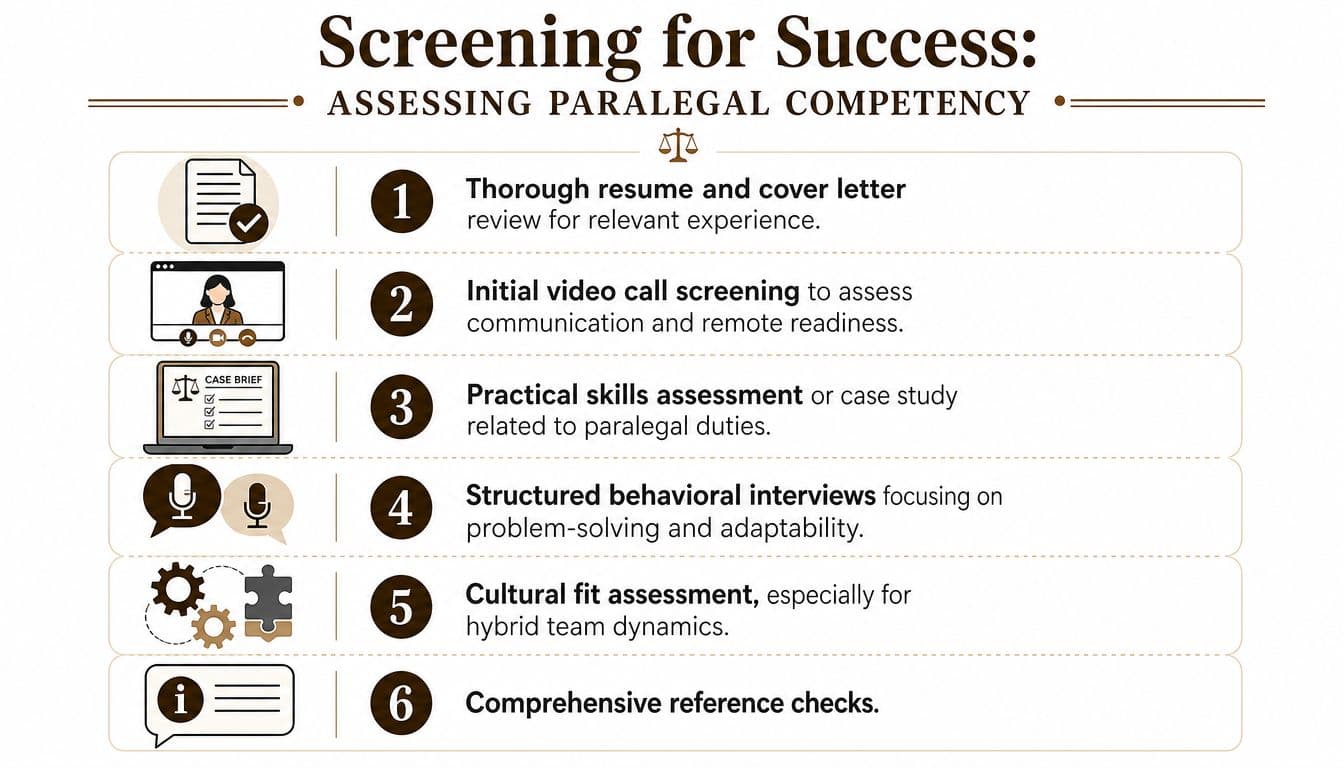
Start with a strict paper screen
I treat the application itself as the first work sample.
That does not mean rejecting every candidate for one small typo. It means reading the submission the way a partner reads a filing packet. Look for care, consistency, and whether the candidate understands what matters in legal support. Sloppy dates, inconsistent formatting, and vague descriptions of prior work often show up again on the job.
Review the application for:
-
Document accuracy
Spelling, formatting consistency, date alignment, and file naming discipline. -
Role clarity
Whether the candidate describes actual work product, attorney support, matter volume, or court and transaction exposure. -
Progression logic
Career moves that make sense by practice area, responsibility, or complexity. -
Tool specificity
Named systems such as Relativity, iManage, NetDocuments, Clio, CaseMap, PACER, or document management platforms used in prior roles.
A strong resume tells me what the candidate owned. A weak one hides behind phrases like “assisted with legal matters” or “supported attorneys with case management.” Those candidates may still be viable, but they need much harder testing before they reach the panel.
Test the work itself
The fastest way to improve screening quality is to add a short practical assessment. Fifteen to thirty minutes is usually enough.
The assignment should mirror the role's real pressure points. For litigation hires, I use exercises that expose attention to detail, deadline awareness, and file discipline. For corporate hires, I care more about version control, signature management, checklist follow-through, and whether the candidate spots missing approvals or incomplete closing documents.
Examples that work well:
-
Editing exercise
Clean up a short filing packet, fix formatting issues, and flag missing or inconsistent information. -
Deadline triage scenario
Review competing requests from two attorneys and set priorities with a short written explanation. -
Document organization task
Rename and organize a small set of matter files using a stated convention. -
Research summary
Read a narrow factual prompt and produce a concise internal summary with clear citations or source notes.
The goal is simple. See how the candidate thinks when the work gets concrete.
A short video perspective on legal assistant and paralegal screening can help hiring teams think more concretely about what they're evaluating:
Screen for technical proficiency in a way that holds up
Many firms ask candidates whether they are “comfortable with legal software.” That question produces useless answers.
Ask what they did inside the system. Did they build productions in Relativity or just review documents? Did they maintain workspaces in iManage or only retrieve files? Did they docket deadlines themselves, reconcile attorney calendars, pull PACER filings, prepare binders, or manage signature packets across multiple parties?
Then verify it with a task.
If the role depends on document management, give a document management problem. If the role depends on e-discovery, ask the candidate to explain a real workflow they handled, then test whether they can follow instructions in a basic mock exercise. Candidates who know the tools well tend to describe sequence, exceptions, and quality checks. Candidates who only touched the system at the margins stay general.
How to screen for hybrid and remote readiness
Hybrid recruiting created a separate screening problem. Good in-office support does not always translate into good distributed support.
Analysts at Scion Staffing, in its discussion of paralegal recruiting, argue that firms should evaluate digital collaboration skills alongside legal competence. That matches what I see in practice. Hybrid failures usually come from weak communication habits, poor task visibility, and confusion around ownership, not from a lack of baseline legal knowledge.
Ask questions like these:
- “How do you keep attorneys updated when a matter has several moving pieces and you are not working side by side?”
- “Which cloud-based systems have you used to manage documents, tasks, or case materials?”
- “Tell me about a time you had to clarify incomplete instructions asynchronously.”
- “When priorities from two attorneys conflict, how do you document, escalate, and confirm next steps?”
Strong candidates answer with process. They mention written recaps, shared task lists, naming conventions, deadline trackers, status notes, and confirmation habits. Weak candidates describe themselves as organized or responsive but cannot explain the mechanics.
Remote readiness is operational discipline.
I also screen for how the candidate learned to work. Some excellent paralegals developed in highly collaborative offices where they could ask quick questions in person and absorb process informally. That background is not a problem. It becomes a problem only when the current role requires independent follow-through, documented communication, and comfort working through ambiguity without constant visibility.
What the screen should prove before interviews begin
By the time a candidate reaches the interview stage, the hiring team should already have evidence on three points:
| Question | Evidence you want |
|---|---|
| Can they do the legal work? | Relevant experience plus a practical exercise tied to the role |
| Can they protect quality? | Clean application materials, careful assessment output, and reliable follow-through |
| Can they function in your workflow? | Specific examples of systems use, communication habits, prioritization, and hybrid work discipline |
That threshold saves time. More important, it changes the interview from basic verification to informed evaluation.
Conducting Interviews That Predict Performance
Interviews go off the rails when they become personality contests. The candidate sounds polished. The panel likes them. Everyone leaves saying they were “sharp.” Then the work starts and the fit falls apart.
A strong paralegal interview is structured, comparative, and tied to evidence from the screening stage.
Use a consistent interview flow
I prefer a five-part interview sequence.
First, spend a few minutes grounding the conversation in the actual role. Not a sales pitch. A realistic description of who they'll support, what kind of matters they'll handle, and where the pressure points are.
Second, move into behavioral questions about execution. Not generic strengths-and-weaknesses questions. Ask about workflow, mistakes, revisions, deadlines, and how they communicate when priorities conflict.
Third, do a technical deep dive. If they say they've managed discovery, ask what that meant. If they mention trial prep, ask which materials they owned. If they claim strong document management habits, ask how they structure files and version control.
Fourth, test judgment. Give them a realistic scenario with competing demands and incomplete instructions. Watch whether they clarify, escalate, sequence, and document their next step.
Fifth, leave time to sell the role authentically. Strong candidates are evaluating your process the same way you're evaluating them.
Questions that reveal how the candidate actually works
These questions tend to produce useful answers:
-
“Tell me about a time you caught a significant error in a legal document before it went out.”
Listen for the checking process, not just the story. -
“Walk me through how you manage multiple deadlines from different attorneys.”
Good candidates describe systems, prioritization logic, and communication habits. -
“Describe a matter where instructions were incomplete or changed quickly.”
You want to hear how they reduced ambiguity. -
“What parts of document management do you consider essential?” This surfaces discipline around naming, filing, and version control.
-
“How do you decide when to solve a problem independently and when to escalate it?”
This gets at judgment, which is often the difference between a useful paralegal and one who creates hidden risk.
Use follow-ups aggressively. “What happened next?” is often more useful than the original question.
A good interview answer names the task, the constraint, the judgment call, and the outcome. If the answer stays broad, keep drilling.
There's a reason firms are moving beyond conversation alone. A reported 63% of firms now require standardized technical assessments for paralegals before hire, and those scores correlate 0.74 with 12-month retention, according to Attorney at Law Magazine's discussion of hiring exceptional paralegals. That doesn't mean interviews are obsolete. It means interviews work best when they validate, probe, and interpret assessment evidence rather than replace it.
A few practical interview mistakes to avoid:
| Mistake | Why it hurts | ||---|---| | Letting each interviewer improvise | You lose comparability across candidates | | Overweighting likability | Friendly doesn't equal organized or accurate | | Skipping role-specific scenarios | You never see how the candidate reasons under realistic pressure | | Saving candidate questions for the very end only | You miss what they care about, which often reveals fit |
The panel should leave with written scores against defined criteria. Not vibes. Not general impressions. Criteria.
For paralegal roles, those criteria usually include:
- Accuracy and attention to detail
- Matter organization
- Deadline management
- Software and workflow fluency
- Communication style
- Judgment under pressure
- Fit for the team's pace and supervision style
When the process is disciplined, interview decisions become clearer. So do rejections.
The Offer Onboarding and Retention Playbook
A candidate accepts on Friday. By Tuesday, they are wondering whether they made a mistake.
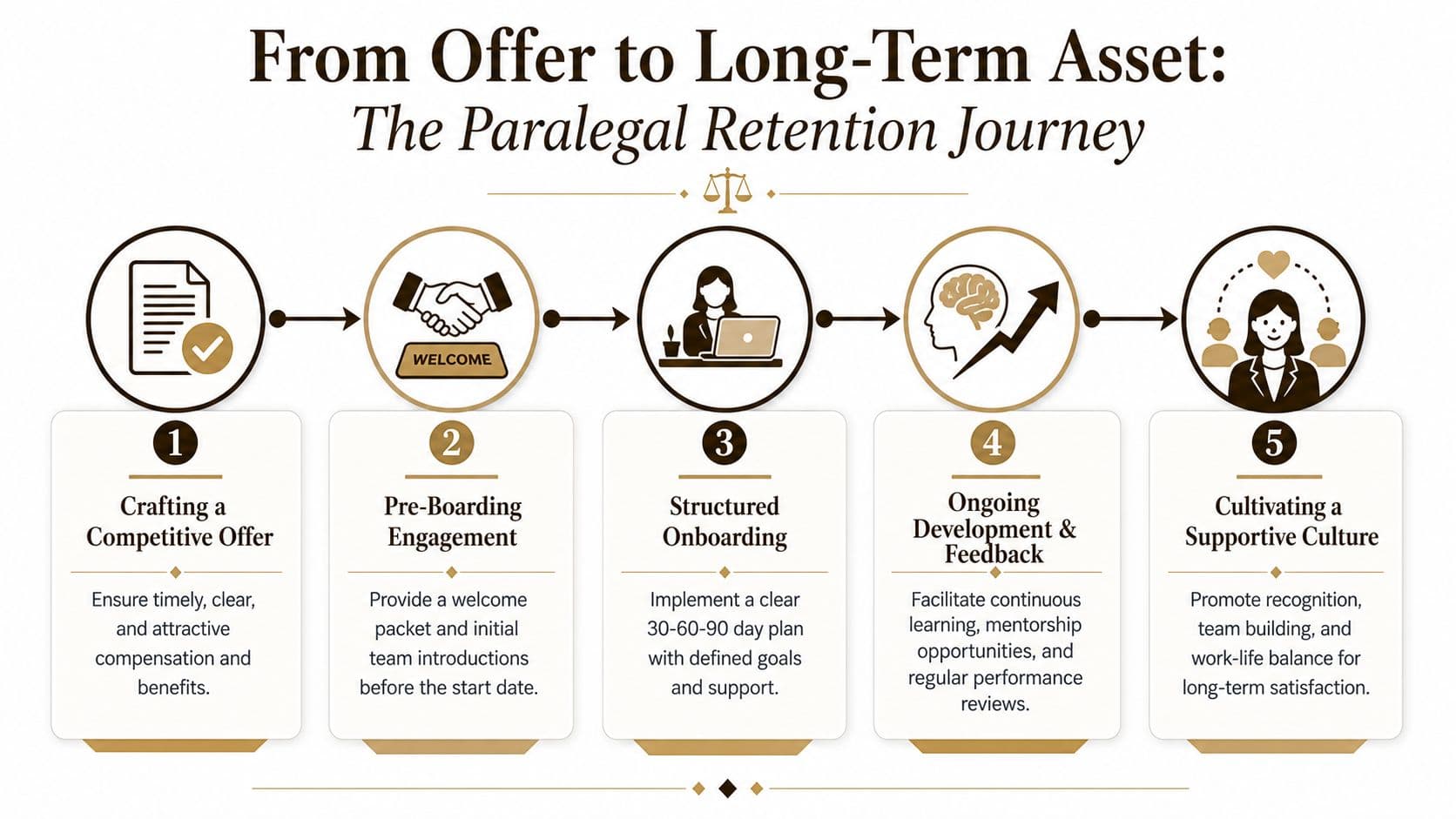
It usually happens for ordinary reasons. No laptop order. No clear start time. Conflicting answers about hybrid attendance. Silence from the supervising attorney. In paralegal recruiting, that gap between offer acceptance and first productive week is where avoidable attrition starts.
Close the candidate cleanly
Strong candidates read the offer stage as a preview of how the firm manages work. If communication gets vague after verbal acceptance, they assume supervision, deadlines, and resourcing may be just as loose once they join.
Spell out the full operating reality. That includes compensation, benefits start date, reporting structure, expected hours, overtime approach, and the actual hybrid schedule. If the role includes trial prep spikes, last-minute filing pressure, or heavy client contact, say it plainly. Good paralegals do not withdraw only over pay. They withdraw when the job they accepted starts changing shape.
The best offer calls also answer five practical questions:
- What should they be able to handle in the first 30 days
- Who is responsible for training and daily oversight
- Which platforms, databases, and document systems they will use on day one
- How assignments are delegated and reprioritized
- How corrections and performance feedback are delivered
Hybrid roles need one more level of specificity. Do not say “flexible” if the team really expects three in-office days, same-day responsiveness on remote days, and camera-on participation in matter reviews. A vague hybrid promise is one of the fastest ways to lose trust early.
Onboarding decides how fast the hire becomes useful
Orientation matters, but work design matters more.
A good paralegal onboarding plan gives the new hire enough structure to produce accurate work without constant rescue. That means system access before day one, a written first-month plan, sample work product, filing and naming conventions, escalation rules, deadline protocols, and one designated person who can answer procedural questions quickly. In hybrid teams, that level of clarity is not optional. Remote-ready candidates still need explicit operating rules. The difference is that strong ones will follow them consistently once you provide them.
The firms that retain paralegals well treat onboarding as a supervised proof period. They do not assume a capable hire will absorb local practice habits by osmosis. They show how the team handles drafts, redlines, docket updates, signature packets, closing checklists, and attorney handoffs. That is how technical skill gets translated into useful output inside your system.
New paralegals should never have to guess how your team names files, flags urgency, or routes a near-final draft for review.
A practical onboarding framework looks like this:
| Timeframe | Focus |
|---|---|
| First two weeks | Systems access, workflow training, template library, communication rules, hybrid logistics |
| First month | Narrow task ownership, quick review cycles, correction patterns, reliability on deadlines |
| Second month | Larger matter support, better prioritization, less procedural confusion, steadier independent execution |
| Third month | Consistent production, fewer preventable edits, stronger trust from attorneys and senior staff |
Retention usually turns on two questions. Does the paralegal know what good performance looks like here? Can they see a credible future if they perform well?
The second point gets ignored too often. Strong paralegals want to know whether the role leads to deeper specialization, informal team leadership, direct client coordination, or higher-value case and transaction support. If the answer is unclear, the firm becomes a stop on the way to a better-defined seat elsewhere.
If your team needs help pressure-testing an offer package or calibrating a hard-to-close hire, use the legal hiring contact page at Five Star Placements to coordinate permanent placement support.
Five Star Placements helps law firms and corporate legal departments hire paralegals and other legal professionals through permanent placement and customized screening. If your team needs help designing a tighter search process, calibrating candidates, or filling a hard-to-close role, you can learn more at Five Star Placements.
Need help filling a legal role?
Five Star Placements partners with law firms and legal departments nationwide.
Schedule a Call