
Partnership Track Law Firms Explained for Attorneys
September 8, 2026 · 14 min read · Five Star Placements

Table of contents
You're comparing two offers. Firm A says, “Partnership in seven years,” while Firm B offers a higher title but gives no clear timetable. Both firms have respected clients, strong practices, and partners who sound confident about your future. The difference is hidden in the structure behind the promise.
A partnership track isn't a countdown to a better title. It's a high-turnover funnel. Associates enter at the wide end, then face reviews, business-development expectations, compensation decisions, and increasingly selective promotion gates. Some become non-equity or income partners. Fewer reach equity. Others move laterally, become counsel, go in-house, or leave private practice.
That distinction matters for anyone researching partnership track law firms. You need to know how long the path takes, what each partnership tier means, how the pipeline narrows, and whether partners remain after promotion. Firms need the same information because an unclear track can weaken recruiting, increase attrition, and make succession planning harder.
Table of Contents
- Introduction to Partnership Tracks and Why They Matter Now
- How Partnership Tracks Work in Modern Law Firms
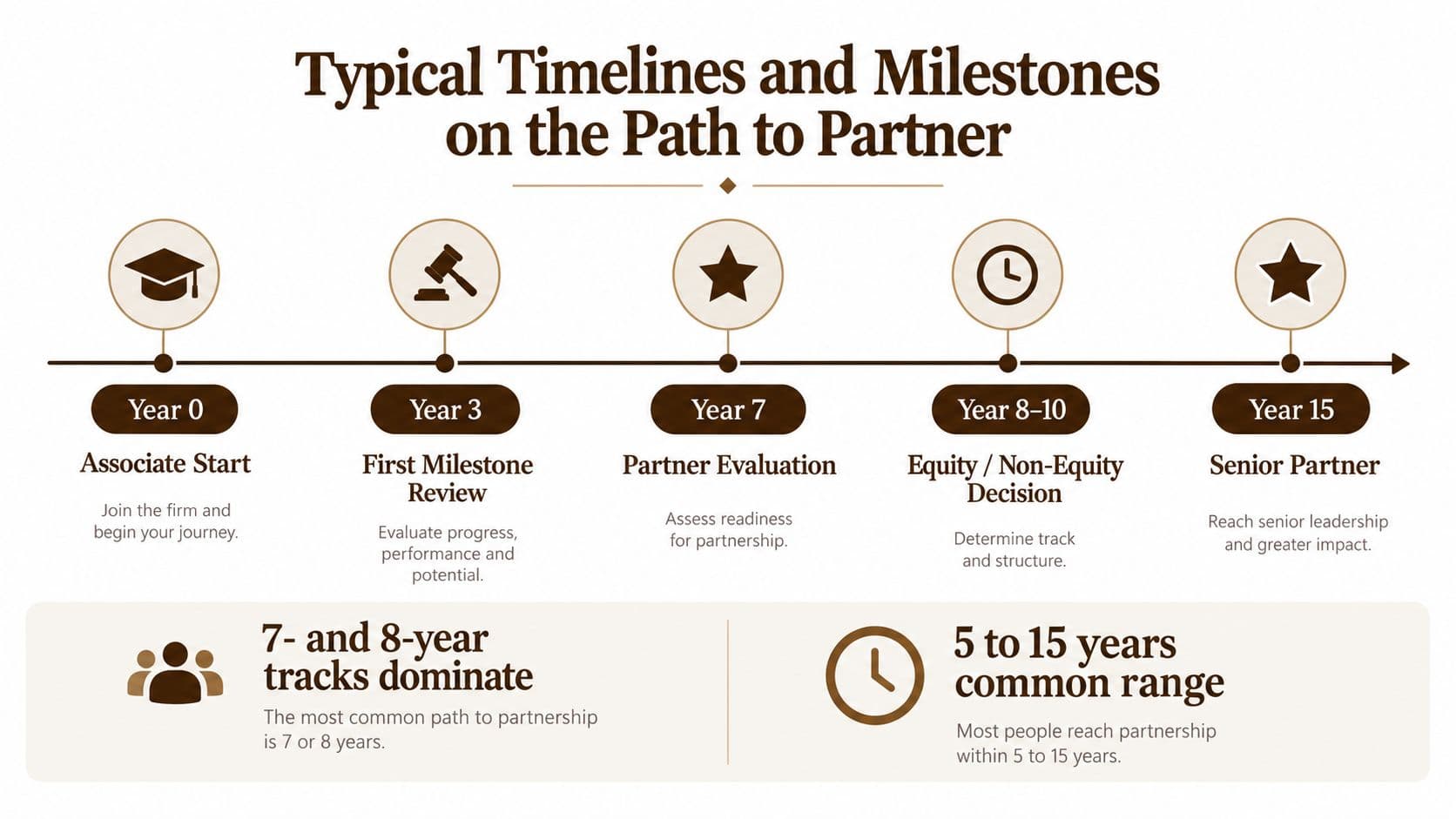
- Typical Timelines and Milestones on the Path to Partner
- Comparing Equity Non Equity and Modified Partnership Models
- Evaluation Checklist for Attorneys Choosing a Firm
- How Hiring Partners Should Design and Communicate Tracks
- Negotiation and Retention Strategies That Protect Your Future
Introduction to Partnership Tracks and Why They Matter Now
You receive an offer promising that you are “on track for partner.” Before treating it as a career commitment, ask what the phrase means at that firm. It may describe satisfactory associate performance, recognition by a committee, or a real decision to consider you for promotion. Those positions carry very different odds and expectations.
Partnership structures have also become more layered across major legal markets. The National Association for Law Placement reported that 64.5% of offices in its 2016 Directory of Legal Employers had two or more partnership tiers, compared with 34.6% in 1995 and 47.2% in 2001. The NALP partnership-tier research helps explain why “make partner” no longer names one standard promotion.
A defined seven-year track still may lead first to non-equity or income partnership, with equity considered later. Another firm may publish a shorter timetable yet have fewer equity openings because many associates support a smaller ownership group. One offer may provide clearer scheduling, while the other may offer a faster title change with more selective ownership decisions.
Recruiter's rule: Treat “partnership” as a series of business and ownership decisions, not as a guaranteed date on a calendar.
The practical questions are these:
- Timeline: How long do lawyers spend before each promotion decision?
- Selectivity: At which points does the pool narrow?
- Economics: Does the title include ownership, voting rights, or profit participation?
- Retention: Do lawyers remain after receiving partnership?
- Alternatives: What happens if equity is not the right fit?
A partnership track can support a strong career, but its value depends on the conditions attached to it. Before accepting an offer, request written criteria, historical promotion information, the firm's tier structure, and a candid explanation of what happens to attorneys who do not advance. Those details show whether the promise is a workable path or an attractive label.
How Partnership Tracks Work in Modern Law Firms
A talented associate can enter a firm expecting a ladder to partnership, then discover a funnel instead. Many lawyers join at the associate level, fewer receive any partnership title, and a smaller group reaches equity ownership. Each stage narrows the group, so the title and the odds behind it matter as much as the advertised timeline.
Associate stage
Associates are employees. The firm evaluates legal judgment, writing, client service, teamwork, workload management, and commercial potential. Early reviews often emphasize technical development. Senior reviews broaden the question: can this lawyer help create and retain profitable client work?
Non-equity or income stage
A non-equity or income partner may have a partnership title without owning a share of the firm's remaining profits. Compensation may look more like a salary, with bonuses or performance adjustments. Firms use this tier to recognize seniority, retain specialists, or assess whether an attorney is ready for ownership responsibilities.
That title can therefore represent either a bridge or a destination. Ask whether lawyers typically advance from the tier, remain there long term, or leave when equity is not offered.
Equity stage
An equity partner contributes capital, participates in profits, and usually has some voting or governance authority. The partnership agreement controls the precise rights. Equity partners also face greater exposure to firm performance, expenses, collections, client concentration, and shifts in practice demand.
Modified and counsel paths
Counsel, senior counsel, and modified partnership roles can suit lawyers who provide valuable expertise without seeking full ownership. These positions may involve less business development, specialized practices, flexible schedules, or a long-term substantive legal career.
The tiers separate different kinds of value. An outstanding litigator, tax specialist, or institutional client adviser may not want to originate work or manage firm operations. A lawyer who brings in substantial business may still spend time in a non-equity tier before taking on equity risk. Neither path automatically signals success or failure. The relevant question is how the firm defines and rewards each contribution.
The funnel also reflects a core economic concept. The American Lawyer's explanation of staffing ratios describes a comparison between total lawyers, excluding equity partners, and equity partners. A firm with a high ratio of associates and non-equity lawyers to equity owners can support substantial client work, while offering fewer ownership seats.
A partnership title alone does not answer the practical question. Confirm which tier the firm means, whether it is transitional or permanent, and how many lawyers its business model can support as owners. Those details show whether the funnel leads to a realistic equity opportunity or mainly supplies senior titles beneath a narrow ownership group.
Typical Timelines and Milestones on the Path to Partner
An associate may receive a promise of partnership after a set number of years, then discover that the promise describes consideration, not ownership. The calendar marks eligibility. The firm's staffing model determines how many lawyers can pass through the funnel.
NALP reported that 7-year and 8-year partnership tracks represented 38% and 48% of reported tracks, respectively, in 2016 to 2017. Together, those tracks accounted for nearly nine in ten reported defined paths, as shown in the NALP market data. Seven or eight years is therefore a useful reference point, not a guarantee of equity ownership at the end.
A later survey of newer partners found that 42% said their partnership track had become longer, while 39% said it hadn't changed. Less than 3% said it had become shorter, and about 16% were unsure, according to the partnership-track transparency report. The same coverage found that nearly 60% of lawyers who became partners spent 5 to 10 years before promotion, while another 31% spent 11 to 15 years.
What the milestones often signal
Early years usually test whether you can deliver reliable legal work. Later milestones test whether you can help sustain the firm as a business, through clients, profitable matters, and leadership.
By the middle of the track, ask whether the firm evaluates:
- Client ownership: Are you trusted to manage relationships, not only matters?
- Business development: Does the firm expect you to identify prospects and convert opportunities?
- Origination credit: Will the firm recognize work you bring in, and under what rules?
- Matter economics: Do realization, collections, staffing, and profitability affect promotion?
- Leadership: Do mentoring, recruiting, or practice-group management count?
- Market relevance: Does your specialty match the firm's growth plans?
Staffing structure explains much of the variation. The cited market analysis found that AmLaw 50 firms averaged 10.3 years to equity partnership, compared with 6.2 years at boutiques. A large firm may provide complex matters and a broad client platform while supporting many associates and non-equity lawyers around each equity owner.
A short track can be more selective than a long one. Ask how many lawyers entered the relevant cohort, how many reached each tier, and what happened to those who did not advance. Those figures reveal whether the stated timeline leads toward a genuine ownership seat or mainly toward senior titles below a narrow equity group.
The following video provides another visual explanation of partnership structures and career progression:
Comparing Equity Non Equity and Modified Partnership Models
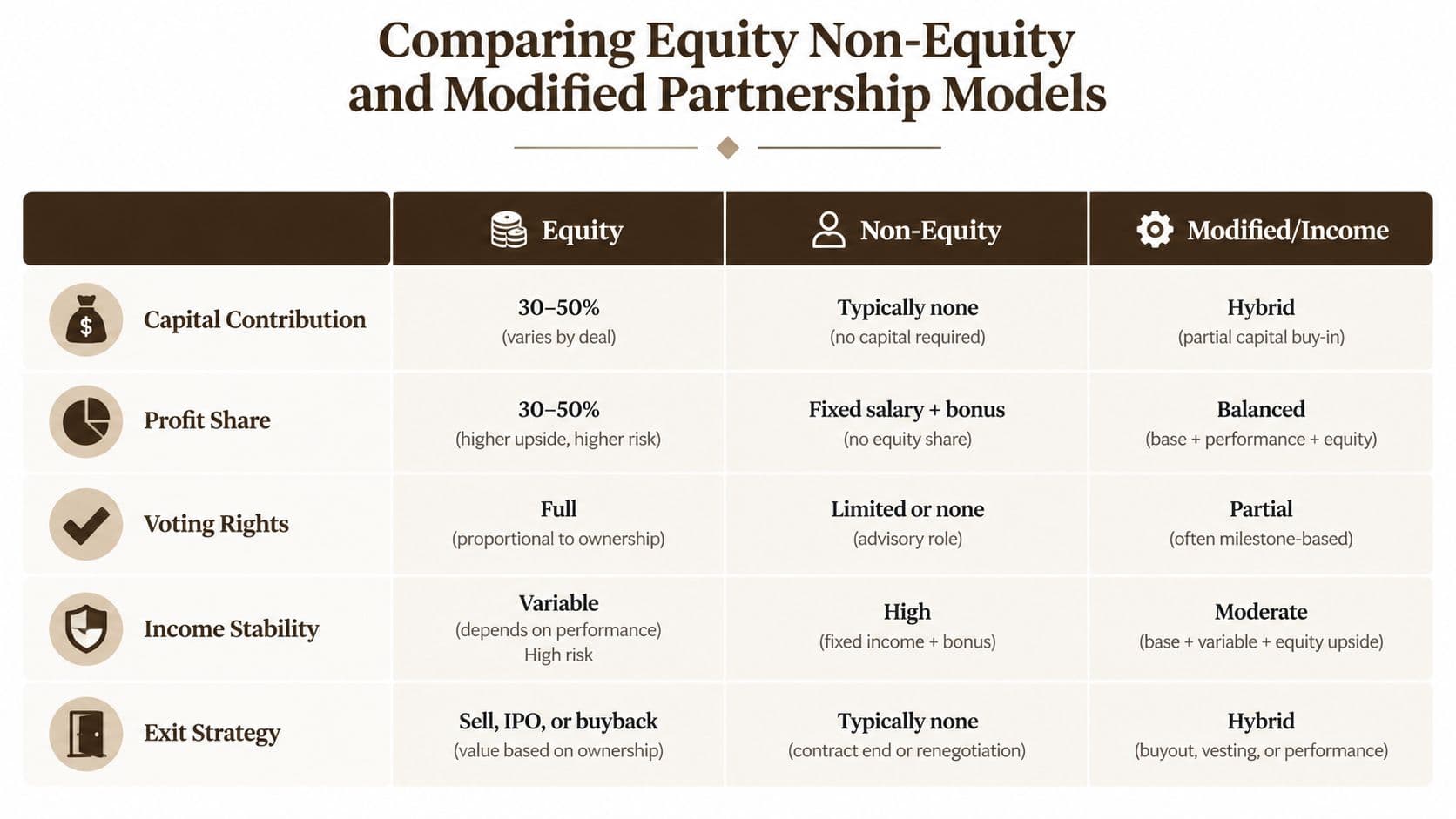
A partner title can mean ownership, seniority, client responsibility, or a higher compensation tier. Before comparing offers, identify what the title provides. The key question is whether you receive a share of profits, a vote in governance, or neither.
| Model | Compensation Structure | Ownership and Risk | Typical Advancement Path |
|---|---|---|---|
| Equity partner | Draws and distributions connected to firm profits | Capital contribution, profit risk, and governance responsibilities | Associate to partner consideration, then equity admission based on firm criteria |
| Non-equity partner | Salary, bonus, or other performance-based compensation | Usually no residual ownership, with less direct exposure to firm profits | Associate to non-equity partner, with equity consideration varying by firm |
| Modified or counsel role | Salary, fixed compensation, or custom arrangement | Limited ownership and a role-specific risk profile | Senior associate or partner alternative for specialists, reduced-hours lawyers, or attorneys not pursuing equity |
Equity partnership ties your financial results most closely to firm profitability. For AmLaw 50 firms, equity partners earned an average of $3.24 million in 2024, compared with $775,000 for non-equity partners, a 4.2 to 1 gap, according to BCG Attorney Search's law-firm economics analysis. The difference reflects ownership economics, but equity also requires capital and carries governance and performance risk.
The funnel narrows at each tier. A firm may hire a large associate class, move a smaller group into non-equity partnership, and admit only a limited number to equity. A non-equity title can therefore be a genuine senior destination or a waiting room below a tightly controlled ownership tier. Ask what percentage of non-equity partners have moved to equity, and over what period.
Non-equity partnership can make sense when the package is clearly defined. It may offer recognition, a senior client role, and compensation above the associate level. Treat the future promise cautiously if the firm cannot explain the conditions, decision makers, or expected timing for equity consideration.
Modified roles serve a different purpose. Counsel may suit a lawyer who wants high-level work and client contact without building a book of business. The role may also fit a specialist whose practice matters to the firm but does not fit its ownership model. Reduced-hours lawyers and attorneys who do not seek equity may find a clearer long-term arrangement in this tier.
Read the partnership agreement, compensation plan, and promotion policy together. An overview of partnership structures and law-firm career options can help organize your questions, but the firm's documents determine the offer.
- Choose equity-oriented opportunities if ownership, governance, and long-term profit participation matter most.
- Consider non-equity partnership if you want seniority and client responsibility with less capital exposure, after confirming whether equity advancement is realistic.
- Explore counsel or modified roles if specialist expertise, flexibility, or substantive practice matters more than ownership.
Evaluation Checklist for Attorneys Choosing a Firm
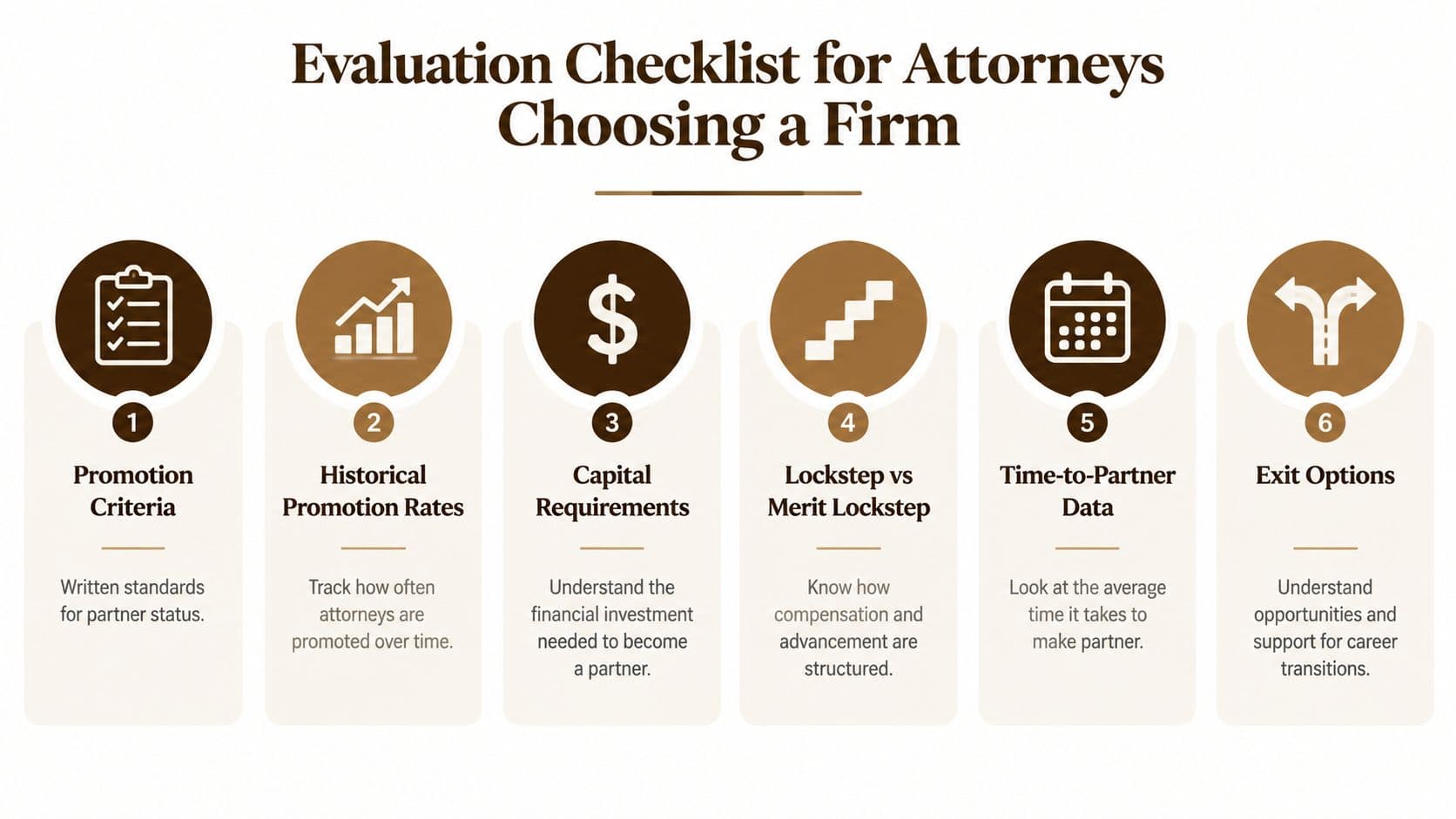
A polished recruiting pitch is a starting point, not due diligence. Ask the hiring partner to describe the track in operational terms, then compare that explanation with written policies and the experience of attorneys who recently moved through the system.
Promotion criteria
Request the actual standards for each stage. “Excellent work” isn't enough. You should understand how the firm weighs legal performance, client relationships, originations, collections, teamwork, leadership, and practice-area demand.
Ask whether the standards differ by practice group. A corporate partner pipeline may emphasize client development and matter flow differently from a litigation pipeline, where courtroom experience and case leadership may carry greater weight.
Historical outcomes
Ask for anonymized information about recent cohorts:
- Advancement: How many associates reached non-equity, income, or equity status?
- Timing: How long did those promotions take in practice?
- Departures: Where did attorneys go when they didn't advance?
- Retention: Do partners stay after promotion, or do they leave for competing firms?
- Lateral arrivals: Does the firm regularly fill partner roles from outside?
A neutral 2026 dataset reported an average of 12.4 years to partnership, 12% overall firm attrition, and female attrition of 14%, compared with 11% for male lawyers, according to the partnership-track talent analysis. Treat those figures as market context, not as a substitute for firm-specific answers.
Economics and mobility
Find out how your prospects are affected. Ask how many equity partners the firm has relative to its total lawyer population, whether the firm expects that ratio to change, and whether your practice is growing or contracting.
Also ask about origination credit, client ownership, compensation review timing, capital requirements, and what happens if the firm changes its partnership model. If you're considering counsel as an alternative, the comparison in of counsel versus partner roles can help separate title, ownership, and day-to-day responsibilities.
Red flag: A firm that can describe the destination but can't explain the gates, evidence, or recent outcomes is asking you to accept career risk without useful information.
How Hiring Partners Should Design and Communicate Tracks
Hiring partners should build partnership tracks as operating systems, not recruiting slogans. A credible track tells attorneys what the firm values, how it measures progress, and what happens when business conditions change. For an associate weighing offers, the track should function like a map, with visible milestones and clearly marked exits.
Start by separating the tiers. State whether non-equity, income, counsel, and equity positions are permanent, transitional, or practice-specific. Define the decision rights, compensation structure, client-credit rules, and ownership attached to each role. An attorney can choose intelligently only when “partner” has a consistent meaning inside the firm.
Connect criteria to the firm's economics
A firm should not imply that excellent legal work alone guarantees equity. If its business model requires a smaller ownership group, it should explain the difference between strong technical performance and equity readiness. The criteria may include client development, matter profitability, supervision, leadership, and whether the practice group can support another owner.
Staffing ratios should be part of the leadership conversation. A higher ratio of associates to equity partners may support strong profitability, but it can also create a narrower promotion funnel. The firm should show how many candidates typically enter the track, how many reach each tier, and how many ultimately receive equity. Without that math, a long track can look open while functioning as a high-turnover filter.
Make communication recurring
Annual reviews are too infrequent for a long track. Firms should schedule regular milestone conversations, provide written feedback, and document status after significant reviews. Each discussion should distinguish among meeting current expectations, developing toward partnership, and being ready for a defined promotion decision. A one-sentence status label is not enough. Attorneys need the evidence behind it and the next action required.
Partner mobility makes this discipline more important. Announced partner moves in London reached 349 in the first half of 2025, 30% above the prior year and 25% above the five-year average, according to Edwards Gibson's partner-moves reporting. In the United States, AM Law 100 partner attrition rose from 6% to 8% in 2025, according to the same verified data. These figures show why firms must treat retention and lateral competition as strategic issues.
Leadership teams can review law-firm partner recruiting considerations when setting search criteria and assessing how a lateral hire fits the existing promotion architecture. The strongest track states both opportunity and limits. That honesty may reduce short-term excitement, but it creates better alignment between the firm's economics and an attorney's career decision.
Negotiation and Retention Strategies That Protect Your Future
Candidates should negotiate clarity before negotiating title. Ask for the expected timeline, the criteria for each tier, the treatment of origination and client relationships, the review process, and the fallback role if equity isn't approved. You may not receive every term in writing, but the firm's willingness to answer precisely tells you something about its culture.
Compare the offer's economics with its selectivity. An attractive non-equity title may not compensate for an indefinite equity process. A longer track may still be worthwhile if the firm provides meaningful client access, credible promotion evidence, strong mentorship, and a practice with room to grow.
Firms can improve retention by making the path visible, rewarding contributions before equity, and treating counsel or modified roles as legitimate professional outcomes rather than failures. Partner retention also depends on lateral economics. Law-firm partner rates continued rising by 5.1% in 2025, which helps explain why experienced partners may consider outside offers, according to the verified market data. Firms need compensation, governance, client-credit, and practice-growth conversations before a competitor starts them.
Your next move should be practical. Write down the firm's stated timeline, identify every promotion gate, request recent outcome information, and speak with attorneys who have completed the process. If the answers remain vague, compare the opportunity with a lateral role, counsel position, or firm whose partnership model better matches your goals.
Five Star Placements provides permanent legal recruiting for attorneys, partners, legal support professionals, and in-house counsel, with customized screening for practice needs and organizational fit. If you're evaluating a partnership track or hiring partner-level talent, visit Five Star Placements to discuss a targeted search or career move.
Need help filling a legal role?
Five Star Placements partners with law firms and legal departments nationwide.
Schedule a Call