
Recruiting Law Firm Partners: A 2026 Playbook
August 5, 2026 · 13 min read · Five Star Placements

Table of contents
Am Law 200 firms hired 3,009 lateral partners in 2025, a 10% year-over-year increase. That's not a casual hiring market, it's a selective competition for partners who can move books of business, open doors in live matters, and justify the cost of change.
Hiring laterals in that environment takes structure, not instinct. The firms that win aren't the ones that spot a strong résumé, they're the ones that validate the mandate, test the portability, and run a process that protects the firm from an expensive mismatch.
Table of Contents
- Why Partner Recruiting Is Harder Than You Think
- Defining the Role and Culture Fit Before You Start Sourcing
- Sourcing Channels and Outreach Strategies That Actually Work
- Running Due Diligence and Structured Interviews
- Structuring Compensation and Equity Offers That Stick
- Evaluating Client Portability and the Verification Problem
- Onboarding, Integration, and Retention Playbook
Why Partner Recruiting Is Harder Than You Think
The market is already telling firms where the pressure points are. In 2025, Am Law 200 firms recorded 3,009 lateral partner hires, a 10% increase year over year, and litigation alone accounted for 26% of those hires, with corporate at 16% and government sources contributing 270 partner hires, or 9% of the total, according to Am Law 200 hiring stats for 2025. That concentration matters, because partner recruiting is not a broad talent grab. It's a fight for partners who can land in active, revenue-sensitive practices and produce quickly.
The mistake many firms make is treating the search like a senior associate hire with better title language. That's backwards. A partner hire changes the economics of a practice group, the politics of a firm, and the client mix a team can credibly serve. If the search team can't define what success looks like before outreach begins, the firm is usually buying hope, not capability.
The real risk is five-year failure
Independent legal recruiting commentary notes that traditional laterals are often only around 60% successful by the five-year mark, which is exactly why résumé-first hiring breaks down. The résumé tells you where someone has been. It doesn't tell you whether their clients will follow, whether they'll collaborate, or whether they'll hit the revenue assumptions built into the offer.
Practical rule: if a partner search starts with prestige instead of portability, the firm is already behind.
That's why structure matters more than charisma in the interview room. A strong process screens for real client demand, conflict cleanability, and the kind of practice fit that can survive once the relationship moves from courting to execution. Firms that want a useful outside benchmark can compare their process against a legal recruiting firm overview and ask whether the search is being run as a business decision or a networking exercise.
Defining the Role and Culture Fit Before You Start Sourcing
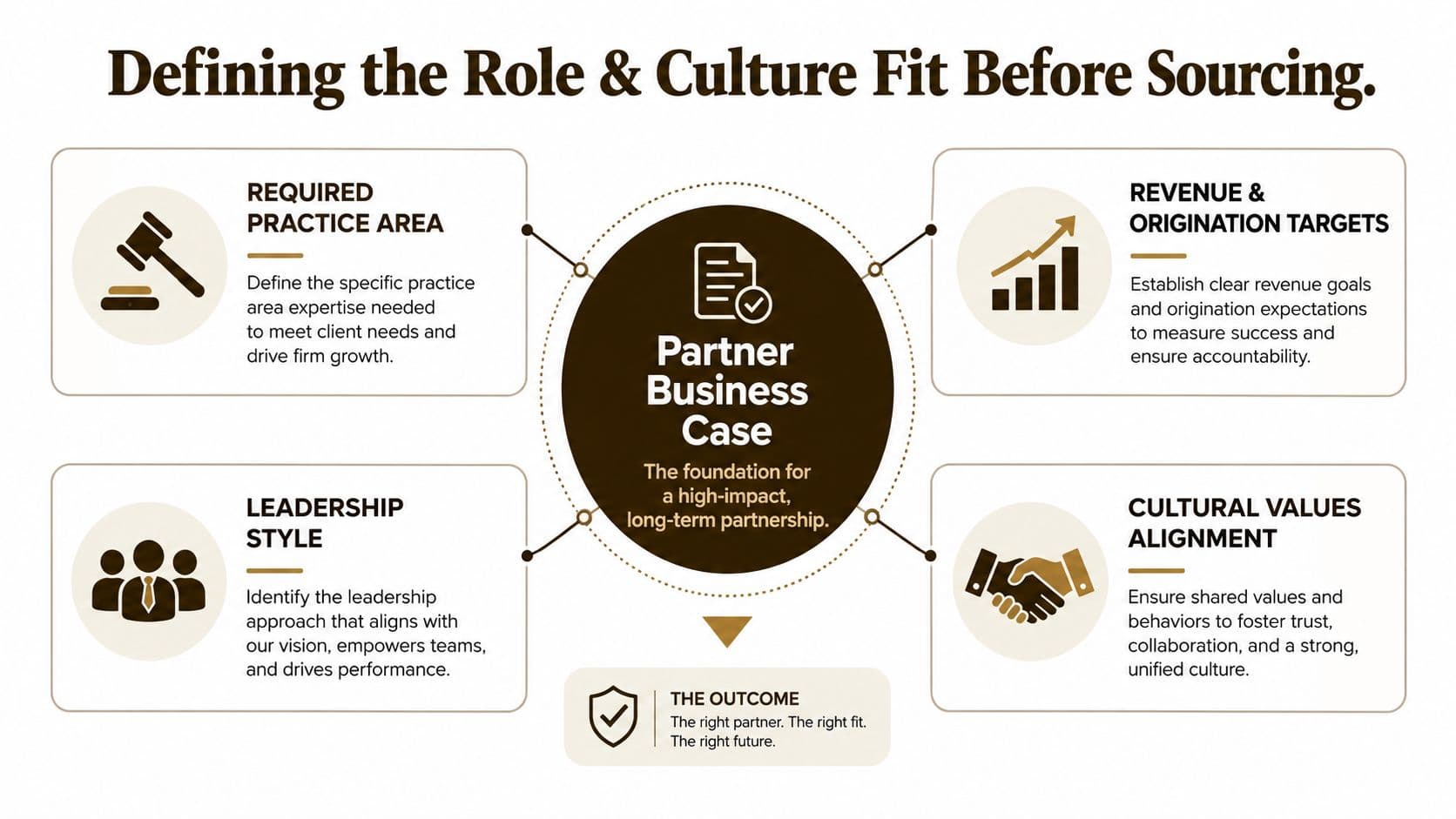
Most partner searches go soft before a single candidate is contacted, because the firm hasn't agreed on what it's hiring for. The cleanest way to avoid that failure is to write a partner business case first. Not a job description, a business case.
Write the mandate in plain business terms
The document should answer three questions. What practice area or sub-specialty is essential. What portable business is required. How will the firm know the hire is working after the first months of integration. That sounds basic, but in many firms those answers live in different heads, which is how candidates get mixed messages and committee members later claim they never meant to approve the deal.
The portability piece needs to be specific. Ask for 3 to 5 years of revenue history and a realistic projection of what can land at the new platform. Don't accept vague language about “significant relationships” or “strong market recognition.” Those phrases rarely survive conflicts review, compensation scrutiny, or the first serious business development discussion after the offer.
Culture fit needs a rubric, not chemistry
Culture fit gets abused because people use it as shorthand for comfort. That's a mistake. Comfort in an interview doesn't tell you whether a partner will delegate well, cross-sell, or operate in a committee-driven environment.
Use criteria the team can score:
- Leadership style: Does the candidate build teams or run solo?
- Client behavior: Are relationships institutional, or tied to one rainmaker?
- Collaboration habits: Will the partner refer work across the platform?
- Decision speed: Can the candidate operate inside your approval process?
The best business case I've seen was short, written, and a little uncomfortable, because it forced the firm to name what it really wanted instead of what sounded flattering.
When leadership, finance, and practice heads agree on the same mandate, the search moves faster and the offer conversation gets cleaner. Without that alignment, the firm spends weeks interviewing people for a role it can't describe consistently.
Sourcing Channels and Outreach Strategies That Actually Work
The best partner candidates don't usually apply. They're surfaced through networks, trusted introductions, conference conversations, alumni circles, and recruiters who understand the market well enough to qualify both sides of the deal. That's especially true when the firm needs confidentiality or when the role is narrow enough that public posting would only create noise.
Use each channel for a different purpose
Warm introductions work best when the firm already has credibility in the practice area. Conference pipelines are stronger for planting long-term relationships than for immediate hires. Alumni referrals help when you need cultural translation, because someone who knows your platform can usually tell you whether the candidate will thrive there.
A contingency recruiter becomes useful when the firm needs speed without guessing. Under a contingency model, the recruiter gets paid only when the hire closes, which aligns incentives better than a search arrangement that rewards activity over outcome. That matters in a market where moves are active, candidates are comparing options quickly, and firms can lose them by moving too slowly. Recent London partner-move reporting showed 548 announced partner moves in 2024 and 349 in the first half of 2025, a pace that stayed well above the five-year average, which is a useful reminder that hesitation has a cost in competitive markets, according to major London partner-move reporting.
Recruiter test: ask how the recruiter learned the candidate's name, whether the search is exclusive, and what prior examples support the outreach. Vague answers are a problem.
That verification discipline matters on both sides. Recruiters should be able to explain why the role exists and why the candidate fits it. Firms should be able to explain the mandate without sounding desperate or improvised.
For firms that want a contingency-based search partner, Five Star Placements' blog reflects the kind of market-facing, screened approach that fits this model, especially when the goal is to reduce wasted interviews and keep the search focused on qualified laterals.
Outreach should signal seriousness
The strongest outreach is short, specific, and respectful of time. Name the practice need, explain why the role exists, and state what the firm can offer. Don't oversell culture. Don't hide compensation forever. Don't send the same message to twenty partners and hope someone bites.
What works is precision. If the candidate sees that you understand their market, their book, and the reputational risk they're taking, the conversation feels credible rather than opportunistic.
Running Due Diligence and Structured Interviews
A partner interview should feel less like a personality test and more like a disciplined investment review. The question is whether the firm can underwrite the move, support the economics, and defend the role once the partner is in seat. That means firms should scrutinize their own mandate before they scrutinize the candidate.
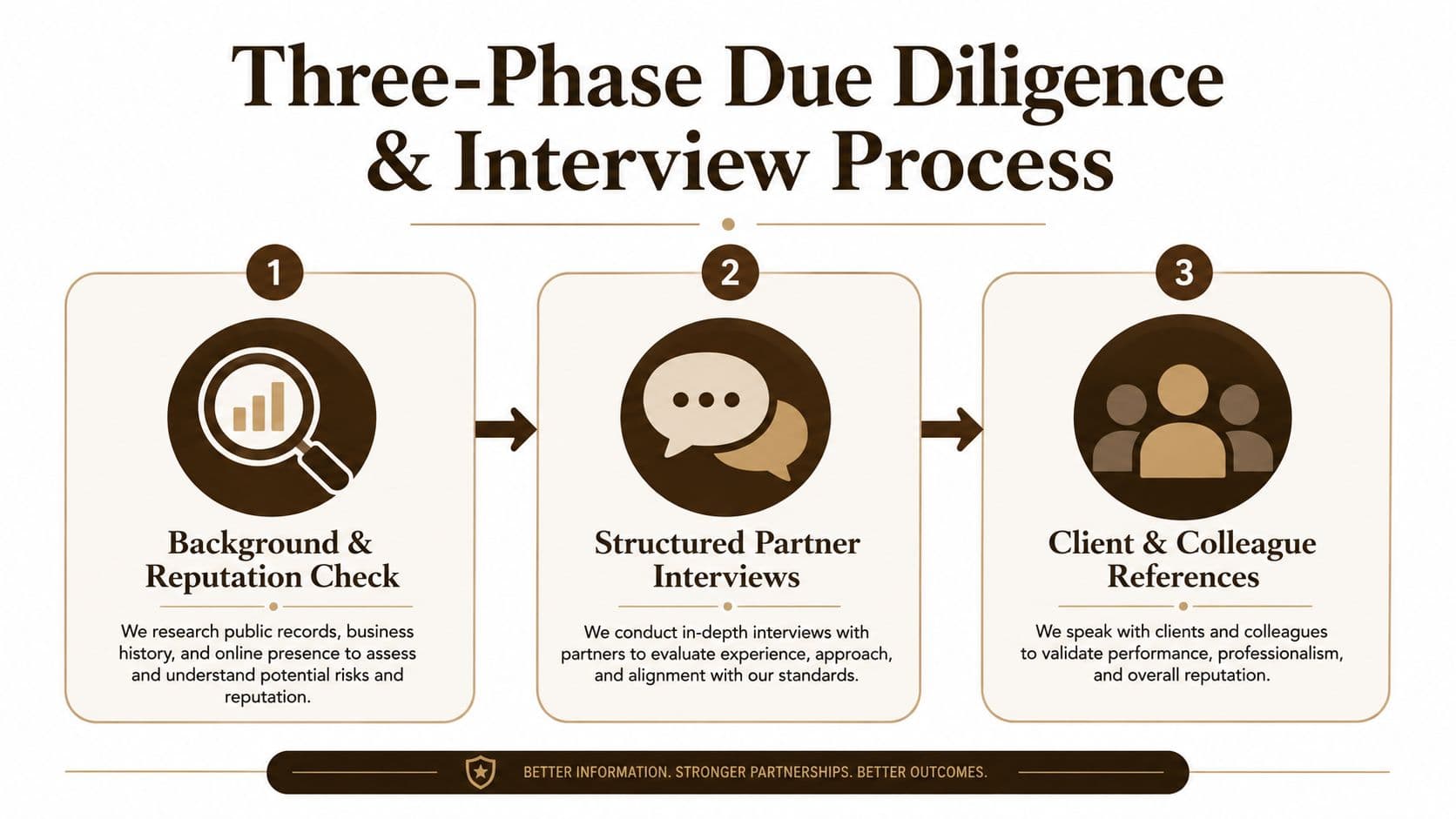
Use a three-phase diligence process
The most practical framework is simple. First, require a written business case with portable clients, revenue history, conflicts, and what the partner expects to bring onto your platform. Second, run structured interviews and have each interviewer record a written view of fit, risk, and expected performance before the group compares notes. Third, define post-join targets for integration, cross-selling, client portability, and the point at which the firm will reassess whether the move is working.
That structure exists for a reason. More rigorous lateral hiring can improve the odds of partner retention and later success over time, while loosely run searches tend to produce a familiar pattern, strong credentials, weak portability, and early disappointment. The point is not that process guarantees success. The point is that process gives the firm a better basis for saying yes.
Ask questions that expose real risk
Here are the questions that matter:
- Which clients are portable today, and which are aspirational?
- What conflicts could block the move before first billing?
- Who in the candidate's current team has to move for the economics to work?
- What evidence shows the candidate can cross-sell outside their core relationships?
The first filter is whether the book can move. The second is whether the firm understands the operational and ethical friction that can stop a lateral before launch. The third is whether the economics depend on people who are unlikely to leave. The fourth is the test most firms soften, because it is easier to admire a brand than to verify that the partner can generate business in a different setting.
The written prediction form changes the tone of the room. It forces interviewers to commit to a view before group dynamics take over, and it makes it harder to hide behind vague enthusiasm for pedigree or title. If someone cannot explain why the candidate should win on paper and in practice, the search is still underdeveloped.
If the interview team can't explain why a candidate wins on paper and in practice, the offer memo is too early.
Written accountability changes behavior. People slow down, ask sharper questions, and stop treating partner hiring as a prestige contest. That is how firms catch problems before they show up as damaged economics, strained integration, and a departure that could have been avoided.
Structuring Compensation and Equity Offers That Stick
Compensation is where many partner searches break down. The number can look acceptable on paper and still fail if the structure rewards the wrong behavior or promises more than the book can support.
Pay for portability, not title
A partner who brings modest portable business should not receive the same structure as someone with durable client relationships and deep origination. The offer has to reflect the reality of the move, not the prestige of the previous platform. If the economics assume more revenue than the business case supports, the firm is setting up a future dispute.
Speed and clarity matter here. Candidates compare firms that speak plainly about compensation with firms that stay vague until late-stage negotiation, and the vague firm usually loses. In a market with constant partner movement, firms that define the economics early have a real advantage because they reduce uncertainty before it starts to spread through the process.
Structure should reinforce retention
Alignment has to be built into the offer:
- Revenue thresholds: Tie protection or guarantee periods to verifiable portability.
- Vesting logic: Don't let equity vest before the partner has integrated.
- Draw design: Make sure cash flow supports the transition without over-subsidizing underperformance.
The risk is easy to see. A generous guarantee can win the hire and lose the retention. The partner may come in satisfied on day one and misaligned by month nine if the economics do not reward the behaviors the firm needs.
Practical rule: if the offer rewards arrival more than contribution, the firm is paying for a headline, not a result.
Compensation talks also need to happen earlier than many committees are comfortable with. Delayed disclosure creates distrust, especially with candidates who are already fielding competing offers. A clean, early discussion does not cheapen the process, it makes the process credible.
Evaluating Client Portability and the Verification Problem
The biggest lie in partner recruiting is usually not malicious. It's optimistic. Candidates believe relationships are portable. Firms believe the candidate's estimates. Then the business case collapses after onboarding.
Verify the book, don't inherit the assumption
One market snapshot cited in the brief notes that candidate client portability averaged 57%, which means nearly half of expected business may not follow unless the firm validates accounts, relationship depth, and conflicts early. That's not a technical detail, it's the central risk in the search.
A partner may have a strong reputation, but the firm still has to ask: Which clients control the work? Which contacts are strategic sponsors rather than familiar names? Which matters are split across other counsel, procurement rules, or internal legal teams that won't move easily? Those questions sound blunt because they are blunt, and they need to be asked before the offer goes out.
Team moves don't solve the problem by default
Firms often assume that if one partner is promising, the team will travel with them and make the economics work. That assumption is dangerous. Each person on a moving team should be assessed separately because team cohesion in one environment doesn't guarantee success in another.
A partner who works well with a senior associate and a paralegal at one firm may not recreate that dynamic after the move. The same is true for revenue. The firm needs independent evidence for each person who is expected to contribute materially.
Don't confuse familiarity with portability. A client who likes the team in theory can still stay put when the invoice changes.
The verification problem is also a search-quality problem. If the recruiter or hiring team never pressures the candidate to show proof, they're not really recruiting a partner, they're negotiating against a story. The smartest firms treat claims as starting points and ask for enough documentation to make the business case believable before any final commitments are made.
Onboarding, Integration, and Retention Playbook
The hire isn't done when the offer is signed. It's done when the partner is producing, cross-selling, and embedded in the firm's operating rhythm.
Build the first 24 months on purpose
The first 30 days should focus on introductions, systems access, and a clean explanation of who owns what internally. The first 90 days should translate the business case into a working plan with concrete cross-selling targets. The first-year review should test whether the partner's real behavior matches the expectations set during diligence.
A dedicated integration sponsor makes this work. Not a ceremonial sponsor, a real one who answers questions, clears blockers, and keeps the partner connected to the people who control resources. Without that person, the hire can look good on paper and still drift into isolation.
Practical rule: early silence is not neutrality. It usually means the integration plan was too soft.
This is also where contingency recruiting support can matter after the hire. Five Star Placements provides candidate interview coaching, training aligned to client processes, and ongoing communication designed to reduce vacancy drag and keep the search moving toward actual placement outcomes, and its contact page is available at Five Star Placements contact information. That kind of support is most useful when the firm wants the hiring process and the post-offer transition to feel connected rather than disconnected.
Track the right post-join signals
The metrics should be practical, not decorative:
- Time to productive: How long before the partner is meaningfully contributing.
- Cross-sell rate: Whether the hire is creating work outside the original book.
- Client portability realization: How much of the expected business followed.
- Integration check-ins: Whether the sponsor is catching friction early.
If those numbers are weak, the problem is usually upstream. Either the mandate was unclear, the portability was overstated, or the compensation structure rewarded the wrong thing. Good onboarding can rescue a promising hire, but it can't fix a broken thesis.
If your firm is recruiting law firm partners and wants a process that starts with role validation, portability screening, and structured follow-through, Five Star Placements can support that search with contingency-based legal recruiting for partner and lateral placements. Talk with them when you want a search built around screened candidates, practical qualification, and a model tied to results, not speculation.
Need help filling a legal role?
Five Star Placements partners with law firms and legal departments nationwide.
Schedule a Call