
Lateral Attorney Recruiting: A Strategic Playbook
August 2, 2026 · 13 min read · Five Star Placements

Table of contents
Lateral attorney recruiting looks like a growth lever until you check the exit data. In the most recent comparable NALP figures, 3,535 lateral hires were reported across 305 law offices/firms, with total hiring up 16.4% in 2025 versus 2024. That rebound matters, but the lesson is harsher, lateral hiring is not a vacancy-fill exercise, it's a 24-month ROI decision with retention, portability, and integration risk built in. NALP's 2026 lateral hiring release makes that clear.
The firms that win in this market don't chase names. They define the work, test whether the revenue is portable, and put a real integration plan around the hire before the offer goes out. If you skip those steps, you're not recruiting talent, you're buying uncertainty at a premium.
Table of Contents
- The Current State of Lateral Attorney Recruiting
- Defining the Strategic Need Before Sourcing Candidates
- Building a Data-Driven Sourcing and Screening Funnel
- Evaluating Candidates Beyond the Resume
- Structuring Offers and Managing Compensation Risk
- Onboarding and Integration for Long-Term Retention
- Your Lateral Recruiting Action Checklist
The Current State of Lateral Attorney Recruiting
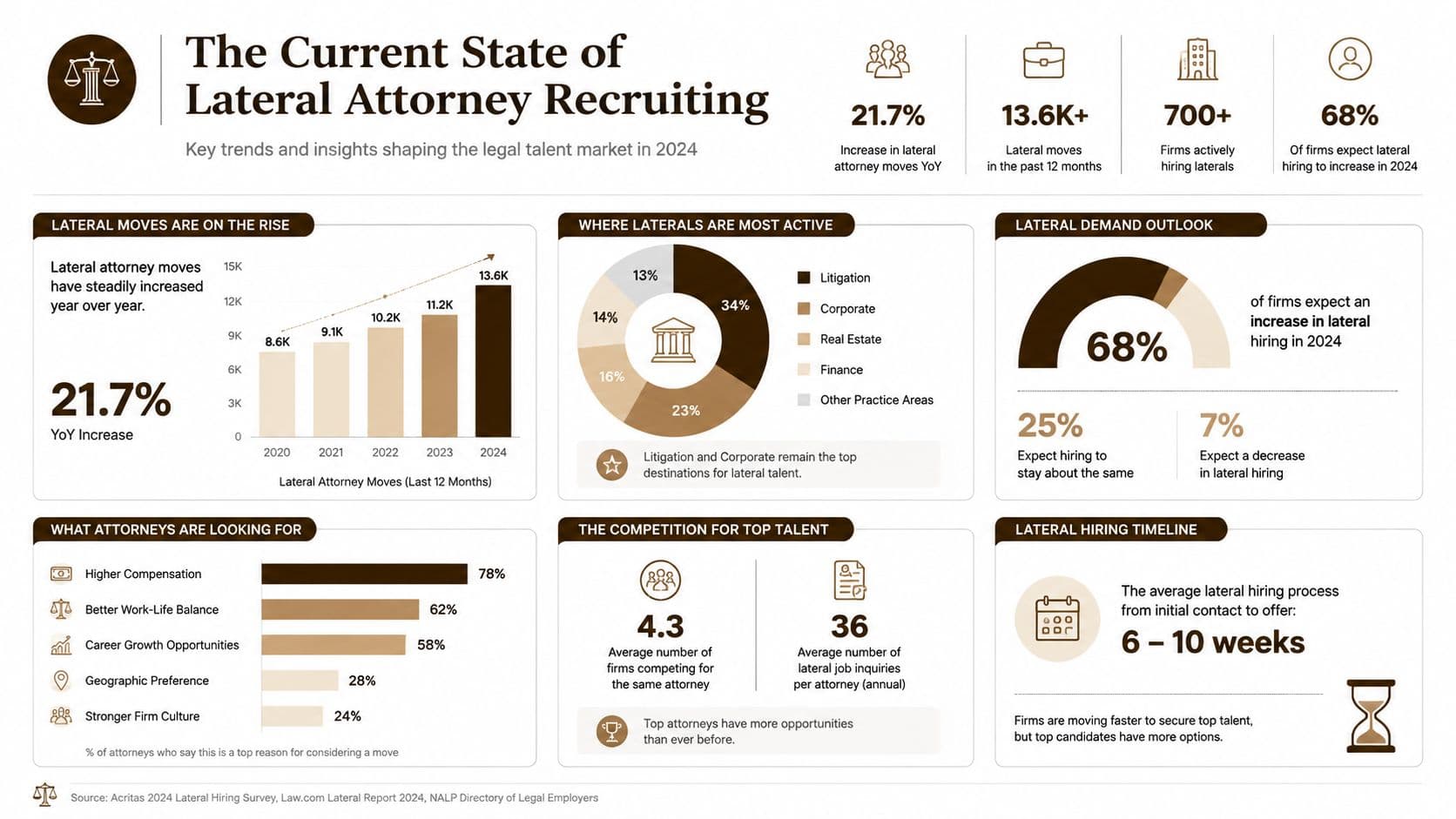
Lateral attorney recruiting moves in cycles, and firms that ignore the swing end up paying for the mistake twice. NALP's lateral hiring history shows the pattern clearly, with lateral lawyer hiring falling 35% in 2023 after an earlier 11.5% decline in 2022, then recovering in 2024 with overall lateral hiring up nearly 14% and lateral associate hiring rising by almost 25%. The market contracts, then rebounds unevenly, and firms that mistake a rebound for stability make expensive decisions.
What the rebound actually means
The rebound is real, but it is not a simple green light. In the latest comparable data, associate lateral hiring made up 58.2% of the market, while partners represented 22.3% and other lateral lawyers 19.5%. That mix matters because it shows demand spread across the market, not concentrated in one seniority band.
Firms often read a hotter market the wrong way. They assume a larger candidate pool means they can be selective without being disciplined, then they rush into interviews without a retention plan, portability review, or integration plan. That is how lateral hires miss their revenue goals and leave before the firm gets any return.
Practical rule: treat lateral hiring as a 24-month return decision, not a vacancy-fill exercise. If the hire does not fit the platform, the market will expose the mistake quickly.
The median firm in the latest comparable dataset hired 4.0 laterals per office or firm, with an average of 11.6. That spread tells you hiring remains uneven, and copying another firm's process will not save you. Your pipeline, your practice mix, your partner group, and your ability to integrate the lawyer into existing work all drive the result. Five Star Placements describes its approach to lateral recruiting on its about page, and that kind of structured process matters because a lateral hire only works when the economics, the workstream, and the culture line up.
Defining the Strategic Need Before Sourcing Candidates
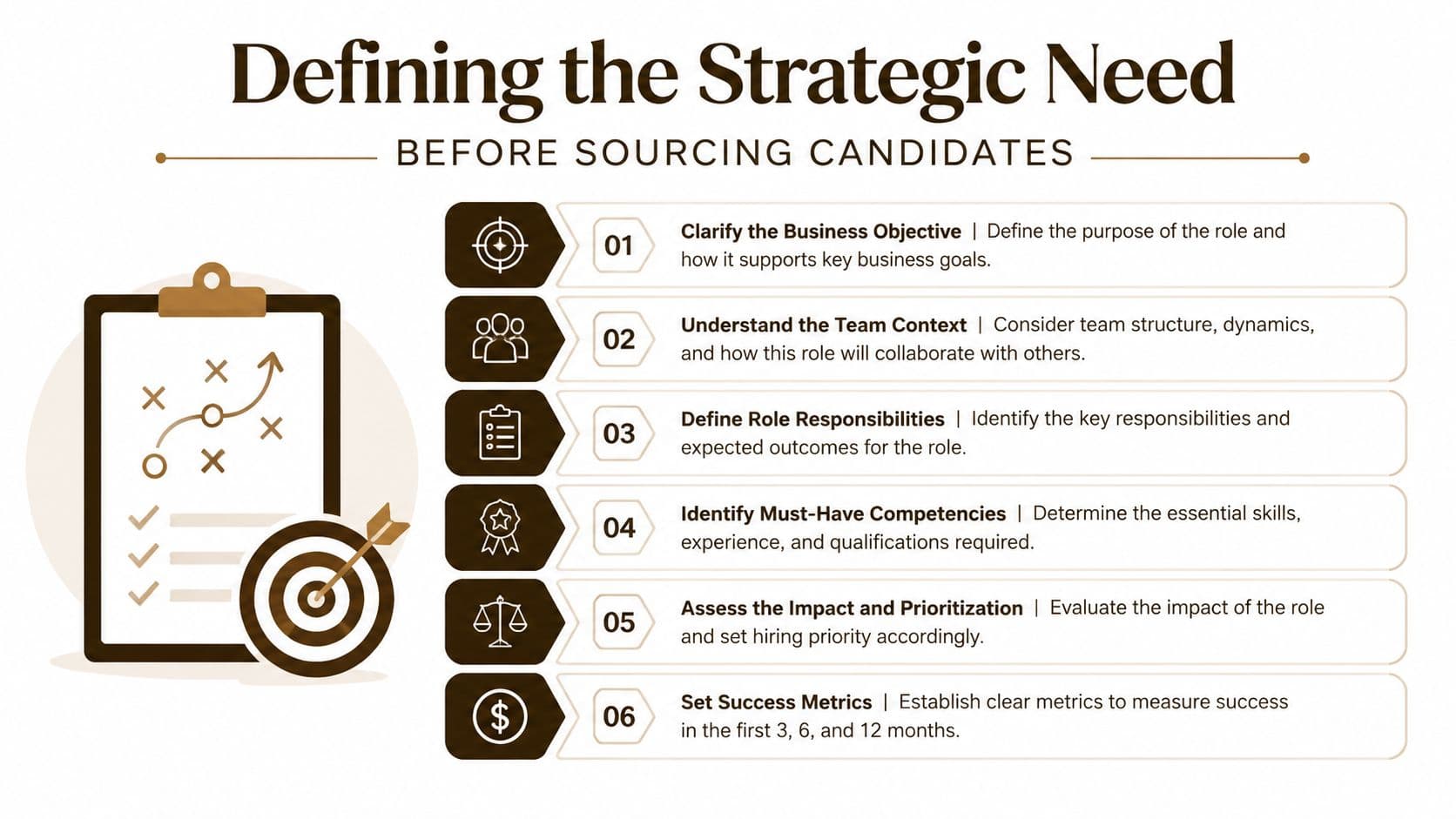
Most lateral searches fail because the firm starts with the lawyer instead of the work. That's backward. If you can't state the practice-area gap, the matter flow you're trying to capture, and the internal capacity problem you're solving, then a hire is just expensive activity.
Start with the work, not the résumé
Aderant's guidance is blunt, firms should first determine whether lateral hiring has a strategic purpose, benchmark prior lateral outcomes, and evaluate cultural fit before sourcing starts. NALP's best-practices thinking points the same way, telling firms to analyze capacity and utilization before they chase résumés. The logic is simple, if the work isn't defined, the candidate can't be evaluated against it.
Use a hard internal question, would this hire improve the platform in 12 to 24 months, or would it just cover a temporary gap? If the answer is unclear, pause. Reactive backfill is the most common way firms overpay for talent they don't need.
Build the business case before the search
Before anybody reaches out to candidates, write down three items in plain English.
- What work is missing: identify the matters, clients, or service lines the firm wants more of.
- What success looks like: define the outcomes you expect the lateral to create across revenue, capacity, and internal delivery.
- What failure would look like: decide in advance what would make the search a bad use of time.
That discipline also keeps the firm honest about culture. A technically excellent candidate can still be wrong if the practice needs a builder, a rainmaker, or a cross-seller and the candidate is none of those.
For firms that want outside help with process and candidate screening, Five Star Placements is one option that works on a contingency basis and screens for experience, skills, and culture fit before candidates reach the hiring committee.
Building a Data-Driven Sourcing and Screening Funnel
A lateral search should be run like a pipeline, not a hunch. NALP's metrics guidance recommends using at least six months of clean data so the funnel is stable enough to expose bottlenecks in sourcing, screening, and closing. NALP's lateral metrics guide is right about the sequence, because firms usually know where the process feels slow, but not where the drop-off happens.
Audit the funnel before you add more names
Start with the raw volume of lateral résumés received, then narrow to the candidates who match the practice-area need. Track how many make it to screening interviews, full interview rounds, offers, and acceptances, then log where the declined candidates go. That final step matters because it tells you whether you lost on compensation, timing, practice fit, or something deeper in the process.
Rule of thumb: if you can't say exactly where candidates disappear, you don't have a sourcing problem, you have a measurement problem.
A clean funnel gives you an edge with internal stakeholders too. Managing partners tend to argue about whether the market is thin. A funnel audit turns that debate into a factual conversation about conversion, responsiveness, and closing discipline.
Use recruiters as a throughput tool, not a crutch
Contingency-based external recruiters make sense when you need reach without fixed overhead. They bring prebuilt networks, they can surface passive candidates faster than an internal team working from scratch, and they only get paid when the hire closes. That structure reduces risk, especially in searches where the unknown is not finding applicants, it's finding the right one quickly enough to matter.
The key is to measure recruiter performance by outcome, not activity. Did they deliver candidates who matched the need? Did those candidates progress through the funnel? Did the hire close on a timeline that kept the practice moving?
Five Star Placements' blog is a practical place to review how legal recruiting is being framed across different role types, but the evaluation standard should stay the same, conversion quality, fit, and speed.
Evaluating Candidates Beyond the Resume
A polished résumé is not a business case. Lateral attorney recruiting fails when firms confuse a credible profile with a durable hire. The right scorecard weighs portable book quality, technical competence, and cultural integration, because the core question is whether the lawyer will hold value, grow value, and stay long enough to justify the move.
Judge the book of business like an asset, not a slogan
Firms still over-weight book size, and that creates expensive mistakes. Thomson Reuters' laterals material and Aderant's framework both push firms to examine durability, client concentration, matter mix, and prior performance, because raw portable-book figures do not show how much revenue will move. A large headline number can look impressive on paper and still underperform if the business sits with one client, one rainmaker contact, or a matter type that does not travel well.
The market also evaluates portability too casually. In one 2024 lateral-partner hiring insights webinar, 93% of respondents said they prioritize book of business and client relationships, while 54% cited limited diversity in the candidate pool as a major frustration. Thomson Reuters' lateral-hiring white paper reinforces the larger point, firms say they want portability, but too many assess it in the simplest possible way.
Use one scorecard, not three disconnected interviews
A useful evaluation model looks like this:
| Evaluation Dimension | Partner-Level Weight | Associate-Level Weight | Key Metrics to Assess |
|---|---|---|---|
| Portable book of business quality | High | Low | Client concentration, matter mix, historical growth, transferability |
| Technical and practice-area skill | High | High | Substantive depth, drafting quality, judgment, speed |
| Cultural integration potential | High | High | Collaboration style, communication habits, responsiveness, reference feedback |
A firm can forgive a modest book if the lawyer integrates well and helps build the platform. It usually cannot forgive a big book that never shows up.
A scorecard like this forces discipline. It keeps partners from giving the highest weight to whichever candidate told the best story in the room, and it makes weak assumptions visible before the firm commits capital and reputation to the hire.
Press hard on references and conflict issues
Reference checks should not be a formality. Ask about responsiveness, client handoff behavior, internal collaboration, and how the candidate handles pressure. Then run conflicts early, because a late conflict discovery can kill a search after the firm has already invested time and political capital.
For partner candidates, ask a blunt question, what portion of the business is portable, and why? If the answer is vague, the move is probably more aspirational than real. That is the kind of gap that turns a lateral hire into a 24-month write-off.
Structuring Offers and Managing Compensation Risk
The fastest way to ruin a lateral search is to let compensation drive the decision instead of economics. A strong offer should be competitive, but it should also reflect the reality that laterals do not instantly deliver the business they forecast. Major-dataset commentary shows why, Thomson Reuters has reported that lateral partners bring only 22% of their book of business to the new firm on average, which means firms need realistic ramp assumptions from day one. Decipher's lateral hire stats summary captures the risk bluntly, and that risk belongs in the offer structure.
Make the economics match the uncertainty
A guaranteed draw can make sense for a true rainmaker, but it shouldn't be blind. Tie compensation to measurable milestones where possible, and make sure the firm can absorb the ramp if work comes in slower than projected. That protects the partnership from overcommitting before the book is proven.
If the candidate wants a heavy guarantee, ask what the firm gets in exchange. The answer should be a credible pathway to revenue, not just reassurance. Otherwise, you're pricing hope.
Keep recruiting spend flexible
Contingency-based recruiting partnerships are worth using when the risk of a miss is high and the search budget has to stay tied to results. A fee that only triggers on a successful hire keeps the firm from paying for pipeline volume that never converts. That's the right model when the business question is whether the hire will be accretive, not whether the recruiter can send over more names.
A few deal terms deserve direct attention:
- Ramp timeline: define when the firm expects meaningful contribution.
- Support commitments: clarify staffing, assistant support, and matter assignment expectations.
- Exit protections: protect the firm if the business doesn't transfer as represented.
- Performance checkpoints: set review dates before frustration turns into churn.
The point is not to be punitive. It's to make the offer reflect the uncertainty baked into lateral attorney recruiting. If the candidate is strong, they'll understand that disciplined terms are part of a serious platform, not a sign of weakness.
Onboarding and Integration for Long-Term Retention
Acceptance is the start of the test, not the end of it. A lateral hire is only working when the lawyer is embedded in the firm, supported by the right people, and producing work without friction. That matters because major-law-firm dataset commentary shows about 48% of lateral partners leave within five years, 62% fail to bring their promised book of business, and 35% fail to integrate with firm culture. Analysts at Decipher's summary of lateral-hire stats present those figures as a warning, and managing partners should treat them that way.
Treat the first year like an integration project
Start with conflict clearance before the start date, not after. Then map the internal relationships the lateral needs, which partners should know them, which associates will support them, and who owns the first round of introductions. If the lawyer's client base is supposed to travel, the firm should help that transition happen. It should not assume the move will happen by inertia.
The first 90 days need structure. Schedule recurring check-ins, assign an integration sponsor, and confirm that the lateral understands how the firm routes work and makes staffing decisions. Most cultural problems show up as workflow problems first, so watch the daily mechanics before you label the hire a bad cultural fit.
Track the right signals early
A clean onboarding plan should watch a few practical indicators:
- Client transition progress: are the expected relationships moving?
- Internal collaboration: is the lateral being pulled into matters and conversations?
- Cross-sell behavior: are other lawyers using the hire to deepen client coverage?
- Engagement level: does the lawyer show up, respond, and participate like a firm builder?
If the lateral is quiet internally after the first quarter, do not wait for year-end. The firm should intervene while the relationship is still salvageable.
Quarterly business reviews should be routine. That is where the firm can tell whether the hire is tracking against the business case, whether the support model is working, and whether a course correction is needed. Most firms fail here because they treat onboarding as administrative work instead of an economic test.
A disciplined integration process also protects the firm from a second, quieter failure mode. A lateral can look strong on paper, clear conflicts, and still underperform if the book does not port cleanly or if key internal relationships never take hold. Managing partners should review those risks with the same seriousness they use on the offer itself.
If a firm wants outside help finding laterals, a contingency recruiting partner like Five Star Placements keeps the search tied to placement results. That matters when the firm wants speed, selectivity, and discipline in the same process.
Your Lateral Recruiting Action Checklist
Use this as a go-no-go filter before launching or continuing a search. If a box stays unchecked, the firm should slow down.
- Define the work first. State the practice-area gap, the client or matter need, and the expected 12-to-24-month outcome.
- Review prior lateral results. If your firm hasn't measured what past laterals delivered, you're guessing.
- Audit the funnel. Track résumés, interviews, offers, and acceptances so you know where candidates drop out.
- Separate book size from book quality. Ask how portable the revenue is, not just how large it sounds.
- Run conflicts early. Don't let a late conflict issue waste partner time.
- Structure the offer around ramp risk. Match guarantees and support commitments to the likely transfer reality.
- Build the onboarding plan before the start date. Name the sponsor, the internal allies, and the first-quarter milestones.
- Measure retention signals immediately. Don't wait for the yearly review to find out the hire isn't integrating.
- Use a contingency partner when speed and selectivity both matter. A firm like Five Star Placements can fit that model because its process is tied to successful placement, not upfront spend.
- Set a 24-month success test. If the hire won't be economically justified by then, the search was never strategic.
A firm that follows this checklist will still take risk, but it'll be measured risk. That's the only way lateral attorney recruiting should be done, with eyes open, a clear business case, and a plan for what happens after the signature.
Five Star Placements works on contingency and supports lateral attorney recruiting with screening that looks beyond the résumé to role fit, skills, and culture. If your firm wants a search process built around retention and ROI, visit Five Star Placements and start with a placement model that's tied to actual hiring outcomes.
Need help filling a legal role?
Five Star Placements partners with law firms and legal departments nationwide.
Schedule a Call