
Legal Executive Search Firms: Key Hiring Insights
July 31, 2026 · 12 min read · Five Star Placements

Table of contents
Legal executive search firms sit inside a $42.3 billion global executive search market, and U.S. recruiters are part of a $10.2 billion industry with 5,293 businesses operating in 2026. In practice, that means the right search partner is not a resume shop. It's a specialist recruiter that places partners, general counsel, legal operations leaders, and senior attorneys through either contingency or retained search, depending on seniority, confidentiality, and how fast the seat has to move.
If you're reading this, you probably already know the problem. A critical legal role has been open too long, internal referrals have dried up, HR is stretched, and every week of delay makes the vacancy more expensive and more visible to the business. The fix is rarely “post it and wait.” It's choosing the right search model, then running the search like a disciplined hiring project instead of a hope strategy.
Table of Contents
- When a Critical Legal Role Stays Open Too Long
- What Legal Executive Search Firms Do
- Benefits for Law Firms and Corporate Legal Departments
- Typical Services and Placements You Can Expect
- Contingency vs Retained Search Pricing Models Compared
- How to Vet and Select the Right Search Firm
- Timeline, Process, and Metrics of a Successful Search
- How Five Star Placements Fits This Picture
When a Critical Legal Role Stays Open Too Long
A managing partner doesn't need a dashboard to know when a seat is hurting the firm. The partner group starts carrying work that should be delegated. The general counsel search gets pushed back again because the shortlist is weak. The legal ops hire sits open while the team keeps patching process gaps with overtime and goodwill.
That's the part most firms underestimate. A vacancy doesn't stay neutral just because everyone is busy. It drags on revenue, decision-making, and morale, especially when the role touches clients, compliance, or matter velocity. In a corporate department, a slow hire can leave business leaders waiting on approvals and risk reviews. In a law firm, it can mean missed lateral momentum, delayed practice growth, and too much pressure on the people already in place.
Practical rule: if the role affects client delivery, risk, or leadership continuity, treat it like a business interruption, not a staffing request.
That's why legal executive search firms matter. They're not just filling a desk. They're bringing structure to roles where the candidate pool is narrow, the fit has to be precise, and the cost of getting it wrong is ugly. Internal recruiting teams can do a lot, but they usually can't sustain the level of targeted outreach and credential checking senior legal hires demand.
The right way to think about the search is simple. Decide whether the role needs broad competition or confidential precision, then choose the engagement model that matches the seat. That's the fundamental decision underneath the sales pitch.
What Legal Executive Search Firms Do
Legal executive search firms are specialist recruiters for senior legal talent. They focus on roles like partners, general counsel, legal operations leaders, and senior attorneys, and they reach those candidates through relationships, market knowledge, and direct outreach, not job-board volume. The work is built for narrow searches where the hire has real weight inside the organization.
The first step is market mapping. A strong firm identifies where comparable talent sits, who is active, who is passive, and which organizations are most likely to produce the right profile. Then it builds a success profile, a practical picture of the candidate the client needs, not just the title they want to post. That profile should reflect scope, reporting lines, stakeholder pressure, and the level of discretion the role requires.
From there, the firm handles the work that internal teams often cannot sustain at senior level. It reaches out confidentially to passive candidates, verifies credentials, checks references, and coordinates interviews so the process keeps moving. The calendar work matters too. Many searches stall because the interview-to-offer path gets slow, inconsistent, or politically messy, and strong candidates do not wait around for that.
For firms that want a more customized approach, Five Star Placements sits in this legal recruiting lane and works across attorneys, legal support, partners, in-house counsel, and legal operations.
A senior legal search should reduce risk, not just increase applicant flow.
The distinction from generalist staffing is simple. Generalist firms can move quickly on broad openings. Legal executive search firms are built for appointments where judgment, confidentiality, and practice fit matter more than volume. If the role is senior, visible, or strategically sensitive, that difference decides whether the search succeeds.
Benefits for Law Firms and Corporate Legal Departments
The clearest benefit is speed, but only if you define speed correctly. Legal executive search firms typically compress senior in-house legal hiring into 90 to 120 days, compared with 150+ days for internal efforts, and pre-vetted candidates can shorten that to 60 to 75 days without lowering quality, according to Momentum Search Group. That time difference matters because senior legal vacancies don't just sit there, they force the rest of the team to absorb the load.
What buyers actually get
A good search partner does four useful things at once. It opens access to passive candidates who aren't replying to job ads. It tightens the screen so you're not wasting time on obvious mismatches. It improves fit by checking how a person works, not just what they've done. And it reduces the hidden cost of delay by keeping the process moving.
Cost logic: the fee for a search is visible. The cost of a vacant legal seat is spread across delay, lost leverage, and overworked people.
For law firms, the upside is usually practice growth and lateral precision. For corporate legal departments, the benefit is often business continuity and risk control. HR leaders tend to care most about process discipline. Managing partners care about revenue impact. General counsel care about fit, credibility, and the ability to operate across functions.
The point is not that every hire must go through a search firm. The point is that senior legal hiring gets harder as the role gets more visible and more specialized. In those cases, a search firm earns its keep by doing the front-end work that internal teams rarely have time to do well.
Typical Services and Placements You Can Expect
A legal executive search firm should make its service scope obvious. If it doesn't, that's usually a bad sign. The practical categories are easy to map.
Role families by buyer need
- Attorney recruitment: litigation, personal injury, trusts and estates, family law, immigration, construction, business and corporate, labor and employment, tax, real estate, and healthcare.
- Partner and lateral team search: managing partner, equity partner, senior partner, junior partner, and practice-specific partners.
- In-house counsel hiring: general counsel, corporate counsel, compliance, intellectual property, mergers and acquisitions, contracts, and tax.
- Legal support staffing: paralegal, legal assistant, legal secretary, law clerk, records clerk, case manager, intake specialist, and litigation support specialist.
- Legal operations and management: COO, CFO, firm administrator, director of operations, director of finance, director of legal recruiting, VP of HR, tax manager, and senior accountant.
That list matters because the search process changes with the seat. A lateral partner search is a different animal from a paralegal placement. A general counsel search is more confidential than an entry-level support hire. A legal operations leader needs cross-functional fluency that a practice attorney may never have had to prove.
The best firms also handle the candidate side with more care than people expect. Interview coaching, training, and development support signal a relationship model, not a transactional one. That matters because many senior candidates are evaluating the search firm as much as the client. If the recruiter can't explain the role clearly, can't prepare the candidate for the client's culture, or can't keep the process disciplined, the placement is already at risk.
Contingency vs Retained Search Pricing Models Compared
Most buyers overcomplicate this choice. Fee structure is not a branding exercise. It is a hiring decision about rigor, exclusivity, confidentiality, and how fast the seat must be filled without lowering the bar.
What buyers gain from each model
| Model | Fee Structure | Best For | Watch Out For |
|---|---|---|---|
| Contingency | Paid only on hire, no upfront fee | Broader candidate pools, mid-level attorneys, paralegals, support roles, and searches where speed and budget matter | Can turn into a volume race if the firm is not selective |
| Retained | Upfront fee, dedicated search partner, exclusivity | Senior partners, general counsel, confidential searches, and hard-to-fill leadership seats | Costs more up front and can be too much for routine hires |
| Hybrid | Milestone payments and partial exclusivity | Searches that need commitment without a full retained structure | Can be vague if the deliverables are not defined clearly |
If the role is senior, sensitive, or politically loaded, retained-style rigor is the right fit. The search needs more than sourcing. It needs a structured discovery process, a tighter success profile, and enough confidentiality to reach passive candidates without leaking the opportunity. That is where retained work earns its fee.
Contingency makes sense when the market is broader and the hire is less exposed. It works well when you want multiple firms competing, the candidate pool is large, and budget discipline matters. The trade-off is simple. Low friction does not mean low risk. A cheap search that produces a weak slate still costs more once the vacancy drags on and the team absorbs the load.
Here is the decision filter I would use:
- Is the role senior enough that a bad hire would hurt the business?
- Does the search require confidentiality or passive-candidate outreach?
- Do you need exclusivity, or do you want several firms in the mix?
- Are you buying a shortlist, or are you buying process discipline?
Vacancy cost is not limited to an open desk. It shows up as delayed decisions, lost momentum, and overworked people who keep the function moving while the search stalls. That is why the right pricing model should match the role, not the sales pitch.
Ask the firm how it handles candidate vetting, replacement terms, fee transparency, specialization depth, and AI-fluency screening for senior hires. If the answers are vague, keep moving. If you want a sharper view of how strong search firms frame this trade-off, review the hiring guidance on our blog.
How to Vet and Select the Right Search Firm
The right search firm should sound specific, not polished. Ask who they've placed in roles like yours, how they source passive candidates, who does the screening, and how they define culture fit beyond the resume. If you get generic answers, the firm probably runs generic searches.
What to look for before you sign
- Practice-area depth: They should know the market for your exact seat, not just “legal.”
- Relevant placements: Ask for similar roles, similar geography, and similar seniority.
- Fee clarity: You want the economics in plain language, not buried in process talk.
- Replacement terms: If a hire fails, what happens next should be written down.
- Screening quality: The firm should explain how it evaluates judgment, communication, and fit.
- AI and change management: Senior legal hires now need more than doctrinal expertise.
That last point matters more every month. Legal teams are being asked to adapt to new tools, new workflows, and new operating expectations. Recent Thomson Reuters research found that 55% of legal professionals expected generative AI to have a high or transformational impact on their work within five years, up from 46% the prior year. That doesn't mean every lawyer needs to be a technologist. It does mean senior candidates should be able to work with AI-enabled processes, govern risk, and partner with the business.
If you're comparing firms, don't be shy about asking which one interviews candidates, which one only forwards resumes, and how quickly they can build a shortlist. For firms that want contingency-based, customized screening with a legal focus, Five Star Placements' blog is worth reviewing for the kind of process language you should expect from a serious recruiter.
The best vendors don't sell you a title. They help you define the person who can survive the job.
Timeline, Process, and Metrics of a Successful Search
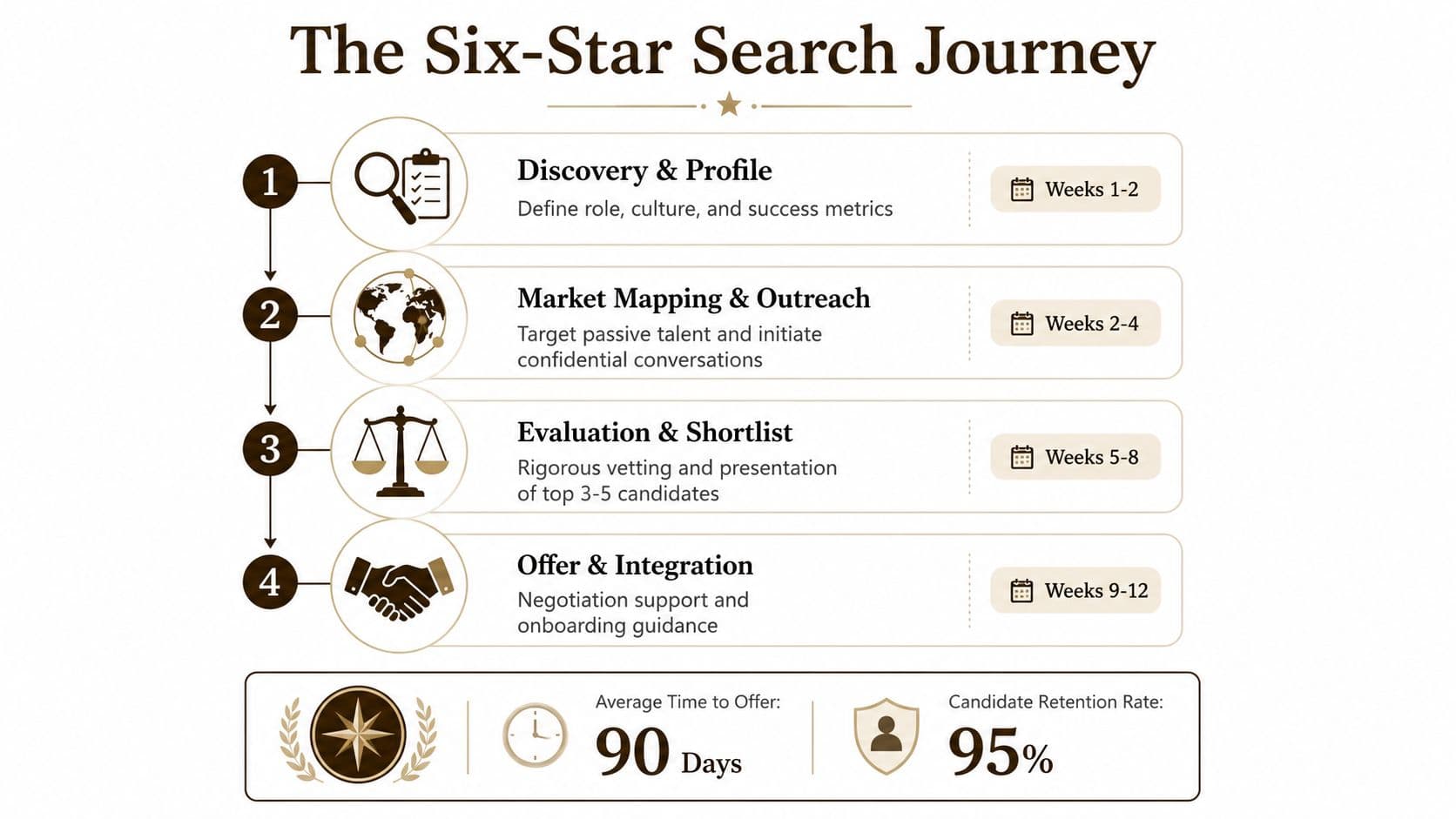
A good search has a rhythm. It should feel controlled, not frantic. The cleanest version is a 60 to 120 day arc, with early discovery, targeted outreach, structured interviews, references, and close.
What the timeline should look like
- Weeks 1 to 2, Discovery and profile: define the role, the culture, the must-haves, and the deal breakers.
- Weeks 2 to 4, Market mapping and outreach: identify passive candidates and start confidential conversations.
- Weeks 5 to 8, Evaluation and shortlist: screen hard and present a tight group of credible options.
- Weeks 9 to 12, Offer and integration: negotiate terms, support acceptance, and hand off for onboarding.
The best metrics are practical. Time-to-shortlist tells you whether the firm is moving. Offer acceptance tells you whether the candidate story is coherent. Retention tells you whether the fit was real. Quality of hire is ultimately measured by performance after the person starts, not by how elegant the shortlist looked.
The five beliefs that sabotage legal hiring
- All search firms are interchangeable. They're not. Specialty, process, and seniority experience matter.
- The lowest fee is the best deal. It isn't if the firm can't deliver a credible slate.
- Internal referrals will fill every senior role. They won't, especially for confidential or niche searches.
- AI sourcing replaces specialist recruiters. It speeds up discovery, but it doesn't replace judgment.
- Hiring ends at offer acceptance. It doesn't. Integration is where many placements succeed or fail.
The delay usually comes from the client side, not the recruiter side. Slow feedback, shifting comp expectations, and unclear decision-makers will stall even the best search. Hidden candidate concerns do the same thing if the firm doesn't surface them early. Strong searches keep the process tight because both sides own the pace.
How Five Star Placements Fits This Picture

Five Star Placements fits the contingency side of this market with a payment-only-on-hire structure and customized screening that goes beyond the resume. It recruits attorneys, partners, in-house counsel, legal support staff, and legal operations leaders across the United States, and its model is built for clients that want senior-hire rigor without retained fees. You can review its firm background at Five Star Placements if you want a better sense of how it frames search, screening, and candidate fit.
The practical value is straightforward. If you need a mid-level attorney, a partner placement, a general counsel, or a legal ops leader, the question isn't whether to pay for prestige. It's whether the recruiter can run a disciplined process, screen for culture fit, and keep momentum without wasting your time. Five Star Placements is positioned for that kind of assignment, especially when the firm wants collaborative support and nationwide reach.
For many law firms and corporate legal departments, that's the right trade. You get retained-style attention where it matters, but you don't give up control or take on upfront search fees. If your next hire has to be more than a warm body in a chair, start with a recruiter that treats the search like a decision, not a transaction.
If your firm or legal department is weighing a senior hire, don't settle for a generic recruiter. Five Star Placements handles legal recruiting with customized screening, nationwide reach, and a contingency model built around successful placement, so you can move on a role without paying upfront. Visit Five Star Placements to discuss the seat you need to fill and what a disciplined legal search should look like.
Need help filling a legal role?
Five Star Placements partners with law firms and legal departments nationwide.
Schedule a Call