
Risk Based Pricing Disclosure Explained for Legal Hiring
September 5, 2026 · 13 min read · Five Star Placements

Table of contents
A managing partner opens a contingency recruiting proposal and pauses at the fee paragraph. The percentage is visible, but the decision risk isn't. What exactly triggers payment? Does the firm owe anything if the candidate withdraws, fails to start, or leaves shortly after joining? Will another recruiter structure the same search differently?
That uncertainty slows the hiring decision before anyone evaluates the candidate. In legal recruiting, risk based pricing disclosure is the discipline of explaining not only what a client pays, but why the fee exists, when it becomes due, and how the recruiter shares placement risk. The concept comes from consumer-credit regulation, but its practical lesson applies directly to contingency hiring: transparent pricing gives both sides a clearer basis for consent.
Table of Contents
- Why Fee Transparency Matters in Legal Recruiting
- What Risk Based Pricing Disclosure Actually Means
- How Disclosure Reduces Hiring Risk for Clients and Candidates
- Comparing Risk-Based Contingency Fees to Other Recruiting Models
- Best-Practice Disclosure Language and Real Examples
- Does Disclosure Actually Change Behavior or Just Check a Box
- Implementing Transparent Risk-Based Pricing in Your Legal Recruiting Process
Why Fee Transparency Matters in Legal Recruiting
A managing partner comparing three recruiting firms isn't comparing percentages. The partner is comparing exposure. One proposal may state a fee with no explanation of the trigger. Another may describe payment upon acceptance but say nothing about a failed start. A third may include a replacement commitment, a defined guarantee period, and a plain-English explanation of what counts as a successful placement.
Those proposals don't create the same commercial relationship, even if their headline fees look similar.
Practical rule: A fee proposal should answer the client's risk questions before the client has to ask them.
Legal hiring carries several forms of uncertainty. A vacancy can delay matter delivery, strain existing attorneys, or force a firm to turn away work. A candidate can look excellent on paper but lack the client-service habits, judgment, or cultural fit the role requires. The recruiter's fee therefore sits beside a larger business concern, the cost of making the wrong hire or leaving the role open.
The hidden cost is ambiguity
Opaque language makes clients assume the most expensive interpretation. If a proposal says fees “may vary depending on the search,” the reader still doesn't know which variables matter. Is the difference based on role seniority, scarcity of talent, geographic reach, urgency, exclusivity, or the expected complexity of screening?
A transparent proposal identifies the relevant factors without pretending that every search has identical economics. It distinguishes the fee formula, payment trigger, replacement or refund terms, and client responsibilities. That separation gives a general counsel or hiring partner something concrete to evaluate.
The same clarity helps candidates. A recruiter who explains the commercial arrangement responsibly signals that the candidate isn't being pushed into a role merely to generate a transaction. Candidates are more likely to engage thoughtfully when they understand how the search works, who makes the hiring decision, and what the recruiter will do after an introduction.
Transparency is a competitive differentiator
Firms evaluating multiple agencies often use the proposal itself as evidence of how the recruiter operates. A concise, complete fee explanation suggests disciplined process management. Vague terms suggest future friction, even if the recruiter has excellent market access.
The best disclosure doesn't apologize for a contingency fee. It explains the exchange. The recruiter invests time in sourcing, screening, and coordinating the search. The client pays when the defined outcome occurs. Both parties understand the boundaries before confidential candidate information and internal hiring details begin moving through the process.
What Risk Based Pricing Disclosure Actually Means
In its formal legal setting, risk-based pricing disclosure is a consumer-credit transparency rule. The Federal Reserve's final implementing rules followed the Fair and Accurate Credit Transactions Act of 2003, which amended the Fair Credit Reporting Act. The Federal Reserve and FTC announced the final rules on December 22, 2009, and the rules generally became effective January 1, 2011.
The federal rule applies when a creditor uses a consumer report and, because of that report, offers credit on materially less favorable terms than the most favorable terms available to a substantial proportion of consumers. The required notice gives the consumer an opportunity to understand the pricing decision and check the accuracy of the underlying report. The rule also provides several compliance paths, including direct comparison, credit score proxy, tiered pricing, and a credit score disclosure alternative.
Recruiting firms aren't creditors, and a legal placement fee isn't consumer-credit pricing. The value of the concept lies in the principle, not in treating employment services as regulated lending.
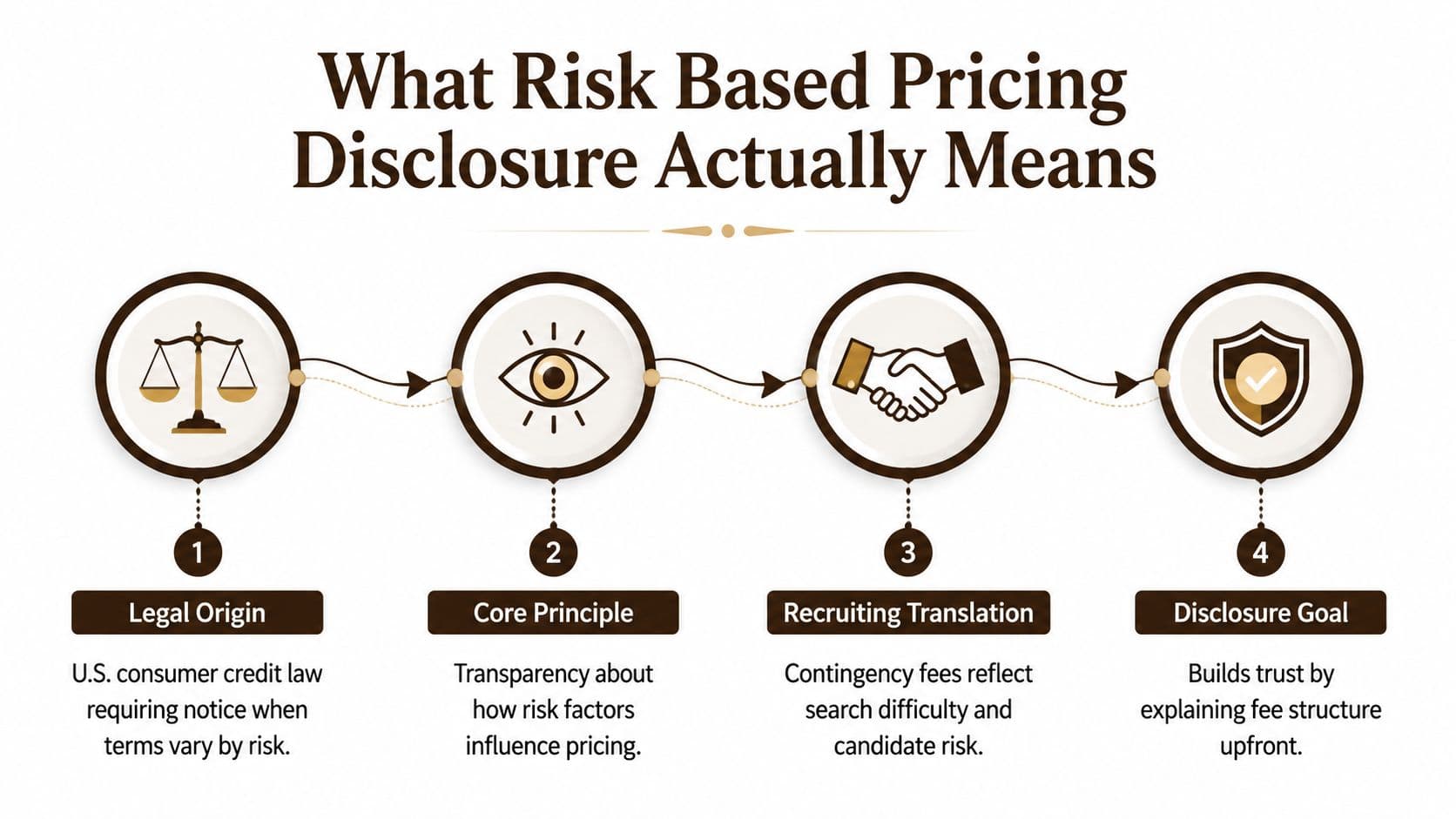
Translate the principle into recruiting
Start with the commercial risk. A contingency recruiter typically performs work before receiving a fee. Payment depends on a defined hiring outcome, rather than on time spent. Readers who need the operating definition can review what contingency recruiting means.
Then disclose the logic behind the fee. A difficult partner search may require a different sourcing strategy from a recurring legal support role. A confidential lateral move may involve more coordination than an openly advertised position. A multi-office search may demand broader market coverage. Those facts can affect the recruiter's work and the proposed commercial terms, but the client should see the relationship rather than receive an unexplained number.
A useful disclosure answers four questions:
- What creates the fee? Define whether payment is triggered by acceptance, start date, or another agreed event.
- What does the fee cover? Identify sourcing, screening, interview coordination, offer support, and any post-placement commitment.
- What happens if the placement fails? State replacement, credit, refund, or exclusion terms in direct language.
- Why do terms differ? Explain the relevant search conditions without presenting subjective judgment as an objective pricing formula.
The analogy is simple. A lender explains why a borrower receives different credit terms. A recruiting firm should explain why a client receives particular placement terms and what outcome makes the fee payable. Disclosure is not the fee itself. It is the explanation that makes the fee evaluable.
How Disclosure Reduces Hiring Risk for Clients and Candidates
Transparent pricing reduces friction because it turns an implied promise into an observable process. The client can see when the recruiter gets paid, what work precedes payment, and what protection exists if the placement doesn't hold. The candidate can see whether the recruiter is presenting a genuine opportunity or maximizing the chance of a quick acceptance.

Clients gain a clearer risk allocation
A well-written contingency arrangement aligns the recruiter's compensation with the client's hiring result. The recruiter doesn't collect merely because résumés were forwarded. That structure can be commercially attractive, but only if the agreement defines success precisely.
Clients should look for language addressing:
- Fee trigger: Whether the fee becomes due at acceptance, commencement, or another specified point.
- Candidate source: Whether the fee applies when the candidate was already known to the client or only when the recruiter introduced the candidate.
- Replacement protection: What the recruiter will do if the new hire leaves under stated circumstances.
- Search ownership: How duplicate submissions and competing agencies will be handled.
- Role changes: Whether a candidate hired into a different position creates a fee obligation.
These provisions reduce disputes because they prevent the parties from negotiating the meaning of “successful placement” after the fact. They also let a managing partner compare proposals based on actual exposure rather than headline pricing alone.
Candidates receive a trust signal
Candidates rarely need the client's precise fee terms to evaluate a recruiter. They do need honest communication about role expectations, process stages, confidentiality, and decision authority. A recruiter who is candid about the commercial relationship is better positioned to explain why a particular opportunity fits the candidate's practice, career direction, and working preferences.
That matters especially for attorneys considering a lateral move or in-house transition. A rushed introduction can damage the candidate's reputation with a prospective employer. A structured process shows respect for the candidate's time and professional standing.
The vacancy itself also creates risk. A legal department may have work waiting for a new counsel, while a firm may need capacity in a practice group. Transparent contingency terms don't eliminate that opportunity cost, but they let the client secure external sourcing without committing to an undefined spend before a hire occurs.
The practical test is straightforward: if a client or candidate has to infer the important terms, the disclosure isn't doing enough.
A short video can help teams discuss how pricing transparency fits into a broader business conversation about risk and trust.
Comparing Risk-Based Contingency Fees to Other Recruiting Models
No recruiting model is universally superior. The right structure depends on the role, the search's difficulty, the client's urgency, and how much financial risk the client is willing to assume before a result exists.
| Fee Model | Payment Timing | Risk to Client | Best For | Transparency Level |
|---|---|---|---|---|
| Risk-based contingency | Upon the defined successful hire | Lower upfront financial exposure, with outcome and guarantee terms requiring careful review | Time-sensitive attorney, support, and recurring legal hiring | High when the formula and protections are written clearly |
| Retained search | Paid in agreed stages or installments | Client commits before the result and may fund the search regardless of placement | Specialized partner, executive, or confidential lateral searches | High when milestones, exclusivity, and deliverables are explicit |
| Hourly consulting | As hours are worked | Client pays for effort even if hiring doesn't occur | Market mapping, compensation analysis, process design, or project recruiting | High if rates, estimates, and reporting are clear |
| Flat-fee recruiting | At agreed milestones or a defined outcome | Predictable spend, but scope and replacement terms can create uncertainty | Clearly scoped support hiring or repeatable recruiting assignments | Moderate to high, depending on scope definition |
Contingency versus retained search
Contingency recruiting is often practical when the client wants access to candidates without paying before a hire. The client should still examine exclusivity, candidate ownership, duplicate submissions, and post-placement protection. A low upfront commitment doesn't excuse imprecise language.
Retained search can make sense for a highly specialized partner or confidential lateral team. The recruiter receives committed resources, and the client may receive a more concentrated search. The trade-off is obvious: the client assumes more financial exposure before the outcome is known.
Hourly and flat-fee structures
Hourly consulting works well when the client needs expertise rather than a placement. A legal department may want help designing an interview process, mapping a market, or evaluating internal recruiting capacity. The client pays for professional time, so the engagement should specify reporting, scope, and approval controls.
Flat-fee recruiting offers budget predictability. It becomes risky when the assignment isn't standardized. A flat fee for a straightforward legal support role may be sensible, while a confidential partner search with shifting requirements may outgrow the original scope.
For a deeper review of commercial terms, compare the considerations in legal recruiting fees explained. The decision should focus on who bears the cost of uncertainty, not on which label sounds most attractive.
Best-Practice Disclosure Language and Real Examples
Strong disclosure language is specific enough to govern a disagreement. Weak language sounds friendly but leaves the commercial relationship open to interpretation.
The required asset above contains the intended contrast, but the written proposal still needs to carry the legal and operational detail. Use plain language, define the trigger, and put the terms in the engagement letter before the search begins.
Weak language creates avoidable disputes
Consider this sentence:
“Our fee may vary depending on the role and search requirements.”
It identifies discretion but not the basis for that discretion. The client doesn't know whether the fee changes because of seniority, exclusivity, urgency, geography, or something else.
A stronger version would read:
“For this search, the placement fee is calculated as [agreed formula] and applies if a candidate introduced by the firm accepts employment with the client or an affiliated entity during the agreed ownership period. The fee is payable upon [agreed trigger]. The proposal also describes the replacement commitment and exclusions below.”
The placeholders belong in the final negotiated document, not in a client-facing template. The important improvement is that the language explains what event, which candidate, which employer, and when payment occurs.
Define protection after the hire
Weak language:
“We stand behind our placements.”
That promise has no operational meaning. It doesn't say whether the recruiter replaces the candidate, issues a credit, provides a refund, or offers nothing if the candidate leaves.
Stronger language:
“If the placed candidate's employment ends during the agreed protection period for reasons covered by this agreement, the firm will provide the stated replacement search or fee credit, subject to the listed exclusions. The client must notify the firm promptly and satisfy the payment and cooperation requirements stated in this letter.”
The client should also see exclusions for termination caused by restructuring, material role changes, compensation changes, misconduct, or other agreed circumstances. A guarantee isn't valuable if the client can't tell when it applies.
Match disclosure to the placement
An attorney search may require language covering practice area, bar admission, portable business expectations, conflicts, and partner compensation discussions. A legal operations appointment may require different definitions, including reporting lines, authority, travel, and performance expectations. A legal support placement may turn on schedule, software proficiency, billing duties, and supervision.
The fee language should not pretend that these searches carry identical risk. State the commercial rule consistently, then identify the role-specific assumptions that could change the search scope. Clients trust a disclosure that reflects the actual assignment more than a generic paragraph copied into every proposal.
Does Disclosure Actually Change Behavior or Just Check a Box
Disclosure has limits. Independent experimental research on personalized pricing disclosures, summarized in an OECD report on online disclosure, found no meaningful behavior change in the studied setting. That finding creates an uncomfortable but useful distinction: a disclosure can satisfy a formal obligation without changing what people do.
The same risk exists in legal recruiting. A client may read a fee paragraph, approve it, and still fail to compare the replacement terms. A candidate may hear that a recruiter operates on contingency and still accept an unsuitable role because the opportunity feels urgent. Transparency doesn't automatically create careful decision-making.
Pair disclosure with operational protection
A credible program combines explanation with conduct:
- Use a written guarantee: State the replacement, credit, or refund remedy and its conditions.
- Set communication checkpoints: Tell the client when sourcing updates, interview feedback, and offer coordination will occur.
- Document candidate consent: Confirm that the candidate understands the role, employer, location, compensation framework, and process.
- Escalate material changes: Revisit the terms when the role, hiring entity, or search scope changes.
- Review outcomes: Track disputes, early departures, duplicate submissions, and recurring questions to improve the language.
Federal consumer-credit guidance offers the same broader lesson. The rules provide alternatives and exception pathways, but process design determines whether teams apply them consistently. The CFPB's regulatory text addresses interactions among risk-based pricing notices, adverse-action notices, credit-score exception notices, and timing rules. In recruiting, the parallel is clear: the document matters, but the workflow determines whether the promise is delivered.
Disclosure is valuable when it helps someone make a better decision. If it only protects the drafter, rewrite it.
Implementing Transparent Risk-Based Pricing in Your Legal Recruiting Process
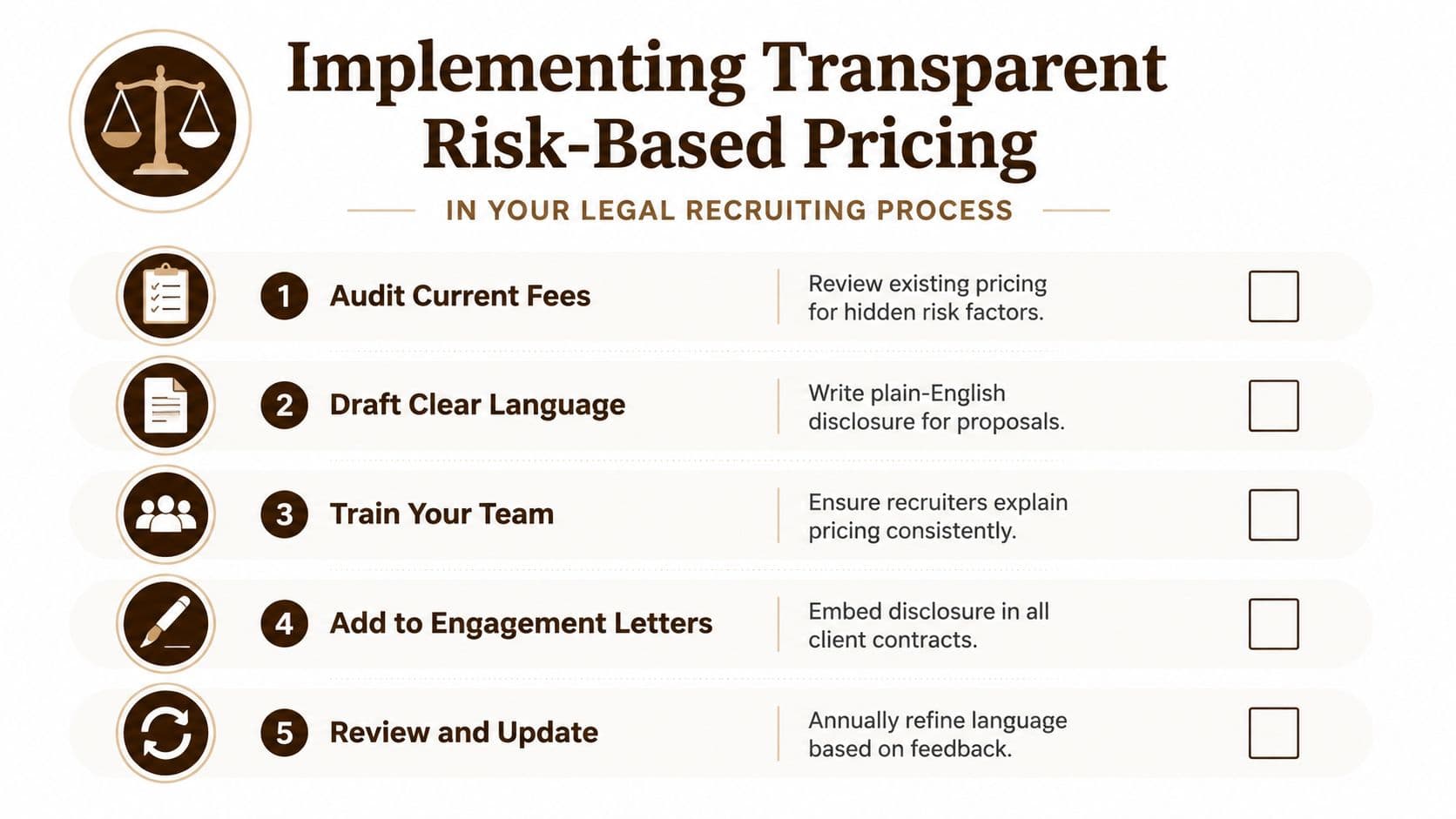
A recruiting firm can implement transparent pricing without turning every proposal into a treatise. Start with the commercial facts, then build a repeatable review process.
- Audit current fees. Identify every variable that affects the proposed fee, payment trigger, ownership period, guarantee, and scope.
- Draft plain-English language. Put the formula, outcome definition, exclusions, and protection terms in the proposal and engagement letter.
- Train the team. Recruiters should explain the terms consistently and escalate unusual arrangements rather than improvising.
- Test edge cases. Review multi-office hires, affiliated entities, partner-level lateral moves, internal candidates, duplicate introductions, and changed roles.
- Review the language. Use client questions and placement disputes to improve the document, not merely to defend it.
Clients should apply the same scrutiny before signing. Ask what happens if the candidate was already in the database, if the candidate joins an affiliate, if the job changes after acceptance, or if the recruiter presents the same person to multiple offices. A proposal that answers those questions earns trust before the first interview.
For a practical benchmark when reviewing your budget and options, use how much a legal recruiter costs as a starting point, then assess the protections attached to the fee rather than treating price as the only variable. The strongest arrangement makes the economics, responsibilities, and remedies visible from the beginning.
Five Star Placements provides contingency-based permanent placement for attorneys, partners, in-house counsel, legal support professionals, and legal operations leaders, with payment due only upon a successful hire and no upfront costs. Visit Five Star Placements to discuss a transparent recruiting process for your role, practice needs, and hiring risk.
Need help filling a legal role?
Five Star Placements partners with law firms and legal departments nationwide.
Schedule a Call