
How to Hire a Law Firm Partner Without Losing the Book
August 4, 2026 · 16 min read · Five Star Placements

Table of contents
A law firm can win the pitch and still lose the hire. That's the problem with partner recruitment, because the market's own record says the risk doesn't show up on signing day, it shows up later, when the client book doesn't move, the partner's practice stalls, or the lawyer leaves. Research cited by The Law Gazette tracked 2,869 qualifying partner hires and found 33% had already moved on, and when the most recent two years were excluded, four in 10 of the partners hired since 2006 had left. In other words, how to hire a law firm partner is really a question about how to avoid paying for a title you can't keep.
The 2024 market makes that warning harder to ignore. NALP reported 4,295 lateral lawyers hired, up 13.9% from 2023, and partner moves made up 22.5% of all lateral hiring that year, which means firms are competing aggressively for portable revenue, not just prestige hires (NALP lateral research). The firms that do this well stop treating the offer letter as the finish line. They treat partner hiring as a risk-adjusted diligence process, then as a two-year integration project.
Table of Contents
- Why Most Partner Hires Quietly Fail by Year Two
- Build the Role Brief Before You Talk to a Single Candidate
- Choose Between Internal Promotion, Lateral Search, and Recruiter Engagement
- Screen for Portability, Conflicts, and Comp Leverage, Not Pedigree
- Structure the Compensation Package So It Actually Pays You Back
- Negotiate the Offer Letter and Lock Down the Close
- Run a 24-Month Integration Plan That Survives the Two-Year Test
Why Most Partner Hires Quietly Fail by Year Two
The partner market isn't thin anymore, it's active and selective. NALP's 2024 data show a rebound in lateral hiring to 4,295 lateral lawyers, with partner moves accounting for 22.5% of all laterals, which tells you firms are still using partner recruitment as a growth lever, especially in revenue-bearing practices (NALP lateral research). But the more useful number is the attrition finding from The Law Gazette, because it exposes what happens after the celebration lunch.
A partner hire can look successful on paper and still underperform in the first two years. If the practice doesn't port cleanly, if clients are loyal to the individual but not to the platform, or if the new lawyer doesn't mesh with the firm's pricing and leadership style, the economics unravel slowly. That's why year-two retention is the scorecard, not the signed offer.
Practical rule: if the firm can't explain how the partner will create value after the first transition year, it doesn't have a hiring thesis, it has a hope.
What the attrition data really changes
The Law Gazette figure matters because it reframes partner recruitment as a durability test. The evidence suggests that pedigree, title, and even a glossy client list are not enough. A firm that hires on reputation alone can end up carrying conflict risk, integration costs, and morale drag long after the move is announced.
That's the commercial reason to think in probabilities, not headlines. A wrong partner hire doesn't just consume recruiter time. It can distract practice leaders, strain staffing, and create an invisible subsidy that the partnership won't spot until the book has already stalled.
What to measure instead of excitement
The firm should start asking a different question during the search, namely, what would have to be true for this hire to still be productive in 24 months? That shifts attention to practice portability, client stickiness, and cultural fit before anyone gets attached to the candidate. It also forces the hiring team to define what success means beyond first-year originations.
The disciplined approach is simple. Treat the first two years as a probationary window, keep the economics conservative, and set integration milestones up front. That's how you turn a lateral move from a recruitment event into a manageable business project.

Build the Role Brief Before You Talk to a Single Candidate
The biggest mistake in partner hiring is starting the search with a personality, not a mandate. A firm says it wants a “strong rainmaker,” then discovers too late that no one agreed on the practice gap, the comp ceiling, or whether the hire is supposed to deepen an existing platform or open a new one. If you want a cleaner process, start with three conversations and put the answers in writing.
The intake meeting that prevents scope creep
First, align with the Managing Partner or chairman on the firm's strategy and financial appetite. The question is not whether the candidate is impressive, it's whether the firm is funding growth in that practice area at all. If leadership isn't aligned on why this seat exists, the search will drift.
Second, sit down with the practice-group leader and define the actual role. Spell out the must-haves, negotiables, and disqualifiers. A role brief that says “litigation partner” is too vague. A brief that says “commercial litigator with portable client relationships, active court presence, and a practice that can cross-sell into employment and investigations” gives the search a target.
Third, get finance in the room early. The compensation band, equity tier, and overhead assumptions all affect whether the hire makes sense on day one. If those numbers aren't visible before outreach starts, the search team will waste time on candidates the firm can't realistically land or afford.
The one-page brief that keeps everyone honest
NALP's lateral partner recruiting guide says to gather a current resume, web bio, LPQ, and a detailed business plan covering clients, contacts, expertise, and strategic fit (NALP lateral partner recruiting guide). That's the operating baseline, not a nice-to-have. Add your own one-page brief around it and keep the document lean enough that partners will read it.
A useful brief includes:
- Portable-client evidence, not just claimed relationships.
- Target matter types, so the team knows what work the partner will touch first.
- Bar admissions and court appearances, especially if the role is litigation-heavy.
- Non-negotiable culture anchors, such as billing expectations, delegation style, or client-service norms.
The cleanest searches aren't broader, they're narrower. The more specific the brief, the easier it is to reject attractive but mismatched candidates early.
That brief also compresses the search. Recruiters and internal talent teams stop chasing shiny resumes and start filtering against the same standard. If a firm wants a tighter process for legal recruiting, it can use the same disciplined intake structure that appears in Five Star Placements' about page, where the model is built around customized search and screening rather than generic resume forwarding.
Choose Between Internal Promotion, Lateral Search, and Recruiter Engagement
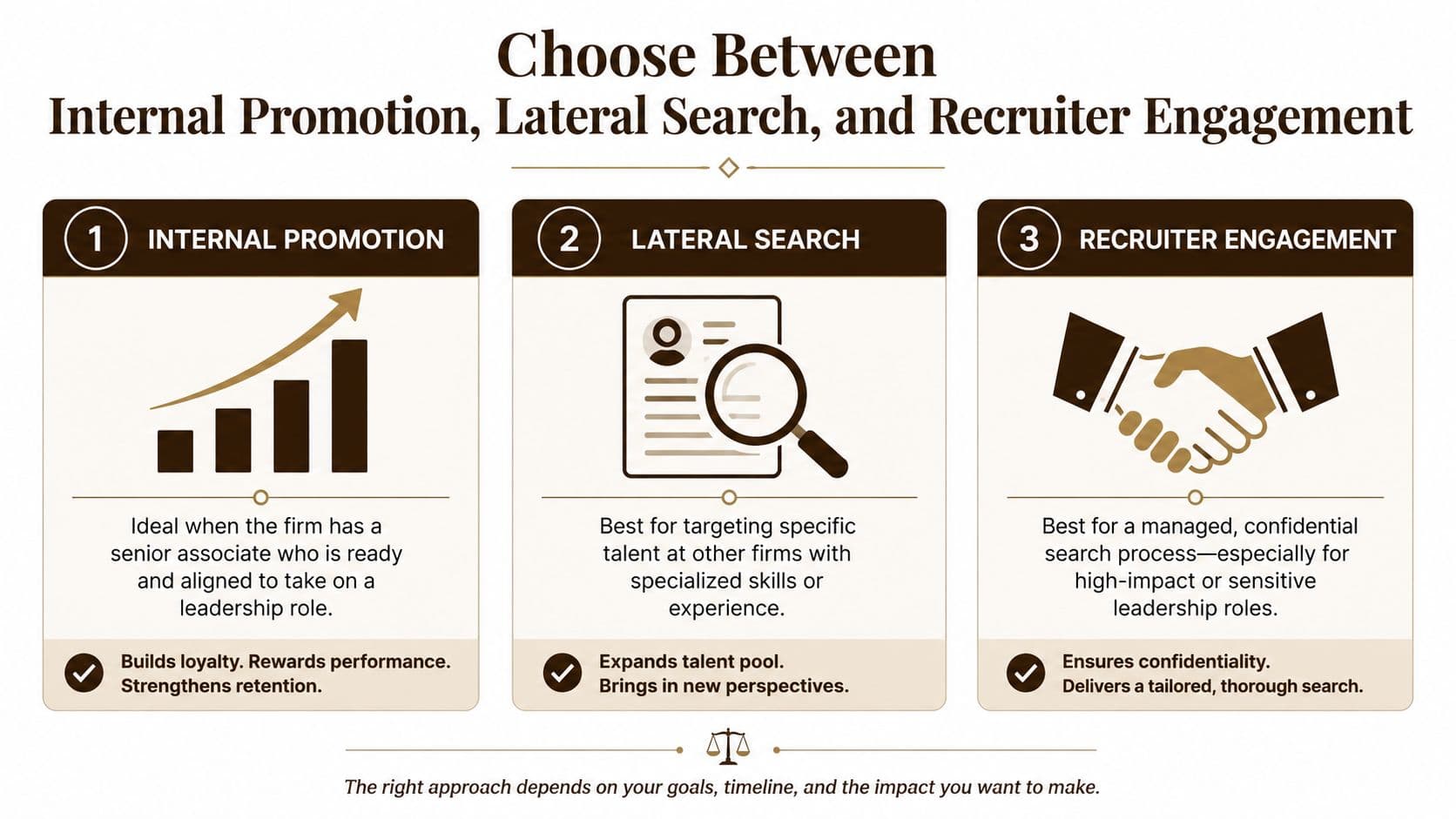
Not every partner seat needs the same sourcing lane. Some firms default to lateral outreach because it feels decisive, then discover they're competing for talent they can't reach quickly or confidentially. Others overuse internal promotion and end up promoting a technically strong lawyer who doesn't have the right book or practice mix. The best choice depends on the role, the timeline, and the political temperature inside the firm.
Internal promotion works when the book is already forming
Internal promotion makes sense when a senior associate or counsel already shows partner behavior, has visible client trust, and can carry a real business plan into the role. It's also the least disruptive option because the firm already knows the candidate's work style, ethics, and internal relationships. That lowers uncertainty, but only if the candidate has genuine portability and buy-in from the partnership.
The weakness is obvious. Internal candidates can be easier to promote than to underwrite. If the firm confuses loyalty with readiness, it can create a partner who's strong technically but weak commercially.
Lateral search fits narrow practice needs
Direct lateral outreach works best when the firm knows the exact practice it wants and has partners who can open doors through warm introductions. It's especially useful when the target market is small and the candidate pool is visible through Chambers, Super Lawyers, legal press, and peer networks. The downside is time, because direct search can be slow and can expose the firm to missed confidentiality if the role is sensitive.
Recruiter engagement earns its keep in hard searches
A contingency recruiter becomes valuable when the role is confidential, the timeline is tight, or the firm doesn't have the internal capacity to run a national search. Five Star Placements, for example, works on a contingency-based model with payment only on a successful hire and customized screening beyond the resume, which matters when the firm needs managed sourcing instead of ad hoc outreach. Its direct-placement approach is also built for nationwide coverage and selective hiring environments, which can be useful when the role is competing with active firm revenue (Five Star Placements services).
If the role is highly selective, confidential, or competes with existing revenue, a recruiter lane usually pays for itself in time saved and fewer false starts.
The decision rule is straightforward. Use internal promotion when the person is already inside and ready, use direct lateral search when the market is narrow and visible, and use recruiter engagement when confidentiality, speed, or search discipline matter more than hands-on sourcing.
Screen for Portability, Conflicts, and Comp Leverage, Not Pedigree
A polished resume can hide a weak transfer path. The hiring committee needs a screening process that looks past titles and asks what moves, what conflicts, and what the economics will tolerate. That starts with documents, then moves to diligence, then to a conversation that tests whether the candidate can bring real work rather than plausible stories.
The documents that matter before first interview
NALP's lateral hiring best-practices guide says firms should verify current employment, confirm the practice area, check bar admission, and for litigators review court dockets during initial screening (NALP lateral hiring best practices). That sounds basic, but many searches still skip one of those steps because the committee gets impressed early. Don't let that happen.
The same guide says every submission should be logged immediately in a tracking system to avoid fee disputes with search consultants. It also recommends a confidentiality agreement before sensitive practice information changes hands. Those aren't formalities, they're controls.
The diligence checks that prevent expensive surprises
The portable book conversation has to get specific. Ask the candidate to identify real clients, the people who control the relationship, how long the work has been open, and what contractual or institutional ties could keep the client from moving. Vague assurances are not enough.
Then add the conflict screen. NALP notes that firms should identify whether the candidate or others at the current firm are on matters adverse to the interviewing firm (NALP lateral hiring best practices). In practice, that means partner hiring is a conflicts exercise as much as a recruiting exercise.
A clean screening sequence usually looks like this:
- Document verification, including license and practice history.
- Portability interview, focused on named clients and actual matter flow.
- Adverse-party review, before any sensitive details are shared.
- Submission log entry, so the source chain is clean.
The committee should also be blunt about comp flexibility. A candidate who needs heavy support, high draw, and a long ramp may look strong on paper and still be expensive to integrate. The point isn't to downgrade the person, it's to price the risk correctly.
A partner hire should be treated like a legal and economic diligence file, not a charm contest.
For firms that want a more operational recruiting workflow, Five Star Placements' blog reflects the same practical posture, namely, screen beyond the résumé and validate the fit before the offer window opens.
Structure the Compensation Package So It Actually Pays You Back
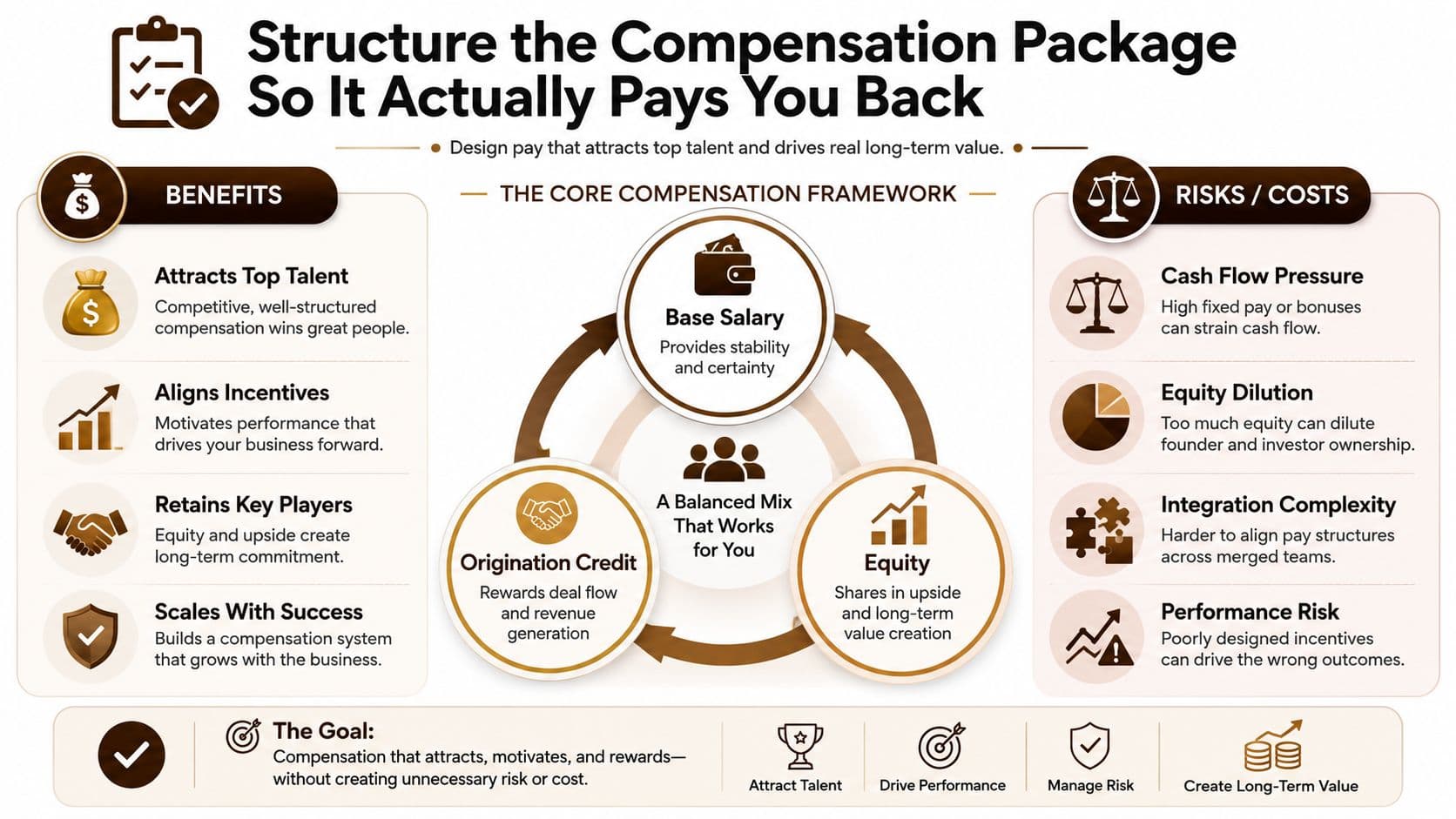
Compensation is where a lot of partner searches go sideways, because the partnership wants to attract talent without overpaying for uncertain portability. The fix is to build the deal around economics first and optics second. If the numbers don't work after draw, overhead, and transition cost, the hire is a liability no matter how attractive the name on the announcement is.
Model the economics before you model the optics
The three numbers that really matter are draw against originations, equity tier, and overhead allocation. Draw tells you how much cash the firm advances before the book proves itself. Equity tier affects both economics and governance. Overhead allocation decides whether the hire is profitable once space, support, and staffing are counted.
Aderant's practitioner analysis makes a useful point here, the strongest rainmaker can still be a weak hire if the economics are opaque (Aderant lateral hiring analysis). That's the right instinct. A candidate's relationship value means little if the firm can't tell whether the practice will produce net profit after transition costs.
Use a conservative model. Start with expected originations, subtract draw, then add a realistic allocation for support and overhead. If the result only works when the book moves perfectly and immediately, the offer is too aggressive. A clearer structure is to set a lower initial draw and tie any increase to actual collections or confirmed client transfer.
The 2024 survey figure cited in the NALP research is also telling, because 93% of respondents prioritized a candidate's book of business and client relationships when evaluating lateral partner hires (NALP lateral research). That doesn't mean the book should be accepted at face value. It means the offer has to be built around verified portability, not interview theater.
When a partner without a book can still be worth hiring
Partners without immediate portable revenue can still be viable, but only if the firm underwrites the path. That usually means a written business-development plan with measurable milestones, a clear support structure, and compensation that rewards progress rather than fantasy. If the candidate can open doors, deepen an underdeveloped practice, or cross-sell into existing client relationships, the economics may still work.
A simple compensation guardrail helps:
- Keep draw conservative until collections are visible.
- Use originations true-ups so credit tracks actual movement, not assumptions.
- Tie part of comp to business-development milestones when the book is still forming.
- Revisit overhead assumptions after the first material matter transfer.
The deal should feel firm enough to attract the candidate and cautious enough to survive a missed projection. That balance is what keeps partner hiring from becoming an expensive guessing game.
Negotiate the Offer Letter and Lock Down the Close
The signed offer isn't the close. The close is the first billable day when the partner's client relationships, conflict clearance, and internal support are in motion. That's why the offer letter has to do more than state the comp package, it has to remove the friction points that usually blow up at the last mile.
The most important clause is the start date tied to client-conflict clearance. If the partner can't work immediately because conflicts are still being resolved, the launch plan should say so. The letter should also address restrictive covenants in a way that respects the relevant states' professional conduct rules, because the firm doesn't want a hire whose exit terms are already under dispute elsewhere.
Deferred comp and forfeited equity from the prior firm matter too. If the candidate is leaving money behind, the offer needs to reflect that reality without creating a reckless guarantee. A relocation clause can also help when the lateral can't move immediately, especially if the practice will begin with hybrid travel or weekly commuting.
The final negotiation points that decide the hire
The same three topics come up in almost every close. Counteroffers from the current firm, sign-on bonus structure, and the spouse or partner-career issue. If the candidate's family situation isn't acknowledged early, the process can collapse after everyone thinks the economics are done.
MLA Global's guidance is useful because it notes that candidates now expect a documented firm story, compensation clarity, business-development support, and an explicit integration plan as part of the offer process (MLA Global lateral partner recruitment). That's exactly right. Candidates don't want a vague promise of support after arrival, they want to know what the platform will do for them on day one.
A clean close usually includes three things:
- A crisp offer memo that matches the business plan.
- A confidentiality and clearance path that avoids premature announcement.
- A written support package for launch, staffing, and introductions.
If those pieces are loose, the candidate will feel it. The move can still happen, but the odds of hesitation rise quickly.
Run a 24-Month Integration Plan That Survives the Two-Year Test
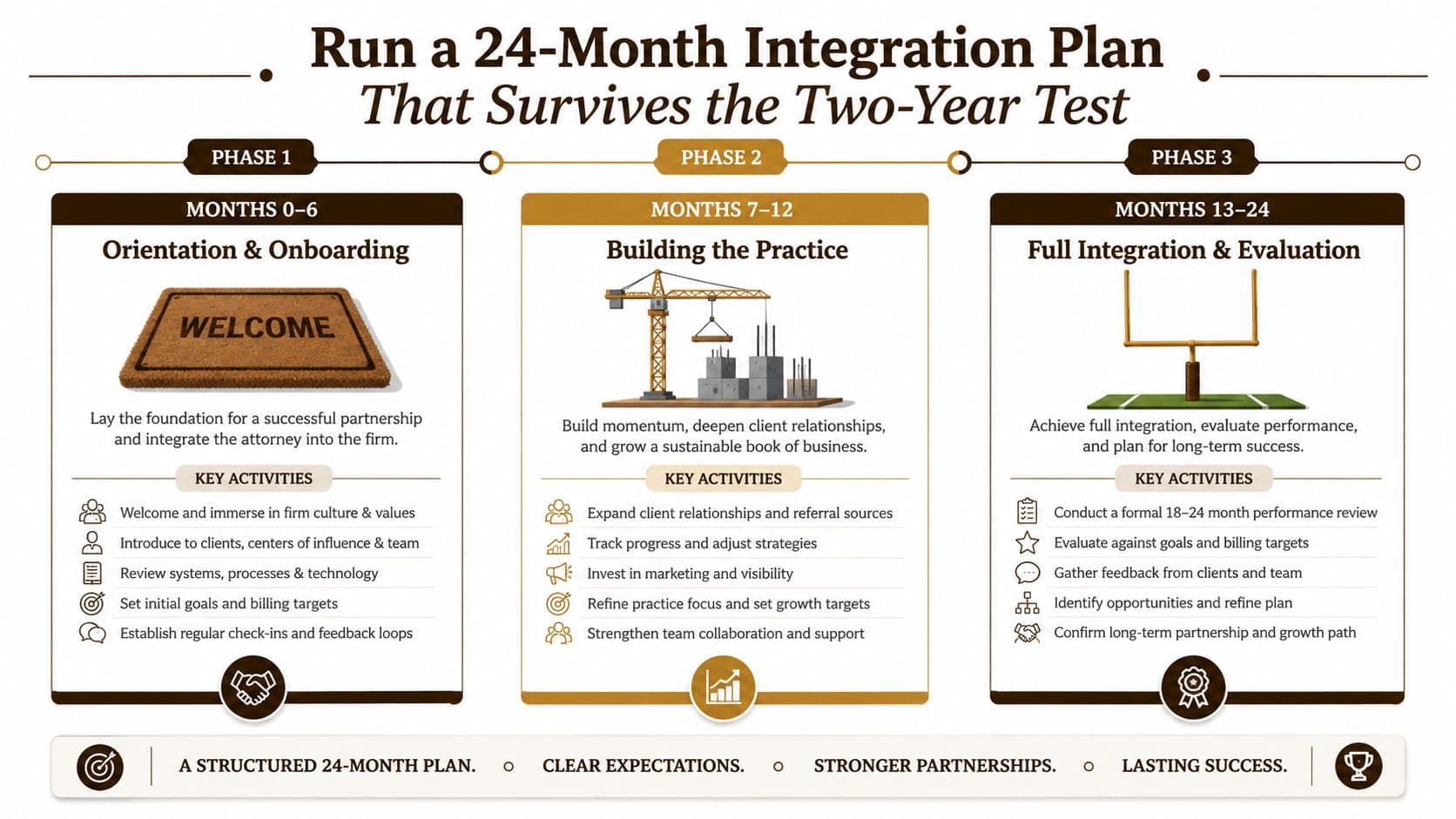
The biggest lie in partner hiring is that integration happens automatically after the signature. It doesn't. The firm has to earn the hire back over time, and the market's own two-year grace period gives you the right frame for that work. The Law Gazette data make that clear, because the judgment point is whether the partner is still there and still productive after the first stretch of transition (The Law Gazette).
The first 90 days decide whether the move feels real
The first phase is about conflict clearance, internal introductions, and the first co-marketed matter. If the firm waits for the partner to “find their way,” the internal network never forms. The new hire should be introduced to practice leaders, key referral partners, and the staffing teams that will execute the work.
The candidate's original business plan should also be visible in the background. If the first quarter already deviates from the plan, leadership should say so early rather than wait for disappointment to harden into silence.
The six-month mark should test the cross-sell story
By six months, the firm should know whether the partner can convert portable relationships into active matters and whether other groups are helping. That means tracked cross-selling, real billing activity, and a candid review of what is and isn't moving. It's also the right point to compare the actual pipeline against the assumptions in the brief.
Retention starts or fades here. If the hire is isolated, the partner will feel underused. If the firm overstaffed too early, others may resent the load. Either way, leadership should use the data, not gut feel.
The 24-month review should be explicit
By month 24, the partner should be measured against the original brief. That includes client conversion, originations credit, and whether the practice fits the platform in a durable way. If the book hasn't materialized, the conversation should be direct and unemotional. That's not punishment, it's management.
Retention depends on visible milestones. If the partner can't see how the firm is judging progress, the firm probably isn't judging the right things.
MLA's older but still relevant guidance on lateral hiring also points to a diversity and sourcing lesson, widen feeder networks, examine unconscious criteria, and avoid reproducing the same partnership pipeline again and again (MLA Global lateral partner recruitment). That matters because a better integration process shouldn't just keep people longer, it should make the search less narrow in the first place.
The retention metrics that matter most are simple enough to track without drama, portable-client conversion rate at six months, originating credit against the comp model at twelve months, and partner-survey engagement at twenty-four months. If those indicators are moving the wrong way, the firm has a management problem, not a recruiting problem.
For a search that needs structured screening, confidential outreach, and a contingency model tied to results, Five Star Placements handles legal recruiting and attorney placement across law firms and corporate legal departments. If you're working through a partner hire and want a practical search process that starts with fit, portability, and risk control, visit Five Star Placements and start the conversation.
Need help filling a legal role?
Five Star Placements partners with law firms and legal departments nationwide.
Schedule a Call