
Equity Partner Real Estate: Roles, Pay and Path to Equity
November 20, 2026 · 13 min read · Five Star Placements

Table of contents
The offer arrives as an email with an attachment. There's a memorandum describing an equity partnership, a capital contribution with a lot of zeros, and a distribution schedule that looks generous until you try to line it up against your mortgage.
You've spent years in real estate work. You've closed acquisitions, run financings to signing, argued a zoning case, and managed the leasing for a client's whole portfolio. Now someone wants to know whether you'd like to own a piece of the firm instead of just working there. The number on the page isn't a salary. It's a purchase price plus a promise about future profit, and nobody has handed you the part that explains how the two connect.
What follows is that missing part: what equity status buys, what it costs in cash and risk, and what a candidate should demand in writing before signing.
Table of Contents
- What Equity Partner Means in a Real Estate Practice
- Core Responsibilities Beyond Billable Hours
- Qualifications Firms Check Before Offering Equity
- Partner Pay, Capital and Downside Risk
- Career Path From Associate to Equity Status
- Deciding Whether the Equity Partner Track Fits You
What Equity Partner Means in a Real Estate Practice
An equity partner owns a piece of the firm. That is the entire idea, and most of the confusion around the title comes from forgetting it. When you're admitted, you buy into the partnership, your name goes on the ownership roll, and your income becomes whatever remains of firm revenue after expenses, nonequity compensation and debt service are paid. You also gain a vote on firm-level decisions, from lateral hires and office leases to how profit is split the following year.
The nearest comparison isn't another law firm role. It's a co-owner of a small business. A store manager paid on commission earns more when sales rise. The owner earns more when sales rise, covers the rent when they fall, and signs the lease either way. The money and the vote arrive from the same source, which is ownership rather than a job description.
Set the two columns side by side and the split stops being abstract.
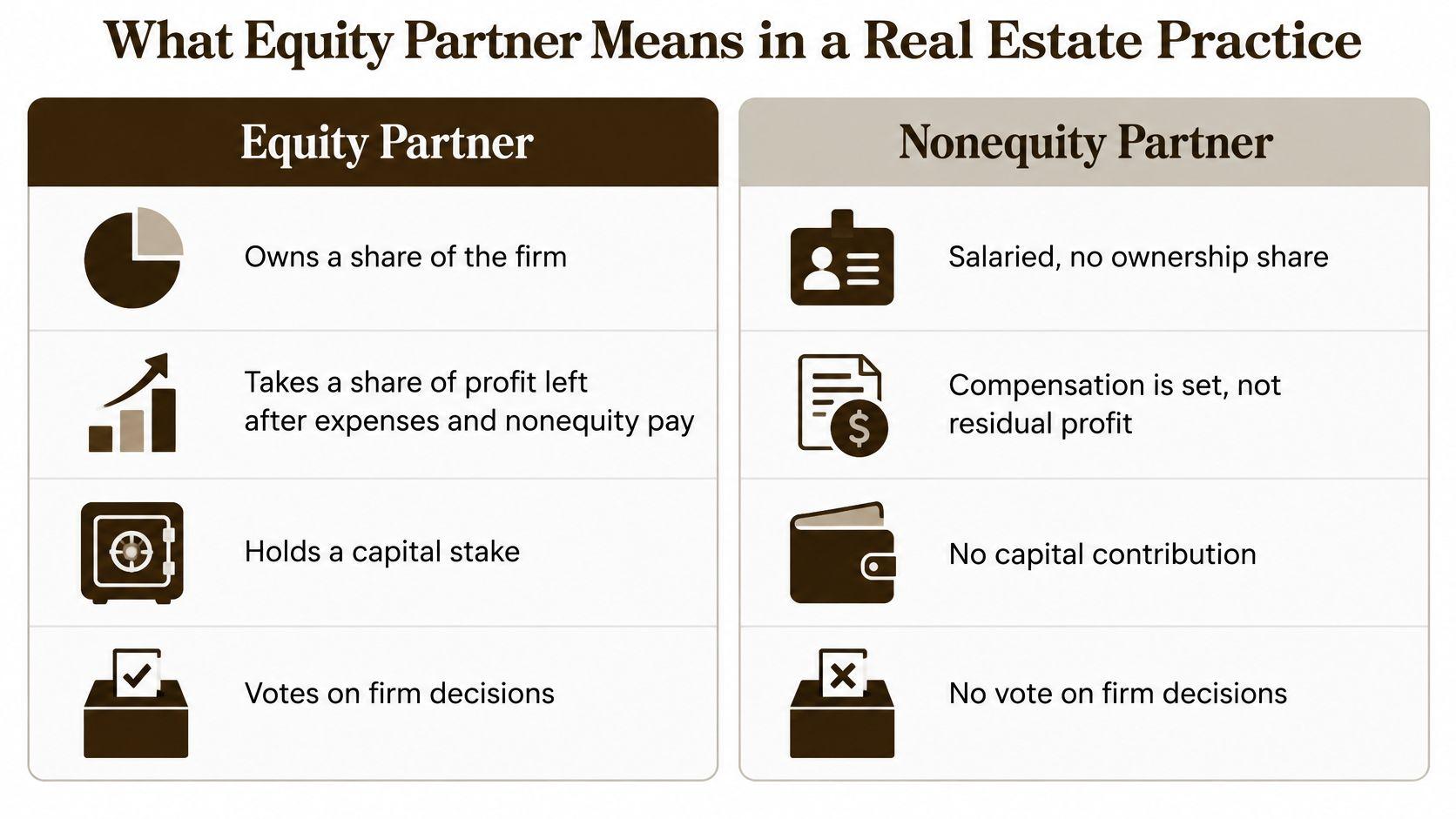
Every offer you'll see lands somewhere on this ladder.
| Tier | Profit participation | Capital contribution | Governance vote | Exit exposure |
|---|---|---|---|---|
| Equity partner | Share of residual profit after expenses | Required, size set by each firm | Yes, on firm-level decisions | Capital account returned after withdrawal |
| Nonequity partner | Fixed salary plus bonus | Usually none | Limited or none | Typically limited to employment terms |
| Income partner | Salary and bonus, no profit share | Usually none | None | Salary only, no capital at risk |
| Of counsel | Fee or salary arrangement set by contract | None | None | Contract terms govern payment on exit |
Why a real estate practice complicates the title
A real estate department earns on several clocks at once. Acquisition and disposition work closes in bursts, financing follows lender and rate calendars, leasing and land use bill steadily, and construction disputes surface long after groundbreaking. A firm weighing an equity grant looks at group-level origination and collections as much as an individual's hours, so two partners with similar billable totals can be treated very differently.
Three questions resolve more confusion than any title comparison:
- What share of profit does it pay? Ask for the formula and the expense allocation, not the average partner draw.
- What capital does it require? Get the figure, the payment schedule, and whether the firm can call more later.
- Does the title carry a vote? A share of profit without a vote is a profit-sharing plan with a better name.
Core Responsibilities Beyond Billable Hours
The record of hours is the smallest part of what an equity partner is paid for in an equity partner real estate practice. The visible work is client meetings, signatures on junior work, and votes on the lease that funds the office everyone sits in.

Four duties sit outside the hours, and a candidate who can't name them will misjudge the job.
- Origination: bringing in the developers, lenders, landlords and institutional owners whose instructions repeat year after year rather than arriving once.
- Supervision: staffing every closing, financing and leasing deal across associates and of counsel, then reading the work before the client does.
- Collections: fees only become partner income when they're paid, so a partner watches realization, write-offs and aged receivables on their own matters.
- Governance: voting on laterals, budgets, leases and expansion, then living with the result.
The occupancy decision nobody audits
Office space is funded from firm revenue, which makes the lease a standing claim on every equity partner's share of profit. Cushman & Wakefield's 2019 Bright Insight Legal Survey found that the average share of gross revenue spent on real estate had stayed below 6% across the four preceding years, even while office rents rose in most major markets, and that only 20% of firms were calculating real-estate costs on a per-equity-partner basis, up from 11% the year before (Cushman & Wakefield).
A partner who commits the group to a ten-year lease to house a hiring plan that stalls has converted a forecast into a fixed cost. The signature takes a minute; the allocation lasts a decade, and the partners still there when the market turns carry it.
Practical rule: before you vote on space, ask for occupied square feet per attorney and rent per equity partner. A firm that can't produce both numbers is asking you to approve a cost you can't see.
The partner who ends up chairing those votes is usually the one described in this look at the managing partner role in a law firm, where the administrative load lands.
Compare your current role against the list. If you can't point to a client you brought in, a receivable you chased, or a firm decision you voted on, you're still being paid for hours, whatever the business card says.
Qualifications Firms Check Before Offering Equity
Firms don't grant equity for hours billed. They grant it for a book they can verify and a practice that holds up in a bad market, and they work through the checks in roughly that order.
Bar admission in the jurisdictions where the practice operates comes first, then a record of independent matters that shows you can run a deal without someone reading over your shoulder. Next is depth across the property mix: acquisitions, development, financing, leasing, land use, construction and workouts, including contentious work, because a partner who has only ever closed clean purchases struggles when a lender relationship sours. Leadership comes last on paper and matters most in practice, meaning you can supervise multidisciplinary teams and hold your own with lenders and developers.
The book test
Two partners bill the same amount and only one is a safe hire. Partner A's revenue comes from a single development client whose pipeline depends on construction loans renewing. Partner B's is split across a REIT's leasing program, a bank's workout portfolio and a developer's land-use matters. Identical billings, different durability. Firms know this, which is why they verify recurring clients, active matters, historical collections and conflict-cleared portability instead of accepting a stated book.
Market conditions make the distinction sharper. JPMorgan reported that most primary metropolitan areas had higher vacancies in Q1 2025 than a year earlier, though 40% saw stable or declining vacancy, nearly twice the share reported in the prior quarter, with New York, Los Angeles and San Francisco among the markets performing well (JPMorgan). The same outlook cites CBRE's projection of difficult bank construction-loan availability alongside a 5% increase in leasing volume in 2025. A partner whose income depends on one transaction type feels that split immediately; a partner who can move between leasing, restructuring, construction disputes and land use keeps producing while the cycle turns.
Score yourself on five criteria before an interview:
- Portable clients you could call tomorrow without a conflict.
- Recurring share of revenue, meaning work that arrives without a new pitch.
- Sector mix, and whether any single asset class carries more than half your book.
- Lender and developer ties that survive a refinancing freeze.
- Team supervision, including whether clients ask for you or for your associates.
Partner Pay, Capital and Downside Risk
A real estate partner signs the equity agreement in a strong year, then learns that the first capital call arrives before the first distribution. That sequence is the whole lesson: equity is a purchase of a profit stream with obligations attached, not a promotion with a bigger salary.
How the draw is calculated
A firm with $100 million in profit and 50 equity partners produces an average draw of $2 million per partner. No individual partner receives the average. The split follows origination credit, collections on that partner's matters, matter profitability and the firm's expense allocation. The partner with the largest billing total in a group can take home less than the partner who collects cleanly on smaller matters, because billings are a promise and collections are cash.
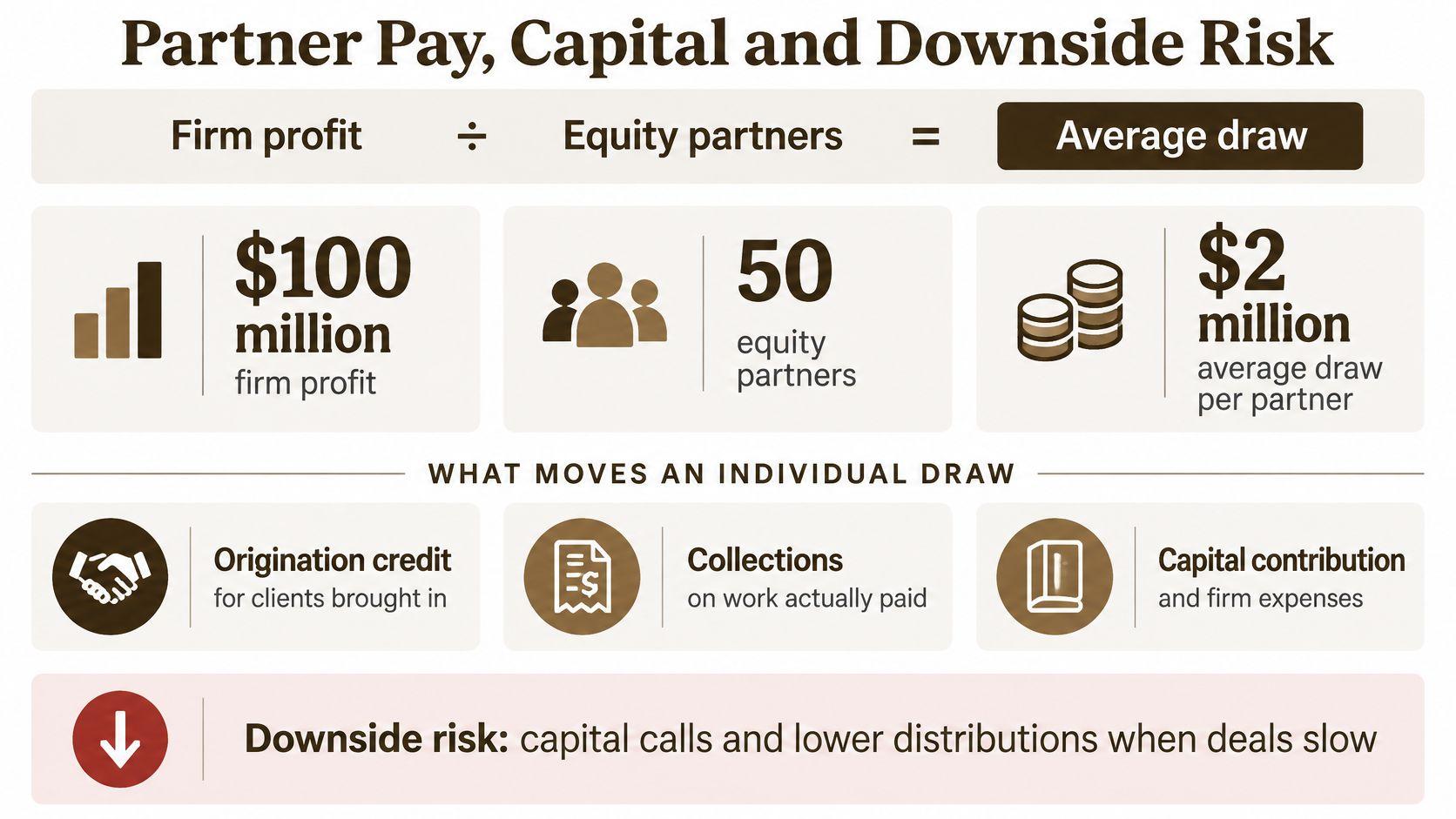
Large-firm benchmarks give you a starting range, not a prediction.
| Metric | Equity partner | Nonequity partner |
|---|---|---|
| Average compensation, Am Law 200 | About $1.94 million | About $558,000 |
| Median originations | About $2.75 million | $750,000 |
| Profits per equity partner, first half of 2025 | Up 13.7% year over year (firm-level) | Firm-wide metric only |
| Equity partner headcount, first half of 2025 | Up 0.7% year over year | Not reported separately |
The 2024 Major, Lindsey & Africa Partner Compensation Survey puts average compensation for Am Law 200 equity partners at about $1.94 million against $558,000 for nonequity partners, with median originations of roughly $2.75 million versus $750,000 (Major, Lindsey & Africa). Those are large-firm figures. A boutique real estate group with eight partners operates at a different scale, so carry the ratio between equity and nonequity pay across rather than the dollar amounts.
Firm-level profit moved faster than owner count in 2025. Profits per equity partner rose 13.7% year over year in the first half while the number of equity partners rose 0.7%, according to Wells Fargo's Legal Specialty Group survey of more than 130 law firms reported by the ABA Journal. Profit climbing roughly twenty times faster than headcount means the average draw rose because revenue rose, not because the firm added owners. The gap between firm-level profit and your own distribution is the thing to understand before you negotiate, and the mechanics are set out in this explanation of profit per equity partner.
The cash you put in
At large firms, the entry check is real. Wells Fargo's Legal Specialty Group estimated average Am Law 100 equity-partner contributions at about 23% in 2023 (LawFuel). The money funds working capital: payroll, occupancy, technology and matter costs arrive before client payments do, so partner capital reduces the firm's reliance on borrowing.
Some partnership agreements repay that capital over several years after a partner leaves. That turns an entry cost into an exit-liquidity problem, and it belongs in the same conversation as your projected draw.
A capital contribution is a loan you make to a business you now partly own. The repayment schedule matters as much as the interest you are not charging.
Where the downside sits
Real estate work makes the timing worse. Development, financing, land-use and construction matters run long cycles with staggered billing and collection milestones, so a real estate partner's capital sits in a firm whose cash flow lags the deal calendar by months.
Market conditions add to it. Refinancing pressure was identified as a major institutional risk in a 2025 partner survey. When clients stall or default, the firm still pays payroll and rent. The equity partners absorb the difference through lower distributions first, then through a capital call.
The video below examines the commercial real estate conditions that feed those collection delays.
Three scenarios to model
Build all three before you sign anything:
- Base case: your expected draws at current realization, net of tax and the capital contribution.
- A low-collection year: same book, slower payments, one major client stretching invoices by ninety days.
- A delayed development closing: the fee you were counting on slips two quarters and the distribution falls with it.
Then request the documents behind the numbers: the partnership agreement, capital-call provisions, distribution calendar, tax-distribution policy, withdrawal repayment schedule and the treatment of unfinished matters. Ask how the firm has handled de-equitization in previous downturns. An after-tax cash-flow model built from those documents turns an equity title into an investment you can evaluate.
Career Path From Associate to Equity Status
The route usually starts with volume. Stage one is transaction depth as an associate across acquisitions, financing, leasing and development, enough that you can run a closing without a checklist in front of you. Stage two is ownership of a matter and then a client relationship, typically one or two recurring clients rather than a single deal. Stage three is a title that pays a salary and expects origination, whether the firm calls it senior counsel, income partner or nonequity partner.
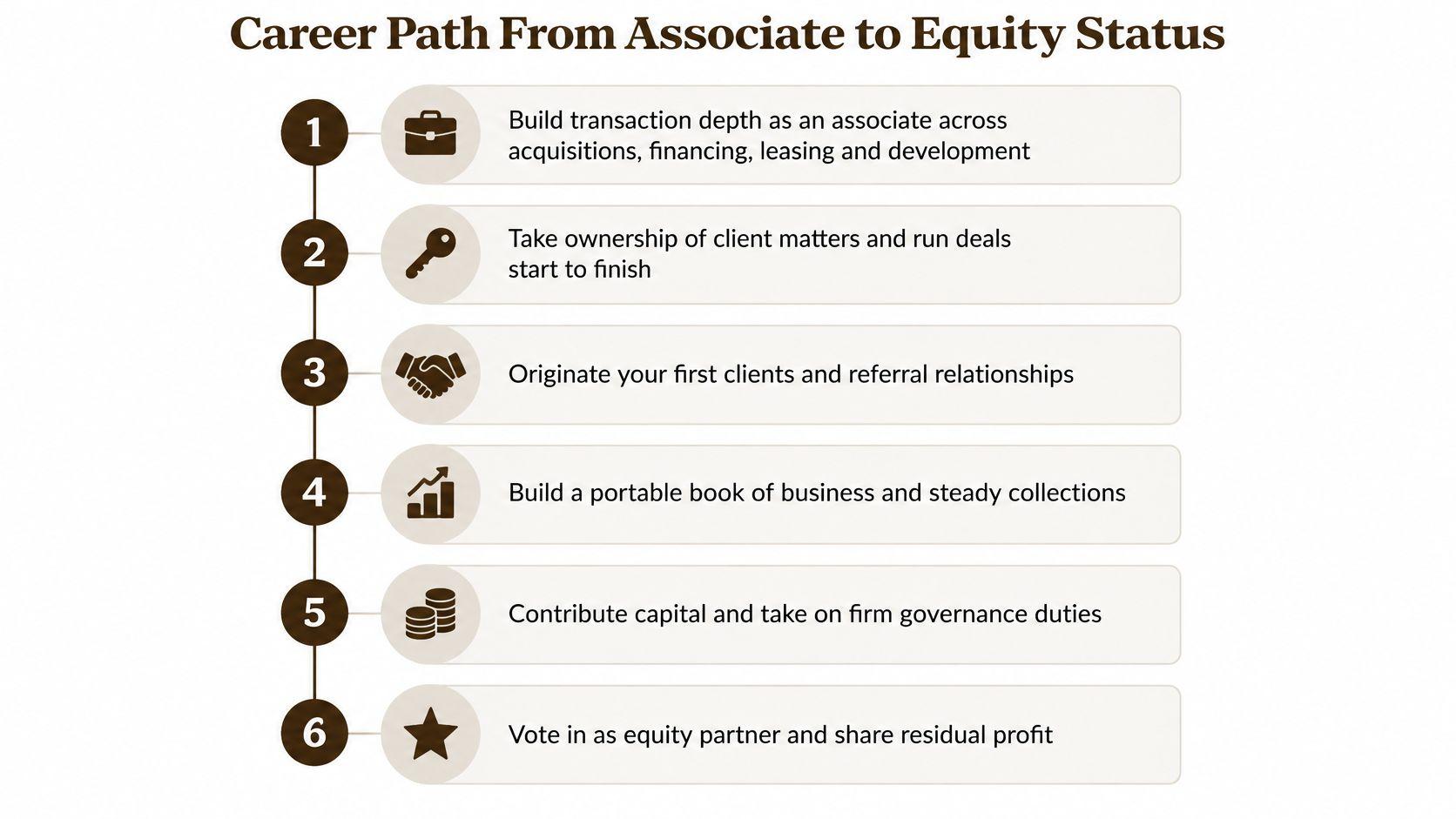
Stage four is where candidates lose the plot. Equity decisions turn on several years of documented origination and collection, with a record of who brought in each client and who kept them, not on a strong year. Stage five is the offer itself, which should specify capital contribution, profit share and origination credit terms in writing. Stage six is maintenance, because equity is reviewed annually and can be reduced.
The steps that get an associate onto a partnership track at a law firm, and the ones that stall a career at stage three, follow a fairly consistent pattern across firms.
The path also runs backwards
In 2025, 27% of surveyed equity partners, nearly 250 partners mostly at Am Law 200 firms, said they expected their firms to carry out partner de-equitizations, according to a survey reported by The American Lawyer. Read that as a warning about the exit as much as the entry: equity isn't permanent, and a partner whose collections sag can be moved down a tier.
Laterals take a shortcut that internal candidates can't. A partner arriving from a regional firm with a recurring institutional client base often receives equity sooner than an associate who has waited eight years, because the firm is buying a verified book rather than a forecast. The offer should still be tested against the same capital and origination terms, and against the same question: what happens to your capital account if you leave in year three?
Deciding Whether the Equity Partner Track Fits You
Three conditions justify serious negotiation. The portable book survives verification, the capital is fundable without touching reserves you may need in a slow year, and the firm puts capital, origination and repayment terms in writing before you commit. Miss one and you are still holding an offer, just not the deal you think you are taking.
Take the partner whose book rests on one transaction type in a cyclical sector. Price that offer against a nonequity alternative before wiring anything. The comparison weighs a capital contribution plus a variable distribution against a fixed number with no call on your savings, and the nonequity side sometimes wins on after-tax cash for the first two years.
Decline or wait if funding the contribution plus a low-draw year would wipe out your reserves. The title doesn't expire if you take it a year later, and firms rarely withdraw an offer because a candidate asked for the distribution history and the capital-call provisions.
One note on scope: our placements run mostly from Am Law firms into boutique and midsize platforms, and we rarely place into Am Law firms. The questions above apply at any size, so test the terms against the firm in front of you rather than against a market average. Smaller platforms often mean smaller capital numbers, but the repayment language still deserves the same scrutiny.
Four steps this week:
- Request the partnership agreement and the capital-call language, not a summary of them.
- Build the after-tax cash-flow model with the low-collection and delayed-closing cases included.
- Compare the offer with a nonequity alternative using the same three scenarios.
- Ask for the origination credit rules in writing, including how credit sunsets after a client has been with the firm for several years.
Five Star Placements recruits partners and laterals for boutique and midsize law firms and corporate legal departments: what a book is really worth, what capital a candidate can fund, and which platform fits. If you're weighing an equity offer in a real estate practice, or your firm is trying to fill a partner seat, visit Five Star Placements and schedule a call to talk through your recruiting needs.
Need help filling a legal role?
Five Star Placements partners with law firms and legal departments nationwide.
Schedule a Call