
How to Find Partner: Steps for Firms and Lawyers
November 3, 2026 · 13 min read · Five Star Placements

Table of contents
Approximately two-thirds of lateral partners generate less than 75% of their expected book of business, according to the ALM Intelligence report cited by the ABA. That's why how to find a partner isn't mainly a sourcing problem. It's a verification problem. Firms that treat a claimed book as cash in hand overpay, guarantee too much, and discover the gap after clients don't move. Lawyers who can't document what they've originated and collected lose credibility in the first serious conversation. Both sides do better when they work from evidence, test the compensation formula in writing, and agree an integration plan before anyone signs.
Table of Contents
- Two Searches, One Partner Decision
- How Firms Define and Source the Right Partner
- How Lawyers Position Their Book Before the Search
- Verifying a Portable Book Before Any Offer
- Testing Compensation Terms Before You Accept
- Interviewing, Offer Timing and the First 18 Months
- Choose Your Next Step This Week
Two Searches, One Partner Decision
A partner search looks different depending on which chair you're sitting in, but the decision is the same. The firm is buying future collected revenue and fit. The lawyer is selling documented capability and choosing a platform. Five stages cover both tracks.
1. Define the role. The firm writes a partner profile covering practice, licenses, matter mix, portable collections, team size and pay range. The candidate confirms which practices and clients they can prove they can move. Vague definitions produce vague shortlists, so both sides should be able to state the target in plain sentences.
2. Source and first contact. The firm ranks target candidates by strategic priority instead of contacting the whole market and hoping for replies. The candidate keeps a current list of target firms and visible work, so they're findable when a search opens.
3. Verify the book. The firm checks matter level revenue, client concentration and conflicts. The candidate supplies matter records and gives written consent to share what's shareable. This stage decides whether the numbers are real.
4. Negotiate terms. The firm reviews origination credit, the compensation formula, draws and guarantees. The candidate requests the written documents before accepting anything. Verbal assurances about pay aren't terms.
5. Integrate. Both sides agree the client introduction plan, name a partner sponsor, and set review dates at 6, 12 and 18 months. A hire that isn't integrated doesn't stay.
Run a quick self check before you start. If your first question is who is hiring, you're on the firm track and your job is definition and diligence. If it's what the firm will need to see, you're on the lawyer track and your job is documentation. Either way, don't skip stage three.
How Firms Define and Source the Right Partner
Firms waste the most time at the start, not the end. A loose brief produces impressive resumes that don't match the practice you need to build. Work through four steps in order.
Four Steps Before Outreach
1. Define the ideal profile with objective variables. Write down practice specialization, jurisdictional licenses, matter mix, client industries, portable collections, team size, pay expectations and geographic limits. These aren't preferences to discuss later. They're the screen every candidate passes or fails, and they stop partners from moving the goalposts mid search.
2. Build a target universe, then rank it. Draw names from practice rankings, bar and professional networks, matter histories and referral intelligence. Segment candidates by strategic priority so the team isn't contacting the entire market. A ranked universe lets you spend your best outreach on the people who matter most.
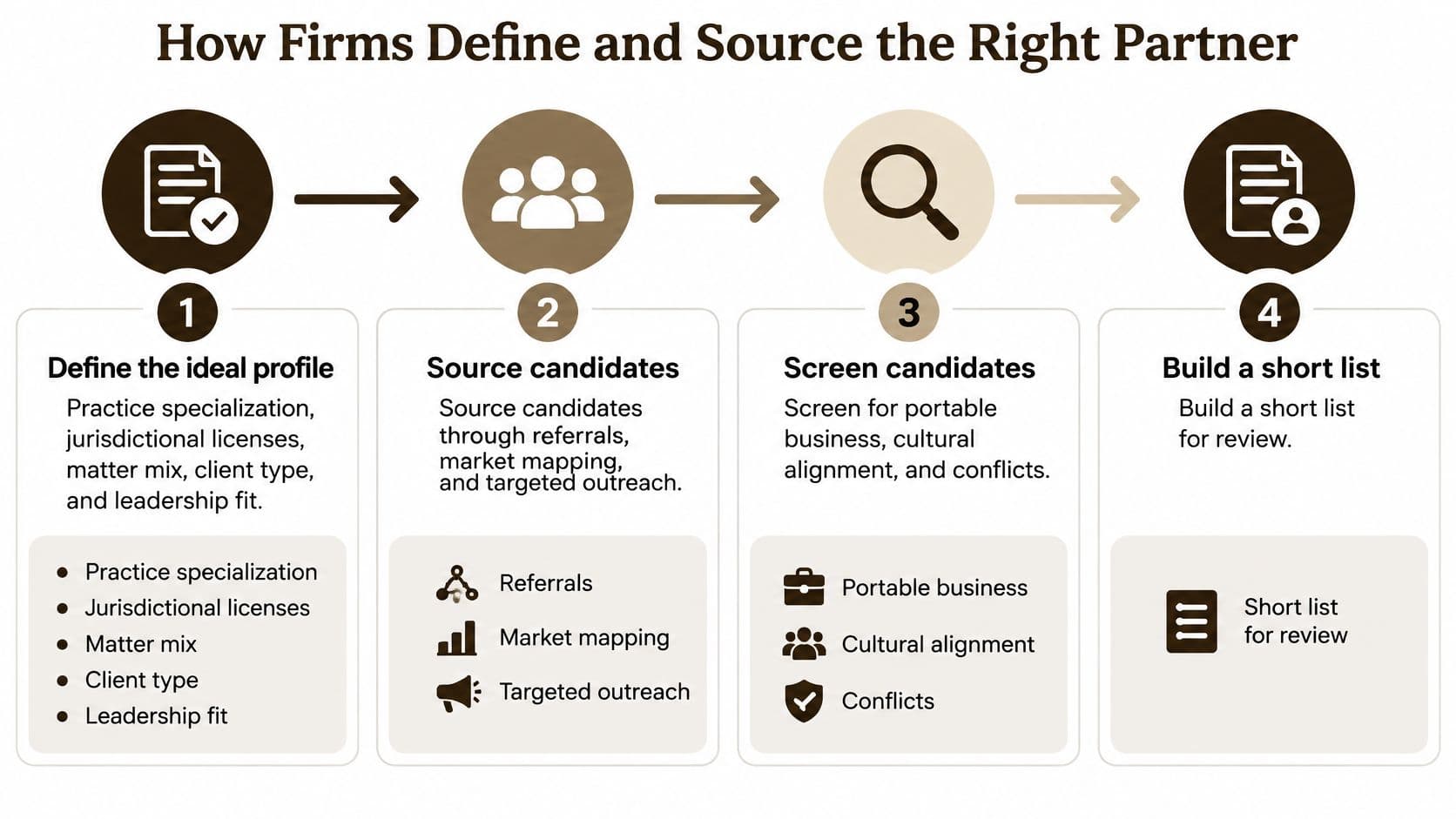
3. Run outreach in calibrated waves. Write to each candidate individually. Be honest about what makes them a fit for the role and where the gaps are. Generic mass messages signal a generic search, and strong partners can tell the difference in one paragraph.
4. Decide whether to source internally or use a recruiter. Internal teams know the culture but often lack reach into passive candidates. External recruiters bring market mapping and existing relationships, including candidates identified through a referral network. We use proprietary tools to find attorneys who match client criteria but don't appear in a standard search, and asking any recruiter how they surface those people is a fair test. A fuller breakdown of what a partner search firm for law firms should do at this stage helps you compare options.
Before a search starts, we ask clients to spend thirty minutes on a call about the role, and every search starts this way. That call tests whether a recruiter understands your practice, client base and culture well enough to represent the role accurately.
The one page test: Write the profile on a single page this week. If a stranger couldn't pick the right candidate from it, the profile isn't finished yet.
Tighten the page before you contact anyone. Every week spent clarifying the brief saves several weeks of interviewing the wrong people.
How Lawyers Position Their Book Before the Search
Start before you talk to anyone. The lawyers who move well have already done the paperwork firms will ask for, and they can answer hard questions without improvising.

Audit Your Own Book First
List your matters from the last three years with your role, billing, client type and whether the client would follow you. Separate work you originated from work you were handed. Firms will make that distinction whether you do or not, so make it first and make it accurately.
Then build visibility where firms look. Referrals from former clients, bar and practice group work, speaking, and published insight on matters you've handled all put you in a firm's own network before a role is ever posted. Most partner searches start with names people already know.
Positioning When the Book Is Small
A large portable book isn't the only route. In the first half of 2026, New York recorded 358 partner moves, up from 313 in the first half of 2025, with corporate practices representing 39% of moves, according to reporting in the Solicitors Journal. That same reporting notes data center related practices are prompting firms to recruit partners from smaller firms and, in some cases, to deprioritize whether candidates bring clients immediately.
That's the build rather than buy opening. Scarce sector knowledge, regulatory expertise, institutional relationships or the ability to assemble a team can outweigh modest originations, but only if you name the pipeline you can produce. Say you're a regulatory lawyer advising on data center permits with no large book. You can still win by naming the approvals you handle, the counterparties you deal with, and the clients likely to need that work next.
The short video below walks through how preparation changes the first conversation with a hiring firm.
Confidentiality matters throughout. Applications to us are confidential, and we won't contact your current employer without your permission. You can browse current openings or tell us what you're looking for, and we'll contact you when a strong fit in our network opens up.
Prepare three items before the first conversation:
- One page practice summary: Your practice, clients and differentiator in plain language.
- Matter list: Three years of matters with your role on each one.
- Statement of the role wanted: Practice, geography, platform and deal breakers.
Verifying a Portable Book Before Any Offer
Verification exists because portability gets overestimated. Industry surveys on lateral partner moves report attrition in the first few years at rates high enough to worry any hiring partner, and a large share of lateral partners produce well below the book they projected during the process. That record is an argument against hiring on trust, not against lateral hiring itself.
Stage One Validate the Book
Check matter level revenue, client concentration, originating versus working credit, billing rates, collections, conflicts and client consent. Collected revenue is the figure that matters, because billings that never convert to cash don't pay anyone. Concentration matters because a book carried by one client is one decision away from disappearing.
Ask for three years of collected fees by matter, not a single originations total. A partner who produced $2 million last year looks different once you learn $1.4 million came from a client tied to a colleague who isn't moving.
Stage Two Test Strategic Fit
A real book in the wrong practice still fails. Test the candidate against your target practice, geography, staffing model and cross selling opportunities. A partner whose clients need services you don't offer, or whose work requires resources you don't have, won't produce what the spreadsheet promises. A well built sample deal sheet shows the matter level detail this stage requires.
| Book metric | Document to request | Sound signal | Red flag |
|---|---|---|---|
| Matter level revenue | Matter list with collected fees by year | Collections match the claimed book | Only gross billings are shown |
| Client concentration | Share of collections from the top clients | No single client carries most of the book | One client drives most collections |
| Originating vs working credit | Written origination record for each key client | Credit matches who did the work | Credit claimed for work done by others |
| Billing rates | Current rate card and realised rates | Realised rates close to published rates | Wide gap between published and realised rates |
| Client consent | Written confirmation that key clients will move or stay | Clients willing to speak with the firm | Consent only in general terms |
| Conflicts | Conflicts check against the firm's target client list | Clean check before the offer stage | Unresolved adverse parties |
Four pitfalls account for most bad outcomes. Firms rely on gross billings instead of collected revenue, ignore client conflicts until late, fail to separate personal relationships from institutional accounts, and commit to guarantees before diligence is complete. Each one is avoidable with documents requested early.
Recruiter vetting should mirror this standard. Every candidate we send has spoken with us on a call before the client sees them, and we vet credentials, bar status, matters handled and fit, then confirm interest in the specific role. Treat every claimed book as a forecast requiring independent corroboration. A forecast earns belief when the underlying matters, clients and collections support it, and an offer should wait until they do.
Testing Compensation Terms Before You Accept
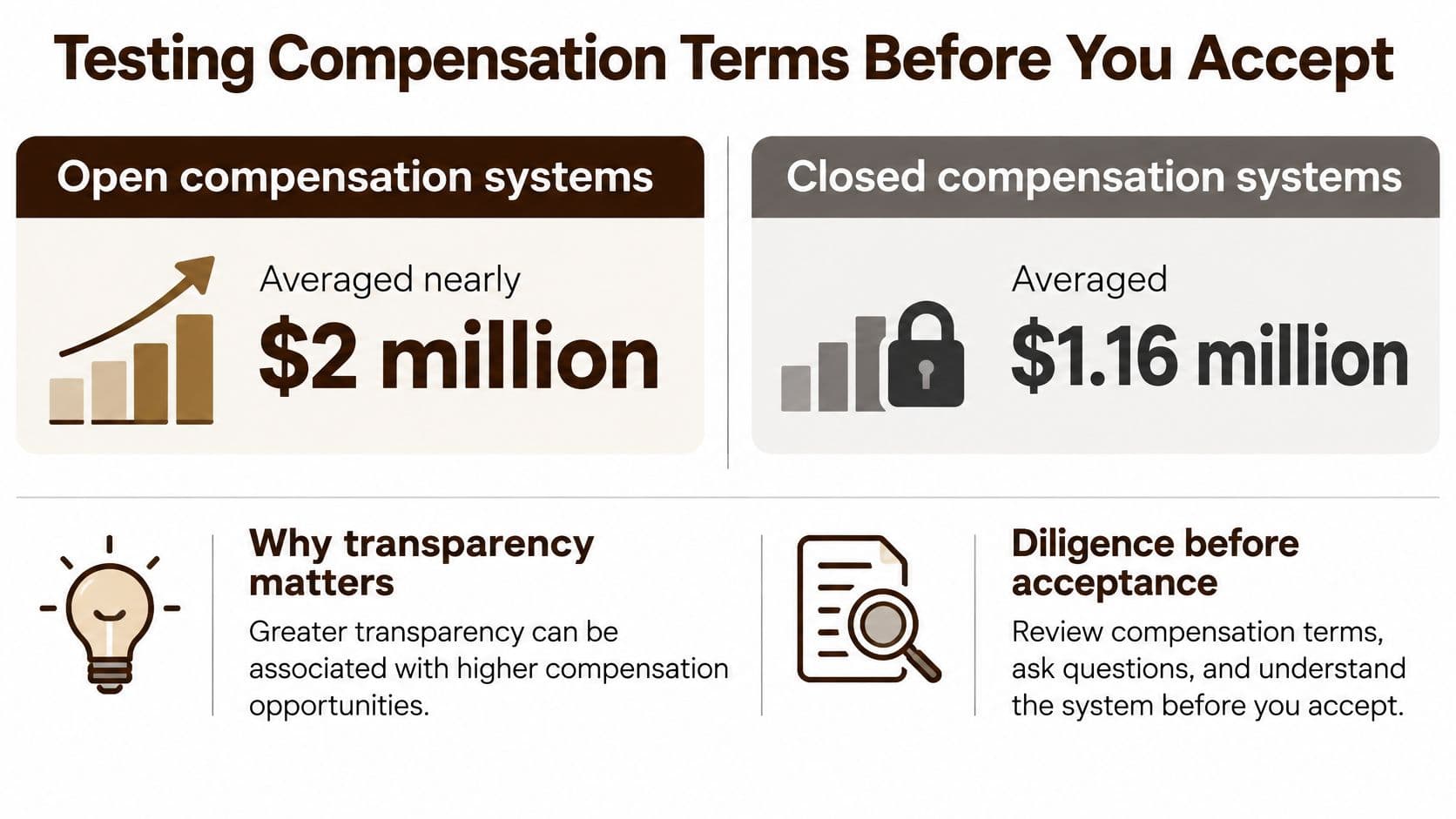
Compensation transparency is a diligence question, not a courtesy. Partners at firms with open compensation systems averaged nearly $2 million, compared with $1.16 million at firms with closed systems, while satisfaction was 73% versus 48%, according to the MLA Global partner compensation survey. If a firm won't explain how pay works, you're accepting a number without knowing how it's produced or defended.
| Compensation item | Document to request | Question that reveals it |
|---|---|---|
| Origination credit | Written origination rules and credit log | Who gets credit when two partners serve the same client? |
| Billing rate expectations | Rate card and realised rates by year | What rate does the firm assume, and what rate is actually collected? |
| Compensation formula | Written points or units schedule | How do points or units convert to pay each year? |
| Collections | Pay calculation policy | Does pay follow cash collected or billings? |
| Performance guarantees | Guarantee letter with term and clawback | How long does it run, what conditions apply and what can be clawed back? |
| Capital contributions | Capital call schedule | How much is due, and when? |
| Draw timing | Draw and reconciliation schedule | When are draws paid and how are they reconciled to final pay? |
| Inherited clients | Client assignment policy | Who keeps inherited clients, and does pay follow them? |
Understanding what an equity partnership involves helps you read these documents properly, especially capital and draw mechanics.
To compare a guarantee with realistic revenue, annualise the guarantee, subtract verified annual portable revenue, and multiply the gap by the guarantee years. For example, a hypothetical $1.5 million guarantee over three years is $500,000 a year. Against verified portable revenue of $300,000 a year, that's a $200,000 annual gap, or $600,000 of total exposure.
A lower offer with transparent attribution and predictable downside protection often beats the highest headline number.
Apply one rule before accepting. If you can't explain your own pay formula in two sentences, ask for the written version first.
Interviewing, Offer Timing and the First 18 Months
After shortlisting, structure beats instinct. Interview every finalist against the same standard scorecard testing client development evidence, collaboration history, conflicts, leadership and willingness to share credit. Ask for named matters and who else did the work. A candidate who describes every big matter as a solo effort is usually claiming shared origination as personal revenue. Press for the names of the partners who appeared on the bills.
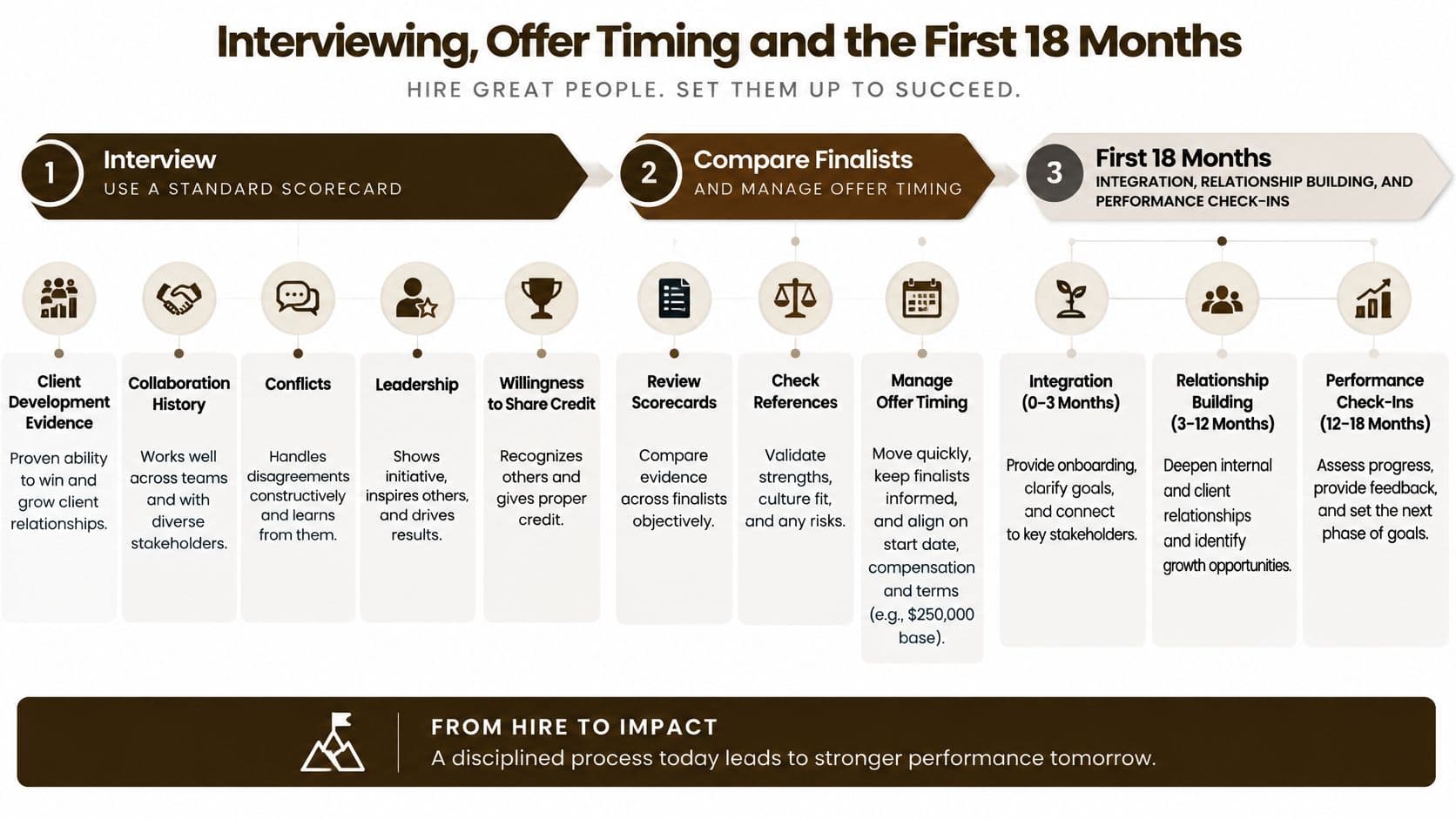
Run reference checks with former colleagues. Validate client continuity only in ways that don't require confidential information, since how a candidate handles that boundary tells you how they'll handle yours. Competition makes speed tempting, because NALP research reported that 2025 lateral partner hiring increased 17.8% year over year and represented 22.3% of all reported lateral hiring across 305 U.S. offices and firms. Speed still must not replace diligence.
Before an offer goes out, know what the candidate is likely to accept. We tell the client that in advance, so the offer lands inside a realistic range instead of starting a negotiation nobody modelled.
The Integration Timeline
Agree a written 12 to 18 month integration plan covering client introductions, matter transfer, a partner sponsor, compensation expectations, and review meetings at 6 and 12 months. A lateral partner needs to integrate with incumbent partners and clients within that window, because flight risk is highest when the work of joining stalls. Put the plan on paper. Integration is scheduled work, not something that happens because people are friendly.
The sponsor matters most in the first quarter. This is the partner who walks the lateral into client meetings, makes the first introductions and absorbs the political friction of matter transfers. Name the sponsor in the plan, not just the role.
Lawyers should prepare symmetrically. Rehearse your matter list, be ready to name who did the work on each matter you cite, and ask the firm to describe the sponsor, first client introductions and review schedule before discussing money. Request the compensation system in writing before any offer.
Track time to shortlist, interview to offer, offer acceptance, 6 and 12 month milestones, collected revenue against forecast, and retention beyond three years. Acceptance alone is a weak measure, because a placement that's accepted but not retained never proved the hire worked.
Choose Your Next Step This Week
Pick the action that matches your side of the table, and do it before another conversation happens.
If you're a firm, run the one page profile test. Ask whether a stranger could pick the right candidate from your profile, tighten it until the answer is yes, then book the 30 minute role call before any search starts so the role, client base and culture are clear enough to begin. A search launched on a fuzzy brief produces confident interviews and a partner who doesn't fit.
If you're a lawyer, finish your matter audit. Draft the one page practice summary and the statement of the role you want, attach the matter list, and give that package to a recruiter so you can be considered when a strong fit opens. Candidates who arrive documented get taken seriously faster, because the firm doesn't have to build your case for you.
We welcome firms and candidates who want to talk through a search, and that 30 minute role call is a practical place to start. Bring your profile page or your matter list, whichever side you're on, and the conversation will be concrete from the first minute.
A partner's book is a forecast until the documents say otherwise.
If you're planning a partner hire or weighing a move yourself, we can help you define the role, verify the book and test the terms before anyone commits. Visit Five Star Placements to start with the 30 minute role call and a search built on evidence, not headline numbers.
Need help filling a legal role?
Five Star Placements partners with law firms and legal departments nationwide.
Schedule a Call