
What Is Managing Partner in Law Firm
October 13, 2026 · 15 min read · Five Star Placements

Table of contents
A managing partner is a partner delegated executive authority to run the law firm while often continuing to practice law. The title is governance language, not a standardized job, so the actual scope is set by the partnership agreement.
That distinction matters the moment a partner inherits a crowded calendar and an even longer list of unresolved firm problems. One week may involve a disagreement over compensation, a stalled lateral hire, a missed deadline in another office, and a major client asking for an answer the new leader isn't authorized to give. The firm may call this person “managing partner,” but the title alone doesn't explain what the person can decide, what remains with the partnership, or how much time the role requires.
The practical question isn't "What is managing partner in law firm?" It's "What governance system has this firm designed around that person?" A useful answer must connect authority, accountability, financial oversight, risk controls, leadership succession, and the candidate signals a US law firm should evaluate before making an appointment.
Table of Contents
- The Role You May Already Know Without Naming It
- Defining What a Managing Partner Actually Does
- Managing Partner vs Chair, Executive Committee, and Practice Leaders
- The Two Jobs Inside One Title
- Why the Highest-Billing Partner Is Not Always the Right Pick
- Governance, Risk, and the External Voice of the Firm
- How the Role Looks in Solo, Mid-Sized, and Large Firms
- What To Confirm Before You Accept or Assign the Role
The Role You May Already Know Without Naming It
The managing partner often appears when a firm realizes that shared responsibility has become nobody's responsibility. Partners may agree that the firm needs better financial reporting, a more disciplined hiring process, and a plan for succession, yet each partner remains focused on client work. Eventually, someone is asked to coordinate everything while maintaining a demanding practice.
The first weeks can feel less like a promotion and more like an operating crisis. A partner wants to change the compensation system, another objects to a lateral candidate, an office misses a procedural deadline, and an important client asks who has authority to approve a new arrangement. The managing partner is expected to respond, but the partnership agreement may not say whether that person can act independently or must obtain committee approval.
Practical rule: A title cannot substitute for decision rights.
The role is real because the firm needs someone to turn collective decisions into coordinated action. It may involve setting priorities, reviewing liquidity, assigning responsibility for projects, resolving partner disputes, representing the firm, and maintaining momentum after a meeting ends. It may also involve continuing to serve clients and generate revenue.
That is why a generic job description rarely works. A small partnership may place most operating authority with one managing partner. A larger firm may divide it among a global leader, regional leaders, office heads, practice leaders, and an executive committee. The relevant scope depends on the positions and hierarchy within a law firm, not on the title in isolation.
For a firm administrator, the first task is therefore diagnostic. Ask what decisions the managing partner owns, which decisions require a vote, what resources are available, and how leadership work will be recognized. Firms such as Five Star Placements treat a managing-partner search as a custom mandate because the right candidate must fit the firm's governance design, not merely match a keyword.
Defining What a Managing Partner Actually Does
A useful working definition is straightforward: the managing partner is a partner delegated executive authority to coordinate the firm's business, governance, professional-risk systems, and often its external presence while continuing, at least partly, to practice law.
Research involving 36 managing partners in mid-sized and large firms in Germany, Austria, and Switzerland identified 15 distinct roles within the position, including strategist, administrator, decision-maker, spokesperson, meeting chair, implementer, finance expert, performance monitor, motivator, mediator, caretaker, and appointer (research on managing-partner roles). Those labels become easier to use when grouped into five operating responsibilities.
Five governance responsibilities
-
Set direction. The managing partner helps convert the partnership's priorities into a strategy covering growth, profitability, practice mix, technology, talent, and client service.
-
Translate decisions into execution. Partnership votes and committee resolutions need owners, timelines, budgets, and follow-up. The managing partner often coordinates that implementation rather than doing every task personally.
-
Monitor performance. This can include reviewing financial indicators, matter economics, collections, staffing, deadlines, strategic projects, and agreed objectives.
-
Coordinate money and people. The role may include budgeting, liquidity oversight, compensation discussions, recruiting, succession, development, and the allocation of management resources.
-
Represent the firm. The managing partner may communicate with clients, professional organizations, recruits, regulators, courts, the press, and other firms.
These categories don't mean the managing partner directly supervises every lawyer. Practice leaders, office heads, committees, a COO, and a firm administrator may own substantial parts of the work. The managing partner's distinctive responsibility is to make the system function as a whole and to escalate decisions at the right level.
A firm should therefore map the title against its governing documents. The partnership agreement may reserve mergers, partner admissions, compensation principles, or major expenditures for the partners. An executive committee may set policy, while the managing partner implements the approved agenda. In another firm, the managing partner may have broader delegated authority.
The title answers who coordinates the enterprise. It doesn't answer how much authority that person has. That answer comes from the firm's size, decision rights, committee structure, growth strategy, and financial complexity.
Managing Partner vs Chair, Executive Committee, and Practice Leaders
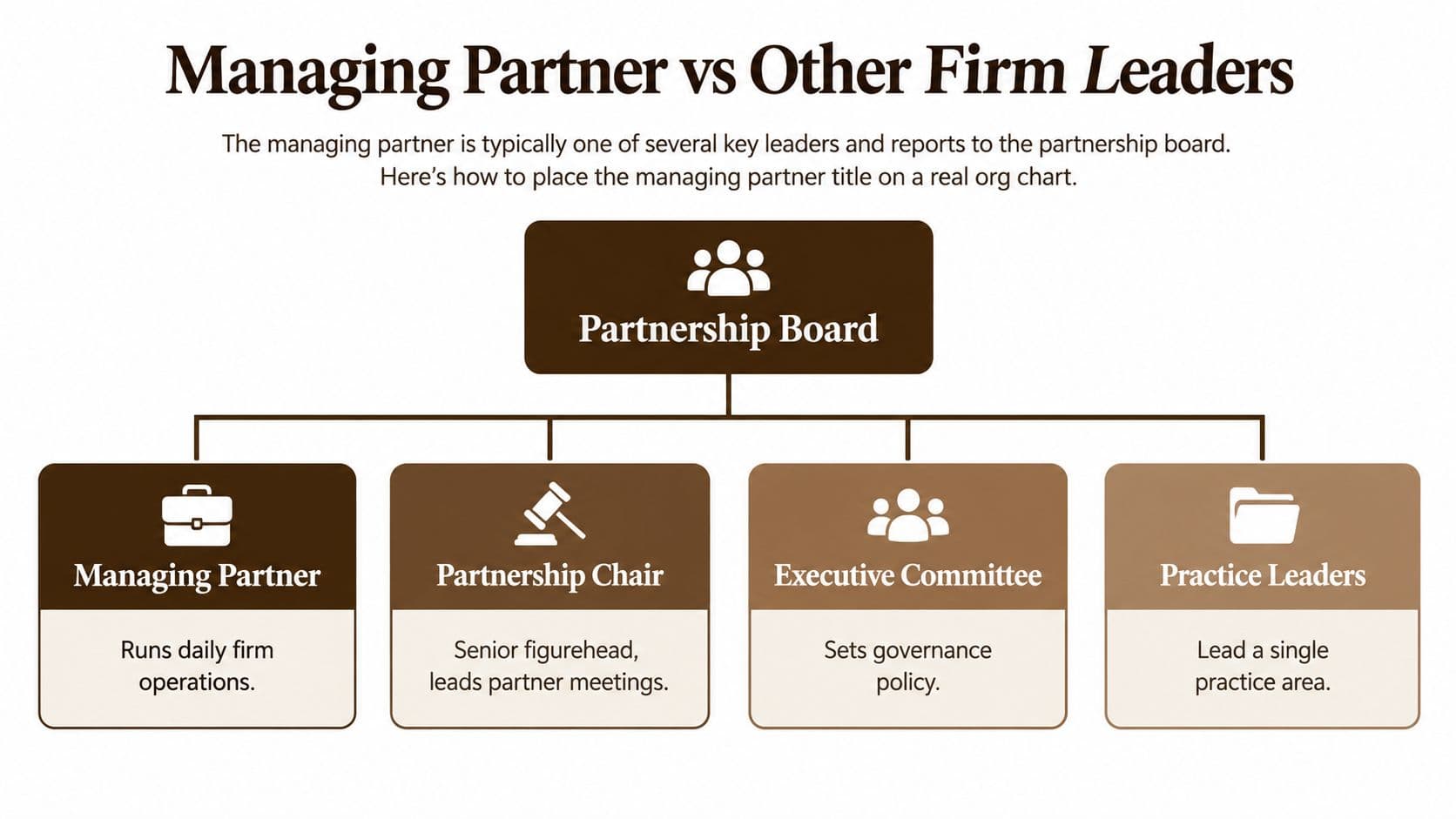
A firm approves a new compensation policy, adopts a technology system, or changes its staffing model. Several leaders may shape the decision, but they do not necessarily own the same work. The managing partner coordinates firm-wide execution, while the chair, executive committee, COO, and practice leaders contribute through distinct governance channels.
| Role | Primary function | Typical boundary |
|---|---|---|
| Managing partner | Coordinates firm-wide execution, finances, people, risk, and strategy | Acts within delegated authority and reports to the partnership or governing body |
| Partnership chair | Serves as senior figurehead and facilitates partner meetings | May influence consensus without owning daily execution |
| Executive committee | Makes or recommends governance decisions | Acts collectively under the partnership agreement |
| COO or firm administrator | Runs operational systems, vendors, finance processes, technology, and administration | Implements policy and manages staff within approved authority |
| Practice or office leader | Leads a practice, office, or client-facing group | Owns local staffing, quality, workflow, and client delivery |
The boundaries work like lanes in a relay. The executive committee may develop or approve a policy. The managing partner turns that decision into an implementation process, coordinates consultation, models consequences, and reports progress. The COO may prepare the analysis and update systems. Practice leaders explain the change to their teams and address operational effects. The chair may lead the partner discussion and help resolve disagreement.
Technology decisions follow the same pattern. The managing partner may define the strategic priority and secure approval. The COO or administrator may evaluate vendors, negotiate implementation, and manage staff adoption. A practice leader may decide how a litigation group uses the system in daily matters. Assigning every step to the managing partner creates unclear accountability and weakens the operating model.
The title also does not reveal whether the person chairs the executive committee, reports to it, or works alongside it. Those arrangements depend on the partnership agreement, committee charters, delegated authority, and reporting practices. A governance design should make clear who decides, who recommends, who implements, and who is accountable for results.
Survey evidence illustrates why firms should not infer the job from the title alone. A survey of 92 leaders at firms with more than 100 lawyers found that 9% regarded management or leadership as a full-time activity, while 72% operated without a formal job description and only 11% of firms reported term limits (managing-partner leadership survey evidence). Another BigLaw survey reported different results, with 56% describing the leadership role as full-time and 67% reporting no formal job description. The differences point to different allocations of authority, time, and accountability, not one standard model.

The Two Jobs Inside One Title
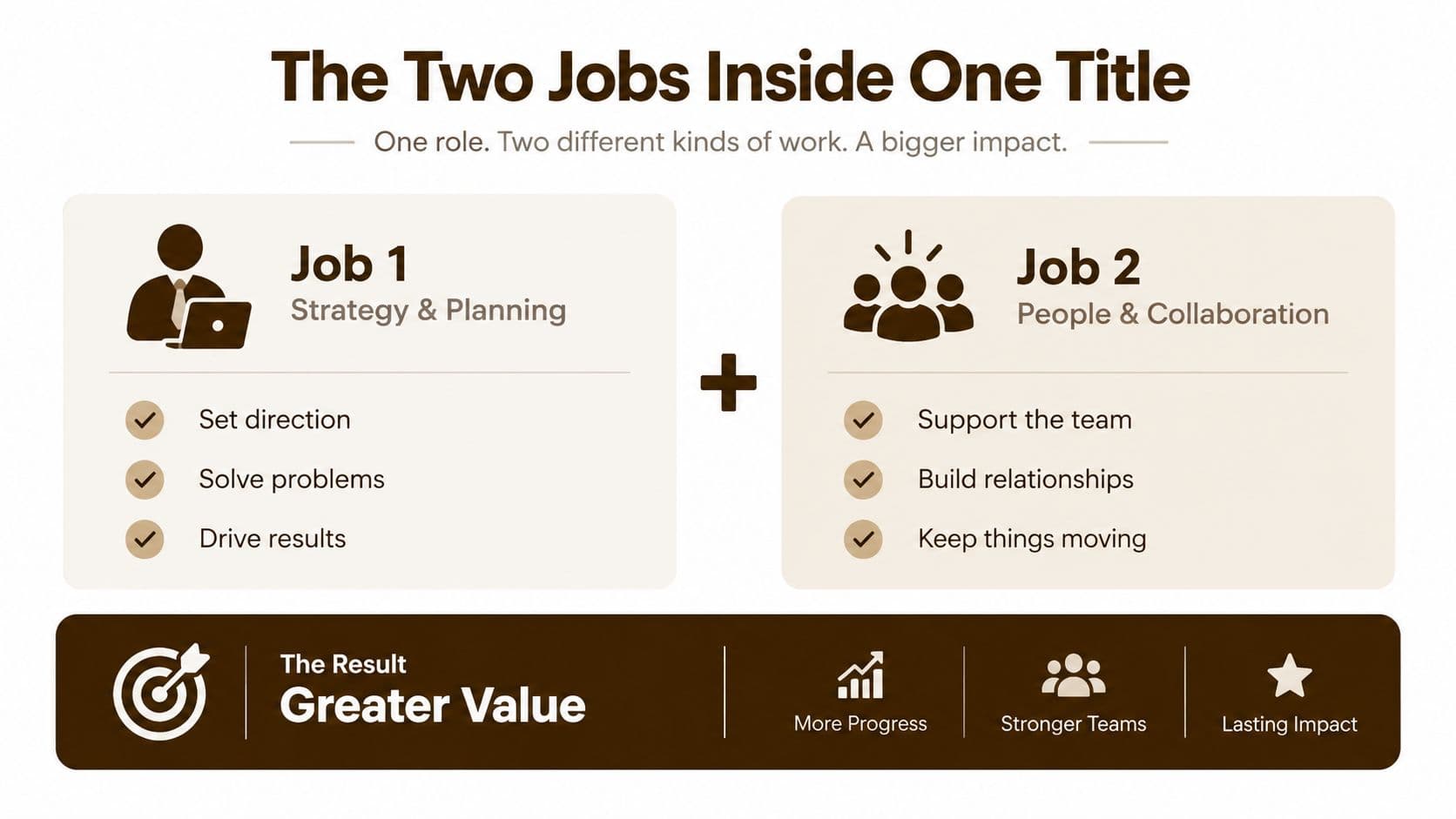
A partner can finish a client call in the morning and spend the afternoon resolving a staffing dispute, reviewing budgets, or aligning practice leaders. Both activities may sit under the same title, yet they answer to different accountability systems. Clients expect excellent legal work. Partners expect the leader to strengthen the firm, manage risk, and deliver agreed initiatives.
The governance question is how those jobs fit together. A firm can keep the managing partner active in client work, reduce the client load, or assign management as a full-time responsibility. Each choice affects authority, delegation, compensation, and the capacity to complete firm-wide work. Whatever model a firm chooses, responsibility without protected time, decision rights, or recognition creates predictable friction.
A useful mandate separates the role into two connected jobs:
- Client practice: What matters remain with the managing partner, and who covers them when firm duties expand?
- Firm leadership: Which strategic, financial, people, and risk responsibilities belong to the role?
- Management credit: How does leadership time count in compensation, performance evaluation, and promotion decisions?
- Delegation: Which duties move to the COO, administrator, executive committee, or practice leaders?
- Authority: Can the managing partner approve spending, change staffing, or launch projects without another vote?
- Continuity: What happens when the term ends, the partner returns to full practice, or an unexpected absence occurs?
This checklist turns a title into a governance design. It also gives a firm concrete signals for hiring and succession decisions. Candidates should be assessed not only on legal judgment and client relationships, but also on their ability to set priorities, work through disagreement, delegate, report results, and prepare another leader.
A written mandate protects both the firm and the individual. It should state expected management time, reporting relationships, decision limits, goals, term, renewal process, and treatment of the leader's practice. It should also explain how client matters will be staffed during major initiatives. Without these decisions, partners may judge the managing partner against private expectations, while the leader spends time on work that one faction supports and another considers unauthorized.
A full-time model can work. A practicing-lawyer model can work. An undefined model creates avoidable conflict.
Why the Highest-Billing Partner Is Not Always the Right Pick
A large book of business proves that a partner can attract and serve clients. It doesn't automatically prove that the partner can govern a partnership, manage financial trade-offs, build consensus, or prepare successors.
Recent compensation reporting illustrates the tension. A 2025 partner-compensation survey reported average partner compensation of $1.4 million, with equity partners at $1.9 million and non-equity partners at $558,000. Origination reportedly explained 64% of compensation variation (2025 legal market compensation report). Those figures describe economic incentives, not a complete leadership profile.
A compensation system that heavily rewards originations may encourage revenue production. It may also make it harder to justify time spent on mentoring, succession, technology, controls, or less immediately profitable firm-wide work. The managing partner must often protect the institution's future even when a short-term decision would benefit a particular partner or practice.

Readiness is another concern. A 2025 partner survey found that 57% of partners received no formal leadership or business training after promotion, while only 25% of non-equity partners reported meaningful involvement in firm decisions (reporting on partner compensation and leadership readiness). A high-performing lawyer may therefore arrive at the leadership decision without having practiced the underlying skills.
Better interview signals
A firm should test evidence, not rely on seniority:
- Financial fluency: Has the candidate managed budgets, profit targets, liquidity, collections, or matter economics?
- Operating discipline: Has the candidate implemented a firm-wide system, workflow, technology initiative, or risk control?
- Consensus building: Can the candidate explain a decision that required partner agreement across competing interests?
- Talent judgment: Has the candidate recruited, developed, evaluated, or retained lawyers and staff?
- Institutional perspective: Does the candidate invest in succession, collaboration, client service, and culture beyond personal originations?
A thoughtful interview asks the candidate to describe a difficult trade-off, not just a successful matter. The strongest evidence may come from how the partner handled an unpopular compensation decision, transferred client relationships, or corrected a recurring operational failure.
For broader context on the economics that can shape partner behavior, review the discussion of per-partner profits. The managing partner should understand the firm's financial model, but shouldn't be selected solely because the candidate currently produces the most revenue.
Governance, Risk, and the External Voice of the Firm
A managing partner can be the person who notices a governance gap before it becomes a client complaint. Managerial lawyers must make reasonable efforts to establish policies for detecting conflicts, tracking procedural deadlines, safeguarding client funds and property, and supervising inexperienced lawyers (professional-responsibility guidance for managerial lawyers).
The title alone does not show whether those duties are covered. A firm needs named owners for the conflicts workflow, calendaring, trust-account controls, and supervision protocol. Each control should also have a documented procedure, an escalation route, training, and periodic review. The managing partner may not perform each task, but should confirm that the system works and that someone is accountable when it does not.
Turn governance into an approved agenda
A firm can translate broad authority into an annual or biennial operating agenda covering:
- Financial objectives: profitability, liquidity, collections, and agreed investment.
- Growth priorities: practice development, lateral hiring, client diversification, and market positioning.
- Major projects: technology implementation, office changes, combinations, or process redesign.
- People commitments: recruiting, development, succession, compensation communication, and culture.
- Risk controls: conflicts, deadlines, trust accounting, supervision, cybersecurity, and client communications.
Partnership or management-committee approval gives this agenda a mandate. It also separates firm strategy from the managing partner's personal preferences. That distinction matters during leadership changes, because successors can inherit agreed priorities rather than reconstructing them from informal decisions.
External representation belongs in the same governance design. The managing partner may speak for the firm with clients, recruits, professional organizations, courts, regulators, the press, and potential merger partners. Those audiences need a consistent account of the firm's capabilities, leadership, standards, and direction.
A leader focused only on financial results can miss client complaints, recruiting delays, weak supervision, or partner disengagement. A leader focused only on risk can overlook growth and succession. Good governance connects both views through assigned owners, reliable information, and decisions the partnership understands.
How the Role Looks in Solo, Mid-Sized, and Large Firms
The same title can describe very different jobs. Firm size changes the number of layers between the managing partner and the work, but the partnership agreement remains the starting point.
In a solo or small partnership, the managing partner may also act as administrator, finance lead, hiring lead, and compensation coordinator. There may be no separate committee or COO, so the partner handles both strategic choices and daily follow-through.
A mid-sized firm may divide authority among a managing partner, executive committee, firm administrator, or COO. The managing partner typically spends more time aligning partners, reviewing performance, approving priorities, and managing succession, while operational professionals prepare data and execute systems.
An AmLaw-style or international firm adds regional managing partners, office heads, and practice-group leaders. The global managing partner may have less direct control over local staffing and more responsibility for cross-border coordination, institutional strategy, leadership continuity, and major lateral or combination decisions.
| Firm size | Authority model | Typical time commitment | Key support |
|---|---|---|---|
| Solo or small partnership | Concentrated authority, often combined with daily administration | Mixed practice and management, with workload driven by firm needs | Bookkeeper, office manager, outside advisors |
| Mid-sized firm | Delegated authority shared with an executive committee or management board | Regular leadership allocation alongside client work, or a more dedicated model | COO or firm administrator, finance and HR support |
| Large or international firm | Layered authority across global, regional, office, and practice leadership | Greater focus on enterprise coordination and institutional strategy | Executive committee, regional leaders, office heads, professional operations team |
Compensation governance can change the role further. More than one-third of firms surveyed expected to change partner-pay models within two years, including changes to compensation spreads or evaluation criteria (reporting on partner-pay model changes). A managing partner entering such an environment needs authority to communicate the model, explain trade-offs, and manage its implementation.
Before beginning a search, map the firm's governance structure, reporting lines, and decision thresholds. The partnership structure of a law firm should be clear enough that a candidate can understand the job before accepting it.
What To Confirm Before You Accept or Assign the Role
Put the mandate in writing before the title changes. A clear document should answer what the managing partner owns, what requires approval, and how the leader will be held accountable.
Use this checklist:
-
Authority and boundaries: Identify decisions involving finances, personnel, compensation, risk, technology, client matters, and external representation. State approval thresholds and reserved partner powers.
-
Time and workload: Define management expectations, remaining billable work, delegation, coverage for the leader's practice, and how leadership time affects compensation.
-
Reporting and appointment: Specify whether the leader is elected or appointed, who receives reports, how partners provide input, and how disagreements escalate.
-
Term and continuity: State the term, renewal process, removal provisions, transition expectations, and the role of a deputy or successor pipeline.
-
Performance measures: Use goals tied to profitability, growth, strategic projects, operational improvements, risk controls, talent, client service, and succession, not only personal originations.
-
Training and support: Provide leadership coaching, financial information, administrative support, committee access, and the authority required to implement approved priorities.
-
Communication: Establish how decisions, budgets, compensation changes, and major projects will be explained to partners, lawyers, staff, and clients.
These questions prevent familiar failures. Undefined authority produces delay. Uncredited management work produces resentment. Unplanned succession creates dependence on one individual. Unclear controls leave conflicts, deadlines, funds, and supervision without accountable owners.
A firm should also interview candidates against the mandate. Ask for examples of implementing change, managing a budget, resolving partner disagreement, developing another leader, and balancing client obligations with institutional work. The candidate's book of business matters, but it should sit beside evidence of operating judgment and stewardship.
When Five Star Placements conducts a managing-partner search, its permanent legal recruiting work can include customized screening for experience, skills, and organizational fit. The discipline is useful even without an outside recruiter: start with the governance chart, then define the candidate profile.
Five Star Placements provides permanent placement for managing partners, lateral partners, attorneys, legal operations leaders, and firm administrators, with searches tailored to practice needs and organizational culture. If your firm needs to define the mandate before building a shortlist, visit Five Star Placements to discuss the role and search requirements.
Need help filling a legal role?
Five Star Placements partners with law firms and legal departments nationwide.
Schedule a Call