
Equity Partner Law Firm Roles: What They Own and Earn
November 19, 2026 · 14 min read · Five Star Placements

Table of contents
An equity partner is an owner of the law firm who holds a capital stake, shares in the firm's profits and votes on its decisions, rather than a salaried senior lawyer with a grander title. Ownership, not seniority, is what the word is supposed to signal.
It often doesn't. According to the American Bar Association's 2026 historical review of the legal profession, which summarizes its 2024 data, only 27 of the Am Law 200 firms still maintained a true single-tier partnership, and 46% of partners were classified as non-equity partners.
So two lawyers can sit in the same partner meeting, appear identically on the website and hold completely different deals. One owns a slice of the firm and answers for its debts and its decisions. The other has a salary with a partner's nameplate attached.
That gap surfaces at three moments: a lateral offer, a promotion conversation, and the afternoon a client asks who runs the firm. What follows is a practical map of the trade, from the side-by-side comparison and the pay formula to the duties, the risks and the specific terms worth verifying before anyone signs.
Table of Contents
- What an Equity Partner in a Law Firm Really Is
- Equity vs Non-Equity Partner Side by Side
- How Equity Partner Compensation Is Really Built
- The Duties and Downsides That Come With the Stake
- Two Partner Journeys and What They Reveal
- Who Gets Access to Equity and Why It Varies
- Deciding Whether Equity Partnership Is Worth It
What an Equity Partner in a Law Firm Really Is
Strip away the ceremony and an equity partner holds three things a non-equity partner does not: a capital or ownership interest, a share of firm profits, and voting or governance rights over how the firm is run. The American Bar Association's 2026 historical review draws that line explicitly, noting that the modern large-firm market increasingly separates ownership rights from the broader title of partner.
An equity partner is therefore exposed to the business, not merely employed by it. A strong year lifts distributions. Weak collections pull them down. The same person who votes on a merger also funds the lease.

Where the confusion actually starts
Readers often meet the word "partner" through a bio page or an announcement, not a partnership agreement. That is why the equity partner law firm role gets mistaken for a promotion ladder when it is closer to a buy-in. A non-equity partner may supervise teams, sign engagement letters and carry a book, yet hold no capital account, no vote and no claim on residual profit.
If you cannot say what percentage of the firm's net income you receive, what capital you have at risk and what you are entitled to vote on, you are not looking at an ownership deal. You are looking at a job title.
Three separate questions need three separate answers. Is the seat equity? What capital does it require, and when is that capital returned? And how is compensation calculated in writing? Hiring partners make the same mistake from the other side of the table, assuming the title communicates terms a candidate will only discover at year-end.
Equity vs Non-Equity Partner Side by Side
Here is the whole distinction in one view. The 2025 compensation and origination averages in the table come from the 2026 partner compensation report published by Major, Lindsey & Africa.
| Dimension | Equity Partner | Non-Equity Partner |
|---|---|---|
| Firm ownership | Yes, holds a capital or ownership interest | No ownership stake |
| Profit participation | Shares distributable net income | Fixed or formula-based compensation |
| Capital contribution | Required buy-in, amount set by each firm | None or minimal |
| Voting and governance | Votes on firm decisions; often holds leadership roles | Limited or none |
| Average compensation (2025) | $2.17 million | $611,185 |
| Pay form | Draw plus distributions, reported on Schedule K-1 | Salary and bonus, largely fixed |
| Average client originations (2025) | $5.45 million | $1.32 million |
| Liability for firm obligations | Shares firm-level exposure | Generally limited |
| Typical path | Invited after proven revenue, leadership and client work | Step toward equity, or a terminal tier |
What the originations row tells you
Equity partners reported average client originations of $5.45 million, more than four times the $1.32 million reported by non-equity partners, per the same Major, Lindsey & Africa report. The title tracks a revenue-generating role, not time served. That single row explains why firms hand equity to the lawyer with portable clients and hold the title back from the reliable technician.
It also explains the shape of the pay distribution. Average partner compensation rose 10% to $1.55 million while the median rose only 3%, so the gains clustered at the top rather than spreading evenly. An average is a market signal, not an offer.
For the other side of that ledger, this look at the non-equity partner role covers how the tier gets structured and what it pays.
The three pillars behind the title
Capital interest. The buy-in sits in a capital account. It comes back when you leave, but it is at risk while you are there if firm obligations outrun assets. Ask for the contribution amount, the payment schedule and the repayment terms in writing.
Profit participation. Equity pay is a share of distributable net income after salaries, rent, interest and reserves. That number moves every year, which is the entire point and the entire risk.
Governance. Votes cover admitting and removing partners, the compensation system, borrowing, mergers and who leads the firm. A partner with no vote is an owner in name.
Think of a restaurant. A general manager on a profit bonus has real responsibility and real upside, but no stake and no say in whether the owner sells. A partner who bought in shares the restaurant's fortunes, signs for the loan and votes on the second location.
The trend line reinforces why firms now recruit equity and non-equity candidates differently. Across National Association for Law Placement samples that are not identical firms, the equity share of partnership fell from 58.2% in 2022 to 56.3% in 2024 and 55.7% in 2025. Read those as market indicators, not a controlled time series.
Strip out capital, profits or votes and the role reverts to senior employment. That is the collapse test, and it works on any offer.
How Equity Partner Compensation Is Really Built
Start with the benchmark everyone quotes: profits per equity partner (PPP) is net operating income divided by the number of equity partners, calculated after operating expenses and interest, as the NALP analysis of law firm economics explains. It is a profitability measure for the firm, not a paycheck for you.
PPP is also easy to distort. Partner-count changes, lateral departures, one-off costs and differing accounting policies all move the number without changing how well the firm served clients. A firm that de-equitizes three partners can post a flattering PPP while the remaining partners earn exactly what they earned last year.
The building blocks of an individual payout
Every compensation system answers the same question: how do we split distributable net income? The components usually include some mix of the following.
- Ownership points or units. Your share of the pool. Points move slowly, and the schedule for earning more matters as much as the starting number.
- Lockstep seniority credit. Automatic progression by class year, which rewards staying and rewards the firm's trust that you will pull your weight in lean years.
- Origination credit. Recognition for clients you bring in. The crediting rules, not the concept, decide how much of that revenue follows you.
- Collections and productivity. What got billed and paid, plus working-attorney contribution on matters you handle.
- Leadership and committee work. Explicit credit in some firms, invisible goodwill in others.
- Holdbacks and reserves. Cash retained at firm level until year-end or departure, which is where surprises usually hide.
Most firms pay a draw through the year and true up with a distribution once the books close. The draw feels like a salary. The true-up is where ownership shows up, in either direction.
For a fuller walk through the profitability metric itself, see this explanation of profit per equity partner.
Four models, four trade-offs
| Model | How Profits Are Allocated | Works Best For | Main Trade-off |
|---|---|---|---|
| Lockstep | Points rise with seniority and tenure | Collaborative firms that want low internal competition | Top performers may subsidize weaker ones |
| Eat what you kill | Pay tracks each partner's originated and collected fees | Firms with strong rainmakers in transactional or plaintiff work | Weakens teamwork, coverage and client sharing |
| Hybrid | Base points plus credits for origination, collections and leadership | Most large firms balancing culture with performance | Disputes over credit weighting and measurement |
| Equal shares | Profits split evenly among equity partners | Small partnerships with similar books and workloads | Free-rider risk and slow exits for underperformers |
Before accepting any seat, request the written formula, three years of historical distributions, the required capital contribution, the origination-credit rules including any clawback on departing partners, and the firm's definition of profit. Those five documents answer more than a year of conversation.
Rule of thumb: never evaluate an offer on PPP. The formula determines what lands in your account, and the average describes someone else's year.
The Duties and Downsides That Come With the Stake
Ownership adds obligations that never appear in a job description. Equity partners are expected to govern: serve on committees, sit in management, mentor associates, hit business-development targets and answer for their share of overhead. The rent, the staff and the technology are now partly your bill.
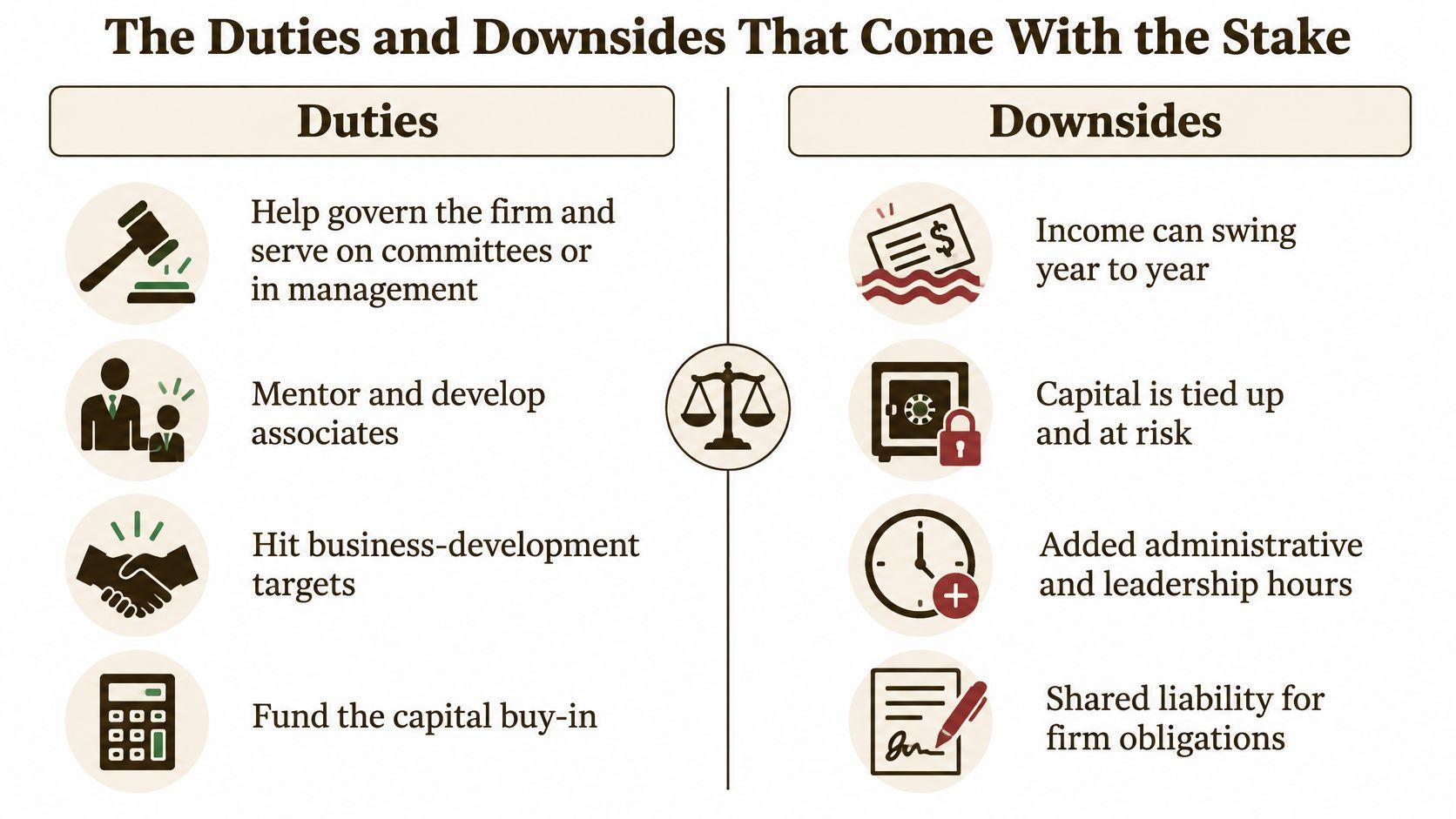
The financial risk is structural. Because compensation is proportional to profitability, distributions can fall while a partner's personal billings stay strong, if firmwide margins slip, overhead climbs, collections weaken or the partnership admits more equity partners faster than net income grows. NALP's snapshot of law firm economic terminology treats equity partners as part owners who share profits and notes the American Lawyer convention: partners receive a Schedule K-1, and no more than half of compensation is fixed income.
Why dilution deserves a worked example
Take a firm with $25 million of net income and 100 equity partners. Aggregate PPP is $250,000. Admit ten more equity partners on the same profit and the average drops. Weight the split by seniority and performance and individual outcomes shift again, all without a dollar of profit changing. Total profit is fixed; your slice is a decision.
That is why lateral equity hiring is a financial integration problem rather than a title transfer. The firm should model collected revenue, portable relationships, matter profitability, conflicts and capital funding, plus a downside case for delayed collections. The candidate should compare guaranteed draws against historical true-ups, and check whether projected business is credited under the actual rules rather than the recruiting version.
For a spoken walkthrough of how these economics play out inside a firm, the video below is a useful companion.
Two more items belong on the downside list. First, tax timing: allocated income can create a tax liability before the cash reaches you. Second, benefits: life insurance, retirement contributions and health coverage are often structured differently for equity and non-equity tiers, so confirm each in writing. And watch the exit. Leaving before year-end can defer or forfeit distributions, which means the timing of a departure matters as much as the negotiation of the entry.
Two Partner Journeys and What They Reveal
Both of the following are composites, built to show how terms shape outcomes.
The internal track
An associate spends eight years at a 40-lawyer regional firm and is promoted to non-equity partner on a fixed package. The announcement goes out. Clients congratulate her. Nothing about her economics changes: no capital account, no vote, no share of residual profit, just a larger salary and a title that helps her bring in work.
Three years of steady origination and committee service follow. Then the equity invitation arrives, and with it the terms: a $150,000 capital contribution, financed from her first two years of distributions, points in a hybrid formula that weights collections and leadership alongside origination, and a seat on the hiring committee. Her income becomes variable. Her influence becomes real. She has traded a predictable salary for a share of a business she now helps run.
Note what did not happen. The non-equity years were not wasted, but they were not ownership either, and her compensation during that stretch never depended on firm profitability.
The lateral move
A partner with a $3 million portable book takes a call from a firm offering the equity partner title. She accepts, then reads the terms sheet properly. Credited origination phases in at 50% in year one and 75% in year two, so a third of her clients' revenue is effectively free to the firm for twelve months. Capital is due at signing, before her first distribution arrives. And 20% of distributions are held back against a reconciliation she does not control.
Same title as her friend on the internal track. Completely different economics, cash-flow profile and downside.
The lesson sits in the paperwork, not the title. The terms sheet, covering capital, credit rules, holdbacks and governance, predicts how the next five years will feel. Before negotiating anything, map your own situation against both paths and write down which one you are in. If you cannot answer whether your origination is credited at full value from day one, you are negotiating blind.
Who Gets Access to Equity and Why It Varies
Promotion to equity is not a pure merit contest, and the composition data shows why. The National Association for Law Placement's 2025 diversity report announcement found that women held 26.5% of equity partner seats, a 1.7 percentage point increase over 2024, while attorneys of color held 10.5%, up only 0.3 points, and Black representation among equity partners fell to 2.42%.
The uncomfortable takeaway is that a firm can improve its total partner diversity without opening its ownership tier. Non-equity ranks are easier to expand than the equity pool, because adding a non-equity partner costs salary rather than profit share and a vote.
Four structural levers determine who gets through the door.
- Origination credit rules. Systems that reward an existing book advantage lawyers who inherited or bought one. Ask whether shared credit and team originations count.
- Committee and leadership roles. These carry credit in most hybrid formulas, so access to them is access to compensation.
- Sponsorship by current equity partners. Someone has to put a name forward in the room where admission is decided.
- The shape of the non-equity tier. A genuine step on a defined path behaves very differently from a terminal tier that absorbs strong lawyers indefinitely.
Candidates should ask three questions before accepting any partnership offer: how many partners were admitted to equity in the last three years, what the admission criteria are in writing, and whether non-equity partners have a defined route to equity. For a structured look at how those tracks are built, this overview of the partnership track in law firms is a useful starting point.
Firms that cannot answer all three have a pipeline problem, not a retention problem.
Deciding Whether Equity Partnership Is Worth It
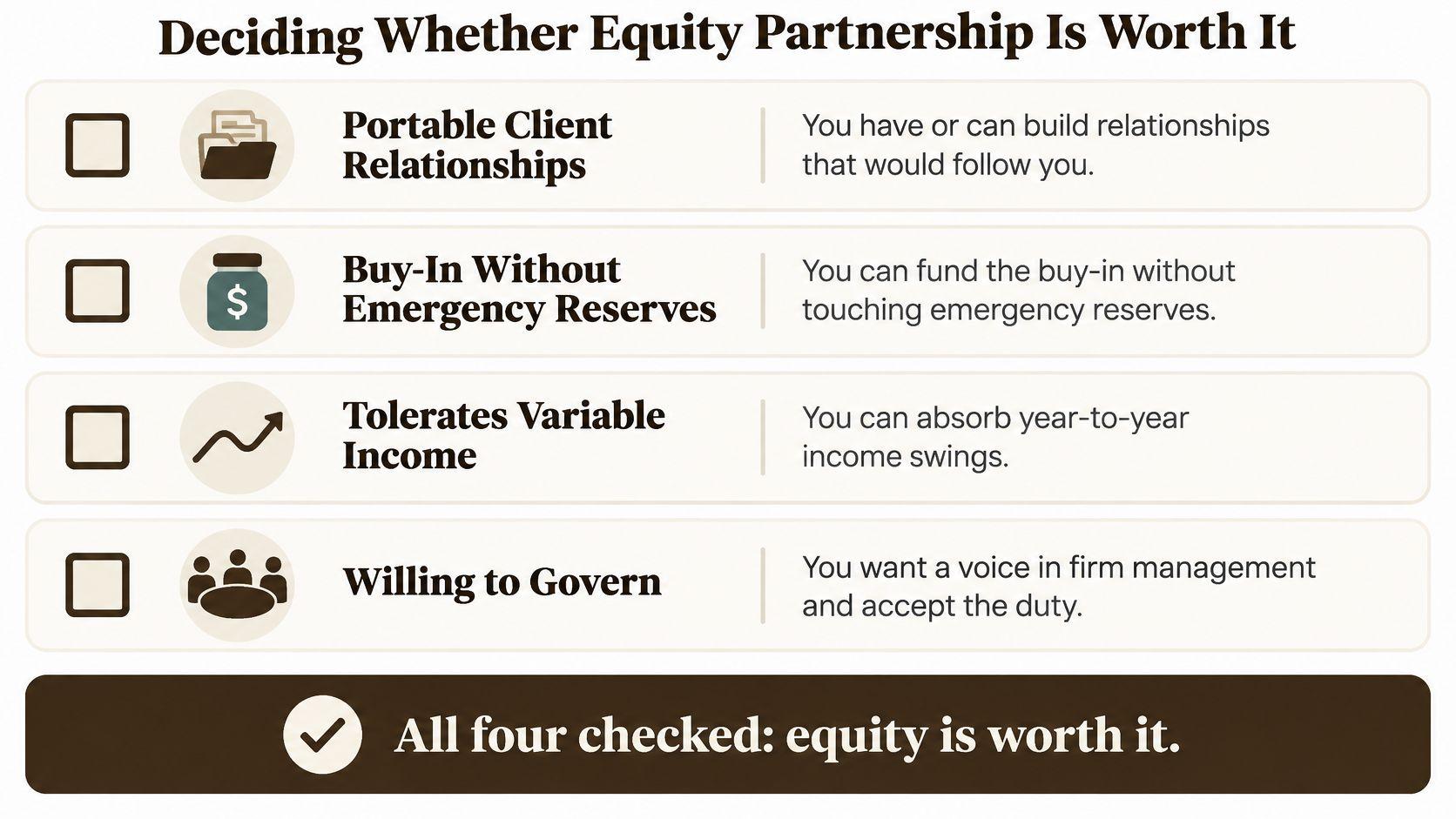
The trade is worth making under four conditions at once: you have or can build client relationships that would follow you, you can fund the buy-in without touching emergency reserves, you can absorb year-to-year income swings, and you want a genuine voice in how the firm is run. Miss any one of those and the math gets uncomfortable.
The reverse test matters just as much. Equity is a poor trade when you need predictable income, when the firm's profit trend is flat or falling, or when management cannot explain the credit rules in writing. A title that arrives with a capital call and no formula is a liability with better stationery.
The diligence checklist
- Confirm the tier. Get equity status and voting rights named in the offer letter, not in a conversation.
- Price the capital. Amount, payment schedule, repayment terms on exit, and what happens if you leave early.
- Get the formula in writing. Along with three years of actual distributions, so you can test promises against history.
- Read the origination and clawback rules. Who is credited, for how long, and what happens to that credit when a client leaves.
- Clarify holdbacks and exit terms. How much cash sits at the firm, when it releases, and on what conditions.
- Check insurance and liability exposure. Confirm what the firm covers and what your personal exposure looks like.
Candidates should pressure-test an offer with a specialist legal recruiter before signing, and firms should benchmark their equity terms against the market before extending them. Five Star Placements recruits only within the legal industry and works primarily with boutique and midsize firms and in-house legal departments. Applications stay confidential, and the firm will not contact an employer without permission.
Five Star Placements places attorneys, partners and in-house counsel across the United States, and its searches routinely turn on exactly the questions above, from whether a candidate's book will be credited at full value to whether an equity seat carries a real vote. If you're weighing a partnership offer or building one for your firm, visit Five Star Placements to start a confidential conversation. Schedule a call and you can talk through the search or your next move with a recruiter who works the legal market every day.
Need help filling a legal role?
Five Star Placements partners with law firms and legal departments nationwide.
Schedule a Call