
Partnership in Law Firms: Equity, Pay and Path to Equity
November 21, 2026 · 15 min read · Five Star Placements

Table of contents
You're sitting across from the managing partner, and the sentence you've worked eight years to hear finally lands: the firm wants to make you a partner. Two weeks later the offer letter arrives and it's thinner than the conversation. It says partner at the top, states a base salary, mentions a discretionary bonus, and refers you to the partnership agreement for everything else. No profit figure. No vote. No date.
That letter is normal, and that's the problem. Partnership in law firms has split into tiers that share a title and almost nothing else, so the word on the letterhead tells you very little about what you're being offered. The title is an economic signal, and like any signal it has to be decoded.
What follows decodes it. What each tier pays, what it controls, where the money comes from, and where an offer that looks generous can leave you worse off than the seat you already hold.
Table of Contents
- Partnership Tiers Compared at a Glance
- What the Partner Title Does and Does Not Guarantee
- What Partners Are Expected to Do
- How Partner Compensation Models Split Profit
- Origination Credit and the Path to Equity
- Lateral Partner Moves and Their Hidden Risks
- How to Negotiate Partner Terms Step by Step
- Confirm Your Partnership Terms Before You Sign
Partnership Tiers Compared at a Glance
| Tier | Profit share | Capital contribution | Voting rights | Pay pattern |
|---|---|---|---|---|
| Equity partner | Shares residual profit | Usually required | Full vote on major decisions | Variable, tied to firm profit |
| Non-equity partner | No ownership share | Usually none | Limited or no vote | Fixed salary plus bonus, often well below equity |
| Income partner | Profit-linked pay, no ownership | Set by the partnership agreement | Limited or none | Mix of salary and profit-linked pay |
| Salaried partner | None | None | None | Fixed salary |
Read the rows as the usual pattern, not as a legal rule. No statute defines an income partner, and nobody audits whether a salaried partner's title matches their economics. The partnership agreement and the offer letter decide the position, which is why two firms can issue identical titles with completely different consequences.
What each tier actually controls
Equity partners own the firm. They share residual profit after expenses and salaries, so their pay rises and falls with firm performance. They usually contribute capital, vote on mergers, lateral hires and the annual budget, and see the firm's financial statements.
Non-equity partners hold the title without an ownership slice. Pay is a fixed salary plus a bonus the firm decides, there's no capital account, and governance rights are limited or absent. The tier exists so a firm can recognise seniority, client responsibility or business development without diluting existing owners.
Income partners sit between the two. Their pay is tied to their own production or a share of profits rather than an ownership stake, and the capital contribution is whatever the partnership agreement says, which ranges from nothing to a modest buy-in financed through the firm.
Salaried partners receive a fixed salary with no profit share, no capital account and no vote. The title often exists for client-facing reasons or to mark tenure.
Ask in this order: profit share first, capital second, vote third. A firm that answers the first question and deflects the other two has already told you which row you're in.
What the Partner Title Does and Does Not Guarantee
A partner title is a seat at the table. An equity stake is a share of the table itself. Those were once the same purchase, and they no longer are.
Partnership in law firms used to bundle ownership, profit participation and governance into one promotion. Today the title can deliver any one of the three without the others, so it no longer signals a single economic position. The split is large enough to measure: at firms supplying tier-specific data to NALP's 2023 Report on Diversity, 57.2% of 20,372 partners were equity partners and 42.8% were non-equity partners.

The trend runs in one direction. NALP's 2022 report on diversity counted 58.2% of 17,285 partners as equity partners, down from 61.3% in 2011. Each year, a larger share of people called partner hold no ownership at all.
Firms use the non-equity tier for sensible reasons. It recognises seniority, client responsibility or business development without forcing a capital commitment or a vote. The risk sits in the version where the title creates status with no credible route to ownership, and that version is common: legal management coverage reports that 86% of the 100 largest law firms had nonequity partners in 2024, with nonequity compensation approximately two-thirds lower than equity-partner compensation. A pay gap that wide is not a rounding difference between rungs on one ladder. It is a different ladder.
Two scenarios show why the title alone can't carry the decision. An associate promoted to non-equity partner keeps the title, the business cards and the client relationships, and loses the right to vote on the budget that funds her practice. A lateral equity partner who moves into a non-equity slot can see a sharp cut in control even when the headline number looks competitive. In both cases, the word "partner" describes the least important part of the offer.
Read the title like a price tag, not a trophy. It tells you what the firm wants clients to see, and nothing about what you will take home or decide. Every offer should answer three questions in writing. What does it pay, in guaranteed and variable terms. What does it control, in votes, information rights and client credit. What does it lead to, with a date and a named decision-maker. A title that answers all three is a position. A title that answers only the first is a salary with better stationery.
What Partners Are Expected to Do
A tier means something only against what the partner must deliver. Five duties appear in most partnership agreements, and each one should be in writing with its measure attached.
- Client work and billing. A partner supervises matters, manages associates and meets a billable or collected target the firm sets. Ask which measure applies, because billed hours and collected revenue reward different behaviour.
- Origination. Most firms expect a partner to bring in or grow clients, and in multi-tier firms that expectation is often written into the tier criteria as a number.
- Governance. Equity partners typically vote on mergers, lateral hires and budgets, and may sit on a management or compensation committee.
- Firm-wide work. Recruiting, mentoring, pro bono and cross-office referrals count in review but are rarely paid for directly, so confirm whether they earn credit or just goodwill.
- Capital and time. A partner may need to fund a capital account, commit to a minimum number of hours and repay a buy-in loan on the firm's schedule.
Practical rule: if a duty isn't written down with a number and a review date, treat it as negotiable in year two, because it will be.
A non-equity partner can carry most of these duties with far less say over how they're rewarded or changed. The duties attached to the managing partner role sit on top of these same expectations, which is why the pyramid narrows so sharply near the top.
How Partner Compensation Models Split Profit
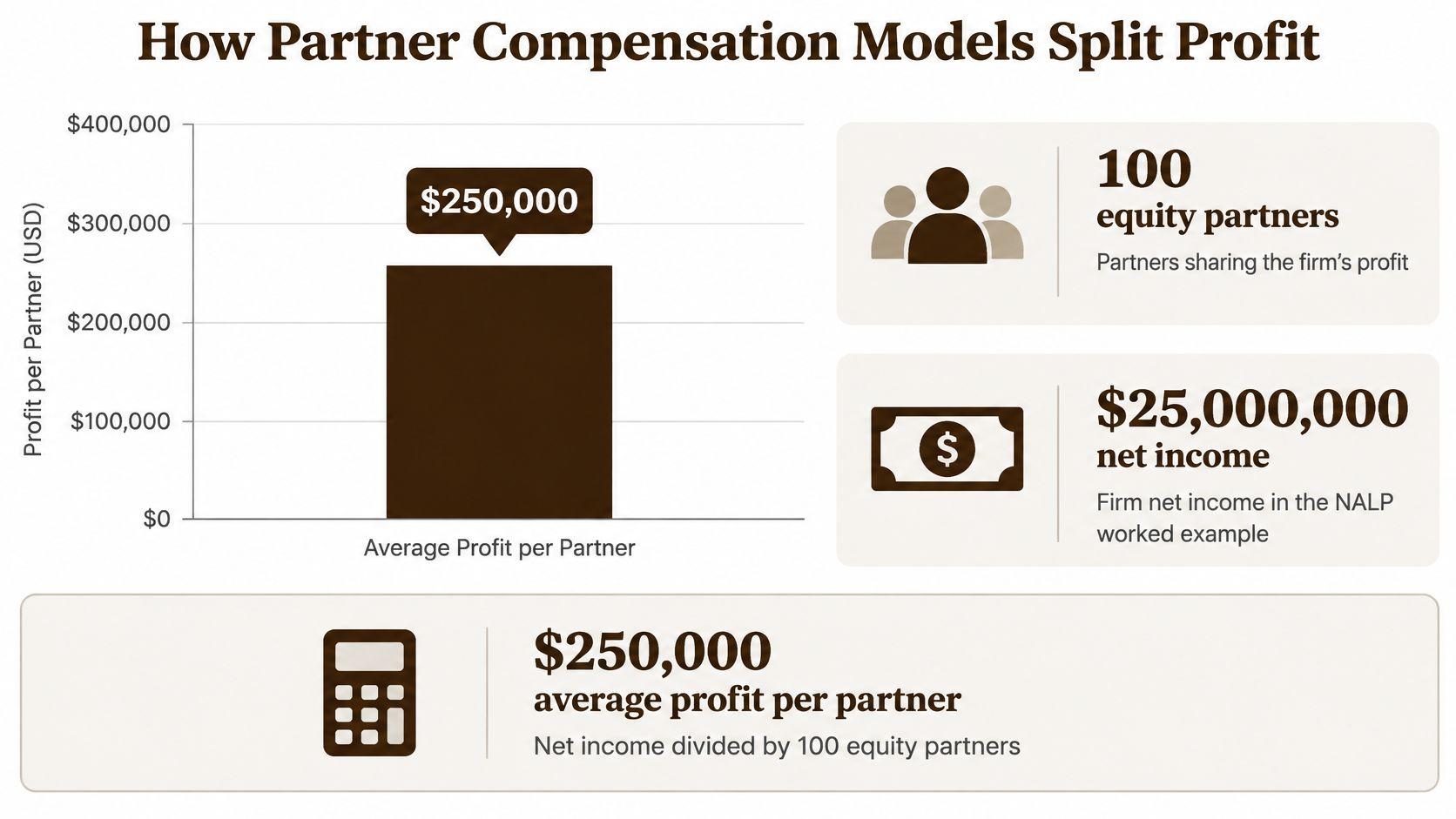
Two partners with identical titles can cash very different checks, and the reason is almost always the formula rather than the work. NALP's financial modeling handout walks through a firm with 100 equity partners and $25 million in net income, which produces average profit per partner of $250,000. Under a relatively compressed lockstep model, individual pay lands roughly between $150,000 and $450,000. A strongly incentive-based formula stretches the same pool from about $50,000 to $750,000. Same firm, same title, fivefold difference at the extremes. The title signals rank; the formula decides money.
The arithmetic behind that example is worth seeing once as a picture, because the average hides the range that decides who stays.
Four models and what each one rewards
| Model | How pay is set | Rewards | Main risk |
|---|---|---|---|
| Lockstep | Pay set by seniority bands shared by peers | Tenure, collaboration and institutional investment | Weak reward for exceptional origination |
| Modified lockstep | Seniority base plus bonus for origination or leadership | Balances tenure with production | Disputes over how bonuses are measured |
| Origination-based | Pay follows the business each partner brings in | Rainmakers and personal books | Discourages firmwide work and shared clients |
| Points system | Annual points set by a committee for contribution | Flexible, reflects leadership and billing | Subjective, opaque and dispute-prone |
A compensation formula works like a scoreboard. Partners chase whatever it counts, and they stop doing whatever it ignores. That is why two firms can offer "partnership" and mean opposite things: one pays you for building the institution, the other pays you for the clients attached to your name, and neither offer is legible until you know which dial moves your number. Before comparing offers, ask which model the firm runs, who sets the inputs each year, and whether the formula is written down or decided in a committee room you will never see.
What the averages hide
The scale at the top of the market is real. Average compensation for U.S. Am Law 200 partners reached $1.55 million in 2025, a 10% increase from 2024, according to Major, Lindsey & Africa's 2026 Partner Compensation Survey. That average describes a group whose internal spread is wider than most associates imagine. A candidate who negotiates against the mean is negotiating against a number nobody earns, so ask for the median, the quartiles and the distance between the top and bottom equity partner instead.
If you want the single-number view of a firm, the profit per equity partner figure is the place to start, and the next question is always the same: what's the spread around it?
Stress tests to request
Ask how the formula behaves when conditions change, and ask with your own numbers attached.
- Rainmaker departure. If the top originator leaves, does the remaining pool shrink proportionally, or do fixed draws stay and squeeze everyone else?
- Realisation decline. If realisation drops five points, which partners absorb the difference?
- Associate staffing change. If the firm hires fewer associates per partner, whose compensation changes and when?
- Cross-office referrals. Does a referral earn origination credit for the sending partner, and how is that credit split?
A firm that answers these questions in writing has a formula it trusts. A firm that answers them only verbally is telling you the terms are negotiable, usually in its favor.
Origination Credit and the Path to Equity
Pay follows clients. When the American Bar Association Journal reported on Major, Lindsey & Africa's survey, one finding carried more weight than the rest: in 2025, 62% of the variation in Am Law 200 partner compensation was associated with client originations (ABA Journal).
What origination credit actually decides
Origination credit is the rulebook that converts a client relationship into money and eventually into an ownership vote. It answers four questions, and each one can move a partner's pay by six figures over a career.
- Who is named as originating a client, and whether that name is set at intake or can be claimed later.
- How credit splits when two partners work one client, and whether a service partner can earn a share.
- Whether credit expires, and what happens when a client is handed to another partner for a decade.
- How cross-office referrals count, since a referral that earns nothing discourages the behaviour firms say they want.
The two-step path, in writing
The usual route runs in two stages. The first is promotion to non-equity partner, decided on book of business, billing and demonstrated leadership. The second is conversion to equity, decided on capital contribution, sustained originations and a partner vote.
Access to that second step isn't automatic or evenly distributed. In multi-tier firms in 2023, women held 23.7% of equity-partner positions while making up 27.76% of partners, and lawyers of color held 9.6% of equity positions against 12.01% of partners, according to NALP's 2024 diversity report. Holding the title and holding the equity are different outcomes.
For the conversion, request four things in writing: the minimum origination level, the review schedule, the capital amount and loan terms, and the date of the next review with the decision-maker named. Vague criteria usually mean the path isn't real.
A promotion with no conversion schedule is a retention tool. Ask which partner decides, on what evidence, and by when.
Say you're a senior associate with two clients you referred into the firm three years ago. Nobody credited you formally because the relationships were opened by a partner. Before your review, document each referral with the intake date, the originating partner, the revenue collected since, and a written request to record your contribution. What goes unrecorded before the vote rarely gets counted after it.
Lateral Partner Moves and Their Hidden Risks
The lateral market is moving faster than the integration behind it. The 200 largest U.S. law firms hired 13,205 lateral lawyers in 2025, a 6.9% increase from 2024, according to Macrae's lateral hiring analysis. Partner-level movement has followed the same curve.
The Macrae analysis of partner hiring recorded 979 partner moves among the 200 largest U.S. firms in the first quarter of 2026, a six-year high and up 9.4% year over year, alongside outcome data that should give both sides pause: only about 20% of lateral partners met financial projections in year one and roughly 30% by year two, with separate figures showing 51% leaving within five years, 64% failing to deliver promised business and 36% never fully integrating.
Why the book doesn't travel
Three forces explain most of the gap. The client relationship may belong to the firm rather than the partner, so a book that looked portable turns out to be borrowed. Realisation can fall under a new fee model, meaning the same clients bill at rates the receiving firm can't collect. And integration takes longer than the deal timeline assumes, because matters need conflicts cleared, teams need to learn each other's habits, and referral flow takes a full budget cycle to appear.
The guarantee is not a risk rating
A high guarantee is often read as a signal of confidence. It can be the reverse. A firm paying for projected revenue before it has verified that clients will follow is buying an assumption, and the size of the guarantee sometimes measures competitive pressure rather than certainty.
Test the offer, don't admire it. Which named clients have confirmed in writing that they will move, and how much of the projected revenue have they actually paid in the last two years?
| Test | What to verify | Red flag |
|---|---|---|
| Client portability | Each client's willingness to follow, confirmed in writing | Book described only as total revenue |
| Conflicts | Matter and adversity conflicts with the new firm's clients cleared | Conflicts checked only after signing |
| Fee and realisation | Realisation and collection history for the last three years | Projections based on billed, not collected, revenue |
| Guarantee terms | Length of any guarantee and clawback conditions | Guarantee running past two years with no review |
| Integration | A 12 to 24 month ramp plan with named team members and cross-referral targets | No named team or ramp milestones |
A 12 to 24 month ramp plan does more work than any other document in the package. It names who brings which client across, when conflicts clear, what revenue is expected in each quarter, and who is accountable for the referrals that make the move pay.
How to Negotiate Partner Terms Step by Step
The sequence matters as much as the questions, because each step depends on what the previous one reveals.
The first step is the one most candidates skip, and the picture below shows why it comes before any number gets discussed.
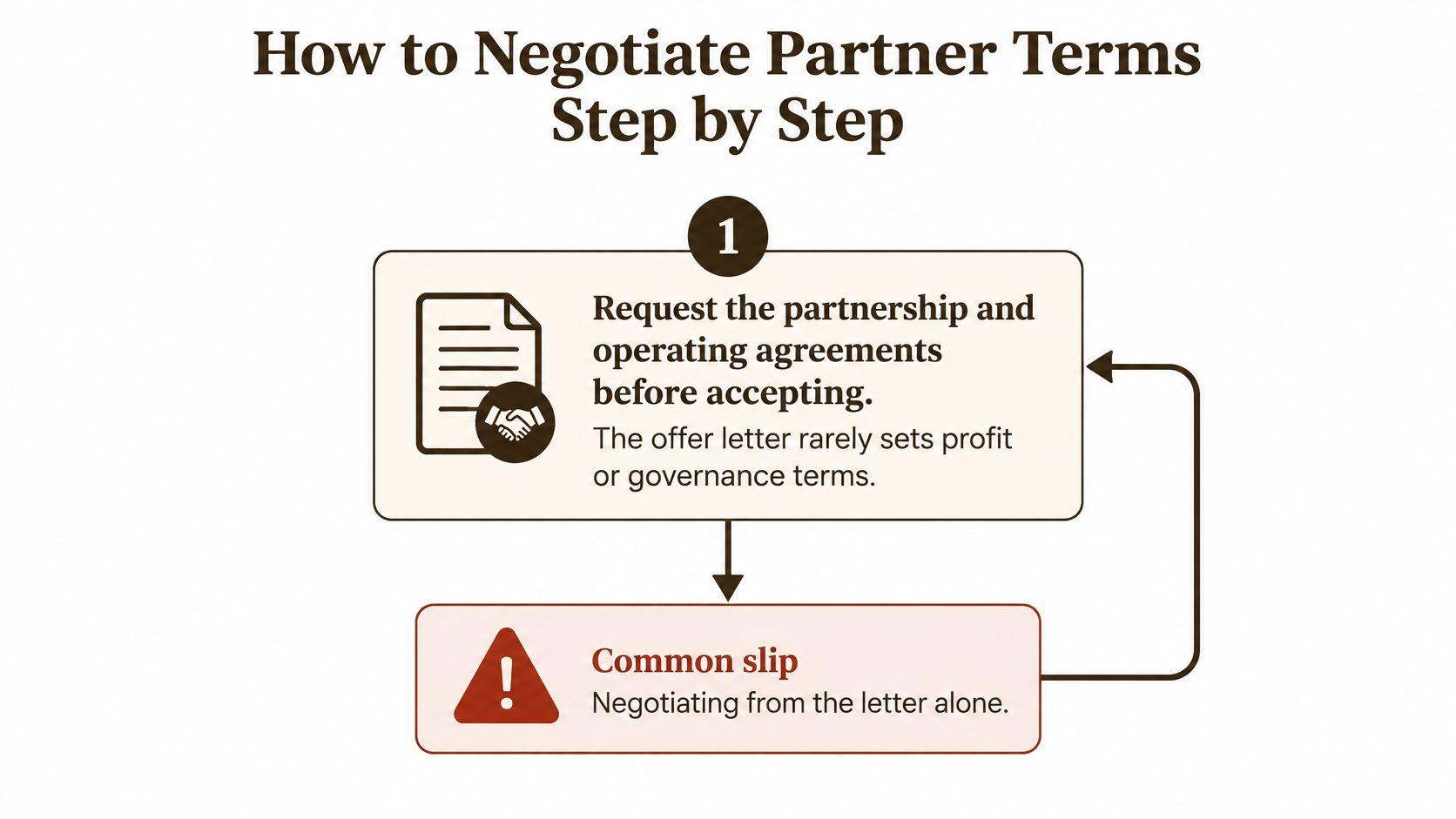
- Request the partnership and operating agreements before you accept. The offer letter rarely sets profit or governance terms; the agreements do. Negotiating from the letter means arguing about the wrong document.
- Ask for a worked profit example built on the firm's own figures. Give the firm your expected origination and billing, then ask what you would have earned in each of the last three years. A generic illustration hides the split; a back-tested one exposes it.
- Confirm the capital contribution, loan terms and interest rate. These often decide whether the partner can afford the role at all. Treating the buy-in loan as a formality is how new partners end up funding firm working capital out of personal cash flow.
- Request access to firm financials and past distribution reports. Profit you can't check is profit you're trusting. The distribution history also shows whether the formula has been applied consistently or adjusted whenever it suited the compensation committee.
- Lock in the origination credit rules and conversion criteria. Get the minimum origination level, the review dates and the name of the decision-maker in writing, because verbal assurances don't survive a change of managing partner.
- Confirm voting rights and any governance seats. Ask what you can vote on in year one, not in year five. A title that carries no vote is a job with a better name.
- Put guarantees and clawbacks in writing with a stated term. An open-ended guarantee isn't a guarantee; it's a discretionary payment with a friendly label.
For a walkthrough of how these conversations sound in practice, the short video below is a useful warm-up before you sit down with the firm.
The signed documents define the deal. Everything said in the meeting is context.
Confirm Your Partnership Terms Before You Sign
An offer becomes real when title, money and authority point in the same direction. Decode the package as an economic signal: compensation shows what the firm expects you to produce, voting and committee access show how much control you have, and origination credit shows whether later equity is plausible or decorative.
Before signing, read the partnership agreement, operating agreement and any employment terms as one deal, and have the employment agreement reviewed with the care you would give a client's contract. Match the written answer to each question: What is paid now, what is deferred, what can be clawed back, who approves origination credit, and which decisions require a vote you do not hold. A lateral offer deserves the same check, because a bigger book at arrival can still come with thin control and slow conversion.
Five Star Placements works only in legal, with a network concentrated in boutique and midsize law firms and companies hiring in-house counsel. Every search starts with a thirty-minute call about the role, since it can present an opportunity only as well as it understands it. Its screening goes beyond resumes to experience, skills and culture fit, and it will say when a search is not the right fit. If an offer or a hiring plan needs that kind of read, start with Five Star Placements and put the promised economics next to the documents.
Need help filling a legal role?
Five Star Placements partners with law firms and legal departments nationwide.
Schedule a Call