
Big Law Recruiting: How Firms Hire and How to Get In
November 27, 2026 · 17 min read · Five Star Placements

Table of contents
80% of offers for 2026 2L summer programs came from employer-sponsored recruiting, leaving just 20% to law-school-sponsored methods such as on-campus interviewing, according to the NALP 2026 Perspectives on Law Student Recruiting press release. In the same survey, 93% of law offices cited direct applications as a recruiting method, compared with 71% citing OCI or comparable school programs. Those numbers upend the way most hiring partners and attorneys still think about Big Law recruiting.
Big Law hiring doesn't run on one unified calendar anymore. It runs as four parallel pipelines, each with its own clock, sourcing channel, and dropout point. Summer classes lock in months ahead of traditional campus dates, third-year hiring fills narrow gaps, and lateral associate and partner searches swing with billing demand rather than academic terms.
When firms treat these four tracks as a single hiring funnel, they lose practice-ready candidates well before an offer ever gets drafted. When candidates rely on outdated campus timelines, they send résumés into seats that were already filled through sponsored outreach. Reading the NALP data pipeline by pipeline shows exactly which hiring decisions the numbers support, and where standard habits fail.
Table of Contents
- Big Law Recruiting Pipelines at a Glance
- How Firms Move a Candidate from Sourcing to Offer
- Associate and Partner Evaluation Criteria Compared
- Lateral Swings and Outreach Timing
- How Candidates Get Into Sponsored Pipelines
- Decide Whether an External Recruiter Fits Your Search
Big Law Recruiting Pipelines at a Glance
Before a hiring partner approves a requisition or an attorney updates a résumé, one question settles the calendar: which of the four Big Law recruiting pipelines governs the seat? Grouping summer associates, 3L entry-level candidates, lateral associates, and lateral partners under one recruiting plan hides the fact that their clocks barely overlap.
The sharpest calendar shift sits in summer hiring. In the NALP 2024 Perspectives on Law Student Recruiting report, which covered 6,639 2L students in summer programs and 6,417 students who received associate offers across approximately 548 responding law offices, 78% of offers for 2L summer-associate positions were made before August 2024, up from 45% in 2023. Direct application led all methods at 91% of participating law offices, ahead of on-campus interviewing at 82% and résumé collection programs at 72%. Traditional OCI fell from 53% of offers in 2023 to 24% in 2024, while 56% of offers came through channels outside law-school interview programs, including direct applications, résumé collects, and referrals. Meanwhile, the average 2L summer class shrank from 14 students in 2023 to 12 in 2024, even as the post-graduation return offer rate ticked up from 96% to 97%.
| Pipeline | Who it targets | Main channel | Timing signal | Key figure |
|---|---|---|---|---|
| 2L summer associate | Law students after their first year | Direct applications, used by 91% of participating law offices | 78% of offers made before August 2024 | 12 students per summer class in 2024 |
| Entry-level 3L associate | Final-year law students | Direct firm postings and targeted referrals | Fall and spring of 3L year, after summer return rates settle | 180 offers and 89.4% acceptance in 2025 |
| Lateral associate | Practicing associates | Direct outreach, referrals, and legal recruiters | Hiring up 24.9% in 2024 | 58.8% of lateral hires in 2024 |
| Lateral partner | Experienced partners with a portable book | Confidential partner outreach and specialized search | Year-round, governed by book transfer and conflicts review | 22.5% of lateral hires in 2024 |
Placing a Candidate on the Right Clock
Sorting any candidate onto the table takes three inputs: class year, years of practice, and portable book of business. Law students finishing their first year belong strictly on the accelerated direct-application clock, while final-year students compete in a narrow 3L market that opens only when a firm's summer class leaves unfilled headcount. Practicing lawyers without client originations sit in the lateral associate row, where demand rises and falls with matter volume; senior attorneys bringing transferable clients sit in the lateral partner row, where diligence and conflicts govern timing.
First diagnostic check: Find the single row that matches your seat or career stage, then compare your current outreach date against that row's timing signal. If a firm is still waiting for campus interviews to source 2Ls, or waiting for a job board posting to fill an urgent lateral seat, it's already operating behind the market clock.
How Firms Move a Candidate from Sourcing to Offer
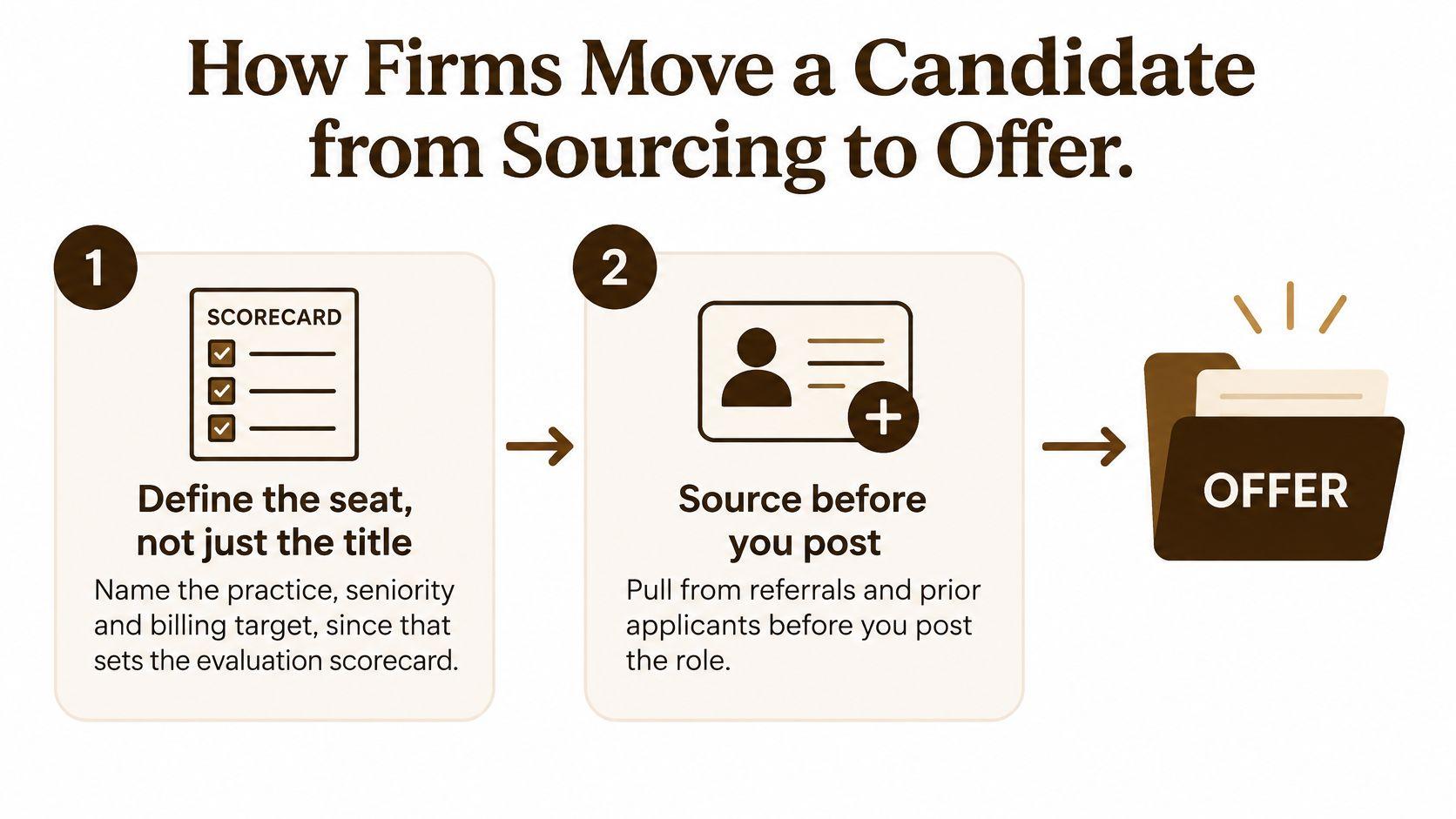
Law-firm recruiting teams tend to blame compensation or rival firms when a search drags on. Look closer at where candidates drop out, and the bottleneck usually sits much earlier in the workflow, long before anyone negotiates a start date.
The process below moves through six sequential stages from requisition to signature, with a predictable failure point at each gate.
Six Stages from Requisition to Signature
- Define the seat, not just the title. Write down the exact practice group, seniority band, supervision ratio, and expected billing load before anyone contacts a candidate. That specification builds your evaluation rubric. Common slip: posting a vague "mid-level corporate associate" need, then watching partners reject finalists because half the group wanted a second-year diligence lawyer and the other half wanted a fifth-year deal runner.
- Source before you post. Pull first from partner referrals, prior runners-up, and direct applications, which already dominate law-office recruiting channels. Common slip: waiting for inbound responses on a public listing while competing firms book callbacks with passive attorneys.
- Screen on portable work. Review representative matters, lead drafting or negotiation roles, and direct client exposure instead of relying on law-school pedigree or class year alone. Common slip: using school rank as a shortcut and passing over practice-ready attorneys who can bill from week one.
- Interview with one consistent scorecard. Give every interviewer in the practice group the same evidence fields, so candidates are judged on comparable matter depth rather than personal chemistry. Common slip: collecting unstructured email impressions two days late, which turns partner debriefs into memory contests.
- Make the offer with a clear decision date. Lateral candidates often juggle overlapping callbacks once their search goes active, so an offer package should include a realistic, firm response window. Common slip: leaving a silent gap between the final interview and written terms while executive-committee approvals stall.
- Track conversion at each stage. Measure screening-to-interview, interview-to-offer, and offer-to-acceptance rates separately. Common slip: reporting only total annual hires, which hides whether a search failed because of weak sourcing or slow partner feedback.
Each stage compounds the one before it. A vague seat definition at stage one produces uncomparable interview notes at stage four, because interviewers never agreed on what evidence they were scoring. A slow channel mix at stage two compresses the funnel before a single callback goes out, which is why sponsored access and referral channels now decide who even gets considered.
Where the Hiring Funnel Actually Leaks
Hiring partners often assume the biggest risk hits after the offer letter goes out. The entry-level figures tell a different story: according to NALP data reported by Legal News, responding law firms extended 180 entry-level associate offers to 3L students in 2025, and 161 offers were accepted, producing an 89.4% acceptance rate.
Nine out of ten extended offers accepted means offer-stage attrition is not the primary leak. Firms lose the bulk of strong candidates between initial sourcing and the first substantive interview, usually because intake criteria were muddy or outreach started too late on that pipeline's clock.
Run a simple operational test on every active search: if any stage sits for more than a few weeks without a recorded advance or decline, the process lacks an enforceable internal deadline. That single habit exposes which of the six gates is leaking, rather than letting the failure surface months later as a rescinded offer or an empty seat.
Associate and Partner Evaluation Criteria Compared
Treating lateral associates and lateral partners as one generic lateral pool creates immediate friction. In the NALP 2025 lateral hiring survey, 305 participating employers reported 3,535 lateral hires; associates represented 58.2% of lateral hiring and partners 22.3%, with lateral associate hiring rising 17.1% and partner hiring increasing 17.8% from 2024. Both segments expanded side by side, yet they test completely different business risks.
Associate searches verify matter-level technical competence, workflow readiness, supervision demands, and likely retention. Partner searches add a commercial audit: quantifiable portable revenue, client mobility, team cohesion, conflicts exposure, and integration economics. One scorecard can't measure both without distorting one of them.
| Criterion | Associate search | Partner search |
|---|---|---|
| Core skill check | Matter-level technical competence and workflow readiness | Practice depth and leadership on complex matters |
| Retention signal | Likely retention after the first year | Client mobility and team cohesion |
| Revenue | Supervision needs and billing readiness | Portable revenue that can be quantified |
| Risk | Standard conflicts check | Conflicts exposure and integration economics |
| Evaluation method | Standardized scorecard applied across practice groups | Bespoke business-case analysis with stakeholder alignment |
Because associate hiring runs at more than double the volume of partner hiring, standardization protects partner time. Say a firm opens a search for a fourth-year commercial litigation associate. The hiring committee evaluates every finalist against the same written rubric: dispositive motion drafting, solo deposition experience, discovery supervision, and realistic ramp-up time on current dockets.
Now contrast that with a corporate partner lateral search. A standardized checklist won't catch whether a partner's top three institutional clients are bound by panel agreements that block portability, or whether bringing two supporting counsel triggers rate compression. That seat demands a bespoke business-case memo aligning the practice chair, conflicts committee, and compensation leadership around verified revenue transfer and integration cost.
Separate Funnel Metrics for Each Segment
Reporting one blended lateral recruiting statistic masks where each market behaves differently. Managing partners get clearer signal by tracking six metrics separately for associates and partners:
- Qualified profiles: Count candidates who meet the technical or book-of-business baseline, not raw résumés received.
- Screening-to-interview conversion: Measure how accurately sourcing filters out mismatched seniority or unverified client claims before partners invest interview hours.
- Interview-to-offer conversion: Flag practice groups where debrief standards drift or partner alignment breaks down mid-search.
- Acceptance rate: Spot compensation gaps, slow approval timelines, or integration concerns that surface after terms are presented.
- Time-to-fill: Track calendar days from kickoff to signed offer, expecting partner diligence to take longer than associate evaluation.
- First-year retention: Audit whether hired associates met billing and quality expectations and whether lateral partners delivered projected portable work.
Build both evaluation templates before a single requisition opens. When a firm drafts an associate scorecard and a partner business-case outline in advance, scarce partner interview hours go to verifying evidence rather than debating what the seat requires.
Lateral Swings and Outreach Timing
Lateral demand moves in sharp multi-year swings that punish firms which stop sourcing during a dip and restart only after billing returns. The result is a set of parallel pipelines with different clocks. Associates, partners, and different firm sizes all enter the market at different speeds, and firms often lose candidates before a formal offer is on the table.
The chart below maps the three-year whiplash in U.S. lateral hiring from the start of the slowdown through the 2024 rebound.
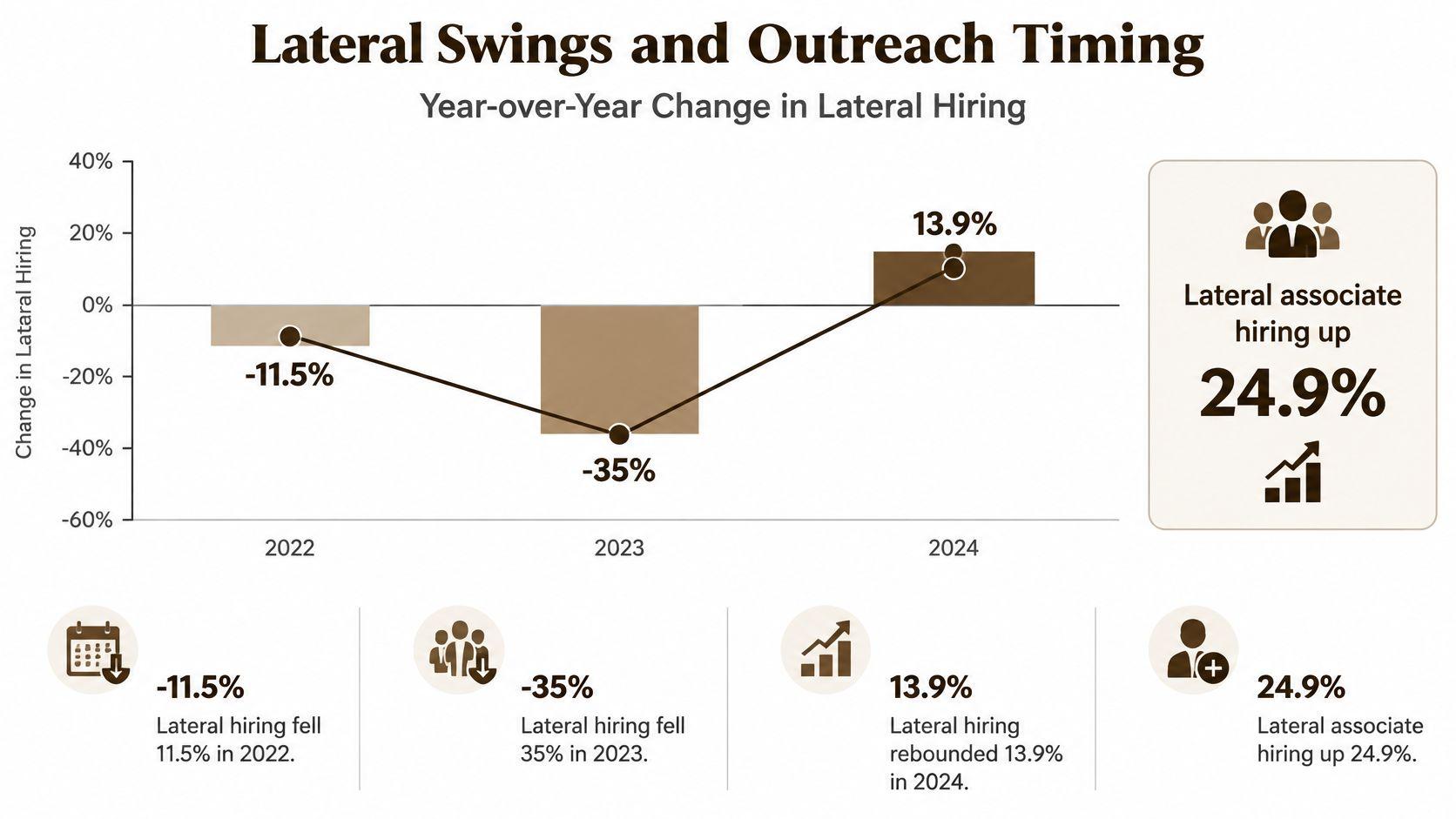
NALP's 2024 lateral hiring research reported that lateral lawyer hiring fell 11.5% in 2022 and plunged 35% in 2023. The market then snapped back. Analyzing aggregate hiring data for 4,295 lateral lawyers across participating U.S. offices and firms, the NALP 2025 lateral hiring report found that total lateral hiring jumped 13.9% in 2024 compared with 2023. Lateral associate hiring drove the rebound, climbing 24.9%, while the average number of lateral associates hired per participating office or firm rose from 5.1 in 2023 to 5.8 in 2024. Associates made up 58.8% of all lateral hires in 2024, compared with 22.5% for partners.
| Year | Total lateral hiring | Lateral associate hiring | Notes |
|---|---|---|---|
| 2022 | Down 11.5% | Not reported separately | Start of the slowdown |
| 2023 | Down 35% | Not reported separately | Steepest decline in the cycle |
| 2024 | Up 13.9% vs 2023 | Up 24.9% | Firms over 1,001 lawyers up 21%; firms of 250 or fewer down 11% |
How Firm Size Changes the Hiring Math
Headline averages conceal a steep split by firm headcount. In 2024, firms with more than 1,001 lawyers increased lateral hiring by 21%, while firms with 250 or fewer lawyers recorded an 11% decline. Across all participating offices and firms, the median office hired four lateral lawyers, yet the average hit 9.9, proving that a relatively small group of high-volume employers drives a disproportionate share of total lateral activity.
That divergence dictates two different recruiting strategies. Say a 250-lawyer firm anticipates modest headcount growth during a soft year. Freezing outreach saves short-term administrative effort, but it leaves the firm starting from zero when regional deal flow or litigation volume picks up. Maintaining warm conversations during slower quarters lets smaller firms recruit strong mid-levels before larger firms re-enter bidding wars.
Now look at a firm with more than 1,000 lawyers entering a recovery. When demand rebounds, competition for practice-ready associates accelerates faster than internal recruiting departments can schedule interviews. Partners who assume a two-year slowdown permanently expanded the available talent pool get caught flat-footed when candidate bargaining power flips overnight. A closer look at law firm lateral hiring dynamics shows why pipeline continuity beats reactive job postings across the cycle.
The video below walks through how legal teams think about lateral timing and candidate readiness during market shifts.
Four Pre-Requisition Outreach Moves
A temporary market dip is not a permanent drop in talent competition. Firms stay ahead of compressed decision windows by locking in four habits before an urgent requisition reaches a partner:
- Hold a 30-minute role kickoff before sourcing starts. Five Star Placements asks clients for thirty minutes on a call about the role before the search starts, aligning on practice realities, team dynamics, and required matter experience before outreach begins.
- Segment prospects by practice area and seniority. Maintain separate warm lists for mid-level litigation associates, senior corporate deal lawyers, and portable-book partners. Five Star Placements uses proprietary tools to locate attorneys matching client criteria who do not appear in standard searches, alongside relationships already built through its referral network.
- Pre-qualify on portable work and real interest. Screen early for lead-role experience, originations, and representative matters rather than waiting for formal callbacks. Every candidate Five Star Placements presents has spoken with the firm on a call first, where it vets credentials, bar status, matters handled, and role fit, and confirms interest in that specific seat.
- Refresh candidate relationships on a set cadence. Checking in quarterly with strong attorneys who were not ready to move six months ago turns a multi-month search into a faster interview launch once a partner approves the headcount.
Sponsored access and warm relationships decide who gets considered before many requisitions become public. A candidate may be qualified on paper and still lose the seat because no one inside the firm has a reason to move that file forward. The same pattern appears on the firm side. A hiring team that waits for applications enters a narrower channel after better-connected candidates are already in conversation.
Delaying a single interview round during a market rebound can forfeit a top candidate to a rival firm whose committee met earlier. A warm, pre-vetted bench moves in days; a cold search stalls for months.
How Candidates Get Into Sponsored Pipelines
Employer-sponsored recruiting now controls the overwhelming majority of Big Law entry paths, while conversion rates inside summer programs and formal offer stages remain remarkably high. That structure flips the traditional career advice handed to law students and junior attorneys. Closing an offer once you're inside the room isn't the primary obstacle anymore. Earning access to the sponsored pipeline before formal recruiting opens is where most searches succeed or stall.
Three Signals That Trigger Employer Sponsorship
Hiring partners don't sponsor candidates into early or direct pipelines out of politeness. They sponsor candidates who reduce evaluation risk right away.
The first signal is practice alignment that matches an active seat. An attorney or student who can point to concrete coursework, clinic work, judicial internships, or prior matter exposure directly relevant to a firm's busy practice group stands out immediately over a generalist pitching broad interest.
The second signal is a trusted internal or peer referral. When a current associate, partner, or respected practitioner vouches for a candidate's work ethic and judgment, recruiting teams move that file out of the general inbox and into an active screening queue.
The third signal is matter-level detail that proves workflow readiness. Vague bullet points like "assisted with M&A transactions" force reviewers to guess what a candidate can execute without heavy supervision. Specific descriptions of drafting purchase agreements, managing diligence trackers, or arguing discovery motions give partners concrete evidence they can trust.
Direct Applications Versus Campus Packets
Submitting a generic on-campus interviewing packet through a direct-application portal misses why firms shifted away from centralized school processes in the first place. Campus packets are built for volume screening across dozens of employers at once. Direct applications are built for targeted fit.
A strong direct package replaces the boilerplate cover letter with a short, practice-specific note naming the exact office, practice group, and recent matters or capabilities that match the applicant's background. For practicing attorneys, pairing a tight résumé with a clean representative matters sheet (stripped of confidential client identifiers) shows seniority and deal or docket complexity at a glance.
For candidates without strong law-school career-office access, alumni connections, or insider coaching on how large U.S. law firms run employer-sponsored hiring, relying solely on public portals puts them behind peers who already have warm introductions. Working with a specialized recruiter bridges that access gap without exposing a current role. Attorneys considering a move can browse our current openings or tell us the exact practice area and seniority they're targeting, and we reach out when a strong fit opens in our network. Every application sent to us stays strictly confidential, and we never contact an applicant's current employer without explicit permission.
Direct channels reward precision, not volume. Ten tailored applications backed by specific matter detail or a warm introduction outperform fifty generic packets dropped into general portals.
Decide Whether an External Recruiter Fits Your Search
Hiring partners shouldn't default to an outside agency on every opening, nor should they force an overloaded internal team to handle specialized lateral searches alone. The decision comes down to where your candidate pool lives and how much partner bandwidth you can spare.
An external partner makes strategic sense under three clear conditions:
- Internal recruiting capacity is stretched thin. During a practice-group surge or market rebound, an outside team expands sourcing reach without pulling partners off billable work to screen unqualified applicants.
- The seat requires lateral or senior talent sitting outside public job boards. Strong mid-level associates, practice-ready counsel, and portable-book partners rarely browse public postings; reaching them requires targeted outreach and established referral networks.
- Your organization is a boutique firm, midsize law firm, or corporate legal department. We're built specifically for boutique and midsize law firms, as well as companies hiring in-house counsel, where our candidate network and placement record are concentrated.
Where an External Search Is the Wrong Choice
Honesty about fit saves months of wasted interviews. An external agency is often the wrong tool when a large firm's internal recruiting staff, summer-associate bench, and partner referral networks already generate enough qualified finalists for standard entry-level or junior associate classes.
We're direct about that boundary ourselves: we may not be the right fit for an AmLaw firm, because we often place attorneys coming out of AmLaw firms into boutiques, midsize firms, and in-house legal teams, rather than placing into AmLaw firms. Any hiring partner evaluating Big Law recruiters should press every agency on where its actual placements concentrate instead of accepting a promise that one firm covers every tier equally well.
Three Tests Before You Commit
Before signing a search engagement, run three straightforward checks against your recruiting plan:
- Audit the vetting protocol. Ask whether the recruiter speaks live with every attorney before forwarding a résumé, verifies bar status and representative matters, and confirms genuine interest in your specific seat rather than batch-sending keyword matches.
- Match the search to your segment scorecards. Confirm that an associate search will run on your standardized technical rubric while a partner search follows your bespoke portable-revenue and conflicts diligence process.
- Lock the cadence to your cycle clock. Agree upfront on target interview windows, candidate feedback turnaround, and realistic decision dates so your search doesn't lose vetted finalists during a busy market swing.
When those three boxes check out, the next step is straightforward: schedule a call to walk through the open seat, and bring your segment scorecards, stage-by-stage funnel metrics, and target decision dates so the search begins from concrete evidence instead of guesswork.
Five Star Placements provides contingency-based permanent placement for boutique and midsize law firms and corporate legal departments across the United States, connecting hiring teams with vetted attorneys, partners, in-house counsel, and legal operations leaders. Every search begins with a focused 30-minute role intake and live candidate vetting so your partners spend interview time only on practice-ready lawyers who fit the seat. To discuss an upcoming lateral search or explore confidential attorney opportunities, visit Five Star Placements.
Need help filling a legal role?
Five Star Placements partners with law firms and legal departments nationwide.
Schedule a Call