
Best Partner Search: 7 Legal Recruiters Compared
November 25, 2026 · 15 min read · Five Star Placements

Table of contents
A managing partner who needs to open an office in a new city and a partner carrying $1.4 million in originations fill out the same intake form at the same national search firm. One gets a callback inside a day. The other waits a week and gets a polite pass.
That isn't a service failure. It's a fit failure. Choosing the best partner search firm is a threshold question before it's a quality question: almost every firm works to a portable-business floor and a firm-size preference, and most will tell you what that floor is, on their website or in the first minute of a call. Your job is to find your own numbers inside that floor before you sit through seven introductions.
The seven firms below offer different answers to one question: who is this built for? The list is sorted by the two things that eliminate half the market in a single read: the size of the book each firm recruits against, and whether the firm is built for one partner or a multi-office group lift. Find your place on both axes, and the shortlist gets short fast.
Table of Contents
- 1. Major, Lindsey & Africa (MLA)
- 2. Lateral Link
- 3. ExecLegal
- 4. Kinney Recruiting
- 5. Larson Maddox
- 6. American Consulting Company
- 7. Lateral Lawyer Group
- Partner search firms compared by focus, book size, and engagement terms
- Matching the Right Search Partner to Your Firm's Next Move
1. Major, Lindsey & Africa (MLA)
MLA is the firm you call when a search needs a bench rather than a single broker. It runs a dedicated Partner Practice Group that works both directions, advising law firms on lateral growth plans and advising partners weighing a move, and it covers U.S. and international markets, so a second-city office opening doesn't fall outside its map.
Scale is the asset here. It's also the trade-off. A partner with a modest book and a nine-partner team lift don't get the same internal priority at a firm that places groups for Am Law 50 clients, so ask directly which consultant owns your search and how many partner mandates that consultant is carrying this quarter.
Where MLA Fits and Where It Does Not
MLA publishes compensation and lateral-market research and uses it in the pitch. Its own Am Law 100 survey on lateral hiring found that 86% of more than 2,200 lateral partners were somewhat or very satisfied with their new firms, while 82% were satisfied with compensation. Hold a search to that benchmark: an accepted offer isn't the outcome, a partner still satisfied and still producing at month eighteen is.
What works here:
- Group lifts and office openings. Multi-hire searches with a defined practice thesis get the most from a large bench.
- Compensation benchmarking. Its market data is a useful check on what a candidate's book is worth.
- Cross-border moves. If the partner needs a London or Hong Kong platform, few boutiques can cover it.
What doesn't work: a single partner with a modest book who wants white-glove handling. Fees aren't published as a standard rate, so confirm terms early. If that's your situation, read how law firms structure a partner search before you call anyone, and check MLA's partner recruiting practice for current coverage.
2. Lateral Link
For a firm hiring an established rainmaker or moving a practice group, Lateral Link belongs on the shortlist. Its partner practice covers individual partners, groups, and office-opening searches for Am Law 200 firms and regional boutiques. The useful filter is substantial portable business, rather than a fixed dollar cutoff. Confirm the book size your specific mandate requires before discussing candidates.
The engagement options include retained, exclusive, and contingent arrangements. For a first partner hire in a new market, that gives you room to discuss commitment before paying a retainer. Get clear on which structure applies to your search and what exclusivity requires.
Portability Is the Whole Conversation Here
The Reuters legal industry survey on partner compensation reports that origination explains 64% of compensation variation, rising to 72% when combined with billing rates. That makes the quality of a book central to the search: matter history, client concentration, realization, and collections deserve more attention than a headline revenue figure.
Ask this on the first call: What portable business would make this mandate viable, and would you run it as an individual partner search or a group move?
Those are separate questions. A substantial individual book and a practice-group move call for different search scopes; establish which assignment the recruiter is proposing.
A junior partner still building originations, or a firm seeking a service partner, should establish fit early. For a discreet individual approach, ask how outreach will be handled rather than assuming group-search capability answers that question. Review Lateral Link's partner and group placement page, then get the fee structure and engagement terms in writing.
3. ExecLegal
ExecLegal sells selectivity, and for the right buyer that's the entire product. The boutique says it works exclusively on lateral partner and practice-group placements, concentrated in the Am Law 100, with recruiters who practiced law before they recruited.

That narrowness cuts both ways. A confidential approach to a partner at a competitor, run by someone who has sat through the same partner comp meetings, beats a generalist's outreach. A search for a five-partner regional firm with a modest portable book isn't what this shop is built for, and you'll feel it in the first conversation.
Why the Am Law 100 Focus Matters in a Soft Market
Partner hiring is cyclical and the cycles are sharp. The NALP research on lateral hiring recorded that lateral partner hiring increased 2.3% in 2024, after declining 10.0% in 2023. When partner demand drops, firms get pickier, and confidential senior searches slow or move in-house. A boutique whose whole book is Am Law 100 partner work is exposed to that cycle. It's also the shop most likely to know which firms are still authorized to hire.
What matters to a managing partner:
- Market research before outreach. Mapping which practices at which firms are growing, rather than blasting a CV.
- Culture and platform fit. The pitch weighs how a partner's clients get served after the move, not just the size of the book.
- Coverage in the major markets. New York, Los Angeles, Chicago, Houston, San Francisco, and Washington, D.C.
Two caveats. Public pricing and independent review material are thin, and the Am Law 100 emphasis means smaller firms and modest books get less attention. If your target list sits outside that tier, read what legal executive search firms actually do, then check ExecLegal's site for current practice coverage.
4. Kinney Recruiting
Kinney Recruiting is a full-service legal recruiter rather than a partner-search boutique, and that shapes both its book threshold and the size of move it handles well. It recruits for law firms and corporate legal departments across major U.S. markets, publishing current partner openings in a range of practices and locations, including roles that carry no portable-business requirement at all.
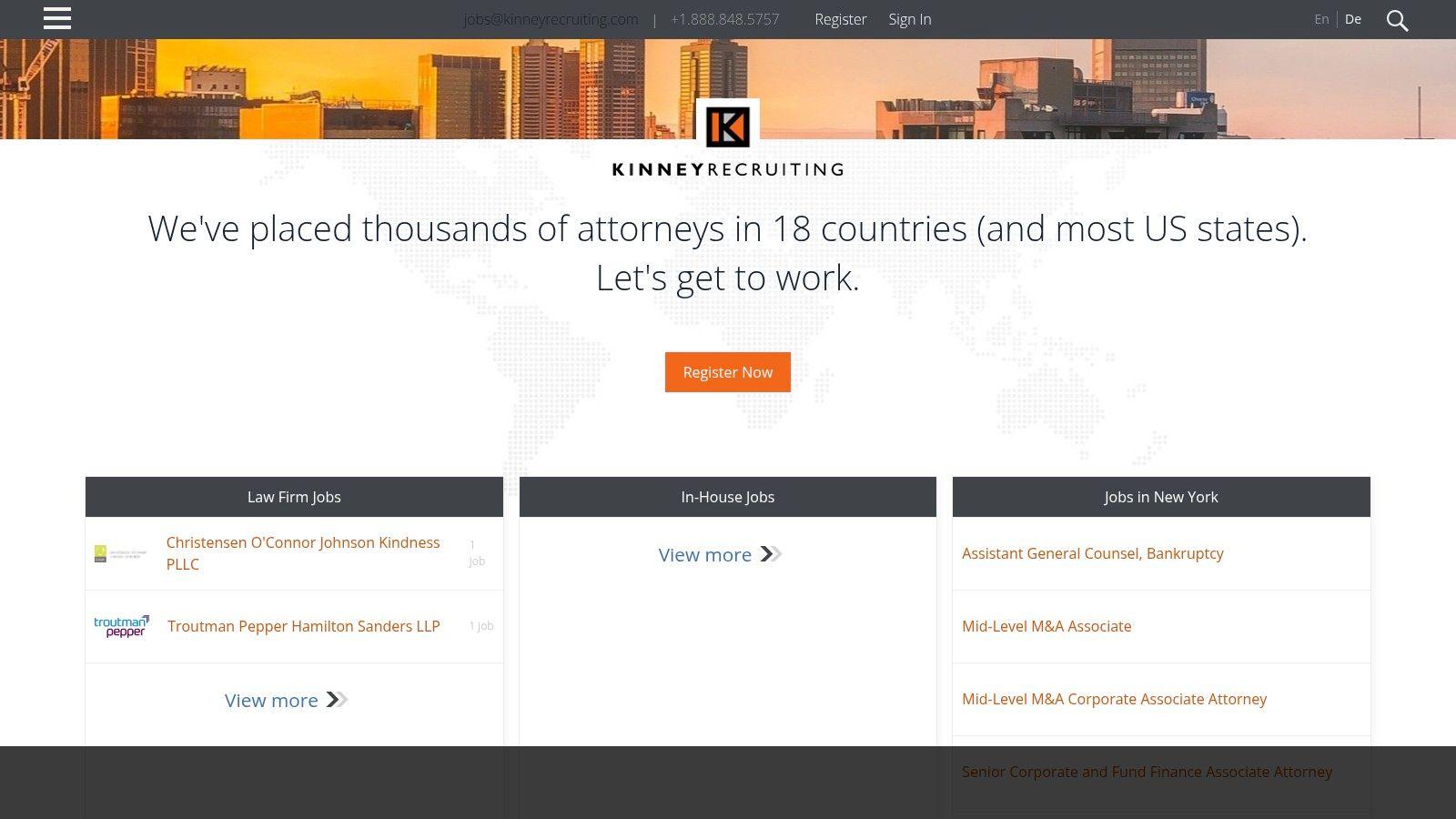
That last detail is where this firm earns its slot on the list. If you are hiring a partner for a succession plan, a service-practice build, or a leadership seat where institutional relationships outweigh originations, most of the firms above will pass because the book does not clear their floor. Kinney will run it. And because partner work sits beside associate and in-house recruiting, one vendor can absorb several hiring needs at once. The trade-off runs the other way too: a multi-office group lift is not the shape of this shop. Single appointments and small additions are.
The Public-Listing Effect
Partners often study a recruiter's live openings before agreeing to a confidential call. A searchable listing page works as quiet due diligence: the candidate reads the practice mix, the markets covered, and the seniority of the roles before deciding the conversation is worth the risk. A recruiter that publishes partner work draws inbound interest a purely relationship-driven shop never sees.
A published opening is a filter as much as an ad. It tells a partner with a serious book whether the firm is worth a confidential call.
The weakness is focus. Partner search is one line among several, and coverage shifts with market and timing. Before signing, ask which partners it placed in your practice area over the last twelve months, and ask who leads the partner desk specifically. Start at Kinney Recruiting.
5. Larson Maddox
Larson Maddox runs partner searches as a defined process rather than a relationship: define the business objective, map the market, approach candidates discreetly, assess fit, and manage the process through appointment. That structure suits a firm that already knows what it wants and needs it executed, whether the hire is one partner, a practice leader, or a partner-led team.
The client profile is mid-to-large firms adding a practice, entering a new market, filling a leadership gap, or planning succession. The same firm also covers wider legal and regulatory recruitment, which is the first thing to clarify on the call. Ask who will lead the partner search, and whether that person's desk is partner work or compliance work.
Partner Demand Is Real, Not a Niche
Market size argues for treating partner search as a planned activity. The NALP 2026 lateral hiring report found that lateral partner hiring grew 17.8% year over year in 2025. Firms that start searching after a partner resigns are competing against every firm that planned three quarters earlier.
What the process gets right:
- Market mapping before outreach. You see the universe of candidates in the practice, not a list of whoever happens to be looking.
- Confidentiality. Outreach to partners who aren't applying anywhere is the normal case, not the exception.
- Team moves. A partner-led team can be scoped in the same brief as a single appointment.
The caution is focus. A firm with a wide recruitment book can staff a partner search with a consultant whose week is mostly in-house and regulatory work. Pricing isn't published, so negotiate the fee and the replacement terms before you sign. Larson Maddox's law firm partner page lists the searches it runs.
6. American Consulting Company
American Consulting Company works the candidate side of partner search, and its own numbers tell you who it's for. The firm says many of its partner referrals carry $2 million to $15 million in portable business and that many of its clients are Am Law 100 firms. A junior partner or a partner with a thin book sits outside that band, and no amount of process description changes it.
The process itself is built around consent: a confidential conversation, a practice assessment, a platform analysis, and introductions only after the partner approves them. That's a meaningfully different product from a firm-side search mandate, where the client is the firm and the recruiter is working a requisition.
A Market Big Enough to Specialize In
Partner moves are a measurable share of lateral activity, not a rounding error. NALP figures reported by Legal News show that lateral partner hiring accounted for 22.3% of all U.S. law-firm lateral hiring in 2025. That volume is why candidate-side advisory persists as a model: enough partners move each year to support a firm that never takes a firm-side retainer.
Where it fits:
- Established partners exploring. No commitment to move, and no CV sprayed across the market.
- Platform comparison. The analysis covers what a firm's infrastructure adds to a practice, not just the comp number.
- Partners with a verified book. The stated range filters out tire-kickers on both sides.
Where it doesn't: broad hiring needs, associate recruiting, in-house roles, or anything that resembles staffing. There's no public fee schedule, and the model is advisory and referral, so a managing partner who wants one vendor running the process end to end should look elsewhere on this list. Background sits on American Consulting Company's site.
7. Lateral Lawyer Group
Lateral Lawyer Group is a boutique built around one thing, partner-level moves, and it works the move differently from the big shops. Instead of chasing a single opening, it positions a partner to create a market among several firms at once, then compares the offers on platform, compensation mechanics, and client portability. The principal recruiter has written a book on partner lateral moves, which is the kind of depth you can't fake in a pitch.

The client list spans national, international, and regional firms, with rare exceptions below partner level. That focus shows up in the questions, which tend to be about origination credit, client consent, and what happens to a book during the transition.
The Failure Rate Nobody Prices In
Acceptance is not the finish line. Average three-year retention in the Am Law 200 was 76% for partners, compared with 61% for counsel and 52% for associates, according to SurePoint's 2025 State of the Legal Industry report. Even at partner level, roughly one hire in four is gone within three years.
Interview the recruiter on integration, not just sourcing. Ask what happens in the first ninety days after a partner starts, and who owns the client-transition map.
Strengths are real: a senior-only focus, discretion, patience with a partner weighing several options, and a multiple-firm approach that gives a candidate actual comparison data instead of one offer. The limitation is capacity. A boutique built for individual moves isn't the right vendor for a five-office team lift with a fixed start date, and employer-side terms aren't published. For the hiring side of that equation, lateral partner hiring strategies covers what to consider. Details at Lateral Lawyer Group's recruiting page.
Partner search firms compared by focus, book size, and engagement terms
Read the table as an elimination pass: the book column separates stated ranges from mandates where portability is priced role by role, and the engagement column shows whether the product is a single discreet approach, a broader recruiting relationship, or a group-capable search.
| Search Firm | Best For | Portable Book Focus | Engagement & Fees | Reach |
|---|---|---|---|---|
| Major, Lindsey & Africa (MLA) | Individual partners, groups, and law-firm expansion | Partner placements where origination and transition history drive the screen | Custom search terms agreed directly with the firm | Broad U.S. and international reach |
| Lateral Link | Partner and group searches, including office openings | Practices with about $2M to $50M in business | Retained, exclusive, or contingent; fee follows the chosen structure | U.S. offices and international reach |
| ExecLegal | Confidential senior partner and practice-group searches | Am Law 100 orientation with a senior-portability screen | Mandate terms negotiated case by case | Major U.S. legal markets |
| Kinney Recruiting | Firms seeking partner recruiting alongside broader legal hiring | Includes published partner roles with no book requirement | Partner search run inside a wider hiring relationship | Many U.S. markets and practice areas |
| Larson Maddox | Individual partners, groups, practice leaders, and teams | Partner profile tied to the client's growth objectives | Search structure set during the scoping conversation | Coverage matched to the mandate |
| American Consulting Company | Established partners seeking confidential move advice and introductions | Typical referrals have $2M to $15M in portable business | Introduction-led process; terms handled directly | Many clients are Am Law 100 firms |
| Lateral Lawyer Group | Partners seeking tailored guidance and opportunities across multiple firms | Client portability assessed candidate by candidate | Boutique multiple-firm approach; employer terms arranged directly | National, international, and regional firms |
A stated range is a hard filter. A qualitative row means the threshold lives in the intake call, so test it before conflicts are run.
Matching the Right Search Partner to Your Firm's Next Move
The market behind these seven firms is bigger and more active than most managing partners assume. Legal News reporting on NALP's 2025 figures puts U.S. lateral hiring growth at 16.4% for the year, across 3,535 lateral lawyers. Volume like that means the bottleneck isn't candidate supply. It's choosing a recruiter whose thresholds match yours.
Start with the two filters and nothing else.
Write down the book you'll accept. Not the book you'd like. If your firm won't pay a premium for a modest book, don't take calls with firms that recruit at the top of the market. They'll bring you candidates you can't close, and you'll spend six weeks learning that.
Decide the shape of the hire. One partner, a practice group, or an office opening are three different products. Group lifts need a bench, market mapping, and a firm that has run multi-hire searches before. A single discreet approach needs a boutique with a light footprint and clean conflicts.
Then ask each finalist four things before the first substantive call:
- How are you paid if the search fails? Retained, exclusive, and contingent structures all exist on this market. A contingency arrangement ties the fee to an accepted start rather than to effort, which is the practical way to cap risk on a first search.
- Who runs this search? Name, desk, current load, and how many partner mandates that consultant carries this quarter.
- What's your replacement and fall-off policy? Get it in writing before you exchange candidate names.
- What does integration look like at day 90 and day 365? A recruiter with no answer is selling sourcing only.
Time-box the shortlist to two firms. Three competing mandates on the same role stalls decisions, burns candidate goodwill, and signals to partners that your firm isn't aligned internally. Two firms with different strengths, one clearly leading, gives you a genuine second opinion on a candidate you're unsure about.
One more practical point: if you're a boutique or midsize firm hiring one or two partners, or a company adding in-house counsel, a contingent structure is usually the right starting point. Five Star Placements runs searches that way, with nothing due until the attorney starts.
If you want a search that runs against your book size instead of a keyword match, Five Star Placements handles partner and lateral searches for law firms and in-house legal departments across the United States, and in 70% of our searches the first candidate goes to the client within two weeks. Tell us the book you'll accept and whether you're buying one partner or a team, and we'll map the market and screen candidates against your criteria, with a contingent fee and nothing due until the attorney starts. Schedule a call with Five Star Placements to start the search.
Need help filling a legal role?
Five Star Placements partners with law firms and legal departments nationwide.
Schedule a Call