
Legal Support Staff Training That Builds Competence
October 20, 2026 · 15 min read · Five Star Placements
Table of contents
Your new legal assistant started Monday with a solid resume, finished every orientation video by Wednesday, and still saved exhibits under three different names on Friday. That's not a motivation problem. It's a training problem. Good legal support staff training doesn't prove someone attended a course. It proves they can handle your work, your systems, and your deadlines without creating risk for the attorney who signs the filing.
Table of Contents
- Why Training Must Build Reliable Performance
- Match Training to Each Legal Support Role
- Build the Competency and Onboarding Foundation
- Deliver Practice Through Milestones and Coaching
- Verify Competence With Practical Assessments
- Add AI Controls Without Generic Tool Training
- Create a Repeatable 90-Day Training Operating Rhythm
Why Training Must Build Reliable Performance
A new paralegal can define discovery, summarize a deposition, and talk confidently about civil procedure. Then she calendars a response date from the wrong trigger event, uploads a document outside your naming convention, and emails a draft before checking whether it contains privileged notes. None of those errors means she's unqualified. They mean general knowledge hasn't yet become reliable performance in your practice.
That's the gap managers miss. They assign courses on terminology, software, and ethics, collect completion records, and assume the person is ready. Completion tells you the employee sat through content. It doesn't tell you whether she can spot a missing certificate of service, choose the correct matter folder, or escalate when a client provides incomplete intake information.

Knowledge Is Only the Starting Point
Formal preparation has deep roots in this profession. The American Bar Association's history of paralegal education approval traces its first guidelines to August 1973, its first eight approved programs to August 1975, and more than 230 approved programs nationwide in its 2023 guidelines. Programs undergo full evaluation every seven years. That external review matters, but it still can't teach your firm's filing preferences, client protocols, or escalation habits.
Your job is to convert that foundation into local competence. A litigation assistant needs reps with your docketing rules. A real estate paralegal needs your closing checklist, title document flow, and lender communication standards. A family law assistant needs judgment about sensitive client contact and document handling. The practice area changes the risk, so the training has to change with it.
Practical rule: If a module doesn't end with work the employee can demonstrate, it's orientation, not training.
Build every lesson backward from a task. Don't ask, what should we teach this week. Ask, what must this person produce accurately by Friday, who will check it, and what error would force us to keep supervision in place. That question cuts wasted content fast.
Effective training also shortens the path to independence without lowering the bar. New hires get clear examples, supervised practice, and specific feedback instead of vague encouragement. Supervisors stop rechecking everything forever because they have evidence of what the employee can already handle. Every module should answer one question, what can this person now demonstrate on the job?
Match Training to Each Legal Support Role
Stop putting every support employee through the same playlist. A paralegal researching case law, a legal secretary managing attorney calendars, and an intake specialist screening potential clients don't fail in the same ways. If you train them identically, you'll overtrain two of them and still miss the errors that matter for all three.
Entry routes already tell you why. Data summarized in a regional workforce report on legal support occupations identifies an associate degree or certificate in paralegal studies as the typical route for paralegals and legal assistants, while legal secretaries and administrative assistants typically enter with a high-school diploma or equivalent. About 39% of paralegals and legal assistants have some college or an associate degree as their highest attainment. Different baselines require different diagnostics, not assumptions.
Baseline Education Is Not Practice Readiness
A candidate's degree tells you where she studied. It doesn't tell you whether she can run conflicts, maintain a chronology, or prepare a filing packet in your jurisdiction. Managers who understand what a paralegal does in a law firm day to day write better role profiles because they start with actual assignments, not job title stereotypes.
Build a task inventory for each role before you assign curriculum. List recurring tasks, systems used, documents touched, deadlines owned, and decisions the employee may make alone. Then mark which errors create client, court, or confidentiality risk. Train the risky tasks first.
Role-Based Training Priorities
| Role | Representative Training Scenarios | Supervisor-Observed Proof |
|---|---|---|
| Paralegal | Research memo, docket review, discovery organization | Accurate citations, complete chronology, deadlines verified |
| Legal Assistant | Draft correspondence, assemble filings, coordinate service | Clean draft, correct attachments, service confirmed |
| Legal Secretary | Calendar entries, travel and meeting changes, file maintenance | No conflicts, correct reminders, files match convention |
| Intake Specialist | Conflict-sensitive intake call, incomplete facts, urgent referral | Proper triage, complete notes, correct escalation |
| Records Clerk | Privilege screening, retention coding, document retrieval | Correct classification, no misfiled restricted material |
| Litigation Support | Exhibit preparation, e-filing packet, production log | Packet accepted in exercise, log reconciles to documents |
Side by Side Scenarios Reveal the Difference
Give a paralegal and a legal secretary the same new matter. The paralegal should identify research issues, key deadlines, and documents needed for the attorney's strategy. The secretary should confirm contacts, calendar controls, file structure, and communication routing. Both need confidentiality training, but they don't need identical exercises.
Use the same logic for experienced hires. A records clerk from a large firm may know document management well yet know nothing about your retention rules. A legal assistant from a small practice may have excellent client judgment but limited exposure to complex docketing. Diagnose the person in the role, in your environment. That's how you avoid treating a resume as proof of unsupervised readiness.
Build the Competency and Onboarding Foundation
Don't start onboarding with a software login and a stack of policies. Start with a written definition of competent performance for that seat. If you can't describe what good work looks like, you can't train it, coach it, or fairly evaluate the employee later.
Define Observable Competencies First
Write competencies as actions a supervisor can see. Replace vague expectations like strong organization with specific outcomes:
- Docket control: Enter deadlines from source documents, apply local counting rules, and flag conflicts before the weekly calendar review.
- Document management: Name, save, and version documents so another employee can retrieve the current draft without asking.
- Confidentiality: Identify privileged or restricted material, limit distribution, and escalate uncertain items before sharing.
- Client intake: Gather required facts, avoid giving legal advice, and route urgent or conflict-sensitive matters immediately.
- Technology workflows: Use email, billing, calendaring, and case management systems according to firm procedure, not personal habit.
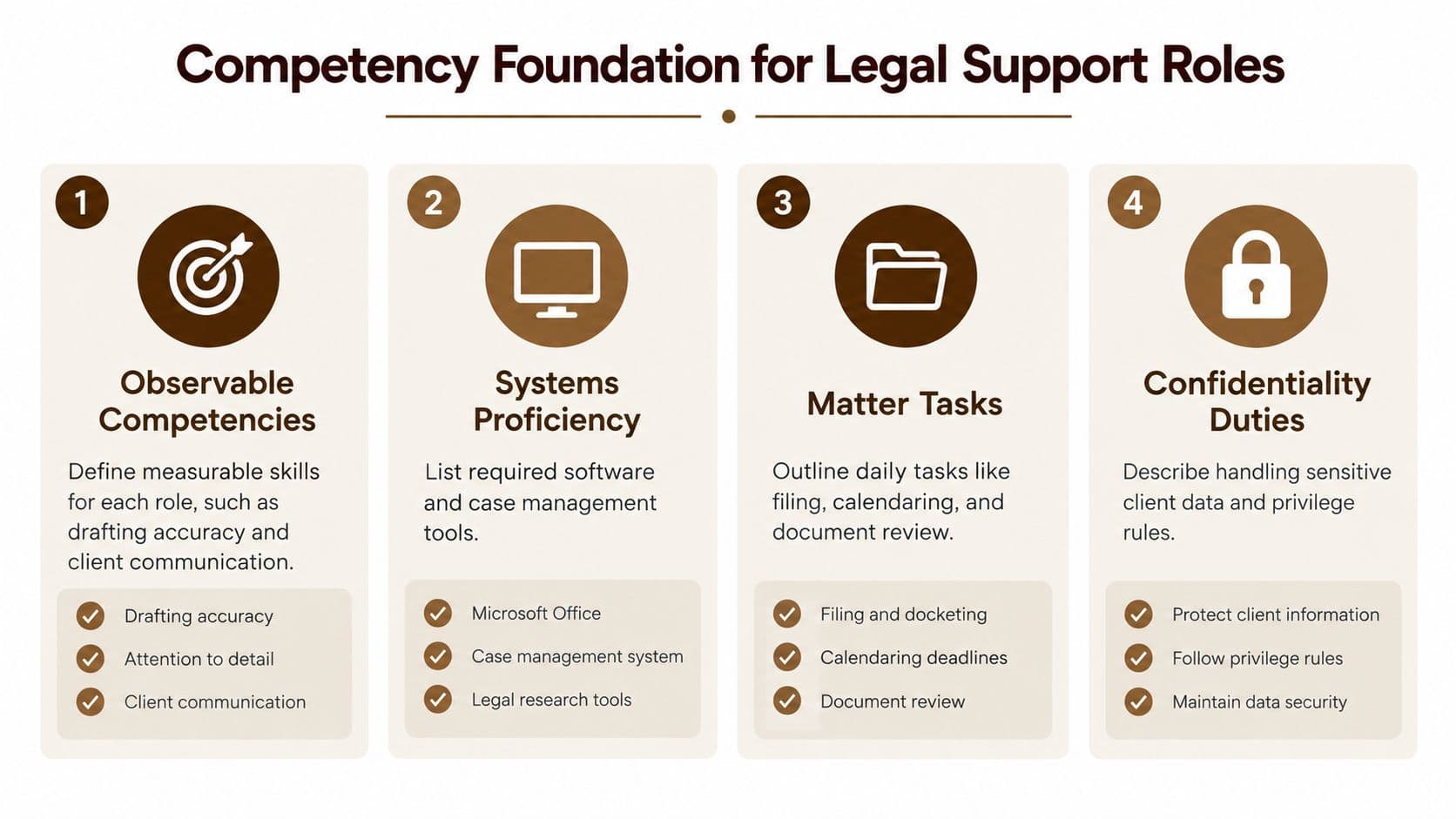
Add the local details that generic courses miss. Name your systems, matter types, approval points, and escalation contacts. Document who can authorize access, who reviews outgoing filings, and which tasks never leave the office without attorney approval. Firms that have already defined their support staff standards for consistent performance can turn those expectations directly into training objectives.
The checklist below organizes that foundation into four areas you should document before assigning modules.
Diagnose Before You Assign
Run a diagnostic assessment during the first week. Use short, realistic exercises and review representative work samples where available. Ask a legal assistant to calendar from a sample order. Ask an intake specialist to document a mock call. Ask a paralegal to organize a small set of docket materials and explain what she would verify next.
Then assign only what closes the gap. Evidence described in a legal technology assessment case study found diagnostic testing let some learners test out of unnecessary modules, reduced total training time to approximately one-third, and increased average assessment scores by more than 40%. Even if your results differ, the principle holds. Targeted instruction respects the employee's time and your production schedule.
Your onboarding checklist should cover systems access, naming conventions, communication norms, quality standards, confidentiality duties, and first assignments in sequence. Don't grant broad access before the employee understands handling rules. Don't assign live deadlines before she has completed a controlled calendaring exercise. Sequence matters because early shortcuts become habits.
Record the baseline result, assigned modules, coach, and review date in one place. That document becomes the employee's development plan, not a loose collection of training certificates. Managers can see what's proven, what's pending, and what still requires supervision at a glance.
Deliver Practice Through Milestones and Coaching
Lectures create familiarity. Practice creates competence. Structure onboarding as a progression from guided work to independent ownership, and make the employee earn reduced supervision by producing reliable work at each stage.
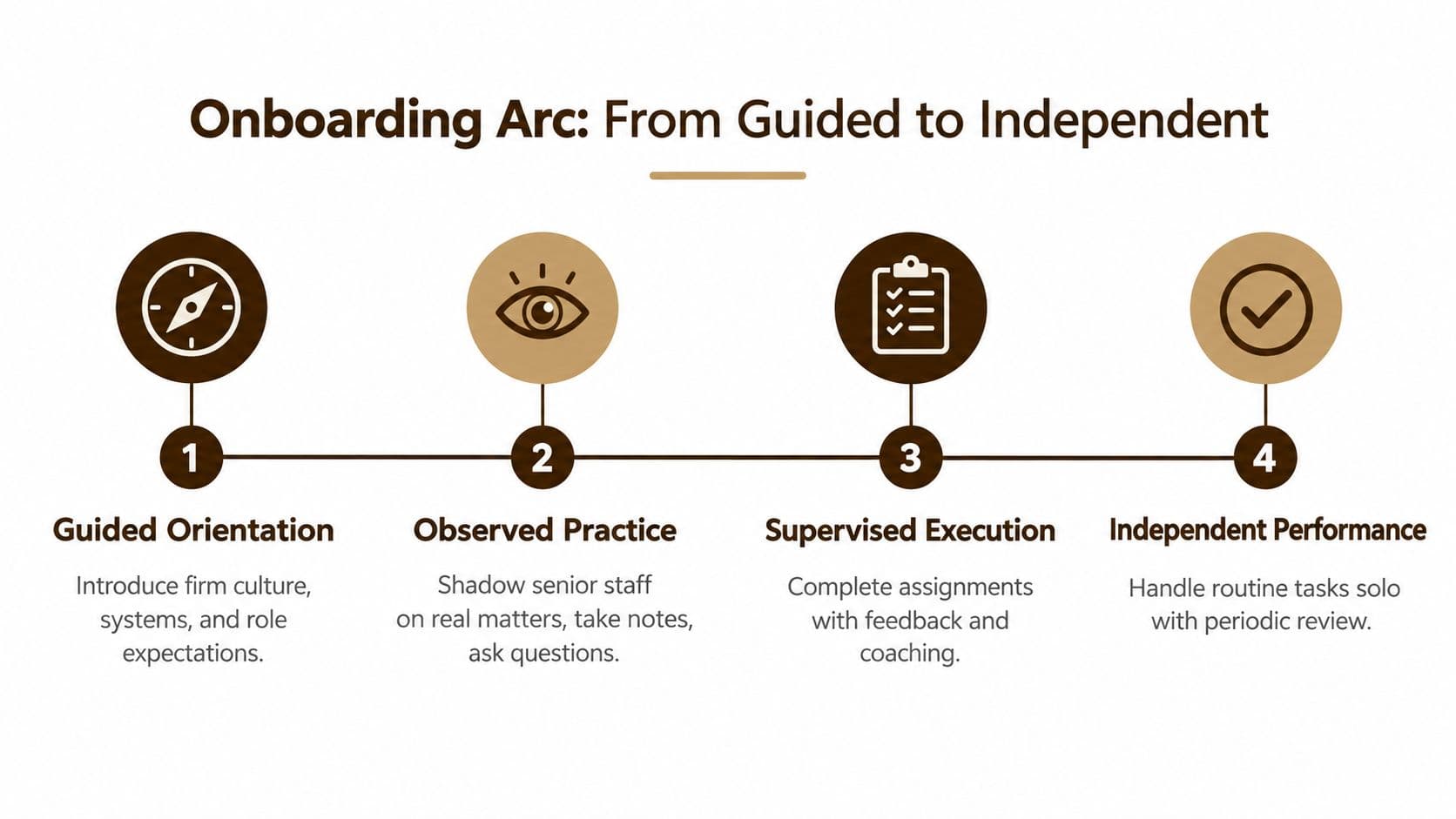
The timeline below shows the four-stage arc organizations can adapt without building a learning department.
Stage the Work Deliberately
Guided orientation comes first. The employee learns matter flow, file structure, communication channels, and who owns each decision. Keep it short and tied to examples from closed or sanitized matters. Nobody retains a policy manual read in isolation.
Next comes observed practice. The employee watches a senior staff member complete real work, takes notes against a checklist, and explains the reasoning back to the coach. That teach-back step is not optional. It exposes misunderstandings before they reach a client file.
Supervised execution is where most learning happens. A litigation support specialist prepares a controlled filing packet. An intake assistant triages sample requests with missing facts and one urgent deadline. A paralegal organizes docket materials, builds a chronology, and flags items requiring attorney review. The coach checks the work, corrects the process, and records whether the error was knowledge, judgment, or attention.
Independent performance begins only for tasks the employee has already demonstrated. She may own routine correspondence while filings remain supervised. She may maintain files independently while privilege decisions still require review. Independence by task is safer and faster than independence by start date.
Don't reduce supervision because two weeks passed. Reduce it because the work product earned that decision.
Protect Practice Time or It Will Disappear
Time pressure will kill your plan unless you schedule around it. A survey summarized in a legal learning report covering 142 respondents from 137 firms and in-house teams found 74% cited time constraints as the leading learning challenge and 26% reported no weekly time for training. Respondents favored firm-specific content at 96%, with webinars at 69%, e-learning at 65%, and on-the-job training at 51%. Blend those formats, but protect the practice blocks.
Use short digital modules for concepts, scheduled exercises for skill building, and weekly manager feedback for correction. Put training windows on the calendar and defend them from routine administrative overflow. A supervisor who cancels coaching three weeks in a row is choosing future rework over present instruction.
The video below is a useful reference point for structuring guided practice and feedback conversations with new staff.
For each milestone, write down who performs the work, who checks it, what evidence you retain, and what result allows supervision to step down. Keep the evidence simple. A reviewed exercise, a completed checklist, and a coach's sign-off are enough. You're building a quality record, not creating another administrative burden.
Verify Competence With Practical Assessments
Attendance is not evidence. Satisfaction scores are not evidence. A multiple-choice quiz can confirm recall, but it can't prove an employee will calendar correctly under pressure or stop before sending restricted material to the wrong recipient.
Compare What Each Method Actually Proves
Use several measures because they answer different questions:
- Pre-training diagnostic: Shows the starting gap and prevents unnecessary modules.
- Immediate knowledge check: Confirms the employee understood the rule or procedure just taught.
- Observed skill demonstration: Proves she can perform the task while explaining decisions.
- Work-product review: Shows whether output meets your format, accuracy, and completeness standards.
- Delayed retention check: Reveals whether the skill survived after the training week ended.
- Job-behavior measures: Track accuracy, turnaround time, escalation frequency, and independent completion on live work.
That layered approach keeps assessment practical. You're not testing for entertainment. You're deciding when supervision can change and where coaching should go next.
Set Pass Standards Before Training Starts
Vague standards produce inconsistent sign-offs. One supervisor approves an employee because she seems confident. Another holds the same employee back because the work feels uneven. Write the threshold down.
For example, require 95% accuracy on a controlled filing or records exercise, zero confidentiality breaches, appropriate escalation on uncertain items, and supervisor sign-off before unsupervised work. Use those standards as management benchmarks, then adjust the exercise to your practice. A calendaring test should include a holiday, a service trigger, and a conflicting deadline. A document-naming test should include drafts, executed copies, and restricted material. An intake test should include a caller who asks for legal advice.
Track baseline and post-training results by task, not just by person. An employee may pass document management quickly and need more practice with research support. Another may write clean correspondence but escalate too late. Task-level records let you assign refreshers precisely instead of sending everyone back through the full course.
This is also where hiring and training meet. A structured candidate testing service for legal support roles can establish baseline skills before start date, and Five Star Placements is one option firms use for screening aligned to the role. Whether you test internally or externally, keep the principle. Verify demonstrated skill, document the result, and train the gap you found.
Don't turn every check into a high-pressure exam. Short exercises, reviewed work samples, and coach observations give you better information with less disruption. The goal is a defensible record that this person can do this task, in this system, to this standard.
Add AI Controls Without Generic Tool Training
Your staff doesn't need another tour of AI buttons. They need rules for what may enter a tool, what must be checked, and when to stop and escalate. Software familiarity without those boundaries creates confident misuse.
The adoption gap is already visible. A Thomson Reuters report on generative AI adoption in professional services reported legal sector generative AI use rose from 14% in 2024 to 26% in 2025, while 48% of law-firm respondents lacked formal AI policies. It also found only 31% of surveyed professional-services respondents had training available, despite 64% receiving no specific GenAI training. Tools are spreading faster than governance.
Teach Permitted Work, Not Just Features
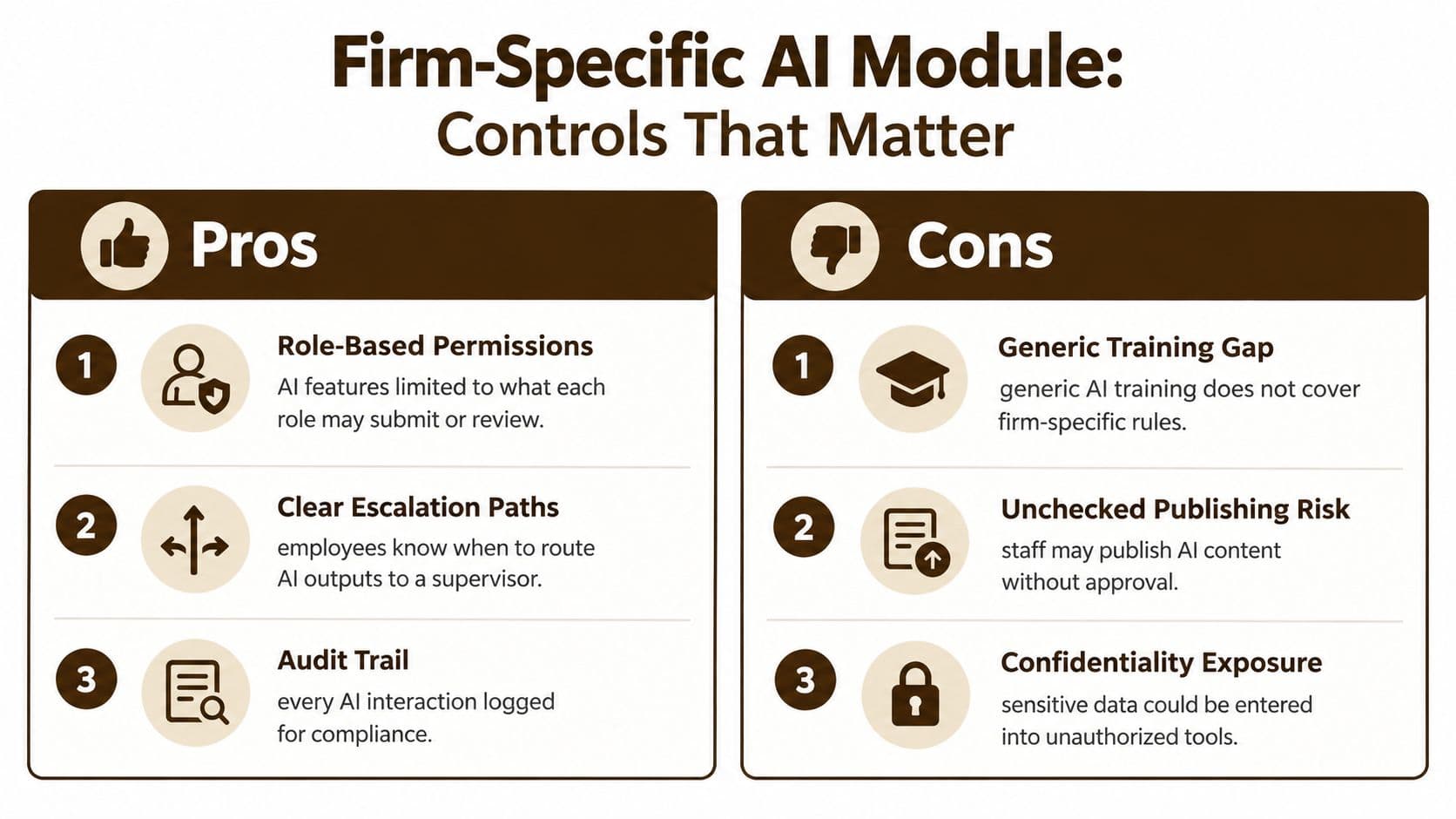
Build a firm-specific module around role-based workflows. Define approved tasks, prohibited tasks, sensitive-information boundaries, human review, prompt and output validation, source checking, and incident escalation. A paralegal organizing research, an intake specialist summarizing notes, and a legal assistant drafting routine language face different exposure. Train each workflow separately.
Use realistic scenarios. Can the employee paste intake notes into an approved tool if names are removed. Who verifies citations in AI-assisted research. What happens if output invents a date or exposes confidential facts. What gets logged, saved, or deleted. If your training doesn't answer those questions, employees will improvise.
The comparison below separates useful firm-specific controls from the risks generic instruction leaves behind.
Small Firms Need a Minimum Viable Version
Resource gaps are real. A Law360 Pulse survey on generative AI training by firm size of nearly 400 U.S. private-practice attorneys found roughly two-thirds of BigLaw attorneys had received firm GenAI training, compared with 40% at midsize firms and under 15% at small-law practitioners. Small firms don't solve that by buying cheaper generic courses. They solve it with a short, enforceable curriculum.
Start with five controls. Use only approved tools. Never enter confidential or privileged material unless the workflow expressly permits it. Require human review before anything reaches a client, court, or file. Verify names, dates, citations, and quoted language against source documents. Escalate suspected exposure immediately.
Screen candidates the same way. Ask, tell me about a time technology produced work you didn't trust, and what did you check before using it. Strong answers mention source verification, confidentiality limits, and supervisor escalation. Weak answers list applications. You're hiring judgment inside your controls, not enthusiasm for automation.
Create a Repeatable 90-Day Training Operating Rhythm
Training fails when it depends on memory and good intentions. Put it on an operating rhythm that survives busy weeks, staff changes, and software updates. The system can be simple. It cannot be informal.
Run the First 90 Days Like a Control System
Give every new hire an individual development plan that lists competencies, baseline results, assigned practice, coach, and target sign-off dates. Protect learning time each week. Keep assignment, completion, and assessment records together so a new supervisor can see the employee's status without reconstructing history from email.
Hold a brief weekly coaching conversation. Review one strong work product, one correction, and the next task the employee will attempt with less supervision. Short feedback loops beat a long performance discussion after errors have hardened into habits.
At 30 to 90 days, compare baseline and current performance on the measures that matter for the role:
- Accuracy: Are calendars, files, drafts, and logs meeting the written standard.
- Turnaround time: Is work moving without repeated reminders or bottlenecks.
- Escalation frequency: Is the employee escalating earlier and for the right reasons, not avoiding decisions or guessing.
- Independent completion: Which core tasks can she now own without routine review.
Use the review to assign targeted refreshers or expand responsibility task by task. Don't promote someone to full independence because the calendar reached day 90. Expand authority where evidence supports it and keep coaching where it doesn't.
Let Audits Change the Curriculum
Run quarterly file audits and review a small sample against your standards for naming, calendaring, privilege handling, and completeness. When the same error appears across employees, fix the training, checklist, or workflow. Repeating the same lecture louder is not a control.
After an incident, conduct a root-cause review. Decide whether the cause was unclear instruction, missing practice, weak supervision, system access, or individual judgment. Then change the relevant exercise or standard. Document who owns refresher training after software changes, too. If nobody owns it, employees will learn new workflows by trial and error on live matters.
Manager's test: If your best trainer left tomorrow, could another supervisor run the next hire's first 90 days from your documents alone?
Hiring leaders should demand evidence of practice readiness, not just credentials. Managers should protect coaching time and sign off by task. Legal support professionals should ask what competence looks like and how it will be verified. When those expectations are explicit, training stops being a playlist and becomes a dependable path to independent, high-quality work.
If you're hiring paralegals, legal assistants, or other support staff and need candidates screened for demonstrated skills, role fit, and readiness for your practice environment, Five Star Placements can help you build a stronger shortlist. Visit us to discuss permanent legal support placement and training-aligned screening for your next hire.
Need help filling a legal role?
Five Star Placements partners with law firms and legal departments nationwide.
Schedule a Call