
What Does a Finance Director Do: A Complete 2026 Guide
October 19, 2026 · 13 min read · Five Star Placements

Table of contents
A finance director owns an organization's financial leadership by connecting accurate reporting, budgeting, controls, and forward-looking analysis to executive decisions. The role combines financial stewardship with practical advice, so leaders can judge what the numbers mean for the business and what to do next.
For a managing partner, the need often becomes clear before a Monday partner meeting: collections are uncertain, compensation needs to be modeled, and someone is considering an office expansion. The director is expected to bring the facts together, show the trade-offs, and help leadership make decisions without losing sight of cash, compliance, or profitability.
Table of Contents
- What a Finance Director Actually Owns
- How the Role Evolved Into Strategic Leadership
- The Operating Rhythm of a Finance Director
- Controls, Compliance, and Risk Ownership
- KPIs and Metrics a Finance Director Owns
- How the Role Changes by Organization and Industry
- Skills, Qualifications, and Career Path
- Hiring and Onboarding a Finance Director for a Legal Organization
What a Finance Director Actually Owns
The finance director's job isn't to close the books or prepare reports. The director owns both the reliability of financial information and the analysis that turns it into decisions. That means leadership should be able to trust the numbers, understand what's driving them, and use them to choose a course of action.
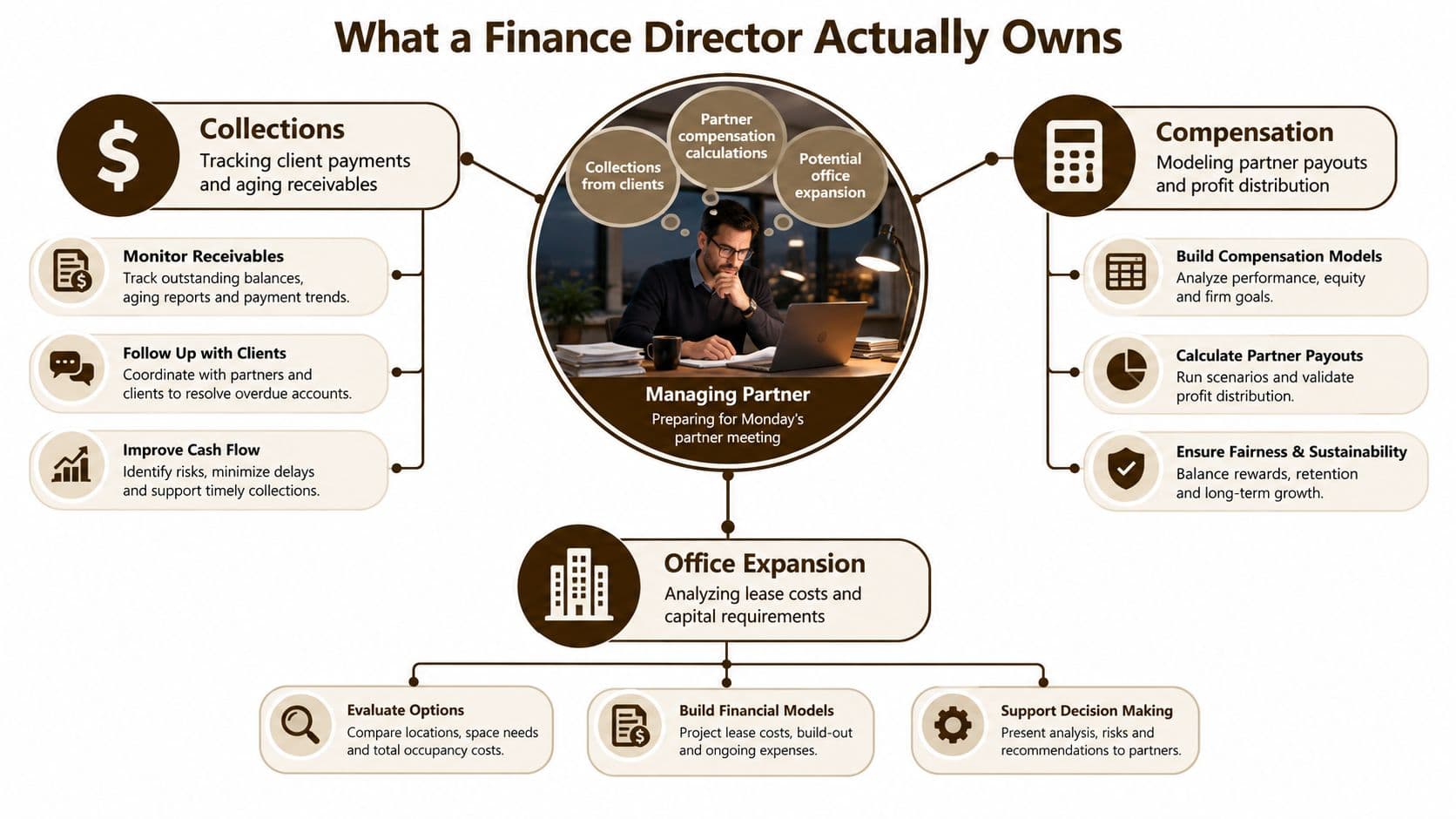
At the partner meeting, each concern calls for a different kind of financial judgment. For collections, the director explains what's been billed, what's been collected, which receivables are aging, and how delayed payments affect available cash. For compensation, the director models how revenue, expenses, and distributions interact, making assumptions clear rather than presenting a payout figure without context. For an office expansion, the director lays out the expected costs and financial commitments, then tests whether the plan fits the organization's resources.
These duties reflect the broader finance-manager function described by the U.S. Bureau of Labor Statistics: planning and coordinating financial activities, preparing reports and forecasts, monitoring compliance, supervising finance staff, and advising management. In a legal organization, those responsibilities can include monitoring matter profitability, forecasting collections and operating costs, managing payroll and vendor payments, and giving partners or general counsel useful financial information.
Practical rule: A finance director should be able to explain what changed, why it matters, and what leadership can do about it.
The role isn't just a renamed controller, nor is it a junior CFO by default. In some organizations, the director may oversee accounting and billing directly. In others, the focus is financial planning and analysis, business partnership, systems, and team leadership. Either way, the central mandate stays the same: protect the integrity of the numbers while helping leaders act on them.
How the Role Evolved Into Strategic Leadership
The traditional accounting function looks backward. It records transactions, reconciles accounts, and reports what has already happened. Those tasks remain essential, but a finance director is also expected to use that history to help leaders plan what comes next.
Organizations have grown more complex, regulated, and connected to capital markets. That shift has changed what leaders need from finance. A legal department or law firm can't make sound decisions about staffing, pricing, technology, or expansion by looking only at last month's expenses. It needs forecasts that connect operational choices to cash, risk, and future financial performance.

From recording results to testing choices
Consider technology investment. A legacy finance role might process invoices for a new billing platform. A strategic finance director helps leadership compare the cost with the operational need, determine whether the spending is affordable, and understand its effect on the budget. The same shift applies to matter profitability: recording fees earned is useful, but leaders also need to know how staffing, realization, and collection performance affect the financial result.
The Bureau of Labor Statistics' financial manager outlook describes work that includes preparing forecasts, directing investment activities, ensuring legal compliance, reducing costs, and helping management make financial decisions. Those responsibilities capture the broader expectations placed on finance leaders. The director must be technically credible, but also able to explain financial implications to executives who don't work in finance.
That's why modern finance leadership increasingly connects operational data with planning. Gartner reports that more than 70% of CFOs have responsibilities extending beyond finance into data and analytics, AI, and corporate strategy, while planning, budgeting, forecasting, analytics, and reporting remain key priorities for finance teams (Gartner's finance technology survey). The figure describes CFO responsibilities, not a rule that every finance director must own those functions. It does help explain why employers increasingly want directors who can interpret data and support strategy, rather than only supervise accounting.
For a broader view of executive finance responsibilities, see this overview of CFO duties and responsibilities. The useful distinction for a hiring partner is that a director turns financial information into workable choices within the organization's operating model.
The Operating Rhythm of a Finance Director
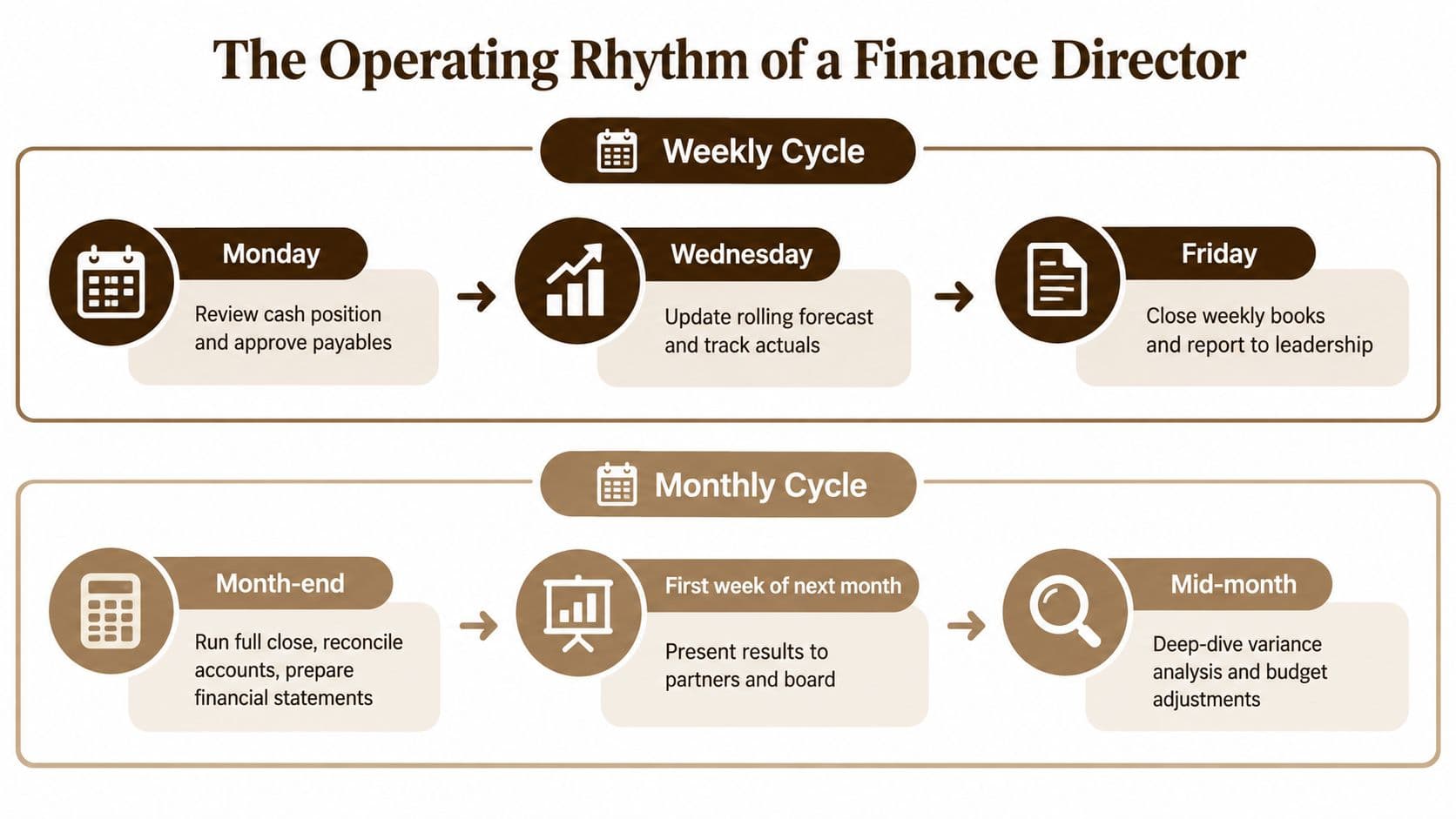
A finance director's value is visible in the operating rhythm: the repeated work that keeps leaders informed and gives them time to respond when conditions change. It starts with dependable reporting, but it doesn't end when the statements are prepared.
Close, explain, and communicate
After a reporting period ends, the director oversees the close process: accounts are reconciled, transactions are reviewed, and financial statements and management reports are prepared. In a legal organization, this might mean checking that fee revenue, payroll, partner distributions, and vendor costs are represented correctly. A clean close gives leaders a dependable starting point.
Next, the director compares actual results with the budget or forecast. The important question isn't only whether a category is above or below plan. It's why. If collections lag, for example, leadership needs to know whether the issue relates to billing timing, client payment patterns, or another operational factor, and what that means for cash planning.
The director then presents results in terms that partners, executives, or department heads can use. A report should distinguish a temporary timing difference from a persistent change in performance, and it should identify decisions that may need attention.
The strongest financial update explains the operational driver behind the number, not just the number itself.
Refresh the forecast and model scenarios
Forecasting translates business assumptions into a view of future financial performance. For a law firm, a driver-based forecast can link fee revenue to lawyer headcount, utilization, billing rates, and collection performance. That gives leadership a clearer basis for adjusting assumptions than applying a flat percentage increase to last year's revenue.
The finance director should document those assumptions, update scenarios as circumstances change, and connect expected revenue to staffing costs, working capital, and operational capacity. If leadership is weighing a new hire or office expansion, the director can model the decision's financial implications and explain the trade-offs.
The cadence also includes ad hoc decision support. A partner may need an updated view of matter profitability, while a general counsel may need to assess vendor spending against a department budget. Good forecasting isn't about pretending the future is certain. It's about making assumptions visible, helping leaders compare possibilities, and responding quickly when new information arrives.
Controls, Compliance, and Risk Ownership
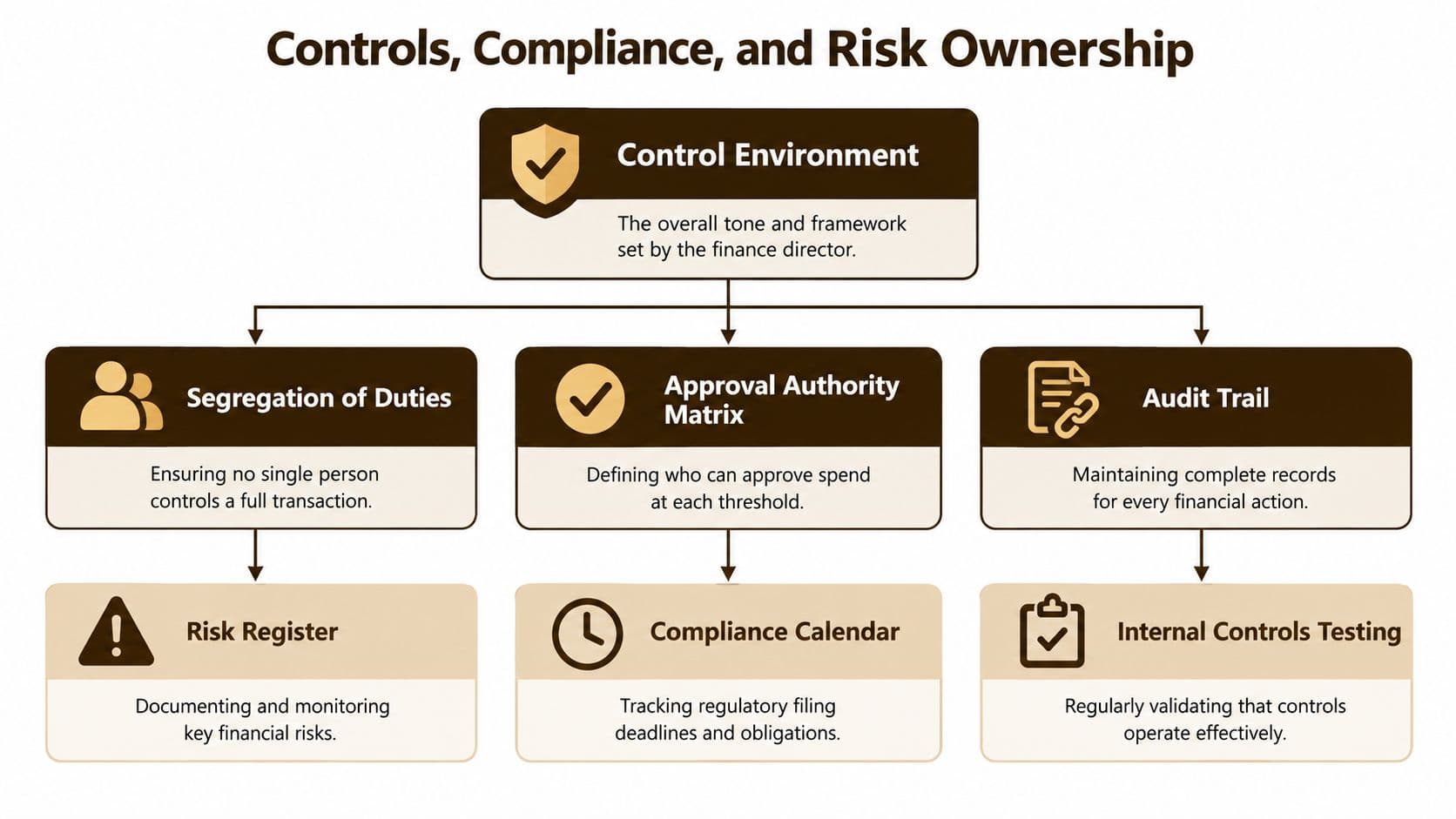
A finance director doesn't just report financial activity. The director helps design and supervise the system that protects its accuracy, completeness, and legality. That control environment makes it harder for errors or unauthorized activity to pass unnoticed.
COSO's Internal Control framework groups effective control into five components: control environment, risk assessment, control activities, information and communication, and monitoring (COSO's internal control guidance). In everyday terms, leaders set expectations, identify risks, put procedures in place, communicate what people need to know, and check whether controls work.
Turn principles into daily procedures
The framework becomes useful when the director builds it into routine workflows. Segregation of duties means separating key steps, such as initiating a transaction, approving it, making payment, and reconciling the account. Access reviews help confirm that people have appropriate permissions in accounting and billing systems. Documented close procedures, account reconciliations, approval thresholds, and exception reports give staff clear ways to handle and flag financial activity.
The goal is to reduce the chance and potential impact of a misstatement, not only to discover a problem after it occurs. A director might require independent review of journal entries, reconciliation of client funds, validation of revenue cut-off, checks on payroll changes, and investigation of aged receivables. The appropriate procedures depend on the organization's structure and risks.
Pay particular attention to legal finance
Legal organizations have financial risks that call for careful oversight. Client funds require reliable accounting and reconciliation. Contingency-fee revenue can require attention to when and how revenue is recognized. Partner distributions, conflicts-related billing restrictions, and confidential financial access also need clear processes and appropriate review.
The director should identify significant accounts and key risks, determine whether controls are designed to address them, and test whether staff follow the procedures. This work calls for more than accounting knowledge. It requires judgment about where errors or unauthorized actions could occur, and the discipline to build safeguards into the process before a problem emerges.
KPIs and Metrics a Finance Director Owns
A finance director's dashboard should help leadership see what's driving performance and where a decision may be needed. Basic business measures include revenue growth, margin, cash conversion, and working capital. They provide context, but legal organizations also need measures that connect financial results to how lawyers work and how clients pay.
For a law firm, utilization shows how available lawyer time is being used. Realization helps explain how much of the value recorded for work becomes billable revenue. Collections track whether billed amounts turn into cash. Matter and practice-group profitability help leadership assess the financial result of the work, while cost-per-lawyer and compensation coverage bring staffing and partner economics into view.
| Category | Metric | What It Tells Leadership |
|---|---|---|
| Revenue | Fee revenue by practice group | Where revenue is generated and how it's distributed across the firm |
| Lawyer capacity | Utilization | How effectively available lawyer time is being used |
| Billing | Realization | How much recorded work converts into billable revenue |
| Cash | Collections and aging receivables | Whether billed revenue is arriving as cash and where delays are building |
| Profitability | Matter and practice-group profitability | Which work or groups contribute to financial performance |
| Compensation | Partner-compensation coverage | How compensation relates to the resources available for distribution |
| Cost management | Cost-per-lawyer | How operating costs compare with lawyer staffing |
The point isn't to collect as many measures as possible. It's to select a manageable set that answers leadership's questions and makes operational drivers visible. For instance, if collections weaken, the dashboard should help the team see whether the change is tied to particular receivables, billing patterns, or client-payment timing. If a practice group's profitability shifts, leaders can examine staffing, realization, and costs before deciding whether pricing or resourcing needs attention.
Interview test: Ask a candidate to explain how they'd turn a change in collections or utilization into a decision for partners. Strong answers connect the metric to an operational cause and a practical response.
The same principle applies to partner economics. A finance director should be able to explain how the firm measures its financial capacity to support compensation, without presenting a headline metric as a complete account of performance. For context on one partner-level measure, see this explanation of profit per equity partner. A useful dashboard is forward-looking in its use: it helps leadership challenge assumptions about pricing, staffing, and growth rather than describing last month.
How the Role Changes by Organization and Industry
The title finance director doesn't guarantee a consistent job. A hiring partner needs to understand the scope, reporting line, team structure, and decisions the person will own. The same title can describe a hands-on finance lead in one firm and a strategic planning leader in another.
| Organization | Typical emphasis | What leadership needs |
|---|---|---|
| Small law firm | Accounting, billing, payroll, and cash oversight | A practical operator who can manage core finance work and explain the firm's financial position |
| Mid-size or large law firm | Forecasting, business partnering, team leadership, and performance analysis | A leader who can support partners with financial insight across practices and operations |
| Corporate legal department | Budgeting, vendor management, and financial partnership with the general counsel | A finance leader who connects legal spend to department priorities and company processes |
| Adjacent industries | Financial planning and controls adapted to the operating model | A candidate who can transfer sound finance discipline while learning industry-specific drivers |
A smaller law firm may need a director who is comfortable overseeing day-to-day accounting and billing as well as planning. In a larger firm, the director may lead a team and spend more time on forecasting, matter and practice-group performance, and communication with partners. For a corporate legal department, the emphasis may shift to working with the general counsel on budget priorities, outside-counsel costs, and vendor management.
Consulting, accounting, and healthcare organizations may have different revenue models and controls, but the underlying discipline is similar: maintain reliable information, plan resources, monitor risk, and advise leaders. A candidate from another industry can bring relevant experience, but the employer should examine how quickly they can learn legal-specific economics and obligations.
An administrator's scope can overlap with finance leadership, particularly in a smaller firm. Comparing the position against a firm administrator job description can help clarify where the new role should own finance directly and where responsibilities sit with operations. Hire for the work, not the title: define which decisions the director will support, what team they'll lead, and how closely they'll work with partners or the general counsel.
Skills, Qualifications, and Career Path
A credible finance director combines technical command with the ability to influence decisions. The technical foundation includes accounting, budgeting, forecasting, financial analysis, reporting, and controls. In a legal organization, familiarity with trust accounting rules and the financial drivers of legal work can also matter, depending on the role's scope.
Credentials such as a CPA, CMA, or MBA can support a candidate's profile, but they don't prove the person can lead. Employers should ask how candidates have handled financial planning, explained an unexpected result, improved a reporting process, or presented a recommendation to nonfinance leaders. For candidates, the development step is to move beyond producing accurate information and show how they use it to guide action.
Most paths build through roles in accounting or finance, such as senior accountant, financial analyst, controller, or finance manager. The transition into a director role usually calls for wider ownership: leading people, setting reporting expectations, connecting operational activity with financial outcomes, and advising executives. A controller may be an excellent candidate if they've also demonstrated those leadership and decision-support skills.
Finance director and CFO are not interchangeable
The titles often overlap, especially in smaller organizations, but the scope can differ. A finance director may lead financial operations, planning, reporting, and analysis while working with a CFO or senior executive. A CFO typically carries broader executive responsibility for the organization's financial direction and leadership relationships. The actual division depends on the organization, so employers should define the reporting line, decision authority, and expectations before hiring.
The right candidate doesn't need to know every answer on day one. They do need sound judgment, clear communication, and the confidence to ask operational leaders for the context behind a number. Those behaviors distinguish a decision-support executive from a technically strong accountant who's had little opportunity to shape business choices.
Hiring and Onboarding a Finance Director for a Legal Organization
Before hiring, define the problems the director must solve and the authority the role will have. Screen for:
- Comparable organizational experience: Has the candidate worked in an environment with a similar structure, complexity, and leadership team?
- Legal finance fluency: Can they discuss matter profitability, realization, collections, partner compensation, and trust accounting where relevant?
- Executive communication: Can they explain financial trade-offs clearly to partners, executives, or general counsel?
- Finance-function development: Have they built or improved reporting, forecasting, controls, or team processes, not only maintained them?
The search model also shapes the process. Under a contingency-based placement model, the recruiting fee is payable upon a successful hire, rather than upfront. Employers should still set clear role criteria and decision steps so that the search evaluates candidates against the organization's actual needs.
After the hire, give the director a structured start:
- First, review existing reports, budgets, cash procedures, systems, and close processes.
- Next, meet with partners or executives, finance staff, and operational leaders to understand what decisions they need to make.
- Then, agree on priorities, reporting expectations, and a practical plan for addressing gaps.
A thoughtful onboarding process helps the director build trust in the numbers and relationships with the people who use them.
Five Star Placements provides permanent placement for legal leadership and operations roles, including finance leaders, for law firms and corporate legal departments. If you're defining a finance director search or considering your next legal-sector leadership move, visit Five Star Placements to discuss the role and the experience it requires.
Need help filling a legal role?
Five Star Placements partners with law firms and legal departments nationwide.
Schedule a Call