
What Does a Paralegal Do in a Law Firm: The Complete Guide
October 8, 2026 · 13 min read · Five Star Placements
Table of contents
A paralegal performs substantive legal work under an attorney's direction and responsibility, rather than practicing law independently. In the United States, the role typically requires an associate degree at entry level, and the median annual wage was $62,890 in 2025, according to the U.S. Bureau of Labor Statistics.
An attorney is preparing for a hearing, answering urgent client calls, and trying to keep a filing deadline from slipping. Meanwhile, someone must organize the evidence, verify the chronology, research the governing authorities, prepare the draft documents, and make sure every person involved knows what happens next. In a well-run law firm, that person is often the paralegal.
The American Bar Association's foundational definition, adopted in 1986, described a paralegal or legal assistant as someone qualified through education, training, or work experience who performs delegated substantive legal work that would otherwise generally be performed by an attorney. That definition remains useful because it captures both sides of the job: meaningful legal production and attorney control.
Table of Contents
- What a Paralegal Actually Does in a Law Firm
- The Supervision Boundary and Unauthorized Practice Risks
- Paralegal Duties by Practice Area
- Daily Tasks and the Matter Lifecycle
- Skills, Education, and Hiring Profiles
- How Technology and AI Are Changing Paralegal Work
- Generalist versus Specialized Paralegal Roles
- Hiring the Right Paralegal for Your Law Firm
What a Paralegal Actually Does in a Law Firm
A paralegal does not just answer phones or maintain a calendar. Although administrative coordination may be part of the job, the core contribution is substantive work that helps attorneys deliver matters accurately and on time. Typical responsibilities include investigating facts, researching statutes and case law, organizing files, drafting correspondence and legal documents, obtaining affidavits, summarizing testimony, coordinating discovery, and preparing materials for hearings or trials. These duties are reflected in the American Bar Association's foundational discussion of the paralegal role.

The work behind attorney capacity
A litigation paralegal might build a document index, coordinate witness interviews, prepare deposition materials, and track discovery obligations. A transactional paralegal might manage due diligence requests, organize corporate records, prepare closing documents, and monitor signature and filing requirements. In both cases, the paralegal turns a large volume of information into a usable matter workflow.
That work increases attorney capacity, but it doesn't transfer legal responsibility. The attorney remains accountable for legal advice, strategy, client representation, and final decisions. A paralegal can prepare a research memorandum or draft a pleading, but counsel must review the work and decide how it should be used.
Practical rule: A paralegal should own the process they've been delegated, but the attorney must own the legal judgment.
This distinction affects profitability as well as compliance. When a trained paralegal manages repeatable substantive work, attorneys have more time for strategy, negotiation, advocacy, and client counseling. When the role is vague, attorneys either redo work unnecessarily or allow important decisions to move forward without the review the matter requires.
The Supervision Boundary and Unauthorized Practice Risks
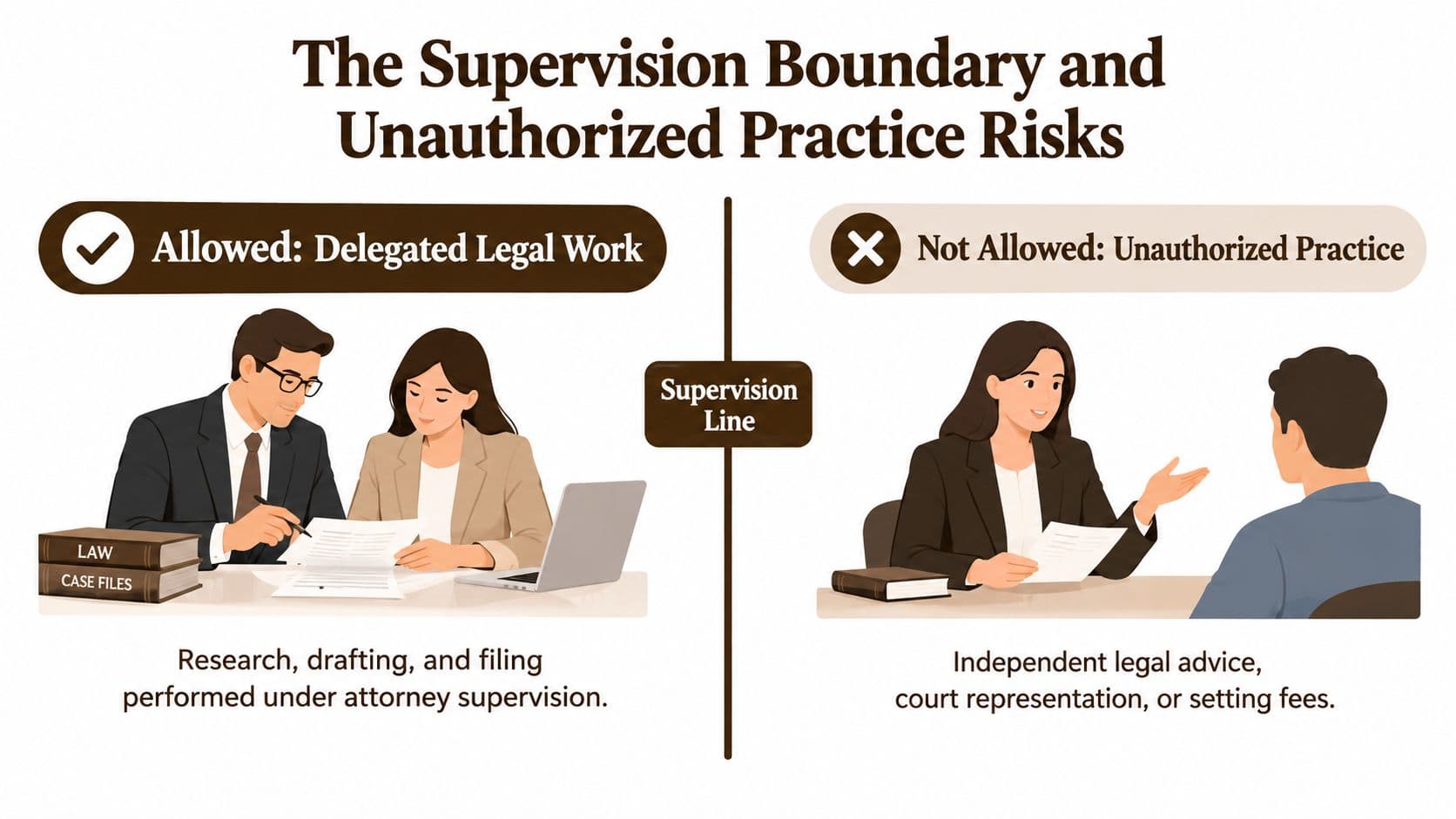
The most important answer to “what does a paralegal do in a law firm” is also the one many job descriptions explain poorly. A paralegal may perform substantive legal work, but only within a properly delegated assignment and under attorney supervision. The attorney maintains the direct client relationship and assumes professional responsibility for the work product under NALA's model standards and professional responsibility guidance.
What a paralegal may do
A paralegal may prepare a research memorandum, draft a contract or pleading for attorney review, organize discovery, contact a witness, obtain factual information from a client under direction, and communicate procedural information within defined limits. The paralegal can also manage the workflow around those assignments, including collecting missing documents, maintaining the file, and flagging an approaching deadline.
The restriction applies to independent legal judgment, not to every task involving legal information. A paralegal may identify an issue for the attorney, but shouldn't decide the legal position the firm will take. They may prepare a draft, but shouldn't send an unreviewed legal opinion to a client or opposing party.
What remains with the attorney
A paralegal may not independently establish an attorney-client relationship, set fees, provide legal advice, give legal opinions, represent a client in court unless authorized, or engage in unauthorized practice of law. Exact requirements can vary by jurisdiction, court rule, practice area, and firm policy, so a generic title isn't a substitute for a defined supervision structure.
For hiring managers, vague language creates avoidable risk. Phrases such as “analyze cases independently,” “advise clients,” or “draft filings without supervision” blur who controls legal conclusions and who reviews the final product.
A stronger job description should identify:
- Delegated workflow: Tasks the paralegal can manage without constant direction.
- Review checkpoints: Documents, communications, and decisions requiring attorney approval.
- Escalation rules: Events that require immediate attorney involvement, such as a new legal issue, settlement discussion, privilege concern, or deadline conflict.
- Communication limits: Factual and procedural information the paralegal may share, alongside subjects reserved for counsel.
- Confidentiality duties: Rules for handling client information, files, and approved technology.
Firms don't reduce risk by treating paralegals as either unrestricted legal professionals or purely administrative staff. They reduce risk by defining the supervision line clearly and applying it consistently.
Paralegal Duties by Practice Area
The title “paralegal” describes a function, not a single daily routine. Practice area determines the documents a paralegal handles, the deadlines they monitor, the people they coordinate with, and the consequences of a missed detail.
| Practice area | Typical work | What success requires |
|---|---|---|
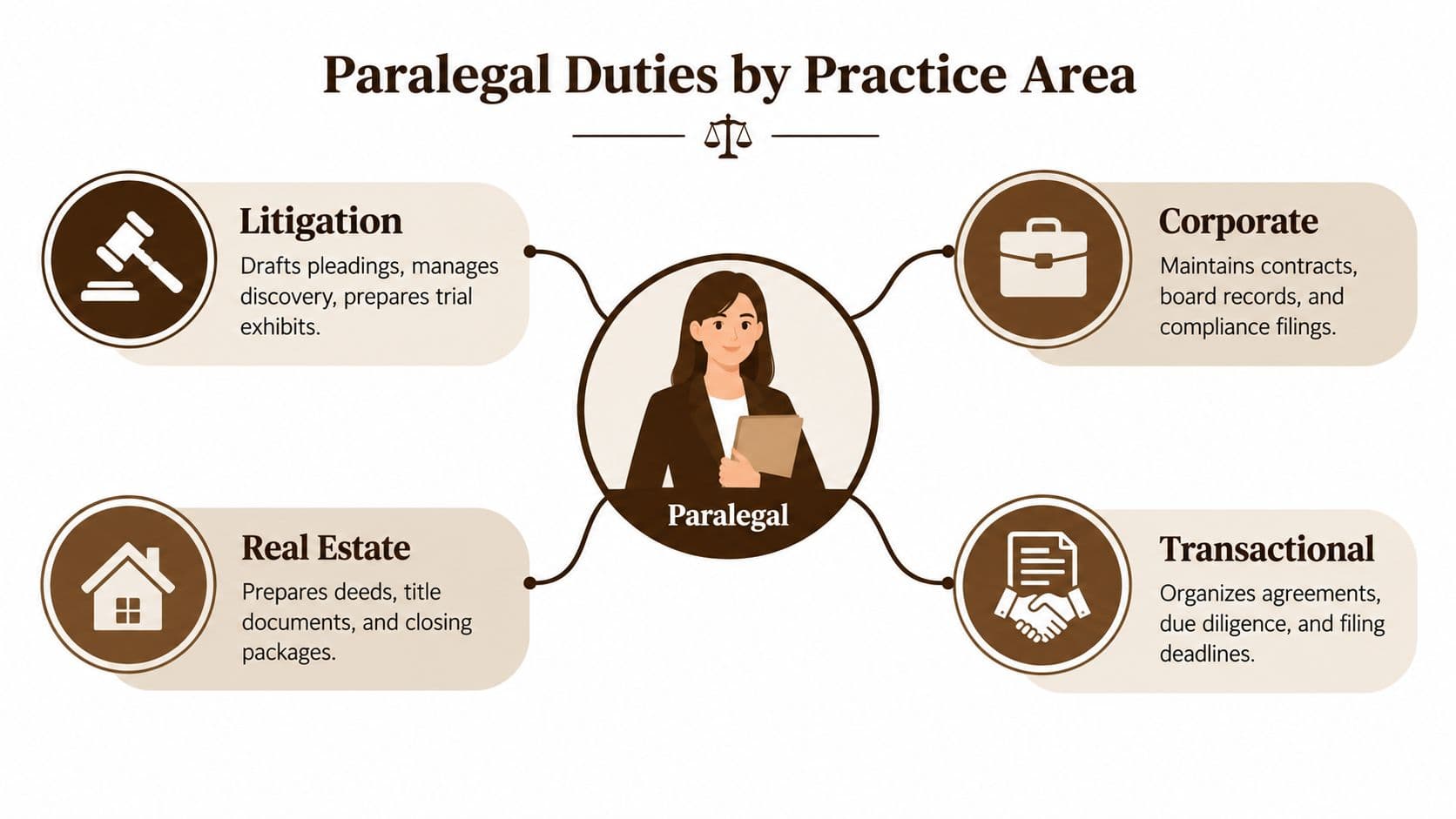
| Litigation | Discovery coordination, pleadings, deposition summaries, evidence organization, and trial exhibits | Deadline discipline, document control, and strong factual organization |
| Corporate | Contracts, board records, corporate filings, and compliance materials | Precision, version control, and familiarity with entity records |
| Real estate | Title documents, deeds, closing packages, and transaction coordination | Careful checklist management and reliable communication |
| Transactional | Due diligence, agreements, signature packets, and filing deadlines | Commercial awareness, follow-up, and orderly document workflows |
Litigation work is deadline-driven
Litigation paralegals often operate across a moving factual record. They may collect medical or employment records, prepare chronologies, coordinate discovery responses, summarize depositions, organize exhibits, and track court or opposing-counsel deadlines. Their work supports the attorney's ability to evaluate evidence and develop strategy.
A candidate who has only handled stable transactional files may struggle in a litigation environment where priorities change quickly and incomplete information must be escalated without delay. Firms hiring for personal injury matters can review the distinct workflow involved in a personal injury paralegal role.
Corporate and transactional work rewards control
Corporate paralegals maintain entity records, organize contracts, prepare compliance filings, and support board or shareholder documentation. Transactional paralegals manage due diligence, coordinate requests across parties, track signatures, and keep closing materials complete and current.
The overlap is substantial. Every practice area benefits from accurate drafting, structured files, dependable follow-up, and deadline awareness. The difference lies in the matter rhythm and the type of error the paralegal must prevent. Litigation often revolves around evidence and procedural deadlines, while corporate and transactional work depends heavily on version control, approvals, and closing readiness.
A strong hiring process therefore tests the candidate against the actual practice. Ask a litigation candidate how they organize a large production or deposition record. Ask a transactional candidate how they identify missing diligence materials and escalate a closing issue. The title alone won't answer either question.
Daily Tasks and the Matter Lifecycle
A paralegal's day becomes easier to understand when viewed through the matter lifecycle. The tasks may look unrelated on a calendar, but they form a connected production system from intake through resolution.
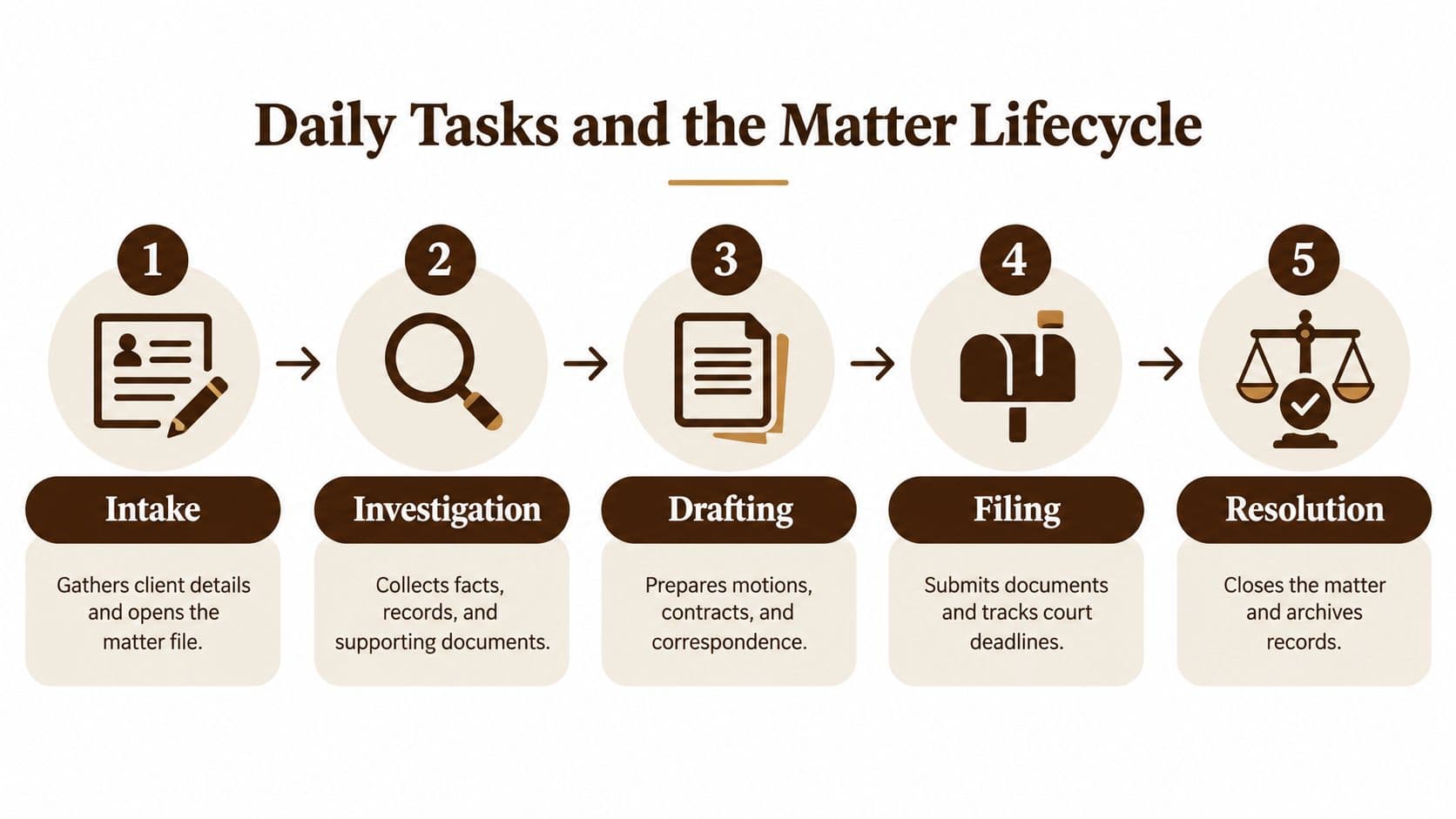
- Intake: The paralegal gathers client details, identifies required information, checks that the matter file is opened correctly, and routes conflicts or legal questions to the attorney.
- Investigation: They collect records, interview sources under direction, organize facts, and build a chronology or issue index that counsel can use.
- Drafting: They prepare correspondence, forms, pleadings, contracts, affidavits, summaries, and other documents for attorney review.
- Filing: They coordinate signatures, submit approved materials, confirm acceptance where appropriate, and track procedural deadlines.
- Resolution: They support settlement, closing, hearing, trial, or final delivery, then organize the file and archive records according to firm policy.
The daily operating habits that matter
Good paralegals don't rely on memory for matter control. They maintain a current task list, record deadlines with enough context to understand the underlying obligation, use consistent file naming, and keep a clear distinction between completed work, pending attorney review, and blocked items.
The strongest workflow also includes escalation. If a record conflicts with the client's account, a deadline appears inconsistent, or a document raises a privilege issue, the paralegal flags it rather than resolving it alone through guesswork.
Technology can support this discipline, but software won't repair unclear ownership. Firms evaluating matter management systems should first define who opens a task, who approves the work, who receives deadline alerts, and who closes the loop with the client or court.
Skills, Education, and Hiring Profiles
A capable paralegal combines legal knowledge with reliable matter control. A resume may show practice-area experience, but hiring outcomes often depend on how the candidate handles incomplete instructions, confidential information, competing deadlines, and work awaiting attorney review.
The Bureau of Labor Statistics identifies an associate degree as the typical entry-level education, but education alone does not establish readiness. Firms should test whether a candidate can apply training to the firm's documents, systems, practice area, and supervision model. A candidate who understands when to ask counsel before acting is safer than one who works quickly across unclear boundaries.
Technical capability
Useful skills include legal research, document drafting, discovery organization, file management, transcript review, calendaring, and electronic filing. Familiarity with Clio, MyCase, NetDocuments, iManage, Relativity, or a court filing portal can shorten onboarding, but platform names should not outweigh process understanding. Systems change. Reliable records, accurate status updates, and careful handoffs remain useful in every practice area.
The role also has a market compensation benchmark. The BLS reported a 2025 median annual wage of $62,890 for paralegals and legal assistants in the United States. Firms should treat that figure as context, not a universal salary promise. Scope, location, specialty, experience, and billing expectations shape an individual offer.
Professional judgment
Strong screening questions reveal behavior rather than memorized terminology:
- Escalation: Ask about a time the candidate found conflicting information and what they did next.
- Confidentiality: Ask how they protect sensitive documents in email, shared drives, and collaboration tools.
- Quality control: Use a short drafting or file-organization exercise and assess how the candidate checks the work.
- Prioritization: Present competing attorney requests and ask how they would clarify urgency, ownership, and required review.
- Supervision: Ask which decisions they would make independently and which they would return to counsel.
Hiring managers should also distinguish transferable ability from narrow platform familiarity. A litigation candidate may be strong at records and deadlines but need training in transactional closing procedures. A corporate candidate may draft accurately yet need support with fast-changing discovery demands.
A practice-ready paralegal asks a precise question early, records the answer, and produces work counsel can review with confidence.
How Technology and AI Are Changing Paralegal Work
Technology is shifting paralegal value rather than removing the need for it. Document management, automated deadline reminders, electronic discovery platforms, templates, and AI-assisted review can reduce manual effort, but they also create new quality-control responsibilities.
Routine organization, first-pass review, summarization, deadline tracking, and portions of legal research may become more automated. The work that grows in importance includes validating outputs, checking sources, handling exceptions, reviewing privilege, designing repeatable processes, and coordinating with clients where context and sensitivity matter.
The new quality-control assignment
AI-generated legal work still requires independent verification, confidentiality controls, monitoring for accuracy and bias, and lawyer supervision under professional-conduct duties, as discussed in professional guidance on paralegal responsibilities and AI. A paralegal shouldn't treat a generated summary as authoritative merely because it is organized or fluent.
A reliable workflow asks:
- Was the tool approved for client information?
- Can the paralegal verify every material source and citation?
- Has someone checked the output for omissions, privilege, and factual distortion?
- Does the attorney review the legal conclusion before it reaches the client or court?
- Is there a record of what the tool produced and how the team validated it?
The valuable technology user isn't the person who produces the fastest first draft. It's the person who knows what must be checked before that draft can be trusted.
Legal operations creates hybrid work
Some firms are also asking paralegals to help build templates, improve intake, standardize naming conventions, map workflows, and measure bottlenecks. Those responsibilities sit close to legal operations, especially when the paralegal understands both matter work and the firm's systems.
Hiring managers should test tool literacy alongside restraint. “Can you use AI?” is too broad to be useful. Better questions address approved tools, verification methods, confidential data, escalation, and the candidate's ability to distinguish automation from legal judgment.
Generalist versus Specialized Paralegal Roles
A generalist paralegal can move between matter types, attorneys, and administrative systems. That flexibility is useful in a smaller firm, a growing practice, or an environment where workload changes frequently. Generalists often become the people who understand how the entire office functions, from intake and records to filing and client coordination.
The trade-off is ramp-up time. A generalist may need more guidance when a matter involves specialized procedural rules, complex discovery, entity structures, or technical documents. Flexibility helps only when the firm has enough process discipline to define priorities and provide access to attorney supervision.
Where specialists create leverage
A specialized paralegal brings deeper familiarity with a practice area's documents, terminology, deadlines, and failure points. A litigation specialist may recognize a missing discovery component quickly. A corporate specialist may know how an entity record should be organized before a transaction begins. A real estate specialist may spot an incomplete closing package before it delays the parties.
Specialization can improve accuracy and reduce repeated instruction, but it can also narrow mobility. If the firm's matter mix changes, a highly specialized hire may have fewer opportunities to use their strongest skills. Firms should also avoid assuming that practice-area experience transfers perfectly between offices. Systems, attorney preferences, court procedures, and client expectations still require adaptation.
| Choose a generalist when | Choose a specialist when |
|---|---|
| Matters vary and the team needs coverage | The practice has a stable, technical workflow |
| Attorneys need flexible support across files | Accuracy depends on deep procedural familiarity |
| The firm can provide clear priorities | The role requires immediate production readiness |
| Cross-training is part of the operating model | The team has enough volume to sustain specialization |
The right choice follows the firm's matter mix, not the prestige of a title. A clear scope and dependable supervision matter more than forcing every hire into a generalist or specialist category.
Hiring the Right Paralegal for Your Law Firm
Start with the work, not the title. Define the practice area, matter stages, documents, systems, attorney review points, client-contact limits, deadline responsibilities, and escalation triggers before interviewing candidates.
Then assess four areas: technical production, practice-area fit, supervision judgment, and confidentiality habits. A strong candidate should be able to explain how they organize work, verify details, identify risk, and communicate a blocked task. Screening only for years of experience often misses the behaviors that determine whether a paralegal can operate safely in your environment.
A specialized legal recruiter can add value when the firm lacks time or access to practice-ready candidates. Five Star Placements provides permanent placement for paralegal and other legal support roles, with screening aligned to client experience, skills, and organizational fit, as described in its paralegal recruiting service.
The best placement isn't just someone who has held the right job title. It's someone whose working habits match the firm's matters, attorneys, systems, and supervision expectations.
Five Star Placements provides contingency-based permanent placement for paralegals and legal support professionals, with customized screening for practice-area experience and organizational fit. If your firm needs a paralegal who can contribute substantively while respecting the supervision boundary, visit Five Star Placements to discuss your hiring needs.
Need help filling a legal role?
Five Star Placements partners with law firms and legal departments nationwide.
Schedule a Call